Research peptides show up in one of two forms: a dry powder in a sealed vial, or a liquid already dissolved and ready to use. The difference reads like convenience, and underneath it is chemistry. Water drives the reactions that break peptides down, so a freeze-dried powder keeps its clock stopped while a pre-mixed solution keeps it ticking. That single fact explains the shelf life, the shipping, and why almost every lab-grade peptide arrives lyophilized.
What Does “Lyophilized” Mean? (Freeze-Dried)
Lyophilized means freeze-dried. The peptide is frozen, then placed under vacuum so the ice turns straight to vapor and leaves, a process called sublimation. What remains is a dry solid, usually a small powder or a light “cake” at the bottom of the vial. How dry the cake is turns out to be part of the specification: research on residual water in solid protein formulations shows that leftover moisture speeds degradation, which is why a good freeze-dry pulls water down to a low single-digit percentage.
The point of doing this without heat is preservation. Water is a participant in the reactions that degrade peptides, so pulling it out puts those reactions on hold. Freeze-drying is the standard method for stabilizing biologic molecules precisely because it removes water while leaving the peptide’s structure intact, a principle laid out in reviews of pharmaceutical protein solids. A dry vial can sit stable for a long time, but the same peptide in water cannot.
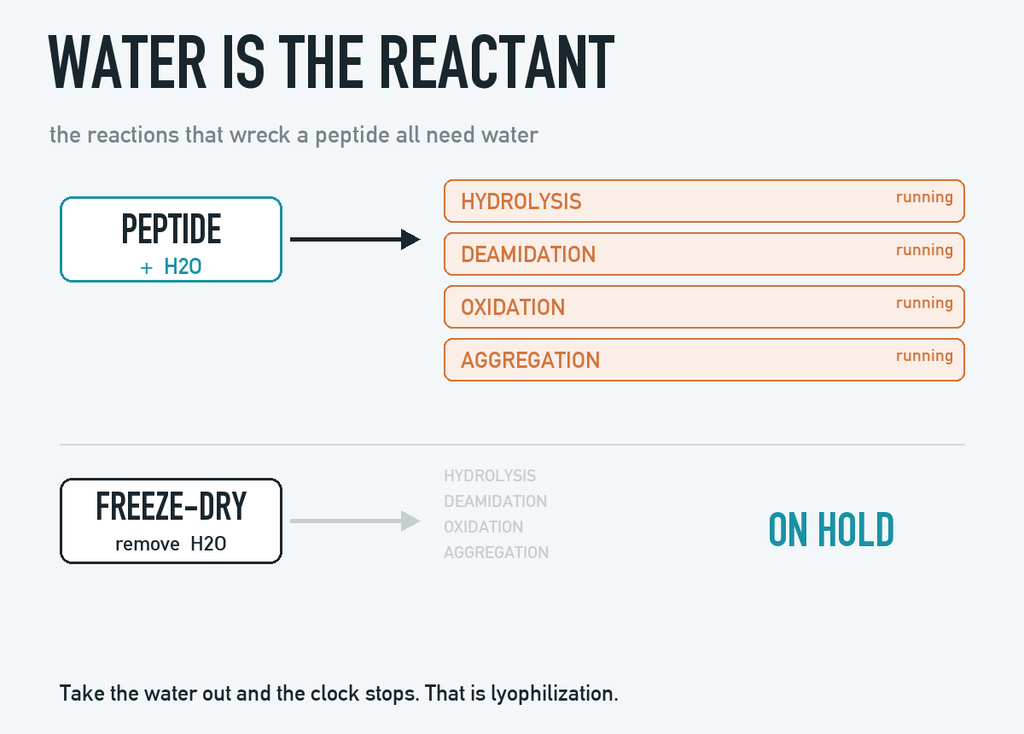
Water drives the degradation reactions. Freeze-drying removes it and puts them on hold.
What Are Pre-Mixed (Reconstituted/Prepared) Peptides?
Pre-mixed peptides arrive already dissolved in liquid, ready to use with no mixing step. The appeal is obvious: open it and go, with no reconstitution or preparation for assay, and no measuring. For a short, immediate research window that convenience could be great.
The trade-off is time. The moment a peptide sits in water, the degradation reactions that the dry form avoids begin running, so a pre-mixed solution has a much shorter usable life. It is also more fragile in transit, since heat speeds the breakdown and the liquid has no buffer against a warm truck or a slow delivery. Pre-mixed suits a fast turnaround; it asks you to use the material quickly. It also arrives at a fixed concentration someone else chose, so that number is set for you before the work begins.
Lyophilized vs Pre-Mixed: Key Differences
The two forms diverge on everything that follows from water content. A dry powder is stable, ships easily, and matches its certificate cleanly; a liquid trades all of that for immediate readiness. The table sets them side by side.
| Feature | Lyophilized (powder) | Pre-mixed (solution) |
| Stability | High, reactions on hold | Lower, reactions running |
| Shelf life | Months to years frozen | Days to weeks refrigerated |
| Shipping | Rugged, tolerates transit | Fragile, needs cold and speed |
| COA verification | One vial, one lot to match | Harder to tie to a batch |
| Convenience | Needs reconstitution | Ready out of the package |
The pattern is consistent, the powder wins on everything except the one step of adding water yourself. For research that stores or travels, that is a trade worth making.
Why Research Peptides Are Usually Lyophilized
Research peptides are lyophilized because the dry form is the stable, lab-standard way to store and move them. A powder survives a courier, a customs delay, and months in a freezer without meaningful loss, which a solution cannot promise. Optimized freeze-drying is what gives biologic material its long-term stability, and peptides inherit that benefit.
There is a control reason too. Selling a peptide dry lets the researcher decide the solvent, the concentration, and the timing of reconstitution, so the material is fresh when the work starts. A pre-mixed vial locks those choices in at the factory and starts the degradation clock before the box even ships.
For a field where purity and identity carry the whole value, the dry vial is the format that protects both. It also travels across borders and sits in inventory without a countdown attached, which suits how research material actually moves from a lab to a supplier to a bench.
Stability & Shelf Life Compared
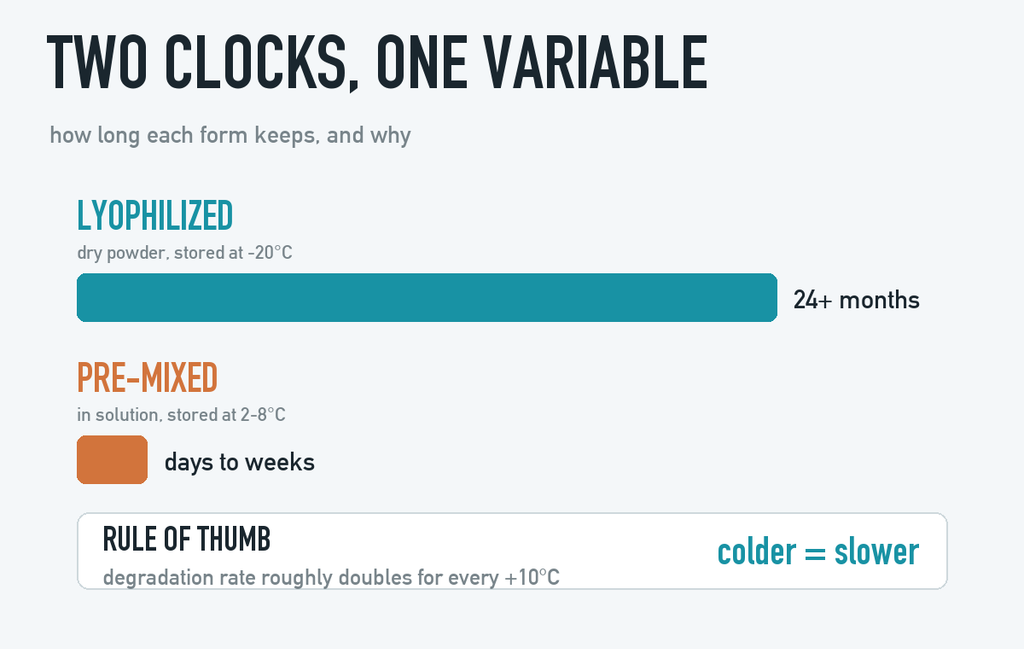
Shelf life is where the difference is widest. A lyophilized peptide stored at -20°C commonly holds for 24 months or longer, while a reconstituted solution is typically good for days to a few weeks in the refrigerator. The dry form buys years; the wet form buys a short window.
Shelf life by form
Temperature is the lever behind those numbers. As a rule of thumb from stability science, reaction rates roughly double for every 10°C rise, which is why cold storage does so much work and why stability testing is run across temperatures.
Take a peptide down to -20°C or -80°C and the water freezes in place, so hydrolysis and its relatives slow to a crawl. Leave the same peptide dissolved at room temperature and the clock runs fast. The practical read is that a dry vial forgives a warm afternoon, while a reconstituted one counts every degree.
Reconstituting a Lyophilized Peptide
Reconstituting means adding a sterile liquid to the dry vial to dissolve the peptide for research. The common diluent is bacteriostatic water, which carries a small amount of benzyl alcohol to hold back bacterial growth in a multi-use vial. Sterile water works for single use; the bacteriostatic version suits a vial opened more than once. Research reagent suppliers provide a sterile water diluent for exactly this step.
The handling logic is simple. Let the vial reach room temperature, swab the stopper, add the water slowly down the side, and swirl gently to dissolve without hard shaking. Once reconstituted, the peptide is now a solution, so it goes in the refrigerator and gets used within its short window. This is general laboratory handling for research material, not usage guidance.
Shipping & Storage Differences
Shipping is where the two forms are least alike. A lyophilized powder tolerates ambient transit and short temperature swings, so it can move without a full cold chain and settle into a -20°C freezer on arrival. Unopened, that dry vial stays stable for its full rated shelf life.
A pre-mixed solution needs more care in both directions. It should stay cold in transit and be refrigerated on arrival, because warmth accelerates the breakdown already underway in the liquid. The storage rule tracks the chemistry: keep peptides dry and frozen for the long haul, and keep any solution cold and short-term.
Light and several freeze-thaw cycles add wear, so a stable spot in the freezer beats a busy shelf. Aliquoting a reconstituted peptide into smaller portions is a common way to avoid thawing the whole supply each time, since every thaw is another pass through the temperatures where breakdown speeds up.
Which Is Easier to Verify Against a COA?
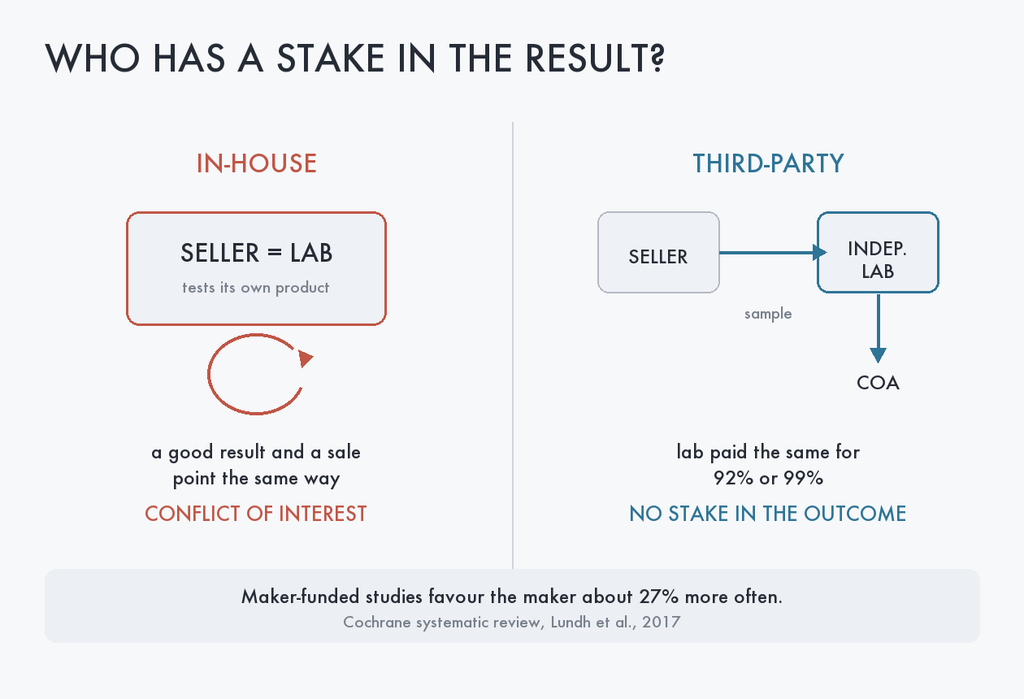
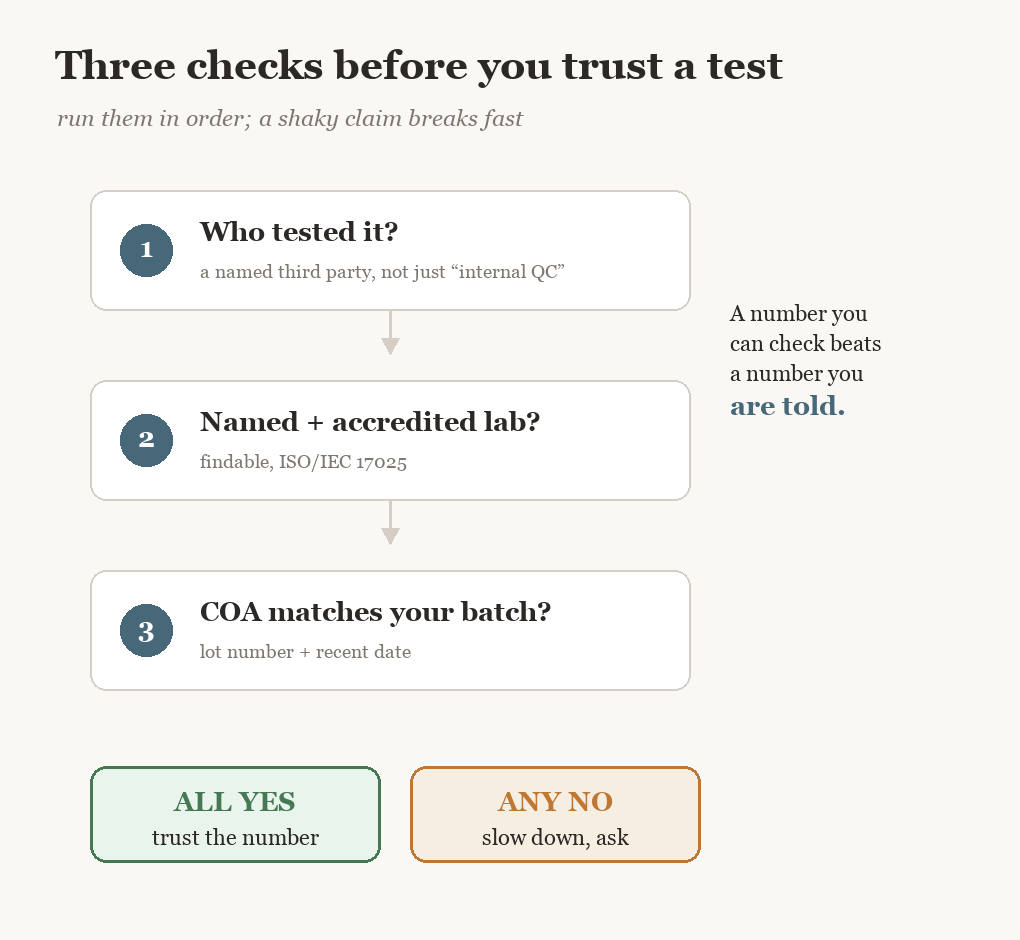
A single lyophilized vial is the easier form to check against a certificate of analysis, because one vial maps to one tested batch. You match the lot number on the COA to the vial, and the purity and identity results describe exactly what you are holding.
A pre-mixed solution muddies that link. Dilution, multi-dose vials, and the changes that happen in liquid make it harder to link the material in front of you to the batch a lab tested. When traceability is the goal, the dry vial gives the cleanest line from certificate to sample, and that clean line is a real part of why the lyophilized format became the research standard.
Pros & Cons of Each
Neither form is universally right; the correct pick depends on how soon the peptide is used and how long it needs to keep. The table weighs each against the research use in front of you.
| Lyophilized | Pre-mixed | |
| Pros | Long shelf life, rugged shipping, clean COA match, you control reconstitution | Ready immediately, no mixing step |
| Cons | Requires a reconstitution step | Short shelf life, fragile shipping, harder to verify |
Though, there’s a nuance to consider. A few peptides, especially those carrying a free cysteine, can degrade even in the dry state, so lyophilization slows the clock without stopping it entirely for every sequence. For the large majority, though, the powder is the stable choice by a wide margin.
The takeaway is not that one format is good and the other bad; it is that the dry form fits long storage and shipping, and the pre-mixed form fits a use-it-now workflow.
Frequently Asked Questions
What does lyophilized mean?
Lyophilized means freeze-dried. The peptide is frozen and placed under vacuum so the ice sublimes away, leaving a dry powder or cake in the vial. Removing water this way, without heat, halts the reactions that degrade peptides and gives the dry form its long shelf life.
Are pre-mixed peptides less stable?
Yes, once a peptide is in solution, water drives hydrolysis, oxidation, and related breakdown, so a pre-mixed peptide is stable for days to weeks refrigerated. A lyophilized powder, with the water removed, holds for months to years at -20°C. The convenience of pre-mixed comes at the cost of shelf life.
Do lyophilized peptides need refrigeration?
For long-term storage, yes. A lyophilized peptide keeps best frozen at -20°C or colder, where degradation slows to a near stop. Short periods at room temperature during shipping are tolerated because the dry form is stable, but the freezer is where an unopened vial should live.
How do you reconstitute a peptide?
Let the vial reach room temperature, swab the stopper with alcohol, then add sterile or bacteriostatic water slowly down the side of the vial. Swirl gently until it dissolves, avoiding hard shaking. Store the resulting solution refrigerated and use it within its short window. This is general lab handling for research.
The Bottom Line
The main difference between lyophilized and pre-mixed peptides is simply the amount of water they contain. The freeze-dried powder has the water removed, so the reactions that degrade peptides stay on hold, giving it months to years of shelf life, rugged shipping, and a clean match to its COA.
The pre-mixed solution trades that stability for immediate use in research, with a short window and fragile transit. Research peptides are lyophilized because the dry vial protects purity and identity best, and preparing it yourself keeps the material fresh when the work begins.
Disclaimer
This article is for educational and informational purposes only. The peptides referenced are research-use-only, not for human or veterinary consumption, and are not FDA-approved. Reconstitution and storage notes describe general laboratory handling, not usage instructions. Intended for adults 18 and older.