

Quick answer
To read a peptide Certificate of Analysis (COA), find the batch or lot number on the document, confirm who ran the testing, check the HPLC purity result, verify identity with mass-spectrometry data, review any extra tests, and confirm the dates. A COA documents the quality of one specific batch.
How to Read a Peptide Certificate of Analysis?
If you buy research peptides in the US, the COA is the single most useful piece of paper you should know about. It is where a supplier shows their work: what the compound is, how pure it is, and who checked. Read it well and you protect your experiments, your budget and your reputation. Skim it and you are trusting a random number on a website.
This guide is written for US labs and qualified professionals working with research-use-only (RUO) peptides. We walk through every part of a COA, from the batch number to the mass-spec trace, and we point out the red flags worth catching before material ever reaches your bench. This information is for research and quality control only. It is not medical or clinical advice.
What Is a Certificate of Analysis (COA) for Research Peptides?
A Certificate of Analysis is a lab document that reports the analytical testing for one specific peptide batch. It records the compound’s identity, its purity, and any other quality checks that were run, and it ties all of that to a single lot number so the paperwork points to the exact material you received.
COA Meaning in Peptide Research
Think of a COA as a batch’s report card. It states the peptide name and sequence, the tests performed, the results, and the date, all for one production run. The key word here is batch. A COA is only meaningful when it belongs to the specific lot in your hand, because purity and identity can vary from one synthesis to the next. A general product COA that covers a product line, with your exact batch missing, is a much weaker signal.
What a COA Can and Cannot Confirm
A good COA can confirm plenty: the analytical purity of the tested batch, the identity of the compound by mass, the extra quality checks that were run, and the source of the testing. It gives you documented evidence you can file, cite and audit.
It also has limits worth knowing. A COA reflects the batch at the time of testing. It cannot confirm how the material was stored after it left the lab, whether the label stayed attached to the right vial, or whether the compound is approved for any use in people. Documentation proves quality; it does not grant approval.
COA vs Marketing
Real COAs and marketing brochures can look similar at a glance, so it helps to know the difference. A real COA is batch-specific, names the methods used, and usually includes the underlying data, such as an HPLC chromatogram or a mass-spec trace. A marketing sheet tends to carry a big purity claim, no batch number, no method detail, and no raw data. When a “COA” has no lot number and no chromatogram, treat it as a brochure.
Research Peptides and RUO Labeling in the US
Research peptides are synthetic peptides sold for laboratory experiments, such as in-vitro, ex-vivo and animal-model work. In the US they are labeled Research Use Only (RUO), which means they are supplied for research and carry no therapeutic claims and no clinical approval.
What “Research Use Only” Means for US Labs
RUO is a specific label with a specific job. Under FDA rules for in-vitro diagnostic products (21 CFR 809.10), material in the research phase must carry the statement “For Research Use Only. Not for use in diagnostic procedures.” That wording exists to keep research material out of clinical diagnosis and patient care. For a peptide buyer, the takeaway is simple: RUO compounds belong in controlled laboratory research.
RUO vs Therapeutic Peptides: The FDA Context
The gap between an RUO peptide and a therapeutic one is wide. An RUO peptide is sold under a research framing, with no clinical approval behind it. A therapeutic peptide is a regulated drug, subject to FDA oversight, manufacturing standards and labeling requirements. A COA does not close that gap. It documents that a batch was tested and how pure it was, and that is all it does. Even a compound with strong regulatory momentum stays research-only until it is actually approved, a point we cover in our KPV research guide and its 2026 update.
Why Is “Not for Human Use” Important
Taking the RUO label seriously protects you on several fronts. There is legal liability if research material is used outside its intended context. There are institutional policies and ethics rules that govern how RUO compounds are handled. And there is the simple matter of doing science properly, with material used only for the research it was sold for. Reading a COA carefully and handling RUO material correctly are two halves of the same responsibility.
What a Complete Peptide COA Should Include
A complete peptide COA should let you identify the compound, tie it to a specific batch, understand the methods used, and read the results in context. If any of those four things is missing, the document is incomplete.
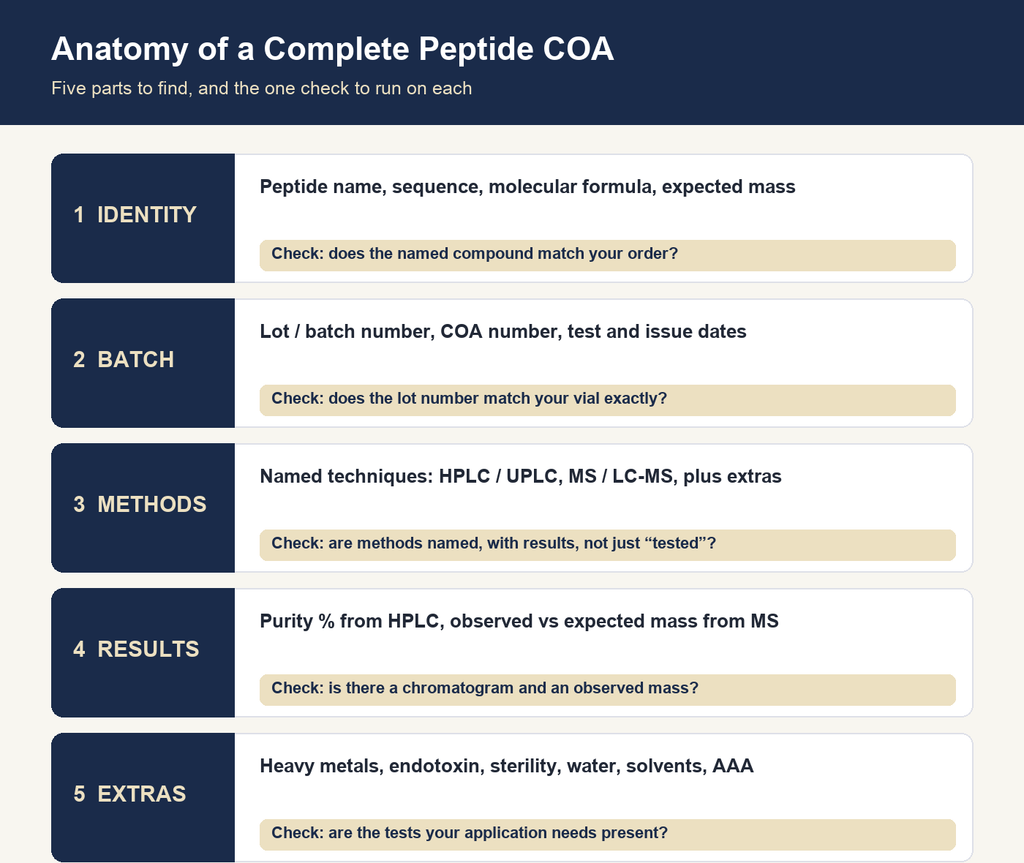
Product Name, Sequence, Molecular Formula and Expected Mass
The top of the COA should name the peptide clearly and, ideally, give its amino-acid sequence or molecular formula along with the expected (theoretical) mass. These details are important because they let you cross-check identity later. When you reach the mass-spec section, you will compare the expected mass shown here against the observed mass the instrument measured.
Batch or Lot Number, COA Number and Dates
The batch or lot number is the thread that ties this document to your vial. Alongside it you should see a COA or report number for document control, plus a testing date and an issue date. These fields turn a general certificate into evidence for one exact run of material, and they let you check the document is current.
Testing Laboratory and Accreditation
A credible COA identifies who did the testing. Look for a named lab with contact details, and where possible a quality system or accreditation such as ISO/IEC 17025. That standard is the international benchmark for lab competence: it lets a lab “demonstrate that they are technically competent and capable of producing valid and reliable results,” according to ISO. A named, accredited third-party lab is one of the strongest quality signals a COA can carry. We verify every batch through Janoshik Analytical and third-party labs both for exactly this reason.
Analytical Methods and Results
Finally, the COA should name its methods and show their results. Purity usually comes from HPLC or UPLC. Identity comes from mass spectrometry or LC-MS. Extra checks might include heavy metals, endotoxin, sterility and water content. Each method should carry a named technique and a real result, in a format like “Purity (HPLC): 99.1%,” not a vague “tested and passed.”
How to Read a Peptide COA: Step by Step
Reading a COA follows a repeatable order. Match the batch, confirm the testing source, read the purity, verify the identity, review the extra tests, and check the dates. Work through the same six steps for every new lot and nothing important slips past you.
Step 1: Find the Batch or Lot Number
Start with the number. Find the lot number on the COA and check it against the supplier’s published batch records or your order paperwork. Then trace it through your packing slip and inventory record so the whole chain agrees. A COA that does not carry your exact lot number is not documentation for your material, however impressive the results look.
Step 2: Confirm Who Did the Testing
Next, find out who ran the tests. In-house quality control has value, but independent third-party testing carries more weight because it removes the supplier from marking their own homework. Most suppliers stop at one or two tests. We run a third-party testing panel on every batch and verify it through outside labs, so the results you read were not generated in the same room they were sold from. If a COA is vague about the testing source, ask.
Step 3: Read the HPLC Purity Result and Chromatogram
Now read the purity. The HPLC result is a percentage that represents the share of the sample made up of the main peptide. A quick look at the chromatogram tells you more: one tall main peak is what you want, and extra peaks are impurities. As a rough guide, 95% suits early screening, while 98 to 99% is the range most labs want for quantitative or publication-grade work.
Step 4: Confirm Identity with Mass Spectrometry
Purity tells you how clean the sample is. It does not tell you the sample is the right compound. That job belongs to mass spectrometry, which measures the molecular mass and lets you compare it to the expected value. A purity figure without identity data is only half a quality check, so never skip this step.
Step 5: Review the Extra Tests
Depending on your work, the extra tests can matter as much as purity. Water content affects how accurately you convert milligrams to moles. Endotoxin and sterility become important for cell-culture and animal work. Scan these results and decide which ones your specific application needs.
Step 6: Check Dates, Version and Authenticity
Finish on the housekeeping. Confirm the testing date is recent, since a very old COA may not reflect the current batch. Check for a version number or document code so you know you have the latest file. And where a supplier offers a QR code or an online lookup, use it to confirm the document is genuine.
Understanding HPLC Purity on a Peptide COA
HPLC purity is the headline number on most peptide COAs. It reports how much of the tested sample is the target peptide, measured by separating the sample’s components and comparing their sizes. Read it alongside the method and the chromatogram, and it becomes a figure you can trust.
What HPLC Purity Measures
High-performance liquid chromatography pushes a sample through a column so its components separate out and pass a detector at different times. Peptides usually run on reverse-phase HPLC. The output is a chromatogram, a chart of peaks, where the main peptide forms the largest peak and any impurities show up as smaller ones.
How the Purity Percentage Is Calculated
The purity figure comes from peak area. The instrument measures the area under each peak, then reports the main peak’s area as a percentage of the total. A result of 99% means the main peptide accounts for 99% of the detected material, with the remaining 1% spread across minor peaks. It is a relative measure, which is why the chromatogram behind it matters.
Purity Thresholds for US Labs: 95%, 98% and 99%
Different work calls for different thresholds. For early screening or exploratory studies, 95% is often workable. For quantitative studies and publication-grade research, most labs want 98 to 99% or higher. Higher purity means fewer stray variables in your data. The number is only as good as the verification behind it, which is the whole point of our guide on what 98% vs 99% purity actually means: a verified 98% beats an unverified 99% every time.
Reading the Chromatogram and Spotting Impurity Peaks
You do not need to be an analyst to read a chromatogram at a glance. Find the tall main peak, then look for extra peaks along the baseline. A few tiny peaks are normal. Large secondary peaks, a noisy wandering baseline, or impurity peaks the report never mentions are all worth questioning. Retention time (where the main peak sits) should also be consistent with the compound.
How Mass Spectrometry Confirms Peptide Identity
Mass spectrometry confirms that your peptide is actually the peptide on the label. It measures the compound’s molecular mass, which you compare against the expected mass from the sequence. Purity and identity answer different questions, and a complete COA answers both.
Why Identity Matters as Much as Purity
A sample can be 99% pure and still be the wrong compound, or the right compound with the wrong modification. Purity cannot catch that; only identity can. Mass spectrometry rules out mislabeled or mis-synthesized material by checking the mass fits the target. This is why the two methods work as a pair, a relationship we break down in our guide on HPLC vs mass spectrometry testing.
Expected Mass vs Observed Mass
The COA shows two mass figures. The expected (theoretical) mass is calculated from the peptide’s sequence. The observed mass is what the instrument actually measured. When the two line up, the report is showing a real measurement that matches the target compound. A COA that lists only the expected mass, with no observed value, has skipped the measurement that matters.
Acceptable Mass Variance
Observed and expected mass rarely match to the last decimal, and that is fine. Instruments have a tolerance, often within a few Daltons for standard equipment, or tighter in parts-per-million on high-resolution systems. A small, expected deviation is normal. A large gap between observed and expected mass is a reason to pause.
What Mass Spectrometry Does Not Confirm Alone
Mass spectrometry is powerful, and it has limits. It confirms the mass, which strongly supports identity, but a basic mass measurement does not always prove the full sequence on its own. That is why identity and purity are read together, mass spec alongside HPLC, so the batch is checked from two angles at once.
The Extra Tests That Separate a Good COA from a Great One
Purity and identity are the baseline. The tests that mark out a serious supplier are the extra ones: heavy metals, endotoxin, sterility and amino acid analysis. Most suppliers run one or two tests. We test identity and purity on every batch, with heavy metals, endotoxin, and sterility on a rotating cycle — the extra checks catch problems purity alone never sees.
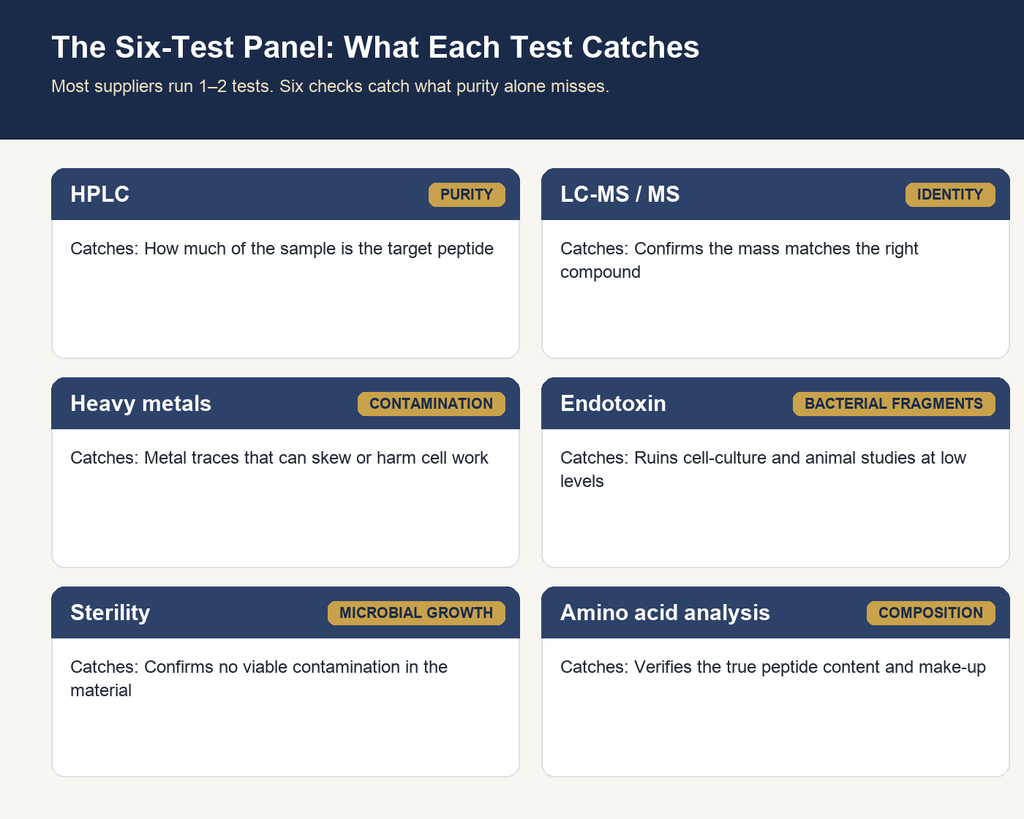
Heavy Metals Screening
Heavy-metal contamination can enter during synthesis or handling, and it can quietly skew sensitive assays or harm cell cultures. A heavy-metals screen checks the batch against acceptable limits. For regulatory-sensitive or cell-based work, it is a check worth seeing on the page, so you can confirm it yourself.
Endotoxin and Sterility Testing
Endotoxins are bacterial fragments that can wreck cell-culture and animal studies even at low levels, so endotoxin testing measures them against a threshold. Sterility testing confirms the material is free of viable microbial growth. Both matter most for in-vivo and cell work, where contamination turns a clean experiment into noise.
Water Content
Water content affects your maths. A peptide that has absorbed moisture weighs more than the peptide alone, which throws off any milligram-to-mole conversion. Seeing water content on a COA means fewer surprises in your calculations.
Amino Acid Analysis
Amino acid analysis confirms the peptide’s composition by breaking it down and measuring the amino acids present. It adds another layer of identity confidence on top of mass spec, and it helps verify the true peptide content of the sample. It is one of the checks in our third-party testing panel, and it is rare to see on a standard COA.
When US Labs Should Insist on These
Not every study needs every test, so match the checks to the work.
- Cell culture and in-vivo studies lean on endotoxin and sterility.
- Quantitative work leans on water content.
- Regulatory-sensitive research may need heavy metals and full identity confirmation.
When your experiment is sensitive, ask for the data before you buy, while it can still shape your decision.
How to Verify Overall Peptide Quality from a COA
Verifying quality means reading the whole COA as one picture: identity confirmed, purity above your threshold, the right extra tests present, and recent, traceable testing behind it all. Any single number in isolation can mislead.
Purity vs Identity: Why You Need Both
The core rule is that purity and identity are not the same thing, and you need both. Purity tells you how clean the sample is. Identity tells you it is the right compound. A batch that is pure but unidentified, or identified but impure, fails the test. Trust comes from the two together.
Setting Your Lab’s Quality Thresholds
Decide your standards before you shop. Set a minimum purity for your work, make mass-spec identity a non-negotiable, and list the extra tests your applications require. Written thresholds turn “this looks fine” into a clear pass-or-fail, and they keep decisions consistent across your team.
A Simple New-Batch Quality Checklist
Turn the six reading steps into a checklist for every new lot: batch matched, testing source confirmed, HPLC purity above threshold, mass-spec identity confirmed, extra tests reviewed, dates current. Six ticks and the batch is cleared for use. A missing tick is a question to resolve first.
When to Reject a Batch
Some findings are a clear stop. Reject or quarantine a batch when the purity sits below your threshold, when there is no mass-spec identity data, when the observed and expected mass disagree sharply, or when the COA cannot be tied to your vial. Rejecting a doubtful batch costs far less than a ruined experiment.
Common COA Red Flags US Buyers Should Watch For
Most weak COAs share the same handful of tells. Once you know them, you can spot a thin document in seconds, before it becomes a problem in your data.
- Missing or non-specific batch numbers. A COA with no lot number cannot be tied to your material. A generic “product” COA is not enough.
- A purity number with no chromatogram. A percentage with no underlying HPLC trace is a claim you cannot check.
- No mass-spec identity data. Purity alone leaves identity unconfirmed, so a COA with no observed mass is half a document.
- A vague or untraceable testing lab. “Independent lab” with no name, address or accreditation is not verifiable.
- Outdated testing dates. A very old COA may not reflect the batch you actually received.
- A COA that does not match the product page. Different sequence, purity or details between the listing and the COA is a real inconsistency to resolve.
COA Best Practices for US Labs
A COA is only useful if you can find it again. Storing, linking and reviewing COAs the same way every time turns a pile of PDFs into an audit trail you can defend.
Documenting COAs in Your Lab
Keep every COA in one place, whether that is a LIMS, a shared drive or a dedicated QA folder. Use a consistent naming convention, such as compound plus batch plus date, so any file is one search away. A tidy repository saves hours during an audit or a publication review.
Linking COAs to Inventory, Experiments and Publications
Tie each COA to the material it documents. Tag it in your inventory against the lot, reference it in your experiment notes, and cite the batch in the methods section of any resulting paper. That chain lets anyone retrace exactly which material produced which result.
A COA-Review SOP and Training Staff
Write a short standard operating procedure for COA review, covering the six steps and who signs off. Then train new staff against it with an onboarding checklist. When everyone reads a COA the same way, quality stops depending on who happened to open the box.
Choosing a Trusted US Research Peptide Supplier
A trustworthy US supplier makes quality easy to verify. Look for transparent, batch-specific COAs, named third-party testing, a broad and consistent test panel, and quick access to the documentation behind every order.
Quality Signals to Look For
The strongest signals are practical ones. A public, searchable COA library. Third-party testing through a named lab. A test panel that goes beyond the basic one or two checks. We built around these on purpose: a third-party testing panel on every batch, third-party verification through Janoshik and third-party labs, and 99%+ purity as the everyday standard on every batch.
Questions to Ask a Supplier About Testing
A few direct questions reveal a lot.
- Is testing done in-house or by a third-party lab?
- Can you share the chromatogram and mass-spec data for this specific batch?
- What does your test panel include?
A confident supplier answers quickly and shows the documents, but a vague answer is its own signal.
Example: Verifying a New Peptide Batch (Walk-Through)
Here is the whole process in one short workflow you can run on any new lot, whether it is BPC-157, MOTS-c, a GLP research compound or PT-141.
1. Download the COA for the batch from the supplier’s library.
2. Match the batch number on the COA to your vial and packing slip.
3. Confirm the testing lab and check for third-party verification.
4. Read the HPLC purity and glance at the chromatogram for stray peaks.
5. Verify the mass-spec identity by comparing observed and expected mass.
6. Review the extra tests your application needs, such as endotoxin or water content.
7. Confirm the dates are recent and the document version is current.
8. Archive the COA in your LIMS or shared drive against the lot.
Frequently Asked Questions
What Purity Percentage Should US Labs Look For in Research Peptides?
It depends on the work. Around 95% suits early screening, while 98 to 99% or higher is the common target for quantitative and publication-grade studies. Just as important, the purity should be verified, since a documented 98% is worth more than an unverified 99%.
Do All COAs Need Both HPLC and Mass-Spec Data?
As best practice, yes. HPLC reports purity and mass spectrometry confirms identity, and the two answer different questions. If a COA shows purity but no observed mass, the compound’s identity is not fully confirmed, so treat that as an incomplete document.
How Often Should COAs Be Updated for Recurring Batches?
Each new batch or lot should get its own COA, because purity and identity can shift between production runs. A COA from a previous lot does not cover the vial in your hand, however recent it looks.
Can a US Lab Rely on Supplier-Run Tests, or Should It Insist on Third-Party Results?
In-house testing can be acceptable, and third-party data is stronger because it is independent. If a COA is unclear about who ran the tests, ask. We verify every batch through Janoshik Analytical and domestic third-party labs so the results stand on their own.
What Should a Lab Do if the COA Does Not Match the Order Records?
Quarantine the batch, hold it out of any experiment, and contact the supplier to resolve the discrepancy before use. A mismatch between the label and the COA breaks the chain of traceability, and using the material anyway risks your data.
What Extra Tests Matter Beyond Purity and Identity?
Heavy metals, endotoxin, sterility, water content and amino acid analysis all add quality confidence. Which ones matter depends on your application, with endotoxin and sterility mattering most for cell-culture and animal work.
Conclusion: Using COAs to Protect Your Research and Your Lab
Reading a peptide COA well comes down to three pillars. The document must be batch-specific, tied to the exact lot in your hand. It should carry both HPLC purity and mass-spec identity, so the material is checked from two angles. And it should rest on legitimate, recent, ideally third-party testing you can trace.
Get those three right and a COA does real work for you. It supports reproducible science, it stands up to audits and publication review, and it gives you confidence in every result that follows. Build your own COA checklist, set your quality thresholds, and lean on suppliers who make their documentation easy to check. Check out our research compounds and their batch COAs and put the checklist to work on your next order.
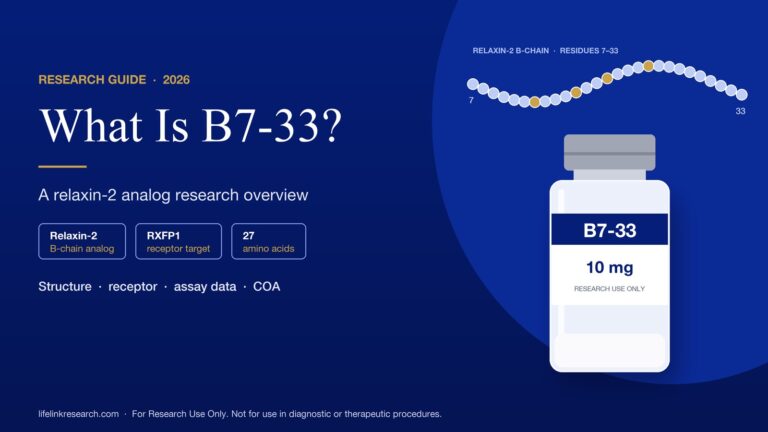
What Is B7-33? Relaxin-2 Analog Research Overview (2026)
Quick Answer B7-33 is a synthetic single-chain peptide built from part of the B chain of human relaxin-2, and it binds the…
Read article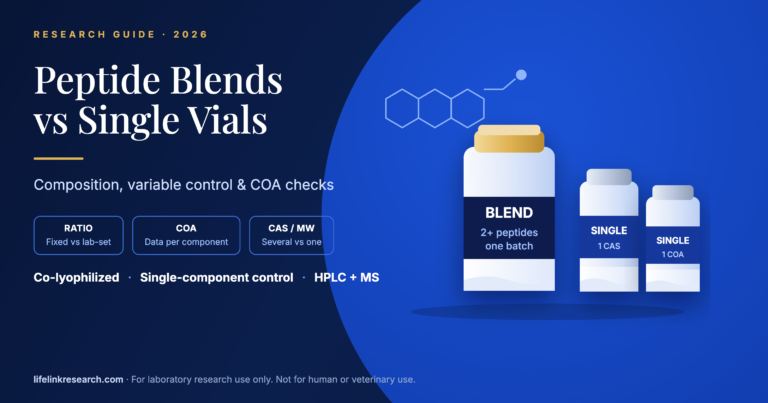
Peptide Blends vs Single Vials: How to Choose for Research (2026)
For Research Use Only. Not for use in diagnostic or therapeutic procedures. Choosing between peptide blends vs single peptides comes down to…
Read article
What Is SLU-PP-332? Structure, Research Use & US Supply
Quick Answer SLU-PP-332 is a synthetic small-molecule agonist of the estrogen-related receptors ERRŒ±, ERRŒ≤ and ERRŒ≥ (CAS 303760-60-3, PubChem CID 5338394). It…
Read articleResearch-grade peptides
99%+ purity. Verified every batch.
Identity and purity tested on every batch by third-party labs, Janoshik Analytical and US-based laboratories. Shipped same day from California.
Shop all peptides