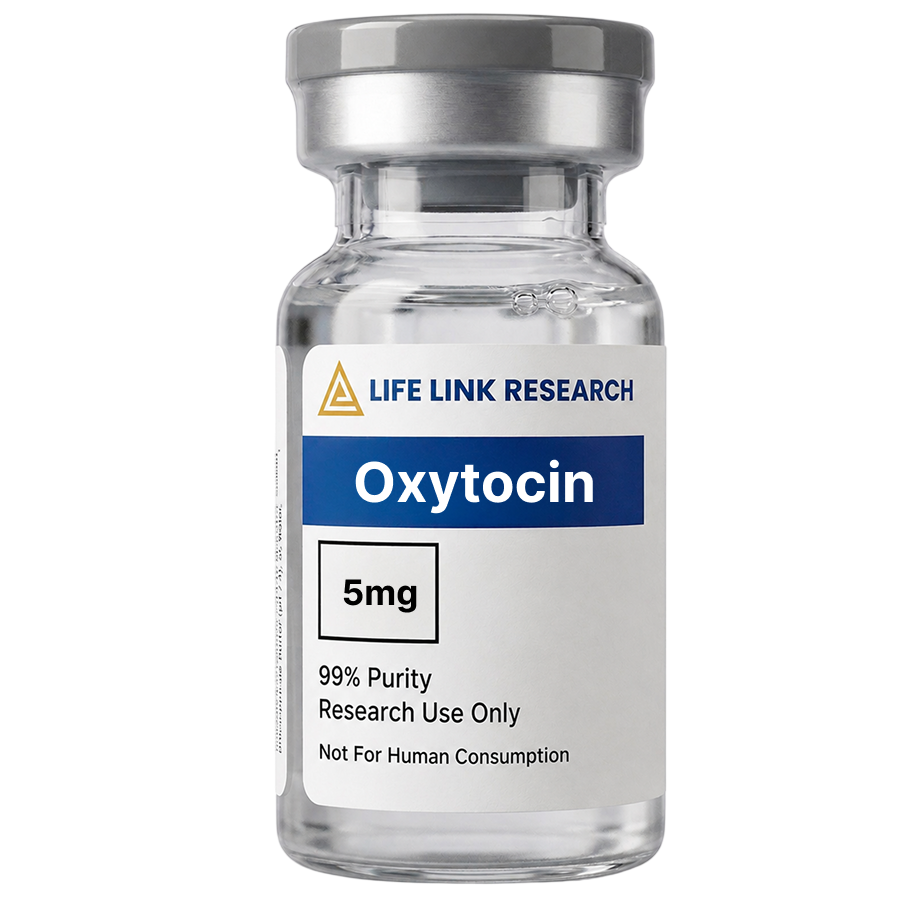
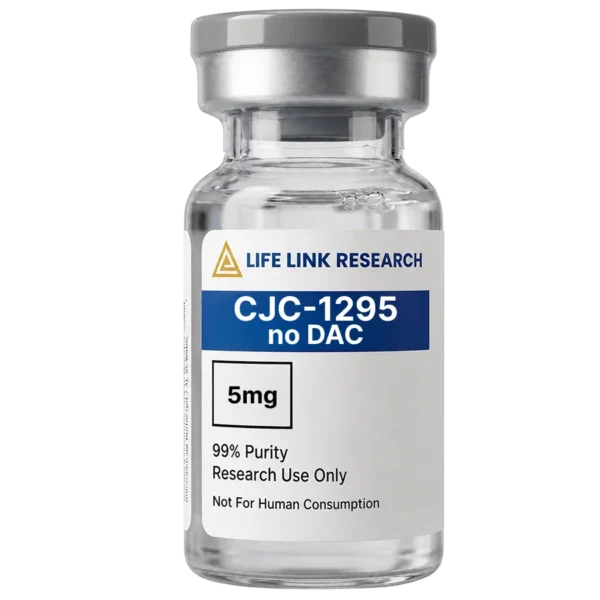
CAS: 50-56-6 · MW: 1007.19 Da · Purity: ≥99% by reverse-phase HPLC · Format: 5 mg lyophilized · Endotoxin: <1 EU/mg (LAL) · Identity: ESI-MS confirmed
Oxytocin is a nine-residue cyclic neuropeptide with the sequence Cys-Tyr-Ile-Gln-Asn-Cys-Pro-Leu-Gly-NH₂, stabilized by a single intramolecular disulfide bridge between Cys¹ and Cys⁶. This research-grade oxytocin acetate is supplied as a 5 mg lyophilized vial at ≥99% purity by reverse-phase HPLC, with third-party analytical verification of identity, purity, and endotoxin load for every manufactured lot. CAS 50-56-6.
For laboratory research use only. Not for human consumption, veterinary use, food, or therapeutic use. Not a drug, supplement, or cosmetic. Sold exclusively to qualified research professionals and institutions.
Oxytocin has been characterized in the published biochemical literature as a cyclic nonapeptide hormone of the neurohypophysial peptide family, sharing structural homology with vasopressin (AVP) at seven of nine residue positions [1]. The molecule was first isolated and sequenced by du Vigneaud and colleagues in 1953 — work that earned the 1955 Nobel Prize in Chemistry as the first chemical synthesis of a polypeptide hormone [1]. The cyclic structure is maintained by a disulfide bond between cysteine residues at positions 1 and 6, forming a six-residue ring closed by a three-residue C-terminal tail terminating in glycinamide. The molecular formula is C₄₃H₆₆N₁₂O₁₂S₂ and the monoisotopic mass is 1006.44 Da; the acetate salt form supplied here has an average molecular weight of approximately 1007.19 Da for the peptide component.
Oxytocin is one of the most extensively characterized neuropeptides in the published literature and serves as a standard reference reagent across multiple research domains. Published research contexts include:
These references describe findings in non-human in vitro and animal systems, or in chemistry and structural biology contexts. They do not constitute claims about effects in humans and are not intended to characterize the product’s therapeutic indications.
| Attribute | Value |
|---|---|
| Sequence | Cys-Tyr-Ile-Gln-Asn-Cys-Pro-Leu-Gly-NH₂ (cyclic, Cys¹–Cys⁶ disulfide) |
| Sequence length | 9 amino acids (cyclic nonapeptide) |
| Synthesis | Solid-phase peptide synthesis (SPPS), Fmoc chemistry |
| Salt form | Acetate |
| CAS Number | 50-56-6 |
| Molecular Formula | C₄₃H₆₆N₁₂O₁₂S₂ (free peptide) |
| Molecular Weight | 1007.19 Da (average); 1006.44 Da (monoisotopic) |
| Purity | ≥99% by reverse-phase HPLC |
| Identity | ESI mass spectrometry |
| Disulfide confirmation | Ellman’s assay (free thiol <0.5%) |
| Endotoxin | <1 EU/mg (LAL chromogenic assay) |
| Bioburden | Sterile-filtered through 0.22 µm prior to lyophilization |
| Format | 5 mg lyophilized powder, single-use amber vial |
| Appearance | White to off-white amorphous powder |
| Solubility (lab context) | Soluble in sterile water, PBS, and most aqueous buffers at neutral pH |
| Counter-ion content | Acetate ≤15% by ion chromatography |
Lyophilized material is stable at -20°C for 24 months from date of manufacture when protected from light and moisture. Oxytocin is sensitive to thermal degradation and oxidation of the disulfide bridge; shipments should be transferred to cold storage immediately upon receipt. Once reconstituted in laboratory buffer, the peptide should be aliquoted into low-binding polypropylene tubes and stored at -80°C; cyclic disulfide peptides are particularly susceptible to disulfide scrambling and oxidative degradation under repeated freeze-thaw conditions. Handling should occur under aseptic conditions in a Class II biosafety cabinet or laminar flow hood. Standard laboratory PPE applies per institutional biosafety guidelines.
Every manufactured lot is accompanied by batch-specific analytical documentation including: third-party reverse-phase HPLC chromatogram, ESI-MS deconvoluted mass spectrum, Ellman’s free-thiol assay confirming disulfide closure, LAL chromogenic endotoxin quantification, residual moisture by Karl Fischer titration, and acetate counter-ion quantification by ion chromatography. Reference standards are maintained at -80°C and cross-validated against pharmacopeial oxytocin reference preparations on a quarterly basis. Manufacturing occurs in ISO 9001-certified facilities under documented cGMP-aligned procedures.
This material is supplied exclusively to qualified research professionals, academic laboratories, contract research organizations, and institutional purchasing departments. Proof of institutional affiliation and a signed research-use acknowledgment may be requested prior to shipment.
For laboratory research use only. Not for human consumption, veterinary use, food, or therapeutic use. Not a drug, supplement, or cosmetic.
Oxytocin is a cyclic nonapeptide of the neurohypophysial peptide family, with the sequence Cys-Tyr-Ile-Gln-Asn-Cys-Pro-Leu-Gly-NH₂ closed by an intramolecular disulfide bridge between Cys¹ and Cys⁶. CAS 50-56-6. Average molecular weight 1007.19 Da.
The free peptide has a monoisotopic mass of 1006.44 Da and an average molecular weight of 1007.19 Da. The acetate salt form supplied includes an acetate counter-ion (≤15% by weight).
50-56-6.
Oxytocin and arginine vasopressin (AVP) are the two principal neurohypophysial peptides in mammals, sharing structural homology at seven of nine residue positions. They differ at positions 3 (Ile vs. Phe) and 8 (Leu vs. Arg). The two peptides are extensively characterized as comparator ligands in receptor pharmacology research [1].
≥99% by reverse-phase HPLC. Each manufactured lot is third-party analyzed and accompanied by batch-specific documentation of HPLC purity, ESI-MS identity, Ellman’s disulfide assay, LAL endotoxin load (<1 EU/mg), residual moisture, and acetate counter-ion content.
Lyophilized vials are stable at -20°C for 24 months when protected from light and moisture. Once reconstituted in laboratory buffer, the peptide should be aliquoted into low-binding tubes and stored at -80°C. Avoid repeated freeze-thaw cycles, as cyclic disulfide peptides are susceptible to disulfide scrambling and oxidative degradation.
In a research-laboratory context, oxytocin acetate is readily soluble in sterile water, PBS, and most aqueous buffers at neutral pH. Researchers typically reconstitute in sterile water or assay buffer for in vitro experimental work, following standard aseptic technique.
Oxytocin has been referenced in the peer-reviewed literature as the reference agonist for oxytocin receptor (OXTR) pharmacology assays, as the parent compound in structure-activity relationship studies of cyclic nonapeptides, and in animal-model neuroscience research examining central oxytocinergic circuitry. All published characterizations referenced here are in non-human in vitro or animal systems.
This material is supplied exclusively to qualified research professionals, academic laboratories, contract research organizations, and institutional purchasing departments. Proof of institutional affiliation and a signed research-use acknowledgment may be requested.
$98.00
23 in stock
Product Usage:
These products are intended for research use only.
This designation permits the use of these research chemicals strictly for in vitro testing and laboratory experimentation. All product information provided on this website is for educational purposes only. Any form of bodily introduction into humans or animals is strictly prohibited by law. These products must be handled only by licensed and qualified professionals.
These products are not drugs, foods, or cosmetics and must not be misbranded, misused, or mislabeled as such.
NewBPC-157 Arginine Salt / KPV 500mcg/500mcg is a dual peptide research formulat...
$150.00Janoshik COA Available
Purchase & earn 150 points.Add to cart
NewCagri/Reta 10/10mg is a dual synthetic peptide formulation combining Cagrilin...
$240.00Janoshik COA Available
Purchase & earn 240 points.Add to cart
Semaglutide, a GLP-1 receptor agonist, effectively lowers blood glucose level...
Janoshik COA Available
Purchase & earn 266 points.Add to cart
NAD+ (Nicotinamide Adenine Dinucleotide) is a coenzyme present in all living ...
$80.00Janoshik COA Available
Purchase & earn 80 points.Add to cart
CJC-1295/Ipamorelin is a dual-peptide research blend combining two mechanisti...
$72.00Janoshik COA Available
Purchase & earn 72 points.Add to cart
The GLOW Research Kit contains BPC-157, TB-500 (Ac-SDKP fragment of Thymosin ...
Janoshik COA Available
Purchase & earn 284 points.Add to cart
BPC-157 / TB-500 10mg/10mg is a dual synthetic peptide formulation studied in...
$160.00Janoshik COA Available
Purchase & earn 160 points.Add to cart
Tirzepatide, a dual GLP-1 and GIP receptor agonist, improves glycemic control...
Janoshik COA Available
Purchase & earn 368 points.Add to cart
The GLOW Research Kit contains BPC-157, TB-500 (Ac-SDKP fragment of Thymosin ...
Janoshik COA Available
Purchase & earn 284 points.Add to cart
Thymosin Alpha-1 (Tα1) enhances immune function by stimulating T-cells, B-cel...
$116.00Janoshik COA Available
Purchase & earn 116 points.Add to cart
B7-33 10mg is a synthetic RXFP1 agonist peptide research compound investigate...
$90.00Janoshik COA Available
Purchase & earn 90 points.Add to cart
Bacteriostatic Water is sterile water preserved with 0.9% benzyl alcohol, int...
$12.00Janoshik COA Available
Purchase & earn 12 points.Add to cartAll Articles And Product Information Provided On This Website Are For Informational And Educational Purposes Only.
The products offered on this website are furnished for in-vitro studies only. In-vitro studies {Latin: in glass) are performed outside of the body. These products are not medicines or drugs and have not been approved by the FDA to prevent, treat or cure any medical condition, ailment or disease. Bodily introduction of any kind into humans or animals is strictly forbidden by law.
CAS: 50-56-6 · MW: 1007.19 Da · Purity: ≥99% by reverse-phase HPLC · Format: 5 mg lyophilized · Endotoxin: <1 EU/mg (LAL) · Identity: ESI-MS confirmed
Oxytocin is a nine-residue cyclic neuropeptide with the sequence Cys-Tyr-Ile-Gln-Asn-Cys-Pro-Leu-Gly-NH₂, stabilized by a single intramolecular disulfide bridge between Cys¹ and Cys⁶. This research-grade oxytocin acetate is supplied as a 5 mg lyophilized vial at ≥99% purity by reverse-phase HPLC, with third-party analytical verification of identity, purity, and endotoxin load for every manufactured lot. CAS 50-56-6.
For laboratory research use only. Not for human consumption, veterinary use, food, or therapeutic use. Not a drug, supplement, or cosmetic. Sold exclusively to qualified research professionals and institutions.
Oxytocin has been characterized in the published biochemical literature as a cyclic nonapeptide hormone of the neurohypophysial peptide family, sharing structural homology with vasopressin (AVP) at seven of nine residue positions [1]. The molecule was first isolated and sequenced by du Vigneaud and colleagues in 1953 — work that earned the 1955 Nobel Prize in Chemistry as the first chemical synthesis of a polypeptide hormone [1]. The cyclic structure is maintained by a disulfide bond between cysteine residues at positions 1 and 6, forming a six-residue ring closed by a three-residue C-terminal tail terminating in glycinamide. The molecular formula is C₄₃H₆₆N₁₂O₁₂S₂ and the monoisotopic mass is 1006.44 Da; the acetate salt form supplied here has an average molecular weight of approximately 1007.19 Da for the peptide component.
Oxytocin is one of the most extensively characterized neuropeptides in the published literature and serves as a standard reference reagent across multiple research domains. Published research contexts include:
These references describe findings in non-human in vitro and animal systems, or in chemistry and structural biology contexts. They do not constitute claims about effects in humans and are not intended to characterize the product’s therapeutic indications.
| Attribute | Value |
|---|---|
| Sequence | Cys-Tyr-Ile-Gln-Asn-Cys-Pro-Leu-Gly-NH₂ (cyclic, Cys¹–Cys⁶ disulfide) |
| Sequence length | 9 amino acids (cyclic nonapeptide) |
| Synthesis | Solid-phase peptide synthesis (SPPS), Fmoc chemistry |
| Salt form | Acetate |
| CAS Number | 50-56-6 |
| Molecular Formula | C₄₃H₆₆N₁₂O₁₂S₂ (free peptide) |
| Molecular Weight | 1007.19 Da (average); 1006.44 Da (monoisotopic) |
| Purity | ≥99% by reverse-phase HPLC |
| Identity | ESI mass spectrometry |
| Disulfide confirmation | Ellman’s assay (free thiol <0.5%) |
| Endotoxin | <1 EU/mg (LAL chromogenic assay) |
| Bioburden | Sterile-filtered through 0.22 µm prior to lyophilization |
| Format | 5 mg lyophilized powder, single-use amber vial |
| Appearance | White to off-white amorphous powder |
| Solubility (lab context) | Soluble in sterile water, PBS, and most aqueous buffers at neutral pH |
| Counter-ion content | Acetate ≤15% by ion chromatography |
Lyophilized material is stable at -20°C for 24 months from date of manufacture when protected from light and moisture. Oxytocin is sensitive to thermal degradation and oxidation of the disulfide bridge; shipments should be transferred to cold storage immediately upon receipt. Once reconstituted in laboratory buffer, the peptide should be aliquoted into low-binding polypropylene tubes and stored at -80°C; cyclic disulfide peptides are particularly susceptible to disulfide scrambling and oxidative degradation under repeated freeze-thaw conditions. Handling should occur under aseptic conditions in a Class II biosafety cabinet or laminar flow hood. Standard laboratory PPE applies per institutional biosafety guidelines.
Every manufactured lot is accompanied by batch-specific analytical documentation including: third-party reverse-phase HPLC chromatogram, ESI-MS deconvoluted mass spectrum, Ellman’s free-thiol assay confirming disulfide closure, LAL chromogenic endotoxin quantification, residual moisture by Karl Fischer titration, and acetate counter-ion quantification by ion chromatography. Reference standards are maintained at -80°C and cross-validated against pharmacopeial oxytocin reference preparations on a quarterly basis. Manufacturing occurs in ISO 9001-certified facilities under documented cGMP-aligned procedures.
This material is supplied exclusively to qualified research professionals, academic laboratories, contract research organizations, and institutional purchasing departments. Proof of institutional affiliation and a signed research-use acknowledgment may be requested prior to shipment.
For laboratory research use only. Not for human consumption, veterinary use, food, or therapeutic use. Not a drug, supplement, or cosmetic.
Oxytocin is a cyclic nonapeptide of the neurohypophysial peptide family, with the sequence Cys-Tyr-Ile-Gln-Asn-Cys-Pro-Leu-Gly-NH₂ closed by an intramolecular disulfide bridge between Cys¹ and Cys⁶. CAS 50-56-6. Average molecular weight 1007.19 Da.
The free peptide has a monoisotopic mass of 1006.44 Da and an average molecular weight of 1007.19 Da. The acetate salt form supplied includes an acetate counter-ion (≤15% by weight).
50-56-6.
Oxytocin and arginine vasopressin (AVP) are the two principal neurohypophysial peptides in mammals, sharing structural homology at seven of nine residue positions. They differ at positions 3 (Ile vs. Phe) and 8 (Leu vs. Arg). The two peptides are extensively characterized as comparator ligands in receptor pharmacology research [1].
≥99% by reverse-phase HPLC. Each manufactured lot is third-party analyzed and accompanied by batch-specific documentation of HPLC purity, ESI-MS identity, Ellman’s disulfide assay, LAL endotoxin load (<1 EU/mg), residual moisture, and acetate counter-ion content.
Lyophilized vials are stable at -20°C for 24 months when protected from light and moisture. Once reconstituted in laboratory buffer, the peptide should be aliquoted into low-binding tubes and stored at -80°C. Avoid repeated freeze-thaw cycles, as cyclic disulfide peptides are susceptible to disulfide scrambling and oxidative degradation.
In a research-laboratory context, oxytocin acetate is readily soluble in sterile water, PBS, and most aqueous buffers at neutral pH. Researchers typically reconstitute in sterile water or assay buffer for in vitro experimental work, following standard aseptic technique.
Oxytocin has been referenced in the peer-reviewed literature as the reference agonist for oxytocin receptor (OXTR) pharmacology assays, as the parent compound in structure-activity relationship studies of cyclic nonapeptides, and in animal-model neuroscience research examining central oxytocinergic circuitry. All published characterizations referenced here are in non-human in vitro or animal systems.
This material is supplied exclusively to qualified research professionals, academic laboratories, contract research organizations, and institutional purchasing departments. Proof of institutional affiliation and a signed research-use acknowledgment may be requested.
Most peptide suppliers run one purity test. We run six, then send every batch to Janoshik for independent verification.
| Life Link Research | Most Suppliers | |
|---|---|---|
| HPLC Purity | ||
| LCMS Identity | ||
| Heavy Metals (ICP-MS) | ||
| Endotoxin (LAL) | ||
| Sterility | ||
| Amino Acid Analysis | ||
| 3rd Party (Janoshik) |

BPC-157 / TB-500 10mg/10mg is a dual synthetic peptide formulation studied in...
$160.00Save 20% on 10+Janoshik COA Available
Purchase & earn 160 points.Add to cart
NewThe GLOW Research Kit contains BPC-157, TB-500 (Ac-SDKP fragment of Thymosin ...
$197.00Save 20% on 10+Janoshik COA Available
Purchase & earn 197 points.Add to cart
B7-33 10mg is a synthetic RXFP1 agonist peptide research compound investigate...
$90.00Save 20% on 10+Janoshik COA Available
Purchase & earn 90 points.Add to cart
CJC-1295 no DAC 5mg (Mod GRF 1-29) — synthetic GHRH analog for licensed labor...
$38.00Save 20% on 10+Janoshik COA Available
Purchase & earn 38 points.Add to cart99%+ purity. 6-test verified. Janoshik-confirmed.
$98.00
/vial

We use cookies to enhance your experience. By continuing to use our site, you consent to our cookie policy.
By using this site, you confirm you have read our waiver and agree to all terms of our disclaimer of liability.
Products are for research and development only — not for human consumption. You confirm you are 21 or older. Statements have not been evaluated by the FDA. Continued use implies acceptance.
By clicking Accept, you agree to these terms and conditions.
ACCEPT