
Quality & Testing
Independent third-party testing on every batch, published before you buy.
Every batch of every peptide we ship gets independent third-party testing before it reaches you: identity and purity on every batch, with secondary testing — heavy metals, bacterial endotoxin, and sterility — on a rotating cycle. Every result lands on a batch-specific Certificate of Analysis you can read before you buy. Most research suppliers stop at identity and purity. We go further.
- Identity
- Purity
- Heavy metals
- Endotoxin
- Sterility
Below, we walk through what each test checks, why we run secondary testing beyond identity and purity, how we work with our third-party labs, and how a batch travels from testing to a signed, published COA.
Our testing at a glance
Here is our testing program: identity and purity on every batch; heavy metals, sterility, and endotoxin on a rotating cycle, along with the method and the recognized standard behind each test.
| Test | What it confirms | Method | Standard | Frequency |
|---|---|---|---|---|
| Identity | The compound is the peptide on the label | LC-MS (electrospray ionization) | Observed vs expected mass | Every batch |
| Purity | How much of the sample is the target peptide | RP-HPLC, UV 210-220 nm | ≥99% | Every batch |
| Heavy metals | Metal contamination is within limits | ICP-MS | USP <232>/<233> | Rotating batch cycle |
| Bacterial endotoxin | The material is low in bacterial toxins | Kinetic chromogenic LAL | USP <85> | Rotating batch cycle |
| Sterility | No viable microbial growth is present | Direct inoculation, 14-day incubation | USP <71> | Rotating batch cycle |
Identity and purity, run on every batch, tell you the peptide is correct and clean. Heavy metals, bacterial endotoxin, and sterility, run on a rotating cycle, tell you the broader catalog is safe enough for sensitive work like cell culture and animal studies.
Why we test beyond identity and purity
Here is something this industry rarely says out loud. When a supplier sends a batch to a third-party lab, the standard certificate they order back covers two results: purity by HPLC and identity by LC-MS. The additional checks — heavy metals, endotoxin, and sterility, on a rotating cycle — are separate assays. A lab runs them only when a supplier specifically asks and pays for each one.
So the reason most vendors stop at two tests is not a mystery. Those two come in the standard package. The rest cost more, add days to the timeline, and take deliberate effort to commission. Skipping them is the easy path, and plenty of suppliers take it.
We take the other path. Every batch gets identity and purity testing, and we commission the extra assays, heavy metals, endotoxin, and sterility, on a rotating cycle across our catalog, so the results stay current without adding weeks to every single batch. The sterility test alone needs a full 14-day incubation before it can be signed off.
A purity figure on its own says nothing about whether the material carries endotoxin or heavy metals into your experiment. That is where the rotating safety testing matters most.
The tests, and what each one protects
Identity and purity are checked on every batch. Heavy metals, bacterial endotoxin, and sterility are checked on a rotating batch cycle across our catalog. Together they build a complete picture, and each result is published on the COA so you can check it yourself.
Identity
LC-MSLiquid chromatography-mass spectrometry confirms that the compound in the vial is the peptide named on the label. The instrument measures the molecular mass and compares it to the mass expected from the sequence. When the observed value matches the expected one, identity is confirmed. A high purity number means little if the underlying compound is wrong, so we treat identity as the foundation every other result sits on.
Purity
RP-HPLC · every batchReverse-phase high-performance liquid chromatography measures how much of the sample is the target peptide. It separates the material into peaks, and the main peak’s share of the total gives the purity percentage. We hold every batch to a stated purity of at least 99%, read at 210 to 220 nm where the peptide bond absorbs. The chromatogram behind that number is part of the record, so the figure is always backed by the data that produced it.
Heavy metals
ICP-MS · rotating cycle · per USP <232>/<233>Inductively coupled plasma-mass spectrometry screens for metal contamination that can enter during production or handling. We test against the elemental impurity limits in USP <232> and <233> on a rotating batch cycle across our catalog. Even trace metals can distort cell-based work or catalyze unwanted reactions, so this screen matters most for researchers running delicate or metal-sensitive assays.
Bacterial endotoxin
LAL · rotating cycle · per USP <85>Bacterial endotoxins are fragments of bacterial cell walls, and they can wreck cell-culture and animal studies at levels far too low to see. We measure them with a kinetic chromogenic Limulus Amebocyte Lysate assay, run to USP <85> on a rotating batch cycle across our catalog. The FDA’s own guidance on pyrogen and endotoxins testing treats endotoxin control as a core safety measure for injectable and biological products. Endotoxin is the test that separates material ready for living systems from material that is merely pure.
Sterility
Direct inoculation · rotating cycle · per USP <71>Sterility testing confirms there is no viable microbial growth in the material. We use direct inoculation with a full 14-day incubation, following USP <71>, on a rotating batch cycle across our catalog. Those two weeks are the reason many suppliers avoid the test altogether, since it slows results down. For any work involving cells or animals, though, sterility data removes a whole category of hidden variables, and that is worth the wait.
How our quality testing panel compares
The research peptide market has a wide quality range, and the testing behind a product is where that range shows up most clearly.
| Testing approach | Identity | Purity | Heavy metals | Endotoxin | Sterility |
|---|---|---|---|---|---|
| Most vendors | Sometimes | Yes | No | No | No |
| Stronger competitors | Yes | Yes | Sometimes | Rarely | Rarely |
| Life Link Research | Yes | Yes | Yes | Yes | Yes |
The pattern is consistent across the industry. Purity is common, identity is frequent, and the three safety assays thin out fast because each one is an extra commissioned test. Identity and purity on every batch, with heavy metals, endotoxin, and sterility on a rotating cycle across our catalog, is the standard we hold ourselves to.
Why we test through third-party labs
We send every batch to third-party labs, Janoshik Analytical and US-based laboratories, because independence is what makes a result mean something. None of them sell peptides, so there is no incentive to flatter a purity number. Their methods are published and reproducible, and their COAs are batch-traceable, which keeps any single certificate tied to the exact lot it describes.
Independence like this is the principle behind lab accreditation more broadly. The international ISO/IEC 17025 standard exists so that a testing lab can show it produces valid, reliable results without a stake in the outcome. A supplier grading its own homework can never offer that. An outside lab can, and that is why every result we publish carries an outside lab’s name beside ours.
From testing to COA: the full workflow
Every batch follows the same path, from third-party testing to a signed, published Certificate of Analysis.
-
1
Received
Finished peptide arrives at our US facility and is logged into inventory.
-
2
Third-party testing
An aliquot from the batch goes to Janoshik Analytical or a US-based lab for identity and purity testing, plus rotating secondary testing.
-
3
COA issued
The lab returns a batch-specific Certificate of Analysis with every result.
-
4
Published
We upload the COA to our online library and link it on the product page.
-
5
Traceable
Each COA is published with its batch number and test date.
-
6
Archived
Earlier COAs stay in the library for reference, so the record is never erased.
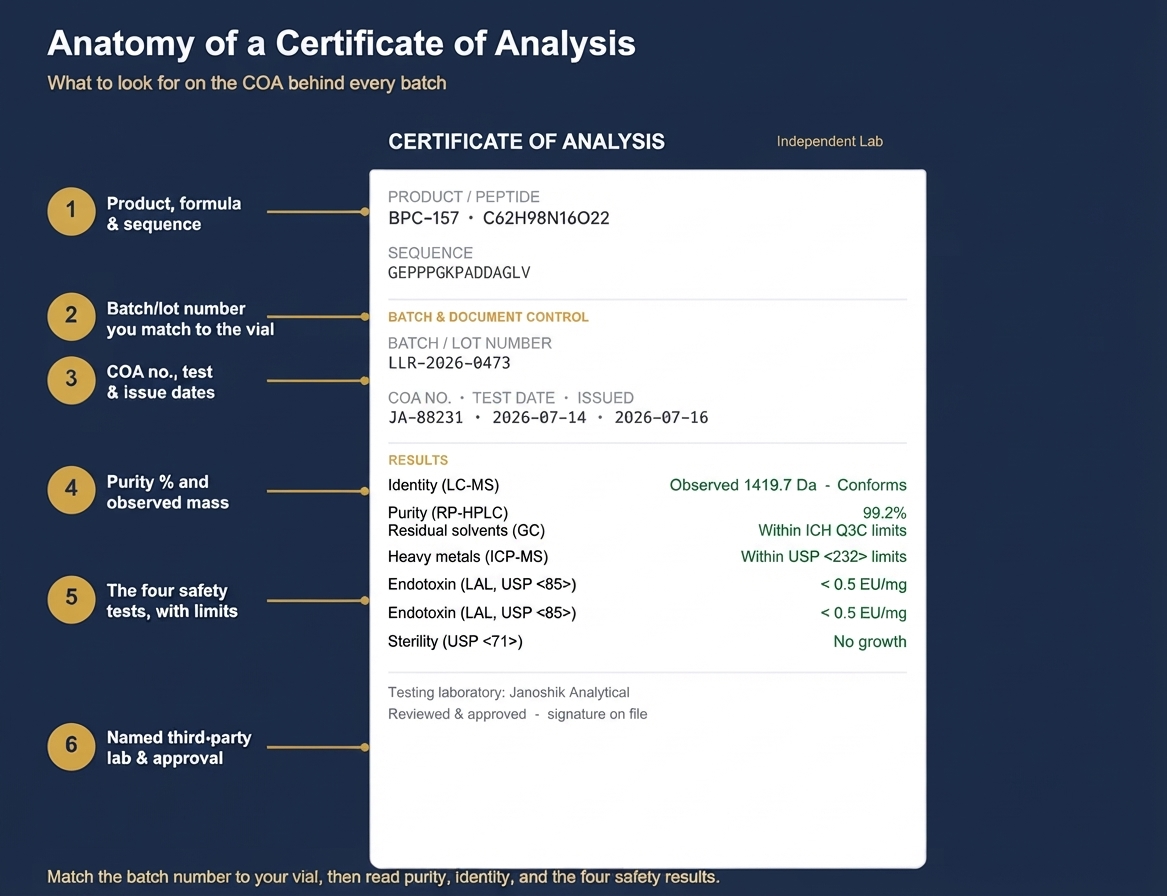
To review your batch record, open the linked COA PDF and confirm the purity result and the observed mass. Our guide on how to read a peptide COA walks through every field on the document, including the chromatogram and the mass data.
What happens when a batch fails
Testing only means something if a failing result actually stops a shipment. When a batch comes back below our purity standard, or shows an endotoxin, sterility, or metals result outside limits, that lot is quarantined. It is never downgraded to a lower grade, relabeled, or shipped anyway. Holding to that rule is the reason our testing panel is worth running in the first place.
Research use only: what testing certifies
Our testing tells you a great deal about a batch, and it is honest about its limits. A full panel of results confirms the identity, purity, and safety profile of the material at the time of testing. It documents quality to recognized standards, and it gives you a record you can file, cite, and audit.
Research use only
What testing does not do is change the product’s status. Our peptides are supplied strictly for laboratory research use only. They are not FDA-approved, and they are not intended for human or veterinary use, consumption, diagnosis, treatment, or prevention. We use the same analytical methods and compendial standards a pharmaceutical lab would recognize, and the material remains research-grade, produced for the laboratory. Clear testing and clear labeling do the same job: they tell you exactly what you are working with.
Frequently asked questions
Do you test every product, or only some?
Every batch is tested for identity and purity; heavy-metals, sterility, and endotoxin testing runs on a rotating cycle across batches. There is no sampling on identity and purity, so the COA for your batch always describes the exact lot you receive.
Why do so few suppliers run this much testing?
Cost and time. Several are separate commissioned assays, and the sterility test alone adds a 14-day incubation. That is why we run them on a rotating cycle across our catalog rather than on every single batch, and why many suppliers skip them entirely and stop at purity and identity.
Can I see a sample COA before I order?
Yes. Our COA library holds batch-specific certificates for our products, and each product page links to the relevant document, so you can review real results before you buy.
How do I find the COA for my batch?
Open the COA linked on the product page or in the COA library — each certificate lists its batch number and test date, so you can confirm the purity result and the observed mass.
What happens to a batch that fails a test?
It is quarantined and kept out of the catalog. A failing lot is never relabeled, downgraded, or shipped, because testing is only useful when a failure actually stops the batch.
Is your material FDA-approved or pharmaceutical grade?
No, we run the same methods and compendial standards a pharmaceutical lab uses, but our peptides are research-grade, supplied for laboratory use only. They are not cGMP-manufactured and not FDA-approved.
Does high purity mean the material is safe for cell or animal work?
Not on its own. Purity and identity confirm the compound is correct and clean, while endotoxin, sterility, and heavy metals results speak to safety. That is why we run those tests on a rotating cycle across our catalog, in addition to identity and purity on every batch.
Where can I find storage and handling guidance?
See our guides on peptide storage and peptide reconstitution for laboratory-focused instructions on temperature, light protection, and preparing your material correctly.
Get in touch
Have a question about a specific batch?
Ask us about a COA or our testing methods and we will help you find the exact document or answer you need before you order.
Shop research peptides Browse the COA library Read about our company