
CJC-1295 and Ipamorelin are two of the most studied growth hormone secretagogues in peptide research, and they are easy to confuse because they chase the same outcome from opposite ends. CJC-1295 imitates growth hormone releasing hormone (GHRH), while Ipamorelin imitates ghrelin. They reach two different receptors on the pituitary, and that single fact explains almost everything else about how they behave and why researchers so often study them as a pair.
The compounds discussed here are sold for laboratory research only and are not for human or veterinary use.
Quick Comparison at a Glance
| Property | CJC-1295 | Ipamorelin |
| Class | GHRH analog | GHRP (ghrelin-receptor agonist) |
| Receptor | GHRH receptor (pituitary somatotrophs) | GHSR-1a (ghrelin receptor) |
| Size | 30 amino acids (with DAC) | 5 amino acids (pentapeptide) |
| Sequence note | Modified GHRH(1-29) backbone | Aib-His-D-2-Nal-D-Phe-Lys-NH2 |
| Half-life | ~30 min (no DAC) or 5.8 to 8.1 days (with DAC) | ~2 hours |
| Selectivity | GHRH-receptor specific | GH release with little cortisol or prolactin |
| Studied for | Sustained GHRH-receptor stimulation, IGF-1 dynamics | GHSR-1a signaling isolated from ghrelin’s other effects |
CJC-1295: The GHRH-Analog Signal
CJC-1295 covers the first of the two growth hormone signals. It is a synthetic version of GHRH, the hypothalamic hormone that switches on GH production, and it binds the GHRH receptor on pituitary somatotrophs to push both synthesis and pulsatile release. In other words, it works upstream, prompting the gland’s own machinery to do more of what it already does.
The wrinkle that trips people up is that CJC-1295 comes in two forms, and they behave very differently.
With DAC vs Without DAC (Mod GRF 1-29)
The DAC (Drug Affinity Complex) version carries a small linker that latches onto albumin in the bloodstream, and that tether is what makes it long-acting. Researchers first characterized this albumin-bioconjugate design as a way to build a long-lasting GRF analog (Jetté et al., 2005). Published pharmacokinetic work (Teichman et al., 2006) reports a half-life of 5.8 to 8.1 days for the DAC form, with GH readouts raised for six days or more.
The CJC-1295 no-DAC version, better known as Mod GRF 1-29, drops the albumin linker. Its half-life falls to roughly 30 minutes, so it produces a sharp, brief spike that looks much closer to the body’s own GHRH rhythm. Researchers choose between the two based on the question: steady receptor occupancy points to DAC, while short physiological pulses point to Mod GRF 1-29.
Ipamorelin: The Selective Ghrelin-Receptor Signal
Ipamorelin stimulates growth hormone via another pathway. It is a five-amino-acid peptide, sequence Aib-His-D-2-Nal-D-Phe-Lys-NH2, and it acts on GHSR-1a, the same receptor ghrelin uses. Its job is to amplify the size of each growth hormone pulse, working alongside the GHRH signal to make the release the gland is already building bigger.
What made Ipamorelin stand out when Raun and colleagues first described it in 1998 was how clean it was. Older ghrelin-receptor compounds also pushed up cortisol and ACTH. Ipamorelin did not, and the researchers reported that this held true “even at doses more than 200-fold higher than the ED50 for GH release.” They called it “the first selective growth hormone secretagogue,” a phrase that still defines its role in the lab today.
Its half-life is short, about two hours, so like Mod GRF 1-29 it delivers a quick, sharp pulse. It also lacks the strong appetite drive that ghrelin itself produces in most research models, which is part of why it is used to study GHSR-1a signaling on its own.
The Core Differences
The fastest way to keep these two straight is by receptor. CJC-1295 works at the GHRH receptor; Ipamorelin works at the ghrelin receptor. Everything else follows from there.
- Pathway. CJC-1295 drives GH synthesis and pulse frequency. Ipamorelin drives pulse amplitude.
- Half-life. Ipamorelin runs about two hours. CJC-1295 runs 30 minutes without DAC or nearly a week with it.
- Selectivity. Both are fairly clean, though Ipamorelin’s separation of GH release from cortisol is its signature trait.
- Size. Ipamorelin is a compact pentapeptide; CJC-1295 is a full 30-residue GHRH backbone.
Read together, the two peptides are less like rivals and more like two halves of the same regulatory circuit.
What Each Peptide Is Studied For
CJC-1295 shows up most in work on sustained GHRH-receptor stimulation and the downstream behavior of IGF-1, the longer-acting hormone that GH switches on. Because the DAC version keeps the receptor engaged for days, it suits studies that call for a steady signal held over time.
That steady signal is useful because IGF-1 moves on a slower clock than GH itself. A brief GH spike may barely register in IGF-1, while days of raised GH, the pattern Teichman’s group recorded, pushes IGF-1 up 1.5- to 3-fold for more than a week. Researchers studying the GH-to-IGF-1 relationship lean on the DAC form for exactly that reason.
Ipamorelin, by contrast, is a tool for looking at GHSR-1a signaling in isolation. Its selectivity lets a study separate growth hormone release from the stress-hormone response that muddies results with older secretagogues. It also serves as a clean reference point when a lab wants to compare ghrelin-receptor activity against a GHRH-driven signal in the same model.
Any of this, of course, only holds if the material in the vial is what the label claims, which is why a research plan usually starts by reading the certificate of analysis for identity and purity before a single data point is collected.
Why They Are Studied Together
Natural growth hormone release runs on two signals at once. GHRH tells the pituitary to build and release GH, and ghrelin turns up the volume on each pulse. CJC-1295 covers the first signal and Ipamorelin covers the second, so pairing them recreates both arms of the system in one experiment.
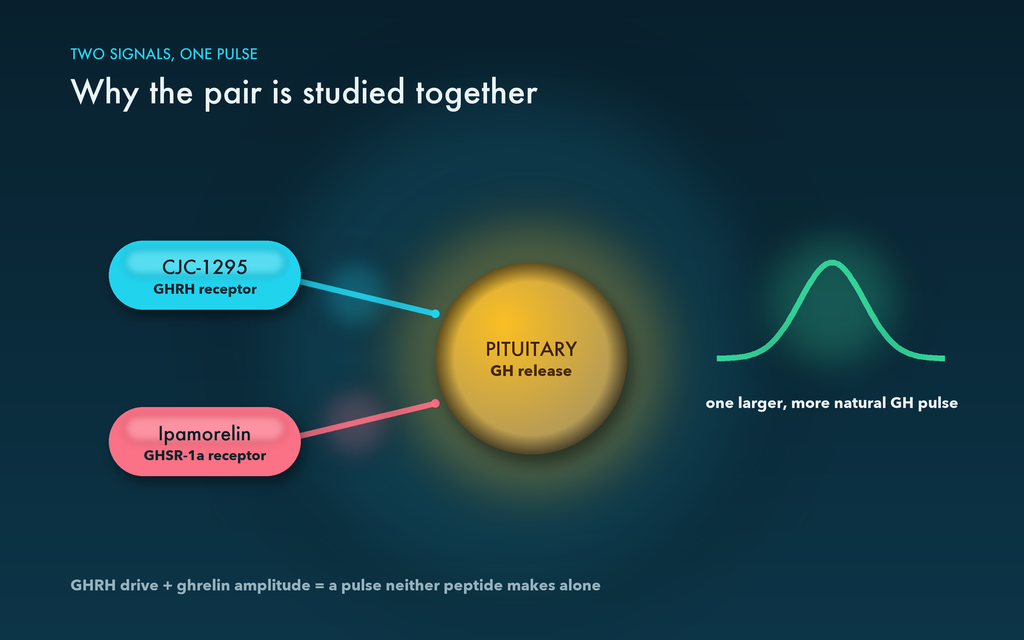
In research models the combination does three things a single peptide cannot. It produces a larger GH pulse than either compound alone, because the two receptors add their effects together. It gives that pulse a shape closer to the body’s own rhythm, since both natural signals are present at once. And it reduces tachyphylaxis, the fading response that can set in when only one pathway is pushed over and over.
There is a design logic here too. Studying the two peptides side by side lets a lab attribute an effect to the right receptor, then watch how the combined signal behaves once both are active. That layered approach is why the CJC-1295 and Ipamorelin pairing has become one of the most examined secretagogue combinations in the field, and why so much of the literature treats them as a set instead of as competitors.
Half-Life and Timing in Research Design
Half-life is where the practical differences show up, because it decides how often a compound has to be introduced to keep a signal going. The three options in this space span two orders of magnitude, from half an hour to more than a week.
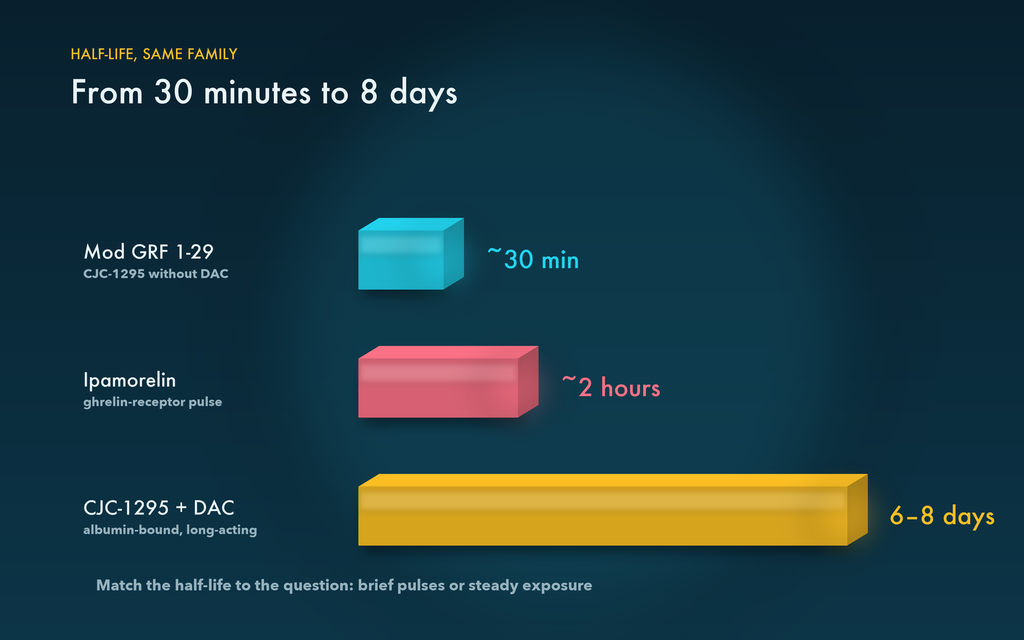
Mod GRF 1-29 clears in about 30 minutes and Ipamorelin in about two hours, so both create brief, well-defined pulses that suit studies of pulse timing. CJC-1295 with DAC holds a raised GH and IGF-1 level for days on a single dose, which is a different kind of experiment altogether. Matching the half-life to the question is one of the first design decisions in this area, and confirming the compound’s identity through a genuine third-party certificate is what keeps that timing meaningful from one batch to the next.
Selectivity and Tolerability in Research Models
The tolerability picture in the source literature is reassuring on both counts. Raun’s team found Ipamorelin left ACTH and cortisol essentially untouched, a clean profile that is still its main selling point as a research tool.
Those findings come from controlled settings with characterized material, and that qualifier carries weight. Reproducibility depends on the peptide being pure and correctly identified, so the quality of the testing behind a vial, whether it was checked by an independent lab or only in-house, shapes how much a result can be trusted.
Regulatory Status in the US and Sport
Neither peptide is an FDA-approved drug. Both are sold as research chemicals, and neither holds approval for human telomerase / cellular-senescence research language, fitness, or clinical use. Anyone implying otherwise is describing a use these compounds do not carry.
For anyone connected to competitive sport, the line is clear: growth hormone secretagogues, including CJC-1295 and Ipamorelin, appear under class S2 of the WADA Prohibited List, so they are banned in tested competition regardless of their research status.
Frequently Asked Questions
What is the difference between CJC-1295 and Ipamorelin?
CJC-1295 is a GHRH analog that binds the GHRH receptor and drives growth hormone synthesis and pulse frequency. Ipamorelin is a ghrelin-receptor agonist that binds GHSR-1a and boosts pulse amplitude. They act on two separate receptors, which is why they are often studied as a complementary pair.
Should CJC-1295 be used with or without DAC?
It depends on the study design. The DAC version binds albumin and holds a half-life of 5.8 to 8.1 days, which suits sustained receptor-occupancy work. The no-DAC version, Mod GRF 1-29, clears in about 30 minutes and produces sharp, physiological pulses instead.
Why are CJC-1295 and Ipamorelin combined?
Natural GH release uses two signals: GHRH and ghrelin. CJC-1295 supplies one and Ipamorelin the other, so together they produce a larger, more natural-shaped GH pulse than either alone, while reducing the tachyphylaxis that single-pathway stimulation can cause.
Does Ipamorelin raise cortisol?
In the original characterization by Raun and colleagues, Ipamorelin released growth hormone without raising ACTH or cortisol, even at doses far above those needed for GH release. That selectivity is what set it apart from earlier ghrelin-receptor compounds.
What is the half-life of each peptide?
Ipamorelin runs about two hours. CJC-1295 depends on the form: roughly 30 minutes without DAC (Mod GRF 1-29), or 5.8 to 8.1 days with DAC, because the albumin tether keeps it in circulation far longer.
Is CJC-1295 the same as Mod GRF 1-29?
Mod GRF 1-29 is CJC-1295 without the DAC modification. Both share the modified GHRH backbone, but Mod GRF 1-29 lacks the albumin-binding linker, so it clears in minutes while the DAC form lasts for days.
Are CJC-1295 and Ipamorelin FDA-approved?
No, both are supplied as research chemicals and neither is approved by the FDA for human use of any kind. They also appear on the WADA Prohibited List, so they are banned in tested sport.
Which is the stronger growth hormone peptide?
There is no single “strongest” one, because they measure different things. Ipamorelin drives a sharp, selective pulse; CJC-1295 with DAC sustains an elevated signal for days. Strength depends entirely on whether the research question calls for a brief pulse or steady exposure.
How do CJC-1295 and Ipamorelin affect IGF-1?
Growth hormone switches on IGF-1, which acts over a longer timescale. In the Teichman study, sustained GH from CJC-1295 with DAC raised IGF-1 by 1.5- to 3-fold for 9 to 11 days. A short Ipamorelin pulse moves GH quickly but has less effect on IGF-1 on its own, which is one reason the two are studied together.
Are CJC-1295 and Ipamorelin studied for body composition?
In research models both are examined for their role in growth hormone and IGF-1 axis signaling. That is a mechanism-level research interest, not a demonstrated human outcome, and neither compound is approved for weight or body-composition use of any kind.
Disclaimer
This article is educational and describes laboratory research on CJC-1295 and Ipamorelin. Both compounds are sold for research use only and are not for human or veterinary use, are not FDA-approved, and are not medicines. Mechanistic and pharmacokinetic details cite published research for context and are not usage guidance. Sources: Raun et al. (1998), Teichman et al. (2006), Jetté et al. (2005), WADA Prohibited List.