Description
Structure & Identity
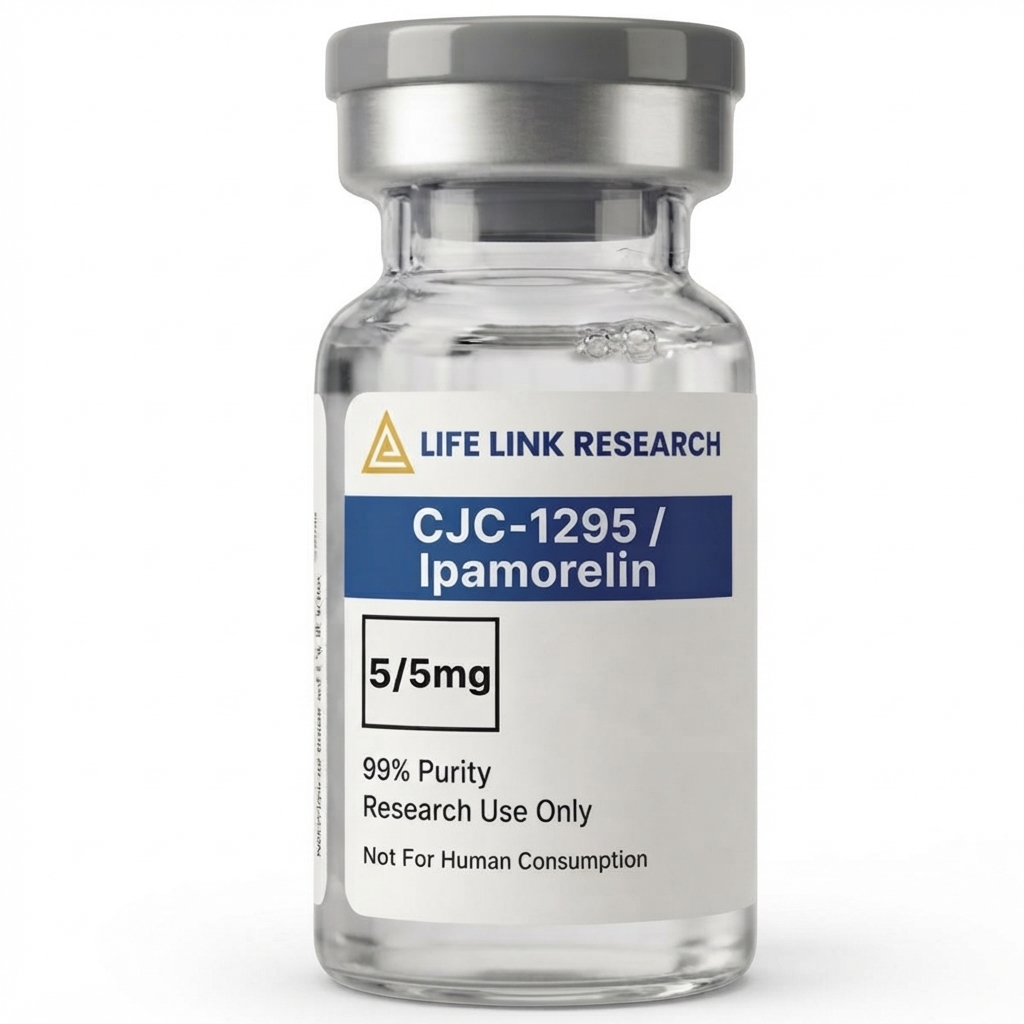
This peptide is a 29-amino-acid modified fragment of GHRH, the “1-29” portion that carries the hormone’s activity, with four stabilizing substitutions built in. The “no DAC” label is the important part: DAC (Drug Affinity Complex) is a chemical group that, when present, binds the peptide to blood proteins and stretches its lifetime dramatically. Without it, this version acts more briefly, which is exactly why some research designs prefer it.
Research Background
CJC-1295 research sits at the GHRH receptor and the growth-hormone/IGF-1 axis it activates.
- GHRH fragment. CJC-1295 (no DAC) is a stabilized 29-residue GHRH fragment; without the DAC group it acts over a shorter window [PMID: 16352683].
- GH/IGF-1 stimulation. Studies documented prolonged stimulation of GH and IGF-1 secretion [PMID: 16352683].
- Axis activation. Research tracked activation of the GH/IGF-1 axis and serum readouts [PMID: 19386527].
- Secretion patterns. Work examined whether GH secretion stays pulsatile under continuous GHRH-analog stimulation [PMID: 17018654].
- Analytical detection. Detection methods have been developed for CJC-1295 and related peptides [PMID: 30489688].
Note that much of the published CJC-1295 literature involves the longer-acting DAC form; the no-DAC version shares the GHRH-receptor mechanism but with a shorter action. These are research contexts, not approved uses.
Specifications
| Attribute | Value |
| Chemical name | CJC-1295 no DAC (Modified GRF 1-29) |
| Also Known As | Mod GRF 1-29 |
| Sequence | Modified GRF(1-29), 29 residues |
| CAS number | 863288-34-0 |
| Molecular weight | 3367.9 g/mol |
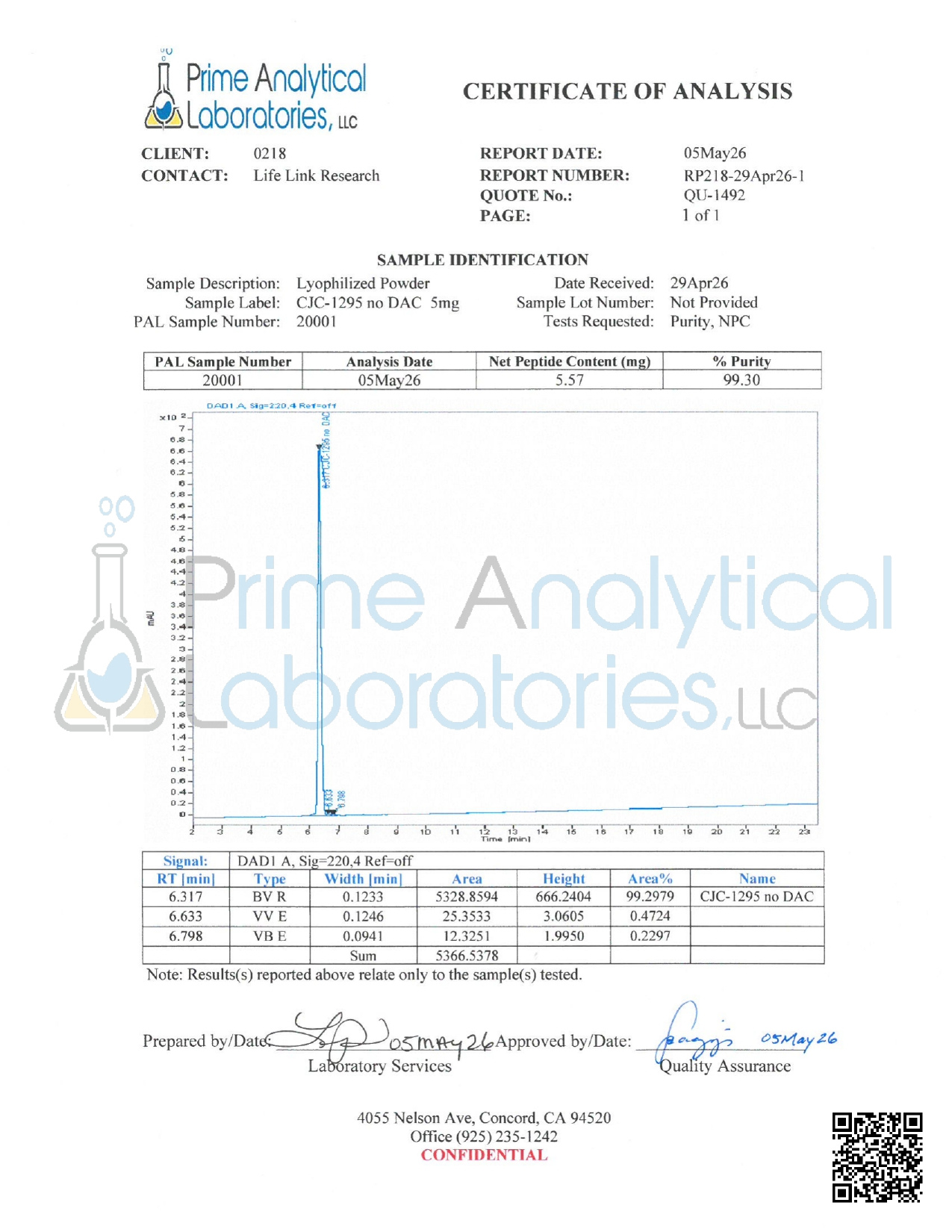
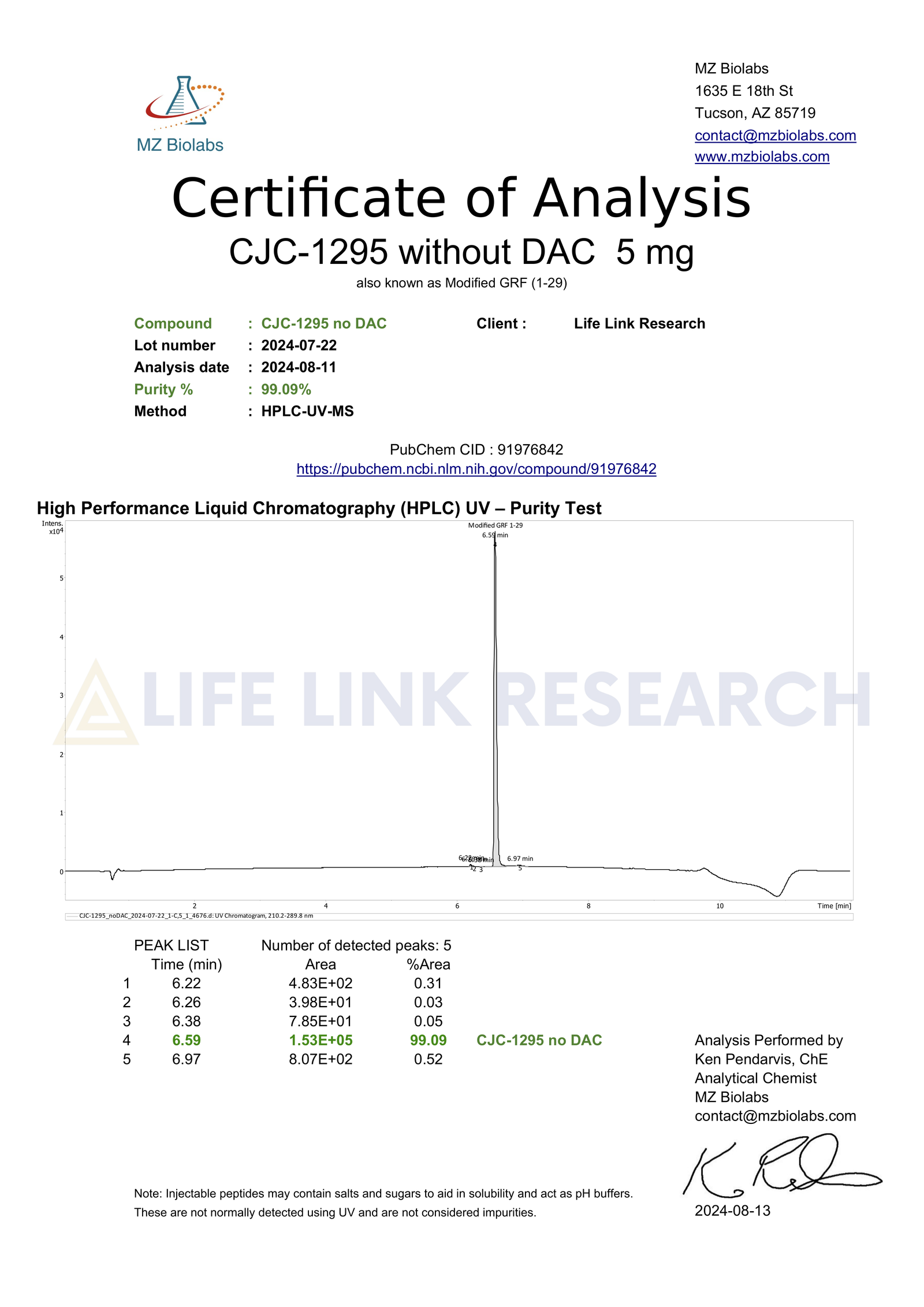
| Purity | ≥99% by reverse-phase HPLC |
| Length | 29 amino acids |
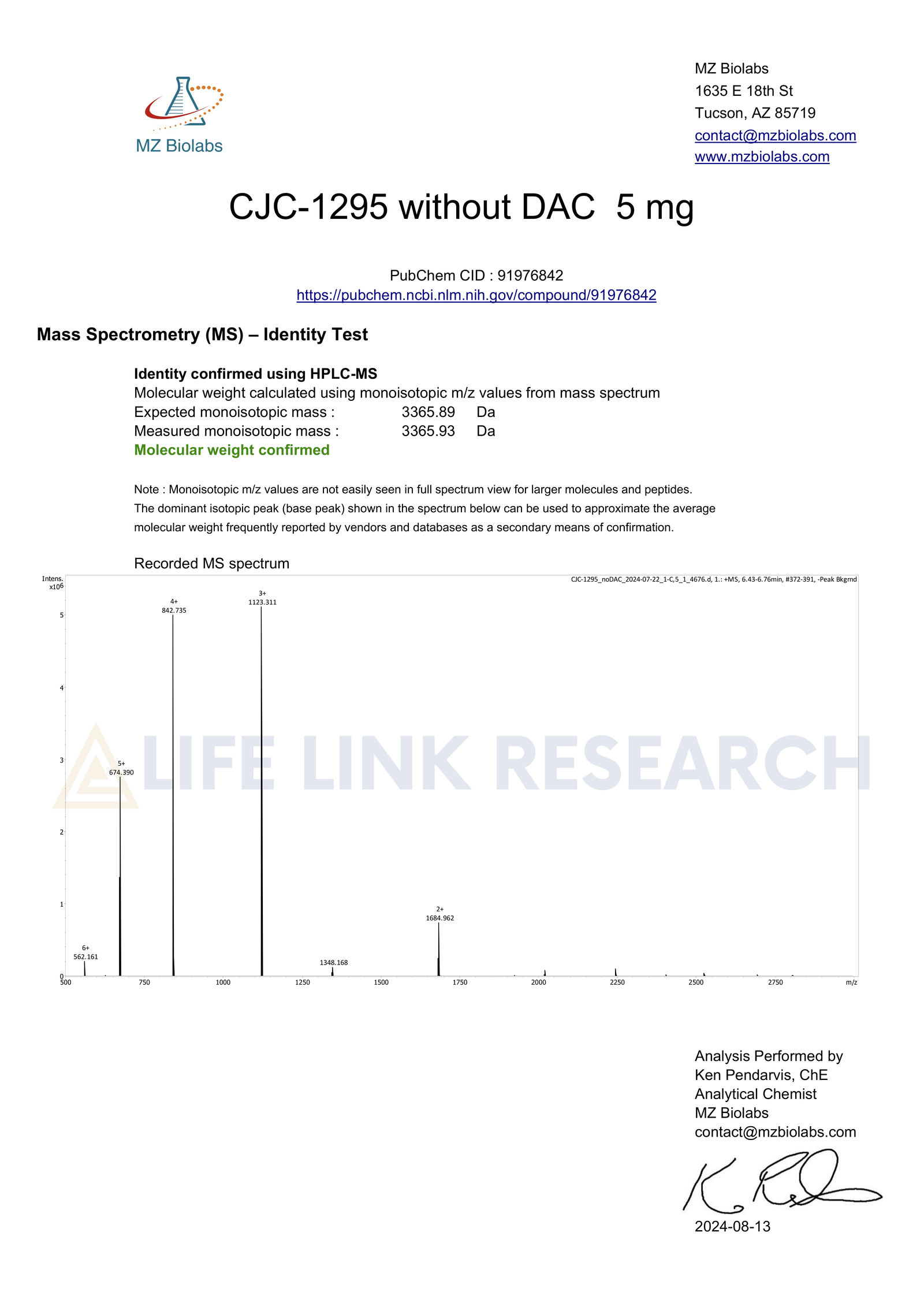
| Identity | Confirmed by ESI mass spectrometry |
| Physical form | Lyophilized powder |
| Appearance | White to off-white solid |
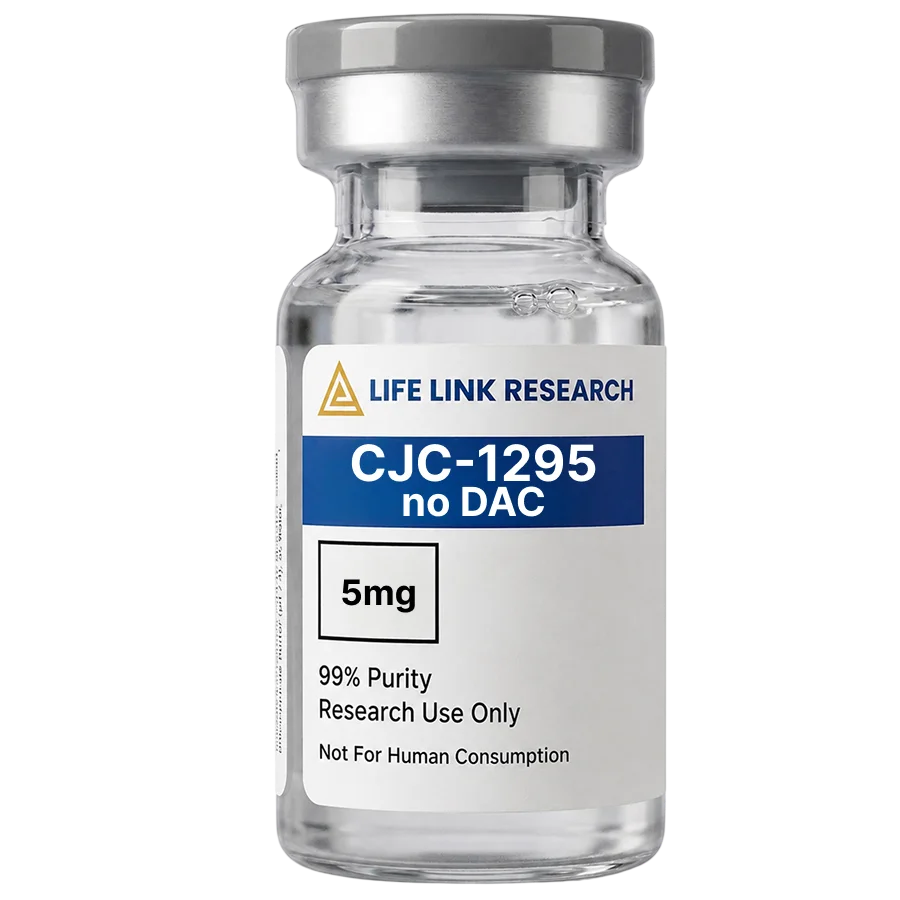
| Quantity | 5 mg per vial |
| Storage | -20°C, protected from light |
| Solubility | Soluble in bacteriostatic or sterile water |
| Classification | Research use only |
Storage & Handling
Store the sealed vial frozen at -20°C, shielded from light, until needed. Once prepared, keep the solution refrigerated at 2-8°C and use for your research within about two weeks. Warming the vial to room temperature before opening reduces condensation, and avoiding repeated freeze-thaw cycles protects the modified peptide chain.
Quality Assurance
CJC-1295 no DAC is produced under research-grade manufacturing controls and verified by an outside lab before it ships. Its purity is measured by reverse-phase HPLC and its identity by mass spectrometry, with testing carried out by independent third-party laboratories, including Janoshik Analytical and domestic US labs. A batch-specific certificate of analysis is provided, so the results can be matched to your exact vial.
Frequently Asked Questions
What is CJC-1295 no DAC?
CJC-1295 without DAC, also called Modified GRF (1-29), is a synthetic, stabilized fragment of GHRH studied in growth-hormone-axis research. It is supplied for research use only.
What does “no DAC” mean?
DAC stands for Drug Affinity Complex, a chemical group that binds the peptide to blood proteins and greatly extends how long it lasts. “No DAC” means that group is absent, so this version acts over a shorter window.
How is CJC-1295 different from ipamorelin?
They work through different receptors. CJC-1295 is a GHRH analog acting at the GHRH receptor, while ipamorelin acts at the ghrelin/GHS-R1a receptor. They are studied together because both feed the growth-hormone pathway.
Is CJC-1295 no DAC the same as Modified GRF (1-29)?
Yes, they are two names for the same peptide, a 29-residue GHRH fragment with stabilizing modifications and no DAC group.
Is CJC-1295 FDA approved?
No. CJC-1295 is not an FDA-approved drug or supplement. It is a research-use-only material and is not meant for human or veterinary use.
How should CJC-1295 no DAC be stored?
Keep the powder frozen at -20°C and protected from light. After preparation for research, store at 2-8°C and use within about two weeks.
How is this peptide’s purity verified?
It is tested to ≥99% purity by reverse-phase HPLC with mass-spec identity confirmation by an independent lab, and each batch has a published certificate of analysis.