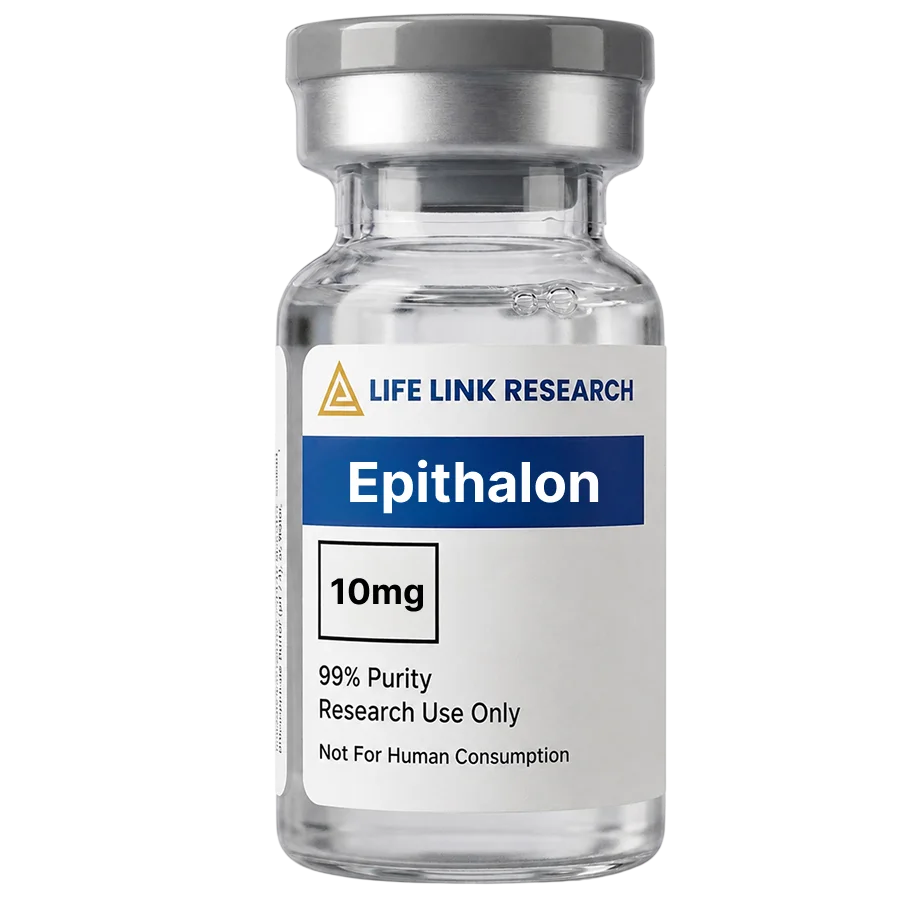

Description
Structure & Identity
Epithalon is a tetrapeptide with the sequence Ala-Glu-Asp-Gly, often written by its one-letter code AEDG. There are no exotic modifications here; its interest comes not from complex chemistry but from what such a simple sequence appears to do in cell and animal models. Because it is so small, it is straightforward to synthesize and characterize.
Research Background
Epithalon research clusters around gene expression, telomerase, and pineal/circadian signaling.
- Pineal fragment. Epithalon (AEDG) is a synthetic tetrapeptide linked to a pineal-gland fragment [PMID: 40141333].
- Telomere research. It has been studied for effects on telomere length via telomerase in human cell lines [PMID: 40908429].
- Gene expression. Work reports it stimulating gene expression and protein synthesis during neurogenesis [PMID: 32019204].
- Circadian biology. Its pineal ties extend to circadian-rhythm gene-expression research [PMID: 33280326].
- Long-term cell models. Cell-line work has examined it for telomerase and telomere-length readouts [PMID: 40908429].
These are research findings, not approved uses, and the material is intended to support continued laboratory study.
Specifications
| Attribute | Value |
| Chemical name | Epithalon (Ala-Glu-Asp-Gly / AEDG) |
| Also Known As | Epitalon, AEDG |
| Sequence | Ala-Glu-Asp-Gly |
| CAS number | 307297-39-8 |
| Molecular formula | C14H22N4O9 |
| Molecular weight | 390.35 g/mol |
| Purity | ≥99% by reverse-phase HPLC |
| Length | 4 amino acids (Tetrapeptide) |
| Identity | Confirmed by ESI mass spectrometry |
| Physical form | Lyophilized powder |
| Appearance | White to off-white solid |
| Quantity | 10 mg per vial |
| Storage | -20°C, protected from light |
| Solubility | Soluble in bacteriostatic or sterile water |
| Classification | Research use only |
Storage & Handling
Store the sealed vial frozen at -20°C and away from light until use. Once reconstituted, keep the solution at 2-8°C and use it in your study within about two weeks. Even though epithalon is a small, relatively robust peptide, warming the vial to room temperature before opening and avoiding repeated freeze-thaw cycles are still good habits that protect the material.
Quality Assurance
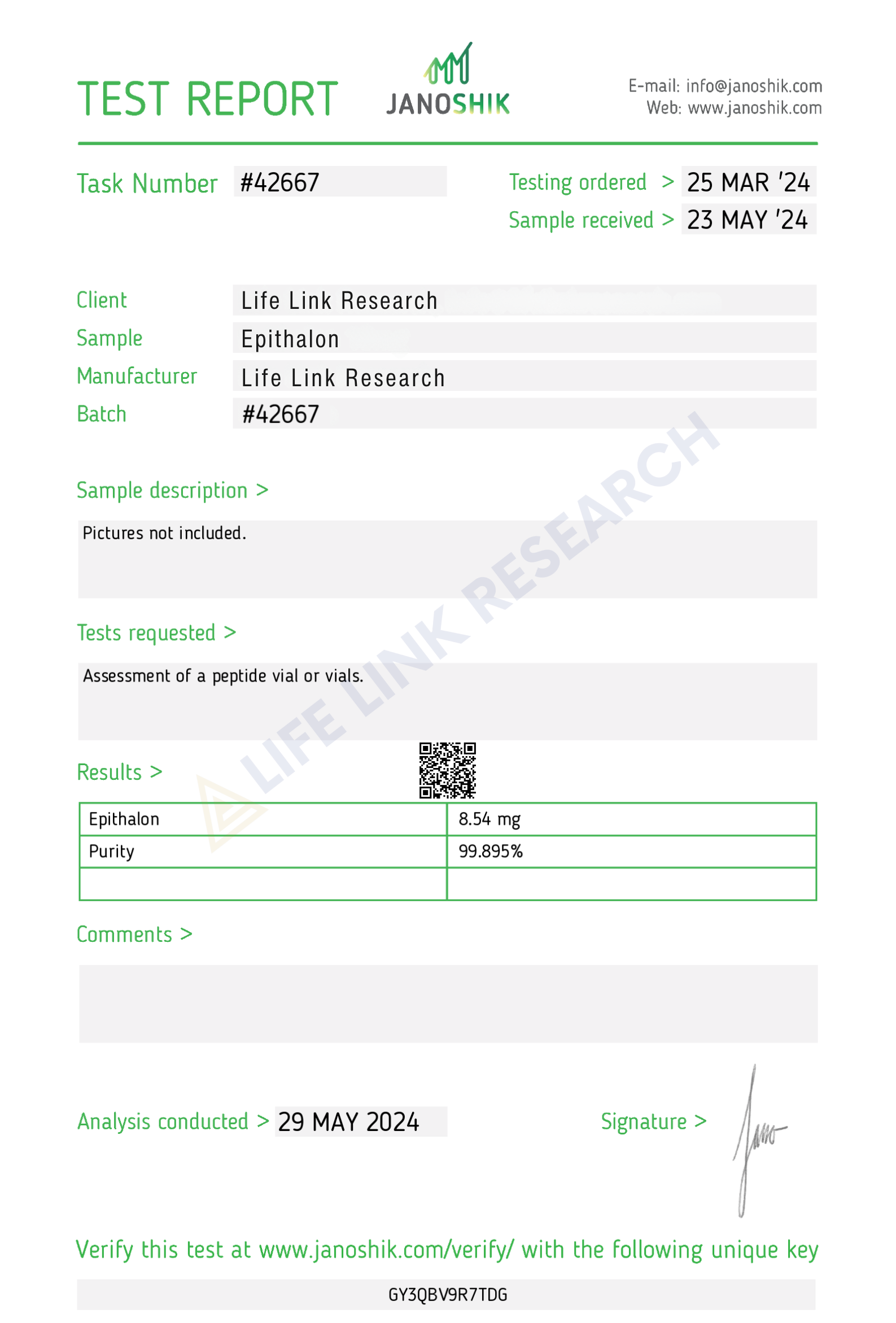
Epithalon is produced to research-grade manufacturing standards and checked by an independent lab before release. Purity comes from reverse-phase HPLC and identity from mass spectrometry, carried out by third-party laboratories such as Janoshik Analytical along with domestic US labs. A certificate of analysis is issued for each batch, so its purity and identity data belong to the vial you receive.
Frequently Asked Questions
What is Epithalon?
Epithalon is a synthetic four-amino-acid peptide (Ala-Glu-Asp-Gly, or AEDG) linked to a pineal-gland fragment. It is studied in gene-expression and telomerase research and is supplied for research use only.
Is it spelled Epithalon or Epitalon?
Both spellings appear in the literature for the same peptide. This product uses “Epithalon” consistently; you may see “Epitalon” elsewhere.
What is the AEDG sequence?
AEDG is the one-letter shorthand for the four amino acids alanine-glutamate-aspartate-glycine (Ala-Glu-Asp-Gly), which make up the entire peptide.
How does Epithalon work in research?
Studies describe it influencing gene expression and protein synthesis, with particular interest in pineal and circadian biology. These are effects observed in cell and animal research, not human outcomes.
Is Epithalon FDA approved?
No, Epithalon is not an FDA-approved drug or supplement. It is a research-use-only material and is not intended for human or veterinary use.
Why is Epithalon only four amino acids?
It is a short natural-fragment peptide, and that small size is part of the research interest, since so simple a sequence appears active in models. It also makes the peptide easy to synthesize and verify.
How should Epithalon be stored?
Keep the powder frozen at -20°C and protected from light. After reconstitution for research, store at 2-8°C and use within about two weeks.
How is this Epithalon verified?
It is tested to ≥99% purity by reverse-phase HPLC with mass-spec identity confirmation by an independent lab, and each batch ships with a certificate of analysis.
References
- AEDG Peptide (Epitalon) Stimulates Gene Expression and Protein Synthesis during Neurogenesis. 2020. PMID: 32019204.
- AEDG peptide regulates human circadian rhythms genes expression during pineal gland acceleration. 2020. PMID: 33280326.
- 3. Al-Dulaimi S, et al. Epitalon increases telomere length in human cell lines through telomerase upregulation or ALT activity. 2025. PMID: 40908429.