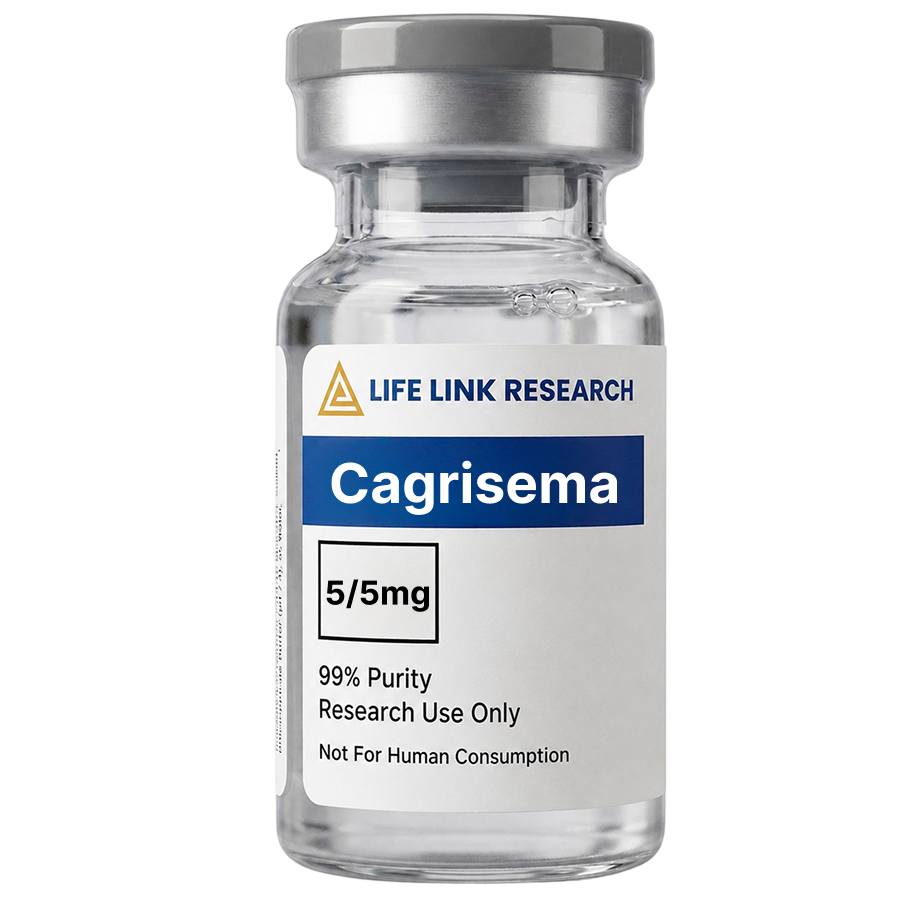

Description
Structure & Identity
Cagrisema is not a single molecule but a pairing of two: cagrilintide (a long-acting amylin analog acting at amylin/calcitonin receptors) and Semaglutide (a GLP-1 receptor agonist). Each keeps its own structure and receptor target; the combination simply brings both into one research preparation so their signaling can be studied together.
Research Background
Cagrisema research is about how amylin and GLP-1 signaling behave in combination.
- Combined pathways. CagriSema pairs amylin signaling (cagrilintide) with GLP-1 signaling (semaglutide) in one preparation [PMID: 40204768].
- Combination. The cagrilintide component’s binding to calcitonin and amylin receptors has been mapped structurally [PMID: 40204768].
- Amylin basis. The amylin half rests on cagrilintide’s development as a long-acting analog [PMID: 34288673].
- GLP-1 basis. The GLP-1 half draws on well-characterized GLP-1 receptor physiology [PMID: 34626851].
- Pharmacology. Concomitant amylin-analog administration has been characterized [PMID: 33894838].
These are laboratory research contexts, not approved uses, and the combination is supplied for that study.
Specifications
| Attribute | Value |
| Product type | Combination (two peptides) |
| Component 1 | Cagrilintide (amylin analog), 5 mg (CAS 1415456-99-3, MW 4409.0 Da) |
| Component 2 | Semaglutide (GLP-1 agonist), 5 mg (CAS 910463-68-2, MW 4113.6 Da) |
| Total quantity | 10 mg per vial |
| Purity | ≥99% by reverse-phase HPLC (each component) |
| Length | 2 peptides (amylin analog + GLP-1 analog) |
| Identity | Confirmed by ESI mass spectrometry |
| Physical form | Lyophilized powder |
| Appearance | White to off-white solid |
| Storage | -20°C, protected from light |
| Solubility | Soluble in bacteriostatic or sterile water |
| Classification | Research use only |
Storage & Handling
Keep the sealed vial frozen at -20°C and shielded from light until use. After preparing for your assay, store the solution at 2-8°C and study it within about two weeks. Because one component is an amylin-type peptide that can aggregate, gentle preparation and minimal freeze-thaw cycles are crucial, and the vial should reach room temperature before opening.
Quality Assurance
Cagrisema’s components are produced under research-grade manufacturing controls and verified by an independent lab before release. Purity is measured by reverse-phase HPLC and identity by mass spectrometry, with testing carried out by third-party laboratories, including Janoshik Analytical and domestic US labs. A certificate of analysis accompanies each batch, so the results trace to the vial you receive.
Frequently Asked Questions
What is Cagrisema?
Cagrisema is a combination research product containing two peptides: cagrilintide (an amylin analog) and Semaglutide (a GLP-1 receptor agonist), 5 mg of each. It is studied in metabolic research and supplied for research use only.
Why combine Cagrilintide and Semaglutide?
Amylin and GLP-1 are different metabolic signals, and pairing them lets researchers study two complementary pathways together in one preparation. That combined approach is the point of Cagrisema.
Why is it labelled both “5/5mg” and “10mg”?
Both describe the same vial: 5 mg of cagrilintide plus 5 mg of Semaglutide equals 10 mg total. Using “10mg (5mg/5mg)” is the clearest way to state it.
Are the two peptides chemically joined?
No, they are two separate molecules combined in one vial, each keeping its own structure and receptor target. Cagrisema is a mixture, not a single fused peptide.
Is Cagrisema FDA approved?
No, Cagrisema is not FDA approved. The material here is a research-use-only compound combination, not for human or veterinary use.
How is Cagrisema stored?
Keep the powder frozen at -20°C and protected from light. Once prepared for assay, store at 2-8°C and study within about two weeks.
How is the quality of both components verified?
Each component is tested to ≥99% purity by reverse-phase HPLC with mass-spec identity confirmation by an independent lab, and each batch ships with a certificate of analysis.
Which receptors does Cagrisema act on?
Through its two components, it engages amylin/calcitonin receptors (cagrilintide) and the GLP-1 receptor (Semaglutide).