
Quick answer: On July 23 and 24, 2026, the FDA’s Pharmacy Compounding Advisory Committee (PCAC) reviewed seven peptides for the Section 503A compounding list and recommended six of them: BPC-157, KPV, TB-500, MOTS-c, Epitalon, and Semax. Only Emideltide was voted down. Every vote was narrow, none is binding, and nothing is approved yet.
Current Status of Peptides the FDA Reviewed in July
For a corner of science that usually grows quietly, the July 2026 advisory meeting was a genuinely big deal. Over two days, a federal committee weighed whether seven research peptides should be available through compounding pharmacies, and it backed most of them. The votes were close, though, and the fine print is just as important as the headline. Here’s the full scorecard, what each peptide was reviewed for, and how much really changed.
Research use only. This page summarizes a regulatory event and preclinical research context. It is not medical guidance, and none of these peptides is approved for human or veterinary use.
What Happened Over the Two Days
The PCAC exists to advise the FDA on which bulk substances compounding pharmacies may use under Section 503A. Across July 23 and 24, the committee reviewed seven peptides and recommended six for the 503A Bulks List. The one it declined was Emideltide.
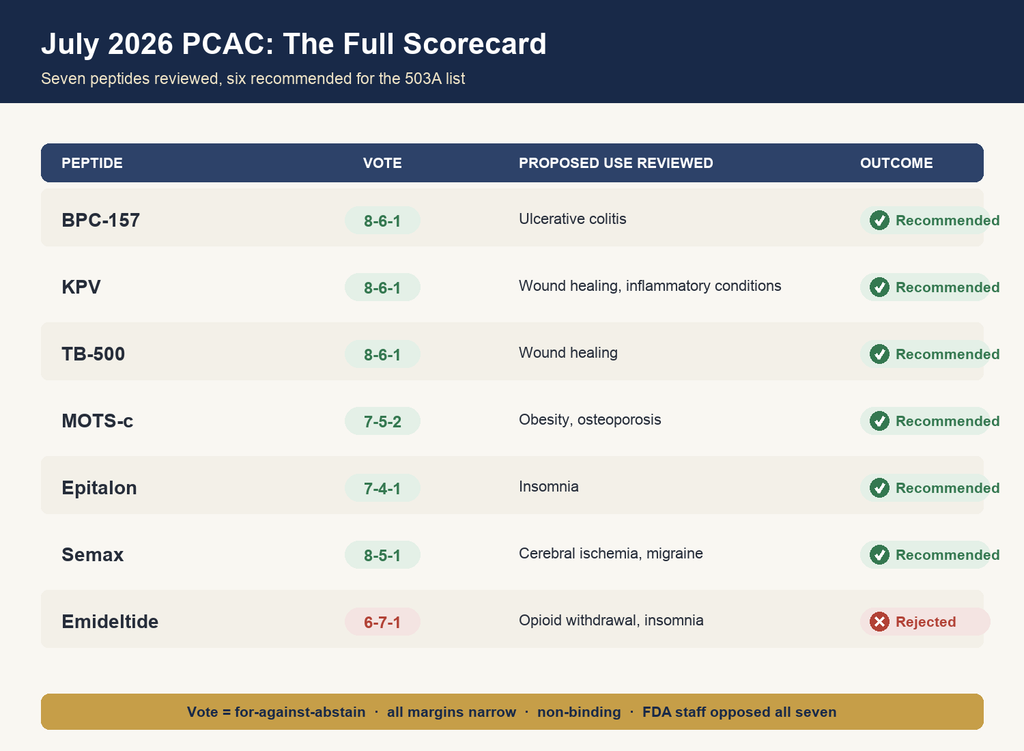
The votes were tight, and the FDA’s own scientists were against the whole slate. During the meeting, FDA reviewers recommended against inclusion of all seven, citing concerns about safety, efficacy, and how well each molecule is characterized. The advisory panel looked at the same evidence and voted the other way on six of them. That gap between the reviewers and the committee is the tension running underneath this entire story.
| Peptide | Committee vote | Outcome | Proposed use reviewed |
| BPC-157 | 8-6-1 | Recommended | Ulcerative colitis |
| KPV | 8-6-1 | Recommended | Wound healing, inflammatory conditions |
| TB-500 | 8-6-1 | Recommended | Wound healing |
| MOTS-c | 7-5-2 | Recommended | Obesity, osteoporosis |
| Epitalon | 7-4-1 | Recommended | Insomnia |
| Semax | 8-5-1 | Recommended | Cerebral ischemia, migraine, neuralgia |
| Emideltide | 6-7-1 | Not recommended | Opioid withdrawal, insomnia, narcolepsy |
The Six the Panel Backed
Each recommended peptide came to the table with a specific proposed use, and the committee’s vote reflected how it weighed the research behind that use.
- BPC-157 drew a wound-and-gut research profile, and the use reviewed was ulcerative colitis. It passed 8-6 with one abstention.
- KPV, the small anti-inflammatory fragment of alpha-MSH, was evaluated for wound healing and inflammatory conditions, clearing on the same 8-6 margin.
- TB-500 and MOTS-c were reviewed for wound healing and for obesity and osteoporosis respectively, and both landed favorable votes. Their regulatory and research picture is worth a closer look on its own.
- Epitalon, a synthetic tetrapeptide studied in longevity research, was reviewed for insomnia and passed 7-4 with one abstention.
- Semax cleared 8-5 with one abstention, reviewed for neurologic uses including cerebral ischemia and migraine.
For anyone new to these compounds, it helps to remember that a peptide is a short chain of amino acids, and each of these six is studied in its own research lane despite sharing a July vote.
The One That Was Rejected
Emideltide, a delta sleep-inducing peptide known in the literature as DSIP, was the only compound the committee declined to recommend. Its vote came in at 6 in favor, 7 against, and 1 abstention, the narrowest margin of the meeting.
The proposed uses reviewed were opioid withdrawal, insomnia, and narcolepsy. A rejection here doesn’t close the door for good, and compounds that fell short can return with stronger data at a future review.
Why FDA Staff Pushed Back
The staff objection is the thread that ties the meeting together, and it’s worth understanding. FDA reviewers looked at the evidence packages for all seven peptides and found them wanting, pointing to short and underpowered studies, thin human safety data, and gaps in how completely each molecule is characterized.
Those concerns didn’t sink the votes, since the advisory committee is free to disagree, but they signal how the agency itself is likely thinking as it moves toward a final decision.
What “Recommended” Actually Means: The Road Ahead
A favorable committee vote is a milestone, and it sits a long way from the finish line. The recommendation guides the FDA without binding it, so more has to happen before any of these peptides could be legally compounded.
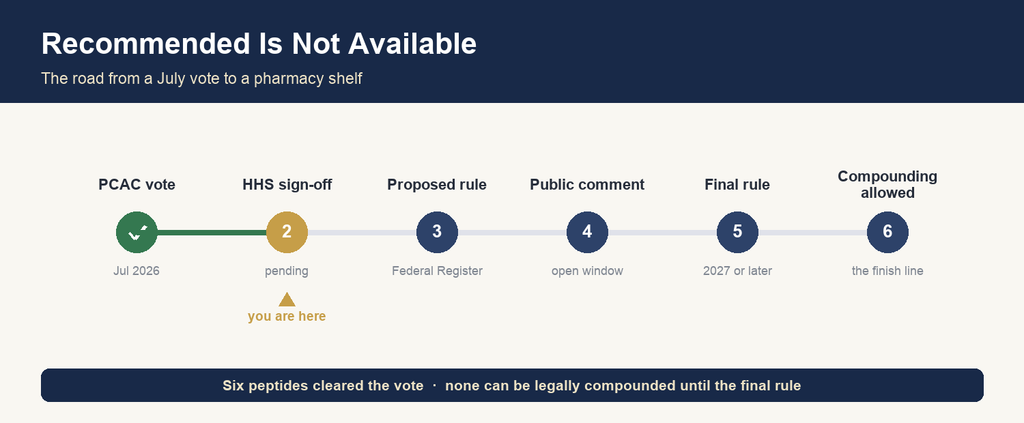
The Secretary of Health and Human Services has a role here, and reporting suggests the agency could add recommended peptides to a Category 1 list on an interim basis or signal enforcement discretion while the rules are worked out.
The durable path, though, runs through formal notice-and-comment rulemaking: the FDA publishes a proposed rule, opens a public comment window, weighs the responses, and issues a final rule in the Federal Register. That process is deliberately slow and may stretch into 2027 or beyond. Until it wraps, pharmacies cannot compound these peptides, even the six with a favorable vote.
What’s Next Before February 2027
The July meeting opened a chapter, and the story keeps moving. The FDA has signaled that more peptides are queued for PCAC review before February 2027, so the bulk list is likely to keep shifting over the coming months.
Stakeholders watching this space are keeping an eye on the Federal Register, where any proposed rule would surface first. For the seven already reviewed, the next real movement depends on how quickly the agency chooses to act on its committee’s advice.
What It Means for Researchers Right Now
For laboratory work, the practical answer is that little has changed. All seven peptides remain research-use-only compounds, supplied strictly for in-vitro study and never for human or veterinary use. The votes hint at where policy could head, yet they grant no new permissions today, and the compounds are not legally available through standard regulated channels.
If anything, a burst of regulatory attention is a reason for more care, since headlines tend to attract new sellers of uneven quality. The regulatory question and the quality question are separate, and only one of them moves on the FDA’s timeline.
Why Quality Still Decides Everything
No committee vote tells you what’s actually in a vial, and that’s where a lab’s diligence earns its keep. Identity and purity are the two things worth confirming before any research begins, and two tests handle them. Mass spectrometry weighs the molecule to verify it matches the intended peptide, while HPLC reports how pure the sample is. The purity number rewards attention, too, since the step from 98% to 99% marks a real change in how much of the sample is anything but the target.
Both results should appear on a Certificate of Analysis tied to your specific batch, and getting comfortable reading a COA is what turns a supplier’s claim into a fact you can check.
We attach a COA to every lot and back it with a broader testing panel that reaches into the safety measures purity alone leaves out. Whatever the FDA decides, that documentation is what makes a research peptide worth choosing.
Frequently Asked Questions
Which peptides did the FDA recommend in July 2026?
The PCAC recommended six of the seven peptides reviewed: BPC-157, KPV, TB-500, MOTS-c, Epitalon, and Semax. Emideltide was the only one the committee voted down, on a narrow 6-7 margin with one abstention.
Are these peptides FDA approved now?
No, a committee recommendation is advisory, and it stops short of approval. Before any of these peptides could be legally compounded, the FDA has to complete formal rulemaking, a process expected to run into 2027 or later. All remain research-use-only for now.
What is the 503A Bulks List?
It’s the FDA’s affirmative list of bulk drug substances that compounding pharmacies are permitted to use under Section 503A. Adding a peptide to it is what would let pharmacies legally compound with it, and that addition still requires formal rulemaking.
Why did FDA staff recommend against the peptides?
FDA reviewers cited short, underpowered studies, limited human safety data, and gaps in how well each molecule is characterized. The advisory committee weighed the same evidence differently and recommended six of the seven anyway.
Which peptide did the committee reject, and why?
Emideltide, a delta sleep-inducing peptide (DSIP), was voted down 6-7 with one abstention. It had been reviewed for opioid withdrawal, insomnia, and narcolepsy. Peptides that fall short can return to a later review with stronger data.
When could these peptides become available for compounding?
There’s no set date. Formal rulemaking includes a public comment period and a final published rule, which typically takes a year or more, pointing toward 2027 at the earliest and only if the FDA follows its committee.
What are the risks around these research peptides?
The FDA’s reviewers flagged limited human safety data and incomplete characterization for all seven, which is part of why they urged caution. For lab use, the practical risk is quality: an unverified peptide can be impure or misidentified, so batch testing and a COA matter regardless of regulatory status.
The Bottom Line
The July 2026 review moved the peptide conversation forward without settling it. Six of seven compounds earned a favorable committee vote, the margins were slim, the FDA’s own scientists remain skeptical, and the rulemaking that would make anything official is still ahead. For researchers, the takeaway is steady: the rules are in motion, the status is unchanged, and a verified COA is still what separates a peptide worth studying from one worth skipping. You can browse our research-grade catalog with that standard in mind.
Research use only. Peptides referenced are for in-vitro laboratory research only, not for human or veterinary use, diagnosis, treatment, or consumption. The claims made on this page have not been assessed by the US Food and Drug Administration.
What Is B7-33? Relaxin-2 Analog Research Overview (2026)
Quick Answer B7-33 is a synthetic single-chain peptide built from part of the B chain of human relaxin-2, and it binds the…
Read article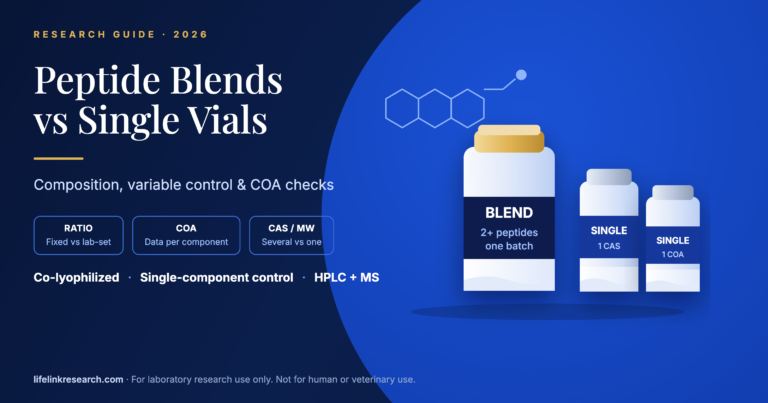
Peptide Blends vs Single Vials: How to Choose for Research (2026)
For Research Use Only. Not for use in diagnostic or therapeutic procedures. Choosing between peptide blends vs single peptides comes down to…
Read article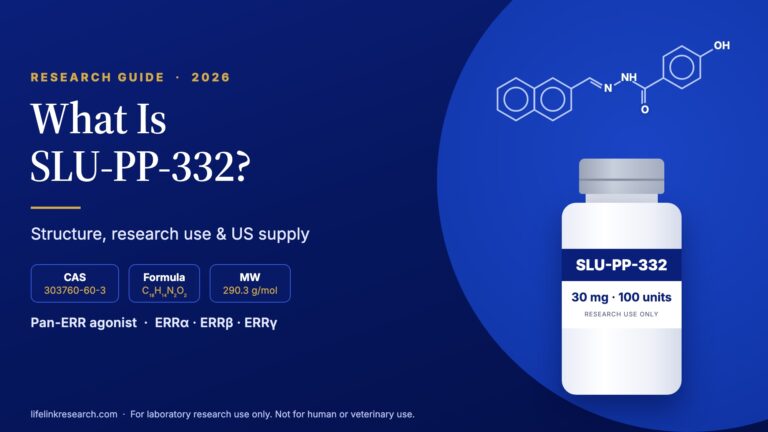
What Is SLU-PP-332? Structure, Research Use & US Supply
Quick Answer SLU-PP-332 is a synthetic small-molecule agonist of the estrogen-related receptors ERRŒ±, ERRŒ≤ and ERRŒ≥ (CAS 303760-60-3, PubChem CID 5338394). It…
Read articleResearch-grade peptides
99%+ purity. Verified every batch.
Identity and purity tested on every batch by third-party labs, Janoshik Analytical and US-based laboratories. Shipped same day from California.
Shop all peptides