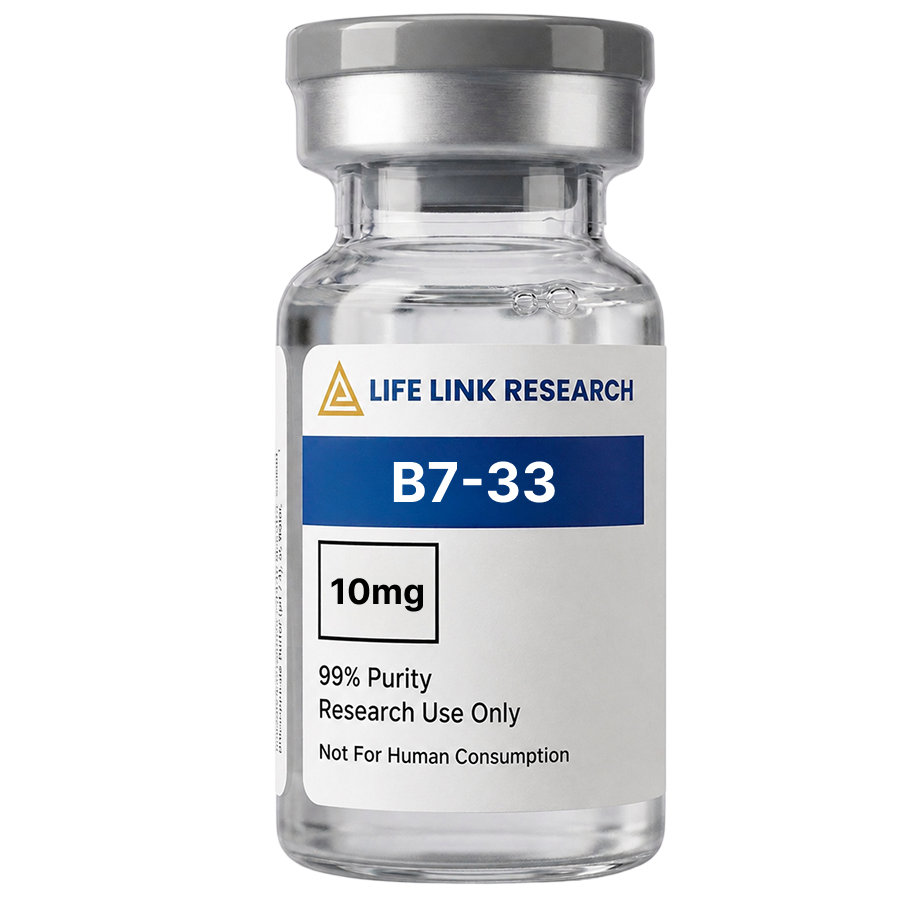
Description
Structure & Identity
B7-33 is a 33-amino-acid single-chain peptide derived from the B-chain of human relaxin-2. Where natural relaxin needs two chains linked by disulfide bonds, B7-33 collapses that into one chain that still engages RXFP1. It is described as functionally selective, meaning it favors particular downstream signals of the receptor rather than triggering every pathway equally.
Research Background
B7-33 research centers on RXFP1 signaling and fibrosis-pathway research.
- Simplified relaxin. B7-33 is a single-chain peptide from the B-chain of relaxin, easier to produce than the two-chain hormone [PMID: 30155023].
- Functionally selective agonist. It acts as a functionally selective agonist of the relaxin receptor RXFP1 [PMID: 30155023].
- Cardiac-cell models. It has been studied in cardiac-cell models for RXFP1 signaling [PMID: 32295457].
- Fibrosis-pathway research. Coatings releasing B7-33 were examined in fibrosis-pathway models [PMID: 31713411].
- RXFP1 signaling. It has been reported to retain relaxin’s RXFP1-signaling activity [PMID: 36753958].
These are research contexts, not approved uses, and the peptide is intended for laboratory study.
Specifications
| Attribute | Value |
| Chemical name | B7-33 (single-chain relaxin B-chain analog) |
| Also Known As | Single-chain relaxin B-chain analog |
| Length | 33 amino acids (single chain) |
| Receptor target | RXFP1 (functionally selective) |
| CAS number | 1818415-56-3 |
| Molecular weight | 2986.54 Da |
| Purity | ≥98% by reverse-phase HPLC |
| Identity | Confirmed by ESI mass spectrometry |
| Physical form | Lyophilized powder |
| Appearance | White to off-white solid |
| Quantity | 10 mg per vial |
| Storage | -20°C, protected from light |
| Solubility | Soluble in water/DMSO for assay preparation |
| Classification | Research use only |
Storage & Handling
Keep the sealed vial frozen at -20°C and shielded from light until use. After you prepare it, store the solution at 2-8°C and use for your study within about two weeks. Warming the vial to room temperature before opening limits condensation, and avoiding repeated freeze-thaw cycles protects the single-chain peptide.
Quality Assurance
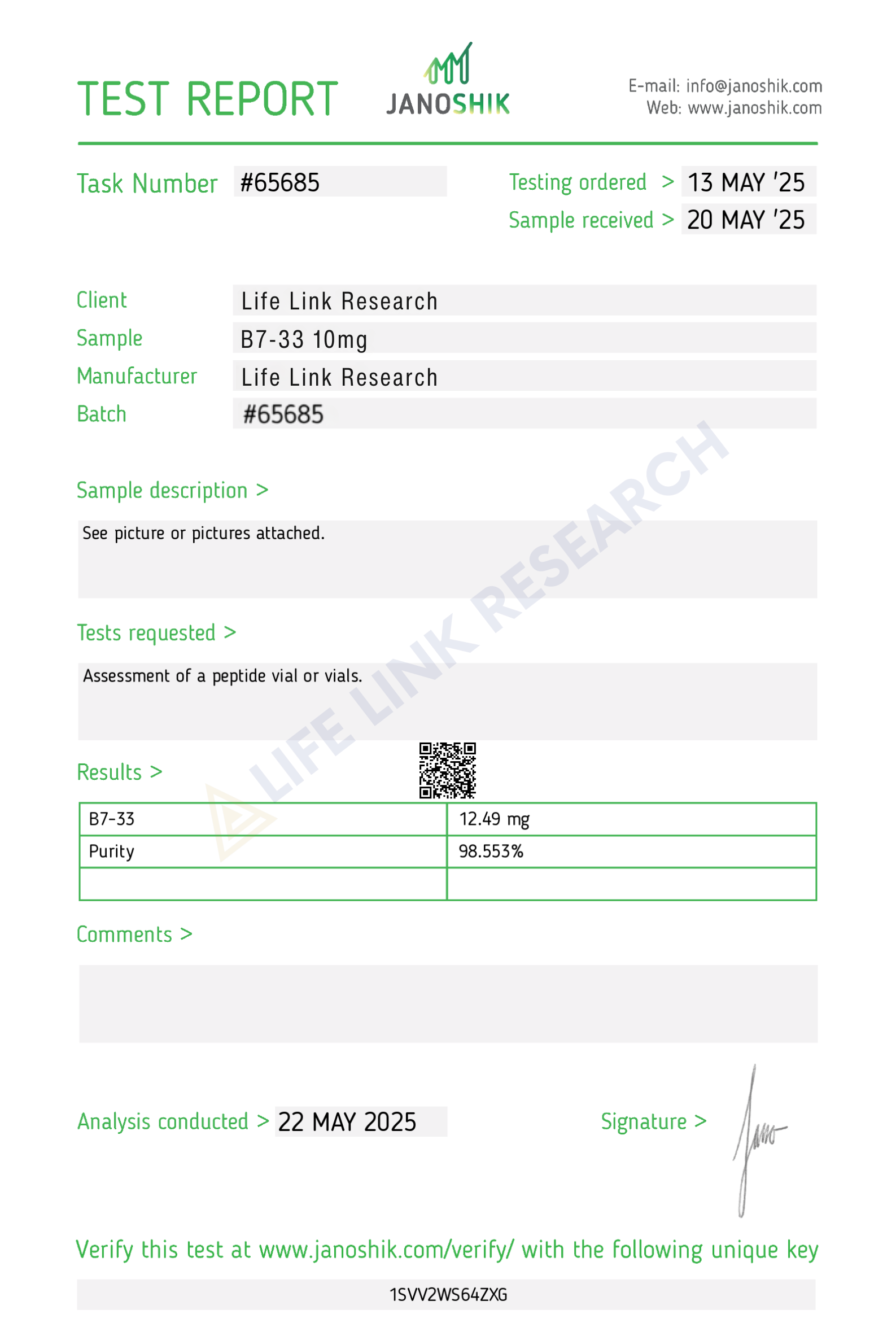
B7-33 is produced under research-grade manufacturing controls and verified by an independent lab before it ships. Purity is measured by reverse-phase HPLC and identity by mass spectrometry, with that testing carried out by third-party laboratories, including Janoshik Analytical and domestic US labs. A certificate of analysis is provided for each batch, so the results trace to the exact vial you receive.
Frequently Asked Questions
What is B7-33?
B7-33 is a synthetic 33-amino-acid single-chain peptide derived from the B-chain of relaxin. It acts as a functionally selective agonist of the relaxin receptor RXFP1 and is studied in fibrosis-pathway research, supplied for research use only.
Why use B7-33 instead of full relaxin?
Full relaxin is a two-chain molecule that is difficult and costly to produce. B7-33 keeps the useful RXFP1 signaling in a single, easier-to-make chain, which makes it a more practical research tool.
What does “functionally selective” mean?
It means the peptide activates certain downstream pathways of the RXFP1 receptor more than others, rather than switching on everything the receptor can do. That selectivity is a key research feature.
What is RXFP1?
RXFP1 is the main receptor for the hormone relaxin. B7-33 is studied as an agonist at this receptor, particularly for signaling relevant to fibrosis research.
Is B7-33 FDA approved?
No. B7-33 is not FDA approved. It is a research-use-only material and is not intended for human or veterinary use.
Why is this one 98% rather than 99%?
B7-33 is a longer single-chain peptide, and ≥98% by HPLC is its verified purity specification here. As with all products, the exact figure is confirmed by third-party testing and shown on the certificate of analysis.
How should B7-33 be stored?
Keep the powder frozen at -20°C and protected from light. Once prepared for research, store at 2-8°C and use within about two weeks.
How is this B7-33 verified?
It is tested to ≥98% purity by reverse-phase HPLC with mass-spec identity confirmation by an independent lab, and each batch ships with a certificate of analysis.
References
- A single-chain derivative of the relaxin hormone is a functionally selective agonist of RXFP1. 2016. PMID: 30155023.
- B7-33, a functionally selective RXFP1 agonist, in a cardiac-cell model. 2020. PMID: 32295457.
- Coatings Releasing the Relaxin Peptide Analogue B7-33 Reduce Fibrotic Encapsulation. 2019. PMID: 31713411.