
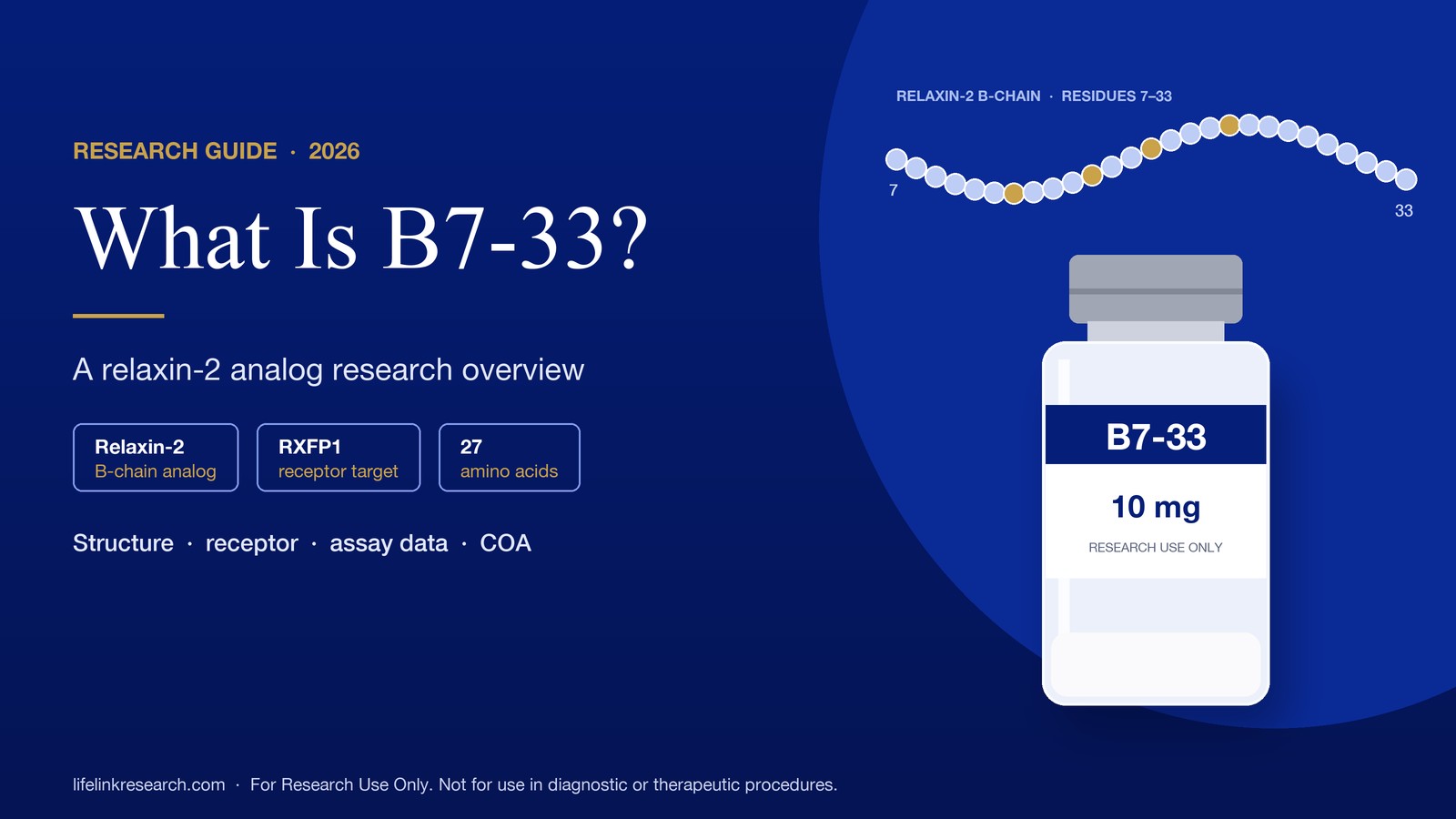
Quick Answer
B7-33 is a synthetic single-chain peptide built from part of the B chain of human relaxin-2, and it binds the RXFP1 receptor. Chemists designed it in 2016 as a simpler stand-in for a hormone that is awkward to make, and it became the first ligand shown to activate one of RXFP1’s two main signalling routes while barely touching the other.
Key Takeaways
- B7-33 is a 27-residue single-chain peptide covering residues 7 to 33 of the relaxin-2 B chain.
- It binds RXFP1 (also called LGR7) and, in cell assays, favours pERK1/2 over cAMP.
- Its RXFP1 binding affinity is more than three log units below native relaxin-2.
- The expected average mass is 2,986.6 Da (C-terminal amide), the figure to check on a COA.
- It is not FDA approved, has no registered human studies and is sold for research use only.
This overview covers its structure and sequence, how it came out of relaxin-2, what cell assays have measured at RXFP1, and how to verify a vial before it reaches the bench. If peptide reagents are new to you, start with our introduction to research peptides.
| Fact | Value |
|---|---|
| Name | B7-33 |
| Class | Single-chain relaxin-2 B-chain analog |
| Origin | Hossain et al., Chemical Science, 2016 |
| Length | 27 residues |
| Sequence | VIKLSGRELVRAQIAISGMSTWSKRSL (C-terminal amide) |
| Molecular weight | 2,986.6 Da (average), formula C131H229N41O36S |
| CAS number | 1818415-56-3 (PubChem CID 162662592) |
| Target | RXFP1, also called LGR7 |
| Signalling profile in cell assays | pERK1/2-biased, weak cAMP |
| Form | Lyophilized powder |
| Status | Research use only |
In this guide
- What B7-33 is
- What relaxin-2 is
- How B7-33 was designed
- How B7-33 interacts with RXFP1
- What B7-33 is used for in research
- B7-33 vs relaxin-2 and other analogs
- Open questions
- Verification and storage
- FDA status
- FAQs
- References
What Is B7-33?
Quick answer: B7-33 is a synthetic, single-chain peptide derived from the B chain of human relaxin-2. Hossain and colleagues designed it (Chemical Science, 2016) as a simplified relaxin-2 analog that binds the RXFP1 receptor and, in cell assays, preferentially activates pERK1/2 signalling over cAMP. It is supplied for laboratory research only.
The name reads as a map of the molecule. “B” is the relaxin-2 B chain, and “7-33” is the stretch of that chain the peptide covers, starting at residue 7 and running to residue 33.
For a lab studying RXFP1, that design is the appeal. Native relaxin-2 switches on two signalling routes at once, so separating their contributions takes extra work. B7-33 leans heavily on one of them, which makes it a reagent for asking narrower questions about how the receptor behaves.
What Is Relaxin-2?
Quick answer: Relaxin-2 is a human peptide hormone in the insulin/relaxin superfamily, which makes it a protein. It has two chains, an A chain and a B chain, joined by disulfide bonds. Its main receptor is RXFP1, also called LGR7, a G protein-coupled receptor. B7-33 keeps part of the B chain, which carries the key receptor-binding residues.
The insulin-like architecture explains both the shape and the problem. Two separate chains have to be made, then linked by three disulfide bonds in the right pairings, and the whole assembly runs to 53 amino acids.
Work on which parts of the molecule touch the receptor pointed at the B chain. Three residues on that chain, two arginines and an isoleucine, carry most of the binding, and no single residue on the A chain was found to control RXFP1 binding at all. That finding is what made a B-chain-only peptide a reasonable thing to attempt.
How Was B7-33 Designed From Relaxin-2?
Quick answer: B7-33 was made by keeping a 7 to 33 residue segment of the relaxin-2 B chain as a single peptide and dropping the A chain, so no inter-chain disulfide bonds are needed. Two cysteines were substituted to prevent unwanted bonding. The result is simpler to synthesize than two-chain relaxin-2 while keeping RXFP1 binding.
Why a single chain?
[IMAGE PLACEHOLDER: upload the relaxin-2 vs B7-33 structure diagram here. Alt text: “Diagram comparing two-chain relaxin-2 with single-chain B7-33”]
Two-chain relaxin-2 (53 amino acids, three disulfide bonds) compared with single-chain B7-33 (27 amino acids, none)
Making the two-chain hormone means building both chains, then folding them so that three disulfide bonds form in the correct pairings. Hossain’s group described the native structure as costly and laborious to produce by either chemical or recombinant routes, and the cost of a single-chain peptide is a fraction of it.
Which residues and substitutions?
Six residues came off the N-terminus of the B1-33 segment. Four residues, KRSL, were added at the C-terminus to raise the overall positive charge. The cysteines at positions 11 and 23 were then swapped for serine, an isosteric replacement that stopped the peptide dimerizing and aggregating.
Why sources disagree on length
Several secondary sources describe B7-33 as a 26-amino-acid peptide, including the Wikipedia entry, yet the sequence those same pages print contains 27 residues. Count the sequence in the primary paper and you get 27. Supplier certificates list 27 as well.
How Does B7-33 Interact With RXFP1?
Quick answer: B7-33 binds RXFP1, the same receptor as relaxin-2, with a different signalling profile in cell assays. Hossain et al. (2016) reported that it activates pERK1/2 while producing little cAMP in cells expressing RXFP1, which is why they called it the first functionally selective agonist of this receptor. Its binding affinity is markedly lower than native relaxin-2.
RXFP1 basics
RXFP1 is a G protein-coupled receptor with an unusual front end: a large leucine-rich repeat ectodomain plus an LDLa module, one of only two mammalian GPCRs to carry that module. A 2023 cryo-EM structure of the active receptor bound to Gs (PDB 7TMW) showed extracellular loop 2 occupying the orthosteric pocket, and the authors proposed that the receptor signals through autoinhibition (Erlandson et al., 2023).
LGR7 is the older name for the same receptor and still turns up in earlier literature and in some catalogue listings, so searches for prior work should cover both terms.
pERK1/2 versus cAMP
A receptor can route a signal down more than one path, and a ligand that strongly favours one of them is called biased, or functionally selective. Picture a junction box wired to two circuits: relaxin-2 lights both, while B7-33 mostly lights the pERK1/2 one and leaves cAMP dim.
Agonist bias is the reason B7-33 shows up in method papers as a comparator, in studies where one pathway has to be isolated from the other.
Affinity compared with relaxin-2
In competition binding assays on HEK-293T cells stably expressing human RXFP1, B7-33 gave a pKi of 5.54 against 8.96 for H2 relaxin. The cAMP results tracked the binding data, at pEC50 5.12 for B7-33 against 10.49 for the hormone. Those gaps, over three log units, set the concentration range any assay needs to cover.
What Is B7-33 Used For in Research?
Quick answer: B7-33 is used as a research tool for studying RXFP1 signalling. Typical work includes receptor-binding assays, cAMP and pERK1/2 readouts in RXFP1-expressing cell lines, and side-by-side comparison with native relaxin-2 to study biased agonism. It is not approved for any medical use and is supplied for research use only.
The assay record from the original paper gives a sense of the readouts involved:
| Study | Year | Study type | What was measured |
|---|---|---|---|
| Hossain et al., Chemical Science | 2016 | In vitro, HEK-293T cells expressing human RXFP1 | Competition binding, pKi |
| Hossain et al., Chemical Science | 2016 | In vitro, HEK-293T cells expressing human, rat or mouse RXFP1 | cAMP accumulation, pEC50 |
| Hossain et al., Chemical Science | 2016 | In vitro, THP-1 cells expressing RXFP1 natively | cAMP response |
| Hossain et al., Chemical Science | 2016 | In vitro, HEK-293T cells expressing RXFP1 and rat primary cells | pERK1/2 time course, peak at 3 to 5 minutes |
| Hossain et al., Chemical Science | 2016 | In vitro, HEK cells expressing RXFP2 | Activity at the related receptor |
In vivo pharmacology in rodent models has also been published.
[IMAGE PLACEHOLDER: upload the RXFP1 / RXFP2 receptor diagram here. Alt text: “Receptor diagram of B7-33 at RXFP1 and RXFP2”]
B7-33 activates RXFP1 in cell assays and shows no activation at RXFP2, even at micromolar concentrations
Two points follow from that record for anyone designing an experiment. Native relaxin-2 makes the obvious positive control, since the pair has been characterised side by side in the same cells. And because the potency gap runs to several log units, a concentration range built around relaxin-2 will sit far below the active range for B7-33.
B7-33 vs Relaxin-2 vs Other Relaxin-2 Analogs
Quick answer: B7-33 is one of several relaxin-2 analogs. They differ in structure, from two-chain forms to single-chain and engineered long-acting constructs, and in their signalling profile at RXFP1.
| Molecule | Structure | Chains | Receptor | Signalling profile | Development status (October 2026) |
|---|---|---|---|---|---|
| Relaxin-2 | Native human hormone, 53 residues | Two, three disulfide bonds | RXFP1 | cAMP and pERK1/2 | Endogenous hormone |
| Serelaxin | Recombinant relaxin-2 | Two | RXFP1 | As native relaxin-2 | Phase 2 and Phase 3 studies registered on ClinicalTrials.gov; no FDA approval |
| B7-33 | Synthetic B-chain segment, 27 residues | One, no disulfide bonds | RXFP1, inactive at RXFP2 | pERK1/2-biased | No registered human studies |
| AZD3427 | Relaxin-2 fused to an IgG1 Fc fragment | Engineered single construct | RXFP1 | RXFP1 agonist | Phase 2 completed (NCT05737940); Phase 1 terminated (NCT06611423) |
| LY3540378 | Relaxin analog with an albumin-binding VHH domain | Engineered single construct | RXFP1 | RXFP1 agonist | Phase 2 terminated (NCT05592275); second Phase 2 withdrawn (NCT06598631) |
Registry statuses were read on ClinicalTrials.gov on 12 October 2026.
What Are the Open Questions About B7-33?
Quick answer: Published B7-33 work is preclinical, and no human studies have been published. Open questions include limited data on its stability in biological matrices, whether its signalling bias holds across cell types and species variants of RXFP1, and a mismatch between sources on its exact length, 26 against 27 residues.
Four gaps stand out for anyone planning experiments:
- Stability: public data on how the peptide behaves in serum or other biological matrices over time is thin, so plan your own stability checks and record the conditions you used.
- Generality of the bias: the pERK1/2 preference was characterised in a specific set of cell backgrounds. Whether it holds in other cells, or at rodent versions of the receptor, is still open.
- Reference data quality: secondary databases carry at least one wrong length and at least one wrong CAS number for this peptide, so the primary paper is the safer source.
- No common reference standard: there is no pharmacopoeial monograph for B7-33, so each supplier’s certificate rests on its own method. Comparing two vendors means comparing two independent reports, with no shared yardstick behind them.
How Should B7-33 Be Verified and Stored?
Quick answer: Check a B7-33 COA for identity by mass spectrometry, where the observed mass should match the expected molecular weight of the sequence, and purity by HPLC, then compare both with the batch result. Store the lyophilized powder cold, dry and away from light, as the label states.
Identity by mass spectrometry
The expected average mass is 2,986.6 Da for the C-terminal amide. The original paper reported an observed m/z of 2,986.4 [M+H]+ against a calculated 2,986.59. A report whose observed mass lands a long way from that figure describes a different molecule.
Check the salt form while you are there: a peptide supplied as a TFA salt weighs more than the net peptide in the vial, and certificates state the two separately when the figure has been measured. For the division of labour between the two techniques, see HPLC vs mass spectrometry.
Purity by HPLC
Read the purity by HPLC on the batch result for the specific lot in front of you. For context on what the figures mean in practice, see what 98% vs 99% purity means.
Spotting a fake or edited COA
Check that the report names the lab, carries a batch number and a test date, and can be traced back to the laboratory that issued it. Our guides on how to read a peptide COA and how to check whether a COA is genuine cover the checks in order.
Storage
Keep the sealed, lyophilized vial cold, dry and shielded from light, following the condition printed on the label. The original synthesis describes B7-33 as freely water-soluble, which is useful when preparing solutions for an assay. Our peptide storage guide covers handling of the dry form.
View B7-33 10 mg research peptide
Is B7-33 FDA Approved?
Quick answer: No. As of October 2026, B7-33 is not an FDA-approved drug, and it is sold only as a research chemical for laboratory use. A search of ClinicalTrials.gov on 12 October 2026 returned no registered human studies of B7-33 itself.
Compounding lists are a separate question from approval, and peptides move on and off them through their own process. Our explainer on how FDA compounding lists work sets out the categories and what they mean for a given compound.
B7-33 FAQs
Is relaxin a protein or a steroid?
A protein. Relaxin-2 is a peptide hormone in the insulin/relaxin superfamily, built from two amino acid chains held together by disulfide bonds. Steroids are lipid molecules built on a four-ring carbon skeleton, a completely different class of chemistry.
Is B7-33 the same as relaxin-2?
No. Relaxin-2 is the full two-chain hormone of 53 residues. B7-33 is a 27-residue synthetic peptide taken from part of its B chain, with a lower binding affinity at RXFP1 and a different signalling profile in cell assays.
How many amino acids does B7-33 have?
Several secondary sources say 26, but the sequence those pages display contains 27 residues, and supplier certificates list 27. Count the sequence in Hossain et al. (2016) when the number has to be right.
What does “biased agonist” mean?
A biased agonist binds a receptor and activates one of its downstream signalling routes much more strongly than another. For B7-33 at RXFP1, that means a clear pERK1/2 response alongside a weak cAMP response in the same cells.
Does Life Link Research supply B7-33 with a batch COA?
Yes. Every vial of B7-33 10 mg research peptide ships with a batch-matched certificate from a third-party laboratory, covering identity and purity for that lot.
References
| Source | Date | Type |
|---|---|---|
| Hossain MA et al. A single-chain derivative of the relaxin hormone is a functionally selective agonist of the G protein-coupled receptor, RXFP1. Chemical Science. | 2016 | Primary research paper |
| Bathgate RAD et al. Relaxin family peptides and their receptors. Physiological Reviews. | 2013 | Review |
| Erlandson SC et al. The relaxin receptor RXFP1 signals through a mechanism of autoinhibition. Nature Chemical Biology. | 2023 | Structural study |
| RCSB Protein Data Bank, entry 7TMW. | 2023 | Structure record |
| PubChem, CID 162662592. | Accessed 12 Oct 2026 | Chemical database |
| ClinicalTrials.gov, search for B7-33. | Accessed 12 Oct 2026 | Trial registry |
For Research Use Only. Not for use in diagnostic or therapeutic procedures. See our terms and research-use policy.
Peptide Blends vs Single Vials: How to Choose for Research (2026)
For Research Use Only. Not for use in diagnostic or therapeutic procedures. Choosing between peptide blends vs single peptides comes down to…
Read article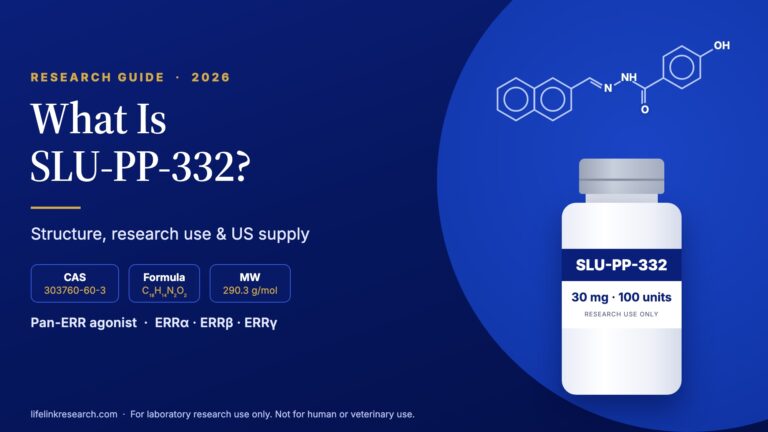
What Is SLU-PP-332? Structure, Research Use & US Supply
Quick Answer SLU-PP-332 is a synthetic small-molecule agonist of the estrogen-related receptors ERRŒ±, ERRŒ≤ and ERRŒ≥ (CAS 303760-60-3, PubChem CID 5338394). It…
Read article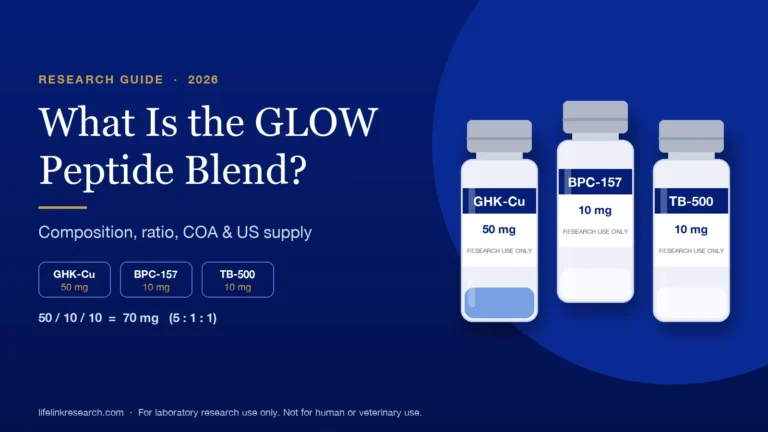
GLOW Peptide Blend: Composition, Ratio & COA (2026)
Quick Answer GLOW is a 70mg research peptide combination of GHK-Cu 50mg, BPC-157 10mg and TB-500 10mg, a 5:1:1 ratio in which…
Read articleResearch-grade peptides
99%+ purity. Verified every batch.
Identity and purity tested on every batch by third-party labs, Janoshik Analytical and US-based laboratories. Shipped same day from California.
Shop all peptides