
Quick answer: A peptide purity figure is the share of the sample that is your target peptide, measured by HPLC. So 98% purity means about 2% of the material is something else, and 99% means about 1% is. Moving from 98% to 99% roughly halves that leftover fraction, which is why sensitive research leans on the higher grade and on the COA that proves it.
98% vs 99% Purity
You’ll see a purity number on the label whenever you buy research peptides: 98%, 99%, sometimes 99.5%. It looks like a simple score, and most buyers read past it in a second. Yet that one figure decides how clean your material is, what the other slice of the vial contains, and whether your results can be trusted. Understanding it takes a few minutes and pays off every time you order.
| Purity grade | Leftover fraction | Typically used for |
| 95% | ~5% other material | Early screening, method development |
| 98% | ~2% other material | Standard cell assays, receptor binding |
| 99%+ | ~1% other material | Sensitive bioassays, structural and quantitative work |
What Purity Measures
Purity is a percentage from high-performance liquid chromatography, or HPLC. The instrument pushes the dissolved sample through a column so its components separate, then a detector reads the ultraviolet light each one absorbs and draws a chromatogram of peaks. Your peptide is the tall main peak, and its purity is that peak’s share of the total peak area. A result of “99% by HPLC” means the target peptide makes up 99% of the UV-absorbing material the detector saw.
That last phrase carries a catch worth knowing. The percentage describes the organic, light-absorbing content, so it says nothing about water, salts, or the counterion left over from synthesis. A vial can read 98% pure on peptide composition and still hold moisture or salt by weight.
Purity tells you how clean the peptide portion is, and a separate net-peptide or salt figure tells you how much actual peptide you’re weighing out. Since every peptide is a defined chain of amino acids, the test is really asking how much of the sample matches that intended chain, and how much drifted off target during manufacture.
What’s in the Other 1 to 2%?
The leftover slice has a name and a story. Peptides are built one amino acid at a time, and every coupling step has a small chance of failing. Those small failures pile up as the chain grows, which is why longer peptides are harder to make clean. The result is a handful of predictable impurities that HPLC separates out.
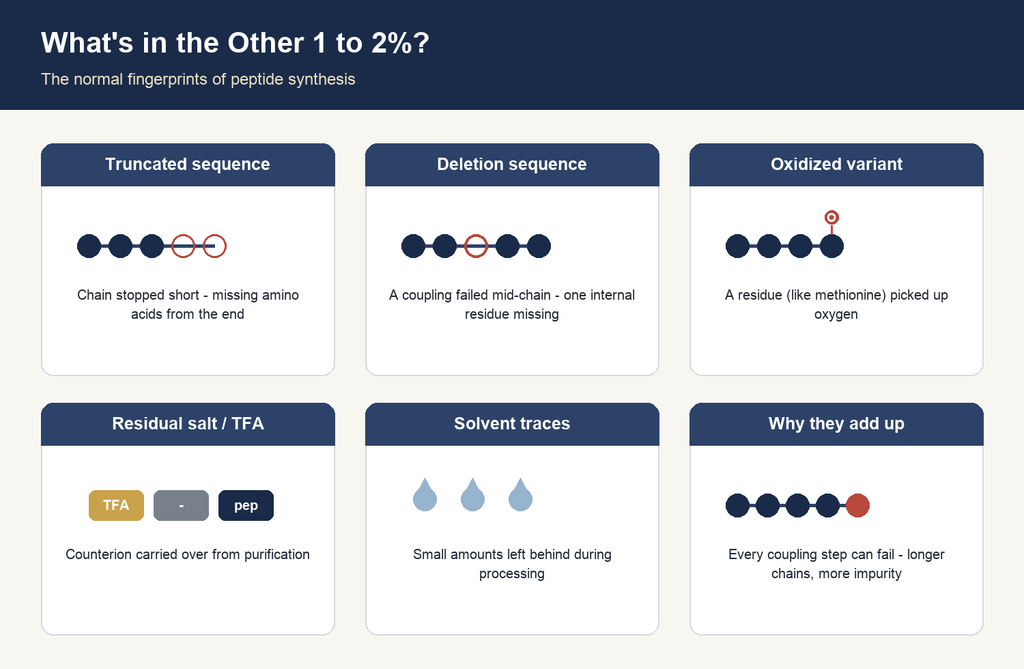
- Truncated sequences, where the chain stopped short and is missing amino acids from the end.
- Deletion sequences, where a coupling failed mid-chain and one internal amino acid is missing.
- Oxidized variants, where a residue such as methionine picked up oxygen after synthesis.
- Residual reagents and counterions, most often trifluoroacetic acid (TFA) salt carried over from purification.
- Solvent traces left behind during processing.
None of these are exotic. They’re the normal fingerprints of solid-phase synthesis, and a good lab openly measures and reports them on the COA. Knowing what the impurities are is what lets you judge whether a 98% and a 99% sample differ in ways that touch your work.
98% vs 99%: Does That 1% Matter?
On paper the gap looks tiny. In practice it depends on how you see it. Going from 98% to 99% takes the leftover fraction from roughly 2% down to 1%, so you’re cutting the impurity load close to half. Framed that way, the “1% difference” is really a halving of everything that isn’t your peptide.
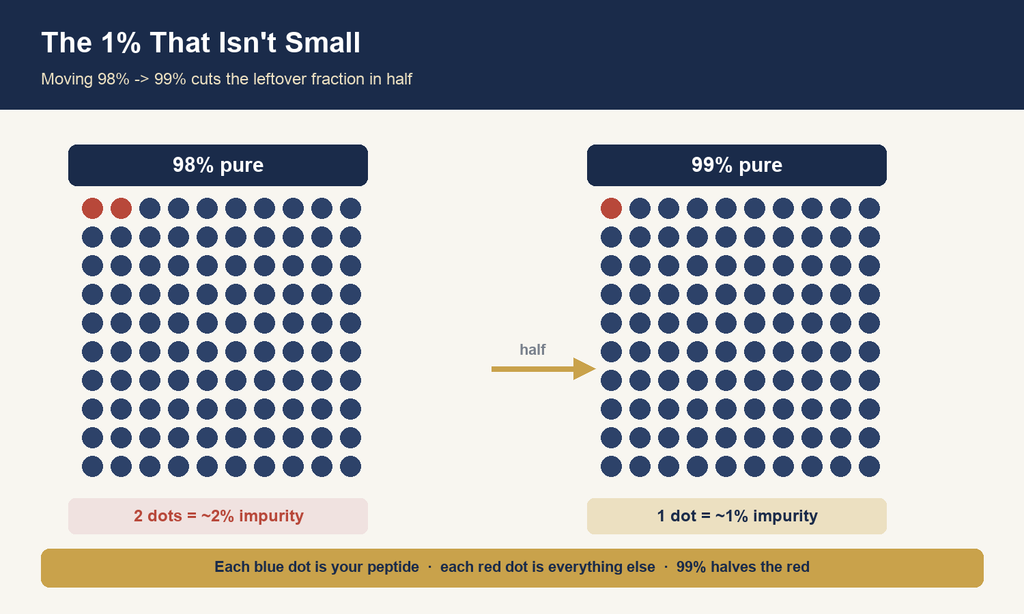
Whether that halving changes your outcome comes down to the application. For early screening or method development, 98% is usually plenty, and paying up for 99% buys little. For sensitive bioassays, structural biology, or quantitative receptor-binding studies, the extra grade earns its keep, because even minor impurities can skew a sensitive readout.
There’s also a more silent reason the profile is important: research on generic peptide products has shown that peptide-related impurities can carry measurable immunogenicity risk, as a 2025 immunogenicity risk assessment in a regulatory review documented. Impurities aren’t inert filler, so the makeup of that last 1 to 2% can matter as much as its size.
Why the Method Matters as Much as the Number
A purity figure is only as good as the test and the lab behind it. Two vials both stamped “99%” can come from different processes with different impurity profiles and different batch-to-batch consistency, so the number alone doesn’t settle the question. What settles it is the evidence.
Start with the chromatogram, the actual HPLC trace, since a clean single peak backs up the percentage in a way a bare number cannot. Pair it with a mass-spec result that confirms the peptide is the right molecule, because purity and identity are two separate questions and a sample can be pure yet wrong. Then check who ran the tests, since an independent third-party lab has no stake in the result. All of this lives on the Certificate of Analysis, and learning to read a peptide COA field by field turns a purity claim into something you can verify. Every batch we sell has $1its own published COA$2 for exactly that reason.
Why Higher Purity Costs More
The price jump between grades reflects real work behind the label. Pushing a peptide from 98% to 99% usually means more preparative HPLC, tighter fraction-collection windows, and more of the good material lost at the edges of each collection.
You’re paying for extra purification passes and the yield sacrificed to reach them. That’s also why an unusually cheap “99%” peptide is worth a second look, since the purification that grade demands has a real cost that honest pricing reflects.
The Regulatory Bar
Regulators treat even sub-1% impurities as serious business, which puts the 98-versus-99 question in useful context. Under the FDA’s guidance for highly purified synthetic peptide drug products, any impurity above 0.10% of the active ingredient has to be individually identified, and a new impurity above 0.5% can block approval outright, per the agency’s published synthetic peptide guidance. Those are pharmaceutical thresholds and research material sits in a different lane, but the numbers show how much a fraction of a percent can weigh when quality is on the line.
The topic is live right now. With the FDA’s July 2026 review of seven peptides and its synthetic-peptide impurity guidance under active revision, verifiable purity has rarely been more relevant. One caution the numbers don’t cover: a purity percentage speaks to organic cleanliness on the chromatogram, and it says nothing about bacterial endotoxin, heavy metals, or sterility. Those are separate safety tests, which is why the strongest suppliers back a purity figure with a full testing panel that covers those safety measures too.
What to Look For
When you’re comparing purity claims, a short checklist keeps you honest:
- A stated purity backed by a visible HPLC chromatogram.
- A mass-spec result confirming the peptide’s identity.
- Testing by an independent third-party lab, named on the report.
- A batch or lot number that matches your vial.
- Clarity on net peptide content if salt weight matters for your dosing math.
Tick those boxes and the difference between a real 98% and a real 99% becomes something you can act on with confidence.
Frequently Asked Questions
Is 98% purity good for a peptide?
Yes, for most research uses. At 98%, roughly 2% of the material is other organic content, which is fine for standard cell assays, receptor binding, and method development. Sensitive quantitative or structural work is where stepping up to 99% starts to pay off.
What is a good purity level for research peptides?
Above 95% is the general floor for quantitative work, 98% is the common research-grade standard, and 99%+ is the top tier for sensitive studies. The right level depends on your application, and any figure means the most when an independent lab verifies it.
Does the 1% difference between 98% and 99% really matter?
It can. Moving from 98% to 99% roughly halves the impurity load, from about 2% down to 1%. For a sensitive bioassay that halving can protect your signal, while for early screening it usually makes little practical difference.
What does peptide purity actually mean?
It’s the percentage of the sample that is your target peptide, measured as the main peak’s share of UV-absorbing material on an HPLC chromatogram. It describes organic cleanliness, so it doesn’t account for water, salt, or safety measures like endotoxin.
How can I tell if a peptide is genuinely high quality?
Look past the headline percentage to the proof behind it: an HPLC chromatogram, a mass-spec identity confirmation, and third-party testing, all tied to your batch on a Certificate of Analysis. Quality is what the documents prove.
The Bottom Line
The difference between 98% and 99% peptide purity is small on the label and meaningful in the vial, since that single point roughly halves what isn’t your peptide. The percentage tells you how clean the peptide portion is, the impurity profile tells you what the rest contains, and the COA behind it tells you whether to believe either one.
Match the grade to your application, insist on the chromatogram and the mass-spec confirmation, and let an independent lab settle the number. That’s the standard every batch we sell is built to meet.
What Is B7-33? Relaxin-2 Analog Research Overview (2026)
Quick Answer B7-33 is a synthetic single-chain peptide built from part of the B chain of human relaxin-2, and it binds the…
Read article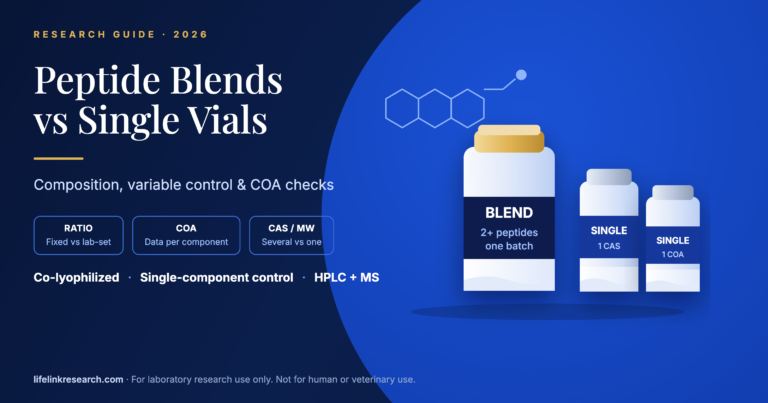
Peptide Blends vs Single Vials: How to Choose for Research (2026)
For Research Use Only. Not for use in diagnostic or therapeutic procedures. Choosing between peptide blends vs single peptides comes down to…
Read article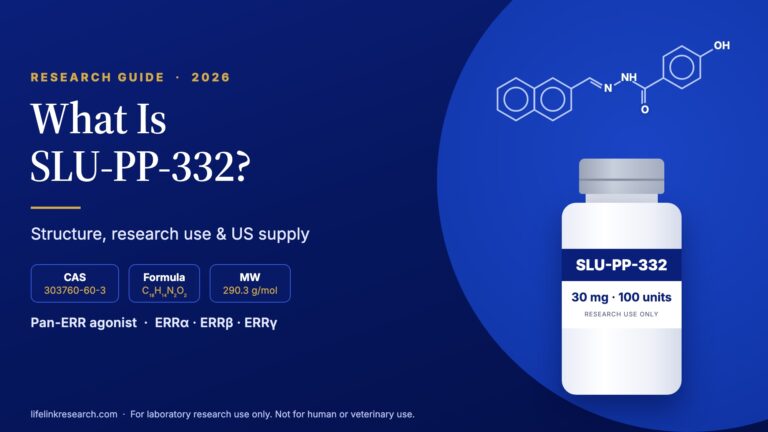
What Is SLU-PP-332? Structure, Research Use & US Supply
Quick Answer SLU-PP-332 is a synthetic small-molecule agonist of the estrogen-related receptors ERRŒ±, ERRŒ≤ and ERRŒ≥ (CAS 303760-60-3, PubChem CID 5338394). It…
Read articleResearch-grade peptides
99%+ purity. Verified every batch.
Identity and purity tested on every batch by third-party labs, Janoshik Analytical and US-based laboratories. Shipped same day from California.
Shop all peptides