CAS: 50-56-6 · MW: 1007.19 Da · Purity: ≥99% by reverse-phase HPLC · Format: 5 mg lyophilized · Endotoxin: <1 EU/mg (LAL) · Identity: ESI-MS confirmed
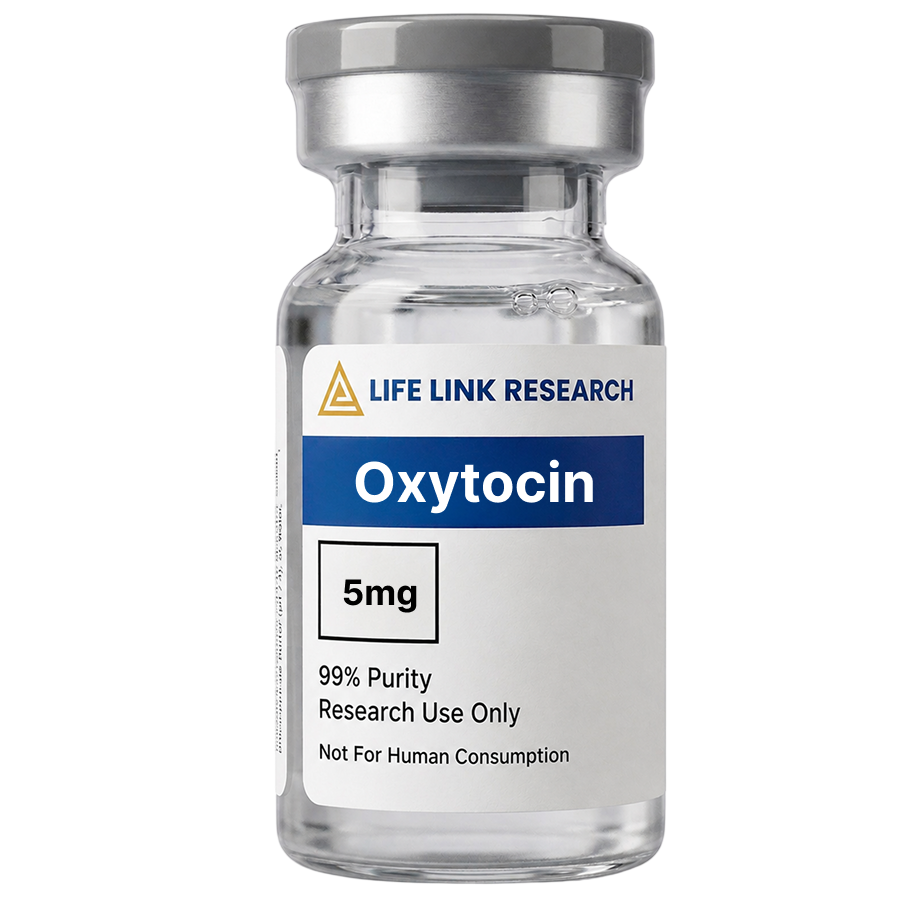
Oxytocin is a nine-residue cyclic neuropeptide with the sequence Cys-Tyr-Ile-Gln-Asn-Cys-Pro-Leu-Gly-NH₂, stabilized by a single intramolecular disulfide bridge between Cys¹ and Cys⁶. This research-grade oxytocin acetate is supplied as a 5 mg lyophilized vial at ≥99% purity by reverse-phase HPLC, with third-party analytical verification of identity, purity, and endotoxin load for every manufactured lot. CAS 50-56-6.
For laboratory research use only. Not for human consumption, veterinary use, food, or therapeutic use. Not a drug, supplement, or cosmetic. Sold exclusively to qualified research professionals and institutions.
Structure & Identity
Oxytocin has been characterized in the published biochemical literature as a cyclic nonapeptide hormone of the neurohypophysial peptide family, sharing structural homology with vasopressin (AVP) at seven of nine residue positions [1]. The molecule was first isolated and sequenced by du Vigneaud and colleagues in 1953 — work that earned the 1955 Nobel Prize in Chemistry as the first chemical synthesis of a polypeptide hormone [1]. The cyclic structure is maintained by a disulfide bond between cysteine residues at positions 1 and 6, forming a six-residue ring closed by a three-residue C-terminal tail terminating in glycinamide. The molecular formula is C₄₃H₆₆N₁₂O₁₂S₂ and the monoisotopic mass is 1006.44 Da; the acetate salt form supplied here has an average molecular weight of approximately 1007.19 Da for the peptide component.
Research Background
Oxytocin is one of the most extensively characterized neuropeptides in the published literature and serves as a standard reference reagent across multiple research domains. Published research contexts include:
- Oxytocin receptor (OXTR) pharmacology. Used as the reference agonist in radioligand binding assays, functional GPCR signaling studies (Gq/PLC/IP₃, MAPK pathways), and OXTR-selective antagonist characterization in cell lines expressing recombinant or native receptor [2].
- Neurohypophysial peptide structure-activity research. Referenced as the parent compound in structure-activity relationship (SAR) studies of cyclic nonapeptides, including comparative work with vasopressin (AVP), carbetocin, atosiban, and other position-substituted analogs [1,3].
- Animal-model neuroscience research. Referenced in rodent and non-human primate model literature investigating central oxytocinergic signaling, paraventricular and supraoptic nucleus circuitry, and OXTR distribution mapping via autoradiography and immunohistochemistry [3,4].
- Smooth-muscle pharmacology. Used as a reference agonist in isolated tissue preparations (uterine and mammary tissue strips ex vivo) for characterization of receptor-mediated contractile responses in classical pharmacology research [2].
These references describe findings in non-human in vitro and animal systems, or in chemistry and structural biology contexts. They do not constitute claims about effects in humans and are not intended to characterize the product’s therapeutic indications.
Specifications
| Attribute |
Value |
| Sequence |
Cys-Tyr-Ile-Gln-Asn-Cys-Pro-Leu-Gly-NH₂ (cyclic, Cys¹–Cys⁶ disulfide) |
| Sequence length |
9 amino acids (cyclic nonapeptide) |
| Synthesis |
Solid-phase peptide synthesis (SPPS), Fmoc chemistry |
| Salt form |
Acetate |
| CAS Number |
50-56-6 |
| Molecular Formula |
C₄₃H₆₆N₁₂O₁₂S₂ (free peptide) |
| Molecular Weight |
1007.19 Da (average); 1006.44 Da (monoisotopic) |
| Purity |
≥99% by reverse-phase HPLC |
| Identity |
ESI mass spectrometry |
| Disulfide confirmation |
Ellman’s assay (free thiol <0.5%) |
| Endotoxin |
<1 EU/mg (LAL chromogenic assay) |
| Bioburden |
Sterile-filtered through 0.22 µm prior to lyophilization |
| Format |
5 mg lyophilized powder, single-use amber vial |
| Appearance |
White to off-white amorphous powder |
| Solubility (lab context) |
Soluble in sterile water, PBS, and most aqueous buffers at neutral pH |
| Counter-ion content |
Acetate ≤15% by ion chromatography |
Storage & Handling
Lyophilized material is stable at -20°C for 24 months from date of manufacture when protected from light and moisture. Oxytocin is sensitive to thermal degradation and oxidation of the disulfide bridge; shipments should be transferred to cold storage immediately upon receipt. Once reconstituted in laboratory buffer, the peptide should be aliquoted into low-binding polypropylene tubes and stored at -80°C; cyclic disulfide peptides are particularly susceptible to disulfide scrambling and oxidative degradation under repeated freeze-thaw conditions. Handling should occur under aseptic conditions in a Class II biosafety cabinet or laminar flow hood. Standard laboratory PPE applies per institutional biosafety guidelines.
Quality Assurance
Every manufactured lot is accompanied by batch-specific analytical documentation including: third-party reverse-phase HPLC chromatogram, ESI-MS deconvoluted mass spectrum, Ellman’s free-thiol assay confirming disulfide closure, LAL chromogenic endotoxin quantification, residual moisture by Karl Fischer titration, and acetate counter-ion quantification by ion chromatography. Reference standards are maintained at -80°C and cross-validated against pharmacopeial oxytocin reference preparations on a quarterly basis. Manufacturing occurs in ISO 9001-certified facilities under documented cGMP-aligned procedures.
This material is supplied exclusively to qualified research professionals, academic laboratories, contract research organizations, and institutional purchasing departments. Proof of institutional affiliation and a signed research-use acknowledgment may be requested prior to shipment.
For laboratory research use only. Not for human consumption, veterinary use, food, or therapeutic use. Not a drug, supplement, or cosmetic.
Frequently Asked Questions
What is oxytocin?
Oxytocin is a cyclic nonapeptide of the neurohypophysial peptide family, with the sequence Cys-Tyr-Ile-Gln-Asn-Cys-Pro-Leu-Gly-NH₂ closed by an intramolecular disulfide bridge between Cys¹ and Cys⁶. CAS 50-56-6. Average molecular weight 1007.19 Da.
What is the molecular weight of oxytocin?
The free peptide has a monoisotopic mass of 1006.44 Da and an average molecular weight of 1007.19 Da. The acetate salt form supplied includes an acetate counter-ion (≤15% by weight).
What is the CAS number for oxytocin?
50-56-6.
What is the difference between oxytocin and vasopressin?
Oxytocin and arginine vasopressin (AVP) are the two principal neurohypophysial peptides in mammals, sharing structural homology at seven of nine residue positions. They differ at positions 3 (Ile vs. Phe) and 8 (Leu vs. Arg). The two peptides are extensively characterized as comparator ligands in receptor pharmacology research [1].
What purity is oxytocin supplied at?
≥99% by reverse-phase HPLC. Each manufactured lot is third-party analyzed and accompanied by batch-specific documentation of HPLC purity, ESI-MS identity, Ellman’s disulfide assay, LAL endotoxin load (<1 EU/mg), residual moisture, and acetate counter-ion content.
How should oxytocin be stored?
Lyophilized vials are stable at -20°C for 24 months when protected from light and moisture. Once reconstituted in laboratory buffer, the peptide should be aliquoted into low-binding tubes and stored at -80°C. Avoid repeated freeze-thaw cycles, as cyclic disulfide peptides are susceptible to disulfide scrambling and oxidative degradation.
How is oxytocin reconstituted for laboratory work?
In a research-laboratory context, oxytocin acetate is readily soluble in sterile water, PBS, and most aqueous buffers at neutral pH. Researchers typically reconstitute in sterile water or assay buffer for in vitro experimental work, following standard aseptic technique.
What is oxytocin used for in research?
Oxytocin has been referenced in the peer-reviewed literature as the reference agonist for oxytocin receptor (OXTR) pharmacology assays, as the parent compound in structure-activity relationship studies of cyclic nonapeptides, and in animal-model neuroscience research examining central oxytocinergic circuitry. All published characterizations referenced here are in non-human in vitro or animal systems.
Who can purchase oxytocin?
This material is supplied exclusively to qualified research professionals, academic laboratories, contract research organizations, and institutional purchasing departments. Proof of institutional affiliation and a signed research-use acknowledgment may be requested.
References
- du Vigneaud V, Ressler C, Swan JM, Roberts CW, Katsoyannis PG. The synthesis of oxytocin. J Am Chem Soc. 1954;76(12):3115-3121. DOI: 10.1021/ja01641a004
- Gimpl G, Fahrenholz F. The oxytocin receptor system: structure, function, and regulation. Physiol Rev. 2001;81(2):629-83. PMID: 11274341
- Manning M, Misicka A, Olma A, Bankowski K, Stoev S, Chini B, Durroux T, Mouillac B, Corbani M, Guillon G. Oxytocin and vasopressin agonists and antagonists as research tools and potential therapeutics. J Neuroendocrinol. 2012;24(4):609-28. PMID: 22375852
- Stoop R. Neuromodulation by oxytocin and vasopressin. Neuron. 2012;76(1):142-59. PMID: 23040812

 New
New
 New
New
 New
New