Description
Structure & Identity
Semaglutide is constructed on the GLP-1 sequence with amino-acid substitutions and an attached fatty-acid chain. The substitutions defend it against the enzyme that clears natural GLP-1, and the fatty-acid chain binds albumin to lengthen its time in circulation. Those engineering choices make it one of the more stable GLP-1-based peptides available for research.
Research Background
Semaglutide research centers on GLP-1 receptor activity and its downstream metabolic effects.
- Receptor signaling. As a GLP-1 receptor agonist, Semaglutide serves as a reference tool for receptor-pharmacology research, grounded in structural work on the receptor complex [1].
- Metabolic pathway mechanisms. Studies have examined signaling bias at the GLP-1 receptor in detail [2].
- Immunological properties. The immune-signaling side of GLP-1 receptor agonism opens an additional research angle [3].
These are laboratory research areas, not approved uses, and the peptide is provided to support that study.
Specifications
| Attribute | Value |
| Chemical name | Semaglutide |
| Also Known As | (GLP-1 receptor agonist) |
| CAS number | 910463-68-2 |
| Molecular formula | C187H291N45O59 |
| Molecular weight | 4113.6 g/mol |
| Purity | ≥99% by reverse-phase HPLC |
| Length | 31 amino acids (modified) |
| Identity | Confirmed by ESI mass spectrometry |
| Physical form | Lyophilized powder |
| Appearance | White to off-white solid |
| Quantity | 15 mg per vial |
| Storage | -20°C, protected from light |
| Solubility | Soluble in bacteriostatic or sterile water (gentle mixing) |
| Classification | Research use only |
Storage & Handling
Keep the sealed vial frozen at -20°C, out of the light, until use. After reconstitution, refrigerate the solution at 2-8°C and use it within about two weeks. With the larger 15 mg quantity, dividing the reconstituted material into aliquots is especially sensible, so the stock is not frozen and thawed repeatedly; let the vial reach room temperature before opening as well.
Quality Assurance
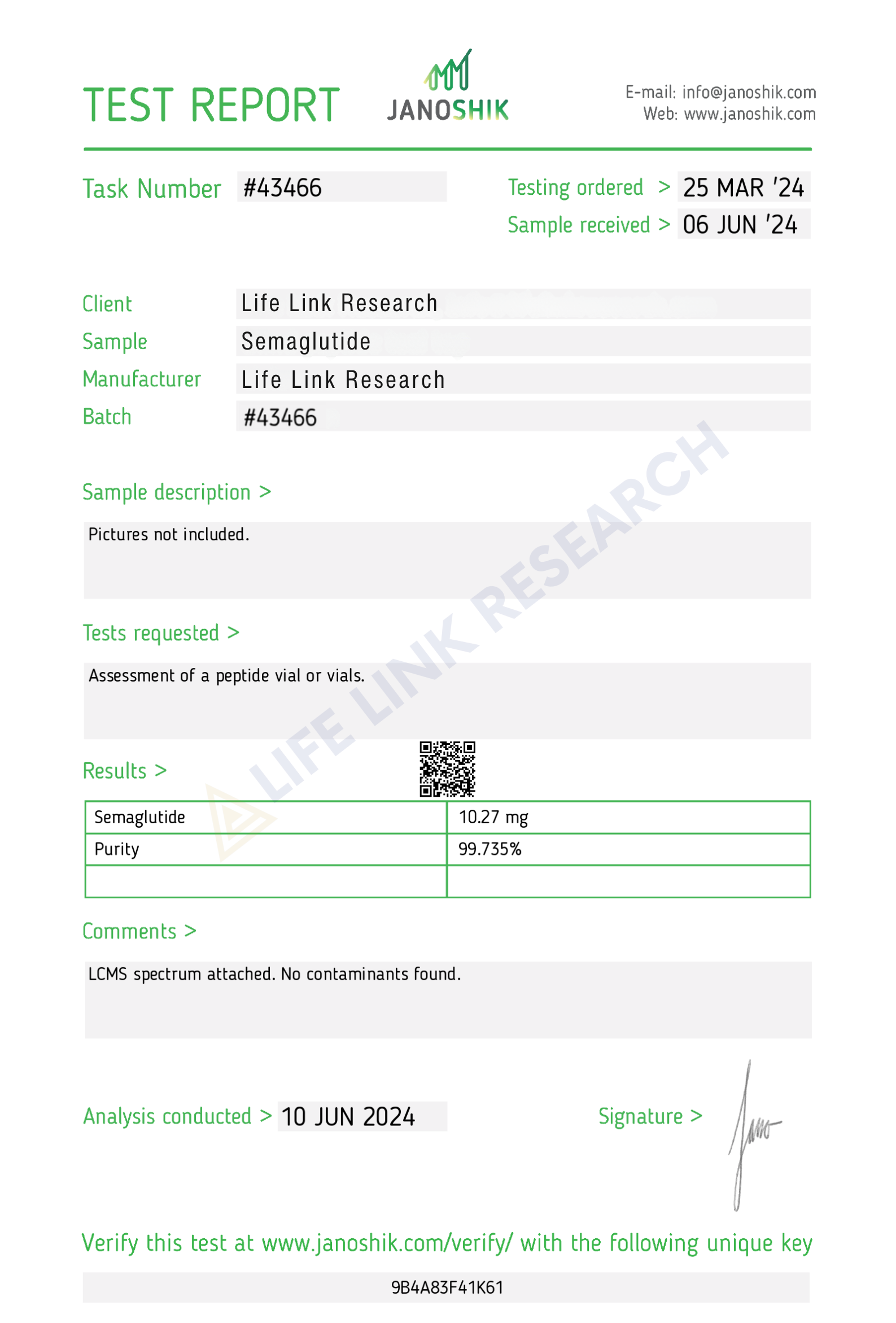
Semaglutide is manufactured under research-grade controls and verified by an independent lab before release. Reverse-phase HPLC establishes purity and mass spectrometry confirms identity, with the analysis handled by third-party laboratories, including Janoshik Analytical and domestic US labs. Each batch carries its own certificate of analysis, tying the results to the material you actually receive.
Frequently Asked Questions
What is the Semaglutide 15 mg used for?
It is a research-use-only GLP-1 receptor agonist studied in metabolic and receptor research. The 15 mg size suits larger research programs. It has no approved human use in this setting.
Is the 15 mg identical to the smaller sizes?
Yes, apart from the amount of peptide in the vial. The larger size is aimed at research that needs more working material.
What is a GLP-1 receptor agonist, in plain terms?
GLP-1 is a gut hormone that switches on the GLP-1 receptor. Semaglutide is a lab-made molecule that switches on the same receptor, but it is engineered to keep doing so for much longer.
How does Semaglutide compare with Tirzepatide?
Semaglutide is a single-receptor (GLP-1) agonist; Tirzepatide is a dual GIP/GLP-1 agonist. Researchers study them side by side to compare single- versus dual-receptor signaling.
Is Semaglutide FDA approved?
The molecule is approved as a drug in specific clinical contexts, but the material sold here is a research-use-only reference peptide, not for human or veterinary use.
What are its molecular details?
Formula C187H291N45O59, molecular weight about 4113.6 g/mol, CAS number 910463-68-2.
How should the 15 mg vial be stored?
Freeze the powder at -20°C, protected from light. After reconstitution for research, store at 2-8°C and use within about two weeks.
How is quality confirmed on this batch?
Purity is verified at ≥99% by reverse-phase HPLC with mass-spec identity confirmation by an independent lab, and a certificate of analysis is published for each batch.
Any handling tips for the larger vial?
Keep it frozen at -20°C, protected from light, and limit freeze-thaw cycles to preserve the intact peptide.
References
- Zhang X, et al. Structure and dynamics of semaglutide- and taspoglutide-bound GLP-1R-Gs complexes. 2021. PMID: 34260945.
- Douros JD, et al. The GLP-1R as a model for understanding and exploiting biased agonism in next-generation medicines. 2024. PMID: 38451873.
- Immunological properties of GLP-1 receptor agonists. 2022. PMID: 35738455.