
Table of Contents
1. What is the GLP-1 Receptor?
2. Receptor Structure and Expression
3. Endogenous Ligands: Native GLP-1
4. GLP-1 Receptor Signaling Cascade
5. Physiological Roles of GLP-1R Activation
6. Research Peptides Targeting GLP-1R
7. Monoagonists vs. Dual and Triple Agonists
8. Purity Requirements for GLP-1 Research Peptides
9. Frequently Asked Questions
What Is the GLP-1 Receptor?
The glucagon-like peptide-1 receptor (GLP-1R) is a class B1 G protein-coupled receptor (GPCR) encoded by the GLP1R gene in humans. It is the primary receptor through which incretin hormones signal to coordinate insulin secretion, glucose homeostasis, and energy balance in response to nutrient intake.
GLP-1R is expressed in multiple tissues:
- Pancreatic beta cells: Primary site of incretin effect (glucose-dependent insulin secretion)
- Pancreatic alpha cells: Glucagon suppression
- Hypothalamus: Satiety and appetite regulation (ARC, PVN, NTS)
- Brainstem (nucleus tractus solitarius, area postrema): Satiety + nausea signaling
- Vagal afferents: Gastric motility signals
- Cardiovascular tissue: Heart and vasculature (cardioprotective observations)
- Kidney: Tubular cells (natriuretic effects in research models)
- Adipose tissue: Lipid metabolism signaling
- Enteroendocrine cells (L-cells): Autocrine/paracrine regulation
The broad tissue distribution makes GLP-1R a high-interest research target across metabolic, cardiovascular, neurological, and renal biology.
Receptor Structure and Expression
GLP-1R belongs to the secretin family (class B) of GPCRs — a structurally distinct subfamily from the more common class A (rhodopsin family) GPCRs. Class B GPCRs share:
- A large N-terminal extracellular domain (ECD) that constitutes the primary ligand-binding site
- Seven transmembrane helices (TMH1–7)
- Intracellular loops that couple to G proteins
Key structural features of GLP-1R:
The N-terminal ECD (~125 amino acids) captures the C-terminus of the GLP-1 peptide in a β-barrel arrangement — this is the “address” recognition. The N-terminus of the peptide then inserts into the transmembrane bundle “core” to activate the receptor — the “message” activation. This two-domain binding model (first characterized crystallographically in 2013) is now the foundational framework for all GLP-1R agonist design, including semaglutide and tirzepatide.
G protein coupling: GLP-1R primarily couples to Gs proteins (stimulatory), activating adenylyl cyclase and raising intracellular cAMP. Secondary coupling to Gq (activating PLC/IP3/PKC) and β-arrestin pathways has been described and is an active area of biased agonism research.
Endogenous Ligands: Native GLP-1
GLP-1 (7-37) and GLP-1 (7-36 amide) are the two primary active forms of glucagon-like peptide-1. They are produced by post-translational processing of preproglucagon in intestinal L-cells (primarily in the ileum and colon) and in certain neurons of the nucleus tractus solitarius.
Limitations of native GLP-1:
– Half-life of 1–2 minutes due to rapid degradation by DPP-4 (dipeptidyl peptidase-4)
– DPP-4 cleaves at His7-Ala8 (positions 1–2 of the active sequence), inactivating the peptide
– Renal clearance further limits circulating exposure
These pharmacokinetic limitations are precisely why research into stable GLP-1R agonist analogs began — and why semaglutide, with its ~7-day half-life, is such a valuable model compound for sustained GLP-1R activation studies.
Other endogenous GLP-1R ligands:
– Oxyntomodulin: a preproglucagon-derived peptide that activates both GLP-1R and glucagon receptor (GCGR) — the endogenous precursor concept that inspired triple agonist design
– Liraglutide-related fragments (research context)
GLP-1 Receptor Signaling Cascade
Upon ligand binding, GLP-1R undergoes conformational change and couples to Gs protein:
Primary pathway (Gs → cAMP → PKA):
1. Gs α-subunit activates adenylyl cyclase (AC)
2. AC catalyzes ATP → cAMP
3. Elevated cAMP activates protein kinase A (PKA)
4. PKA phosphorylates:
– Voltage-gated K⁺ channels (KATP) → membrane depolarization
– L-type Ca²⁺ channels → Ca²⁺ influx
– Insulin granule exocytosis machinery
Result: Glucose-dependent insulin secretion (the “incretin effect”). Critical: insulin secretion is glucose-dependent — GLP-1R activation augments glucose-stimulated insulin secretion but does not trigger insulin release independently of glucose.
Secondary pathways:
| Pathway | Mechanism | Research significance |
|---|---|---|
| cAMP → EPAC2 | Exchange protein directly activated by cAMP; activates Rap1 GTPase; potentiates Ca²⁺-induced Ca²⁺ release | Alternative to PKA; explains some GLP-1 effects in PKA-independent models |
| Gq → PLC → IP3/DAG | Phospholipase C activation; IP3-mediated Ca²⁺ from ER; DAG activates PKC | Reported at supraphysiological ligand concentrations; context-dependent |
| β-arrestin | Receptor internalization and downregulation; ERK1/2 signaling via β-arr scaffold | Biased agonism research — agonists that preferentially activate β-arr (vs. G protein) show distinct profiles |
| PI3K → Akt | Downstream of both Gs and Gq; anti-apoptotic signaling in beta cells | Cytoprotective research in diabetic models |
In the CNS: GLP-1R activation in hypothalamic arcuate nucleus and NTS → POMC/CART neuron activation → anorexigenic signaling. The CNS route is the primary target for research into appetite regulation beyond the pancreatic incretin effect.
Physiological Roles of GLP-1R Activation
| System | Effect | Mechanism |
|---|---|---|
| Pancreatic β-cells | ↑ Insulin secretion (glucose-dependent) | cAMP/PKA; Ca²⁺ influx |
| Pancreatic α-cells | ↓ Glucagon secretion | Direct + paracrine via ↑ insulin/somatostatin |
| Gastric motility | ↓ Gastric emptying rate | Vagal efferent signaling |
| Hypothalamus/brainstem | ↑ Satiety; ↓ food intake | POMC/CART activation; NTS inputs |
| Cardiovascular | Anti-inflammatory; possible cardioprotection | cAMP in cardiomyocytes; reduced oxidative stress |
| Hepatic | ↓ Hepatic glucose output | Indirect (↓glucagon) + possible direct effect |
| Adipose | ↑ Lipolysis (rodent models) | cAMP in adipocytes |
| Kidney | Natriuresis; renoprotection in preclinical models | Tubular GLP-1R; anti-inflammatory |
Research note: The cardiovascular and renal observations are particularly active areas of translational research. The mechanisms are not fully characterized and represent significant ongoing research interest.
Research Peptides Targeting GLP-1R
The table below summarizes the major GLP-1R agonist research compounds available from Life Link Research, ordered by mechanistic complexity:
| Compound | Receptor targets | Half-life | Structure | Research use |
|---|---|---|---|---|
| Semaglutide | GLP-1R | ~7 days | GLP-1 analog, C18 fatty diacid | GLP-1R monoagonism reference |
| Tirzepatide | GLP-1R + GIPR | ~5 days | GIP-based dual agonist | Dual incretin research |
| Retatrutide | GLP-1R + GIPR + GCGR | ~6 days | Triple agonist | Triple receptor interaction studies |
| CagriSema | GLP-1R + AMYR | Dual component | Semaglutide + cagrilintide | GLP-1 + amylin pathway studies |
Design principle: Each successive compound adds a receptor pathway to the GLP-1R base. This allows researchers to study isolated GLP-1R effects (semaglutide), dual incretin synergy (tirzepatide), triple receptor interaction (retatrutide), or GLP-1 + amylin pathway co-activation (CagriSema) in controlled experimental designs.
Monoagonists vs. Dual and Triple Agonists
Why multi-receptor agonism is an active research area:
GLP-1R activation alone has known ceiling effects in research models — additional metabolic and physiological effects may require input from complementary receptor pathways. The incretin field has systematically explored this by studying compounds that activate:
- GLP-1R alone (semaglutide): Clean, well-characterized monoagonism
- GLP-1R + GIPR (tirzepatide): GIPR adds incretin augmentation + adipose and bone effects distinct from GLP-1R
- GLP-1R + GIPR + GCGR (retatrutide): GCGR adds hepatic metabolism and thermogenesis angles
- GLP-1R + AMYR (CagriSema): Amylin pathway adds brainstem satiety signaling distinct from hypothalamic GLP-1 effects
Research design consideration: When comparing GLP-1 monoagonist effects to dual/triple agonist effects, matching receptor occupancy and half-life is critical. Semaglutide and tirzepatide have similar half-lives (~7 and ~5 days respectively), making them more directly comparable in matched dosing models than compounds with very different kinetics.
Purity Requirements for GLP-1 Research Peptides
GLP-1R agonist research peptides are large, complex molecules (31–39 amino acids + fatty acid modifications). Synthesis complexity creates specific quality risks:
| Quality issue | Risk to research | Detection method |
|---|---|---|
| Incomplete synthesis (deletion sequences) | False negative in receptor binding; altered pharmacokinetics | HPLC (impurity peaks) |
| Racemization | Altered receptor conformation; reduced activity | Amino acid composition |
| Fatty acid modification failure | Loss of extended half-life; altered albumin binding | Mass spectrometry |
| Endotoxin contamination | Pro-inflammatory signal in cell culture; confounds in vivo results | LAL assay |
| Incorrect molecular weight | Wrong compound or major synthesis error | Mass spectrometry |
Minimum specification for GLP-1 research peptides:
– HPLC purity ≥98% (single main peak, impurities <2%)
– Mass spectrometry: molecular weight within 0.1% of theoretical
– Endotoxin: <1 EU/mg (for in vitro cell work); <0.1 EU/mg (for in vivo)
– COA from independent third-party laboratory (not vendor-internal)
Life Link Research provides independent third-party testing (identity and purity on every batch; heavy metals, sterility and endotoxin on a rotating cycle) from independent third-party labs on every batch.
→ View our COA verification process →
Frequently Asked Questions
What tissues express the GLP-1 receptor?
GLP-1R is expressed in pancreatic beta cells (primary incretin effect site), pancreatic alpha cells, hypothalamus, brainstem (NTS, area postrema), vagal afferents, cardiovascular tissue, kidney, and adipose tissue. The broad distribution explains why GLP-1R agonism research spans metabolic, neurological, cardiovascular, and renal biology.
What is the difference between GLP-1R and GIPR?
Both are class B GPCRs and incretin receptors, but with distinct ligands and tissue distributions. GLP-1R is activated by GLP-1, expressed prominently in pancreatic beta cells and the CNS. GIPR is activated by GIP (glucose-dependent insulinotropic polypeptide), expressed in beta cells, adipose tissue, and bone. Tirzepatide co-activates both receptors, making it the primary research tool for studying GLP-1 + GIP pathway interactions.
Why is semaglutide used as a research reference compound?
Semaglutide is a well-characterized GLP-1R monoagonist with a well-established structure-activity relationship, a long half-life (~7 days) that enables sustained receptor occupancy studies, and extensive preclinical literature. These properties make it the standard reference for GLP-1R-specific research before introducing multi-receptor complexity.
What is the difference between GLP-1R agonists and DPP-4 inhibitors?
DPP-4 inhibitors (e.g., sitagliptin) prevent degradation of endogenous GLP-1, modestly elevating native GLP-1 levels. GLP-1R agonist research peptides (semaglutide, tirzepatide) directly activate the GLP-1 receptor with full agonist efficacy and extended half-lives that far exceed what DPP-4 inhibition can achieve. For receptor pharmacology research, direct agonists are required.
What purity level is needed for GLP-1 receptor research?
≥98% by HPLC, with mass spectrometry confirmation of the correct molecular weight. For cell culture work, endotoxin <1 EU/mg is required to prevent lipopolysaccharide-driven inflammatory confounds. Third-party COA documentation is preferred for research that will be presented or published.
What is biased agonism at the GLP-1 receptor?
Biased agonism refers to compounds that preferentially activate one signaling pathway (e.g., Gs protein vs. β-arrestin) over others at the same receptor. For GLP-1R, Gs bias is associated with classical incretin effects, while β-arrestin bias may modulate receptor internalization and duration of effect. This is an active research area exploring whether GLP-1R agonists with different bias profiles produce distinct physiological responses.
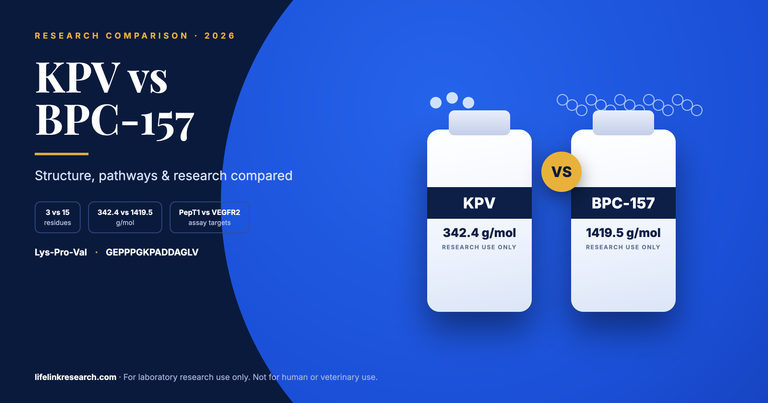
KPV vs BPC-157: Molecular Identity, Pathways and Research Compared
A PubMed search run in late October returns 230 records for BPC-157 and 47 for KPV. Exactly one record names both, and…
Read article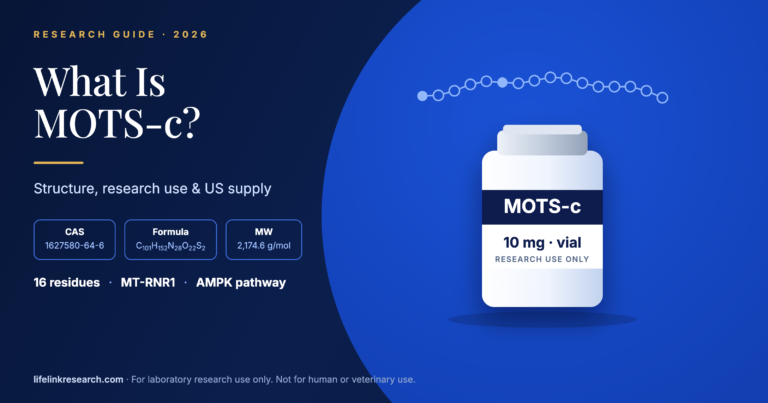
What Is MOTS-c? Structure, Research Use & US Supply
Quick Answer MOTS-c is a 16-amino-acid peptide coded within a short open reading frame of the mitochondrial 12S rRNA gene (MT-RNR1). It…
Read article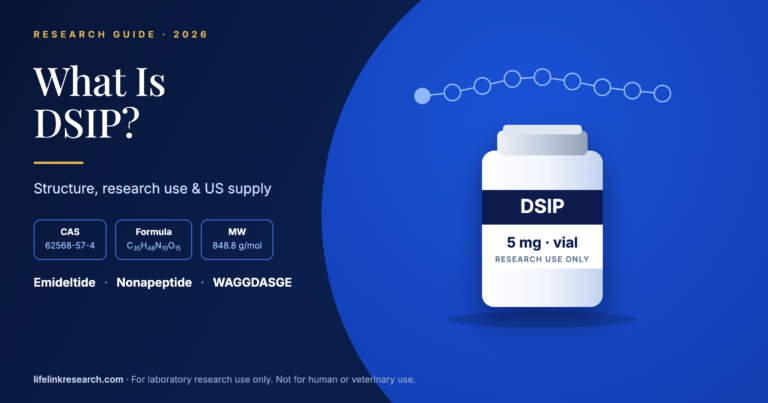
What Is DSIP? Structure, Research Use & US Supply
DSIP is a synthetic nine-residue peptide, WAGGDASGE, listed under the international name Emideltide. On July 24, 2026, it drew the narrowest vote…
Read articleResearch-grade peptides
99%+ purity. Verified every batch.
Identity and purity tested on every batch by third-party labs, Janoshik Analytical and US-based laboratories. Shipped same day from California.
Shop all peptides