
BPC-157 and TB-500 get talked about as a matched set, and most guides blur them into one “healing peptide” idea. They are two different molecules from two different proteins, and they act through mechanisms that have almost nothing in common. Once you see where each one comes from and what it does at the cellular level, the pairing makes a lot more sense.
These are research reagents for laboratory use only, not for human or veterinary use.
BPC-157 and TB-500 Side by Side
| Property | BPC-157 | TB-500 |
| Origin | Sequence from gastric juice | Fragment of thymosin beta-4 (Tβ4) |
| Type | Synthetic pentadecapeptide | Synthetic actin-binding fragment |
| Size | 15 amino acids (~1,419.5 Da) | Based on the ~43-aa, ~4.9 kDa Tβ4 protein |
| Sequence | GEPPPGKPADDAGLV | Actin-binding motif (LKKTET region) |
| Main pathway studied | Nitric oxide system, VEGF, angiogenesis | G-actin sequestration, cell migration |
| Research lean | Localized vascular and gut models | Systemic cell-movement models |
BPC-157: Structure and Mechanisms
BPC-157 is a synthetic chain of 15 amino acids, sequence GEPPPGKPADDAGLV, drawn from a protein found in gastric juice. The “157” marks its position in that original isolate. It is one of the smaller, more stable peptides in this space, which is part of why it has been studied so widely.
Where it comes from and what it does
Its research thread runs through the vascular system. A 2025 systematic review by Vasireddi and colleagues pulled together 36 studies, 35 of them preclinical, and reported that BPC-157 acts on growth-hormone-receptor expression and on pathways tied to cell growth and angiogenesis, the formation of new blood vessels. That angiogenic thread is the through-line of most BPC-157 work.
The nitric-oxide angle
Underneath the angiogenesis findings is the nitric oxide (NO) system. In cell and rodent models, BPC-157 is associated with upregulation of eNOS, the enzyme that produces NO in the vessel lining, alongside effects on VEGF signaling. The two connect: NO relaxes and protects the vessel wall, and VEGF drives the growth of new vessels, so a compound touching both is a natural probe for vascular biology.
Researchers also report activity on fibroblast migration in connective-tissue models and on dopaminergic and serotonergic pathways in rodent brain studies, which is a reminder that BPC-157’s literature reaches beyond the vascular story. Almost all of it is preclinical, so these are mechanisms mapped in the lab, not conclusions about people. Its small size and stability are practical reasons it turns up in so many of these models.
TB-500: Structure and Mechanisms
TB-500 is where precision pays off, because the name covers more ground.
What TB-500 actually is
Thymosin beta-4 (Tβ4) is a naturally occurring protein of about 43 amino acids, roughly 4.9 kDa, and Goldstein and colleagues describe it as “the major actin-sequestering molecule in eukaryotic cells.” TB-500 is a synthetic peptide built around Tβ4’s actin-binding region, the stretch centered on the LKKTET motif.
In the research-chemical market the label is used two ways: for the short acetylated fragment that carries that motif, and, more loosely, for full-length Tβ4 itself. That is why vials sold as “TB-500” can differ in size and molecular weight, and why the certificate on a given batch tells you more than the name does.
Actin sequestration and cell migration
The mechanism is the actin cytoskeleton. By binding monomeric G-actin, Tβ4 controls how quickly actin assembles and disassembles, the process cells use to change shape and move. A cell that cannot rebuild its actin scaffold cannot migrate, so a molecule that meters that supply becomes a lever on cell movement itself. That makes TB-500 a tool for studying migration and distribution across tissue.
Its actin-binding site does more than move cells, too. Work by Philp and colleagues showed that the actin-binding site on Tβ4 promotes angiogenesis, which is how TB-500 reaches the same vascular endpoint as BPC-157 while starting from a completely different molecule. That shared destination, approached from actin on one side and nitric oxide on the other, is the single most interesting thing about comparing the two.
How the Two Actually Differ
The cleanest way to hold them apart is by origin and mechanism.
- BPC-157 traces to a gastric-juice sequence and runs on the nitric-oxide and VEGF pathways.
- TB-500 is a piece of the cytoskeletal protein Tβ4 and works by binding actin.
- Those are unrelated starting points reaching unrelated machinery. The difference carries into how each gets studied.
- BPC-157 shows up mostly in localized vascular and gut models, TB-500 in systemic cell-movement work, and the two molecules differ in size by roughly a short peptide against a protein fragment.
- Angiogenesis is the one place their paths cross, which is what makes a head-to-head design worth running.
Local vs Systemic: Two Scales
A useful way to hold the two apart is by the scale each one works at. BPC-157 shows up most in localized models, where a specific site is under study, and its vascular and gut-tissue literature reflects that focus. TB-500, through its effect on cell migration, is studied more in systemic terms, tracking how cells move and distribute across a wider area.
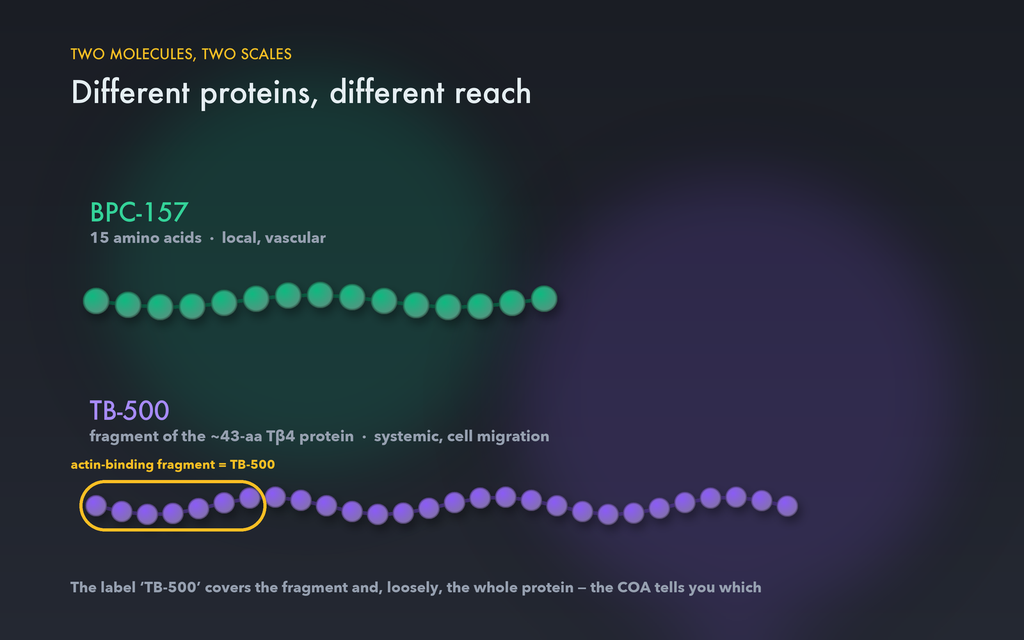
That difference is exactly why the two land in comparative study designs together. One covers a local vascular question, the other a whole-field movement question, and a researcher can watch how those scales interact. The complementary angles are the whole reason the pairing exists as a research idea.
Which Peptide Fits Which Question
There is no overall winner here, only a better fit for a given experiment. The matrix below maps common research questions to the compound with the stronger literature behind it.
| Research question | Better-supported compound | Why |
| Nitric-oxide / eNOS pathway | BPC-157 | Its primary reported mechanism |
| Actin cytoskeleton dynamics | TB-500 | G-actin binding is its defining action |
| Localized vascular models | BPC-157 | Deeper connective-tissue and gut literature |
| Cell migration and distribution | TB-500 | Tβ4’s core biological role |
| Gastrointestinal mucosal models | BPC-157 | Originally isolated from a gastric protein |
| Comparative angiogenesis | Both | Same phenotype, two distinct pathways |
None of it holds up if the vial is mislabeled. Pinning down identity and purity from the batch certificate is what keeps a two-peptide comparison about the peptides instead of about a synthesis error.
TB-500 is not the only compound BPC-157 gets measured against. For the comparison with the alpha-MSH tripeptide, including the PepT1 uptake and NF-κB reporter work that has no TB-500 equivalent, see KPV vs BPC-157.
The Logic Behind Pairing Them
The combination, often sold as the Wolverine kit, rests on a simple bet: two mechanisms aimed at overlapping biology might add up to more than either delivers alone. BPC-157 brings the NO and VEGF angle, TB-500 the actin regulation and cell movement, and between them they cover a wide stretch of the vascular-and-migration map.
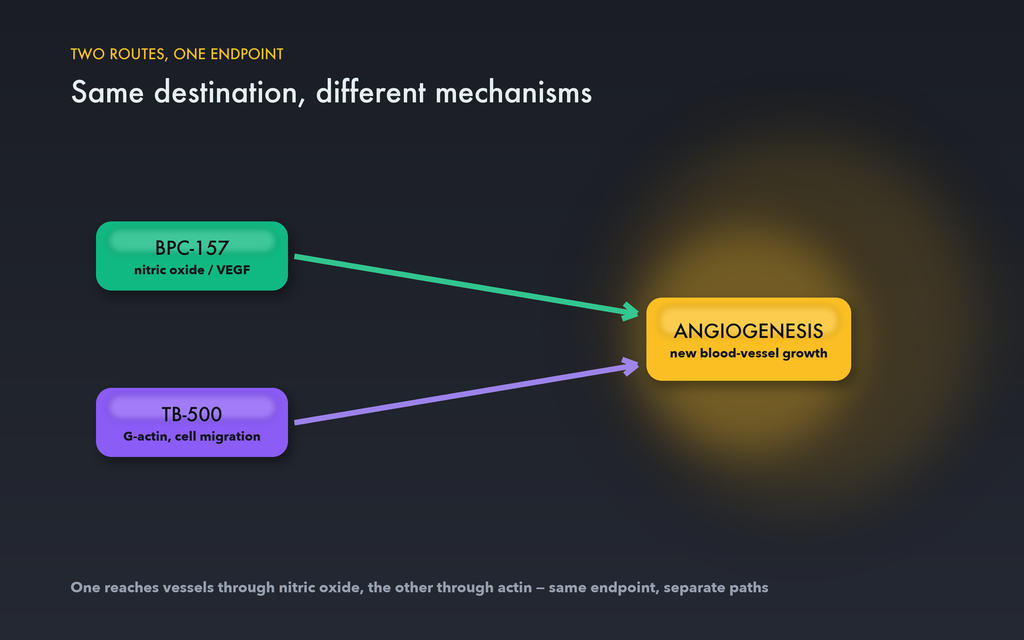
Whether that adds up to true synergy or plain additivity is still unsettled in the preclinical work, which makes the pairing a tidy experiment in itself: run each alone, run both together, measure the gap. Since these are two separate compounds, a combined design only stays clean if the paperwork on both matches, so the in-house-versus-independent testing question decides whether purity quietly skews the comparison.
Purity and Verification for Comparative Work
Both peptides are smaller and easier to synthesize than the GLP-1 class, yet both still carry synthesis-quality variation that can move a result. For research-grade material the checks are straightforward:
- HPLC purity of 98% or higher for each compound.
- Mass spectrometry to confirm identity, which counts double for TB-500, where the fragment-versus-full-protein question changes the expected mass.
- Endotoxin (LAL) testing below 1 EU/mg, which is critical for any cell-culture work.
- A batch-specific certificate from an outside lab, available before purchase.
A faked or recycled certificate undoes all of it, so telling a real certificate from a doctored one is part of the groundwork before any serious comparison begins. Life Link Research publishes third-party certificates for both compounds.
Where They Stand in the US and in Sport
In the United States, both peptides are supplied as research chemicals. Neither carries FDA approval, and neither is cleared for human injury, recovery, or clinical use, so any listing that presents them as treatments has overstated what they are.
Athletes have a harder line to watch. WADA places both compounds in class S2 of its Prohibited List, a category banned in and out of competition, which puts them off-limits for anyone subject to drug testing.
Frequently Asked Questions
How are BPC-157 and TB-500 different?
BPC-157 is a 15-amino-acid peptide from a gastric-juice sequence, studied around the nitric-oxide system and angiogenesis. TB-500 is a synthetic fragment of thymosin beta-4, studied around actin sequestration and cell migration. Different source, different size, different mechanism.
Is TB-500 necessary with BPC-157?
No, each is studied on its own. They are paired in some research designs because their mechanisms differ, so a combined model can test whether the two add up to more than either alone. That combined effect is still an open question in preclinical work.
Is TB-500 better than BPC-157?
Neither is better in the abstract. The right compound depends on the research question: BPC-157 for nitric-oxide and localized vascular models, TB-500 for actin dynamics and cell-migration models. Many comparative designs include both.
What is TB-500, exactly?
TB-500 is a synthetic peptide based on the actin-binding region of thymosin beta-4, a roughly 43-amino-acid cytoskeletal protein. The name is used for both the short acetylated fragment and full-length Tβ4, so the certificate and mass on a batch define what you actually have.
Do BPC-157 and TB-500 both affect angiogenesis?
Yes, but through separate routes. BPC-157 is linked to the nitric-oxide and VEGF pathways, while the actin-binding site on thymosin beta-4 promotes angiogenesis directly. Reaching one endpoint by two mechanisms is part of why they are compared.
Which has the stronger preclinical literature?
BPC-157 has broader preclinical coverage in localized vascular and gastrointestinal models. Thymosin beta-4, the parent of TB-500, has deeper literature in actin biology and cell migration. Each one leads in its own area, which is why the choice comes down to the research question.
What purity should research-grade BPC-157 or TB-500 be?
At least 98% by HPLC, with mass-spectrometry identity confirmation and low endotoxin for cell work. Independent third-party certificates are preferred over vendor-internal assays, since the testing source is part of the result.
Can BPC-157 and TB-500 be used together in research?
Yes, some comparative designs run them side by side and in combination, testing whether their separate mechanisms add up. Matching third-party documentation for both compounds keeps purity from becoming a hidden variable in that kind of study.
Are BPC-157 and TB-500 FDA-approved?
No, both are research chemicals with no FDA approval for any human use. They also carry a class S2 listing on the WADA Prohibited List, which places them off-limits for athletes in drug-tested sport.
Disclaimer
This is an educational comparison of laboratory research on two peptides. BPC-157 and TB-500 are research reagents only, hold no FDA approval, and are not medicines or products for human or veterinary use. The mechanisms described here point to published studies for context and should not be read as instructions for use. Sources: Goldstein et al. (2005), Philp et al. (2003), Vasireddi et al. (2025), WADA Prohibited List.