
For researchers studying incretin biology, tirzepatide and semaglutide represent two distinct pharmacological tools. Both activate the GLP-1 receptor — but tirzepatide also activates the GIP receptor (GIPR), creating a different downstream signaling profile. This is not a difference of degree. It is a difference in mechanism.
This page covers: structural differences, receptor binding profiles, downstream signaling, and research use cases where one compound is preferred over the other.
All compounds referenced are for research purposes only.
Quick Reference
| Property | Semaglutide | Tirzepatide |
|---|---|---|
| Receptor targets | GLP-1R only | GLP-1R + GIPR (dual) |
| Amino acids | 31 | 39 |
| Molecular weight | ~4,113 Da | ~4,813 Da |
| Half-life (in vivo) | ~7 days | ~5 days |
| Fatty acid chain | C18 diacid (albumin binding) | C20 diacid (albumin binding) |
| GLP-1R potency | High | Moderate (GIPR balanced) |
| GIPR activity | None | High (full agonist) |
| Primary research use | GLP-1R signaling reference | Dual incretin interaction studies |
| LLR availability | 10mg, 15mg vials | 15mg vials |
Structure and Design
Semaglutide is a 31-amino acid GLP-1 analog. The native GLP-1 sequence (positions 7–36) was modified at position 8 (Aib substitution for DPP-4 resistance) and conjugated to a C18 fatty diacid chain via a mini-PEG linker at position 26, enabling albumin binding and extending the half-life from the native GLP-1’s 1–2 minutes to approximately 7 days.
Tirzepatide is a 39-amino acid synthetic peptide designed as a “twincretin” — a single molecule that activates both GLP-1R and GIPR. It is based on the native GIP sequence, with modifications for GLP-1R binding introduced into the structure. The C20 fatty diacid chain (also via mini-PEG linker) achieves albumin binding comparable to semaglutide, with a slightly shorter half-life of approximately 5 days.
The structural implication: these are not interchangeable analogs. Tirzepatide’s GLP-1R affinity is moderate — comparable to the endogenous GLP-1 ligand, but lower than semaglutide’s engineered high affinity. Tirzepatide compensates with potent GIPR activity. This co-activation is fundamental to how it differs from semaglutide in signaling studies.
Receptor Binding and Signaling
GLP-1 Receptor (GLP-1R) — Class B1 GPCR
Both compounds activate GLP-1R. The key mechanistic difference: semaglutide is a high-affinity GLP-1R monoagonist; tirzepatide is a balanced dual agonist with moderate GLP-1R affinity.
At GLP-1R:
- Primary pathway: Gs coupling → adenylyl cyclase → ↑cAMP → PKA activation
- Secondary pathways: EPAC2, Gq (lower magnitude), β-arrestin recruitment
- Downstream effects in pancreatic β-cells: glucose-dependent insulin secretion, proinsulin gene expression, β-cell survival signaling (via cAMP/CREB)
- CNS effects: hypothalamic appetite suppression, area postrema activation, reduced gastric emptying
GIP Receptor (GIPR) — Class B1 GPCR (tirzepatide only)
GIP receptor signaling in research is less characterized than GLP-1R but increasingly studied:
- Primary pathway: Gs → cAMP → PKA (parallel to GLP-1R in pancreatic β-cells)
- Adipose tissue: GIPR is expressed in adipocytes; GIP promotes lipid uptake and storage in energy surplus states
- Bone: GIPR expressed in osteoblasts; GIP has proposed role in bone turnover
- CNS: GIPR expression in hypothalamus, hippocampus, VTA — emerging area of research
- Interaction with GLP-1R signaling: simultaneous GLP-1R + GIPR activation produces different cAMP kinetics than GLP-1R activation alone (synergistic effects observed in some tissue models)
Signaling Research Implication
For researchers studying GLP-1R signaling specifically, semaglutide’s high monoagonist activity and extensive literature characterization make it the cleaner reference compound. For researchers studying incretin-incretin interaction, GIP receptor biology, or comparing mono vs. dual receptor activation, tirzepatide is required.
Research Use Case Matrix
| Research Question | Preferred Compound | Reason |
|---|---|---|
| GLP-1R signaling characterization | Semaglutide | High-affinity monoagonist; extensive reference literature |
| Dose-response at GLP-1R | Semaglutide | Cleaner pharmacology; no GIPR confound |
| GLP-1R + GIPR interaction studies | Tirzepatide | Only compound that activates both simultaneously |
| Comparing mono vs. dual incretin receptor activation | Both (head-to-head) | By design, this requires both compounds |
| GIP receptor biology research | Tirzepatide | GIPR component; also consider tirzepatide vs. native GIP |
| CNS incretin receptor studies | Both | GLP-1R is better characterized; GIPR CNS studies use tirzepatide or GIP analogs |
| Adipose tissue GIP/GLP-1 interaction | Tirzepatide | GIPR is highly expressed in adipocytes; dual activation model |
| Cell culture: cAMP assays at GLP-1R | Semaglutide | High potency, clean single-receptor readout |
| Cell culture: insulin secretion from β-cell lines | Either | Tirzepatide may produce higher response via dual pathway |
| In vivo metabolic phenotyping (rodent) | Both | Design study to separate GLP-1R and dual-agonist effects |
Purity Requirements and COA Verification
Both compounds require the same minimum documentation standard for research use:
- HPLC purity: ≥98%
- Mass spectrometry: molecular weight confirmation (semaglutide: ~4,113 Da; tirzepatide: ~4,813 Da)
- Endotoxin (LAL assay): <1 EU/mg for cell culture applications
- Sterility: required for in vivo applications
- Moisture content: affects accurate mass-based dosing
- Amino acid composition: confirms sequence identity
Third-party independent COA is required — not in-house vendor testing. The Amino Asylum and Paradigm Peptides enforcement actions resulted directly from inadequate independent verification of product identity. Third-party mass spectrometry is the only way to confirm you are receiving the compound you ordered.
Life Link Research provides third-party independent COAs for both semaglutide and tirzepatide, available before purchase.
Frequently Asked Questions
What is the main difference between tirzepatide and semaglutide?
Semaglutide is a GLP-1 receptor monoagonist — it activates only GLP-1R. Tirzepatide is a dual GLP-1/GIP agonist — it simultaneously activates GLP-1R and GIPR. This makes tirzepatide the appropriate compound when studying dual incretin receptor activity or GIP receptor biology. For pure GLP-1R research, semaglutide is the cleaner tool.
Which has higher GLP-1R potency — tirzepatide or semaglutide?
Semaglutide has higher GLP-1R binding affinity. Tirzepatide’s GLP-1R potency is similar to native GLP-1, but moderate relative to semaglutide’s engineered high affinity. Tirzepatide’s in vivo potency is enhanced by its GIPR component acting in parallel, not by superior GLP-1R binding.
Can I substitute tirzepatide for semaglutide in an existing study?
In most cases, no. The compounds activate different receptor profiles. If your study involves GLP-1R-specific signaling, substituting tirzepatide introduces GIPR activity as an uncontrolled variable. For studies where “incretin receptor activation” is the relevant parameter (not specifically GLP-1R), tirzepatide and semaglutide may produce comparable directional results — but they are mechanistically distinct tools.
Are tirzepatide and semaglutide the same molecular weight?
No. Semaglutide has a molecular weight of approximately 4,113 Da; tirzepatide approximately 4,813 Da. This difference (700 Da) is due to tirzepatide’s longer peptide chain (39 vs 31 amino acids) and longer fatty acid modification (C20 vs C18). Verify both against your COA.
What is the next compound after tirzepatide for incretin research?
Retatrutide adds a third receptor: the glucagon receptor (GCGR). It is a GLP-1R/GIPR/GCGR triple agonist, representing the next level of incretin receptor complexity. See our retatrutide vs tirzepatide comparison.
Order Semaglutide →
Order Tirzepatide →
All products for research purposes only. Not for human use.
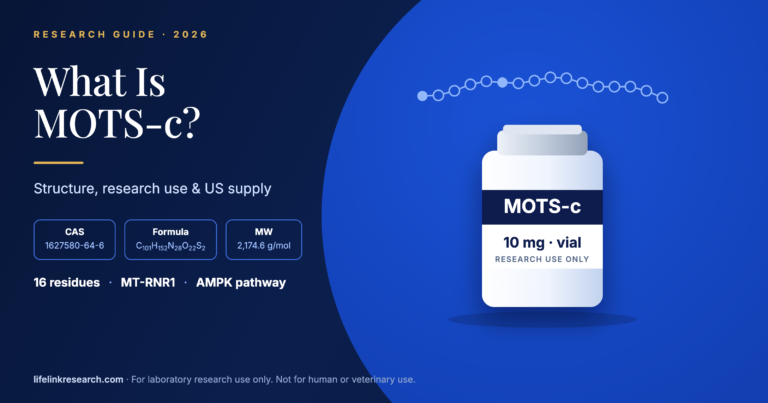
What Is MOTS-c? Structure, Research Use & US Supply
Quick Answer MOTS-c is a 16-amino-acid peptide coded within a short open reading frame of the mitochondrial 12S rRNA gene (MT-RNR1). It…
Read article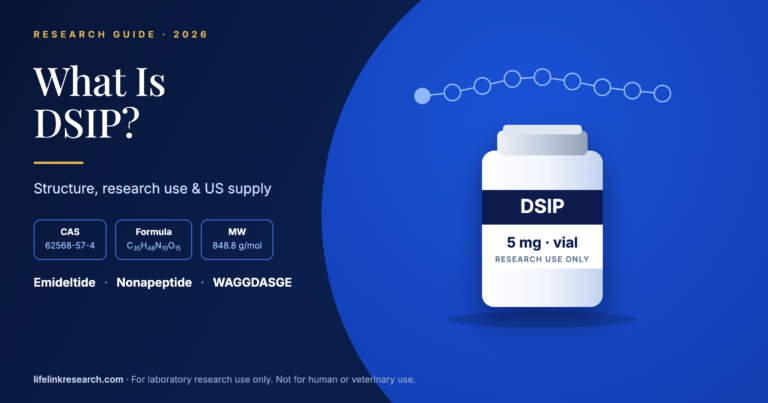
What Is DSIP? Structure, Research Use & US Supply
DSIP is a synthetic nine-residue peptide, WAGGDASGE, listed under the international name Emideltide. On July 24, 2026, it drew the narrowest vote…
Read article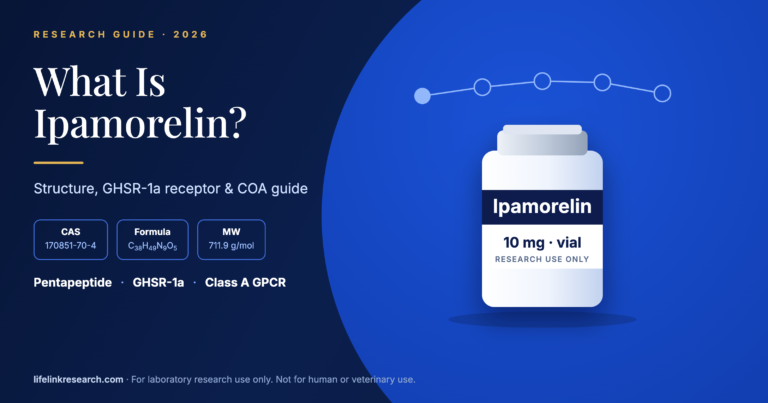
What Is Ipamorelin? Structure, GHSR-1a Receptor and COA Guide
Ipamorelin is a synthetic five-residue peptide that acts as an agonist at the ghrelin receptor, GHSR-1a. It started life as a subtraction.…
Read articleResearch-grade peptides
99%+ purity. Verified every batch.
Identity and purity tested on every batch by third-party labs, Janoshik Analytical and US-based laboratories. Shipped same day from California.
Shop all peptides