
Semaglutide is a glucagon-like peptide-1 (GLP-1) receptor agonist — a synthetic peptide that mimics the action of the GLP-1 hormone naturally produced in the gastrointestinal tract. It was originally developed for metabolic and endocrine research, and has become one of the most studied peptide compounds of the past decade.
In research contexts, semaglutide is studied for its effects on the GLP-1 receptor pathway, including downstream effects on insulin secretion signaling, gastric motility, satiety signaling, and energy homeostasis. It is structurally related to human GLP-1 (7-37) but modified to extend its half-life significantly beyond the 1–2 minute half-life of the native hormone.
Research use only: All semaglutide available from Life Link Research is sold strictly for laboratory and research purposes. It is not for human consumption, clinical administration, or veterinary use.
Semaglutide Structure and Mechanism
Molecular formula: C₁₈₇H₂₉₁N₄₅O₅₉ (approximate; varies by salt form)
Molecular weight: ~4,114 Da
Amino acid sequence: 31-amino acid GLP-1 analog with C-18 fatty diacid chain at K26 and Aib substitution at A8
Semaglutide works by binding to the GLP-1 receptor (GLP1R), a G protein-coupled receptor expressed in pancreatic beta cells, the central nervous system, the gastrointestinal tract, and cardiovascular tissues. Receptor activation triggers:
- Stimulation of adenylyl cyclase → increased cAMP
- Downstream PKA activation → insulin secretion augmentation (glucose-dependent)
- Inhibition of glucagon secretion
- Slowed gastric emptying
- CNS satiety signaling via vagal afferents and hypothalamic pathways
The fatty acid chain modification and Aib substitution (replacing alanine at position 8) provide resistance to DPP-4 cleavage, extending the half-life to approximately 7 days — making semaglutide a valuable model compound for sustained GLP-1 receptor agonism studies.
Semaglutide vs. Other GLP-1 Peptides
| Peptide | Type | Approx. Half-Life | Receptor Targets |
|---|---|---|---|
| Semaglutide | GLP-1 RA | ~7 days | GLP-1R |
| Liraglutide | GLP-1 RA | ~13 hours | GLP-1R |
| Tirzepatide | GLP-1 / GIP dual agonist | ~5 days | GLP-1R + GIPR |
| Retatrutide | GLP-1 / GIP / glucagon triple agonist | ~6 days | GLP-1R + GIPR + GCGR |
| CagriSema | Semaglutide + cagrilintide combination | Dual components | GLP-1R + AMYR |
Semaglutide is a monoagonist, acting only at GLP-1R. This makes it a clean reference compound for GLP-1R-specific studies, before introducing the complexity of dual or triple agonism.
Research Applications
Semaglutide is used in preclinical and in vitro research to study:
- GLP-1 receptor pharmacology: Binding affinity, downstream signaling, receptor internalization
- Metabolic pathway research: Insulin secretion modeling, glucose homeostasis, lipid metabolism
- CNS effects: Appetite regulation pathways, neuroprotective signaling, reward circuit modulation
- Cardiovascular research: GLP-1R expression in cardiac tissue, anti-inflammatory pathways
- Comparative agonist studies: Benchmarking novel GLP-1 analogs against the established semaglutide reference
Purity and Quality Considerations for Research
Semaglutide is a large, complex peptide (31 amino acids + fatty acid chain). Synthesis quality varies significantly between suppliers. For research applications requiring reproducible results, the critical specifications are:
- HPLC purity: ≥98% by high-performance liquid chromatography
- Mass spectrometry confirmation: Molecular weight verification to confirm correct sequence synthesis
- Endotoxin testing: LAL assay to rule out contamination that would confound in vitro or in vivo results
- Moisture content: Critical for accurate mass calculation and dosing in research
Life Link Research provides third-party independent COAs covering identity and purity for every batch of semaglutide, with heavy metals, sterility and endotoxin on a rotating cycle.
Frequently Asked Questions
What is semaglutide used for in research?
In research contexts, semaglutide is studied as a GLP-1 receptor agonist model compound. Research applications include GLP-1R signaling studies, metabolic pathway research, CNS effects on appetite regulation, and cardiovascular biology. It is not approved for these uses in humans outside of specific clinical settings.
Is semaglutide a peptide or a drug?
Semaglutide is a synthetic peptide — a 31-amino acid GLP-1 analog. As a research chemical, it is studied for its peptide pharmacology. Research-grade semaglutide from suppliers like Life Link Research is for laboratory use only.
What is the molecular weight of semaglutide?
The molecular weight of semaglutide is approximately 4,113.58 Da (free base form). Researchers should verify this against the COA for each batch, as the exact weight should fall within a narrow tolerance of the theoretical value.
What is the difference between semaglutide and tirzepatide?
Semaglutide is a GLP-1 monoagonist; tirzepatide is a GLP-1/GIP dual agonist that activates both GLP-1R and GIPR. In research comparing these two compounds, tirzepatide’s dual receptor activity produces a different signaling profile that can be studied comparatively.
→ Semaglutide Research Peptide — Life Link Research Shop
For research purposes only. Not for human use.
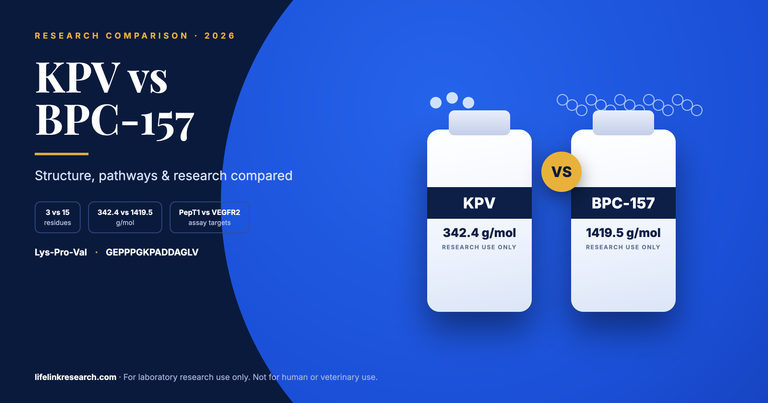
KPV vs BPC-157: Molecular Identity, Pathways and Research Compared
A PubMed search run in late October returns 230 records for BPC-157 and 47 for KPV. Exactly one record names both, and…
Read article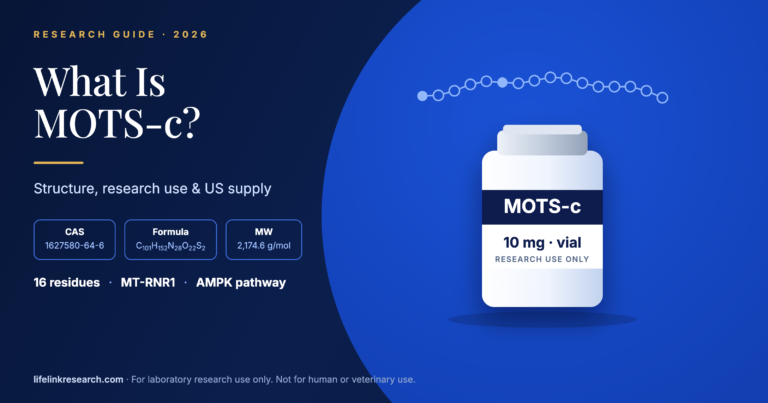
What Is MOTS-c? Structure, Research Use & US Supply
Quick Answer MOTS-c is a 16-amino-acid peptide coded within a short open reading frame of the mitochondrial 12S rRNA gene (MT-RNR1). It…
Read article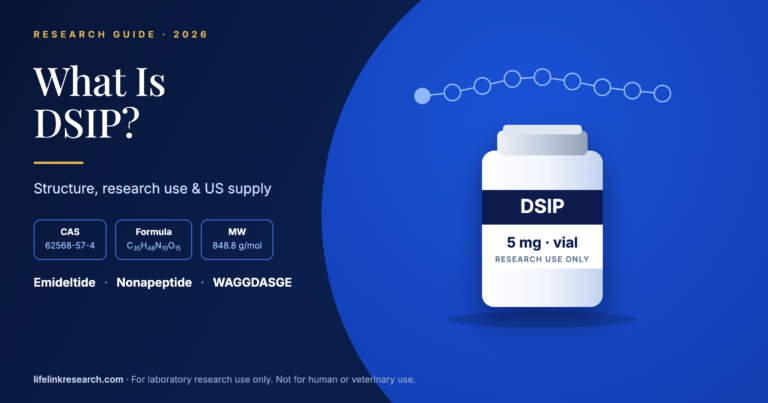
What Is DSIP? Structure, Research Use & US Supply
DSIP is a synthetic nine-residue peptide, WAGGDASGE, listed under the international name Emideltide. On July 24, 2026, it drew the narrowest vote…
Read articleResearch-grade peptides
99%+ purity. Verified every batch.
Identity and purity tested on every batch by third-party labs, Janoshik Analytical and US-based laboratories. Shipped same day from California.
Shop all peptides