
Description
Structure & Identity
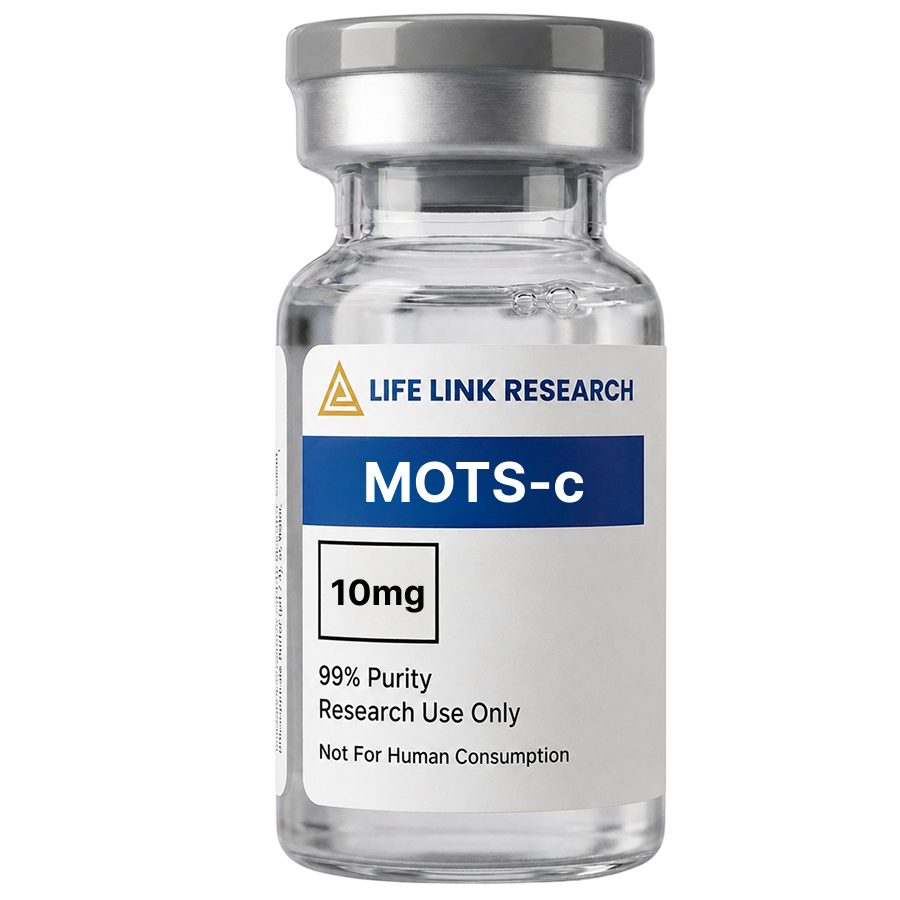
MOTS-c is a 16-amino-acid peptide with the sequence Met-Arg-Trp-Gln-Glu-Met-Gly-Tyr-Ile-Phe-Tyr-Pro-Arg-Lys-Leu-Arg. It is encoded within the 12S ribosomal RNA region of mitochondrial DNA, which is what ties it to cellular energy machinery. Its longer chain, compared with the small signaling peptides, reflects the fuller functional role researchers attribute to it.
Research Background
MOTS-c research is firmly metabolic, focused on how the peptide influences the way cells manage energy.
- Mitochondrial origin. MOTS-c is one of a small group of peptides encoded in mitochondrial DNA, in the 12S rRNA region [PMID: 27216708].
- Metabolic homeostasis. Foundational work tied it to metabolic regulation in animal models [PMID: 25738459].
- AMPK pathway. It is described as acting mainly through the AMPK energy pathway [PMID: 36670507].
- Nuclear signaling. It can move into the nucleus to influence gene expression under stress [PMID: 29983246].
- Cell models. It has been studied in AMPK-pathway and cultured-cell metabolic models [PMID: 34798268].
These findings describe an active research area, not an approved use, and the material is supplied to support that laboratory work.
Specifications
| Attribute | Value |
| Chemical name | MOTS-c (mitochondrial-derived peptide) |
| Also Known As | Mitochondrial ORF of the 12S rRNA type-c |
| Sequence | Met-Arg-Trp-Gln-Glu-Met-Gly-Tyr-Ile-Phe-Tyr-Pro-Arg-Lys-Leu-Arg |
| CAS number | 1627580-64-6 |
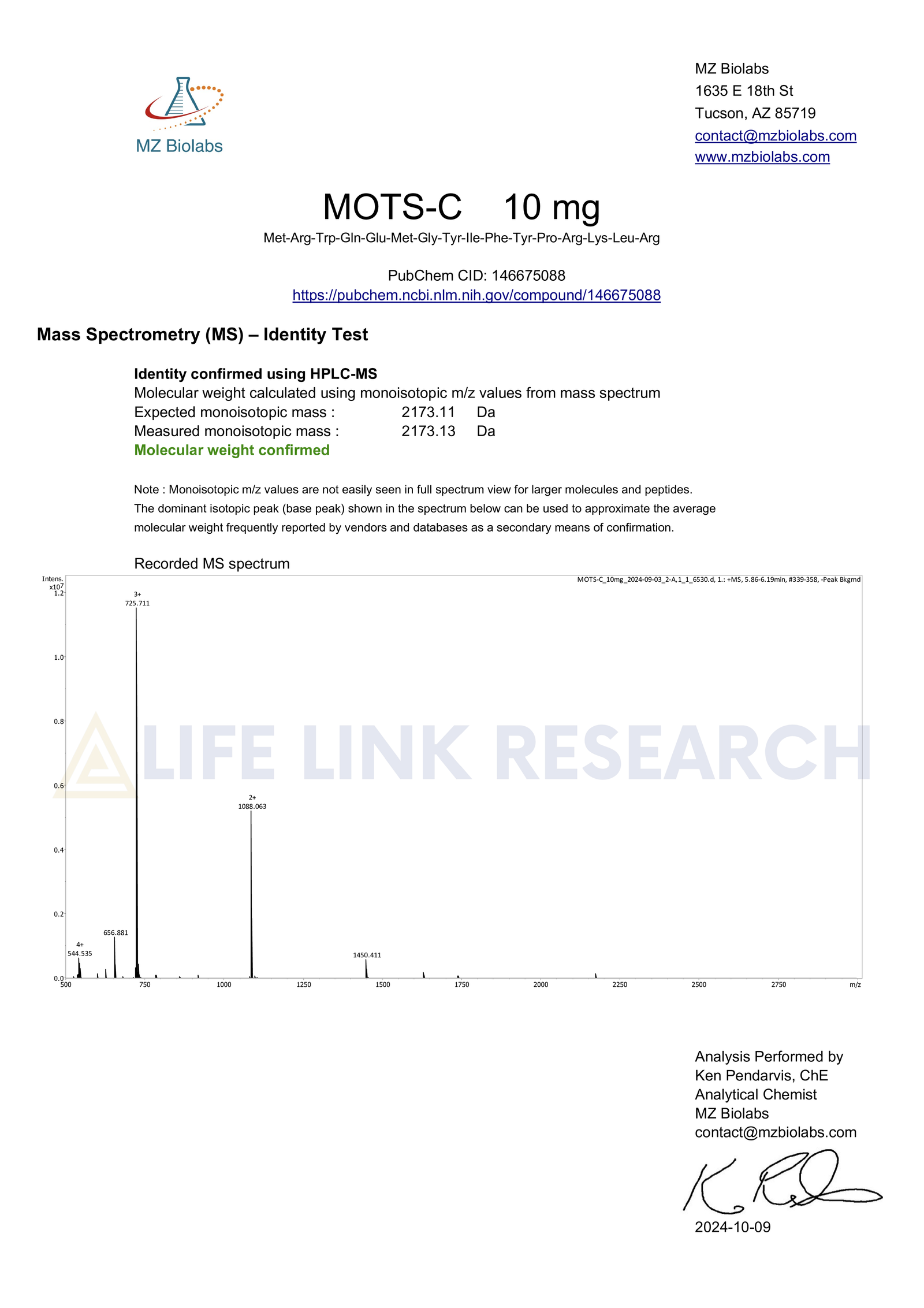
| Molecular weight | 2174.6 g/mol |
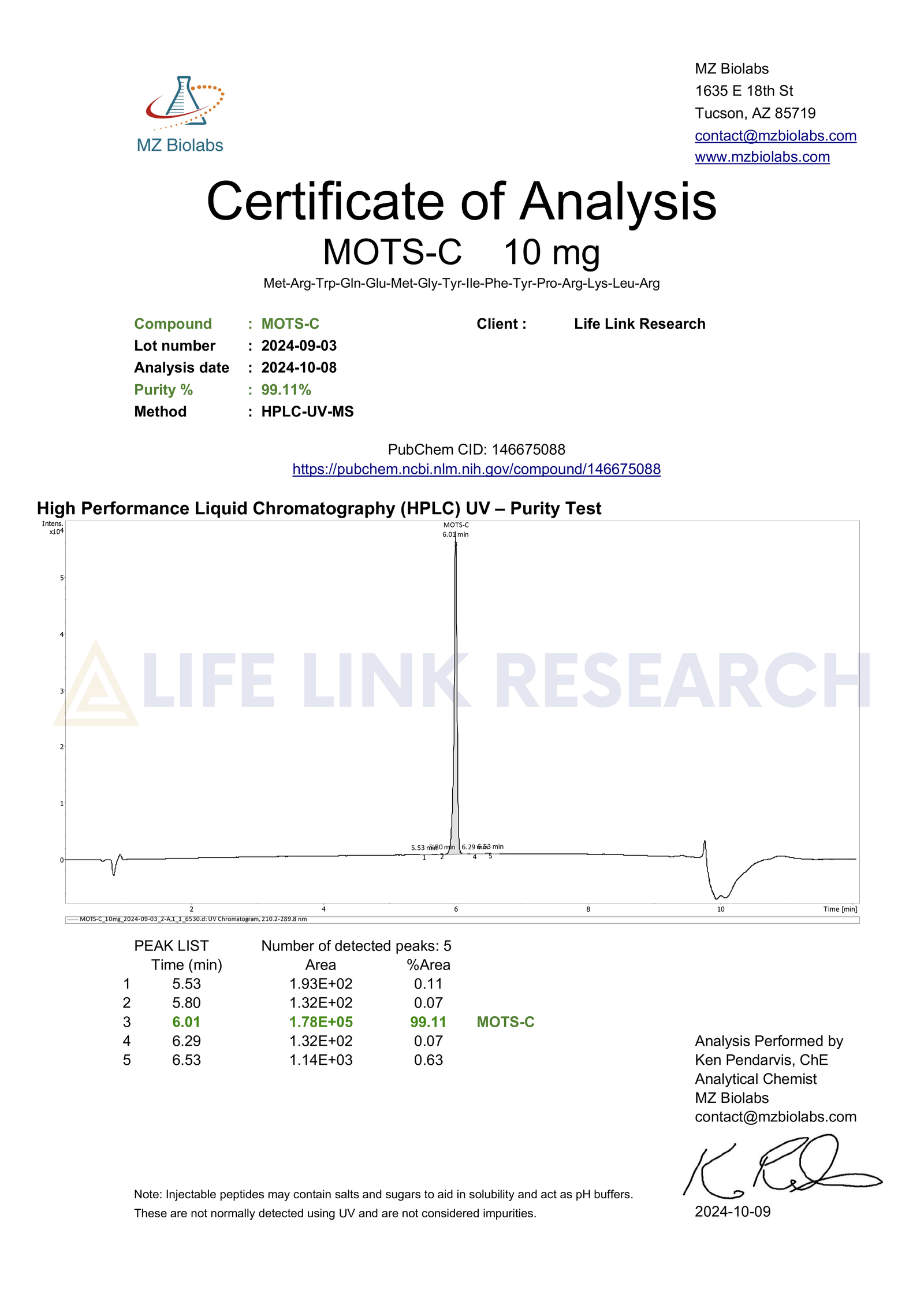
| Purity | ≥99% by reverse-phase HPLC |
| Length | 16 amino acids |
| Identity | Confirmed by ESI mass spectrometry |
| Physical form | Lyophilized powder |
| Appearance | White to off-white solid |
| Quantity | 10 mg per vial |
| Storage | -20°C, protected from light |
| Solubility | Soluble in bacteriostatic or sterile water |
| Classification | Research use only |
Storage & Handling
Keep the unopened vial at -20°C, out of the light, until use. Once prepared, store the solution at 2-8°C and use it in your study within roughly two weeks. Because MOTS-c is a longer peptide, it is especially worth warming the vial to room temperature before opening and avoiding repeated freeze-thaw cycles, both of which help preserve the intact chain.
Quality Assurance
MOTS-c is manufactured under research-grade controls and is released only after independent verification. Its purity is measured by reverse-phase HPLC and its identity confirmed by mass spectrometry, with that work done by third-party laboratories such as Janoshik Analytical along with domestic US labs. Each batch carries a certificate of analysis, letting you trace the results to the exact vial you receive.
Frequently Asked Questions
What is MOTS-c?
MOTS-c is a 16-amino-acid mitochondrial-derived peptide, meaning it is encoded in mitochondrial rather than nuclear DNA. It is studied in metabolic research, particularly around the AMPK energy pathway, and is supplied for research use only.
What makes MOTS-c a “mitochondrial-derived” peptide?
Its gene sits inside the mitochondrial genome, in the 12S rRNA region, rather than in the cell’s main nuclear DNA. Only a handful of peptides share that origin, which is a large part of the research interest.
How does MOTS-c work in research models?
Studies describe it acting mainly through AMPK, a master switch for cellular energy, and it has also been shown to enter the nucleus and affect gene activity under stress. These are findings from cell and animal research.
What is MOTS-c’s sequence?
Met-Arg-Trp-Gln-Glu-Met-Gly-Tyr-Ile-Phe-Tyr-Pro-Arg-Lys-Leu-Arg, a 16-residue peptide with CAS number 1627580-64-6 and a molecular weight near 2174.6 g/mol.
Is MOTS-c FDA approved?
No. MOTS-c is not an approved drug or supplement. It is a research-use-only material and is not for human or veterinary use.
Is MOTS-c a hormone?
It is often described as a hormone-like signaling peptide because it is released and acts on distant tissues, but for practical purposes it is handled as a research peptide studied in metabolic models.
How should MOTS-c be stored?
Keep the powder frozen at -20°C and protected from light. After reconstitution for research, store at 2-8°C and use within about two weeks.
How is this MOTS-c tested?
It is verified to ≥99% purity by reverse-phase HPLC with mass-spec identity confirmation by an independent lab, and every batch ships with a certificate of analysis.
References
- Lee C, et al. The mitochondrial-derived peptide MOTS-c and metabolic regulation in animal models. 2015. PMID: 25738459.
- Kim KH, et al. The Mitochondrial-Encoded Peptide MOTS-c Translocates to the Nucleus to Regulate Nuclear Gene Expression. 2018. PMID: 29983246.
- MOTS-c: A Mitochondrial-Encoded Regulator of the Nucleus. 2019. PMID: 36761202.