
Quick answer: In July 2026, an FDA advisory committee voted to recommend both TB-500 and MOTS-c for the Section 503A compounding list, part of a wider vote that backed six of seven peptides reviewed. A recommendation is not approval, though. Both peptides stay research-use-only while the FDA works through final rulemaking, a process expected to run into 2027.
TB-500 & MOTS-c
The July 2026 advisory meeting was the biggest regulatory moment the peptide industry has seen in years, and the headlines that followed were easy to misread. TB-500 and MOTS-c both came out of it with a favorable committee vote, yet neither is FDA-approved, and nothing about their legal status changed overnight. This guide lays out exactly what the panel decided, what each peptide is studied for, and what still has to happen before anything shifts.
Research use only. The material below summarizes a regulatory event and preclinical (laboratory and animal-model) findings. It is not medical guidance, and neither peptide is approved for human or veterinary use.
| Status at a glance | TB-500 | MOTS-c |
| Peptide class | Thymosin beta-4 fragment | Mitochondrial-derived peptide |
| Research focus | Tissue repair, cell migration | Metabolic and mitochondrial signaling |
| July 2026 committee vote | Recommended for 503A list | Recommended for 503A list |
| FDA-approved? | No | No |
| Current status | Research-use-only, pending rulemaking | Research-use-only, pending rulemaking |
What Happened at the July 2026 Review
On July 23 and 24, 2026, the FDA’s Pharmacy Compounding Advisory Committee (PCAC) reviewed seven peptides for possible addition to the Section 503A Bulks List, which sets out the bulk substances that compounding pharmacies are allowed to use. The panel recommended six of the seven: BPC-157, KPV, TB-500, MOTS-c, Epitalon, and Semax. Only Emideltide missed the cut.
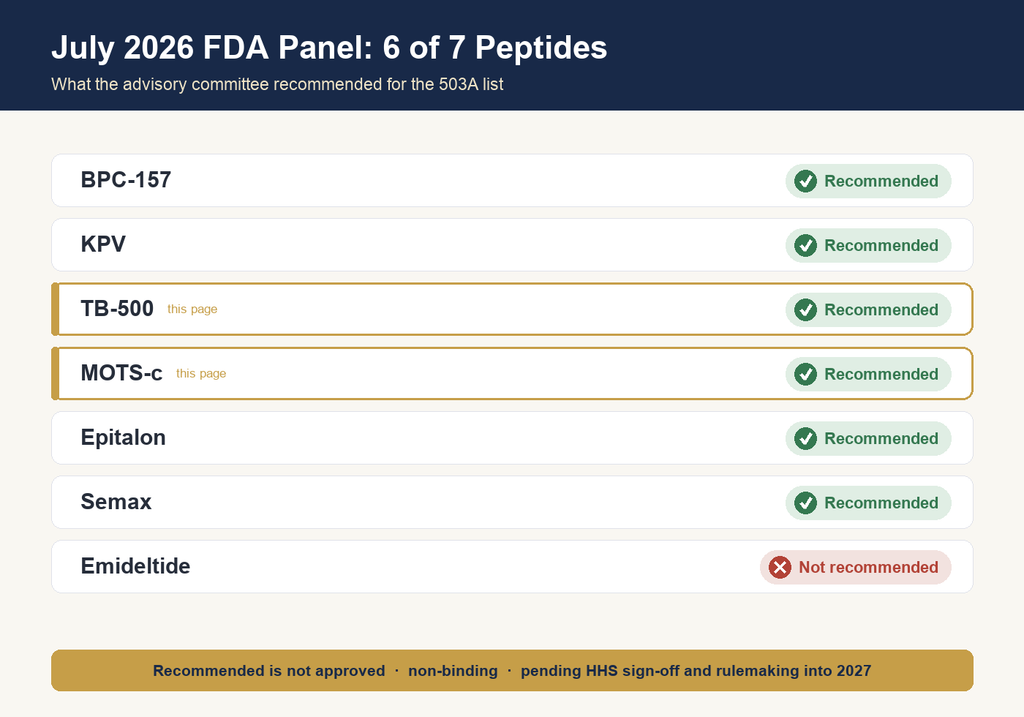
TB-500 and MOTS-c both landed in the recommended group, with TB-500 backed in its free-base and acetate forms. Here’s the twist that most coverage buried: the FDA’s own career scientists had recommended against all seven peptides, citing short, underpowered studies and gaps in safety and effectiveness data.
The advisory panel voted to recommend anyway, over the objection of FDA staff. That split between the reviewers and the panel is a big part of why the outcome sits in a gray zone: it signals a direction while leaving the real question open.
TB-500: What It Is and What Researchers Study
TB-500 is a synthetic version of a section of thymosin beta-4, a naturally occurring peptide involved in cell movement and tissue repair. It appears often in cell-migration research, frequently alongside BPC-157. The use the FDA panel reviewed was wound healing.
Its mechanism is what makes it interesting in the lab. Thymosin beta-4 binds and sequesters G-actin, the building-block form of the protein cells use to build their internal scaffolding. By managing that actin pool, the peptide influences cell migration in wound-model assays, a process documented in the research on this actin-sequestering protein.
Preclinical work has linked that same activity to angiogenesis and tissue remodeling across a range of animal models. As with most peptides in this space, the laboratory evidence is broad while human data stays limited, which is precisely the concern FDA staff raised.
MOTS-c: What It Is and What Researchers Study
MOTS-c comes from an unusual place: it’s encoded inside mitochondrial DNA, making it one of a small group of mitochondrial-derived peptides. In the lab, MOTS-c is studied in AMPK and mitochondrial signaling. The uses the FDA panel reviewed were obesity and osteoporosis.
The peptide acts mainly through the AMPK pathway, a central regulator of how cells manage energy. Published work describes MOTS-c influencing energy metabolism, insulin sensitivity, and exercise adaptation through AMPK signaling, and notes that the body’s own MOTS-c levels rise with physical activity.
Interest has stayed current, too. A March 2026 study reported that MOTS-c altered mitochondrial readouts in skeletal-muscle models, through PGC-1alpha and AMPK pathways, adding fresh detail to a mechanism researchers are still mapping.
TB-500 vs MOTS-c: How They Differ
For all that they were voted on together, these two peptides have almost nothing in common beyond their July 2026 status. They come from different biology and get studied for different reasons.
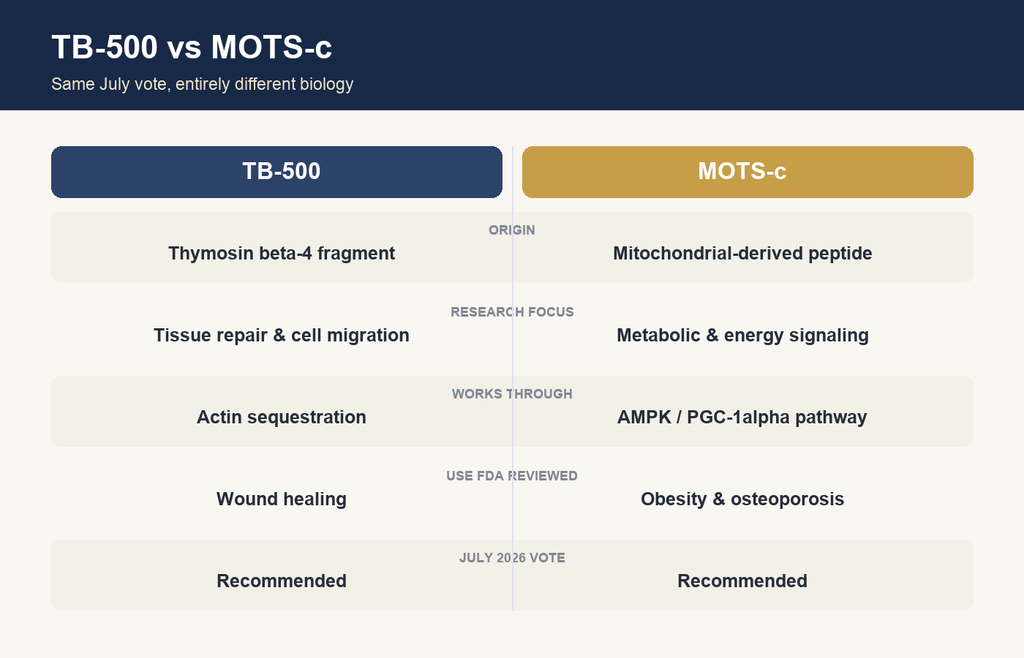
- TB-500 traces back to thymosin beta-4 and centers on structural repair, working through actin and cell migration.
- MOTS-c is a mitochondrial messenger focused on energy and metabolism, working through AMPK.
- One is studied as a repair signal, the other as a metabolic one.
- The shared thread is simply that both are synthetic research peptides that drew regulatory attention at the same meeting, and both still need verified quality before any lab work is worth trusting.
What “Recommended” Really Means
A committee recommendation is a signal, and it stops well short of a green light. The PCAC advises the FDA, so its votes carry weight without binding the agency to anything. Before TB-500 or MOTS-c could be legally compounded, the Secretary of Health and Human Services has to sign off, and the FDA has to complete formal rulemaking, which means a proposed rule, a public comment period, and a final rule published in the Federal Register.
That process is slow by design and typically runs a year or more, which is why the timeline points toward 2027. Until it finishes, pharmacies cannot compound these peptides even if pharmaceutical-grade material exists, and the compounds are not legally available through standard regulated channels. This vote is one piece of a broader FDA peptide review that is still unfolding, and the peptides in play could see their status shift again as the rules take shape.
What It Means for Researchers Right Now
In practical terms, nothing has changed for lab work. TB-500 and MOTS-c remain research-use-only compounds, supplied strictly for in-vitro study and never for human or veterinary use. The July vote is worth watching because it hints at where policy may head, yet it grants no new permissions today.
That makes sourcing discipline more important than ever. A favorable regulatory signal tends to bring a wave of new sellers, and the quality bar is what separates a usable research compound from a questionable one. The regulatory story and the quality story run on parallel tracks, and only one of them is settled.
How TB-500 and MOTS-c Quality Is Verified
Whatever a label promises, two lab tests decide whether a vial holds what it claims. Mass spectrometry confirms identity by weighing the molecule against its expected mass, while HPLC measures how pure the sample is. Read together, they answer the only two questions that matter at the bench: is this the right peptide, and how much of the vial actually is it.
The purity reading rewards a careful eye, since the difference between a 98% and a 99% result is a real change in how much of the sample is something else. Both findings belong on a Certificate of Analysis, and being able to read a COA confidently is what lets you check a claim against your specific batch.
We publish a COA for every lot we ship and stand it on a multi-test quality panel that reaches past purity into the safety checks a percentage alone can’t capture.
Research Blends and Related Compounds
Labs studying tissue-repair pathways often reach for TB-500 as part of a pairing. It anchors a BPC-157 and TB-500 blend for actin and angiogenesis signaling research, and the same duo forms the core of the Wolverine research kit. TB-500 is also available on its own for single-peptide work.
Each is supplied for laboratory research only, and every unit ships with batch documentation so identity and purity can be confirmed before anything begins.
Frequently Asked Questions
Is TB-500 FDA approved?
No, in July 2026 an FDA advisory committee recommended TB-500 for the Section 503A compounding list, but a recommendation is not approval. It stays research-use-only while final FDA rulemaking plays out, a process expected to continue into 2027.
Is MOTS-c FDA approved?
No, MOTS-c received the same favorable committee recommendation in July 2026, yet it is not FDA-approved and cannot be legally compounded until rulemaking is complete. For now it remains a research-use-only compound.
What peptides did the FDA panel recommend in July 2026?
The committee recommended six of seven peptides for the 503A Bulks List: BPC-157, KPV, TB-500, MOTS-c, Epitalon, and Semax. Emideltide was the one peptide the panel declined to recommend.
Does the committee vote make TB-500 legal?
No. The vote is advisory. The Secretary of Health and Human Services still has to approve the addition, and the FDA has to finish formal rulemaking, so these peptides are not legally available through regulated channels yet.
What is the difference between TB-500 and MOTS-c?
They come from different biology. TB-500 is a thymosin beta-4 fragment studied for tissue repair through actin and cell migration. MOTS-c is a mitochondrial-derived peptide studied for metabolism through the AMPK pathway.
Why did FDA staff disagree with the panel?
FDA reviewers recommended against all seven peptides, pointing to short, underpowered studies and gaps in safety and effectiveness data. The advisory committee weighed the same evidence differently and voted to recommend six of them anyway.
When could TB-500 or MOTS-c actually become available for compounding?
There’s no fixed date. The FDA would need to complete formal rulemaking, which includes a public comment period and a final published rule, and that typically takes a year or more. The realistic window points to 2027 at the earliest, and only if the agency follows the panel.
The Bottom Line
TB-500 and MOTS-c both cleared the July 2026 advisory vote, and that’s genuinely notable, but a recommendation is the start of a long process, with the finish line still well ahead. The peptides remain research-use-only, the FDA’s own scientists remain unconvinced, and final rules are still a year or so out.
For anyone sourcing either compound for laboratory work, the regulatory noise changes little: a verified COA is what tells you a vial is worth your time.
Research use only. Peptides referenced are for in-vitro laboratory research only, not for human or veterinary use, diagnosis, treatment, or consumption. The claims made on this page have not been assessed by the US Food and Drug Administration.
What Is B7-33? Relaxin-2 Analog Research Overview (2026)
Quick Answer B7-33 is a synthetic single-chain peptide built from part of the B chain of human relaxin-2, and it binds the…
Read article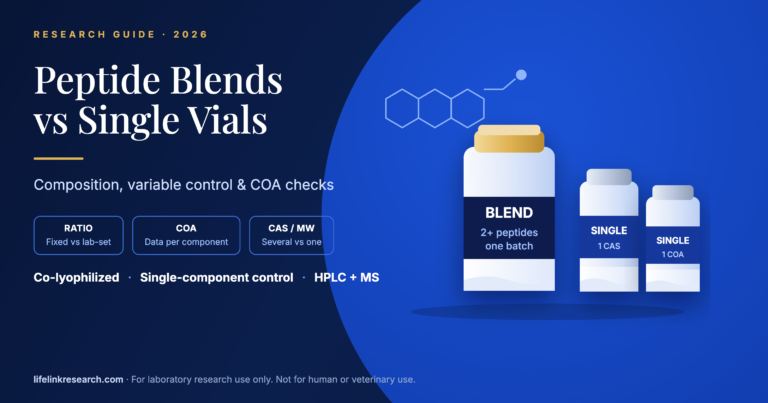
Peptide Blends vs Single Vials: How to Choose for Research (2026)
For Research Use Only. Not for use in diagnostic or therapeutic procedures. Choosing between peptide blends vs single peptides comes down to…
Read article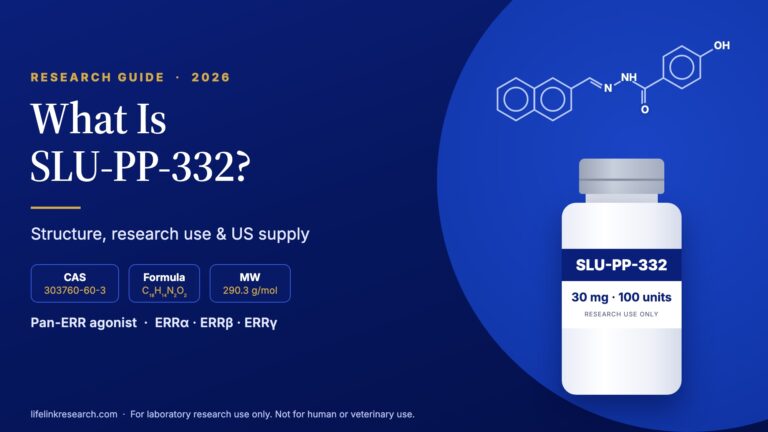
What Is SLU-PP-332? Structure, Research Use & US Supply
Quick Answer SLU-PP-332 is a synthetic small-molecule agonist of the estrogen-related receptors ERRŒ±, ERRŒ≤ and ERRŒ≥ (CAS 303760-60-3, PubChem CID 5338394). It…
Read articleResearch-grade peptides
99%+ purity. Verified every batch.
Identity and purity tested on every batch by third-party labs, Janoshik Analytical and US-based laboratories. Shipped same day from California.
Shop all peptides