
Quick Answer
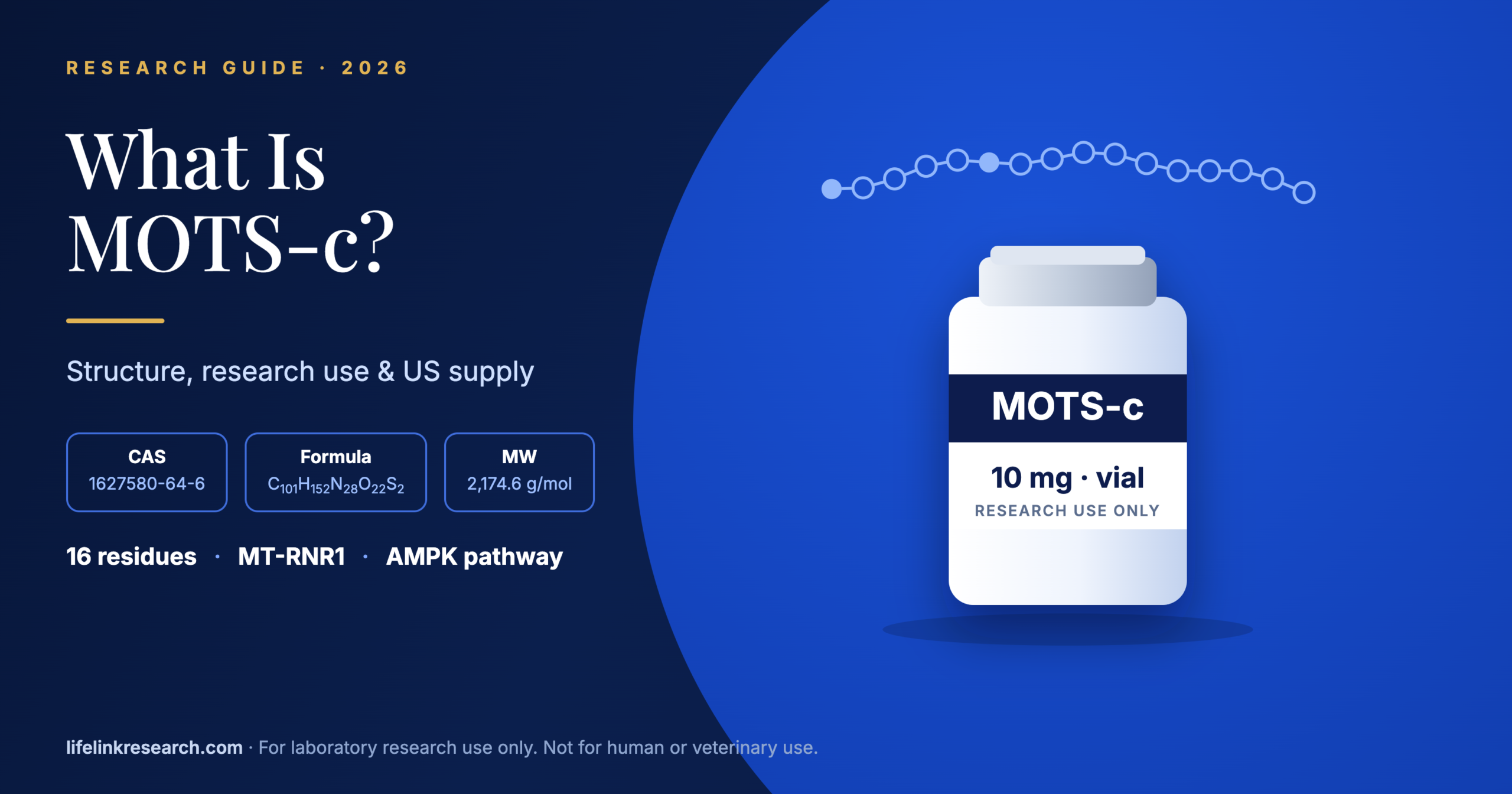
MOTS-c is a 16-amino-acid peptide coded within a short open reading frame of the mitochondrial 12S rRNA gene (MT-RNR1). It was first described in 2015 and is classed as a mitochondrial-derived peptide. It’s studied in cell and animal models for AMPK pathway signaling and is supplied in the US as a lyophilized research reagent.
Ribosomal RNA genes aren’t supposed to make proteins. Their RNA becomes part of the ribosome itself, so finding a peptide recipe tucked inside one surprised a lot of people. MOTS-c is that peptide, and it gives labs a short, fully defined molecule for studying how mitochondria send signals to the nucleus and cytoplasm. For a lab that wants a MOTS-c peptide with clean identity data, the structure is the place to start. New to peptide chemistry? Research peptides explained covers the basics.
For Research Use Only. Not for use in diagnostic or therapeutic procedures.
By Tyler Morgan · Scientific review by Kristen Doyle, PhD (biochemistry) · Updated October 18, 2026
What Is MOTS-c?
Quick answer: A 16-residue signaling peptide encoded in mitochondrial DNA, MOTS-c belongs to a small group called mitochondrial-derived peptides. A University of Southern California team, with Changhan Lee as first author and Pinchas Cohen as senior author, reported it in Cell Metabolism in 2015 (in vitro and mouse work). It’s made today by solid-phase synthesis.
The 2015 paper (Cell Metabolism, 2015) described a short coding sequence (sORF) within the 12S rRNA gene and showed, in cell and mouse models, that its peptide acts on “the folate cycle and its tethered de novo purine biosynthesis, leading to AMPK activation.” That pathway language is still how the field describes MOTS-c today. Our research library covers related peptides in the same style.
What does MOTS-c stand for?
The name is a compressed description of where the peptide comes from: Mitochondrial Open reading frame of the Twelve S rRNA, type c. UniProt lists the same expansion, with the gene name MT-RNR1, and a 2023 review in Antioxidants spells it out in full as “Mitochondrial open reading frame of the 12S rRNA type-c” (review, 2023).
Mitochondrial-derived peptides: humanin, SHLPs and MOTS-c
MOTS-c has two better-known relatives. Together they form a family defined by origin, not by shared sequence.
| Peptide | Length | Gene region | First reported |
| Humanin | 24 residues | 16S rRNA (MT-RNR2) | 2001 |
| SHLP1 to SHLP6 | 20 to 38 residues | 16S rRNA (MT-RNR2) | 2016 (Cobb et al., in vitro and animal) |
| MOTS-c | 16 residues | 12S rRNA (MT-RNR1) | 2015 |
Of the three, only MOTS-c maps to the 12S region, and it’s also the shortest.
What Is the Structure of MOTS-c?
Quick answer: MOTS-c is an unbranched chain of 16 residues with the sequence MRWQEMGYIFYPRKLR. Its formula is C101H152N28O22S2, with an average molecular weight near 2174.6 Da. It carries two methionines, one tryptophan, two tyrosines and a run of basic residues near the C-terminus.
Each row was cross-checked on October 18, 2026 with PubChem CID 146675088, UniProt A0A0C5B5G6 and the FDA GSRS record.
| Field | Value |
| Sequence (one-letter) | MRWQEMGYIFYPRKLR |
| Sequence (three-letter) | Met-Arg-Trp-Gln-Glu-Met-Gly-Tyr-Ile-Phe-Tyr-Pro-Arg-Lys-Leu-Arg |
| Length | 16 amino acids |
| Molecular formula | C101H152N28O22S2 |
| Average molecular weight | 2174.6 Da |
| Monoisotopic mass | 2173.1077 Da |
| UniProt ID | A0A0C5B5G6 (MOTSC_HUMAN) |
| CAS | 1627580-64-6 |
| FDA UNII | A5CV6JFB78 |
| Gene origin | MT-RNR1 (12S rRNA), mitochondrial DNA |
| Form | Lyophilized powder |
Reading the sequence
Walk along the chain and three features jump out:
- Two methionines (M1 and M6). Both carry sulfur, the “S2” in the formula, and both can oxidize. Each oxidation adds 16 Da, a change a mass spectrum picks up easily.
- An aromatic core (W3, Y8, F10, Y11). These residues give MOTS-c strong UV absorbance at 280 nm, which helps on an HPLC trace.
- A basic tail (R13, K14, R16). Add R2 and the N-terminal amine, and the peptide carries about five positive charges against one acidic glutamate (E5) and the C-terminal acid. At neutral pH that leaves a net charge near +3.
That charge profile explains why MOTS-c shows up mostly as 3+ and 4+ ions in electrospray mass spectrometry, a point the COA section comes back to.
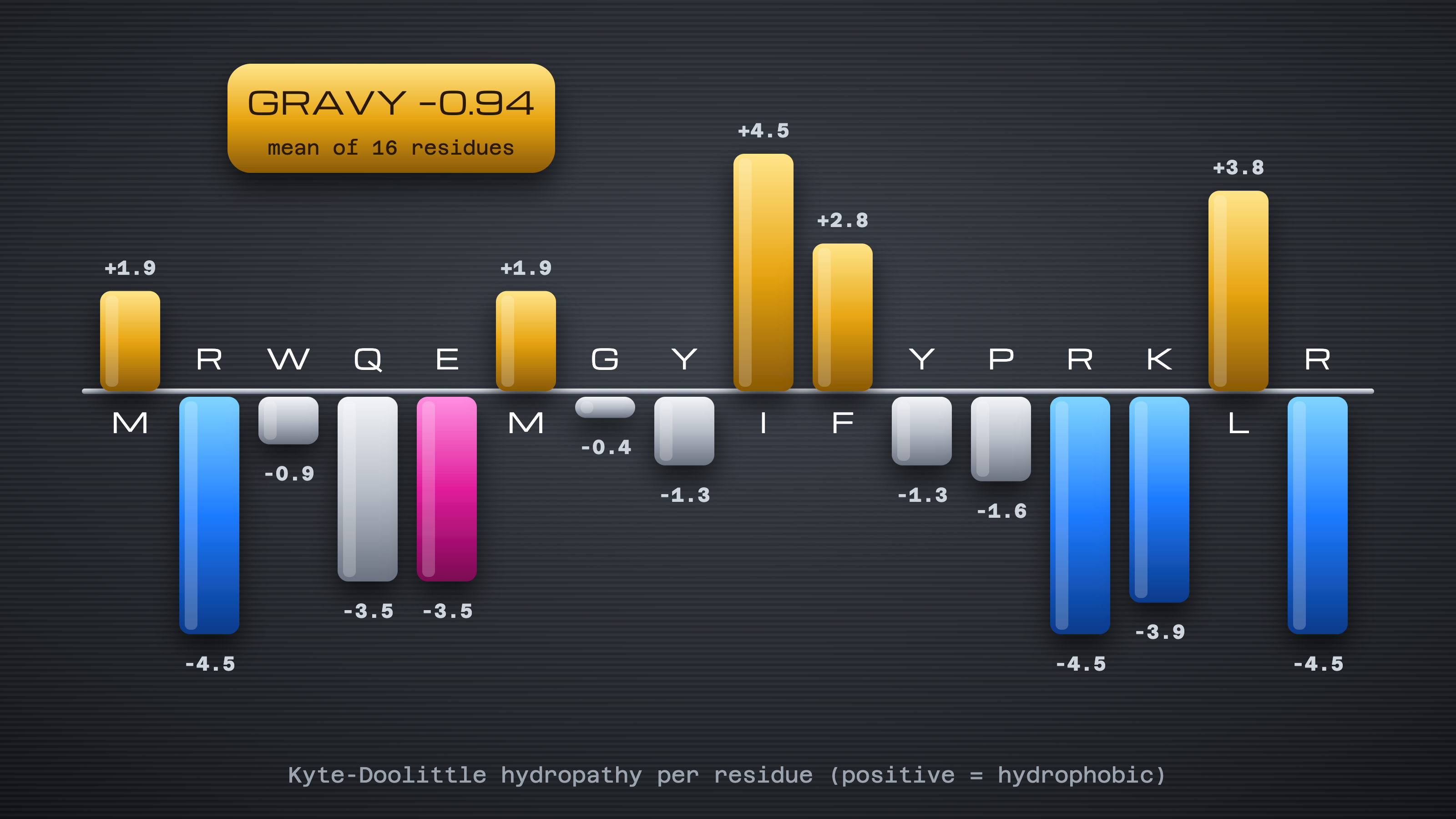
Each MOTS-c residue, with a hydrophobic Ile-Phe core, a charged Arg-Lys tail and a GRAVY score of -0.94
Gene origin: a peptide encoded in mitochondrial DNA
Human mitochondria carry their own small circular genome of about 16.6 kb. Most of it encodes respiratory-chain subunits, transfer RNAs and the two ribosomal RNAs. MOTS-c’s coding stretch overlaps the 12S rRNA gene, so the same stretch of DNA serves two purposes. Kim and colleagues later described this arrangement as evidence “that mitonuclear communication is genetically integrated” (Cell Metabolism, 2018).
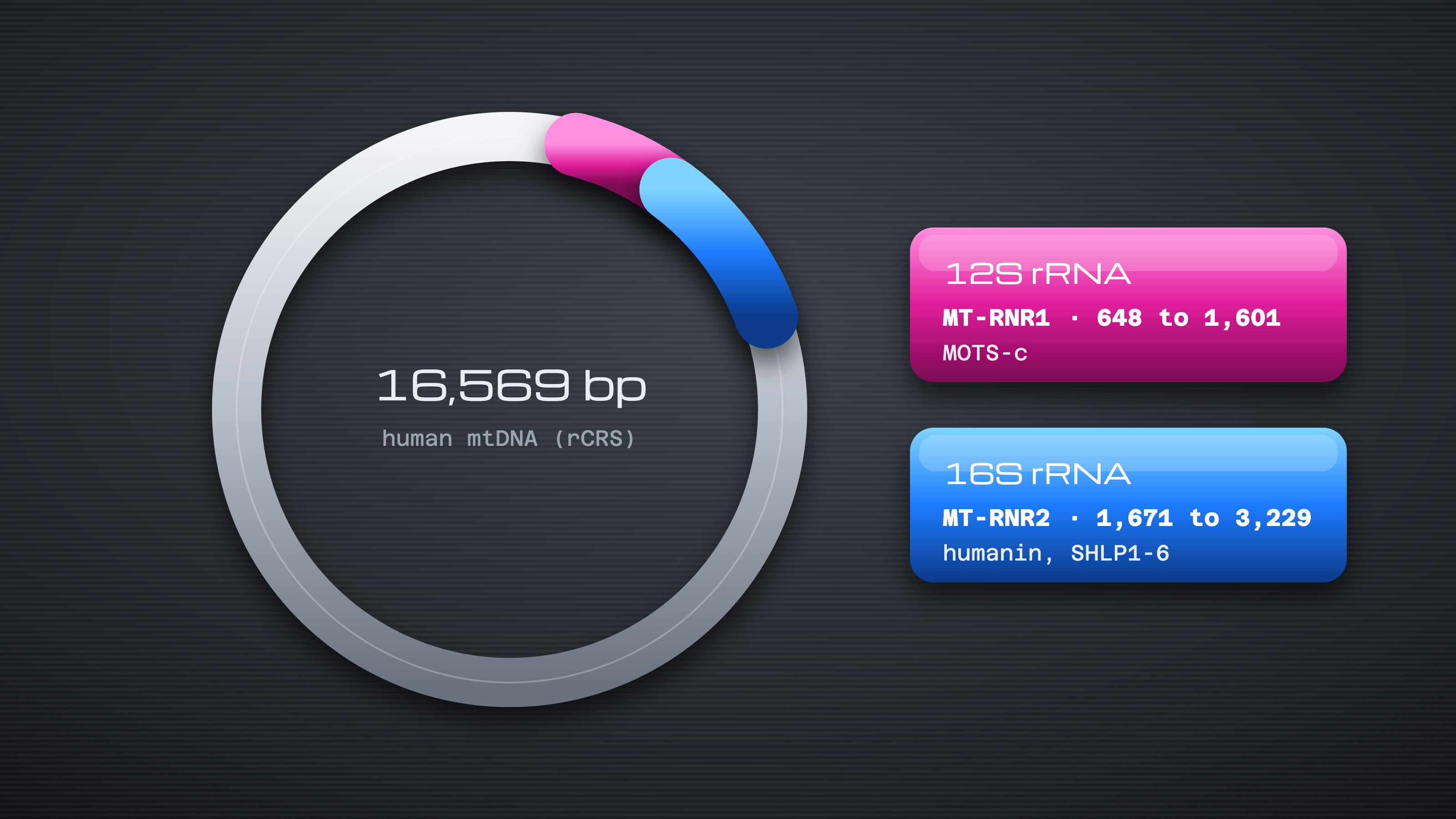
16,569 bp human mitochondrial genome highlighting the 12S rRNA gene (MT-RNR1, 648 to 1,601), home of MOTS-c, and the 16S rRNA gene (MT-RNR2, 1,671 to 3,229), home of humanin and SHLP1-6
Handling properties for the lab
- Storage: −20 °C, desiccated, in the sealed vial.
- Solubility: soluble in water for assay preparation.
- Watch points: methionine oxidation and moisture uptake are the main ways a dry sample drifts from its original COA.
How Is MOTS-c Used in Research?
Quick answer: MOTS-c is studied in in vitro and rodent models as a tool for AMPK pathway signaling, folate-cycle and AICAR assays, and nuclear translocation studies. Human data are limited to observational measurements and registered studies, so each finding needs its model type attached before it’s compared with anything else.
AMPK and folate-cycle signaling
The 2015 paper placed MOTS-c upstream of AMPK through the folate cycle. In that model (cell lines and mice), MOTS-c slowed folate-cycle flux, which let AICAR, an intermediate in de novo purine synthesis, build up. AICAR is a known AMPK activator, so a typical assay pairs AICAR measurement with AMPK phosphorylation at Thr172 by western blot. Many labs add a second read-out downstream, phosphorylation of the AMPK substrate acetyl-CoA carboxylase (ACC) at Ser79, to confirm the pathway is engaged and not just the kinase itself.
Nuclear translocation and gene-expression studies
Three years later, the same lab showed in cultured cells that MOTS-c moves into the nucleus under glucose restriction, in an AMPK-dependent manner. There it regulated genes carrying antioxidant response elements (ARE) and interacted with the transcription factor NRF2 (in vitro, Cell Metabolism, 2018). These experiments rely on cell fractionation, imaging of tagged peptide and transcript profiling.
Study types at a glance
| Model | What is measured | Source |
| Cell lines (in vitro) | Folate-cycle metabolites, AICAR levels, AMPK phosphorylation by western blot | Cell Metabolism, 2015 |
| Cell lines (in vitro) | Nuclear vs cytoplasmic peptide, ARE-gene transcript levels, NRF2 binding | Cell Metabolism, 2018 |
| Rodent | Pathway markers in tissue samples by western blot | Cell Metabolism, 2015 |
| Human, observational | Circulating peptide quantified by ELISA | Clinical Endocrinology, 2019; Experimental Physiology, 2026 |
| Human, registered study | NCT07505745: Phase 2, interventional, recruiting since February 2026 | ClinicalTrials.gov, checked October 18, 2026 |
What the research does not establish
No regulator has approved MOTS-c for any human use. Results from cell lines and rodents describe how a pathway behaves in that model, and they don’t carry over to people by default. The single registered human study is still recruiting, with no posted results as of October 2026. Observational studies, for their part, measure how much MOTS-c peptide circulates; they don’t test what it does. Keeping those categories apart is the simplest way to read the literature accurately.
Is MOTS-c FDA Approved?
Quick answer: Not as of October 18, 2026. There’s no FDA-approved MOTS-c product, and openFDA’s Drugs@FDA database returns no record for it. US suppliers offer it only as a lab research reagent. A compounding vote in July 2026 left its approval status unchanged.
Each line below is dated and sourced:
- Compounding review. On July 23 and 24, 2026, MOTS-c came before FDA’s Pharmacy Compounding Advisory Committee as a 503A Bulks List candidate, and the panel voted 7 for, 5 against, with 2 abstentions, to recommend it (source: FDA meeting page, July 2026).
- Status after the vote. The committee advises FDA. A listing still needs notice-and-comment rulemaking, so MOTS-c’s 503A category is unchanged as of October 2026 (source: Federal Register, April 16, 2026).
- WADA. The 2026 Prohibited List, effective January 1, 2026, names MOTS-c under S4 (hormone and metabolic modulators) as an example of an AMPK activator, alongside AICAR (source: WADA Prohibited List, 2026).
For the full timeline and what happens next, read MOTS-c and TB-500 FDA status (2026), and for the other six peptides on that agenda, see FDA’s July 2026 peptide review.
How Is MOTS-c Supplied for Research in the US?
Quick answer: Research MOTS-c in the US typically comes as a 10 mg lyophilized vial with a lot number that links to its batch COA. Life Link ships from California and sells only under research-use-only terms to researchers aged 21 or older, so each order arrives documented and traceable to a tested lot.
What arrives and how to store it on receipt
The MOTS-c 10 mg research peptide arrives as a sealed vial in plain outer packaging. On receipt:
- Check the seal and compare the vial’s lot number with its COA.
- Move it to −20 °C, dry and dark.
- Log the lot, receipt date and freezer location.
The dry, freeze-dried format is deliberate. With two methionines in the sequence, MOTS-c is more exposed to oxidation than many short peptides, and removing water slows that chemistry. A sealed, cold, dark vial keeps the sample close to the state its COA describes.
Ordering terms and US shipping
Same-day dispatch applies to orders in by 2 PM PST, sent UPS 2-Day Air out of California, with tracking by email. Every sale carries research-use-only terms, and buyers confirm they’re 21 or older. Carrier options and timings are set out in the US shipping policy.
What Should a MOTS-c COA Show?
Quick answer: A MOTS-c COA should show HPLC purity with its chromatogram, a mass-spectrometry identity result matching about 2174.6 Da, net peptide content, and the lot number, test date and testing lab. Purity by HPLC, see the batch result. Everything on the report should trace to the lot on your vial.
| Test | What it confirms | What to check |
| HPLC purity | Share of UV signal in the main peak | A chromatogram is attached, not just a number |
| MS identity | The molecule is MOTS-c | Charge-state ions near 1088.06 (2+), 725.71 (3+) and 544.28 (4+), or a deconvoluted mass near 2173.1 Da |
| Net peptide content | Peptide vs counter-ions and water | Stated as a percentage; with five basic sites, counter-ions can make up a large share of the powder |
| Counter-ion | Salt form (acetate or TFA) | Named on the report; TFA often carries over from synthesis unless the batch was exchanged to acetate |
| Lot, date, lab | Traceability | Matches your vial; lab named; date close to manufacture |
The charge-state values above are calculated from PubChem’s monoisotopic mass. A peak 16 Da heavier on any of them points to oxidized methionine. Every Life Link lot is listed in the batch COA library.
Red flags on a peptide COA
- The lot number is missing or differs from the vial.
- Purity appears as a bare number.
- The reported mass fits neither 2174.6 Da nor a known charge state.
- One report is reused across several lots.
- No lab name or test date appears.
Our guide on how to verify a peptide COA walks through each check.
MOTS-c FAQs
How many amino acids are in MOTS-c?
MOTS-c has 16 amino acids: MRWQEMGYIFYPRKLR. That’s short enough to make by solid-phase synthesis in one run, and long enough that electrospray tends to show it carrying several charges at once. UniProt lists it as MOTSC_HUMAN (A0A0C5B5G6), encoded within the mitochondrial MT-RNR1 gene.
Who discovered MOTS-c?
A University of Southern California group led by Changhan Lee, with senior author Pinchas Cohen, reported MOTS-c in Cell Metabolism in March 2015. Their work combined cell-line experiments and mouse models. Lee’s lab followed up in 2018 with the nuclear translocation study, also in Cell Metabolism and also in cultured cells.
Is MOTS-c on the WADA Prohibited List?
Yes. WADA’s 2026 Prohibited List, in force since January 1, 2026, names MOTS-c under section S4, hormone and metabolic modulators, as an example of an activator of AMP-activated protein kinase (AMPK). It appears there alongside AICAR.
Is MOTS-c the same as humanin?
No. Both are mitochondrial-derived peptides, but they’re different molecules from different genes. Humanin has 24 residues and comes from the 16S rRNA region (MT-RNR2). MOTS-c is 16 residues long and traces to the 12S region (MT-RNR1). Their sequences don’t overlap, so their mass-spectrometry identities are entirely distinct.
Does Life Link publish a COA for every MOTS-c batch?
Yes. Each lot goes to Janoshik Analytical or a US-based lab for two checks, LC-MS for identity and RP-HPLC for purity, and its report carries the batch number and test date. A wider panel (heavy metals, endotoxin, sterility) runs on rotation. See our testing process.
Closing Notes
MOTS-c is a compact, well-mapped peptide: 16 residues, one mitochondrial gene and a pathway literature built mostly on cell and rodent models. For lab work, the identity data on its COA count for more than any label. Product details and the current batch report are on the MOTS-c product page linked above.
Lab use only. For Research Use Only. Not for use in diagnostic or therapeutic procedures. MOTS-c from Life Link Research is sold to professionals as a laboratory reagent. FDA has not reviewed or approved it, and this article offers no medical advice. See our Terms and Conditions for the conditions of sale. Last updated October 18, 2026.
References
Access date for every source: October 18, 2026.
- Lee C, et al. Cell Metabolism. 2015;21(3):443-454. In vitro and mouse study. doi:10.1016/j.cmet.2015.02.009
- Kim KH, et al. The mitochondrial-encoded peptide MOTS-c translocates to the nucleus to regulate nuclear gene expression in response to metabolic stress. Cell Metabolism. 2018;28(3):516-524. In vitro. doi:10.1016/j.cmet.2018.06.008
- Cobb LJ, et al. 2016;8(4):796-809. In vitro and animal study. doi:10.18632/aging.100943
- PubChem CID 146675088; UniProt A0A0C5B5G6; FDA GSRS UNII A5CV6JFB78
- ClinicalTrials.gov NCT07505745
- FDA Pharmacy Compounding Advisory Committee, July 23 and 24, 2026
- WADA Prohibited List, 2026 edition
What Is DSIP? Structure, Research Use & US Supply
DSIP is a synthetic nine-residue peptide, WAGGDASGE, listed under the international name Emideltide. On July 24, 2026, it drew the narrowest vote…
Read article
What Is Ipamorelin? Structure, GHSR-1a Receptor and COA Guide
Ipamorelin is a synthetic five-residue peptide that acts as an agonist at the ghrelin receptor, GHSR-1a. It started life as a subtraction.…
Read article
Gonadorelin: GnRH Decapeptide Structure and Receptor Research (2026)
Gonadorelin is the synthetic GnRH decapeptide. Sequence, structure, salt forms, GnRH receptor (GnRHR) signalling, assay readouts and COA checks.
Read articleResearch-grade peptides
99%+ purity. Verified every batch.
Identity and purity tested on every batch by third-party labs, Janoshik Analytical and US-based laboratories. Shipped same day from California.
Shop all peptides