
Description
Structure & Identity
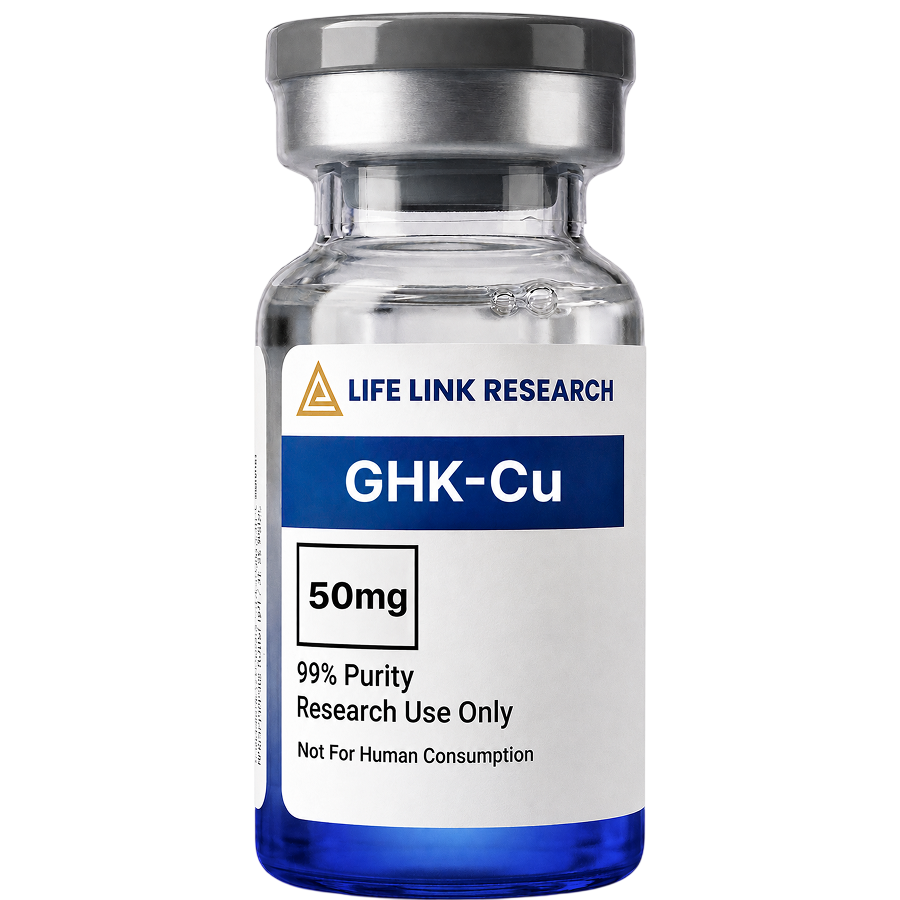
GHK-Cu is a copper complex of a tripeptide: three amino acids, glycine, L-histidine, and L-lysine (Gly-His-Lys), bound to a copper(II) ion. The histidine in the middle is the key, because it provides the anchor point that grips the copper. Take the copper away and you have plain GHK; add it back and you get the active complex that gives this material its identity.
Research Background
GHK-Cu has one of the longer research histories among small peptides, and the copper is woven through most of it.
- Copper complex. GHK-Cu is the tripeptide glycyl-histidyl-lysine bound to copper(II), and the copper is central to its activity [PMID: 22666519].
- Oxidative-stress research. It has been studied for redox activity in oxidative-stress assays [PMID: 22666519].
- Collagen signaling. In a rat model it was linked to collagen and extracellular-matrix (ECM) readouts [PMID: 25731775].
- Pulmonary-cell signaling. It has been examined in pulmonary-cell signaling models [PMID: 38879894].
- C. elegans model. Recent work studied GHK-Cu and mitochondrial-pathway regulation in C. elegans [PMID: 42084774].
These are research findings rather than approved uses, and the material is intended to support continued laboratory study.
Specifications
| Attribute | Value |
| Chemical name | GHK-Cu (glycyl-L-histidyl-L-lysine : copper(II)) |
| Also Known As | Copper peptide, GHK-copper |
| Sequence | Gly-His-Lys (copper complex) |
| CAS number | 89030-95-5 |
| Molecular formula | C14H24CuN6O4 (complex) |
| Molecular weight | 404 g/mol (complex) |
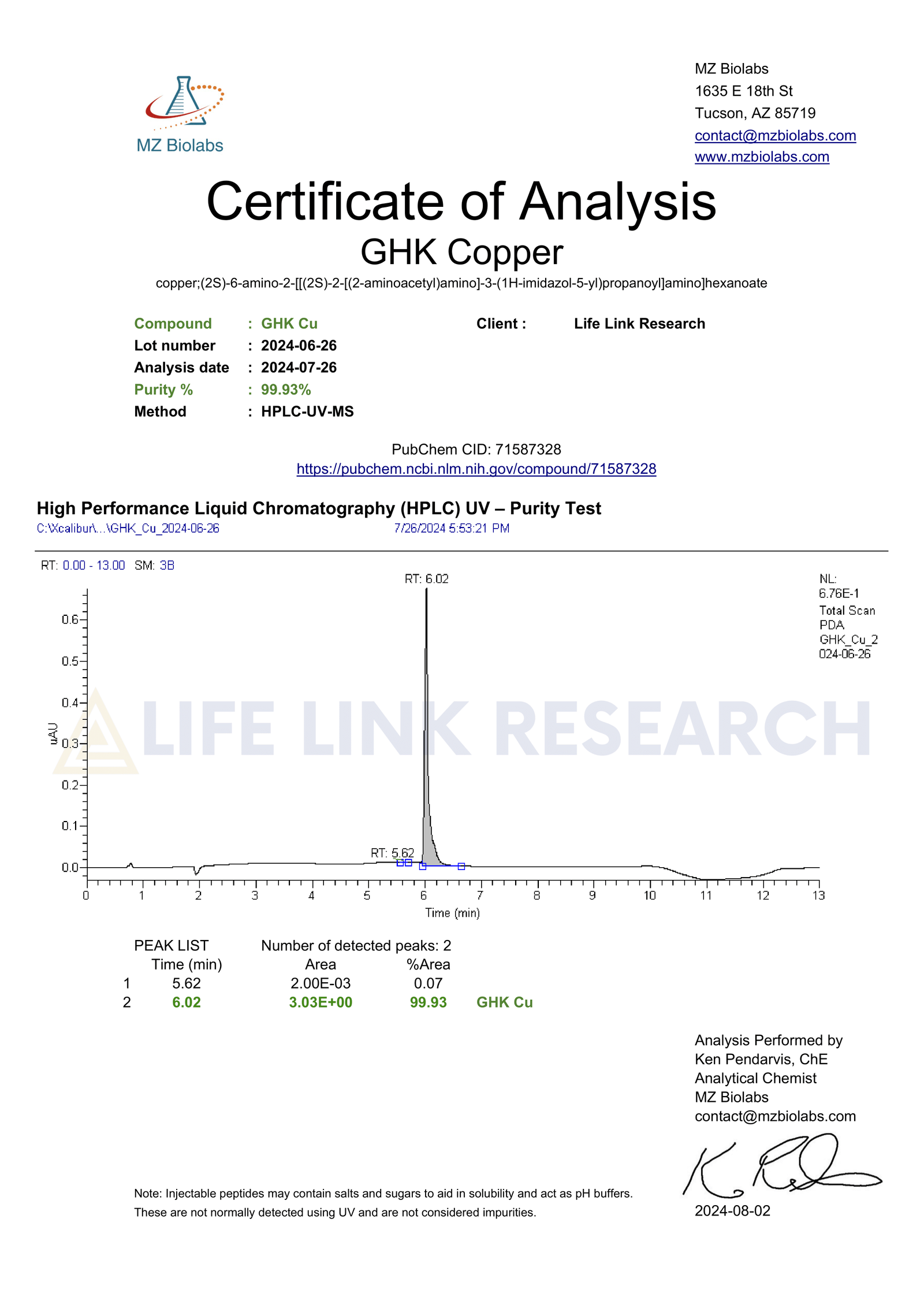
| Purity | ≥99% by reverse-phase HPLC |
| Length | 3 amino acids (Tripeptide) |
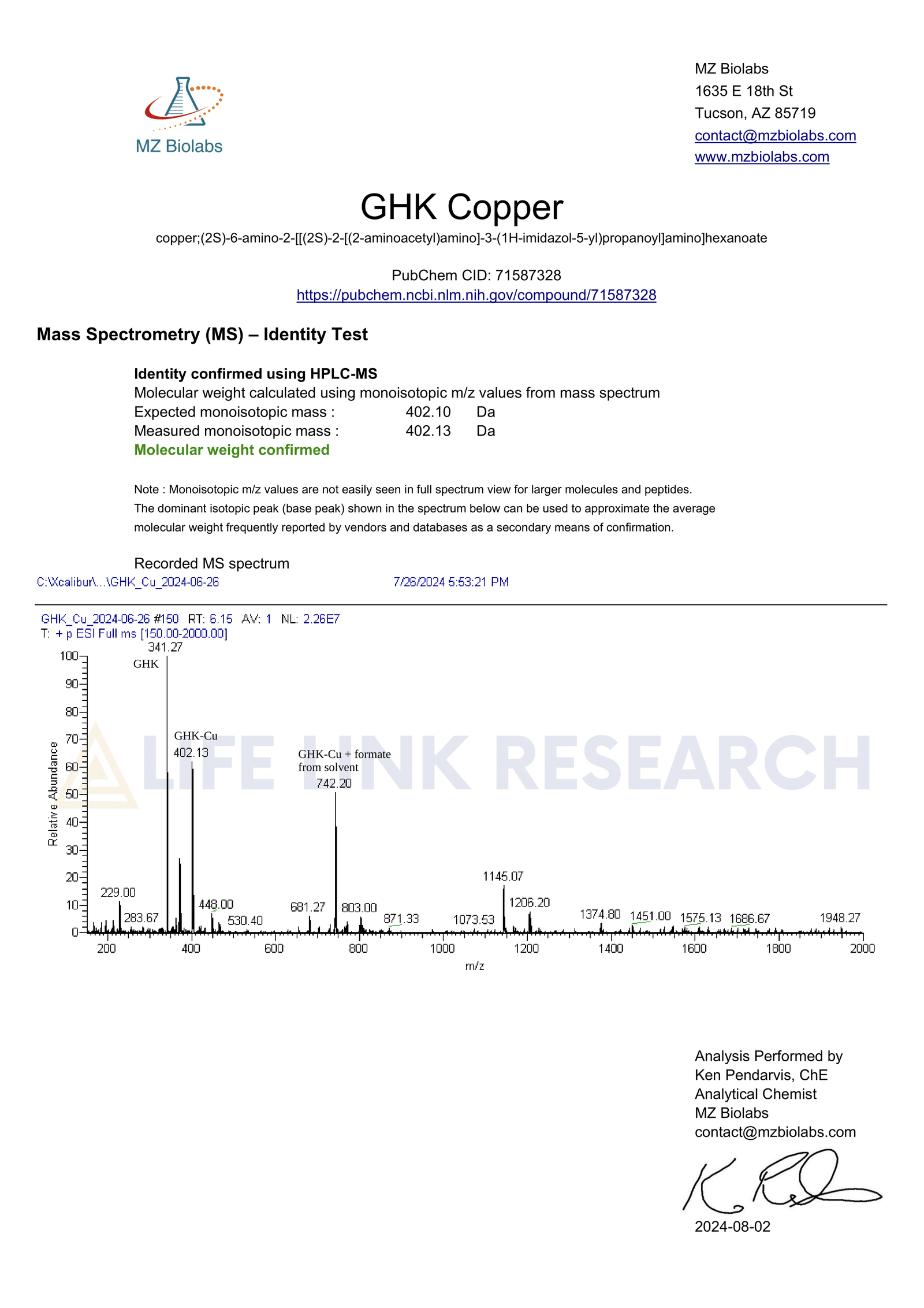
| Identity | Confirmed by ESI mass spectrometry |
| Physical form | Lyophilized powder |
| Appearance | Blue to blue-violet solid |
| Quantity | 50 mg per vial |
| Storage | -20°C, protected from light |
| Solubility | Soluble in sterile water (blue-tinged solution) |
| Classification | Research use only |
Storage & Handling
Store the sealed vial frozen at -20°C and away from light. After you prepare it, keep the blue solution refrigerated at 2-8°C and use it in your study within about two weeks. As with other compounds, letting the vial reach room temperature before opening reduces condensation, and repeated freeze-thaw cycles are best avoided so the copper complex stays intact.
Quality Assurance
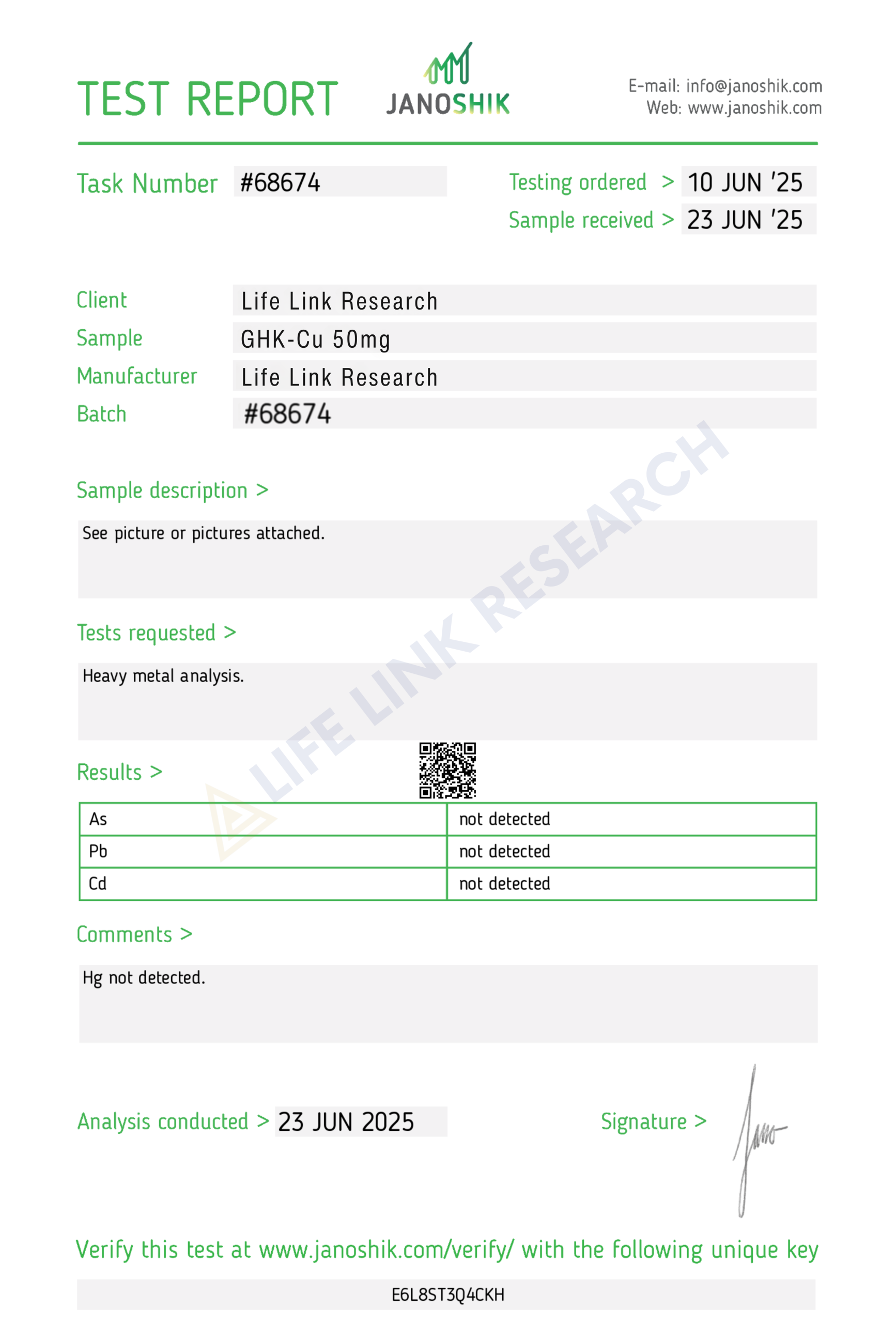
GHK-Cu is produced to research-grade manufacturing standards and verified by an independent lab before release. Reverse-phase HPLC establishes purity and mass spectrometry confirms identity, with the analysis carried out by third-party laboratories, including Janoshik Analytical and domestic US labs. A certificate of analysis is generated for each batch, so the purity and identity data belong to the vial you actually receive.
Frequently Asked Questions
What is GHK-Cu?
GHK-Cu is a naturally occurring tripeptide (glycyl-histidyl-lysine) bound to a copper ion. This copper tripeptide is studied in oxidative-stress, collagen-signaling, and extracellular-matrix research and is supplied for research use only.
Why does GHK-Cu contain copper?
The tripeptide GHK binds copper naturally, and the copper is part of what researchers study, from redox activity to collagen and matrix signaling. Without the copper it is just GHK; the complex is the active research subject.
What color is GHK-Cu, and why?
It is blue to blue-violet. The color comes from the copper(II) ion held by the peptide, so a genuine GHK-Cu powder or solution carries that characteristic tint.
What is GHK-Cu’s structure?
It is a copper complex of the tripeptide Gly-His-Lys, with CAS number 89030-95-5 and a molecular weight around 404 g/mol for the complex.
Is GHK-Cu FDA approved?
No, GHK-Cu is not an FDA-approved drug or supplement. It is a research-use-only material and is not intended for human or veterinary use.
How is GHK-Cu different from plain GHK?
GHK is the peptide on its own; GHK-Cu is that same peptide holding a copper ion. Most of the research interest is in the copper complex rather than the bare peptide.
How should GHK-Cu be stored?
Keep the powder frozen at -20°C and protected from light. Once reconstituted for research, store it at 2-8°C and use within about two weeks.
How do I confirm this GHK-Cu is what it claims?
Each batch is tested to ≥99% purity by reverse-phase HPLC with mass-spec identity confirmation by an independent lab and ships with a batch-specific certificate of analysis.
References
- Pickart L, et al. The human tripeptide GHK-Cu in oxidative-stress and redox research. 2012. PMID: 22666519.
- Tripeptide-copper complex GHK-Cu(II) collagen/extracellular-matrix readouts in a rat cell model. 2015. PMID: 25731775.
- GHK-Cu(II) tripeptide complex in a pulmonary-cell signaling model. 2024. PMID: 38879894.