
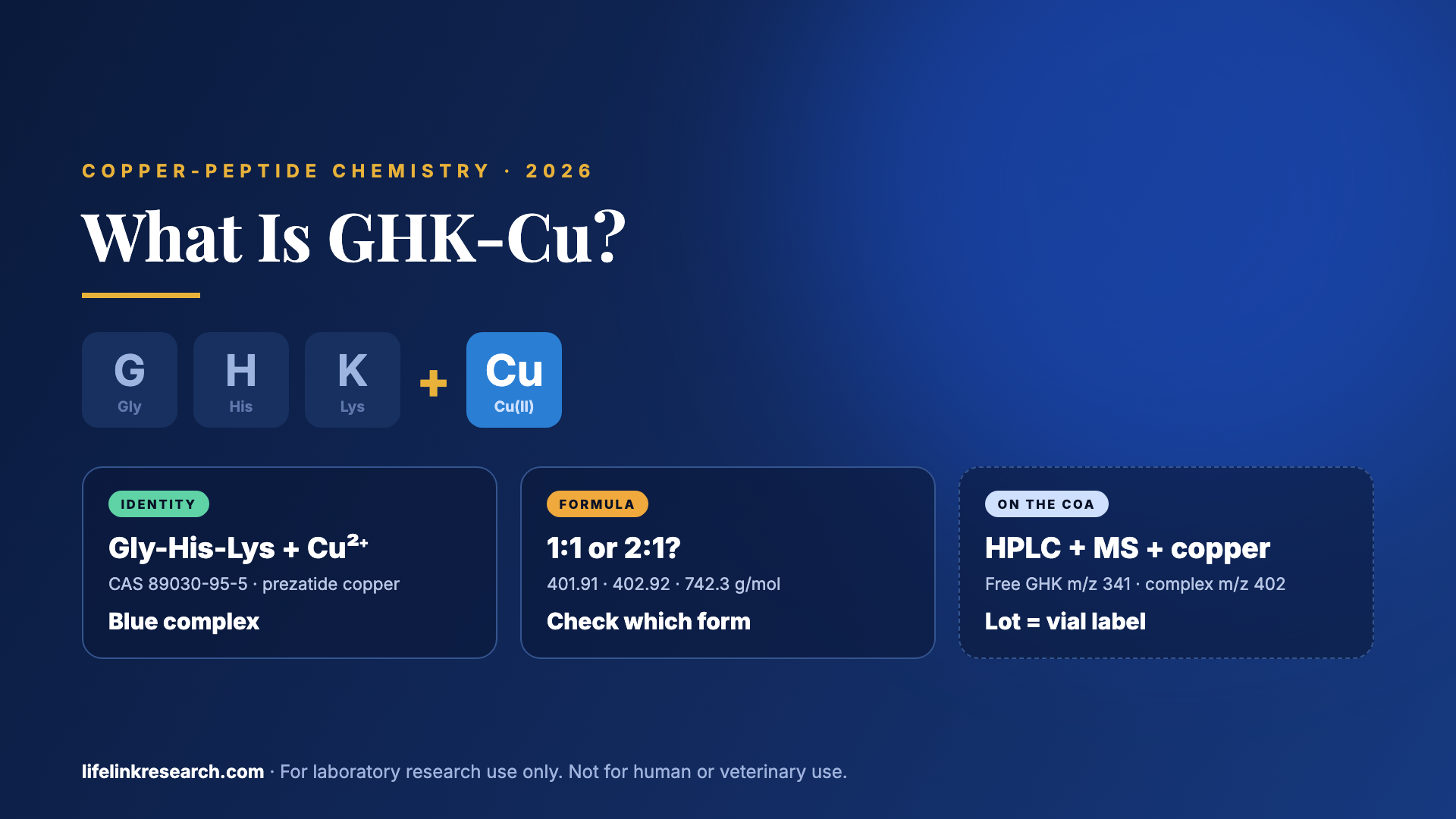
Quick Answer
GHK-Cu is the copper(II) complex of the tripeptide glycyl-L-histidyl-L-lysine (Gly-His-Lys). The peptide holds one Cu²⁺ ion through three nitrogen atoms, which turns the powder blue. It is listed under CAS 89030-95-5 (prezatide copper), and the 1:1 complex weighs about 401.9 to 402.9 g/mol depending on how hydrogens are counted.
Key takeaways
- GHK-Cu = Gly-His-Lys bound to one copper(II) ion; free GHK is a white powder
- Copper is held by the glycine amino N, the Gly-His amide N and a histidine imidazole N
- 1:1 complex: 401.91 g/mol (neutral) or 402.92 g/mol (CAS 89030-95-5 cation); 2:1 complex: 742.3 g/mol
- On a COA, mass spec shows free GHK near m/z 341 and the intact complex near m/z 402
- Also known as copper tripeptide-1 (INCI) and prezatide copper
GHK-Cu is a copper(II) complex built on glycyl-L-histidyl-L-lysine, a three-amino-acid peptide that holds a single copper ion tightly enough to turn the powder blue. That colour is a quick visual clue, and it’s also the first thing to check when a vial arrives.
So what is GHK-Cu at the level of atoms and numbers? It’s one of the smallest and best-characterised copper peptides in the research catalogue, with a crystal structure, a PubChem record and a CAS number of its own. It’s also listed with at least three different formulas, which confuses plenty of buyers.
This guide covers the molecule, how copper binds to it, why those formulas differ, and how to confirm identity on a COA, using our GHK-Cu 50 mg as the example.
What Is GHK-Cu?
Quick answer: GHK-Cu is the copper(II) complex of the tripeptide glycyl-L-histidyl-L-lysine (Gly-His-Lys). The peptide binds one Cu²⁺ ion through nitrogen atoms in its glycine and histidine residues, forming a blue coordination complex. It was first isolated from human serum in 1973 and is now made synthetically for laboratory research.
The same molecule carries several names, depending on who’s writing the label:
- GHK-Cu: the common research name, from the one-letter codes G, H and K plus copper.
- Copper tripeptide-1: its INCI name, used on cosmetic ingredient lists.
- Prezatide copper: its nonproprietary name, listed in PubChem under CAS 89030-95-5.
- Copper peptide or GHK copper: looser labels used by suppliers.
The origin story is a dated one. Loren Pickart and M. M. Thaler reported the tripeptide from human serum in Nature New Biology in May 1973, and a synthetic version followed in a paper that September. All research material today is synthetic.
GHK vs GHK-Cu: What’s the Difference?
Quick answer: GHK is the free tripeptide Gly-His-Lys with no metal bound. GHK-Cu is the same peptide carrying one copper(II) ion. They have different formulas, molecular weights, and CAS numbers, so a COA must state which form the vial contains. “Copper peptide” usually means GHK-Cu, though it can describe other copper complexes too.
| Property | GHK | GHK-Cu (prezatide copper) |
| Formula | C14H24N6O4 | C14H23CuN6O4⁺ (PubChem record for the CAS below) |
| Molecular weight | 340.38 g/mol | 402.92 g/mol |
| CAS | 49557-75-7 | 89030-95-5 |
| Appearance | White to off-white powder | Blue to blue-violet powder |
| Charge | Neutral record | Listed as a +1 cation |
| PubChem CID | 73587 | 71587328 |
When a supplier calls its product a GHK-Cu peptide, the copper form is what the label promises, and the CAS number should be 89030-95-5. The quickest field test is colour. A free GHK sample looks like any other white peptide powder, while the copper complex is unmistakably blue.
GHK-Cu Structure: How Copper Binds the Peptide
Quick answer: In GHK-Cu, the Cu²⁺ ion is held by three nitrogen atoms from the peptide: the glycine amino nitrogen, the deprotonated amide nitrogen between glycine and histidine, and the histidine imidazole nitrogen. A fourth site is filled by another ligand, which in the crystal is a carboxylate oxygen from a neighbouring GHK. This coordination gives the complex its blue colour.
Amino Acid Sequence and Stereochemistry
The sequence runs glycine, histidine, lysine, from the free amino end to the free carboxyl end. Glycine has no side chain and no stereocentre. Histidine and lysine are both the L-form, which gives the molecule two (S) stereocentres, as its IUPAC name records. The lysine side chain ends in a free amino group that stays away from the copper and carries a positive charge.
Copper Coordination Sites
The Cu(II) ion rests in a pocket formed by the first two residues. Three nitrogens grip it:
- The glycine α-amino nitrogen at the N-terminus.
- The amide nitrogen of the Gly-His peptide bond, which loses its proton to bind the metal.
- A nitrogen on histidine’s imidazole ring.
Those three donors and the copper form two small chelate rings, which is why the complex holds together so well. In the X-ray structure reported by Hureau and colleagues in 2011, the fourth position is taken by a carboxylate oxygen from the lysine of a neighbouring complex, giving a square-pyramidal arrangement. In solution, water or other ligands can occupy that position instead.
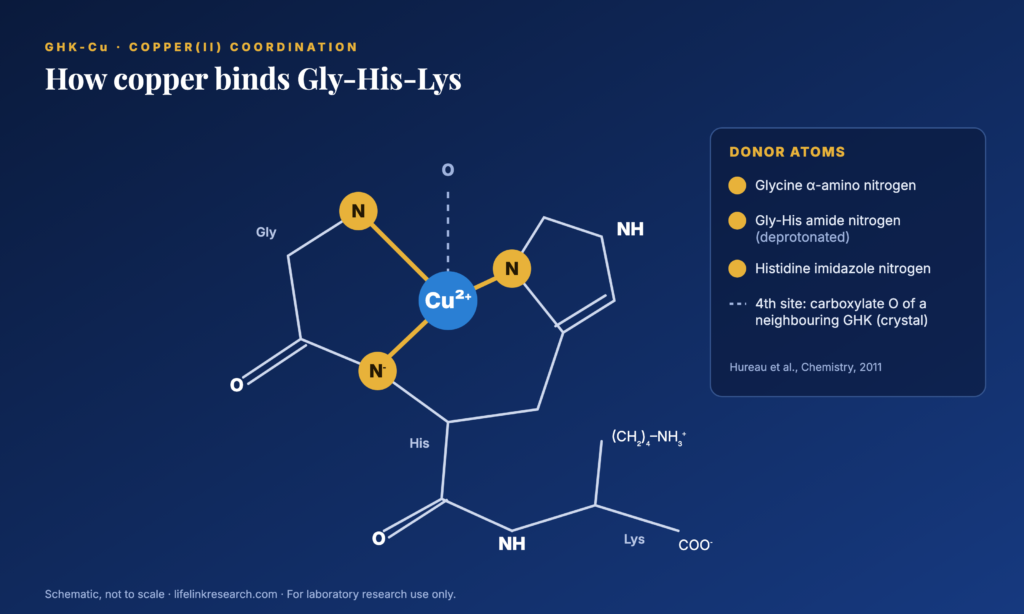
GHK-Cu structure, with the three peptide nitrogens that bind copper(II) highlighted.
Why the Powder Is Blue
Copper(II) has nine electrons in its outer d orbitals. When nitrogen atoms bind the ion, those orbitals divide into slightly different energy levels. The electrons can jump between them by absorbing visible light from the orange-red end of the spectrum, and the light left over reaches the eye as blue. A powder that looks white or pale grey has little bound copper.
GHK-Cu Molecular Weight and Formula: 1:1 vs 2:1
Quick answer: Most suppliers list GHK-Cu as the 1:1 complex, C14H22CuN6O4, with a molecular weight of about 401.9 g/mol. PubChem also lists a 2:1 form (two peptides per copper, C28H46CuN12O8), which has a much higher weight. Check which form a COA reports, because the expected mass-spec value depends on it.
The confusion comes from hydrogen counting. Binding copper strips protons from the peptide, and each database record counts them differently.
| Form | Formula | MW (g/mol) | Source |
| Free GHK | C14H24N6O4 | 340.38 | PubChem CID 73587 |
| GHK-Cu 1:1, neutral | C14H22CuN6O4 | 401.91 | PubChem CID 165429100 |
| GHK-Cu 1:1, cation (CAS 89030-95-5) | C14H23CuN6O4⁺ | 402.92 | PubChem CID 71587328 |
| GHK-Cu 2:1 (bisprezatide copper) | C28H46CuN12O8 | 742.3 | PubChem CID 9831891 |
A fourth figure turns up on some product pages: C14H24CuN6O4 at about 404. That figure is GHK plus one copper atom with no protons removed, a convenient sum that has no database record of its own. The three 1:1 figures, 401.9, 402.9, and about 404, all describe the same complex, so the useful question for any COA is which one the lab used as its reference.
Physical and Chemical Properties
| Property | Detail |
| Appearance | Blue to blue-violet lyophilized powder |
| Solubility | Soluble in water or DMSO for assay preparation |
| Storage (powder) | -20 °C, dark and dry, in the sealed vial |
| Moisture | Hygroscopic, so let the vial reach room temperature before opening |
| pH sensitivity | Copper binding depends on pH; strongly acidic conditions protonate the binding nitrogens and release copper |
The pH point is the one that catches people out. Copper binding needs the amide nitrogen to lose its proton, so at low pH the complex comes apart and the blue fades.
How to Read a GHK-Cu COA
Quick answer: A GHK-Cu COA should confirm three things. HPLC purity of the peptide, with a chromatogram. Mass-spec identity matching the expected mass for the stated form (1:1 or 2:1). Copper content, by ICP-OES or titration, showing the copper is actually bound. Also check that the lot number, test date, and testing lab match your vial.
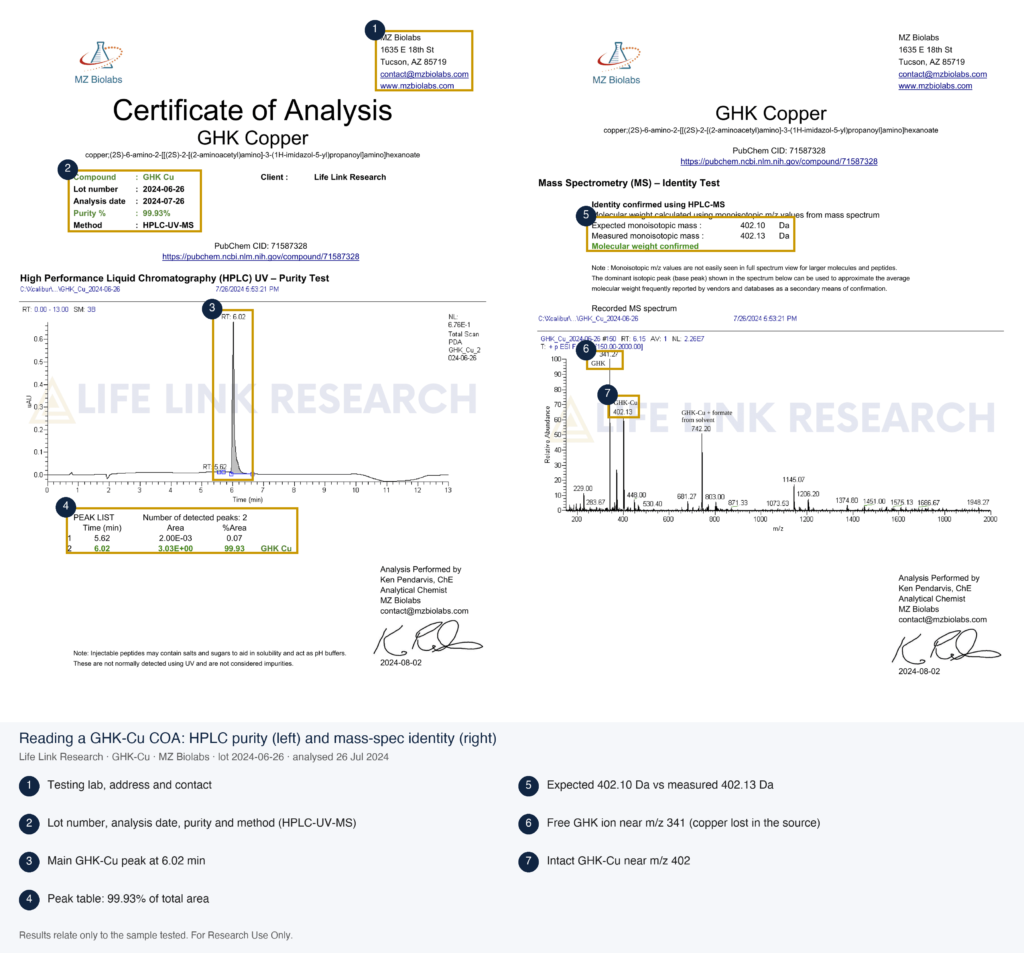
A Life Link Research GHK-Cu COA (MZ Biolabs, lot 2024-06-26) with the HPLC and mass-spec results labelled.
HPLC Purity
Look for a chromatogram with one dominant peak and a peak table showing area %, plus the method and detection wavelength. On the earlier MZ Biolabs report pictured above, the GHK-Cu peak elutes at 6.02 minutes and accounts for 99.93% of the area, with one small peak at 5.62 minutes making up the rest. A tiny tripeptide elutes early on reverse-phase columns, so a short retention time is normal here.
Mass Spec: What Mass to Expect for GHK-Cu
Electrospray mass spec often shows two signals for GHK-Cu. Some copper falls off in the instrument, so free GHK appears near m/z 341, its protonated mass. The intact complex appears near m/z 402. On the same report, the lab expected a monoisotopic mass of 402.10 Da and measured 402.13 Da. Seeing both peaks is ordinary; seeing only 341 means the copper complex wasn’t confirmed. Our guide to HPLC vs mass spectrometry explains why the two tests answer different questions.
Copper Content and Colour
Copper content is measured separately, usually by ICP-OES, an elemental analysis method, or by titration. In a 1:1 complex, copper makes up roughly 16% of the mass. A colourless or pale powder suggests free GHK, whatever the label says, so colour and copper content should agree.
Lot, Date and Lab Checks
Finish with the paperwork. The lot number on the COA should match the vial label, the test date should fit the batch, and the lab should be named with a way to check the report. Reports issued with a verification key can be confirmed on the lab’s own site. Our guide on how to verify a peptide COA covers all six checks.
What Is GHK-Cu Studied for in the Lab?
Quick answer: In laboratory research, GHK-Cu is used as a copper-binding and copper-transport model, and in cell-based assays that measure oxidative-stress markers and extracellular-matrix gene expression. Published work is mostly in vitro and animal studies. Each result applies to its own model and does not show an effect in humans.
Here’s how the main lines of work divide by study type:
| Assay type | Study type | Reference |
| Copper coordination and redox chemistry of the complex | In vitro (chemistry, X-ray) | Hureau et al., 2011 |
| Oxidative-stress markers and peroxiredoxin 6 binding in RAW264.7 macrophage cells | In vitro and animal (mouse) | Bian et al., 2024 |
| Extracellular-matrix readouts | Animal (rat) | PMID 25731775 |
| Mitochondrial-function and stress-pathway (DAF-16/SKN-1) assays | Animal (nematode, C. elegans) | Wen et al., 2026 |
| Gene-expression profiling across cell lines | Review of Connectivity Map data | Pickart and Margolina, 2018 |
| Oxidative-stress literature | Review | Pickart et al., 2012 |
The 2026 nematode study is the newest entry, published in Biogerontology in May. Read each row as a description of the model and the measurement. A result in one cell line or one species belongs to that model, and the table makes no claim beyond it.
GHK-Cu in Multi-Peptide Blends
GHK-Cu is often the largest component by mass in multi-peptide blends. In the BPC-157 + TB-500 + GHK-Cu combination, for example, it’s 50 mg beside 10 mg of each of the others. That makes its COA entry easy to overlook. Each component needs its own identity result, and GHK-Cu needs the copper-complex mass near m/z 402, ideally alongside a measured amount. Our BPC-157 + TB-500 + GHK-Cu blend guide walks through a three-component example. The four-compound BPC-157 + TB-500 + GHK-Cu + KPV kit adds KPV to the same trio, so its documents need four identity results.
Is GHK-Cu Legal? Regulatory Status in 2026
Quick answer: GHK-Cu is sold in the US as a research chemical and is used as a cosmetic ingredient under the INCI name copper tripeptide-1. It is not an FDA-approved drug. Research-grade GHK-Cu is sold for laboratory use only.
The dated record:
- Drug status: NPR reported on 7 September 2026 that GHK-Cu “isn’t an approved drug,” and topical copper-peptide products have been sold for decades.
- Compounding: the FDA’s bulk drug substances page, current as of 22 April 2026, lists a GHK-Cu nomination among those withdrawn.
- Research supply: research-grade material is sold for in-vitro laboratory work under research-use terms.
Buy GHK-Cu 50 mg with a Batch COA
Our GHK-Cu comes as 50 mg of blue lyophilized powder per vial. Identity and purity are tested on every batch through Janoshik Analytical and US-based laboratories, with current and earlier reports kept on the product’s certificate page. To find the batch COA, open the product, click View report and match the batch number to the vial label. Orders placed before 2 PM PST ship the same day from California by UPS 2-Day Air.
FAQs
What does GHK stand for?
GHK stands for the three amino acids in the peptide, written in one-letter code: G for glycine, H for histidine, and K for lysine. The full name is glycyl-L-histidyl-L-lysine. Adding “-Cu” marks the form with a copper(II) ion bound to the glycine and histidine end.
Is GHK-Cu the same as copper peptide?
Usually, yes. “Copper peptide” on a label almost always means GHK-Cu, also listed as copper tripeptide-1 or prezatide copper. The phrase can technically describe other copper-binding peptides, though, so the sequence Gly-His-Lys and CAS 89030-95-5 on the COA are the reliable identifiers.
What is the molecular weight of GHK-Cu?
The 1:1 complex weighs 401.91 g/mol as a neutral formula (C14H22CuN6O4) or 402.92 g/mol as the cation; PubChem links to CAS 89030-95-5. The 2:1 complex, two peptides per copper, weighs about 742.3 g/mol. Free GHK without copper weighs 340.38 g/mol.
Why is GHK-Cu blue?
The colour comes from the copper(II) ion. Bound by three nitrogen atoms, copper absorbs light from the orange-red part of the visible spectrum through d-d electron transitions, so the light that remains looks blue. Free GHK without copper is a white powder.
What should a GHK-Cu COA include?
A complete GHK-Cu COA shows HPLC purity with a chromatogram and a mass-spec result near m/z 402 for the copper complex. Ideally, it also reports how much copper is present, measured by elemental analysis. Add the usual paperwork: a lot number matching the vial, a test date, and a named, checkable lab.
How should lyophilized GHK-Cu be stored?
Store the sealed vial of powder at -20 °C, dry and protected from light. Because the powder pulls in moisture, warm the closed vial to room temperature first and open it only then. A steady blue colour is a simple visual check that the copper complex is intact.
For Research Use Only. Not for use in diagnostic or therapeutic procedures.
All products are supplied for in-vitro laboratory research by qualified professionals. Read the full research use disclaimer.
References
- PubChem CID 71587328, prezatide copper (GHK-Cu): https://pubchem.ncbi.nlm.nih.gov/compound/71587328
- Pickart and Thaler, Nature New Biology, 1973 (PMID 4349963): https://pubmed.ncbi.nlm.nih.gov/4349963/
- PubChem CID 73587, GHK: https://pubchem.ncbi.nlm.nih.gov/compound/73587
- Hureau et al., Chemistry, 2011 (PMID 21780203): https://pubmed.ncbi.nlm.nih.gov/21780203/
- PubChem CID 165429100, GHK-Cu 1:1 neutral: https://pubchem.ncbi.nlm.nih.gov/compound/165429100
- PubChem CID 9831891, bisprezatide copper (2:1): https://pubchem.ncbi.nlm.nih.gov/compound/9831891
- Bian et al., Redox Biology, 2024 (PMID 38879894): https://pubmed.ncbi.nlm.nih.gov/38879894/
- J Orthop Res, 2015 (PMID 25731775): https://pubmed.ncbi.nlm.nih.gov/25731775/
- Wen et al., Biogerontology, 2026 (PMID 42084774): https://pubmed.ncbi.nlm.nih.gov/42084774/
- Pickart and Margolina, Int J Mol Sci, 2018 (PMC6073405): https://pmc.ncbi.nlm.nih.gov/articles/PMC6073405/
- Pickart et al., Oxid Med Cell Longev, 2012 (PMID 22666519): https://pubmed.ncbi.nlm.nih.gov/22666519/
- NPR, 7 September 2026: npr.org/2026/09/07/nx-s1-5955552
- FDA, bulk drug substances for compounding (current as of 22 April 2026): https://www.fda.gov/drugs/human-drug-compounding/certain-bulk-drug-substances-use-compounding-may-present-significant-safety-risks
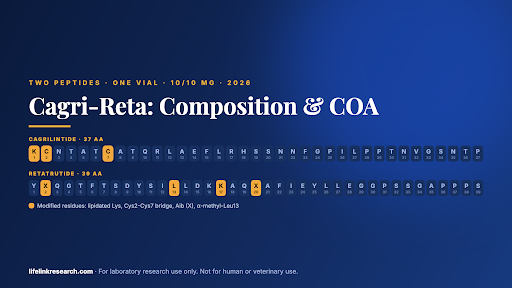
Cagri-Reta (Cagrilintide + Retatrutide): Composition, Structure & COA
Quick Answer Cagri-Reta is a research blend of two synthetic peptides in one vial: cagrilintide, a long-acting amylin analog (4409.0 g/mol), and…
Read article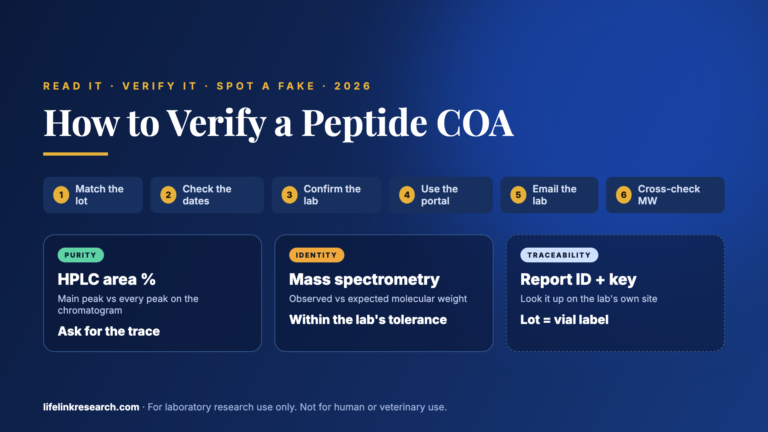
How to Verify a Peptide COA Is Real (and Spot a Faked One)
Quick Answer To verify a peptide COA, check the vial’s lot number against the report, confirm the named lab exists and is…
Read article
What Is TB-500? Thymosin Beta-4, Full-Length vs Fragment
Quick Answer TB-500 is a market name used for two different molecules. Some sellers mean full-length thymosin beta-4 (Tβ4), a 43-residue protein…
Read articleResearch-grade peptides
99%+ purity. Verified every batch.
Identity and purity tested on every batch by third-party labs, Janoshik Analytical and US-based laboratories. Shipped same day from California.
Shop all peptides