
Last updated: June 2026. 2025–2026 was an extinction-level stretch for grey-market research-peptide suppliers. At least eight major vendors went dark between mid-2025 and early 2026 under a convergence of FDA enforcement, pharmaceutical litigation against GLP-1 suppliers, payment-processor cutoffs, and failed third-party testing. The real question now isn’t “where’s the cheapest replacement” — it’s “how do I tell who is actually trustworthy before I send money again.”
This page is two things: a sourced status list of who closed and who is still operating, and a 7-point checklist you can apply to any vendor yourself. We operate Life Link Research, so treat our self-assessment with appropriate skepticism — every claim we make about ourselves links to verifiable proof, and the checklist lets you score us exactly the way you would score anyone else. For licensed laboratory research use only.
The shutdown list (2025–2026)
Status reflects publicly reported cessation of operations; verify current status before transacting with anyone.
| Vendor | Status | When | Publicly reported reason |
|---|---|---|---|
| Peptide Sciences | Closed | Mar 6, 2026 | Voluntary shutdown amid FDA pressure, GLP-1 litigation |
| Science.bio | Closed | Jan 2026 | Ceased operations under regulatory pressure |
| Amino Asylum | Closed | 2025 | FDA warehouse raid (June 2025); founders entered federal guilty pleas (Dec 2025) |
| Paradigm Peptides | Closed | 2025–2026 | Reported closure during the enforcement wave |
| Royal Research | Closed | 2025–2026 | Reported closure during the enforcement wave |
| Peptide Tech Labs | Closed | 2025–2026 | Reported closure during the enforcement wave |
| American Research Labs | Closed | 2025–2026 | Reported closure during the enforcement wave |
| Unchained Compounds | Closed | 2025–2026 | Reported closure during the enforcement wave |
Deep-dives: Science.bio.
What caused the 2025–2026 vendor collapse
- FDA enforcement escalated from letters to raids — 50+ warning letters to GLP-1 compounders and manufacturers in September 2025, plus at least one warehouse raid that took a major vendor offline overnight.
- GLP-1 litigation from Eli Lilly and Novo Nordisk targeting semaglutide suppliers.
- Payment-processor cutoffs that stranded orders.
- Failed third-party testing — independent labs flagged quality failures, the trust trigger that pushed buyers to leave.
The 7-point vendor trust checklist (score anyone, including us)
Give 1 point per “yes.” 6–7 = strong; 4–5 = proceed with caution; 3 or fewer = walk away.
- Third-party COA, not in-house — a certificate of analysis from an independent lab (e.g., Janoshik), not a self-issued sheet.
- Batch/lot-specific COAs — each COA is tied to a specific production lot.
- Full panel — identity and purity on every batch, plus safety testing (sterility, endotoxin, heavy metals) on a defined schedule.
- Public COA library — browsable on-site before you buy.
- Track record — 12+ months under the same name with a real support channel.
- Domestic stock & fulfillment — US warehouse and shipping.
- Transparent ownership & stable payments.
How Life Link Research scores (verify it yourself)
| Criterion | Life Link | Proof |
|---|---|---|
| Third-party COA | Yes | Janoshik & third-party labs — COA library |
| Batch/lot-specific | Yes | Lot numbers shown on COAs |
| Full third-party testing panel | Yes | Identity + purity every batch; heavy metals, sterility + endotoxin rotating |
| Public COA library | Yes | lifelinkresearch.com/coa |
| Track record | Yes | Operating with responsive support |
| US stock & shipping | Yes | Ships from the USA |
| Transparent + stable payments | Yes | Card, ACH, and BTCPay crypto; 30-day money-back guarantee |
If your vendor shut down, here is the tested equivalent
Mapped to the closed vendors’ most-popular compounds (GLP-1 analogs first). For licensed laboratory research use only.
| If you bought… | From a closed vendor | Tested equivalent at Life Link |
| Semaglutide | Multiple | Browse semaglutide |
| Cagrisema / Cagrilintide | Multiple | Browse cagrisema |
| BPC-157 / TB-500 | Amino Asylum / Science.bio | Browse BPC-157 |
| Ipamorelin / CJC-1295 / GHK-Cu / KPV / DSIP / MT-2 | Science.bio / Amino Asylum | Shop all |
Switching from a closed vendor? Use code SWITCH15 for 15% off your first order.
Frequently asked questions
Which research peptide vendors shut down in 2026?
Peptide Sciences (March 6, 2026) and Science.bio (January 2026) are the largest; at least eight closed across 2025–2026, including Amino Asylum, Paradigm Peptides, Royal Research, Peptide Tech Labs, American Research Labs, and Unchained Compounds.
Why did so many peptide vendors close at once?
A convergence of FDA enforcement (warning letters and at least one warehouse raid), GLP-1 litigation from Eli Lilly and Novo Nordisk, payment-processor cutoffs, and failed third-party testing.
How do I know if a peptide vendor is legit?
Apply the 7-point checklist above. The single most important factors are independent, batch-specific COAs and a public COA library you can check before buying.
What is a trustworthy alternative now?
Any vendor that scores 6–7 on the checklist. We score our own COAs and testing transparently above so you can verify rather than trust.
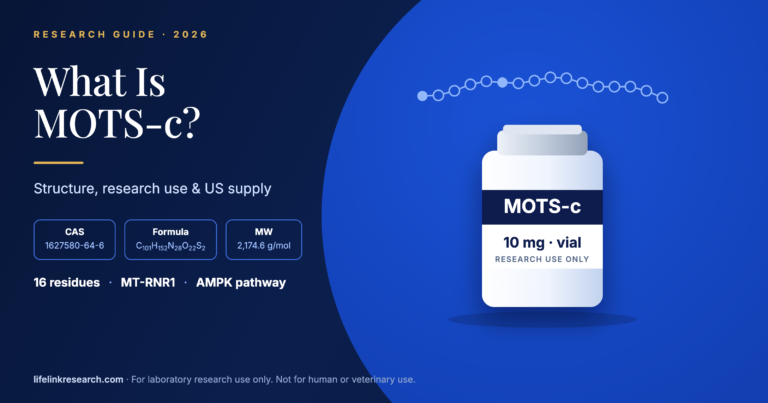
What Is MOTS-c? Structure, Research Use & US Supply
Quick Answer MOTS-c is a 16-amino-acid peptide coded within a short open reading frame of the mitochondrial 12S rRNA gene (MT-RNR1). It…
Read article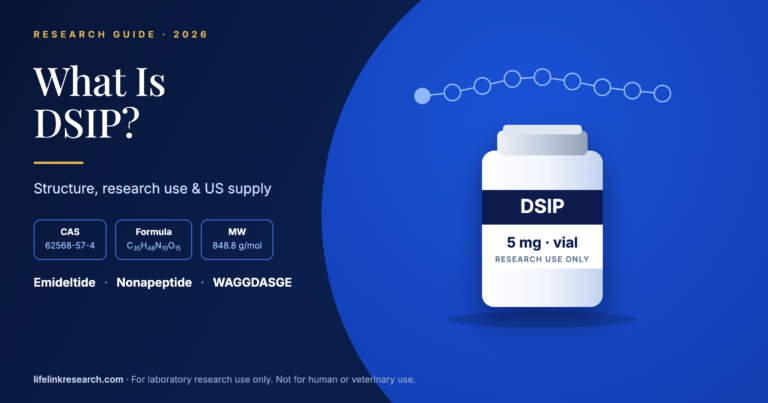
What Is DSIP? Structure, Research Use & US Supply
DSIP is a synthetic nine-residue peptide, WAGGDASGE, listed under the international name Emideltide. On July 24, 2026, it drew the narrowest vote…
Read article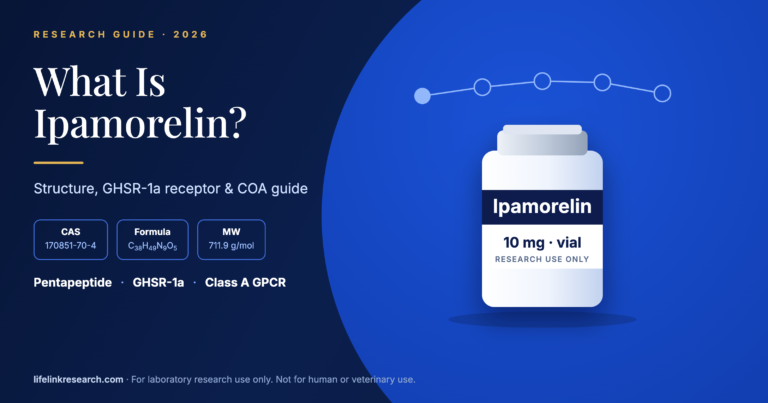
What Is Ipamorelin? Structure, GHSR-1a Receptor and COA Guide
Ipamorelin is a synthetic five-residue peptide that acts as an agonist at the ghrelin receptor, GHSR-1a. It started life as a subtraction.…
Read articleResearch-grade peptides
99%+ purity. Verified every batch.
Identity and purity tested on every batch by third-party labs, Janoshik Analytical and US-based laboratories. Shipped same day from California.
Shop all peptides