For Research Use Only. Not for use in diagnostic or therapeutic procedures.
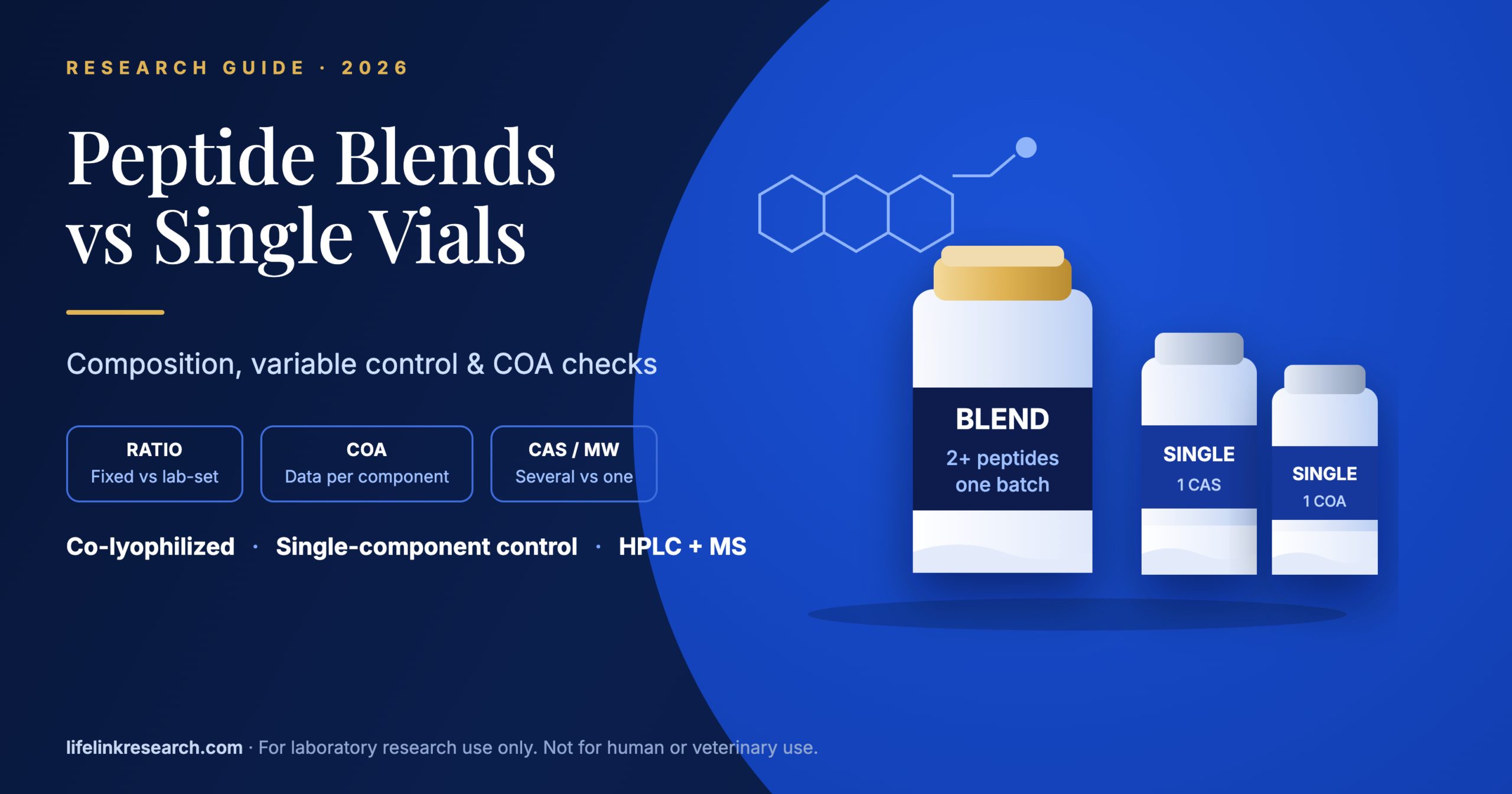
Choosing between peptide blends vs single peptides comes down to one design question: does your study need to isolate each compound, or is it studying a fixed combination as a unit? If you need to know which peptide produced a measured result, single vials give you that. If the combination itself is the object of study, a blend can fit.
This guide compares the two formats on composition, variable control, documentation and COA checks. It also walks through a blend certificate component by component, so you can judge any blend before it reaches the bench.
Key takeaways
A blend is a fixed-ratio mixture of separate peptides in one vial.
Single vials let you assign a result to one compound and set any ratio.
A blend COA must show identity and amount for every component.
Product names don’t tell you the composition. The label and COA do.
What Is a Peptide Blend?
A peptide blend is two or more synthetic peptides lyophilized together in one vial at a fixed, labelled ratio, for example a BPC-157 / TB-500 mixture. Each component keeps its own sequence, molecular weight and CAS number, so a blend is a mixture of distinct reagents, and its COA must report every component.
The ratio is locked in when the vial is filled. A 10 mg / 10 mg mixture stays 1:1 for every sample drawn from that vial, and no step at the bench can change it.
Every component also shares one batch number. That’s convenient for record keeping, since one lot code covers the whole vial. It also means a single documentation trail has to carry the identity and content data for two, three or four different molecules at once.
What Is a Single-Peptide Vial?
A single-peptide vial holds one synthetic sequence as a lyophilized powder, with one CAS number, one molecular weight and one HPLC purity result on its batch COA. Because only one compound is present, the amount, identity and purity of the material in an experiment can be traced to one specification.
That one-to-one link is the whole appeal. When a lab notebook records “BPC-157, batch X,” anyone reviewing the work later can pull up a single certificate and see exactly what went into the assay. If you’re new to how these reagents are described and documented, our introduction to research peptides covers the basics.
Peptide Blends vs Single Vials: Side-by-Side Comparison
Most of the differences trace back to one fact: a blend puts several reagents under one label, one batch and one certificate. Single vials give each reagent its own.
Here’s how that plays out across the points labs usually weigh:
Feature
Blend
Single vials
Components per vial
Two or more
One
Ratio
Fixed at manufacture
Set by the lab
Assigning a result to one compound
Needs extra controls
Direct
CAS number and MW
Several per vial
One per vial
COA content
Data for each component
Data for one compound
Analytical complexity
Higher
Lower
Batch traceability
One batch for all components
One batch per compound
Cost
Compare per mg of each component
Compare per mg of each component
Flexibility
Limited to the labelled ratio
Any ratio or concentration
A BPC-157 10 mg single vial is a typical example of the right-hand column: one sequence, one CAS number (137525-51-0), one certificate.
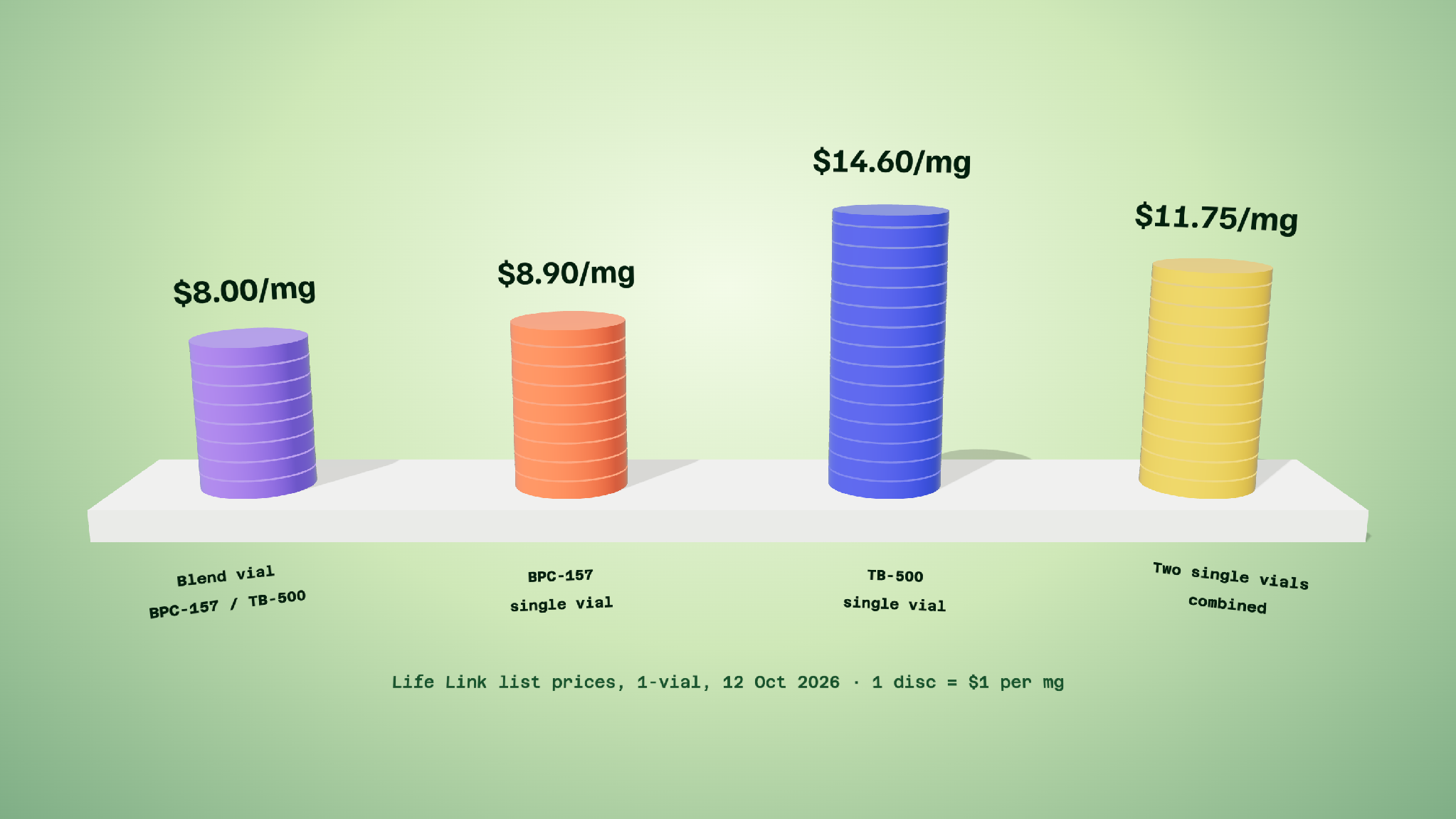
The cost row deserves a closer look. Comparing sticker prices tells you little, because a blend vial holds more total peptide. Divide the price by the mg of each component, then add any single vials you’ll need as controls.
Why Is Attribution Harder With a Blend?
In a blend, every component is present in every sample, so a result measured in an assay can’t be assigned to one peptide without separate single-component controls. The ratio is also fixed at manufacture, which means the concentration of one component can’t change without changing the others.
Statisticians call this confounding. Two variables move together, so the data can’t tell them apart.
Picture a concentration series run with a 1:1 mixture. Doubling the amount of material doubles both peptides at once. Any change in the readout lines up with both, and the experiment has no way to say which one drove it.
The fix is a control design that breaks the link:
Component A alone, at the same concentration it has in the mixture
Component B alone, matched the same way
The mixture, run alongside both
A vehicle control, so the baseline is clear
That’s four arms where a single-compound study might need two. Plan the extra plate space, reagent quantity and analysis time up front.
When Does a Single Vial Make More Sense?
Single vials suit studies that need to isolate one variable: concentration-response series in an assay, receptor-binding work, reference standards, or controls for a blend experiment. They also let a lab set any ratio between compounds, while a blend arrives at the ratio the manufacturer chose.
Isolating one variable
A concentration-response curve only means something when one thing changes. With a single vial, the x-axis is one compound, and every point on the curve traces back to one certificate.
Building controls for a blend study
Even a lab committed to a blend usually needs single vials too. The single-component arms described above can’t be run from the mixture, so budget for them from the start.
Reference standards and receptor-binding assays
Binding constants, calibration curves and retention-time references all assume a single known analyte. A second peptide in the same solution can compete for the same site or overlap on the same chromatogram.
Needing a ratio other than the labelled one
Need a 2:1 ratio, or a whole series of ratios? Separate vials let you set each amount independently. A blend gives you one ratio per product.
When Can a Peptide Blend Make Sense?
A blend can make sense when the research question is about a defined combination at a fixed ratio, such as replicating a published design that used that exact mixture. It also means one batch number and one COA for the combined material, with fewer weighing steps. It does not tell you what each component contributes.
Replication is the strongest case. If a protocol you’re following specified a 1:1 BPC-157 / TB-500 mixture, using a pre-combined vial at that ratio removes one source of variation between your work and the original.
Fewer weighing steps help too. Every separate weighing adds its own error, and with small masses on an analytical balance those errors add up. A BPC-157 / TB-500 mixture at 10 mg of each peptide is a common example of a fixed 1:1 design.
The trade-off from the attribution section still applies: the blend describes the pair, and only single-component controls can describe each half.
Blend vs Separate Vials: Is the Material the Same?
Not exactly. A pre-blended vial is co-lyophilized under one batch, so its COA must confirm each component and the ratio in that one lot. Separate vials each carry their own batch COA, giving independent identity and purity data per compound. The chemistry can match; the documentation and traceability differ.
The peptides themselves can be the same sequences made the same way. What changes is the paper trail around them.
Documentation point
Pre-blended vial
Separate vials
Batch numbers
One for all components
One per compound
Certificates
One, covering every component
One per compound
Who confirms the ratio
The manufacturer, on the COA
The lab, in its own records
Re-testing one component
Requires testing the whole mixture
Test that vial alone
For audit purposes, separate vials give each compound its own independent record. A blend puts all of that weight on one document, so anyone choosing the pre-blended route needs to read that certificate closely.
How Do You Check a Peptide Blend’s COA?
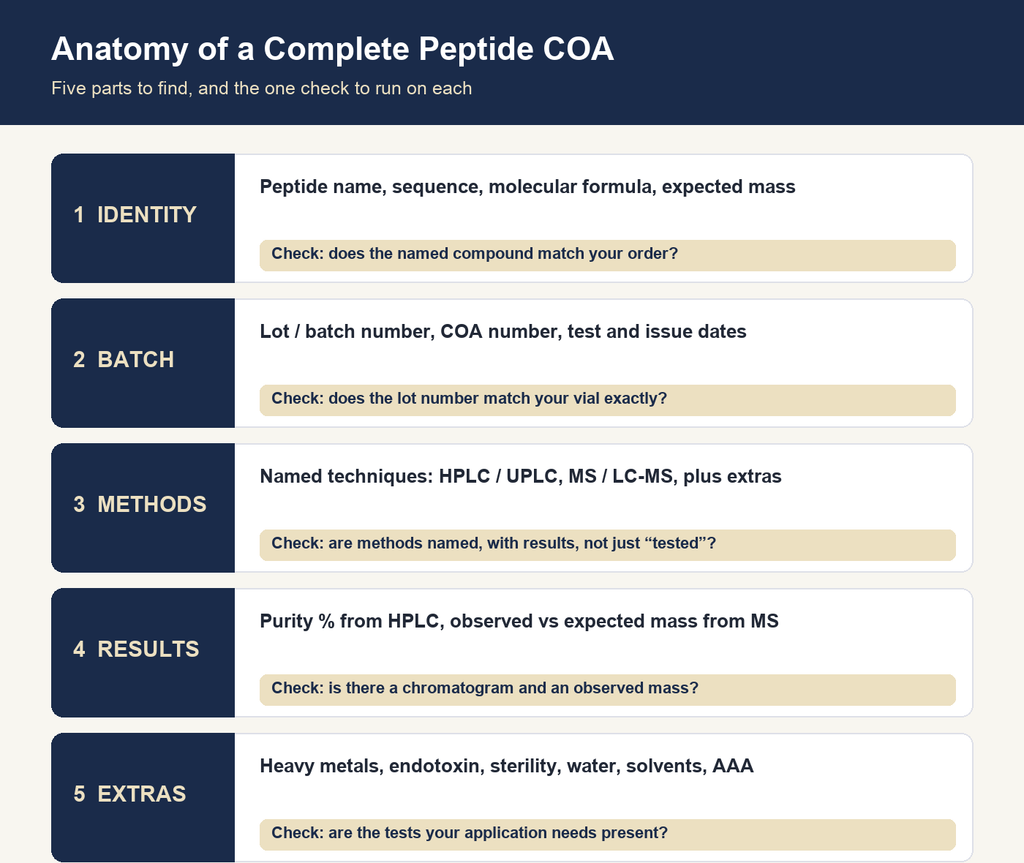
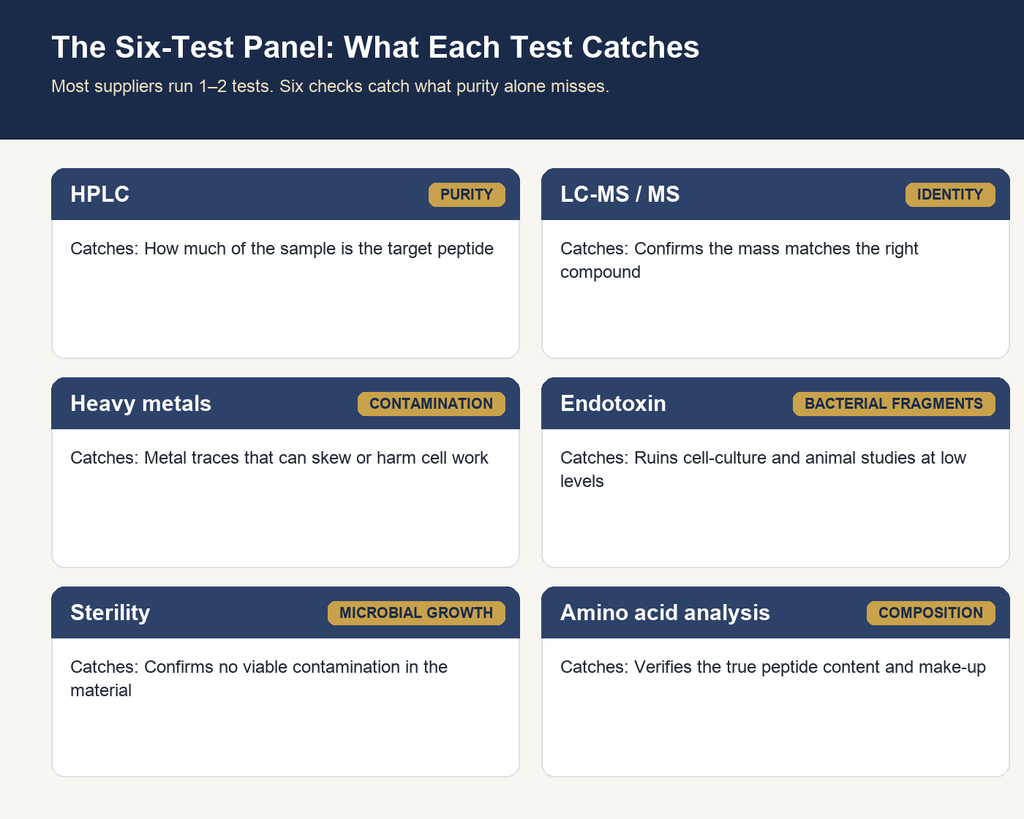
Check that the COA lists every component by name, confirms each one’s identity by mass spectrometry, reports a separate HPLC result per component, and states the labelled amount or ratio for each. A blend COA with one purity number and no per-component data can’t show what is in the vial.
The underlying standard comes from analytical method validation. The ICH Q2 guideline defines specificity as the ability to “assess unequivocally the analyte in the presence of components which may be expected to be present” (ICH Q2(R1), EMA). In a blend, the other peptides are exactly those expected components, so the method has to tell each one apart. Our guide on how to read a peptide COA covers the general layout; the checks below are specific to blends.
Identity by mass spectrometry for each component
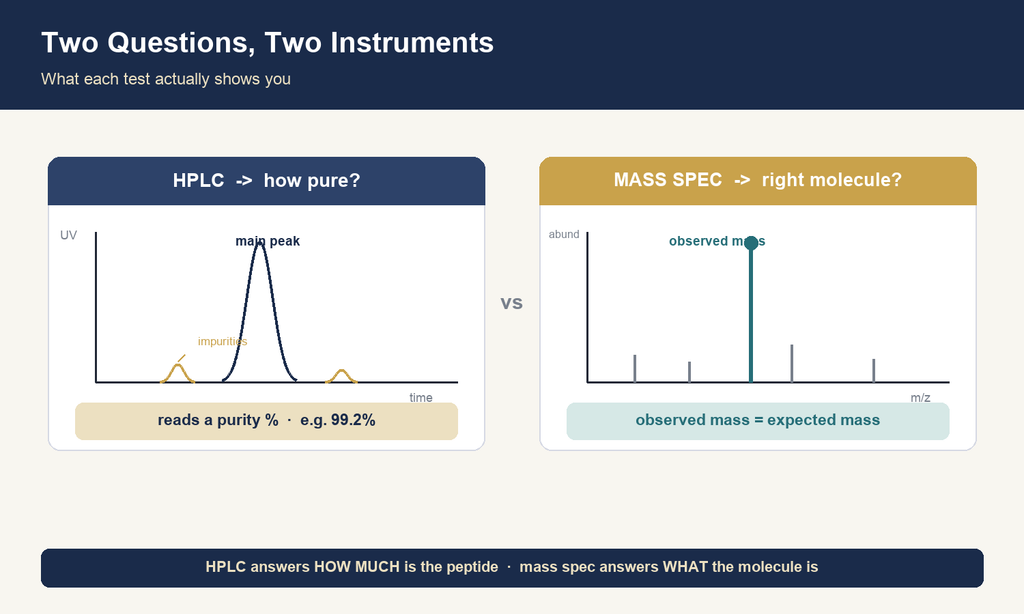
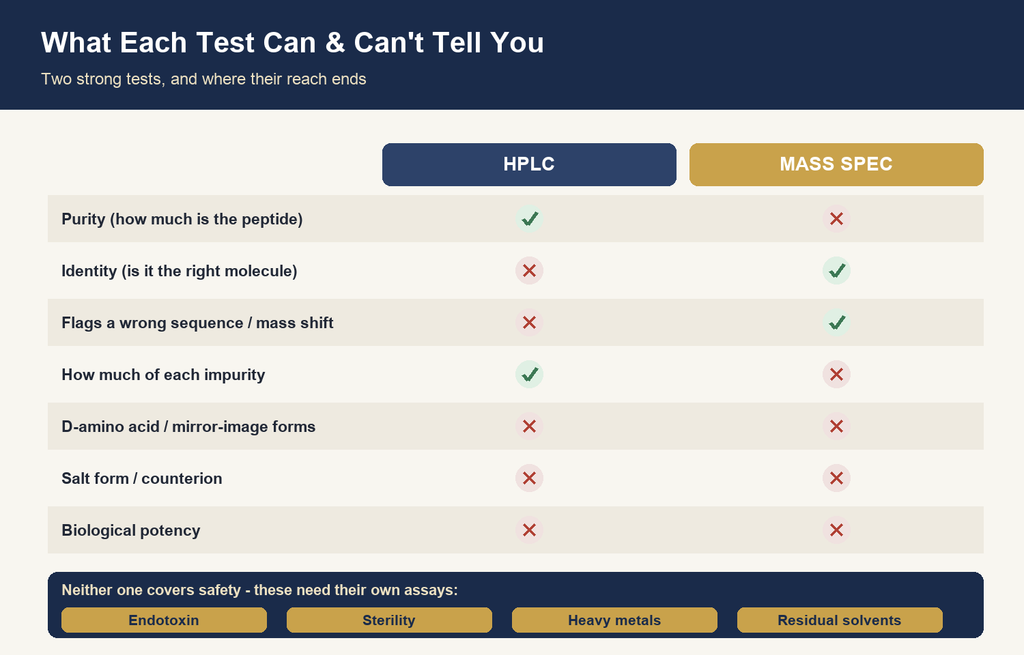
Mass spectrometry confirms identity by matching an observed mass to the expected one. For a blend, every expected mass should appear on the report, one per component. A spectrum showing only one peptide’s mass leaves the others unconfirmed. Here’s how the two techniques divide the work: HPLC vs mass spectrometry.
HPLC purity for each component
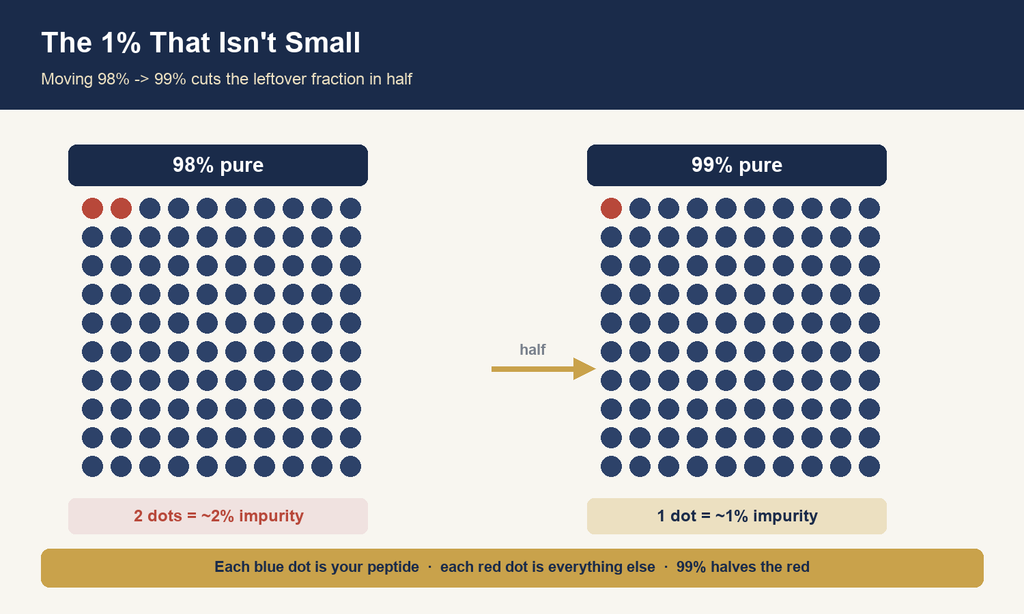
A well-resolved chromatogram shows a separate main peak for each peptide, and the report gives a separate purity result for each. Look for purity by HPLC, see the batch result, listed against every component name. For context on the figures themselves, see what 98% vs 99% purity means.
Ratio and content
Compare the labelled mg of each component with the measured mg. A useful report lists a measured amount for every peptide on its own line, so you can confirm the ratio in that lot matches the label.
Does a blend have one CAS number or molecular weight?
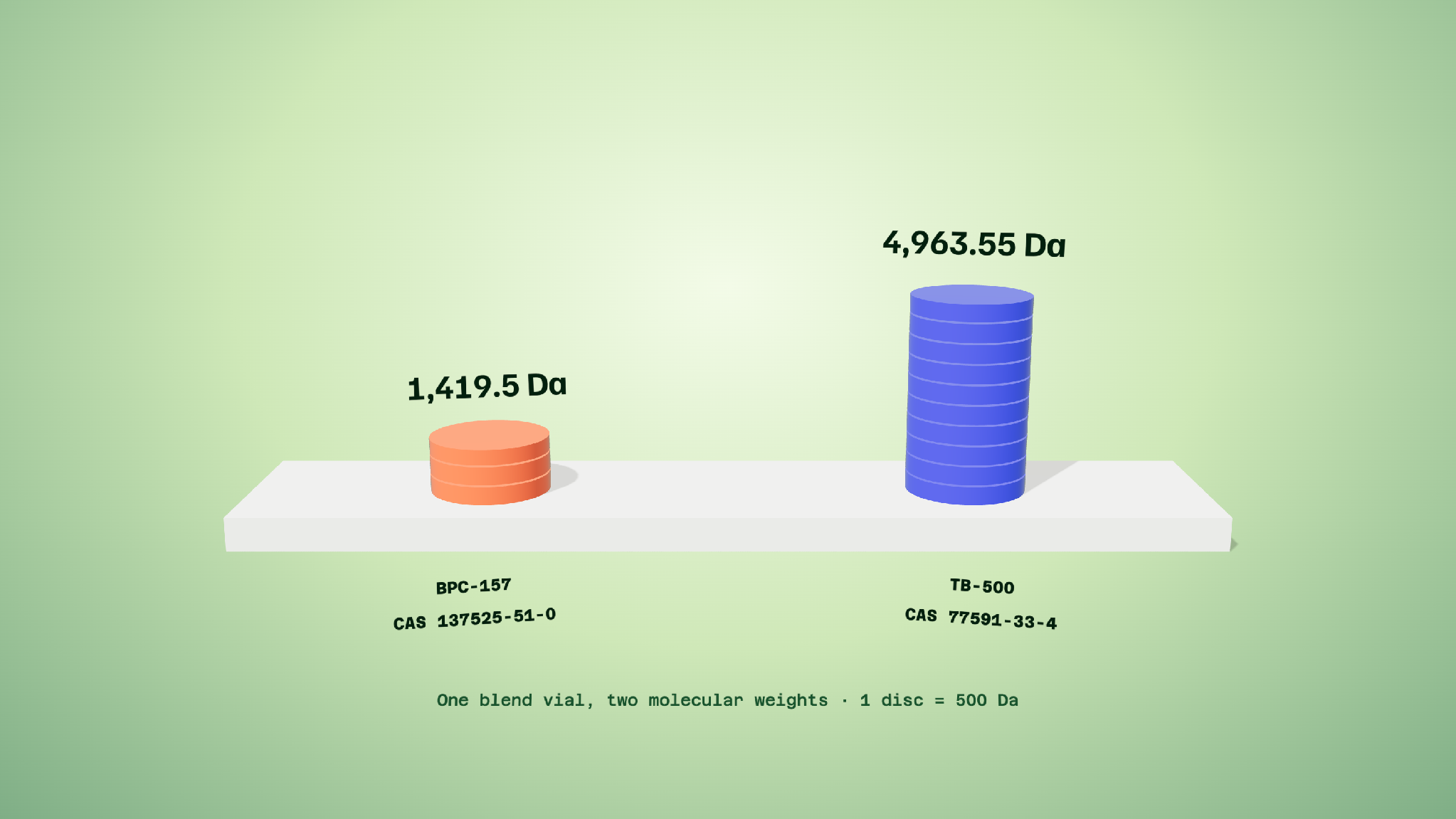
No. Each component keeps its own. On a BPC-157 / TB-500 mixture, expect BPC-157 (CAS 137525-51-0) and TB-500 (CAS 77591-33-4) listed as separate lines, each with its own molecular weight.
Red flags
One blended purity figure for the whole vial
No mass spectrometry data
No batch number
No labelled amount or ratio for each component
Blend vs “Stack”: What Do the Terms Mean?
A blend is several peptides in one vial. “Stack” is a marketing term usually used for separate vials sold together, and it carries no technical definition. For research documentation, describe either one by its components and amounts, for example “GHK-Cu / BPC-157 / TB-500 mixture,” in place of the product nickname.
Lab records should read the same way a methods section would: compound names, amounts and batch numbers.
Why Do Blends Have Names Like GLOW or KLOW?
Names such as GLOW, KLOW or Wolverine are brand names. They don’t tell you the components, the ratio or the amount of each peptide. Check the label and COA for the composition, for example GHK-Cu / BPC-157 / TB-500 / KPV, before comparing any two blend products.
Do Blends Need Different Storage From Single Vials?
Lyophilized blends and single vials follow the same general storage approach: cold, dry and away from light, as stated on the product label. With a blend, check the stability data for every component, because the vial is only as stable as its least stable peptide.
Read the sealed-vial condition printed for the blend, then confirm it against the data for each component. The peptide storage guide covers general handling, and lyophilized vs pre-mixed peptides explains why the dry form is the shipping standard.
How to Choose: 5 Questions to Ask
Run through these before ordering:
Do you need to assign a result to one compound? Choose single vials.
Do you need a ratio other than the labelled one? Choose single vials.
Are you replicating a design that used this exact fixed-ratio mixture? A blend may fit.
Does the blend COA give identity, purity and amount for each component? If not, choose single vials.
Will you need single-component controls anyway? Budget for single vials alongside the blend.
Peptide Blends vs Single Vials FAQs
Are peptide blends better than single peptides?
Neither format is better in general. The right one depends on the research question, and mainly on whether you need to attribute a result to one compound.
Can a blend’s components be measured separately?
Yes, analytically. HPLC separates the components into individual peaks, and mass spectrometry confirms each mass. A per-component COA reports those results line by line.
Is a blend cheaper than single vials?
Sometimes. Compare the cost per mg of each component, then add the single vials you’ll need for controls. The total study cost is the fairer comparison.
Does each component in a blend need its own COA data?
Yes. The batch COA should give identity and purity for each component, plus its measured amount against the label.
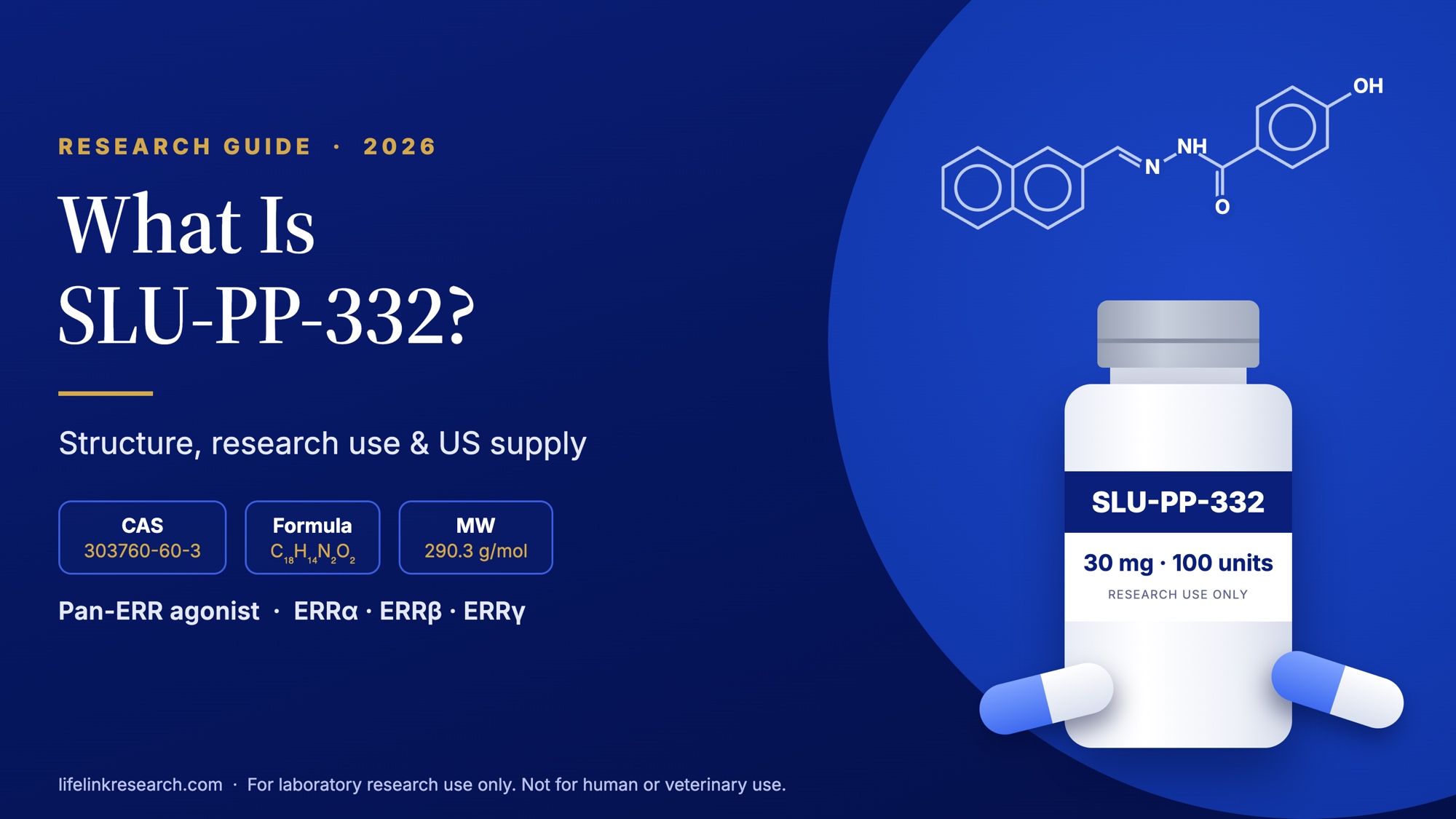
SLU-PP-332 is a synthetic small-molecule agonist of the estrogen-related receptors ERRα, ERRβ and ERRγ (CAS 303760-60-3, PubChem CID 5338394). It is not a peptide, has no approved use, and is supplied as a research chemical for receptor and cell-assay work.
Key Takeaways
SLU-PP-332 is an acyl hydrazone small molecule, C18H14N2O2, 290.3 g/mol.
It activates all three ERR isoforms, most potently ERRα (EC50 98 nM in HEK293 reporter assays).
Labs use it as a reference agonist in reporter, gene-expression, SAR and LC-MS metabolite studies.
It has no FDA approval and no registered human clinical trials.
Verify a batch by HPLC purity, mass-spec identity, measured content and traceability on the COA.
SLU-PP-332 is a synthetic small-molecule agonist of the estrogen-related receptors (ERRs), supplied as a research chemical for receptor and cell-assay work.
This guide covers its chemical identifiers, how its acyl hydrazone structure is built, which receptors it activates and at what potency, where it stands with regulators, and how to check a batch before it reaches your bench. For the wider set of compounds we document, start with our research library.
For Research Use Only. Not for use in diagnostic or therapeutic procedures.
In this guide
What SLU-PP-332 is
Whether it is a peptide
Chemical structure and identifiers
Receptor targets and potency
How labs use it
FDA and WADA status
How to verify a US batch
FAQ
What Is SLU-PP-332?
Quick answer: SLU-PP-332 is a synthetic, non-peptide small molecule that acts as an agonist at all three estrogen-related receptors: ERRα, ERRβ and ERRγ. It carries CAS number 303760-60-3 and PubChem CID 5338394. Labs use it as a tool compound in nuclear-receptor reporter assays and cell-based gene-expression studies.
The “SLU” in the name stands for Saint Louis University. A team at its School of Medicine built the compound as a structural analog of GSK4716, an older acyl hydrazone from GlaxoSmithKline. GSK4716 was first described in a 2005 Journal of Medicinal Chemistry study as a selective agonist for ERRŒ≤ and ERRŒ≥ only.
SLU-PP-332 added something its parent lacked: solid activity at ERRŒ± as well. That’s why PubChem lists one of its synonyms as “ERR pan-Agonist 332.” Pan means it hits every member of the receptor family.
The Saint Louis group later published a follow-up series in the European Journal of Medicinal Chemistry (2023). There, John K. Walker and colleagues describe SLU-PP-332 as a potent agonist on all three ERR isoforms and use it as the benchmark for their newer compounds. Since then, it has turned into the default reference agonist whenever a lab needs to switch on the whole ERR family at once.
SLU-PP-332 has no approved use anywhere. It’s a research chemical, sold for laboratory study.
Is SLU-PP-332 a peptide?
No. A peptide is a chain of amino acids joined by amide bonds. SLU-PP-332 is a single small organic molecule with 22 heavy atoms and no amino acids at all.
Size makes the difference easy to see. SLU-PP-332 weighs 290.3 g/mol, while a 15-residue research peptide like BPC-157 comes in around 1,419 g/mol, roughly five times heavier.
So why do peptide suppliers list it? The lab workflow is the same. Researchers who buy peptides also run receptor assays, and the compound goes through the same HPLC and mass-spec testing, COA paperwork and cold storage. If the difference between the two classes is new to you, our introduction to peptides explains how peptides are built.
What Is the Chemical Structure of SLU-PP-332?
Quick answer: SLU-PP-332 has the formula C18H14N2O2 and a molecular weight of 290.3 g/mol. Its core is an acyl hydrazone: a 4-hydroxybenzoyl group joined through a C(=O)-NH-N=CH linker to a naphthalen-2-yl ring, with the double bond in the E configuration.
Picture the molecule as three pieces in a row, a head, a linker and a tail:
Phenol head: a benzene ring carrying a hydroxyl (OH) group at the 4-position. That OH can donate a hydrogen bond.
Acyl hydrazone linker: a carbonyl (C=O), an N-H and an imine (C=N). The carbonyl accepts a hydrogen bond, the N-H donates one, and the C=N double bond keeps the chain fairly flat and rigid.
Naphthalene tail: two fused aromatic rings that give the molecule most of its hydrophobic bulk.
PubChem’s computed properties put numbers on that picture: 2 hydrogen-bond donors, 3 acceptors, 3 rotatable bonds, an XLogP of 3.7 and a polar surface area of 61.7 √Ö¬≤. In plain terms, it’s a compact, fairly greasy molecule with a few well-placed polar contacts.
The linker is also the part chemists keep reworking. In the 2023 series, the Saint Louis team moved away from the acyl hydrazide because of “potential concerns around the overall physicochemical properties of this scaffold,” which led to the SLU-PP-915 series. In March 2026, a structure-activity study in the International Journal of Biological Macromolecules (Okda and colleagues) went further. It paired synthesis and cell-based assays with docking and molecular dynamics, and reported analogs with better ligand efficiency, solubility or metabolic stability.
Physical form, solubility and storage
Pure SLU-PP-332 is a solid at room temperature. For assay preparation, labs dissolve it in DMSO and dilute from that stock.
Life Link supplies it as a 30 mg capsule format, 100 units per pack. The product datasheet lists storage at -20°C, protected from light. Our research compound storage guide covers freezer handling, light protection and limiting freeze-thaw cycles.
What Receptors Does SLU-PP-332 Target?
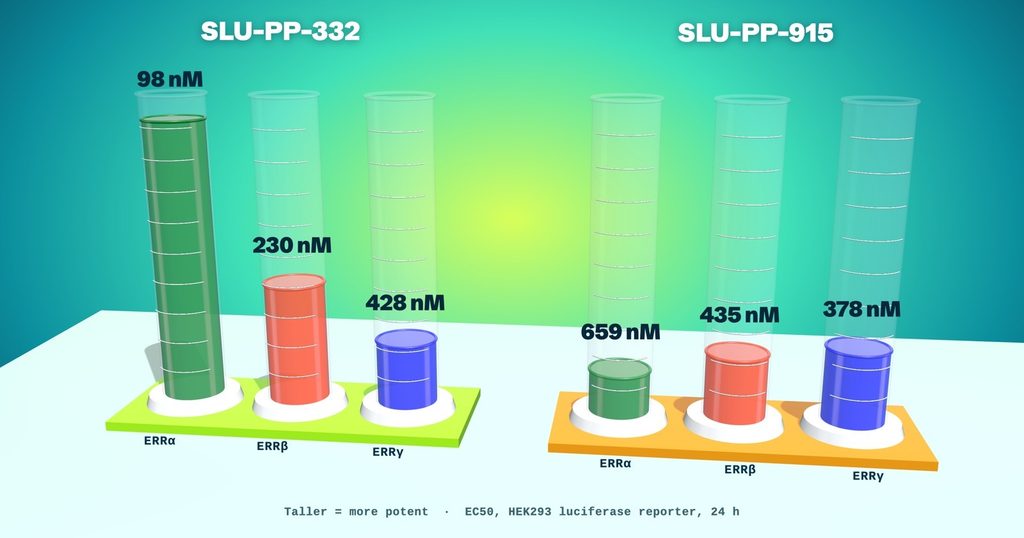
Quick answer: SLU-PP-332 is an agonist at all three estrogen-related receptors: ERRŒ±, ERRŒ≤ and ERRŒ≥. In HEK293 cell reporter assays it’s most potent at ERRŒ± (EC50 98 nM), followed by ERRŒ≤ (230 nM) and ERRŒ≥ (428 nM).
ERRs are nuclear receptors, proteins that bind DNA and switch target genes on or off. They’re called “orphan” receptors because no natural hormone has been confirmed as their ligand. Their DNA-binding region resembles the estrogen receptors’, yet they don’t bind estradiol.
ERRs are also constitutively active. They drive some gene expression even with no ligand present, so an agonist like SLU-PP-332 pushes that baseline activity higher.
Sources: the cell-based values come from the 2023 European Journal of Medicinal Chemistry series linked above, and match the bioassay records on PubChem. The TR-FRET value comes from a 2018 Bioorganic & Medicinal Chemistry Letters study on ERRγ agonists.
Look at the two ERRγ rows. Same receptor, roughly a five-fold gap. Whole cells with a full-length receptor gave 428 nM, while a purified ligand-binding domain in a cell-free test gave about 2 µM. The assay format shapes the number, so compare EC50 values only when they come from the same assay type.
ERRs also work through coregulator proteins. PGC-1α is the best-known coactivator partner, and RIP140 acts as a corepressor. In the lab, these partnerships show up as readouts: coactivator recruitment, corepressor release (the 2018 TR-FRET assay measured a drop in RIP140 peptide binding) and target-gene mRNA levels by qPCR.
SLU-PP-332 vs SLU-PP-915 EC50 at ERRα, ERRβ and ERRγ
How Is SLU-PP-332 Used in Research?
Quick answer: SLU-PP-332 serves as a reference tool compound in four kinds of lab work: nuclear-receptor reporter assays, target-gene expression assays in cultured cells, analog (SAR) development in medicinal chemistry, and analytical studies that map its in vitro metabolites by LC-MS.
Receptor and reporter assays
A reporter assay turns receptor activity into light you can measure. The ERR version runs in four steps:
Transfect HEK293 cells with an ERR isoform and a luciferase reporter driven by an ERR response element.
Add SLU-PP-332 across a concentration series, with a vehicle-only control.
Read luminescence after about 24 hours.
Fit a concentration-response curve and calculate the EC50.
With EC50 values between roughly 100 and 430 nM, a useful concentration series runs from the low nanomolar range up into the low micromolar range, so the curve captures both its floor and its plateau.
Because its potency at each isoform is well documented, SLU-PP-332 often serves as the positive control when labs screen new ERR ligands. The 2023 series also used it in C2C12 cells to track ERR target-gene expression by qPCR.
Medicinal chemistry and analog work
For chemists, SLU-PP-332 is the yardstick. New ERR agonists get tested side by side with it, and their EC50 values are reported relative to it.
Its selectivity ratios guide that work. SLU-PP-332 is about 2.3 times more potent at ERRŒ± than at ERRŒ≤, and about 4.4 times more potent at ERRŒ± than at ERRŒ≥. A new compound’s ratios show at a glance whether it leans toward one isoform or stays pan. The 2005 GSK series and the 2018 phenol amide series both chased ERRŒ≥ preference, while SLU-PP-332 covers all three, which is exactly why it works as the comparison point.
The SLU-PP-915 series came straight out of that comparison. The 2023 team reported that SLU-PP-332 was stable in both human and mouse microsome assays, with a half-life of 60 minutes or more, and used that as a stability baseline for the new compounds.
Analytical and metabolite studies
In January 2026, Tim Möller, Oliver Krug and Mario Thevis at the German Sport University Cologne published the first detailed in vitro metabolism study of the compound in Rapid Communications in Mass Spectrometry. They incubated SLU-PP-332 with human-derived microsome and S9 enzyme fractions and analyzed the products on a Vanquish UHPLC coupled to an Orbitrap Exploris 480 high-resolution mass spectrometer.
What they measured
What they found
Total metabolites identified
9
Phase I products
6 (hydroxylation, bishydroxylation, bishydroxylation with reduction)
Phase II conjugates
3 (glucuronidation, sulfation, hydroxylation followed by sulfation)
Analytical platform
LC-HRMS/MS
The goal is reference data. Testing labs need to know what a compound and its breakdown products look like on a mass spectrometer before they can detect them, and this study gives them that map.
Is SLU-PP-332 FDA-Approved?
Quick answer: No. SLU-PP-332 isn’t approved by the FDA for any use, and it isn’t sold as a drug, dietary supplement or food ingredient in the US. Suppliers offer it for laboratory research only. Life Link sells it to qualified researchers aged 21 and over.
Authority or registry
Status
Checked
US FDA
No approval for any use
10 Oct 2026
ClinicalTrials.gov
0 registered studies for “SLU-PP-332”
10 Oct 2026
WADA Prohibited List 2026
Covered by class S0, Non-Approved Substances
Writer to verify
There are no published human clinical trials. A ClinicalTrials.gov search for SLU-PP-332 returned zero registered studies on 10 October 2026, and the Cologne authors note that clinical studies would still be needed to confirm their in vitro metabolite findings.
Research-chemical status shapes how the compound is sold. Labels carry research-use wording, buyers confirm the material is for laboratory study, and suppliers publish identity and purity data in place of any usage guidance.
In sport, the WADA Prohibited List for 2026 took effect on 1 January 2026. Its S0 class covers any pharmacological substance with no current approval from a government health authority for human therapeutic use, including compounds in pre-clinical development, and prohibits them at all times. SLU-PP-332 meets that definition.
How Do You Verify an SLU-PP-332 Batch From a US Supplier?
Quick answer: Check the batch certificate of analysis (COA). Look for HPLC purity, mass-spec identity that matches the 290.3 g/mol molecular weight, a lot or verification number, and the test date. Then confirm an independent lab issued it and that you can verify it.
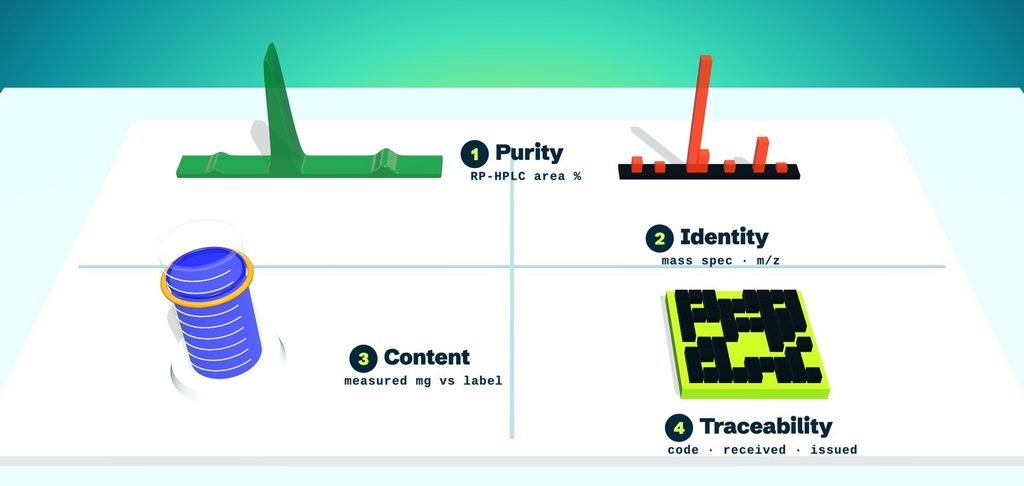
We call this the four-line COA check. Here’s how it reads against the current COA on our SLU-PP-332 product page:
COA line
What to look for
Current Life Link COA
Purity
RP-HPLC result with wavelength and chromatogram
99.9% by RP-HPLC at 214 nm, single main peak at 1.725 min
Identity
Mass-spec method and observed ion
Confirmed via MALDI-MS
Content
Measured amount against the label
31.18 mg against a 30 mg label
Traceability
Verification code, sample and issue dates
Code COA5139, received 8 June 2026, issued 16 June 2026
The four lines to check on an SLU-PP-332 COA
HPLC purity: see the batch result
Reverse-phase HPLC pushes the sample through a column and measures what comes out with a UV detector. Purity is the main peak’s share of the total peak area, so 99.9% means almost every UV-absorbing signal at 214 nm came from one compound. At 214 nm, the aromatic rings and the carbonyl group absorb strongly, so most organic impurities show up as their own separate peaks.
HPLC tells you how clean the sample is. It can’t tell you what that compound is. For the difference a single percentage point makes, read what 98% vs 99% purity means.
Mass-spec identity and why both tests count
Mass spectrometry weighs the molecule. For SLU-PP-332, the monoisotopic mass is 290.1055 Da, so the protonated ion [M+H]+ should appear near m/z 291.11 and the sodium adduct [M+Na]+ near m/z 313.09.
Run both tests and you get both answers: HPLC says how pure, mass spec says what it is. A clean peak of the wrong compound would pass HPLC alone. Our guide to HPLC vs mass spectrometry walks through how the two methods work together.
Lot traceability and US supply
A research supplier should give you a paper trail you can follow from the vial back to the lab report. For SLU-PP-332, that means:
A batch-specific COA linked from the product page
The testing lab’s name and a verification code
Sample-received and issue dates
Storage conditions on the datasheet
A clear statement of which tests run on every batch
A COA with no chromatogram, no named lab, or a generic compound name in place of SLU-PP-332 gives you nothing to check, so ask the supplier for the batch-specific report before you order.
At Life Link, identity and purity testing runs on every batch, through Janoshik Analytical and US-based laboratories. Heavy metals, endotoxin and sterility testing run on a rotating cycle across the catalog. Orders ship from California, with same-day dispatch on orders placed before 2 PM PST and UPS 2-Day Air delivery. For the full checklist, see our guide to choosing a US research supplier.
Ready to check the batch yourself? The current COA and specifications are on the SLU-PP-332 product page. It’s supplied to qualified researchers for laboratory use only.
SLU-PP-332 FAQ
What is the CAS number of SLU-PP-332?
The CAS number of SLU-PP-332 is 303760-60-3. Its PubChem CID is 5338394 and its ChEMBL ID is CHEMBL4208749. Its InChIKey, RNZIMBFHRXYRLL-XDHOZWIPSA-N, is the quickest way to match the exact E-isomer structure across chemical databases.
What is its molecular formula and weight?
SLU-PP-332 has the molecular formula C18H14N2O2 and a molecular weight of 290.3 g/mol. Its monoisotopic mass is 290.1055 Da, which puts the protonated ion [M+H]+ near m/z 291.11 in mass-spec identity testing.
Is SLU-PP-332 a peptide?
No. SLU-PP-332 is a synthetic small molecule with no amino acids. It’s an acyl hydrazone built from a 4-hydroxyphenyl group and a naphthalene ring. Peptide suppliers carry it because it goes through the same HPLC, mass-spec and COA workflow.
Is SLU-PP-332 FDA-approved?
No. SLU-PP-332 has no FDA approval for any use and no registered human clinical trials on ClinicalTrials.gov as of 10 October 2026. It’s supplied as a research chemical for laboratory study by qualified researchers only.
Is SLU-PP-332 on the WADA Prohibited List?
SLU-PP-332 falls under class S0, Non-Approved Substances, of the 2026 WADA Prohibited List. S0 covers pharmacological substances with no government approval for human therapeutic use and applies at all times. Anti-doping researchers at the German Sport University Cologne published its in vitro metabolite profile in 2026.
What solvents is it soluble in?
For assay preparation, SLU-PP-332 is dissolved in DMSO, and working solutions are diluted from that stock. Check the supplier datasheet for storage conditions; Life Link lists -20°C, protected from light.
SLU-PP-332 gives receptor labs a well-characterized pan-ERR agonist with clean identifiers, documented potency at every isoform and a growing analytical record. Before any batch reaches an assay plate, read its COA line by line and match the mass-spec result to 290.3 g/mol.
For Research Use Only. Not for use in diagnostic or therapeutic procedures.
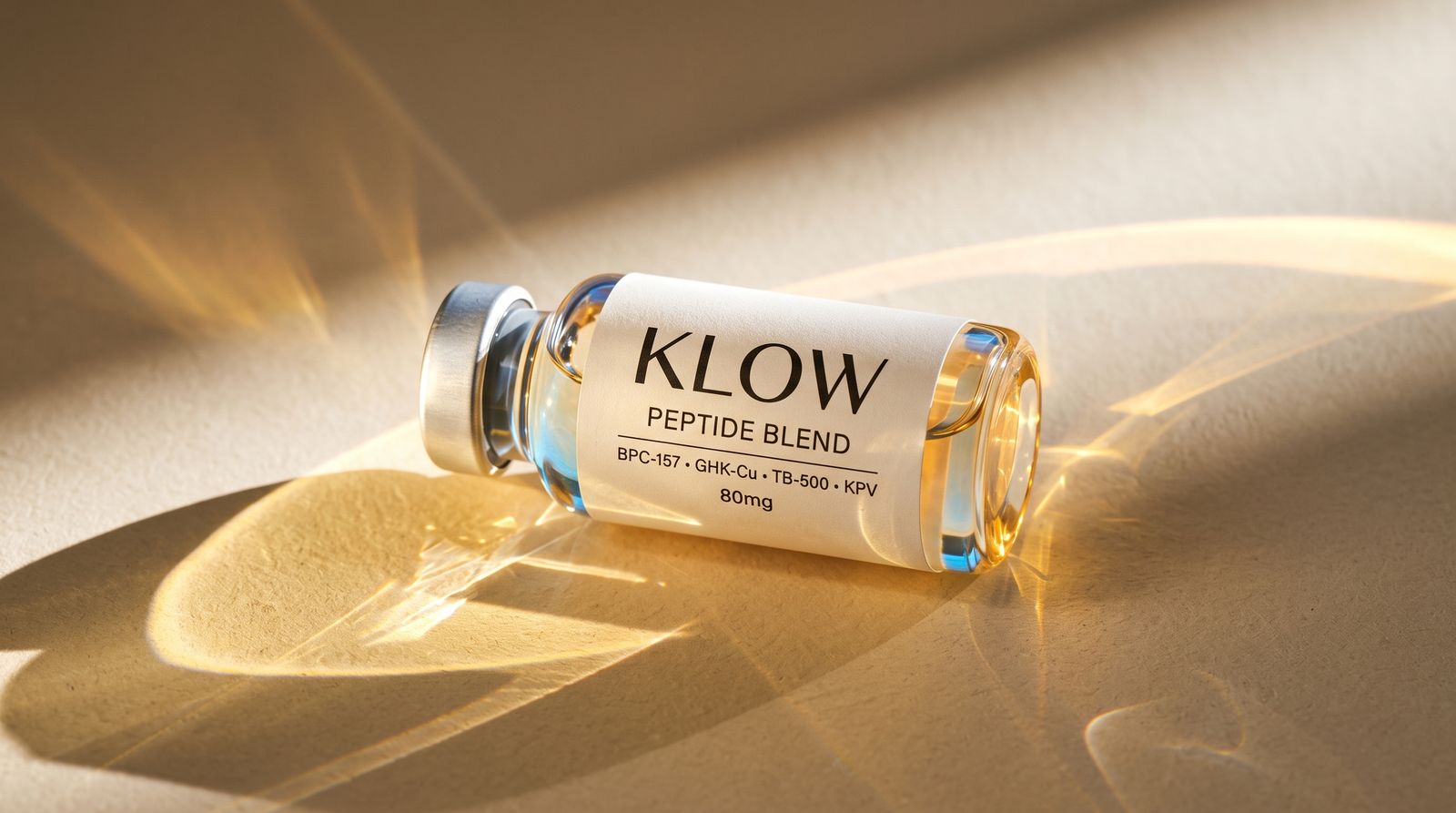
KLOW is an 80mg research peptide combination of GHK-Cu 50mg, BPC-157 10mg, TB-500 10mg and KPV 10mg, a 50/10/10/10 ratio. The name comes from its parts: the three-peptide GLOW blend plus KPV. It is supplied for laboratory research only, either as one blended vial or as four separate vials.
Key Takeaways
KLOW is GLOW (GHK-Cu, BPC-157, TB-500) with KPV added.
The ratio is 50/10/10/10, for 80mg in total.
GHK-Cu makes up 62.5% of the mass.
A KLOW COA has to confirm all four compounds, one by one.
Compare price per mg of verified compound, never price per vial.
Search “KLOW peptide” and the first page is mostly clinic pages, med spa blogs, a busy Reddit thread and nine shopping listings. Almost none of them explain what’s in the vial at the molecular level, or how a researcher can check it before lab use.
This guide does that. It covers what the KLOW peptide blend contains, why the ratio leans so hard toward one compound, what a proper certificate looks like, and what the four-part blend costs per milligram in the US. It’s written for researchers sourcing research-use-only laboratory materials. Readers new to the category can begin with what research peptides are.
In this guide
What KLOW is
What’s in the blend
Each component
Why the ratio is 50/10/10/10
KLOW vs GLOW
Why KLOW turns blue
One vial or four
Reading a KLOW COA
Published research
Legal status in the US
Storage
Why no dosing is published
Cost and US supply
FAQs
What Exactly Is KLOW Peptide?
Quick answer: KLOW is a market name for a combination of four separately made research peptides: GHK-Cu, BPC-157, TB-500 and KPV. Suppliers sell it as “KLOW blend”, “KLOW 80” or “KLOW stack”, and almost always in the same 50/10/10/10 amounts.
No company owns the name, and no regulator has reviewed a product called KLOW. The word is a mash-up of its ingredients. GLOW came first as a three-peptide combination, and KPV’s arrival turned its first letter into a K.
You’ll see three labels on listings and forums:
KLOW blend: all four peptides freeze-dried together in one vial.
KLOW 80: the same blend, named after its 80mg total.
KLOW stack: usually the four peptides sold as separate vials in one kit.
Those labels aren’t standardized, so read the contents line on any listing. A “stack” from one seller can be a single blended vial from another.
The name stuck because it’s short and easy to search. That convenience has a cost: a buyer typing “KLOW” sees four very different molecules flattened into one word, and has to unpack them again to check what arrived.
What Is in the KLOW Peptide Blend?
Quick answer: KLOW contains GHK-Cu (50mg), BPC-157 (10mg), TB-500 (10mg) and KPV (10mg), for 80mg in total. GHK-Cu makes up 62.5% of the mass. BPC-157, TB-500 and KPV make up 12.5% each.
Every figure below comes from our product specifications, so the table matches what’s on each vial’s documentation.
Component
Amount
% of mass
Type
Sequence
Molecular weight
CAS
GHK-Cu
50 mg
62.5%
Copper-bound tripeptide
Gly-His-Lys : Cu(II)
404 g/mol (complex)
89030-95-5
BPC-157
10 mg
12.5%
Synthetic 15-residue peptide
GEPPPGKPADDAGLV
1,419.5 g/mol
137525-51-0
TB-500
10 mg
12.5%
Full-length thymosin beta-4
43 residues, N-acetylated
4,963.55 Da
77591-33-4
KPV
10 mg
12.5%
Tripeptide, alpha-MSH(11-13)
Lys-Pro-Val
342.4 g/mol
67727-97-3
The 80mg total is the sum of four separate weights, and that simple fact drives almost every question further down: how the ratio works, how a certificate should read, and how pricing compares.
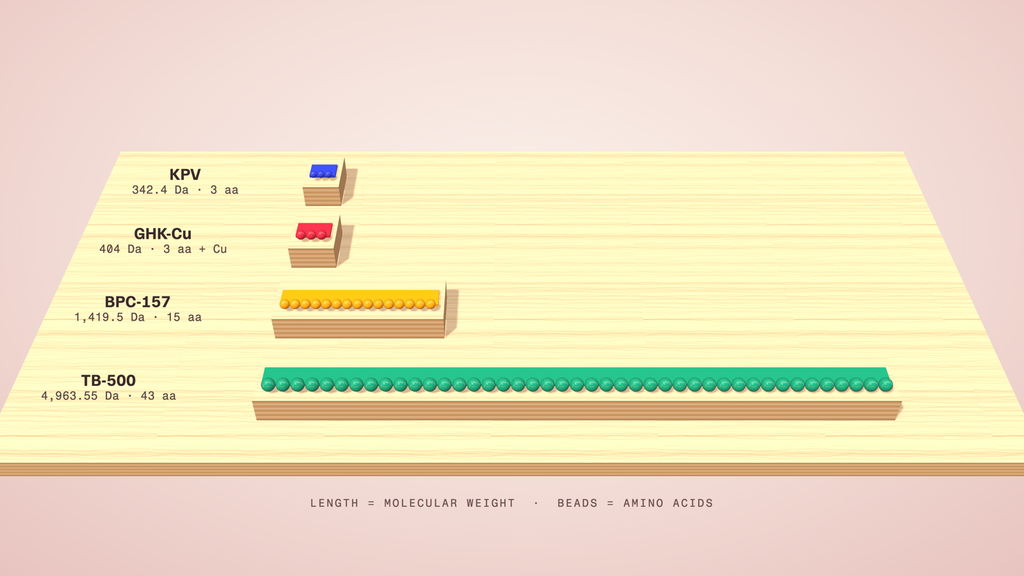
Read the table from right to left and the gaps show up fast. The molecular weights run from 342.4 to 4,963.55, a fourteen-fold range, while the milligram column barely moves. Those two columns together decide how much of each molecule a vial really stores.
What Is Each Component of KLOW?
Quick answer: GHK-Cu is a copper-binding tripeptide, BPC-157 is a 15-amino-acid synthetic peptide, TB-500 here is full-length thymosin beta-4, and KPV is a three-amino-acid fragment of alpha-MSH. Each has its own literature, mostly in cell and animal models.
The four molecules differ hugely in size, from three amino acids up to 43. That spread explains why equal milligrams don’t mean equal amounts of each molecule.
KLOW peptide components molecular size to scale
GHK-Cu (50mg)
GHK is the tripeptide glycyl-L-histidyl-L-lysine, and in KLOW it carries a bound copper(II) ion. That copper is why GHK-Cu takes the largest share by weight: suppliers handle it in larger mass amounts than the other three.
Chemists have mapped its copper binding closely. A 2011 structural study in Chemistry: A European Journal called GHK one of the “naturally occurring high-affinity copper(II) chelators” and solved its copper complex by X-ray and spectroscopy (Hureau et al., 2011). Cultured cell models make up most of the remaining work. See the GHK-Cu 50mg listing for full specifications.
BPC-157 (10mg)
BPC-157 is a synthetic 15-amino-acid sequence, Gly-Glu-Pro-Pro-Pro-Gly-Lys-Pro-Ala-Asp-Asp-Ala-Gly-Leu-Val, derived from a gastric protein. It’s the longest of KLOW’s three short peptides, and the only one with a run of three prolines near its start.
Most published work on it uses rodent models, with a smaller set of cell studies. It’s the second-heaviest molecule in KLOW at 1,419.5 g/mol, so its 10mg share holds relatively few molecules. Specifications are available on the BPC-157 10mg page.
TB-500 (10mg)
“TB-500” causes more confusion than any other name in the blend. Some sellers use it for a short seven-residue fragment, Ac-LKKTETQ. Others use it for the full 43-amino-acid thymosin beta-4 protein, which is where the CAS number 77591-33-4 belongs.
The material in Life Link’s kit is full-length thymosin beta-4 at 4,963.55 Da. Its September 2026 certificate from Prodigy Labs in San Diego names it that way. Thymosin beta-4 is studied mainly in cell culture and animal models for its role in binding actin. Check which version a supplier sells before you compare prices, then see TB-500 10mg for the full specification.
KPV (10mg)
KPV is Lys-Pro-Val, the C-terminal end of alpha-melanocyte-stimulating hormone (alpha-MSH), at positions 11 to 13. At 342.4 g/mol it’s the smallest molecule in KLOW, which means its 10mg holds the most molecules of the three minor parts.
A 2008 study in Gastroenterology examined how intestinal epithelial cell lines take KPV up through PepT1, a transporter for small peptides (Dalmasso et al., 2008). Most KPV work stays in cell and rodent models like these. For a longer walk through that literature, read our KPV research guide.
Why Is the KLOW Ratio 50/10/10/10?
Quick answer: The ratio weights KLOW toward GHK-Cu, one of the smallest molecules after KPV and the one usually handled in larger mass amounts. It is a supplier convention. No published research has validated it as a formula for the four-compound combination.
The 50/10/10/10 pattern traces back to GLOW, which already paired 50mg of GHK-Cu with 10mg each of BPC-157 and TB-500. KLOW kept that base and added 10mg of KPV. Nothing in the literature tested the combination first and arrived at those numbers.
Weight also hides how many molecules you’re working with. GHK-Cu is light, so its 50mg contains far more molecules than its 62.5% weight share suggests. Full-length TB-500 runs the other way: at nearly 5,000 Da, its 10mg holds only a small fraction of the vial’s molecules.
The ratio also gives you something to check. On separate-vial certificates, each compound’s measured milligrams should sit close to its label. On a blended certificate, the four results should land near 50, 10, 10, and 10. A blend reporting 50mg of GHK-Cu and noticeably less of the others points to a filling or synthesis problem that the vial alone would never reveal.
Amounts also vary between suppliers. Some listings use different totals or proportions, so read the label and the certificate before treating any “KLOW” as interchangeable.
KLOW vs GLOW: What’s the Difference, and Which Is Better for Research?
Quick answer: GLOW contains GHK-Cu, BPC-157 and TB-500 (70mg). KLOW adds 10mg of KPV (80mg), so the two share 75% of their composition. Neither is better: KLOW adds one more compound to study and one more identity to verify. Wolverine is BPC-157 plus TB-500 only.
Here’s each option in one line:
GHK-Cu alone: the copper tripeptide on its own.
Wolverine: BPC-157 and TB-500, 10mg each.
GLOW: Wolverine plus 50mg of GHK-Cu.
KLOW: GLOW plus 10mg of KPV.
GHK-Cu alone
Wolverine
GLOW
KLOW
Components
GHK-Cu
BPC-157, TB-500
GHK-Cu, BPC-157, TB-500
GHK-Cu, BPC-157, TB-500, KPV
Total
50 mg
20 mg
70 mg
80 mg
Ratio
n/a
10/10
50/10/10
50/10/10/10
Identities to verify
1
2
3
4
Life Link format
Single vial
Kit, two vials
Kit, three vials
Kit, four vials
The choice comes down to the question a study is asking. A study focused on copper-peptide chemistry needs GHK-Cu alone. A design looking at how four compounds behave side by side needs KLOW, and it inherits four certificates to check.
KLOW vs GHK-Cu alone is the other comparison people search for. Since GHK-Cu is 62.5% of KLOW by weight, a blend can look like GHK-Cu with extras. In practice, the extras change the paperwork. A single GHK-Cu vial needs one identity and one purity result, while KLOW needs four of each before any experiment starts.
Quick answer: KLOW turns blue because of the copper in GHK-Cu. Copper(II) complexes give a blue tint when dissolved, so blue is expected in any material containing GHK-Cu. A KLOW sample with no blue tint may be missing its GHK-Cu.
Copper(II) ions absorb light at the warm end of the spectrum. As a university chemistry course puts it, the absorption band for dissolved copper(II) “spans the red-orange-yellow portion of the spectrum and green, blue and violet are transmitted” (Western Oregon University). Your eye sees what’s left over, which is blue.
The tint is a useful first check and a weak final one. Blue shows that some copper complex is present. It can’t tell you how much GHK-Cu is in the vial, whether the copper is bound to GHK, or whether the other three peptides are there at all. Only the certificate answers those.
Even the dry powder shows it. Life Link’s GHK-Cu specification lists the appearance as a “blue to blue-violet solid”, while BPC-157, TB-500 and KPV are all white to off-white. So in a KLOW vial, the color comes from one of its four ingredients, the same one that makes up five-eighths of its weight.
Does Mixing GHK-Cu With Other Peptides in One Vial Cause Problems?
Quick answer: There is little published stability data on GHK-Cu combined with BPC-157, TB-500 and KPV in a single vial, and copper can interact with other peptides. Separate vials avoid the question: each compound is stored dry on its own and checked against its own COA.
The concern on Reddit threads is reasonable, and it’s still an open question. Copper binding to GHK is strong and also mobile. The 2011 structural study found that Cu(II)-GHK exchanges its copper quickly and can form mixed complexes with amino acids such as glycine and histidine (Hureau et al., 2011). Nobody has published what happens when GHK-Cu shares a vial with three other peptides over months of storage.
The practical risk is quiet drift. If one compound in a blend breaks down faster than the rest, the 50/10/10/10 ratio changes without any visible sign, and a certificate issued at release won’t show it. With separate vials, every compound has its own dated report, so a change in one never hides inside the others.
Factor
One blended vial
Four separate vials
Verification
One certificate covering four compounds
Four certificates, one per compound
Stability unknowns
Copper shares a vial with three other peptides
Each compound stays apart until use
Ratio flexibility
Fixed at 50/10/10/10
Any ratio a study design needs
Storage
One vial to track
Four vials, each labeled
Price per mg
Lower
Higher
That table explains why Life Link sells KLOW as a four-vial kit, and why the kit costs more. Keeping each powder dry and apart follows the same logic as why lyophilized beats pre-mixed.
How Do You Read a KLOW COA?
Quick answer: 1. Check that all four compounds are named. 2. Confirm each identity by mass spec. 3. Check purity per compound by HPLC. 4. Match the batch number to your vial. 5. Verify the report with the testing lab.
A Certificate of Analysis (COA) is a testing lab’s record for one production batch. HPLC (high-performance liquid chromatography) pushes the sample through a column, so each compound exits as its own peak, and the peak areas give purity. ESI-MS (electrospray ionization mass spectrometry) measures each molecule’s mass, and a match with the expected mass confirms identity.
A blend makes both jobs harder. Four peptides produce four peaks that can overlap, so a certificate reading “KLOW 80mg: 99%” doesn’t tell you which compound that number belongs to, or whether all four are present. A useful blend COA lists each component by name with its own result.
With separate vials, each compound gets its own report. The current certificates for Life Link’s four KLOW components come from three independent labs: Janoshik Analytical for GHK-Cu and BPC-157, Prodigy Labs in San Diego for TB-500, and Prime Analytical Laboratories in Concord, California for KPV. Each report gives its compound’s purity on a line of its own.
A kit also means four batch numbers. Match each vial to its own report, and keep in mind that the four compounds can come from different production runs with different test dates. That’s normal for a kit. What you’re checking is that every vial has a current report, with no gaps.
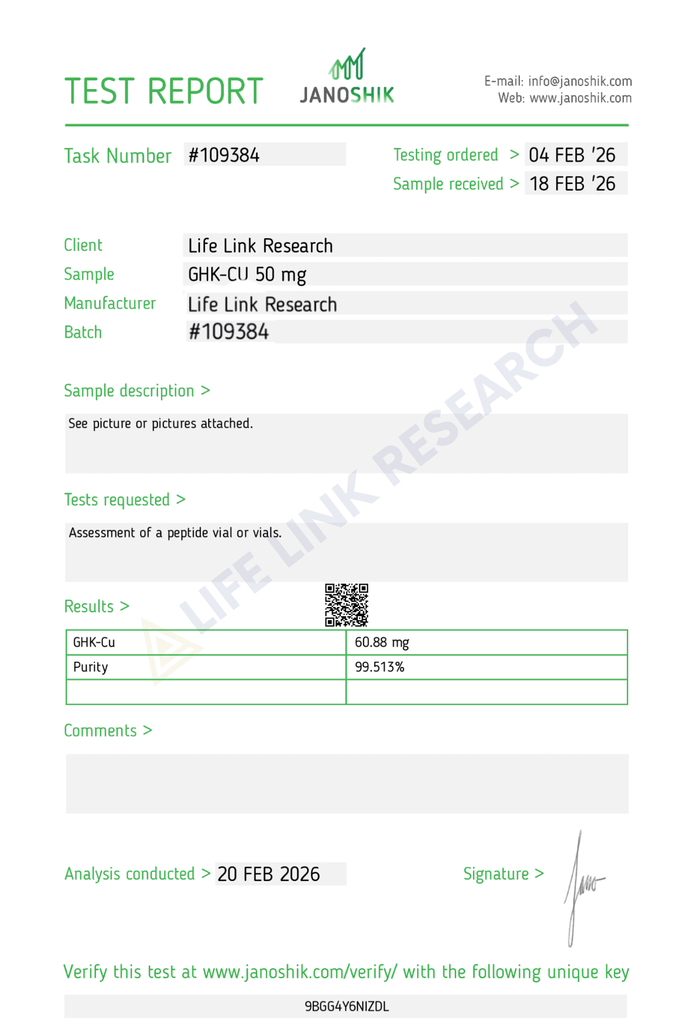
KLOW component peptide COA example
Field on the GHK-Cu report
What to check
Task #109384
Enter it with the unique key to confirm the report at the lab
Quick answer: No published study has tested the four-compound KLOW combination. Each component has its own literature, mostly in cell and animal models. Claims about what KLOW “does” usually stitch together separate single-compound findings, which isn’t evidence for the combination.
That gap answers the “is KLOW worth it?” question better than any review could. PubMed lists 2026 review articles that discuss several of these peptides side by side, and no experimental study of all four together. A search for each component returns its own literature, built over decades for GHK and over years for the others.
Each study used its own compound, its own model and its own conditions, and none of them tested the others alongside it. The practical route is to read each compound’s primary papers directly, starting with the original structural and cell-model work, and to treat review articles as maps to those papers.
For a researcher, that makes KLOW a design choice with open questions, and each component a separate reading list.
Do You Need a Prescription for KLOW? Is It Legal in the US?
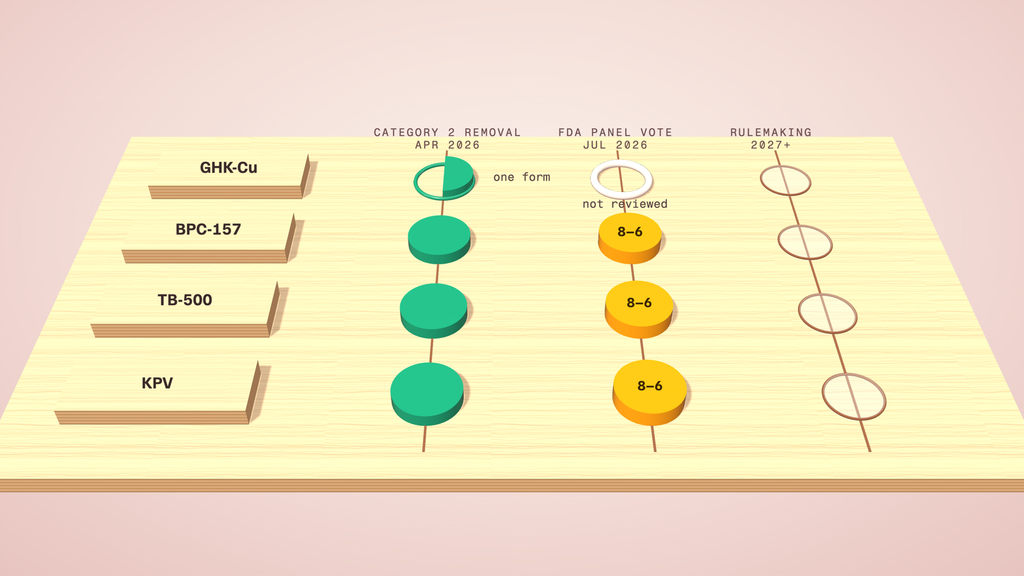
Quick answer: KLOW is not an FDA-approved drug, so there is no prescription version. Its components are sold as research reagents for laboratory use only. In July 2026 an FDA advisory committee recommended BPC-157, KPV and TB-500 for the 503A compounding list, and that vote is non-binding.
Two 2026 events moved the conversation. In April, the FDA took 12 peptides out of Category 2, its list of substances flagged for compounding concerns. All four KLOW components were in that group, though GHK-Cu’s removal covered only one of its forms.
In July, the Pharmacy Compounding Advisory Committee met on July 23 and 24. The FDA describes these committees as a source of “independent expert advice to the FDA on broad scientific topics.” BPC-157, KPV and TB-500 were on the first day’s agenda. GHK-Cu wasn’t on it.
KLOW components FDA status 2026
That leaves the four components in two different places. Three have a committee recommendation behind them and a rulemaking ahead of them. GHK-Cu, the largest part of KLOW by weight, hasn’t had its committee review yet.
The vote starts a process. Lawyers at McDermott Will & Schulte note that formal rulemaking “could occur in 2027 or extend into a multi-year process” (McDermott, July 27, 2026). A “research use only” label describes what the material is sold for, and it carries no approval with it. The details are in our piece on the July 2026 FDA advisory vote.
How Should KLOW Be Stored?
Quick answer: Store lyophilized KLOW at -20°C, protected from light and moisture. Let vials reach room temperature before opening to prevent condensation, and avoid repeated freeze-thaw cycles.
Lyophilized means freeze-dried: the water is removed under vacuum, leaving a dry cake or powder that holds up far longer than any liquid. Moisture is the main thing to keep out. A cold vial opened straight from the freezer pulls condensation onto the powder, so give it time to warm up first.
With a four-vial kit, store all four together and label the box with the batch numbers. Keep a printed or saved copy of each certificate with the box as well, so the batch on each vial can be matched to its report without a search. Our peptide storage guide covers freezer choice, light and handling in more detail.
Why Don’t Research Suppliers Publish KLOW Dosing?
Quick answer: KLOW is not approved for human or animal use, so responsible suppliers publish no dosing. Study designs belong in the primary literature and in a laboratory’s own protocols.
Dosing tables online usually come from clinics or social media. A research supplier that published one would be presenting its vials for use in people. A supplier’s job is to document what’s in the vial: identity, purity, amount and storage. How that material gets used in an experiment is set by the research team and its own review processes.
How Much Does KLOW Cost, and Where Can You Buy It in the US?
Quick answer: US suppliers list KLOW 80mg blends at roughly $70 to $170 per vial (October 2026), about $0.87 to $2.12 per mg. Separate-vial kits cost more. Choose a supplier with US stock and a COA confirming all four compounds, and compare price per mg of verified compound.
Format
Typical price (October 2026)
Price per mg
What you get
Single blended 80mg vial
$70 to $170
$0.87 to $2.12
One vial, often one combined COA line
Four-vial kit (Life Link)
$376.20
About $4.70
Four vials, a separate COA for each compound
Four vials bought one by one (Life Link)
$396.00
About $4.95
The same four vials, without the kit discount
The kit costs more, and here’s what the extra pays for. Four separate syntheses, four separately tested powders, and four reports from independent labs, with no copper sharing a vial with the other three.
A blended vial at the low end of the range can still be a sound purchase if its certificate names all four compounds with individual results. A cheap vial with a single “99%” line leaves you paying for a number you can’t connect to anything.
The TB-500 naming issue affects price too. A blend built on the seven-residue fragment and one built on full-length thymosin beta-4 can both say “TB-500 10mg” on the label. The two molecules differ in size by more than five times, so check which one a listing uses before comparing prices.
To compare suppliers on equal terms, divide the price by the milligrams each certificate confirms. Our guide on how to choose a US peptide supplier covers the checks beyond price. The Life Link KLOW kit ships from US stock, with each component’s certificate on its product page.
A KLOW peptide stack is the four KLOW peptides (GHK-Cu, BPC-157, TB-500 and KPV) sold together, usually as separate vials in one kit. The amounts match the blend: 50mg, 10mg, 10mg and 10mg, for 80mg in total. Some sellers use “stack” for a single blended vial, so check the format before buying.
Which is better, KLOW or GLOW?
Neither is better; they answer different research questions. GLOW holds GHK-Cu, BPC-157 and TB-500 at 70mg. KLOW adds 10mg of KPV for 80mg, which means one more compound to study and one more identity to verify. The two share 75% of their composition by mass.
Is KLOW a brand name?
No, KLOW is a market nickname built from its ingredients, GLOW plus KPV. No company owns it, and no regulator has reviewed a product under that name. Different suppliers use it for slightly different products, so the contents line and the certificate tell you more than the name does.
Is KLOW legal in the US?
KLOW’s components are sold in the US as research reagents for laboratory use only, and none is an FDA-approved drug. The FDA’s July 2026 advisory vote on three of them is a recommendation, and the law stays as it is until rulemaking finishes. Our page on BPC-157’s legal status explains how that plays out for one component.
Can you buy the KLOW components separately?
Yes, each KLOW component is sold as its own vial. That lets you set your own ratio and check each certificate in isolation. GHK-Cu, BPC-157 and TB-500 are linked above, and KPV 10mg completes the set.
What should a KLOW COA show?
A KLOW COA should name all four compounds and give each its own identity and purity result. It should also carry a batch number that matches your vial and a verification code for the issuing lab. A single combined percentage for the whole blend doesn’t show that every compound is there.
⏱ KLOW in 30 seconds
An 80mg combination of GHK-Cu 50mg, BPC-157 10mg, TB-500 10mg and KPV 10mg, in a 50/10/10/10 ratio. GHK-Cu is 62.5% of the mass. It’s GLOW plus KPV, and it’s sold as a blended vial or as four separate vials. Verify all four compounds on the COA, and compare price per verified milligram.
Research use only: KLOW and its four components are laboratory reagents for in-vitro research by qualified professionals. They have no FDA approval and are not for human or veterinary use, or for diagnostic or therapeutic procedures. This guide is not medical advice.
The best US peptide supplier keeps its stock in the US and posts a Certificate of Analysis (COA) from an outside lab for every batch, which you can confirm on that lab’s own site. Those reports confirm 99%+ purity by HPLC and identity by mass spectrometry. Every product is labeled research use only, and the company shows a registered business, written payment and refund policies, and real contact details.
Key Takeaways
Records you can look up count for more than any marketing line.
A strong COA names an outside lab, matches the batch on your vial and verifies on the lab’s own site.
Purity (HPLC) and identity (mass spec) answer two different questions, so you want both.
Genuine US suppliers publish company details, a US dispatch point and written policies.
Dosing charts, “protocols” and human-use claims are the clearest red flags.
The supplier list most US labs relied on in 2024 doesn’t exist anymore. Amino Asylum went offline in 2025, Science.bio announced its closure in January 2026, and Peptide Sciences shut its doors on March 6, 2026. Between March and August, the FDA posted warning letters to more than a dozen other sellers. Plenty of researchers switching suppliers are now starting from a blank page.
So where does that leave anyone looking for the best US peptide supplier when half the old names are gone? You check the evidence, and you let the rankings go. Lists of the top research peptide companies in the USA tend to be written by the companies themselves. This guide gives you a 10-point check that takes about ten minutes and leans on public records anyone can open.
It covers sourcing for research-use-only laboratory materials. In the interest of transparency, it’s written by the team at Life Link Research, and the final section runs our own batch through the same test.
In this guide
What makes a supplier trustworthy
Types of US peptide suppliers
The 10-point checklist
How to tell if a supplier is legit
Red flags
What Reddit researchers check
Suppliers after the 2025-2026 shutdowns
Legal status in the US
Where to buy safely
Popular compounds and their COAs
Wholesale orders
How Life Link meets these standards
FAQs
What Makes a Peptide Supplier Trustworthy?
Quick answer: A peptide supplier earns trust by handing over evidence that outside records confirm. Look for testing by an independent lab, a COA for each batch that the lab itself can confirm, a registered company with written policies, and product pages limited to chemistry, storage and a research-use notice.
Anyone can type “99% pure” on a product page. It costs nothing and proves nothing. A trustworthy supplier hands you something you can test against an outside record, and then it passes that test.
If you’re new to the category, start with what research peptides are. Then judge every supplier on three pillars:
Testing evidence. Independent lab reports tied to the exact batch you’ll receive.
Business transparency. A company on file with a state, a street address, written policies and someone who replies to email.
Compliance. Product pages describe chemistry and storage, and they stop there.
Each of the ten checks below protects one of these pillars. A supplier that’s strong on two and missing the third still isn’t ready for your lab.
The pillars also catch problems at different speeds. Testing evidence shows up in the first COA you open. Business gaps tend to appear the first time a parcel goes missing. Compliance problems often stay hidden until a warning letter lands, and by then your supplier may already be gone.
What Types of US Peptide Suppliers Are There?
Quick answer: US peptide suppliers fall into four types. US manufacturers make peptides in-house. US-stocked resellers import, test and ship from US stock. Drop-shippers send orders straight from overseas. Custom-synthesis labs make peptides to order for institutions. Each type carries different testing habits and delivery times.
Searches for the “top peptide companies in the USA” mix all four types together, which is why so many lists feel like they’re comparing apples with forklifts. A contract manufacturer that sells by the kilogram won’t take a two-vial order. A drop-shipper may list a US phone number while your parcel waits in customs.
Supplier type
How it works
Typical testing
Delivery speed
Best for
US manufacturer
Synthesizes and purifies peptides in its own US facility
In-house QC, sometimes with outside checks
Days to weeks, often made to order
Large or GMP-adjacent projects
US-stocked reseller
Sources synthesized material, tests each batch, holds stock in the US
Third-party COA per batch when done well
1 to 3 days domestic
Most catalog research compounds
Drop-shipper
Takes the order online, ships from an overseas warehouse
Often a generic or recycled COA
1 to 4 weeks plus customs
Rarely the right choice
Custom-synthesis lab
Builds a sequence to your spec
Full analytical package per order
2 to 6 weeks
Novel or modified sequences
The US-stocked reseller is the model most research buyers end up using. It’s also the type where quality varies the most, which is why the checklist exists.
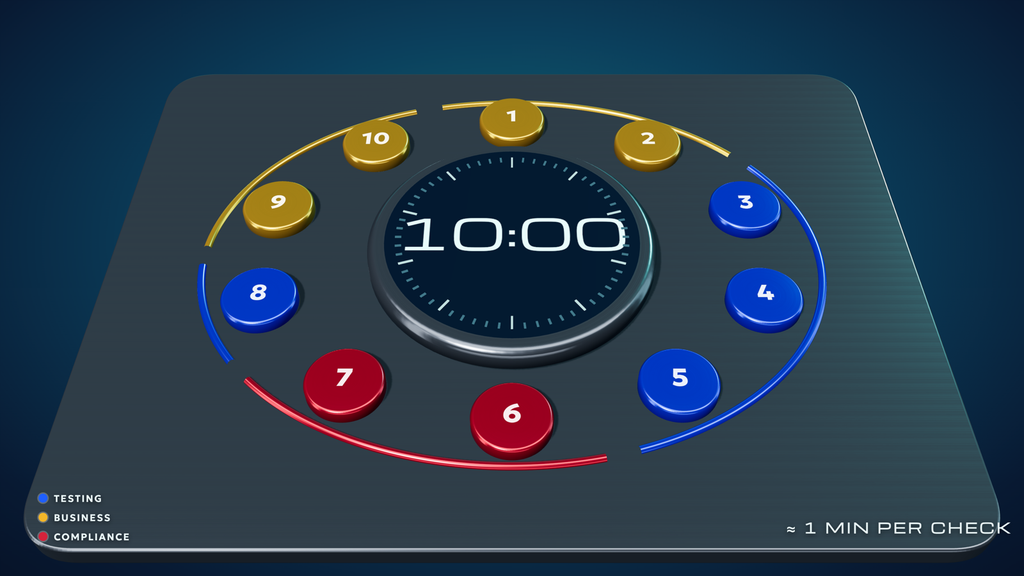
How Do You Choose a US Peptide Supplier? The 10-Point Checklist
📌 Quick answer: The 10-Minute Supplier Check
1. Registered US business with verifiable details
2. US-held stock and US dispatch
3. Independent, batch-specific COAs
4. COAs that verify at the lab
5. 99%+ purity (HPLC) plus mass-spec identity
6. Research-use-only labeling
7. Complete product documentation
8. Realistic pricing
9. Mainstream payment options and a written refund policy
10. Real reviews and responsive support
Best US peptide supplier checklist 2026
Each check below opens with the short answer, explains what it protects, then gives you a 30-second test you can run right now.
1. Is the Supplier a Registered US Business?
A real supplier is an LLC or corporation with a public filing, a physical address and a business email domain.
Registration gives you a legal entity behind the storefront. When a parcel goes missing or a batch looks wrong, you know who you’re dealing with. A Gmail address and a PO box give you nothing to hold onto. You can see who we are as one example of the details to expect.
⏱ 30-second check: Search the company name on its state’s Secretary of State business search, or on OpenCorporates, which pulls filings from every US state into one search. Match the legal name to the one in the site’s footer.
2. Does It Ship From US-Held Stock?
A US-stocked supplier names its dispatch location, its carrier and a daily cut-off time.
Those three details are hard to fake for long. A drop-shipper can’t promise a 2 PM cut-off when the vial is stored in another country. Stock held in the US also means one customs-free leg, which keeps lyophilized material moving fast.
⏱ 30-second check: Look for a stated US dispatch city and a cut-off time. A good example spells out shipping times and cut-offs in plain numbers.
3. Does Every Batch Have an Independent COA?
A Certificate of Analysis (COA) reports on a single batch, and a solid one names an outside lab, a batch number and a test date.
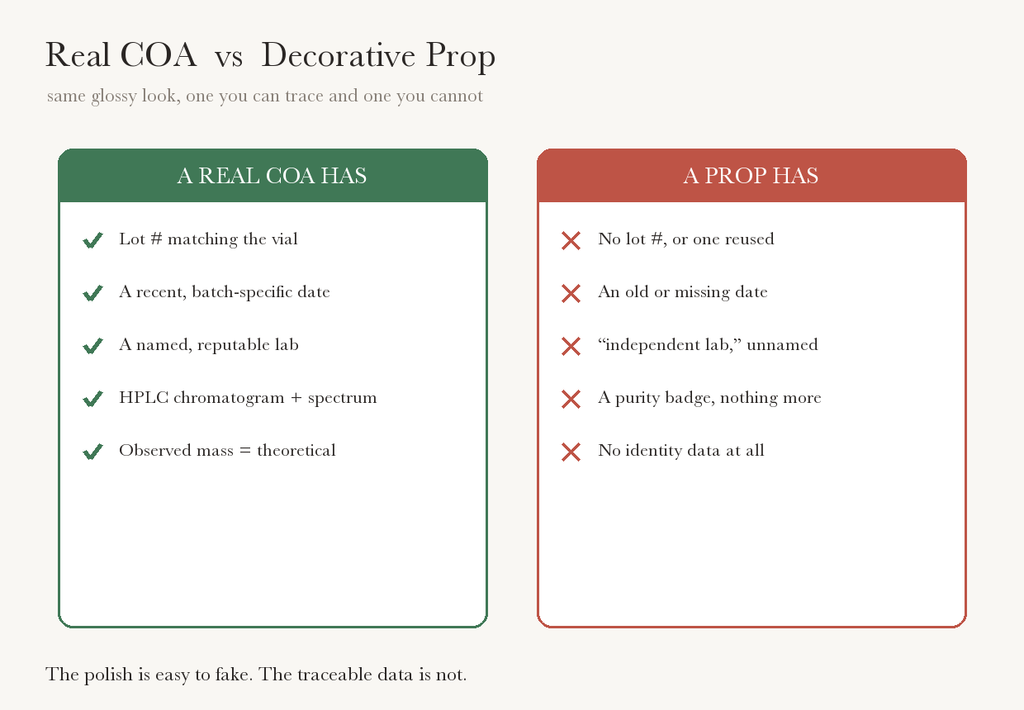
A single “sample COA” reused across a year of stock tells you about one old vial. A batch-specific report tells you about the vial in your box. The difference between third-party vs in-house testing comes down to who has a reason to report the result straight.
⏱ 30-second check: Open the COA from the product page. Does its batch number match the batch listed on the product, and is the test date within the last year?
4. Can You Verify the COA With the Testing Lab?
A genuine COA carries a code that brings up the identical result in the lab’s database.
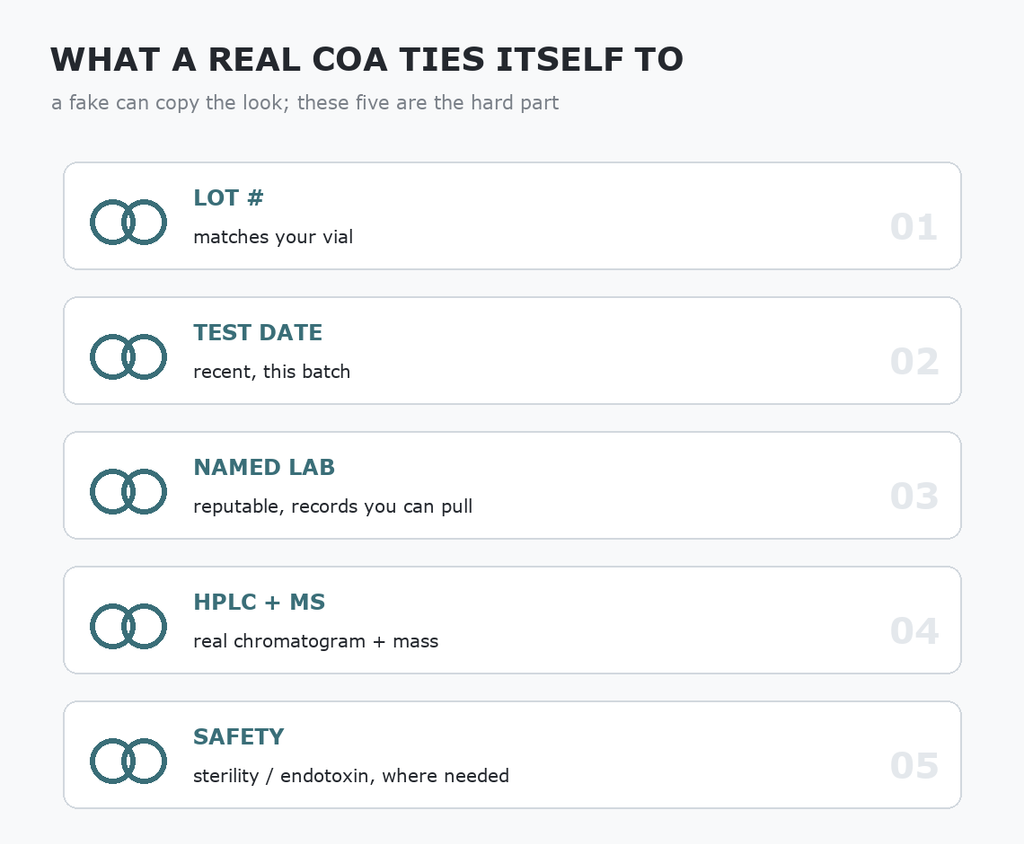
Editing a PDF takes about five minutes, so the PDF alone proves little. Janoshik, for instance, stamps every report with a task number plus a unique key, and the original stays on file at the lab. Faked COAs tend to share a few tells: no key, a key that returns a different compound, mismatched fonts, or a date that falls after the batch went on sale. The walkthrough on how to verify a peptide COA is real walks through each one.
⏱ 30-second check: Type the task number and unique key into Janoshik’s verification page. The compound, purity and dates should match the supplier’s copy exactly.
5. Is Purity 99%+ by HPLC, With Identity Confirmed by Mass Spec?
A complete COA answers three questions: is it the right molecule, how clean is it, and how much is in the vial?
United States Pharmacopeia scientists, writing in Pharmaceutical Research, note that peptide quality is “evaluated using a series of analytical tests… to determine identity, purity, and strength” (McCarthy et al., 2023). A research COA follows the same logic on a smaller scale.
Question
Test
What a good result looks like
Purity: how clean is it?
HPLC (high-performance liquid chromatography), which separates a sample into peaks
99% or higher for the main peak
Identity: is it the right molecule?
LC-MS or ESI-MS (mass spectrometry), which weighs the molecule
Measured mass lines up with the theoretical mass
Content: how much is there?
Quantified against a reference
At or above the labeled mg per vial
A sample that reads 99% pure could still be the wrong peptide. That’s the reason the two tests travel together. Our breakdown of HPLC vs mass spectrometry covers the detail, along with a common follow-up: is 99% always better than 98%?
⏱ 30-second check: Find three numbers on the COA: a purity percentage, an observed mass and a measured mg figure. If one is missing, ask the supplier for the report that covers it.
6. Is Everything Labeled Research Use Only?
A compliant supplier describes compounds by chemistry, testing and storage, and publishes no dosing guides or effect claims.
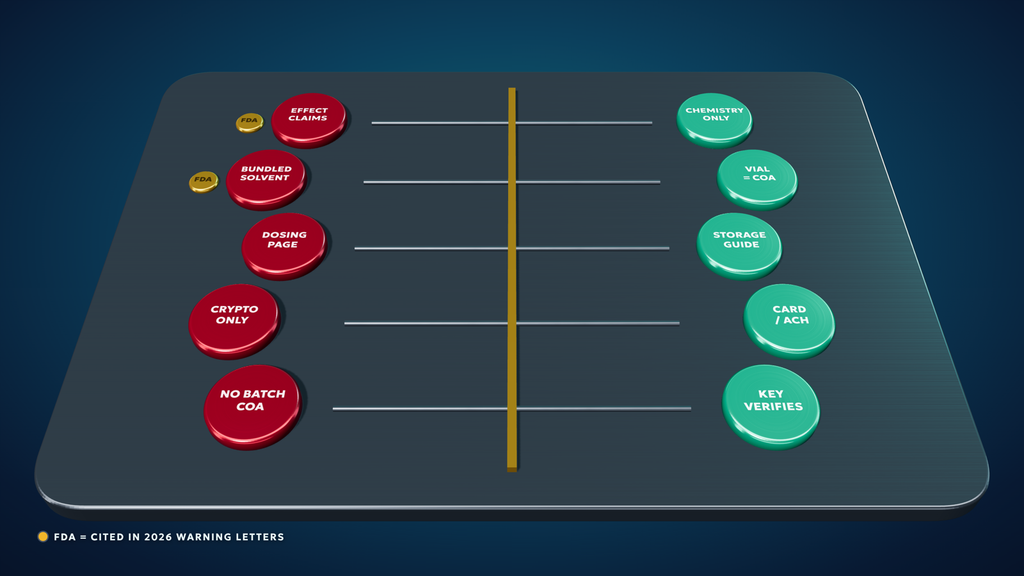
The FDA decides what a product is by how it’s sold. Its 2026 warning letters, dated March 31, June 17 and August 24, cited sellers whose pages carried effect claims and who offered bacteriostatic water as a solvent alongside the vials. A “research use only” label didn’t change the outcome. See where peptides stand with the FDA in 2026 for the full picture.
⏱ 30-second check: Run the site’s search box for “dose”, “protocol” and “results”. Before-and-after photos or bundled injection supplies are an instant fail.
7. Is the Product Documentation Complete?
Every listing should show the sequence, molecular weight, CAS number, physical form, batch number and storage guidance.
⏱ 30-second check: Pick one product and tick off the six fields. Missing two or more is a warning sign.
8. Is the Pricing Realistic?
A price well under the US norm usually means a skipped test or a light vial.
Third-party testing, US warehousing and domestic shipping all cost money. A vial priced well under the market floor leaves very little room for any of them. Here’s what US listings looked like when we checked:
Compound
Range across US listings (checked October 4, 2026)
A price inside the range proves nothing on its own. A price far below it is a reason to look harder at checks 3 to 5.
⏱ 30-second check: Compare one 10mg vial against three other US listings. Anything priced under half the lowest of them needs a very good COA.
9. Are Payment Options Mainstream, With a Written Refund Policy?
A stable supplier takes cards or ACH, runs a secure checkout and publishes its refund terms.
Card processors and banks review the merchants they work with. Crypto-only or gift-card checkouts often mean a seller couldn’t pass that review. A written refund policy tells you, before you pay, what happens if a parcel arrives damaged. Check the payment options and the refund and returns policy before your first order.
⏱ 30-second check: Go to checkout without paying. Do you see card or ACH, and can you find refund terms in the footer?
10. Are There Real Reviews and Responsive Support?
Good suppliers have independent reviews, answer an email within one business day and give you a real way to reach them.
Reviews on Trustpilot or long-running forum threads carry more weight than five-star quotes on the seller’s own homepage. Support quality shows up the first time something goes wrong. Send a technical question first, such as “which lab tested batch X?”, and see how fast a clear answer arrives. You can contact a real person on our side to try it.
⏱ 30-second check: Email a question about a specific batch. A reply with the lab name and batch number within one business day is a pass.
How Do I Know If a Peptide Supplier Is Legit? (Comparison Table)
Quick answer: You can confirm a peptide supplier is legit in about ten minutes. Its batch COA should match your vial and check out on the lab’s website. The company should appear in a state business registry, publish its policies, take card or ACH, and keep dosing and human-use language off every page.
Use this table side by side with any supplier’s website. Most of these checks take under a minute each.
Check
Where to find it
Green flag
Red flag
Business registration
State registry or OpenCorporates
Active LLC or corporation, name matches the site
No filing, or a name that doesn’t match
Dispatch location
Shipping policy
US city, carrier and cut-off listed
“Ships worldwide” with no origin
Batch COA
Product page or COA library
Batch number and test date shown
One generic COA for every batch
Lab verification
The lab’s own site
Task number and key verify
No key, or a key that fails
Purity and identity
The COA
HPLC 99%+ and a mass-spec result
Purity only, no identity data
Labeling
Product pages
Chemistry, storage and RUO notice
Dosing charts, “protocols”, effect claims
Documentation
Product listing
Sequence, MW, CAS, form, batch
Name and price only
Pricing
Market comparison
Within the normal US range
Far below every other listing
Payment and refunds
Checkout and footer
Card or ACH, written refund terms
Crypto-only, gift cards, no policy
Support and reviews
Contact page, third-party sites
Named lab in a one-day reply
Social DMs only, no email
How to know if a peptide supplier is legit
What Are the Red Flags of an Untrustworthy Peptide Supplier?
Quick answer: Steer clear of any supplier showing these signs: COAs that aren’t tied to a batch, reports the lab has no record of, dosing charts or talk of human use, no company filing, prices well under the US range, crypto-only checkout, sales run through social media alone, or missing refund terms.
One red flag can be an oversight. Two together usually aren’t. Here’s what to watch for, and why each one counts:
No batch-specific COA. You can’t connect the report to the vial you’re holding.
A COA that won’t verify. If the lab has no record, treat the PDF as decoration.
Dosing, “protocols” or effect claims. These are the exact things FDA letters cite, and they put the supplier’s future at risk.
Reviews that describe effects. A seller that publishes these is marketing to people, whatever the label says.
No registered business. There’s no legal entity to hold to its refund policy.
Prices far below the market. Testing and US stock cost money, and something gets cut.
Crypto-only or gift-card payment. Mainstream payment partners usually declined the merchant first.
Sales through Instagram, Telegram or DMs only. No storefront means no policies and no paper trail.
A sudden rebrand to a new domain after an FDA letter. The same operation under a new name still has the same history.
Every one of these shows up on the COA or around it. Learning how to read a peptide COA makes the first two flags easy to spot.
What Do Researchers on Reddit Check Before Buying From a Peptide Supplier?
Quick answer: On Reddit and research forums, the common advice is “order, test, filter.” Buy a small amount, send it for independent testing, and only reorder from suppliers whose results match their COA. Forum users also check vendor history, refund experiences and whether the supplier still operates.
Forum regulars treat a supplier’s COA as a claim to test. Many pool money for group tests, where several members send vials from one batch to a lab and post the results publicly. A batch that tests well gets mentioned again. One that doesn’t gets called out within days.
That testing habit has grown fast. Janoshik’s peptide test volume rose more than 1,200% between 2023 and 2025, according to data the lab shared with Bloomberg Businessweek in June 2026. Much of that growth came from sellers and buying groups sending in samples before they trusted a batch.
They also read a supplier’s history before buying. Long-running threads track who changed domains, who stopped answering emails and who paid refunds without a fight. Since the shutdowns, one more question comes up constantly: is this supplier still shipping this month? Sorting threads by “new” answers that faster than any ranking page.
The habit worth copying is the paper trail. Keep the COA, the batch number and your order date together for every vial. When a forum thread later questions a batch, you’ll know within seconds whether it’s yours.
Are US Peptide Suppliers Legit After the 2025-2026 Shutdowns?
Quick answer: Plenty of US peptide suppliers are real, properly run research-reagent companies. Still, several big vendors closed in 2025-2026, and the FDA sent warning letters to others. The suppliers still worth using publish lab-verifiable results, show their company filing and sell for research use. Anyone missing those is unverified.
The shakeout came in three waves. Amino Asylum went offline in 2025. Science.bio announced its closure on January 27, 2026. Peptide Sciences, long one of the biggest names in the US market, closed on March 6, 2026. The FDA’s warning letters followed on March 31, June 17 and August 24.
Demand kept climbing through all of it. Chainalysis tracked $32 million in crypto payments to peptide sellers in Q1 2026, up 159% on the previous quarter and on pace for more than $100 million a year. Over the same period, average spending on independent testing fell 88%, to about $8 per buyer. More buyers doing less of their own testing puts the weight on suppliers that publish verifiable COAs up front.
Reviews alone couldn’t have predicted any of this. Several of the closed vendors had years of glowing feedback right up to the last day. Reviews describe past orders, while COAs, registry filings and public FDA letters describe the business as it stands today. We track these signals across vendors in our vendor trust index.
Is It Legal to Buy Research Peptides in the US?
Quick answer: In the US, research peptides are sold as lab reagents that carry a research-use-only label. None is an FDA-approved drug, and none is meant for human or veterinary use. Because the FDA looks at how a product is marketed, a seller promoting human use can face enforcement even with the research-use label in place.
The 2026 headlines made this feel murkier than it is. In April, the FDA moved 12 peptides off its “Category 2” list of substances flagged for compounding concerns. In July, its Pharmacy Compounding Advisory Committee voted to recommend six of seven reviewed peptides, including BPC-157, TB-500 and Epitalon, for the 503A compounding list.
Those votes concern compounding pharmacies, and they’re recommendations. As FDA lawyer Joanne S. Hawana of Mintz put it, “Nothing has legally changed yet,” because “an advisory committee vote is not an agency action” (Mintz, July 29, 2026).
Where Can You Buy Research Peptides in the USA Safely?
Quick answer:
1. Shortlist registered US suppliers.
2. Confirm their COAs on the testing lab’s site.
3. Check payment and refund policies.
4. Start with a small order and check the vial’s batch against the COA.
The best place to buy peptides online in the USA is any supplier that survives those four steps. In practice, that’s a direct storefront run by a registered company. Marketplaces, social media sellers and resellers who can’t name their lab drop out at step two.
Your first order should be small on purpose, because it’s a test of the supplier as much as the product. Buy one or two vials, match the label’s batch code to the published COA, and store the material as directed. If everything lines up, you’ve found a supplier worth building on. When you’re ready, you can browse US-stocked research peptides with every COA one click away.
Which Research Peptides Are Most Popular, and What Should Their COAs Show?
Quick answer: Researchers most often order BPC-157, TB-500 and GHK-Cu, blends like KLOW, and neuropeptides like Selank. For each one, a full COA shows three things: mass-spec identity, HPLC purity and the measured amount in the vial. Blends need a confirmed result for every component, one by one.
The same three questions apply to every compound, but some products need extra attention. Blends are the big one. A single purity figure for a four-part blend tells you almost nothing about each part.
Short peptides like Epithalon have small, distinctive masses, so mass spec confirms them quickly. Longer sequences and blends take more work, which makes a lab name on the report even more useful.
Where Can I Find Wholesale Research Peptides in the USA?
Quick answer: For bulk research peptides, pick a US supplier that ships the full order from a single batch backed by one COA. Get the volume price in writing, and confirm lead time and storage details before paying.
Bulk orders raise the stakes on every check above. Ten vials from three different batches means three COAs to verify and three chances for variation across your experiments. Ask for a single-batch fill up front.
Quick answer: Life Link Research ships from US stock in California with same-day dispatch before 2 PM PST. It publishes third-party COAs from Janoshik and US laboratories, labels its full catalog research use only, and accepts card, ACH and Bitcoin under a published refund policy.
Here’s how we score on the same ten checks:
Criterion
Life Link
Registered business
Business address in Sheridan, Wyoming, on every policy page
US stock and dispatch
Ships from California; same-day before 2 PM PST, UPS 2-Day Air
Independent COAs
Janoshik Analytical and US-based labs
Lab verification
Task number and unique key on each Janoshik report
Purity and identity
HPLC purity of 99%+ plus mass-spec identity on each batch
Wider panel
Heavy metals, endotoxin and sterility on a rotating cycle
Research-use labeling
On every product and page
Documentation
Sequence, MW, CAS, form and batch on each listing
Payment and refunds
Card, ACH and Bitcoin; 30-day returns on sealed items
Support
Direct email to customerservice@lifelinkresearch.com
In 2026 so far, we’ve sent 148 batches for third-party testing. A batch that fails is quarantined, and it never gets relabeled or shipped.
Here’s what one of those reports looks like, field by field.
How to verify a peptide COA batch number and purity
Field on the report
What it shows
Why you check it
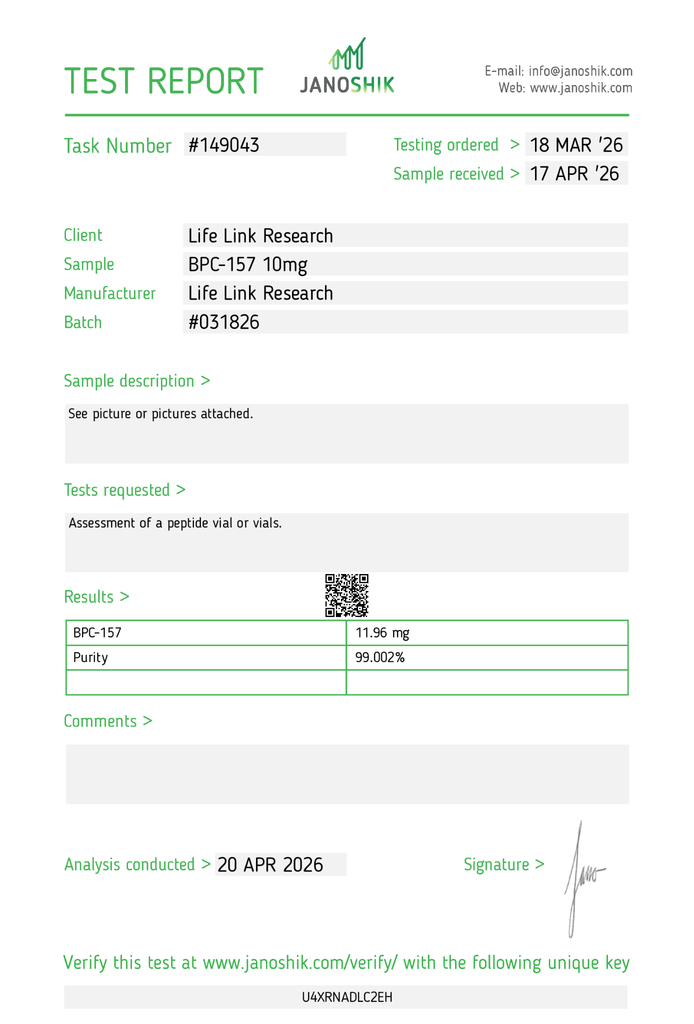
Task #149043
Janoshik’s record number
Needed for verification
Batch #031826
The lot this report covers
Must match the batch on your vial
Analysis conducted: April 20, 2026
Test date
Shows the report is current
BPC-157: 11.96 mg
Measured content
Above the 10 mg on the label
Purity: 99.002%
HPLC result
Clears the 99% standard
Unique key
Lab-side code
Enter it with the task number to confirm
That report covers purity and content. Identity comes from mass spectrometry, and an earlier BPC-157 report (task #43463) notes “LCMS spectrum attached.” A separate endotoxin report (task #65203) recorded 2.167 EU as part of the rotating panel. All three sit on the product’s certificate page. See our quality and testing process for the full method.
What is the most trusted peptide supplier in the USA?
The most trusted US supplier is whichever one’s evidence survives your own checking. That means batch-specific COAs that verify at the lab, a registered company, US dispatch and research-use-only labeling. Trust earned this way survives shutdowns and rebrands, because it rests on records you can open today. A name on someone’s ranking list doesn’t carry the same weight.
How do I know if a peptide supplier is legit?
You know a peptide supplier is legit when its claims match outside records. Verify the COA key on the lab’s site, find the company in a state business registry, and confirm card or ACH checkout and a written refund policy. Then search the FDA warning letter database for the company name. A supplier that passes all four is a strong candidate.
What is the best website to buy research peptides in the USA?
The best website is a supplier’s own storefront that publishes a COA library, a US dispatch point and its legal business details. Product pages should list sequence, molecular weight, CAS number and batch. Checkout should offer card or ACH. Avoid marketplaces and social media sellers, because they rarely link a vial to a verifiable lab report.
Where do peptide sellers get their products?
Most research peptides are synthesized by specialist manufacturers, many of them in China, with a smaller share made in the US. Good resellers then test each incoming batch through an independent lab, store it in the US and package it for dispatch. The testing step is where suppliers differ most, so ask any seller which lab tested your batch.
What happened to Peptide Sciences and other US vendors?
Peptide Sciences closed on March 6, 2026, after Science bio announced its own closure on January 27, 2026. Amino Asylum went offline in 2025. The closures came alongside a run of FDA warning letters, dated March 31, June 17 and August 24, 2026, that targeted sellers marketing research peptides for human use.
What purity should research peptides be?
Research peptides should reach at least 99% purity on HPLC, and a separate mass-spec run should confirm identity. Purity tells you what share of the sample is the target peptide. Identity tells you the molecule is correct. A complete COA also reports the measured amount per vial, so you can confirm the vial holds at least what the label states.
Does a higher price mean better quality?
A higher price doesn’t guarantee quality, but a very low one usually signals missing testing or under-filled vials. Use price as a filter and evidence as the decision. Compare the COA, the lab verification and the documentation first. Between two suppliers that pass every check, choose on price, shipping speed and support.
⏱ The 10-minute supplier check
Registered US business · US stock and a stated cut-off · batch COA from an outside lab · a key that verifies at the lab · 99%+ HPLC purity plus a mass-spec match · research-use-only labeling · full product documentation · market-range pricing · card or ACH with written refunds · a one-day support reply. Ten passes, and you’ve found a supplier worth trusting.
Every product discussed here is a laboratory reagent sold for research use only. None is FDA-approved, and none is intended for human or veterinary use or for diagnostic or therapeutic procedures. Nothing in this guide is medical advice.
A certificate of analysis is supposed to be your proof that a research peptide is what the label claims. It only works as proof if the document is real. Grey-market sellers have learned that a slick-looking COA sells product, so a screenshot with a purity number and a lab logo is easy to copy, edit, or reuse across every batch. The good news is that a genuine COA leaves a trail a fake cannot easily follow. Here is how to check it in a few minutes.
What Is a Peptide COA? (Quick Recap)
A peptide certificate of analysis is a batch-specific lab report that states what a vial contains and how pure it is. The two results that carry the load are identity, measured by mass spectrometry, and purity, measured by HPLC. A full COA links both to a specific lot number and test date.
The keyword there is batch-specific. A COA describes one production run, so the numbers on it apply to the vial that came from that run and no other. If you have never worked through one line by line, our guide to reading a peptide COA breaks down each field. This piece picks up where that leaves off: confirming the document is genuine.
Why Fake & Generic COAs Exist
Fake and generic COAs exist for one plain reason: a certificate sells peptides, and producing a real one costs money. Independent testing runs a fee per batch, so a seller cutting corners feels a strong pull toward faking the paperwork over paying for the test.
The forms this takes are predictable. Some sellers run one legitimate test, then paste that single COA onto every product and every future batch, so the document no longer describes what you receive. Others build a COA in an image editor, complete with an invented purity figure and a copied lab logo.
A few post a real lab’s report for a product they do not actually sell. Each shortcut hands you a number with nothing behind it, which is why the checks below focus on tying the document to a real batch and a real lab.
How to Verify a Peptide COA Is Real: Step by Step
Verifying a COA is a five-step check, and you can run all of it before you buy. Each step ties the document to something a fake cannot easily produce: a matching batch, a recent date, a reputable lab, real instrument data, and safety results where they apply.
Confirm the lot or batch number on the COA is the one shown on your vial or product page.
Check the test date is recent and belongs to that batch.
Verify the testing lab is named, reputable, and ideally accredited, with COAs you can actually access.
Confirm HPLC purity and mass-spec identity are both present, with real data and not just a headline percentage.
Look for sterility and endotoxin results where the research use calls for them.
Clear all five and the certificate is trustworthy. Miss one and you have a question worth asking before any money changes hands. The sections that follow take each step in turn.
The five features of a genuine COA
Step 1: Match the Lot/Batch Number
Start with the lot or batch number, because it is the thread that ties the whole certificate to your vial. A genuine COA carries a lot number, and that number should appear on the product itself or on the page you are buying from. When the two match, the report describes the material in front of you.
A mismatch, or a COA with no lot number at all, is the most common tell of a reused or generic certificate. If a single document shows up under several different products, it is describing none of them accurately. Reputable vendors publish a separate COA per batch and let you match it before ordering, so this check takes seconds.
Step 2: Check the Test Date
Next, read the test date. It should be recent and it should belong to the batch you are looking at, since peptides are tested as they are produced. A date from years ago on a current product suggests the COA was recycled from an older run.
There is a practical reason the date carries weight beyond freshness. Peptides can degrade over long or poor storage, so a purity figure from a test run long before your vial was made no longer describes the material reliably. A current, batch-tied date keeps the number meaningful.
Step 3: Verify the Testing Lab
The signal that carries the most weight is the lab itself. A real COA names the laboratory that ran the analysis, and that lab should have a reputation you can check. An unnamed “independent lab” gives you nothing to verify, while a named facility can be searched, confirmed, and often looked up directly.
Reputation and access go together. A well-regarded third-party peptide lab publishes its results in records you can pull up, so the report stands as an independent entry you can find, beyond whatever PDF the seller emailed. Accreditation raises the bar again: a lab certified to ISO/IEC 17025, the international standard for testing competence, has had its methods and impartiality checked by an outside body.
Labs such as Janoshik Analytical are widely used precisely because their reports are independently searchable. For the difference between an outside lab and a vendor grading its own product, see our guide on third-party vs in-house testing.
Step 4: Confirm HPLC Purity + Mass-Spec Identity
A trustworthy COA answers two questions with two methods, and both should be on the page. HPLC gives the purity percentage, the share of the sample that is your target peptide. Mass spectrometry gives identity, confirming the vial holds the peptide you ordered and not a different sequence.
The identity result is the one a cheap fake tends to fumble. A real LC-MS line shows the observed mass next to the theoretical mass for that peptide, and the two should match within the instrument’s resolution.
Look past the headline number to the actual data: a real report shows the HPLC chromatogram and the mass spectrum, while a fake often shows only a percentage. Our HPLC vs mass spectrometry guide explains what each proves.
Step 5: Look for Sterility/Endotoxin (Where Relevant)
For any peptide headed into cell or animal research, purity and identity are only part of the picture. Sterility and bacterial endotoxin testing catch contamination that a purity percentage never would, and a thorough COA reports them alongside the core results.
These results carry the most weight for sensitive work, where a stray endotoxin could throw off an inflammatory readout. A vendor that runs a broader safety panel and publishes those lines is showing you more of its hand. Their absence is a smaller flag than a missing lot number, though for research that touches living systems it is worth confirming.
Red Flags of a Faked or Generic COA
Some patterns tell you a COA is decorative before you finish reading it. Any single one is a reason to slow down and ask the vendor a direct question.
No lot number or test date. With nothing tying the document to a batch, it describes nothing you can hold.
No named lab. A vague “independent lab” credit leaves you no facility to look up.
One COA for every product. A single certificate reused across the catalog is a template, not a result.
A picture with no readout. A purity badge floating free of a chromatogram or spectrum shows a conclusion and buries the work.
Mismatched or impossible figures. A purity number that clashes with the vial label, or shifts between the page and the PDF, points to editing. Our explainer on 98% vs 99% purity covers what those numbers should and should not do.
Spot two of these on one certificate and the safe move is to buy from a source that documents each batch.
Real COA vs Decorative COA
The gap between a real COA and a decorative one comes down to whether the document can be traced. A real certificate is batch-specific, names its lab, and shows the underlying instrument data, so every claim on it can be followed back to a source. A decorative COA is built to reassure at a glance and falls apart the moment you check a detail.
A real COA has
A decorative prop has
A lot number that matches the vial
No lot number, or one reused across products
A recent, batch-specific test date
An old or missing date
A named, reputable lab
“Independent lab” with no name
HPLC chromatogram + mass spectrum
A purity badge and nothing else
Observed mass matching theoretical
No identity data at all
The difference is not how polished the PDF looks. A convincing design is the easy part to fake; the traceable data is the hard part.
A real COA versus a decorative prop
What to Do If a COA Can’t Be Verified
If a certificate fails a check, the safe move is to pause and ask the vendor for the batch-specific COA that matches your lot, from a named lab. A legitimate seller can produce it quickly, since the document already exists for every batch they stock or ship.
A vendor that stalls, sends the same generic file again, or cannot name its lab has told you what you need to know. There is no research upside to a peptide whose identity and purity you cannot confirm, and plenty of downside if the material is off-spec. When verification fails and the seller cannot fix it, walk away and buy from a source that publishes real, batch-matched COAs.
Frequently Asked Questions
Can peptide COAs be faked?
Yes, a COA is a document, so it can be edited, invented, or reused. Common fakes include an image-editor certificate with a made-up purity number, a real lab’s report reused across every batch, and a genuine COA posted for a product the seller does not actually stock. Verifying it against a batch and a named lab is how you catch these.
How do I know a peptide COA is real?
Do these five checks: the lot number matches your vial, the test date is recent and batch-specific, the lab is named and reputable, HPLC purity and mass-spec identity are both shown with real data, and safety testing appears where relevant. A certificate that clears all five is trustworthy.
What should a real peptide COA include?
A real COA includes a lot or batch number, a test date, the named testing laboratory, an HPLC purity result with a chromatogram, and a mass-spectrometry identity result showing observed mass against theoretical mass. For sensitive research it also includes sterility and endotoxin results. Each item ties the document to a real batch and lab.
Should the lot number on the COA match the vial?
Yes, and this is the single most important check. The lot number on the certificate must match the number on your vial or product, because a COA describes one specific batch. A mismatch, or a missing lot number, means the document does not describe the material you are actually receiving.
The Bottom Line
A peptide COA is only proof when the document is real, and confirming that takes about five minutes. Match the lot number to your vial, check that the test date is recent and batch-specific, confirm the lab is named and reputable, and look for both an HPLC purity result and a mass-spec identity result backed by real data, with sterility and endotoxin where the work calls for it.
A certificate that clears those checks, from a lab whose COAs you can access, is worth trusting. One that cannot is a reason to buy elsewhere.
Disclaimer
This article is for educational and informational purposes only. The peptides referenced are research-use-only, not for human or veterinary consumption, and are not FDA-approved. Nothing here is medical or legal advice. Intended for adults 18 and older.
To read a peptide Certificate of Analysis (COA), find the batch or lot number on the document, confirm who ran the testing, check the HPLC purity result, verify identity with mass-spectrometry data, review any extra tests, and confirm the dates. A COA documents the quality of one specific batch.
How to Read a Peptide Certificate of Analysis?
If you buy research peptides in the US, the COA is the single most useful piece of paper you should know about. It is where a supplier shows their work: what the compound is, how pure it is, and who checked. Read it well and you protect your experiments, your budget and your reputation. Skim it and you are trusting a random number on a website.
This guide is written for US labs and qualified professionals working with research-use-only (RUO) peptides. We walk through every part of a COA, from the batch number to the mass-spec trace, and we point out the red flags worth catching before material ever reaches your bench. This information is for research and quality control only. It is not medical or clinical advice.
What Is a Certificate of Analysis (COA) for Research Peptides?
A Certificate of Analysis is a lab document that reports the analytical testing for one specific peptide batch. It records the compound’s identity, its purity, and any other quality checks that were run, and it ties all of that to a single lot number so the paperwork points to the exact material you received.
COA Meaning in Peptide Research
Think of a COA as a batch’s report card. It states the peptide name and sequence, the tests performed, the results, and the date, all for one production run. The key word here is batch. A COA is only meaningful when it belongs to the specific lot in your hand, because purity and identity can vary from one synthesis to the next. A general product COA that covers a product line, with your exact batch missing, is a much weaker signal.
What a COA Can and Cannot Confirm
A good COA can confirm plenty: the analytical purity of the tested batch, the identity of the compound by mass, the extra quality checks that were run, and the source of the testing. It gives you documented evidence you can file, cite and audit.
It also has limits worth knowing. A COA reflects the batch at the time of testing. It cannot confirm how the material was stored after it left the lab, whether the label stayed attached to the right vial, or whether the compound is approved for any use in people. Documentation proves quality; it does not grant approval.
COA vs Marketing
Real COAs and marketing brochures can look similar at a glance, so it helps to know the difference. A real COA is batch-specific, names the methods used, and usually includes the underlying data, such as an HPLC chromatogram or a mass-spec trace. A marketing sheet tends to carry a big purity claim, no batch number, no method detail, and no raw data. When a “COA” has no lot number and no chromatogram, treat it as a brochure.
Research Peptides and RUO Labeling in the US
Research peptides are synthetic peptides sold for laboratory experiments, such as in-vitro, ex-vivo and animal-model work. In the US they are labeled Research Use Only (RUO), which means they are supplied for research and carry no therapeutic claims and no clinical approval.
What “Research Use Only” Means for US Labs
RUO is a specific label with a specific job. Under FDA rules for in-vitro diagnostic products (21 CFR 809.10), material in the research phase must carry the statement “For Research Use Only. Not for use in diagnostic procedures.” That wording exists to keep research material out of clinical diagnosis and patient care. For a peptide buyer, the takeaway is simple: RUO compounds belong in controlled laboratory research.
RUO vs Therapeutic Peptides: The FDA Context
The gap between an RUO peptide and a therapeutic one is wide. An RUO peptide is sold under a research framing, with no clinical approval behind it. A therapeutic peptide is a regulated drug, subject to FDA oversight, manufacturing standards and labeling requirements. A COA does not close that gap. It documents that a batch was tested and how pure it was, and that is all it does. Even a compound with strong regulatory momentum stays research-only until it is actually approved, a point we cover in our KPV research guide and its 2026 update.
Why Is “Not for Human Use” Important
Taking the RUO label seriously protects you on several fronts. There is legal liability if research material is used outside its intended context. There are institutional policies and ethics rules that govern how RUO compounds are handled. And there is the simple matter of doing science properly, with material used only for the research it was sold for. Reading a COA carefully and handling RUO material correctly are two halves of the same responsibility.
What a Complete Peptide COA Should Include
A complete peptide COA should let you identify the compound, tie it to a specific batch, understand the methods used, and read the results in context. If any of those four things is missing, the document is incomplete.
Product Name, Sequence, Molecular Formula and Expected Mass
The top of the COA should name the peptide clearly and, ideally, give its amino-acid sequence or molecular formula along with the expected (theoretical) mass. These details are important because they let you cross-check identity later. When you reach the mass-spec section, you will compare the expected mass shown here against the observed mass the instrument measured.
Batch or Lot Number, COA Number and Dates
The batch or lot number is the thread that ties this document to your vial. Alongside it you should see a COA or report number for document control, plus a testing date and an issue date. These fields turn a general certificate into evidence for one exact run of material, and they let you check the document is current.
Testing Laboratory and Accreditation
A credible COA identifies who did the testing. Look for a named lab with contact details, and where possible a quality system or accreditation such as ISO/IEC 17025. That standard is the international benchmark for lab competence: it lets a lab “demonstrate that they are technically competent and capable of producing valid and reliable results,” according to ISO. A named, accredited third-party lab is one of the strongest quality signals a COA can carry. We verify every batch through Janoshik Analytical and third-party labs both for exactly this reason.
Analytical Methods and Results
Finally, the COA should name its methods and show their results. Purity usually comes from HPLC or UPLC. Identity comes from mass spectrometry or LC-MS. Extra checks might include heavy metals, endotoxin, sterility and water content. Each method should carry a named technique and a real result, in a format like “Purity (HPLC): 99.1%,” not a vague “tested and passed.”
How to Read a Peptide COA: Step by Step
Reading a COA follows a repeatable order. Match the batch, confirm the testing source, read the purity, verify the identity, review the extra tests, and check the dates. Work through the same six steps for every new lot and nothing important slips past you.
Step 1: Find the Batch or Lot Number
Start with the number. Find the lot number on the COA and check it against the supplier’s published batch records or your order paperwork. Then trace it through your packing slip and inventory record so the whole chain agrees. A COA that does not carry your exact lot number is not documentation for your material, however impressive the results look.
Step 2: Confirm Who Did the Testing
Next, find out who ran the tests. In-house quality control has value, but independent third-party testing carries more weight because it removes the supplier from marking their own homework. Most suppliers stop at one or two tests. We run a third-party testing panel on every batch and verify it through outside labs, so the results you read were not generated in the same room they were sold from. If a COA is vague about the testing source, ask.
Step 3: Read the HPLC Purity Result and Chromatogram
Now read the purity. The HPLC result is a percentage that represents the share of the sample made up of the main peptide. A quick look at the chromatogram tells you more: one tall main peak is what you want, and extra peaks are impurities. As a rough guide, 95% suits early screening, while 98 to 99% is the range most labs want for quantitative or publication-grade work.
Step 4: Confirm Identity with Mass Spectrometry
Purity tells you how clean the sample is. It does not tell you the sample is the right compound. That job belongs to mass spectrometry, which measures the molecular mass and lets you compare it to the expected value. A purity figure without identity data is only half a quality check, so never skip this step.
Step 5: Review the Extra Tests
Depending on your work, the extra tests can matter as much as purity. Water content affects how accurately you convert milligrams to moles. Endotoxin and sterility become important for cell-culture and animal work. Scan these results and decide which ones your specific application needs.
Step 6: Check Dates, Version and Authenticity
Finish on the housekeeping. Confirm the testing date is recent, since a very old COA may not reflect the current batch. Check for a version number or document code so you know you have the latest file. And where a supplier offers a QR code or an online lookup, use it to confirm the document is genuine.
Understanding HPLC Purity on a Peptide COA
HPLC purity is the headline number on most peptide COAs. It reports how much of the tested sample is the target peptide, measured by separating the sample’s components and comparing their sizes. Read it alongside the method and the chromatogram, and it becomes a figure you can trust.
What HPLC Purity Measures
High-performance liquid chromatography pushes a sample through a column so its components separate out and pass a detector at different times. Peptides usually run on reverse-phase HPLC. The output is a chromatogram, a chart of peaks, where the main peptide forms the largest peak and any impurities show up as smaller ones.
How the Purity Percentage Is Calculated
The purity figure comes from peak area. The instrument measures the area under each peak, then reports the main peak’s area as a percentage of the total. A result of 99% means the main peptide accounts for 99% of the detected material, with the remaining 1% spread across minor peaks. It is a relative measure, which is why the chromatogram behind it matters.
Purity Thresholds for US Labs: 95%, 98% and 99%
Different work calls for different thresholds. For early screening or exploratory studies, 95% is often workable. For quantitative studies and publication-grade research, most labs want 98 to 99% or higher. Higher purity means fewer stray variables in your data. The number is only as good as the verification behind it, which is the whole point of our guide on what 98% vs 99% purity actually means: a verified 98% beats an unverified 99% every time.
Reading the Chromatogram and Spotting Impurity Peaks
You do not need to be an analyst to read a chromatogram at a glance. Find the tall main peak, then look for extra peaks along the baseline. A few tiny peaks are normal. Large secondary peaks, a noisy wandering baseline, or impurity peaks the report never mentions are all worth questioning. Retention time (where the main peak sits) should also be consistent with the compound.
How Mass Spectrometry Confirms Peptide Identity
Mass spectrometry confirms that your peptide is actually the peptide on the label. It measures the compound’s molecular mass, which you compare against the expected mass from the sequence. Purity and identity answer different questions, and a complete COA answers both.
Why Identity Matters as Much as Purity
A sample can be 99% pure and still be the wrong compound, or the right compound with the wrong modification. Purity cannot catch that; only identity can. Mass spectrometry rules out mislabeled or mis-synthesized material by checking the mass fits the target. This is why the two methods work as a pair, a relationship we break down in our guide on HPLC vs mass spectrometry testing.
Expected Mass vs Observed Mass
The COA shows two mass figures. The expected (theoretical) mass is calculated from the peptide’s sequence. The observed mass is what the instrument actually measured. When the two line up, the report is showing a real measurement that matches the target compound. A COA that lists only the expected mass, with no observed value, has skipped the measurement that matters.
Acceptable Mass Variance
Observed and expected mass rarely match to the last decimal, and that is fine. Instruments have a tolerance, often within a few Daltons for standard equipment, or tighter in parts-per-million on high-resolution systems. A small, expected deviation is normal. A large gap between observed and expected mass is a reason to pause.
What Mass Spectrometry Does Not Confirm Alone
Mass spectrometry is powerful, and it has limits. It confirms the mass, which strongly supports identity, but a basic mass measurement does not always prove the full sequence on its own. That is why identity and purity are read together, mass spec alongside HPLC, so the batch is checked from two angles at once.
The Extra Tests That Separate a Good COA from a Great One
Purity and identity are the baseline. The tests that mark out a serious supplier are the extra ones: heavy metals, endotoxin, sterility and amino acid analysis. Most suppliers run one or two tests. We test identity and purity on every batch, with heavy metals, endotoxin, and sterility on a rotating cycle — the extra checks catch problems purity alone never sees.
Heavy Metals Screening
Heavy-metal contamination can enter during synthesis or handling, and it can quietly skew sensitive assays or harm cell cultures. A heavy-metals screen checks the batch against acceptable limits. For regulatory-sensitive or cell-based work, it is a check worth seeing on the page, so you can confirm it yourself.
Endotoxin and Sterility Testing
Endotoxins are bacterial fragments that can wreck cell-culture and animal studies even at low levels, so endotoxin testing measures them against a threshold. Sterility testing confirms the material is free of viable microbial growth. Both matter most for in-vivo and cell work, where contamination turns a clean experiment into noise.
Water Content
Water content affects your maths. A peptide that has absorbed moisture weighs more than the peptide alone, which throws off any milligram-to-mole conversion. Seeing water content on a COA means fewer surprises in your calculations.
Amino Acid Analysis
Amino acid analysis confirms the peptide’s composition by breaking it down and measuring the amino acids present. It adds another layer of identity confidence on top of mass spec, and it helps verify the true peptide content of the sample. It is one of the checks in our third-party testing panel, and it is rare to see on a standard COA.
When US Labs Should Insist on These
Not every study needs every test, so match the checks to the work.
Cell culture and in-vivo studies lean on endotoxin and sterility.
Quantitative work leans on water content.
Regulatory-sensitive research may need heavy metals and full identity confirmation.
When your experiment is sensitive, ask for the data before you buy, while it can still shape your decision.
How to Verify Overall Peptide Quality from a COA
Verifying quality means reading the whole COA as one picture: identity confirmed, purity above your threshold, the right extra tests present, and recent, traceable testing behind it all. Any single number in isolation can mislead.
Purity vs Identity: Why You Need Both
The core rule is that purity and identity are not the same thing, and you need both. Purity tells you how clean the sample is. Identity tells you it is the right compound. A batch that is pure but unidentified, or identified but impure, fails the test. Trust comes from the two together.
Setting Your Lab’s Quality Thresholds
Decide your standards before you shop. Set a minimum purity for your work, make mass-spec identity a non-negotiable, and list the extra tests your applications require. Written thresholds turn “this looks fine” into a clear pass-or-fail, and they keep decisions consistent across your team.
A Simple New-Batch Quality Checklist
Turn the six reading steps into a checklist for every new lot: batch matched, testing source confirmed, HPLC purity above threshold, mass-spec identity confirmed, extra tests reviewed, dates current. Six ticks and the batch is cleared for use. A missing tick is a question to resolve first.
When to Reject a Batch
Some findings are a clear stop. Reject or quarantine a batch when the purity sits below your threshold, when there is no mass-spec identity data, when the observed and expected mass disagree sharply, or when the COA cannot be tied to your vial. Rejecting a doubtful batch costs far less than a ruined experiment.
Common COA Red Flags US Buyers Should Watch For
Most weak COAs share the same handful of tells. Once you know them, you can spot a thin document in seconds, before it becomes a problem in your data.
Missing or non-specific batch numbers. A COA with no lot number cannot be tied to your material. A generic “product” COA is not enough.
A purity number with no chromatogram. A percentage with no underlying HPLC trace is a claim you cannot check.
No mass-spec identity data. Purity alone leaves identity unconfirmed, so a COA with no observed mass is half a document.
A vague or untraceable testing lab. “Independent lab” with no name, address or accreditation is not verifiable.
Outdated testing dates. A very old COA may not reflect the batch you actually received.
A COA that does not match the product page. Different sequence, purity or details between the listing and the COA is a real inconsistency to resolve.
COA Best Practices for US Labs
A COA is only useful if you can find it again. Storing, linking and reviewing COAs the same way every time turns a pile of PDFs into an audit trail you can defend.
Documenting COAs in Your Lab
Keep every COA in one place, whether that is a LIMS, a shared drive or a dedicated QA folder. Use a consistent naming convention, such as compound plus batch plus date, so any file is one search away. A tidy repository saves hours during an audit or a publication review.
Linking COAs to Inventory, Experiments and Publications
Tie each COA to the material it documents. Tag it in your inventory against the lot, reference it in your experiment notes, and cite the batch in the methods section of any resulting paper. That chain lets anyone retrace exactly which material produced which result.
A COA-Review SOP and Training Staff
Write a short standard operating procedure for COA review, covering the six steps and who signs off. Then train new staff against it with an onboarding checklist. When everyone reads a COA the same way, quality stops depending on who happened to open the box.
Choosing a Trusted US Research Peptide Supplier
A trustworthy US supplier makes quality easy to verify. Look for transparent, batch-specific COAs, named third-party testing, a broad and consistent test panel, and quick access to the documentation behind every order.
Quality Signals to Look For
The strongest signals are practical ones. A public, searchable COA library. Third-party testing through a named lab. A test panel that goes beyond the basic one or two checks. We built around these on purpose: a third-party testing panel on every batch, third-party verification through Janoshik and third-party labs, and 99%+ purity as the everyday standard on every batch.
Questions to Ask a Supplier About Testing
A few direct questions reveal a lot.
Is testing done in-house or by a third-party lab?
Can you share the chromatogram and mass-spec data for this specific batch?
What does your test panel include?
A confident supplier answers quickly and shows the documents, but a vague answer is its own signal.
Example: Verifying a New Peptide Batch (Walk-Through)
Here is the whole process in one short workflow you can run on any new lot, whether it is BPC-157, MOTS-c, a GLP research compound or PT-141.
1. Download the COA for the batch from the supplier’s library.
2. Match the batch number on the COA to your vial and packing slip.
3. Confirm the testing lab and check for third-party verification.
4. Read the HPLC purity and glance at the chromatogram for stray peaks.
5. Verify the mass-spec identity by comparing observed and expected mass.
6. Review the extra tests your application needs, such as endotoxin or water content.
7. Confirm the dates are recent and the document version is current.
8. Archive the COA in your LIMS or shared drive against the lot.
Frequently Asked Questions
What Purity Percentage Should US Labs Look For in Research Peptides?
It depends on the work. Around 95% suits early screening, while 98 to 99% or higher is the common target for quantitative and publication-grade studies. Just as important, the purity should be verified, since a documented 98% is worth more than an unverified 99%.
Do All COAs Need Both HPLC and Mass-Spec Data?
As best practice, yes. HPLC reports purity and mass spectrometry confirms identity, and the two answer different questions. If a COA shows purity but no observed mass, the compound’s identity is not fully confirmed, so treat that as an incomplete document.
How Often Should COAs Be Updated for Recurring Batches?
Each new batch or lot should get its own COA, because purity and identity can shift between production runs. A COA from a previous lot does not cover the vial in your hand, however recent it looks.
Can a US Lab Rely on Supplier-Run Tests, or Should It Insist on Third-Party Results?
In-house testing can be acceptable, and third-party data is stronger because it is independent. If a COA is unclear about who ran the tests, ask. We verify every batch through Janoshik Analytical and domestic third-party labs so the results stand on their own.
What Should a Lab Do if the COA Does Not Match the Order Records?
Quarantine the batch, hold it out of any experiment, and contact the supplier to resolve the discrepancy before use. A mismatch between the label and the COA breaks the chain of traceability, and using the material anyway risks your data.
What Extra Tests Matter Beyond Purity and Identity?
Heavy metals, endotoxin, sterility, water content and amino acid analysis all add quality confidence. Which ones matter depends on your application, with endotoxin and sterility mattering most for cell-culture and animal work.
Conclusion: Using COAs to Protect Your Research and Your Lab
Reading a peptide COA well comes down to three pillars. The document must be batch-specific, tied to the exact lot in your hand. It should carry both HPLC purity and mass-spec identity, so the material is checked from two angles. And it should rest on legitimate, recent, ideally third-party testing you can trace.
Get those three right and a COA does real work for you. It supports reproducible science, it stands up to audits and publication review, and it gives you confidence in every result that follows. Build your own COA checklist, set your quality thresholds, and lean on suppliers who make their documentation easy to check. Check out our research compounds and their batch COAs and put the checklist to work on your next order.
Quick answer: A peptide purity figure is the share of the sample that is your target peptide, measured by HPLC. So 98% purity means about 2% of the material is something else, and 99% means about 1% is. Moving from 98% to 99% roughly halves that leftover fraction, which is why sensitive research leans on the higher grade and on the COA that proves it.
98% vs 99% Purity
You’ll see a purity number on the label whenever you buy research peptides: 98%, 99%, sometimes 99.5%. It looks like a simple score, and most buyers read past it in a second. Yet that one figure decides how clean your material is, what the other slice of the vial contains, and whether your results can be trusted. Understanding it takes a few minutes and pays off every time you order.
Purity grade
Leftover fraction
Typically used for
95%
~5% other material
Early screening, method development
98%
~2% other material
Standard cell assays, receptor binding
99%+
~1% other material
Sensitive bioassays, structural and quantitative work
What Purity Measures
Purity is a percentage from high-performance liquid chromatography, or HPLC. The instrument pushes the dissolved sample through a column so its components separate, then a detector reads the ultraviolet light each one absorbs and draws a chromatogram of peaks. Your peptide is the tall main peak, and its purity is that peak’s share of the total peak area. A result of “99% by HPLC” means the target peptide makes up 99% of the UV-absorbing material the detector saw.
That last phrase carries a catch worth knowing. The percentage describes the organic, light-absorbing content, so it says nothing about water, salts, or the counterion left over from synthesis. A vial can read 98% pure on peptide composition and still hold moisture or salt by weight.
Purity tells you how clean the peptide portion is, and a separate net-peptide or salt figure tells you how much actual peptide you’re weighing out. Since every peptide is a defined chain of amino acids, the test is really asking how much of the sample matches that intended chain, and how much drifted off target during manufacture.
What’s in the Other 1 to 2%?
The leftover slice has a name and a story. Peptides are built one amino acid at a time, and every coupling step has a small chance of failing. Those small failures pile up as the chain grows, which is why longer peptides are harder to make clean. The result is a handful of predictable impurities that HPLC separates out.
Truncated sequences, where the chain stopped short and is missing amino acids from the end.
Deletion sequences, where a coupling failed mid-chain and one internal amino acid is missing.
Oxidized variants, where a residue such as methionine picked up oxygen after synthesis.
Residual reagents and counterions, most often trifluoroacetic acid (TFA) salt carried over from purification.
Solvent traces left behind during processing.
None of these are exotic. They’re the normal fingerprints of solid-phase synthesis, and a good lab openly measures and reports them on the COA. Knowing what the impurities are is what lets you judge whether a 98% and a 99% sample differ in ways that touch your work.
98% vs 99%: Does That 1% Matter?
On paper the gap looks tiny. In practice it depends on how you see it. Going from 98% to 99% takes the leftover fraction from roughly 2% down to 1%, so you’re cutting the impurity load close to half. Framed that way, the “1% difference” is really a halving of everything that isn’t your peptide.
Whether that halving changes your outcome comes down to the application. For early screening or method development, 98% is usually plenty, and paying up for 99% buys little. For sensitive bioassays, structural biology, or quantitative receptor-binding studies, the extra grade earns its keep, because even minor impurities can skew a sensitive readout.
There’s also a more silent reason the profile is important: research on generic peptide products has shown that peptide-related impurities can carry measurable immunogenicity risk, as a 2025 immunogenicity risk assessment in a regulatory review documented. Impurities aren’t inert filler, so the makeup of that last 1 to 2% can matter as much as its size.
Why the Method Matters as Much as the Number
A purity figure is only as good as the test and the lab behind it. Two vials both stamped “99%” can come from different processes with different impurity profiles and different batch-to-batch consistency, so the number alone doesn’t settle the question. What settles it is the evidence.
Start with the chromatogram, the actual HPLC trace, since a clean single peak backs up the percentage in a way a bare number cannot. Pair it with a mass-spec result that confirms the peptide is the right molecule, because purity and identity are two separate questions and a sample can be pure yet wrong. Then check who ran the tests, since an independent third-party lab has no stake in the result. All of this lives on the Certificate of Analysis, and learning to read a peptide COA field by field turns a purity claim into something you can verify. Every batch we sell has $1its own published COA$2 for exactly that reason.
Why Higher Purity Costs More
The price jump between grades reflects real work behind the label. Pushing a peptide from 98% to 99% usually means more preparative HPLC, tighter fraction-collection windows, and more of the good material lost at the edges of each collection.
You’re paying for extra purification passes and the yield sacrificed to reach them. That’s also why an unusually cheap “99%” peptide is worth a second look, since the purification that grade demands has a real cost that honest pricing reflects.
The Regulatory Bar
Regulators treat even sub-1% impurities as serious business, which puts the 98-versus-99 question in useful context. Under the FDA’s guidance for highly purified synthetic peptide drug products, any impurity above 0.10% of the active ingredient has to be individually identified, and a new impurity above 0.5% can block approval outright, per the agency’s published synthetic peptide guidance. Those are pharmaceutical thresholds and research material sits in a different lane, but the numbers show how much a fraction of a percent can weigh when quality is on the line.
The topic is live right now. With the FDA’s July 2026 review of seven peptides and its synthetic-peptide impurity guidance under active revision, verifiable purity has rarely been more relevant. One caution the numbers don’t cover: a purity percentage speaks to organic cleanliness on the chromatogram, and it says nothing about bacterial endotoxin, heavy metals, or sterility. Those are separate safety tests, which is why the strongest suppliers back a purity figure with a full testing panel that covers those safety measures too.
What to Look For
When you’re comparing purity claims, a short checklist keeps you honest:
A stated purity backed by a visible HPLC chromatogram.
A mass-spec result confirming the peptide’s identity.
Testing by an independent third-party lab, named on the report.
A batch or lot number that matches your vial.
Clarity on net peptide content if salt weight matters for your dosing math.
Tick those boxes and the difference between a real 98% and a real 99% becomes something you can act on with confidence.
Frequently Asked Questions
Is 98% purity good for a peptide?
Yes, for most research uses. At 98%, roughly 2% of the material is other organic content, which is fine for standard cell assays, receptor binding, and method development. Sensitive quantitative or structural work is where stepping up to 99% starts to pay off.
What is a good purity level for research peptides?
Above 95% is the general floor for quantitative work, 98% is the common research-grade standard, and 99%+ is the top tier for sensitive studies. The right level depends on your application, and any figure means the most when an independent lab verifies it.
Does the 1% difference between 98% and 99% really matter?
It can. Moving from 98% to 99% roughly halves the impurity load, from about 2% down to 1%. For a sensitive bioassay that halving can protect your signal, while for early screening it usually makes little practical difference.
What does peptide purity actually mean?
It’s the percentage of the sample that is your target peptide, measured as the main peak’s share of UV-absorbing material on an HPLC chromatogram. It describes organic cleanliness, so it doesn’t account for water, salt, or safety measures like endotoxin.
How can I tell if a peptide is genuinely high quality?
Look past the headline percentage to the proof behind it: an HPLC chromatogram, a mass-spec identity confirmation, and third-party testing, all tied to your batch on a Certificate of Analysis. Quality is what the documents prove.
The Bottom Line
The difference between 98% and 99% peptide purity is small on the label and meaningful in the vial, since that single point roughly halves what isn’t your peptide. The percentage tells you how clean the peptide portion is, the impurity profile tells you what the rest contains, and the COA behind it tells you whether to believe either one.
Match the grade to your application, insist on the chromatogram and the mass-spec confirmation, and let an independent lab settle the number. That’s the standard every batch we sell is built to meet.
Quick answer: HPLC and mass spectrometry answer two different questions about a peptide. HPLC measures how pure a sample is by separating it into its parts and reporting the percentage that is the target peptide. Mass spectrometry measures the molecule’s mass to confirm the sample is the peptide it claims to be. A trustworthy Certificate of Analysis reports both, because purity and identity together are what tell you the material is right and clean.
HPLC vs Mass Spectrometry
Buy a research peptide and the quality of your whole experiment rests on two numbers on a lab report. One is a purity figure from HPLC. The other is an identity check from mass spectrometry. They sound similar and get lumped together, yet each answers a question the other cannot, and knowing the difference is the fastest way to read a COA with confidence.
Question you are asking
The test that answers it
What it reports
How much of this is the peptide?
HPLC
A purity percentage
Is this actually the right peptide?
Mass spectrometry
Observed mass vs expected mass
Is the material also safe to use?
Separate assays
Endotoxin, sterility, and more
HPLC: How Pure Is It?
High-performance liquid chromatography is the purity test. It pushes the dissolved sample through a packed column, and the sample’s components travel at different speeds and come out separated. A detector watches them exit and draws a chromatogram, a chart of peaks where each peak is a component.
The target peptide forms the tall main peak, and any impurities show up as smaller peaks around it. Purity is the main peak’s share of the total peak area, so a result of “99.2% by HPLC” means the peptide accounts for 99.2% of everything the detector saw. A lot of peptide work uses reverse-phase HPLC with the detector reading ultraviolet light at around 214 to 220 nanometers, the wavelength where the peptide bond absorbs.
What HPLC gives you is a clean, quantified answer to one question: how much of this vial is the peptide, and how much is something else. If you want to understand why a stated 99% can still vary in what it means, the gap between an unverified 98% and a verified 99% is where that story lives.
Mass Spectrometry: Is It the Right Molecule?
Mass spectrometry is the identity test. It measures the molecular mass of the compound in the vial and lets you compare that measured value against the mass expected from the peptide’s amino-acid sequence. When the observed mass matches the expected mass, identity is confirmed.
This matters because purity says nothing about correctness. A sample can be 99% pure and still be the wrong peptide, or the right sequence with a modification you did not order. Since every peptide is a specific chain of amino acids, its true mass is fixed, and mass spectrometry is how you check the material lives up to that number.
The sample is first ionized, most often by electrospray ionization (ESI), which gently charges the molecules so the instrument can weigh them. The output is a mass spectrum, and the peak you care about sits at the peptide’s mass. In short, HPLC tells you how much, and mass spectrometry tells you what.
Is HPLC the Same as LC-MS?
No, though they are close relatives. HPLC is the separation step on its own, ending at a detector that measures light. LC-MS, or liquid chromatography-mass spectrometry, plugs a mass spectrometer onto the end of that same separation, so the sample is separated first and then weighed. You get the purity view and the identity view from one run.
That pairing is why you often see LC-MS named on a peptide COA. It is HPLC’s separating power feeding directly into the mass spectrometer’s identifying power. Research on peptide quality control notes that combined liquid chromatography and high-resolution mass spectrometry “are capable of detecting and identifying co-eluting impurities at low levels,” as Zeng and colleagues reported in The AAPS Journal. In other words, joining the two catches problems that a purity number alone can hide.
Why You Want Both
A COA that reports only one of the two is telling you half the story. HPLC purity without an identity check leaves open the possibility that the clean-looking sample is the wrong compound. A mass confirmation without a purity figure leaves open how much of the vial is actually that compound. Read together, they close both gaps at once.
The science backs up reading them side by side. Mass spectrometry is sensitive to the exact structure, and as Zeng and colleagues explain, “changes to the primary amino acid sequence due to degradation, truncation, insertion, substitution, or deletions typically result in detectable mass shifts.” So the mass number does double duty: it confirms the right peptide and flags a wrong one.
Building on that, a review in Pharmaceutical Research by McCarthy and colleagues points out that confident characterization “often requires multiple orthogonal techniques” read together. Two views of the same batch simply beat one.
What HPLC and Mass Spectrometry Do Not Catch
Even together, these two tests have blind spots, and a genuine lab report accounts for them. Knowing the limits is what separates reading a COA from truly understanding it.
HPLC and mass spectrometry both struggle with mirror-image molecules. A D-amino acid substituted for its normal L-form has the identical mass and can travel through the column at the same speed, so it can slip past both a standard purity trace and a mass check. Neither test reports the salt form or counterion the peptide is paired with, which affects how much actual peptide you are weighing out. Neither one measures biological potency, since a molecule can be pure and correctly identified and still behave differently in an assay.
The bigger point is safety. Purity and identity say nothing about whether the material is free of bacterial endotoxin, sterile, or clear of heavy metals. Those are separate assays a lab only runs when asked, which is exactly why the strongest COAs go beyond HPLC and mass spec. A batch that passes purity and identity has cleared two important hurdles, and the safety hurdles are their own tests entirely.
Reading Both on a COA
When reviewing a Certificate of Analysis (COA), look for the HPLC and mass spectrometry results in their respective sections.
The HPLC result gives you a purity percentage and, on a good report, the chromatogram behind it.
The mass-spec result gives you an observed mass next to the expected mass, and they should agree within the instrument’s small tolerance.
Find the batch or lot number on the report first, then read the two results in that order: identity to confirm the compound is right, purity to confirm it is clean.
The full field-by-field walkthrough of reading a peptide COA covers the rest of the document, from dates to the testing lab.
One habit protects you more than anything: check who ran the tests. An independent, third-party lab has no stake in the result, so the figures stand on their own. We conduct our peptide quality analysis through ISO accredited Janoshik Analytical and domestic labs for multi-level testing that most vendors shy away from.
Frequently Asked Questions
Is HPLC or mass spectrometry better?
Neither is better, because they answer different questions. HPLC measures purity, and mass spectrometry confirms identity. The strongest peptide testing uses both, so a COA can tell you at once that the material is the right compound and that it is clean.
What HPLC purity is good for a research peptide?
Many labs look for 99% or higher for quantitative and publication-grade work, with 95% or above workable for early screening. The purity figure means the most when it is verified by an independent lab and backed by the chromatogram that produced it.
What is ESI in mass spectrometry?
Electrospray ionization (ESI) is the most common way peptides are prepared for mass spectrometry. It gives the molecules a gentle electric charge so the instrument can measure their mass without breaking them apart, which makes it well suited to intact peptides.
Do you really need both tests, or is one enough?
You want both. A purity result on its own leaves identity unconfirmed, and an identity result on its own leaves purity unknown. Reading the two together is what turns a lab report into real confidence in the vial.
Can HPLC and mass spec confirm a peptide is safe?
No, and this is the common misunderstanding. They confirm purity and identity, while safety measures like endotoxin and sterility are separate assays. A complete quality picture reads the purity and identity results alongside those safety tests.
The Bottom Line
HPLC and mass spectrometry are the two pillars of peptide testing, and each carries half the weight. HPLC tells you how pure the sample is, mass spectrometry tells you what it actually is, and a COA that reports both, verified by an independent lab, gives you a batch you can trust. With the FDA taking a closer look at peptide compounding in its July 2026 review, being able to read these results has never counted for more.
That is the thinking behind the third-party testing panel we run on every batch, where HPLC and mass spec are the first two of six checks, and every result lands on a COA you can read before you buy.
Products are sold exclusively to qualified researchers and licensed laboratories. They are not drugs, foods or cosmetics, and are not for human or veterinary use. Create your researcher account once; we will remember you on this device.
Welcome back. Sign in with the email and password you used to create your researcher account.