
Quick Answer
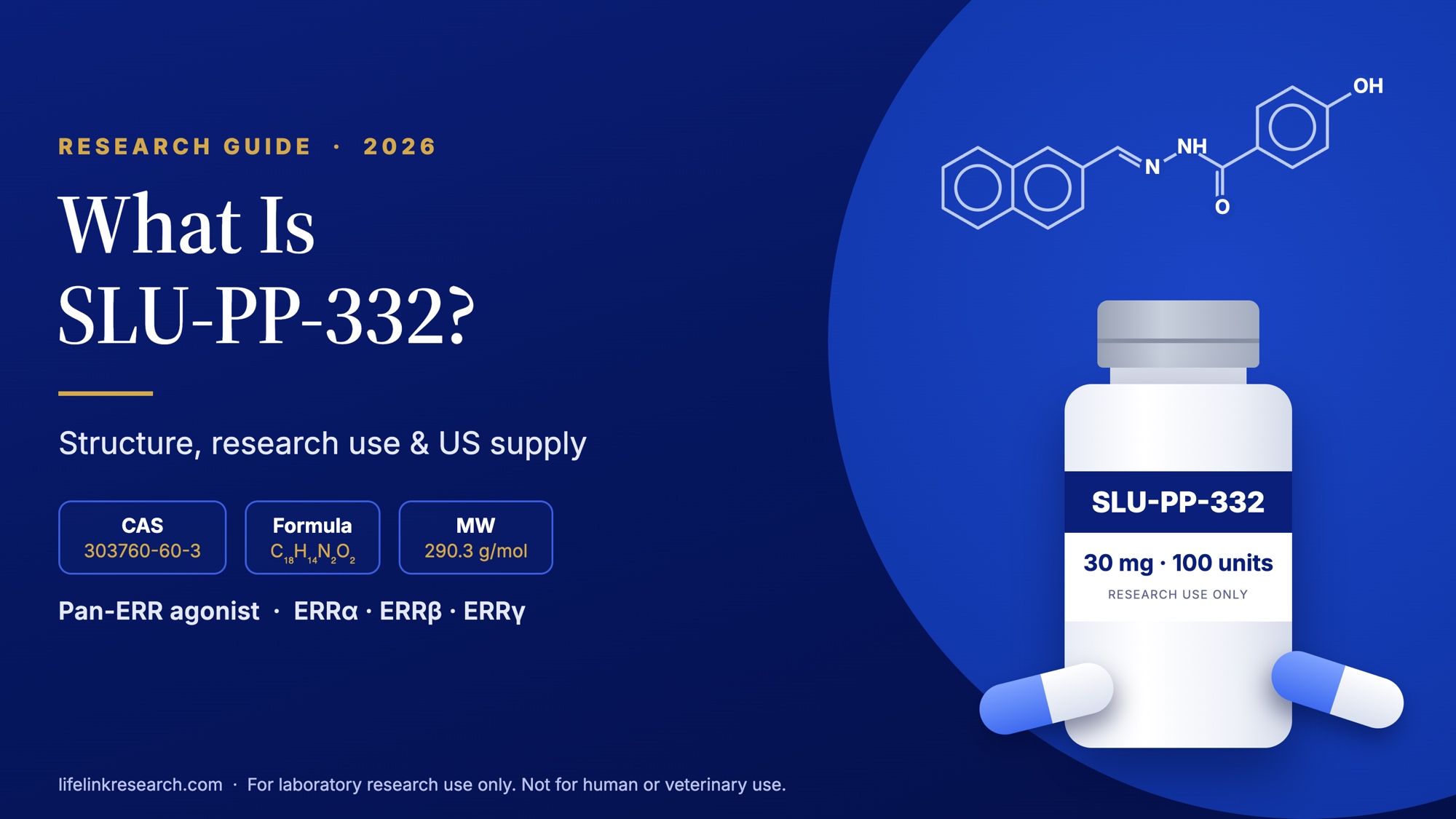
SLU-PP-332 is a synthetic small-molecule agonist of the estrogen-related receptors ERRα, ERRβ and ERRγ (CAS 303760-60-3, PubChem CID 5338394). It is not a peptide, has no approved use, and is supplied as a research chemical for receptor and cell-assay work.
Key Takeaways
- SLU-PP-332 is an acyl hydrazone small molecule, C18H14N2O2, 290.3 g/mol.
- It activates all three ERR isoforms, most potently ERRα (EC50 98 nM in HEK293 reporter assays).
- Labs use it as a reference agonist in reporter, gene-expression, SAR and LC-MS metabolite studies.
- It has no FDA approval and no registered human clinical trials.
- Verify a batch by HPLC purity, mass-spec identity, measured content and traceability on the COA.
SLU-PP-332 is a synthetic small-molecule agonist of the estrogen-related receptors (ERRs), supplied as a research chemical for receptor and cell-assay work.
This guide covers its chemical identifiers, how its acyl hydrazone structure is built, which receptors it activates and at what potency, where it stands with regulators, and how to check a batch before it reaches your bench. For the wider set of compounds we document, start with our research library.
For Research Use Only. Not for use in diagnostic or therapeutic procedures.
In this guide
- What SLU-PP-332 is
- Whether it is a peptide
- Chemical structure and identifiers
- Receptor targets and potency
- How labs use it
- FDA and WADA status
- How to verify a US batch
- FAQ
What Is SLU-PP-332?
Quick answer: SLU-PP-332 is a synthetic, non-peptide small molecule that acts as an agonist at all three estrogen-related receptors: ERRα, ERRβ and ERRγ. It carries CAS number 303760-60-3 and PubChem CID 5338394. Labs use it as a tool compound in nuclear-receptor reporter assays and cell-based gene-expression studies.
The “SLU” in the name stands for Saint Louis University. A team at its School of Medicine built the compound as a structural analog of GSK4716, an older acyl hydrazone from GlaxoSmithKline. GSK4716 was first described in a 2005 Journal of Medicinal Chemistry study as a selective agonist for ERRŒ≤ and ERRŒ≥ only.
SLU-PP-332 added something its parent lacked: solid activity at ERRŒ± as well. That’s why PubChem lists one of its synonyms as “ERR pan-Agonist 332.” Pan means it hits every member of the receptor family.
The Saint Louis group later published a follow-up series in the European Journal of Medicinal Chemistry (2023). There, John K. Walker and colleagues describe SLU-PP-332 as a potent agonist on all three ERR isoforms and use it as the benchmark for their newer compounds. Since then, it has turned into the default reference agonist whenever a lab needs to switch on the whole ERR family at once.
SLU-PP-332 has no approved use anywhere. It’s a research chemical, sold for laboratory study.
Is SLU-PP-332 a peptide?
No. A peptide is a chain of amino acids joined by amide bonds. SLU-PP-332 is a single small organic molecule with 22 heavy atoms and no amino acids at all.
Size makes the difference easy to see. SLU-PP-332 weighs 290.3 g/mol, while a 15-residue research peptide like BPC-157 comes in around 1,419 g/mol, roughly five times heavier.
So why do peptide suppliers list it? The lab workflow is the same. Researchers who buy peptides also run receptor assays, and the compound goes through the same HPLC and mass-spec testing, COA paperwork and cold storage. If the difference between the two classes is new to you, our introduction to peptides explains how peptides are built.
What Is the Chemical Structure of SLU-PP-332?
Quick answer: SLU-PP-332 has the formula C18H14N2O2 and a molecular weight of 290.3 g/mol. Its core is an acyl hydrazone: a 4-hydroxybenzoyl group joined through a C(=O)-NH-N=CH linker to a naphthalen-2-yl ring, with the double bond in the E configuration.
Identifiers
| Identifier | Value |
| Common name | SLU-PP-332 |
| Systematic name | (E)-4-hydroxy-N’-(naphthalen-2-ylmethylene)benzohydrazide |
| IUPAC name (PubChem computed) | 4-hydroxy-N-[(E)-naphthalen-2-ylmethylideneamino]benzamide |
| Molecular formula | C18H14N2O2 |
| Molecular weight | 290.3 g/mol |
| Monoisotopic mass | 290.1055 Da |
| CAS number | 303760-60-3 |
| PubChem CID | 5338394 |
| ChEMBL ID | CHEMBL4208749 |
| Isomeric SMILES | C1=CC=C2C=C(C=CC2=C1)/C=N/NC(=O)C3=CC=C(C=C3)O |
| InChIKey | RNZIMBFHRXYRLL-XDHOZWIPSA-N |
Every value above was checked against the PubChem record for CID 5338394 on 10 October 2026.
The acyl hydrazone scaffold
Picture the molecule as three pieces in a row, a head, a linker and a tail:
- Phenol head: a benzene ring carrying a hydroxyl (OH) group at the 4-position. That OH can donate a hydrogen bond.
- Acyl hydrazone linker: a carbonyl (C=O), an N-H and an imine (C=N). The carbonyl accepts a hydrogen bond, the N-H donates one, and the C=N double bond keeps the chain fairly flat and rigid.
- Naphthalene tail: two fused aromatic rings that give the molecule most of its hydrophobic bulk.
PubChem’s computed properties put numbers on that picture: 2 hydrogen-bond donors, 3 acceptors, 3 rotatable bonds, an XLogP of 3.7 and a polar surface area of 61.7 √Ö¬≤. In plain terms, it’s a compact, fairly greasy molecule with a few well-placed polar contacts.
The linker is also the part chemists keep reworking. In the 2023 series, the Saint Louis team moved away from the acyl hydrazide because of “potential concerns around the overall physicochemical properties of this scaffold,” which led to the SLU-PP-915 series. In March 2026, a structure-activity study in the International Journal of Biological Macromolecules (Okda and colleagues) went further. It paired synthesis and cell-based assays with docking and molecular dynamics, and reported analogs with better ligand efficiency, solubility or metabolic stability.
Physical form, solubility and storage
Pure SLU-PP-332 is a solid at room temperature. For assay preparation, labs dissolve it in DMSO and dilute from that stock.
Life Link supplies it as a 30 mg capsule format, 100 units per pack. The product datasheet lists storage at -20°C, protected from light. Our research compound storage guide covers freezer handling, light protection and limiting freeze-thaw cycles.
What Receptors Does SLU-PP-332 Target?
Quick answer: SLU-PP-332 is an agonist at all three estrogen-related receptors: ERRŒ±, ERRŒ≤ and ERRŒ≥. In HEK293 cell reporter assays it’s most potent at ERRŒ± (EC50 98 nM), followed by ERRŒ≤ (230 nM) and ERRŒ≥ (428 nM).
ERRs are nuclear receptors, proteins that bind DNA and switch target genes on or off. They’re called “orphan” receptors because no natural hormone has been confirmed as their ligand. Their DNA-binding region resembles the estrogen receptors’, yet they don’t bind estradiol.
ERRs are also constitutively active. They drive some gene expression even with no ligand present, so an agonist like SLU-PP-332 pushes that baseline activity higher.
| Receptor | Gene | EC50 | Assay |
| ERRα | ESRRA | 98 nM | HEK293 cells, luciferase reporter, 24 h |
| ERRβ | ESRRB | 230 nM | HEK293 cells, luciferase reporter, 24 h |
| ERRγ | ESRRG | 428 nM | HEK293T cells, full-length ERRγ co-transfection reporter |
| ERRγ ligand-binding domain | ESRRG | 2 µM | Cell-free TR-FRET, RIP140 coregulator peptide |
Sources: the cell-based values come from the 2023 European Journal of Medicinal Chemistry series linked above, and match the bioassay records on PubChem. The TR-FRET value comes from a 2018 Bioorganic & Medicinal Chemistry Letters study on ERRγ agonists.
Look at the two ERRγ rows. Same receptor, roughly a five-fold gap. Whole cells with a full-length receptor gave 428 nM, while a purified ligand-binding domain in a cell-free test gave about 2 µM. The assay format shapes the number, so compare EC50 values only when they come from the same assay type.
ERRs also work through coregulator proteins. PGC-1α is the best-known coactivator partner, and RIP140 acts as a corepressor. In the lab, these partnerships show up as readouts: coactivator recruitment, corepressor release (the 2018 TR-FRET assay measured a drop in RIP140 peptide binding) and target-gene mRNA levels by qPCR.
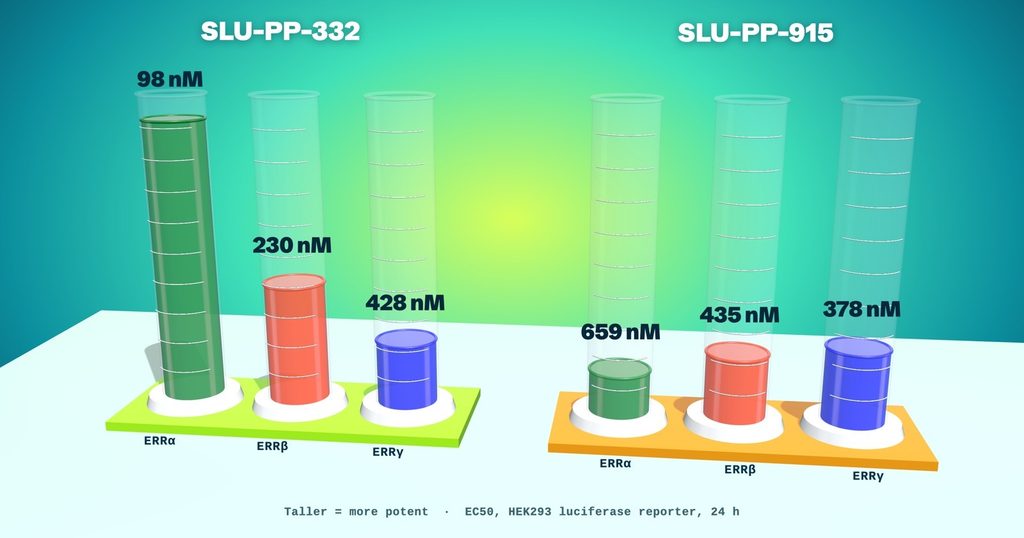
SLU-PP-332 vs SLU-PP-915 EC50 at ERRα, ERRβ and ERRγ
How Is SLU-PP-332 Used in Research?
Quick answer: SLU-PP-332 serves as a reference tool compound in four kinds of lab work: nuclear-receptor reporter assays, target-gene expression assays in cultured cells, analog (SAR) development in medicinal chemistry, and analytical studies that map its in vitro metabolites by LC-MS.
Receptor and reporter assays
A reporter assay turns receptor activity into light you can measure. The ERR version runs in four steps:
- Transfect HEK293 cells with an ERR isoform and a luciferase reporter driven by an ERR response element.
- Add SLU-PP-332 across a concentration series, with a vehicle-only control.
- Read luminescence after about 24 hours.
- Fit a concentration-response curve and calculate the EC50.
With EC50 values between roughly 100 and 430 nM, a useful concentration series runs from the low nanomolar range up into the low micromolar range, so the curve captures both its floor and its plateau.
Because its potency at each isoform is well documented, SLU-PP-332 often serves as the positive control when labs screen new ERR ligands. The 2023 series also used it in C2C12 cells to track ERR target-gene expression by qPCR.
Medicinal chemistry and analog work
For chemists, SLU-PP-332 is the yardstick. New ERR agonists get tested side by side with it, and their EC50 values are reported relative to it.
Its selectivity ratios guide that work. SLU-PP-332 is about 2.3 times more potent at ERRŒ± than at ERRŒ≤, and about 4.4 times more potent at ERRŒ± than at ERRŒ≥. A new compound’s ratios show at a glance whether it leans toward one isoform or stays pan. The 2005 GSK series and the 2018 phenol amide series both chased ERRŒ≥ preference, while SLU-PP-332 covers all three, which is exactly why it works as the comparison point.
The SLU-PP-915 series came straight out of that comparison. The 2023 team reported that SLU-PP-332 was stable in both human and mouse microsome assays, with a half-life of 60 minutes or more, and used that as a stability baseline for the new compounds.
Analytical and metabolite studies
In January 2026, Tim Möller, Oliver Krug and Mario Thevis at the German Sport University Cologne published the first detailed in vitro metabolism study of the compound in Rapid Communications in Mass Spectrometry. They incubated SLU-PP-332 with human-derived microsome and S9 enzyme fractions and analyzed the products on a Vanquish UHPLC coupled to an Orbitrap Exploris 480 high-resolution mass spectrometer.
| What they measured | What they found |
| Total metabolites identified | 9 |
| Phase I products | 6 (hydroxylation, bishydroxylation, bishydroxylation with reduction) |
| Phase II conjugates | 3 (glucuronidation, sulfation, hydroxylation followed by sulfation) |
| Analytical platform | LC-HRMS/MS |
The goal is reference data. Testing labs need to know what a compound and its breakdown products look like on a mass spectrometer before they can detect them, and this study gives them that map.
Is SLU-PP-332 FDA-Approved?
Quick answer: No. SLU-PP-332 isn’t approved by the FDA for any use, and it isn’t sold as a drug, dietary supplement or food ingredient in the US. Suppliers offer it for laboratory research only. Life Link sells it to qualified researchers aged 21 and over.
| Authority or registry | Status | Checked |
| US FDA | No approval for any use | 10 Oct 2026 |
| ClinicalTrials.gov | 0 registered studies for “SLU-PP-332” | 10 Oct 2026 |
| WADA Prohibited List 2026 | Covered by class S0, Non-Approved Substances | Writer to verify |
There are no published human clinical trials. A ClinicalTrials.gov search for SLU-PP-332 returned zero registered studies on 10 October 2026, and the Cologne authors note that clinical studies would still be needed to confirm their in vitro metabolite findings.
Research-chemical status shapes how the compound is sold. Labels carry research-use wording, buyers confirm the material is for laboratory study, and suppliers publish identity and purity data in place of any usage guidance.
In sport, the WADA Prohibited List for 2026 took effect on 1 January 2026. Its S0 class covers any pharmacological substance with no current approval from a government health authority for human therapeutic use, including compounds in pre-clinical development, and prohibits them at all times. SLU-PP-332 meets that definition.
How Do You Verify an SLU-PP-332 Batch From a US Supplier?
Quick answer: Check the batch certificate of analysis (COA). Look for HPLC purity, mass-spec identity that matches the 290.3 g/mol molecular weight, a lot or verification number, and the test date. Then confirm an independent lab issued it and that you can verify it.
We call this the four-line COA check. Here’s how it reads against the current COA on our SLU-PP-332 product page:
| COA line | What to look for | Current Life Link COA |
| Purity | RP-HPLC result with wavelength and chromatogram | 99.9% by RP-HPLC at 214 nm, single main peak at 1.725 min |
| Identity | Mass-spec method and observed ion | Confirmed via MALDI-MS |
| Content | Measured amount against the label | 31.18 mg against a 30 mg label |
| Traceability | Verification code, sample and issue dates | Code COA5139, received 8 June 2026, issued 16 June 2026 |
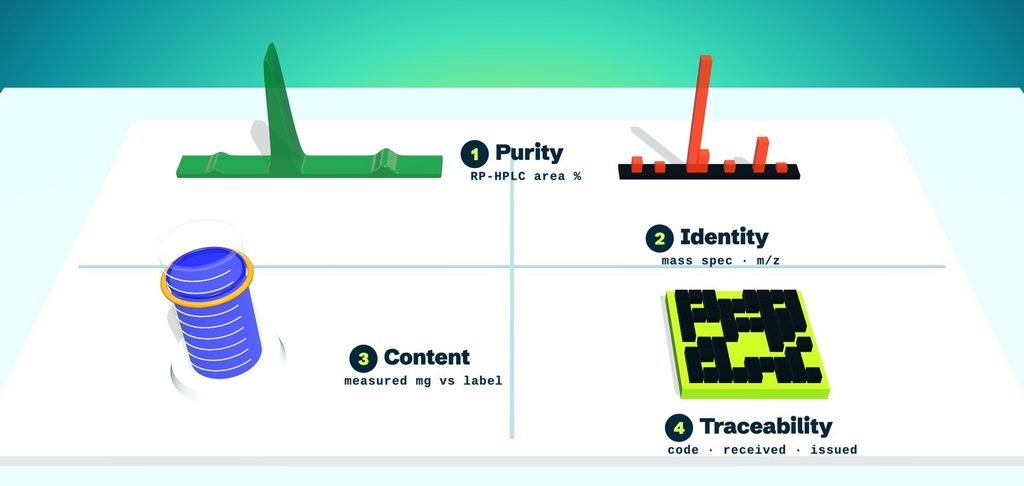
The four lines to check on an SLU-PP-332 COA
HPLC purity: see the batch result
Reverse-phase HPLC pushes the sample through a column and measures what comes out with a UV detector. Purity is the main peak’s share of the total peak area, so 99.9% means almost every UV-absorbing signal at 214 nm came from one compound. At 214 nm, the aromatic rings and the carbonyl group absorb strongly, so most organic impurities show up as their own separate peaks.
HPLC tells you how clean the sample is. It can’t tell you what that compound is. For the difference a single percentage point makes, read what 98% vs 99% purity means.
Mass-spec identity and why both tests count
Mass spectrometry weighs the molecule. For SLU-PP-332, the monoisotopic mass is 290.1055 Da, so the protonated ion [M+H]+ should appear near m/z 291.11 and the sodium adduct [M+Na]+ near m/z 313.09.
Run both tests and you get both answers: HPLC says how pure, mass spec says what it is. A clean peak of the wrong compound would pass HPLC alone. Our guide to HPLC vs mass spectrometry walks through how the two methods work together.
Lot traceability and US supply
A research supplier should give you a paper trail you can follow from the vial back to the lab report. For SLU-PP-332, that means:
- A batch-specific COA linked from the product page
- The testing lab’s name and a verification code
- Sample-received and issue dates
- Storage conditions on the datasheet
- A clear statement of which tests run on every batch
A COA with no chromatogram, no named lab, or a generic compound name in place of SLU-PP-332 gives you nothing to check, so ask the supplier for the batch-specific report before you order.
At Life Link, identity and purity testing runs on every batch, through Janoshik Analytical and US-based laboratories. Heavy metals, endotoxin and sterility testing run on a rotating cycle across the catalog. Orders ship from California, with same-day dispatch on orders placed before 2 PM PST and UPS 2-Day Air delivery. For the full checklist, see our guide to choosing a US research supplier.
Ready to check the batch yourself? The current COA and specifications are on the SLU-PP-332 product page. It’s supplied to qualified researchers for laboratory use only.
SLU-PP-332 FAQ
What is the CAS number of SLU-PP-332?
The CAS number of SLU-PP-332 is 303760-60-3. Its PubChem CID is 5338394 and its ChEMBL ID is CHEMBL4208749. Its InChIKey, RNZIMBFHRXYRLL-XDHOZWIPSA-N, is the quickest way to match the exact E-isomer structure across chemical databases.
What is its molecular formula and weight?
SLU-PP-332 has the molecular formula C18H14N2O2 and a molecular weight of 290.3 g/mol. Its monoisotopic mass is 290.1055 Da, which puts the protonated ion [M+H]+ near m/z 291.11 in mass-spec identity testing.
Is SLU-PP-332 a peptide?
No. SLU-PP-332 is a synthetic small molecule with no amino acids. It’s an acyl hydrazone built from a 4-hydroxyphenyl group and a naphthalene ring. Peptide suppliers carry it because it goes through the same HPLC, mass-spec and COA workflow.
Is SLU-PP-332 FDA-approved?
No. SLU-PP-332 has no FDA approval for any use and no registered human clinical trials on ClinicalTrials.gov as of 10 October 2026. It’s supplied as a research chemical for laboratory study by qualified researchers only.
Is SLU-PP-332 on the WADA Prohibited List?
SLU-PP-332 falls under class S0, Non-Approved Substances, of the 2026 WADA Prohibited List. S0 covers pharmacological substances with no government approval for human therapeutic use and applies at all times. Anti-doping researchers at the German Sport University Cologne published its in vitro metabolite profile in 2026.
What solvents is it soluble in?
For assay preparation, SLU-PP-332 is dissolved in DMSO, and working solutions are diluted from that stock. Check the supplier datasheet for storage conditions; Life Link lists -20°C, protected from light.
SLU-PP-332 gives receptor labs a well-characterized pan-ERR agonist with clean identifiers, documented potency at every isoform and a growing analytical record. Before any batch reaches an assay plate, read its COA line by line and match the mass-spec result to 290.3 g/mol.
For Research Use Only. Not for use in diagnostic or therapeutic procedures.
Peptide Blends vs Single Vials: How to Choose for Research (2026)
For Research Use Only. Not for use in diagnostic or therapeutic procedures. Choosing between peptide blends vs single peptides comes down to…
Read article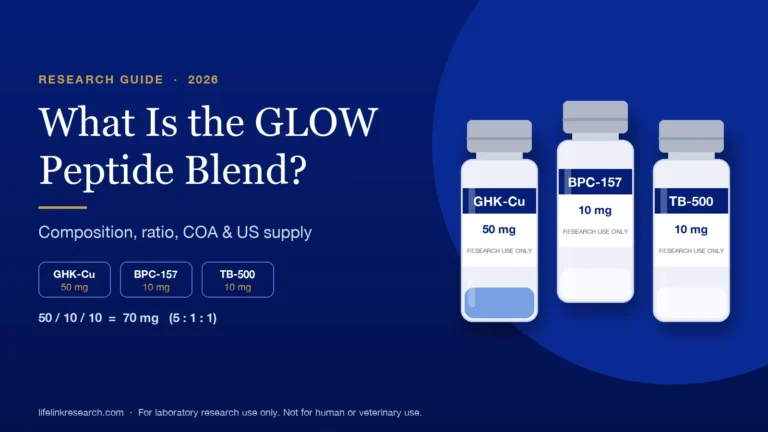
GLOW Peptide Blend: Composition, Ratio & COA (2026)
Quick Answer GLOW is a 70mg research peptide combination of GHK-Cu 50mg, BPC-157 10mg and TB-500 10mg, a 5:1:1 ratio in which…
Read article
What Is the KLOW Peptide Blend? Composition, Ratio, COA & US Supply
Quick Answer KLOW is an 80mg research peptide combination of GHK-Cu 50mg, BPC-157 10mg, TB-500 10mg and KPV 10mg, a 50/10/10/10 ratio.…
Read articleResearch-grade peptides
99%+ purity. Verified every batch.
Identity and purity tested on every batch by third-party labs, Janoshik Analytical and US-based laboratories. Shipped same day from California.
Shop all peptides