
Quick answer: HPLC and mass spectrometry answer two different questions about a peptide. HPLC measures how pure a sample is by separating it into its parts and reporting the percentage that is the target peptide. Mass spectrometry measures the molecule’s mass to confirm the sample is the peptide it claims to be. A trustworthy Certificate of Analysis reports both, because purity and identity together are what tell you the material is right and clean.
HPLC vs Mass Spectrometry
Buy a research peptide and the quality of your whole experiment rests on two numbers on a lab report. One is a purity figure from HPLC. The other is an identity check from mass spectrometry. They sound similar and get lumped together, yet each answers a question the other cannot, and knowing the difference is the fastest way to read a COA with confidence.
| Question you are asking | The test that answers it | What it reports |
| How much of this is the peptide? | HPLC | A purity percentage |
| Is this actually the right peptide? | Mass spectrometry | Observed mass vs expected mass |
| Is the material also safe to use? | Separate assays | Endotoxin, sterility, and more |
HPLC: How Pure Is It?
High-performance liquid chromatography is the purity test. It pushes the dissolved sample through a packed column, and the sample’s components travel at different speeds and come out separated. A detector watches them exit and draws a chromatogram, a chart of peaks where each peak is a component.
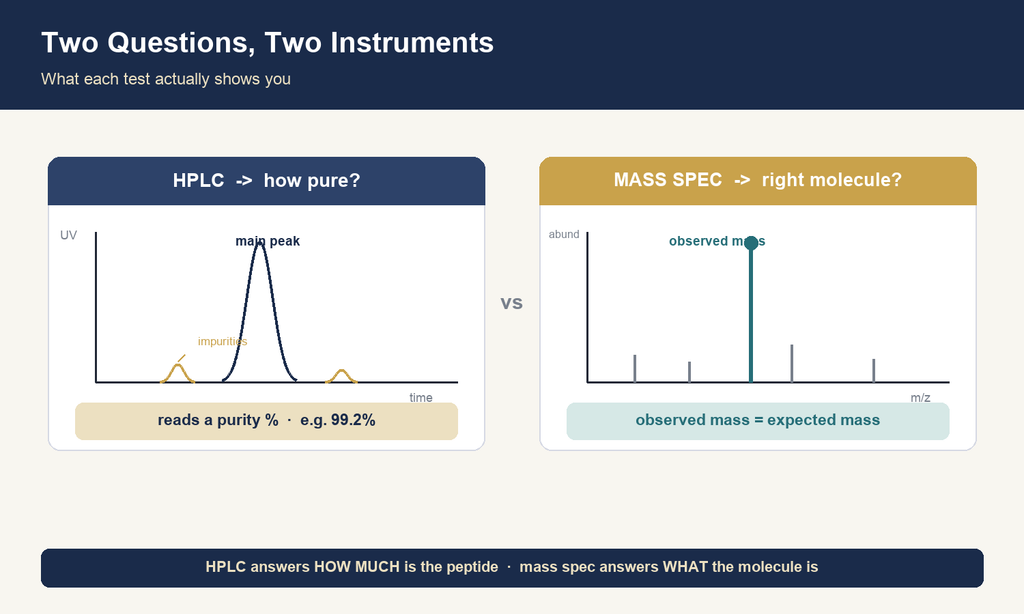
The target peptide forms the tall main peak, and any impurities show up as smaller peaks around it. Purity is the main peak’s share of the total peak area, so a result of “99.2% by HPLC” means the peptide accounts for 99.2% of everything the detector saw. A lot of peptide work uses reverse-phase HPLC with the detector reading ultraviolet light at around 214 to 220 nanometers, the wavelength where the peptide bond absorbs.
What HPLC gives you is a clean, quantified answer to one question: how much of this vial is the peptide, and how much is something else. If you want to understand why a stated 99% can still vary in what it means, the gap between an unverified 98% and a verified 99% is where that story lives.
Mass Spectrometry: Is It the Right Molecule?
Mass spectrometry is the identity test. It measures the molecular mass of the compound in the vial and lets you compare that measured value against the mass expected from the peptide’s amino-acid sequence. When the observed mass matches the expected mass, identity is confirmed.
This matters because purity says nothing about correctness. A sample can be 99% pure and still be the wrong peptide, or the right sequence with a modification you did not order. Since every peptide is a specific chain of amino acids, its true mass is fixed, and mass spectrometry is how you check the material lives up to that number.
The sample is first ionized, most often by electrospray ionization (ESI), which gently charges the molecules so the instrument can weigh them. The output is a mass spectrum, and the peak you care about sits at the peptide’s mass. In short, HPLC tells you how much, and mass spectrometry tells you what.
Is HPLC the Same as LC-MS?
No, though they are close relatives. HPLC is the separation step on its own, ending at a detector that measures light. LC-MS, or liquid chromatography-mass spectrometry, plugs a mass spectrometer onto the end of that same separation, so the sample is separated first and then weighed. You get the purity view and the identity view from one run.
That pairing is why you often see LC-MS named on a peptide COA. It is HPLC’s separating power feeding directly into the mass spectrometer’s identifying power. Research on peptide quality control notes that combined liquid chromatography and high-resolution mass spectrometry “are capable of detecting and identifying co-eluting impurities at low levels,” as Zeng and colleagues reported in The AAPS Journal. In other words, joining the two catches problems that a purity number alone can hide.
Why You Want Both
A COA that reports only one of the two is telling you half the story. HPLC purity without an identity check leaves open the possibility that the clean-looking sample is the wrong compound. A mass confirmation without a purity figure leaves open how much of the vial is actually that compound. Read together, they close both gaps at once.
The science backs up reading them side by side. Mass spectrometry is sensitive to the exact structure, and as Zeng and colleagues explain, “changes to the primary amino acid sequence due to degradation, truncation, insertion, substitution, or deletions typically result in detectable mass shifts.” So the mass number does double duty: it confirms the right peptide and flags a wrong one.
Building on that, a review in Pharmaceutical Research by McCarthy and colleagues points out that confident characterization “often requires multiple orthogonal techniques” read together. Two views of the same batch simply beat one.
What HPLC and Mass Spectrometry Do Not Catch
Even together, these two tests have blind spots, and a genuine lab report accounts for them. Knowing the limits is what separates reading a COA from truly understanding it.
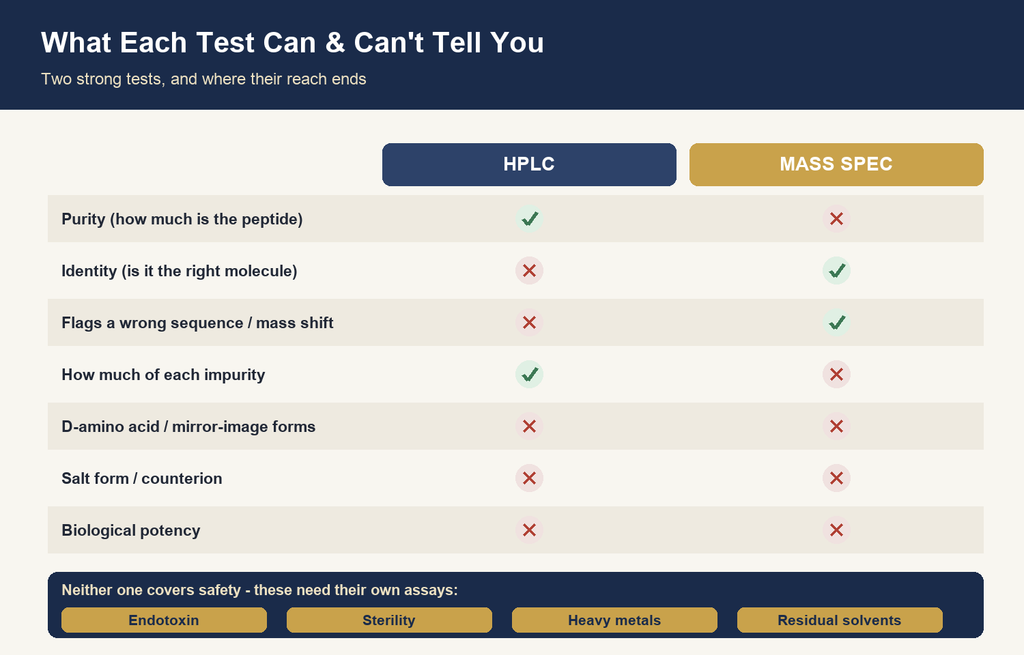
HPLC and mass spectrometry both struggle with mirror-image molecules. A D-amino acid substituted for its normal L-form has the identical mass and can travel through the column at the same speed, so it can slip past both a standard purity trace and a mass check. Neither test reports the salt form or counterion the peptide is paired with, which affects how much actual peptide you are weighing out. Neither one measures biological potency, since a molecule can be pure and correctly identified and still behave differently in an assay.
The bigger point is safety. Purity and identity say nothing about whether the material is free of bacterial endotoxin, sterile, or clear of heavy metals. Those are separate assays a lab only runs when asked, which is exactly why the strongest COAs go beyond HPLC and mass spec. A batch that passes purity and identity has cleared two important hurdles, and the safety hurdles are their own tests entirely.
Reading Both on a COA
When reviewing a Certificate of Analysis (COA), look for the HPLC and mass spectrometry results in their respective sections.
- The HPLC result gives you a purity percentage and, on a good report, the chromatogram behind it.
- The mass-spec result gives you an observed mass next to the expected mass, and they should agree within the instrument’s small tolerance.
- Find the batch or lot number on the report first, then read the two results in that order: identity to confirm the compound is right, purity to confirm it is clean.
- The full field-by-field walkthrough of reading a peptide COA covers the rest of the document, from dates to the testing lab.
One habit protects you more than anything: check who ran the tests. An independent, third-party lab has no stake in the result, so the figures stand on their own. We conduct our peptide quality analysis through ISO accredited Janoshik Analytical and domestic labs for multi-level testing that most vendors shy away from.
Frequently Asked Questions
Is HPLC or mass spectrometry better?
Neither is better, because they answer different questions. HPLC measures purity, and mass spectrometry confirms identity. The strongest peptide testing uses both, so a COA can tell you at once that the material is the right compound and that it is clean.
What HPLC purity is good for a research peptide?
Many labs look for 99% or higher for quantitative and publication-grade work, with 95% or above workable for early screening. The purity figure means the most when it is verified by an independent lab and backed by the chromatogram that produced it.
What is ESI in mass spectrometry?
Electrospray ionization (ESI) is the most common way peptides are prepared for mass spectrometry. It gives the molecules a gentle electric charge so the instrument can measure their mass without breaking them apart, which makes it well suited to intact peptides.
Do you really need both tests, or is one enough?
You want both. A purity result on its own leaves identity unconfirmed, and an identity result on its own leaves purity unknown. Reading the two together is what turns a lab report into real confidence in the vial.
Can HPLC and mass spec confirm a peptide is safe?
No, and this is the common misunderstanding. They confirm purity and identity, while safety measures like endotoxin and sterility are separate assays. A complete quality picture reads the purity and identity results alongside those safety tests.
The Bottom Line
HPLC and mass spectrometry are the two pillars of peptide testing, and each carries half the weight. HPLC tells you how pure the sample is, mass spectrometry tells you what it actually is, and a COA that reports both, verified by an independent lab, gives you a batch you can trust. With the FDA taking a closer look at peptide compounding in its July 2026 review, being able to read these results has never counted for more.
That is the thinking behind the third-party testing panel we run on every batch, where HPLC and mass spec are the first two of six checks, and every result lands on a COA you can read before you buy.
What Is B7-33? Relaxin-2 Analog Research Overview (2026)
Quick Answer B7-33 is a synthetic single-chain peptide built from part of the B chain of human relaxin-2, and it binds the…
Read article
Peptide Blends vs Single Vials: How to Choose for Research (2026)
For Research Use Only. Not for use in diagnostic or therapeutic procedures. Choosing between peptide blends vs single peptides comes down to…
Read article
What Is SLU-PP-332? Structure, Research Use & US Supply
Quick Answer SLU-PP-332 is a synthetic small-molecule agonist of the estrogen-related receptors ERRŒ±, ERRŒ≤ and ERRŒ≥ (CAS 303760-60-3, PubChem CID 5338394). It…
Read articleResearch-grade peptides
99%+ purity. Verified every batch.
Identity and purity tested on every batch by third-party labs, Janoshik Analytical and US-based laboratories. Shipped same day from California.
Shop all peptides