
Quick Answer
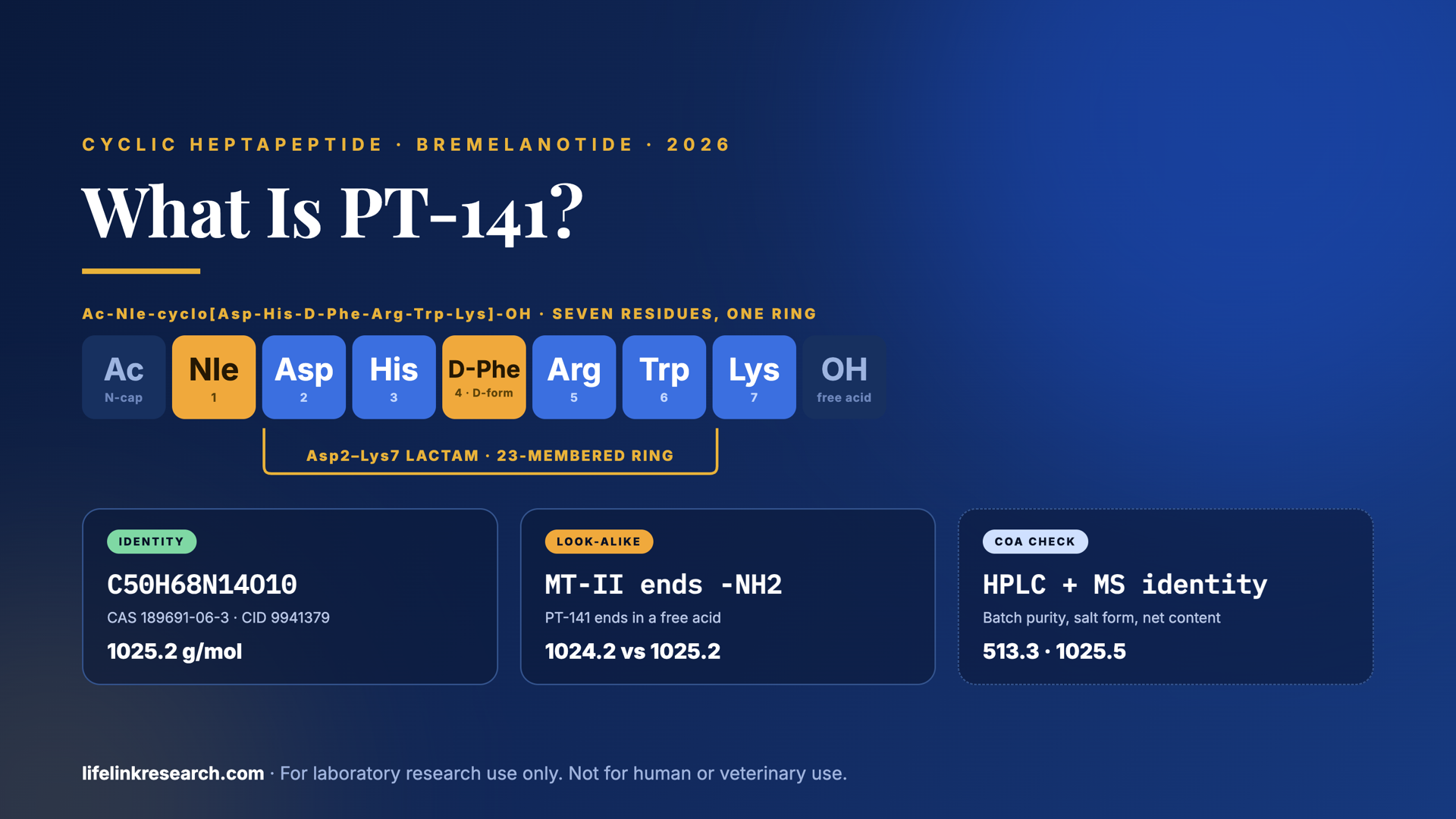
PT-141 is the research code for bremelanotide, a synthetic cyclic peptide studied at melanocortin receptors. Seven amino acids, one ring, one well-documented structure in the public databases.
This page sticks to the chemistry: the sequence residue by residue, the ring bond and where it falls, the molecular weight in both forms labs report, the cryo-EM structure showing the peptide inside MC4R, and a field-by-field walk through a batch certificate. Life Link Research supplies PT-141 to qualified labs for in vitro work.
For Research Use Only. Not for use in diagnostic or therapeutic procedures. Full terms are set out in the Life Link research disclaimer.
| Field | Value |
|---|---|
| Name | PT-141, bremelanotide |
| Class | Cyclic heptapeptide, melanocortin ligand |
| Sequence | Ac-Nle-cyclo[Asp-His-D-Phe-Arg-Trp-Lys]-OH |
| Molecular formula | C50H68N14O10 |
| Molecular weight | 1025.2 g/mol avg; 1024.52 Da monoisotopic |
| CAS number | 189691-06-3 free base; 1607799-13-2 acetate |
| PubChem CID | 9941379 |
| FDA UNII | 6Y24O4F92S |
| Receptor structure | PDB 7F55 |
What Is PT-141?
Quick answer: PT-141 is the research code for bremelanotide, a synthetic cyclic heptapeptide. Its seven residues carry an N-terminal acetyl group, a norleucine and a D-phenylalanine, and an Asp–Lys lactam bridge closes the ring. In research, it is studied as a melanocortin receptor agonist, mainly at MC3R and MC4R, using binding and cAMP assays.
Two names, one molecule. PT-141 is the development code the compound picked up in the lab; bremelanotide is its International Nonproprietary Name. Papers and catalogues use both, sometimes in one sentence, and both point to C50H68N14O10, CAS 189691-06-3.
It belongs to the melanocortin peptide family, built around a short stretch of alpha-melanocyte-stimulating hormone. The family shares a four-residue core, His-Phe-Arg-Trp, that the receptors recognise, and PT-141 carries it inside the ring.
The ring is the point. A straight peptide chain is floppy: it wanders through hundreds of shapes a second, and only a few of those fit a receptor. Tie two side chains together, and it can no longer flop. That’s what “cyclic” means here.
PT-141 Structure: The Ring, the Residues and the Ends
PT-141 bremelanotide structure
The Asp2–Lys7 Lactam Bridge
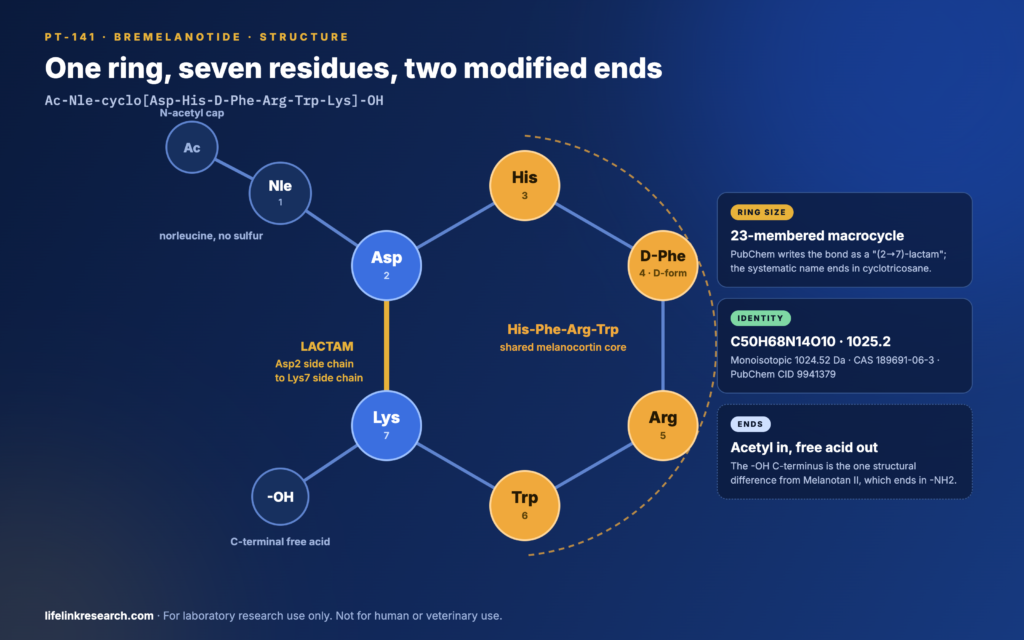
The bond that closes the ring is a lactam, chemistry’s word for an amide bond formed inside a molecule. The side-chain carboxyl of aspartic acid at position 2 joins the side-chain amine on the end of lysine at position 7, which PubChem writes as a “(2→7)-lactam”.
Count the atoms going round, and you get 23, so it’s a 23-membered macrocycle. That comes straight off the PubChem record for CID 9941379, whose IUPAC name ends in “hexazacyclotricosane-23-carboxylic acid”. Tricosane means 23.
Norleucine, D-Phe and the His-Phe-Arg-Trp Core
Two residues are swapped out from what you’d expect in a natural peptide, and both swaps are deliberate.
Norleucine takes position 1, where the parent hormone has methionine. The two are near twins, except norleucine has a plain carbon chain where methionine has a sulfur atom. Sulfur oxidises, so removing it leaves one less way for the molecule to go off in storage and one less stray peak on a chromatogram.
Position 4 is D-phenylalanine. Amino acids come in left-handed and right-handed versions, and biology almost always uses the left-handed (L) form. This one is the mirror image, and it falls midway through the His-Phe-Arg-Trp stretch at positions 3 to 6.
The N-Acetyl Cap and the C-Terminal Free Acid
Both ends are modified. The N-terminus carries an acetyl group, a small cap that blocks the free amine, and the other end finishes as a carboxylic acid, written -OH.
That second detail is easy to skim past and worth slowing down for. Plenty of research peptides end in an amide (-NH2) instead, and the choice changes the formula, the mass, and which molecule you have.
PT-141 and Melanotan II: One Structural Difference
Same seven residues, same ring, closed the same way in the same place. The two diverge at one spot: the C-terminus.
| PT-141 | Melanotan II | |
|---|---|---|
| C-terminus | Free acid, -OH | Amide, -NH2 |
| Formula | C50H68N14O10 | C50H69N15O9 |
| Average MW | 1025.2 | 1024.2 g/mol |
The team behind the MC4R cryo-EM structures put it in three words, calling bremelanotide “C-terminal OH-MT-II” in Cell Research. One nitrogen traded for one oxygen, about 1 g/mol apart. Keep the Melanotan II structure and sequence beside this one if you run both: a single mass near 1024 to 1025 cannot separate them on a low-resolution instrument.
What Is the PT-141 Sequence?
Quick answer: PT-141’s sequence is Ac-Nle-cyclo[Asp-His-D-Phe-Arg-Trp-Lys]-OH, seven residues. A lactam bond between the Asp2 side chain and the Lys7 side chain closes the ring, and the N-terminus is acetylated. The one-letter form is Ac-[Nle]-c[DH(f)RWK]-OH, where lowercase f marks D-phenylalanine.
Read that line left to right, and it gives you the chain, the odd residue out, and where the ring starts and stops. Square brackets flag a residue with no standard one-letter code, and lowercase f is the convention for a D-amino acid.
| Position | Residue | Configuration | Notes |
|---|---|---|---|
| 1 | Norleucine (Nle) | L | Outside the ring; carries the acetyl cap |
| 2 | Aspartic acid (Asp) | L | Side-chain carboxyl forms the lactam |
| 3 | Histidine (His) | L | Starts the His-Phe-Arg-Trp core |
| 4 | Phenylalanine (Phe) | D | The single D-configuration residue |
| 5 | Arginine (Arg) | L | Core; main basic site |
| 6 | Tryptophan (Trp) | L | Core; absorbs the UV HPLC reads |
| 7 | Lysine (Lys) | L | Side-chain amine closes the ring; free-acid C-terminus |
These are PT-141’s own positions, 1 through 7. Older melanocortin papers number the same residues by where they fell in the parent hormone, which is why the literature gives Asp5 and Lys10 for the same bond in related analogues.
What Is PT-141’s Molecular Weight?
Quick answer: PT-141 (bremelanotide) has an average molecular weight of 1025.2 g/mol and a monoisotopic mass of 1024.52 Da (formula C50H68N14O10, PubChem CID 9941379). Research material is often an acetate salt, which has its own CAS and a higher weight per mole, so net peptide content is reported separately.
Most mismatches people worry about come down to which of the two numbers a report picked. 1025.2 g/mol is the average mass, every atom weighed by how common its isotopes are, and it’s the number to use at the balance. 1024.52 Da is the monoisotopic mass, counting only the lightest common isotope of each element, and that’s what a spectrometer reads. Compare a measurement against the wrong one and a clean sample looks off.
Then there’s the salt. As the acetate, PT-141 becomes CAS 1607799-13-2, formula C52H72N14O12, and the weight climbs to 1085.2 g/mol. Those 60 extra grams per mole are acetate, so the peptide is roughly 94% of that salt before bound water. Hence the separate net-peptide-content line on a good certificate.
Here’s what the ions look like, with real numbers from a tested batch:
| Ion | Expected | Measured, Life Link batch |
|---|---|---|
| [M+2H]²⁺ | 513.3 | 513.271 |
| [M+H]⁺ | 1025.5 | 1025.529 |
Those come from the MZ Biolabs certificate for PT-141 lot 2024-09-03, analysed on 8 October 2024 by analytical chemist Ken Pendarvis: expected monoisotopic mass 1024.52 Da against a measured 1024.53 Da. The doubly charged ion is the taller peak, normal for a peptide this size.
Which Receptors Does PT-141 Bind?
Quick answer: PT-141 is studied as an agonist at melanocortin receptors, with most data at MC4R and MC3R. In vitro work measures its activity with cAMP accumulation and radioligand-binding assays. A 2021 cryo-EM structure (PDB 7F55, Cell Research) shows bremelanotide bound to MC4R in complex with the Gs protein.
Melanocortin receptors are G protein-coupled receptors, and the standard way to read activity at them is cAMP. The receptor couples to Gs, Gs switches on adenylyl cyclase, cAMP rises inside the cell, and a plate reader picks up the change. Radioligand binding runs alongside it, measuring how well the compound displaces a labelled tracer in HEK293 or CHO cells carrying one human subtype. Binding tells you how tightly it grips; cAMP tells you what the receptor does next.
What the 7F55 Structure Shows
PDB entry 7F55 is the bremelanotide–MC4R–Gs–Nb35 complex, solved by cryo-electron microscopy at 3.1 Å and released on 3 November 2021, from work by Hui Zhang and colleagues at Zhejiang University and the Shanghai Institute of Materia Medica published in Cell Research (PMID 34433901).
The surprise was an extra passenger in the pocket. A divalent calcium ion is lodged in the binding site alongside the peptide, and the authors describe it as “considered a necessary cofactor for ligand binding and activity”. Strip calcium out with EGTA and bremelanotide stops producing cAMP. Mutating receptor residue D126 abolishes the response; mutating E100 cuts potency about twentyfold.
Inside the pocket, the His-Phe-Arg-Trp core does the recognising, as it does for every peptide in this family. The D-Phe of bremelanotide “almost stayed at the same position” as the equivalent residue in alpha-MSH, which is the structural reason the mirror-image swap works. Professor Zhang Yan of Zhejiang University, who led the work, said the results “offer unprecedented structural insights into the pharmacological and signaling features of MC4R” (university announcement, 2 October 2021).
How to Read a PT-141 COA
Quick answer: A PT-141 COA should show RP-HPLC purity for that batch with its chromatogram, ESI-MS identity matching 1025.2 Da, net peptide content, the salt form, lot number, test date, and testing lab. Report purity as the batch result. Check that the lot on the COA matches your vial.
| What to check | What it should show |
|---|---|
| HPLC purity | The batch result, with its chromatogram |
| MS identity | [M+H]⁺ about 1025.5 and/or [M+2H]²⁺ about 513.3 |
| Salt form | Free base or acetate, stated |
| Net peptide content | Stated separately from purity |
| Appearance | White lyophilized powder |
| Lot number | Matches the vial label |
| Lab name and date | Present, checkable |
Purity and identity answer different questions, and you need both. HPLC purity is the share of UV-absorbing material under the main peak, read at 210 to 220 nm, so it tells you how clean the sample is. What the main peak actually is comes from the mass spectrometer, which for this compound is looking at 1025.5 or 513.3.
Net peptide content is the line most certificates leave off. A vial labelled 10 mg carries peptide plus counterion plus whatever water the powder picked up, so the net figure is what tells a lab how much PT-141 it’s weighing. Life Link’s current PT-141 certificate, from Prime Analytical Laboratories on 19 March 2026 under report RP218-16Mar26-8, gives 99.78% purity at 210.4 nm and 11.53 mg net peptide content. That report lists the sample lot number as “Not Provided”, which shows what the lot line is for: a certificate with no lot can be attached to any batch, so ask for one carrying the code printed on your vial.
A few independent services now re-test vials and publish what they find, a useful cross-check when a certificate looks too tidy. What they flag most often is ordinary: round purity numbers with no chromatogram, identical reports across lots, a blank testing-lab field. Learning how to verify a peptide COA end to end makes those quick to spot. Identity and purity run on every batch under our third-party testing, with heavy metals, endotoxin, and sterility on a rotating cycle across the catalogue. PT-141 is soluble in water/DMSO for assay preparation, and the lyophilized powder is stored at -20 °C, dry, dark, and sealed.
Is PT-141 the Same as Bremelanotide?
Quick answer: Yes. PT-141 is the development code, and bremelanotide is the International Nonproprietary Name for the same molecule, C50H68N14O10, CAS 189691-06-3. Research-grade PT-141 from chemical suppliers is sold as a laboratory reagent for research use only. It is not a pharmaceutical product and is not intended for human use.
Matching a catalogue listing against a paper, the identifiers settle it faster than the names. CAS 189691-06-3, PubChem CID 9941379, and FDA UNII 6Y24O4F92S all resolve to the same structure, whichever name is on the label. A UNII is an identity code and carries no approval.
The material a chemical supplier ships under either name is a laboratory reagent for in vitro research by qualified professionals.
PT-141 FAQ
How many amino acids are in PT-141?
Seven: Nle, Asp, His, D-Phe, Arg, Trp, and Lys. Six of them are inside the ring, with the norleucine hanging off the outside under its acetyl cap.
Is PT-141 a cyclic peptide?
Yes. A lactam bond between the Asp2 and Lys7 side chains closes a 23-membered ring. PubChem records this as a “(2→7)-lactam”, and the ring size shows up in the systematic name as “cyclotricosane”.
What is the CAS number for PT-141?
189691-06-3 for the free base. The acetate salt has its own number, 1607799-13-2, formula C52H72N14O12, average weight 1085.2 g/mol. Check which form a certificate means before any weight calculation.
How should lyophilized PT-141 be stored?
Keep the vial at -20 °C, dry, dark, and sealed, with a desiccant if you have one. Bring it to room temperature before opening so moisture doesn’t condense on cold powder. Tryptophan absorbs UV, so amber glass or a closed box earns its keep.
Is PT-141 soluble in water?
PT-141 is soluble in water/DMSO for assay preparation. The arginine and histidine give the molecule charged sites that water interacts with well.
Working With PT-141 in the Lab
Four checks cover most of what can go wrong: a chromatogram behind the purity figure, a mass reading near 1025.5 or 513.3, a lot code matching the label, and a named testing lab you can contact.
Life Link publishes the current certificate on each product page, so you can read the lab, the date, and the chromatogram before ordering: open the product and click “COA verified – View report”. Specifications and the batch report for the PT-141 10mg research vial are published together, tested by Janoshik Analytical or a US lab.
For Research Use Only. Not for use in diagnostic or therapeutic procedures. Life Link Research supplies PT-141 to qualified laboratories for in vitro study only.
What Is Cagrilintide? Structure, Sequence & COA
Quick Answer Cagrilintide is a synthetic amylin analog developed by Novo Nordisk under the code AM833. If you have a vial on…
Read article
What Is Tesamorelin? Structure, Sequence, and COA Guide
Quick Answer Tesamorelin is a synthetic 44-amino-acid analog of human GHRH(1-44), carrying a trans-3-hexenoyl group on the nitrogen end of its first…
Read article
What Is GLP-3 RT? Structure, Sequence and Research-Grade COA
Quick Answer GLP-3 RT is a synthetic 39-residue peptide carrying the research code LY3437943, with a 20-carbon fatty diacid chain attached to…
Read articleResearch-grade peptides
99%+ purity. Verified every batch.
Identity and purity tested on every batch by third-party labs, Janoshik Analytical and US-based laboratories. Shipped same day from California.
Shop all peptides