
A certificate of analysis is supposed to be your proof that a research peptide is what the label claims. It only works as proof if the document is real. Grey-market sellers have learned that a slick-looking COA sells product, so a screenshot with a purity number and a lab logo is easy to copy, edit, or reuse across every batch. The good news is that a genuine COA leaves a trail a fake cannot easily follow. Here is how to check it in a few minutes.
What Is a Peptide COA? (Quick Recap)
A peptide certificate of analysis is a batch-specific lab report that states what a vial contains and how pure it is. The two results that carry the load are identity, measured by mass spectrometry, and purity, measured by HPLC. A full COA links both to a specific lot number and test date.
The keyword there is batch-specific. A COA describes one production run, so the numbers on it apply to the vial that came from that run and no other. If you have never worked through one line by line, our guide to reading a peptide COA breaks down each field. This piece picks up where that leaves off: confirming the document is genuine.
Why Fake & Generic COAs Exist
Fake and generic COAs exist for one plain reason: a certificate sells peptides, and producing a real one costs money. Independent testing runs a fee per batch, so a seller cutting corners feels a strong pull toward faking the paperwork over paying for the test.
The forms this takes are predictable. Some sellers run one legitimate test, then paste that single COA onto every product and every future batch, so the document no longer describes what you receive. Others build a COA in an image editor, complete with an invented purity figure and a copied lab logo.
A few post a real lab’s report for a product they do not actually sell. Each shortcut hands you a number with nothing behind it, which is why the checks below focus on tying the document to a real batch and a real lab.
How to Verify a Peptide COA Is Real: Step by Step
Verifying a COA is a five-step check, and you can run all of it before you buy. Each step ties the document to something a fake cannot easily produce: a matching batch, a recent date, a reputable lab, real instrument data, and safety results where they apply.
- Confirm the lot or batch number on the COA is the one shown on your vial or product page.
- Check the test date is recent and belongs to that batch.
- Verify the testing lab is named, reputable, and ideally accredited, with COAs you can actually access.
- Confirm HPLC purity and mass-spec identity are both present, with real data and not just a headline percentage.
- Look for sterility and endotoxin results where the research use calls for them.
Clear all five and the certificate is trustworthy. Miss one and you have a question worth asking before any money changes hands. The sections that follow take each step in turn.
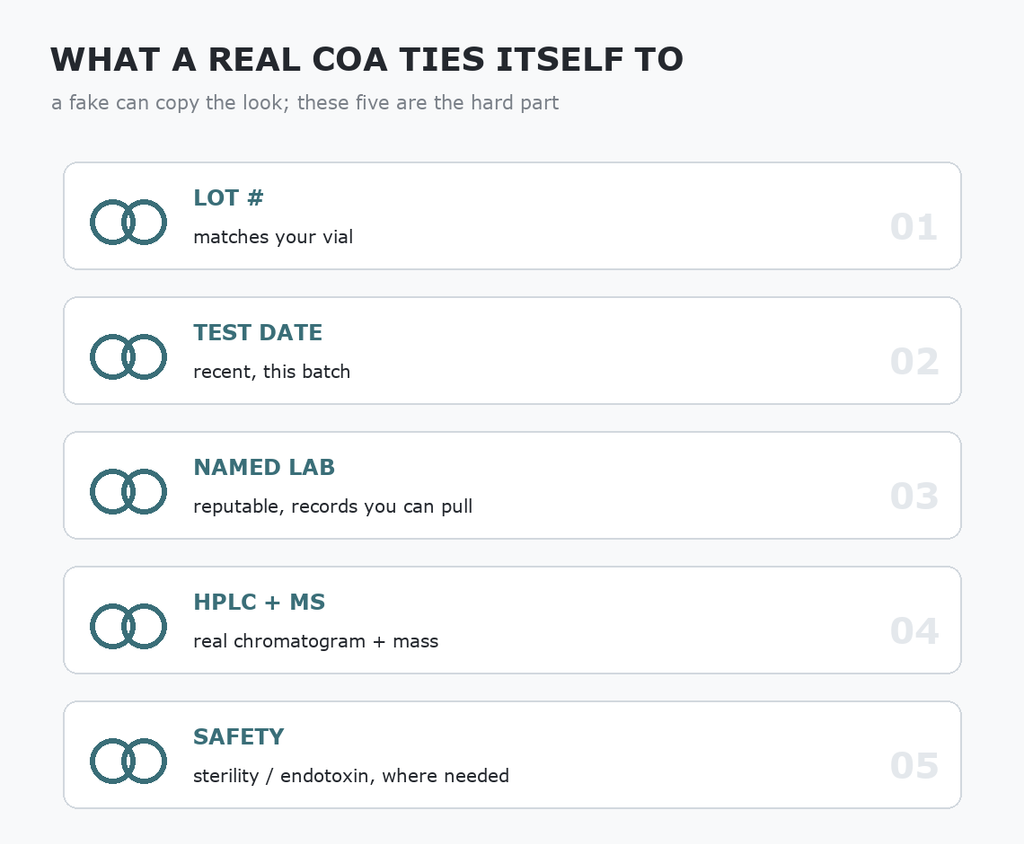
The five features of a genuine COA
Step 1: Match the Lot/Batch Number
Start with the lot or batch number, because it is the thread that ties the whole certificate to your vial. A genuine COA carries a lot number, and that number should appear on the product itself or on the page you are buying from. When the two match, the report describes the material in front of you.
A mismatch, or a COA with no lot number at all, is the most common tell of a reused or generic certificate. If a single document shows up under several different products, it is describing none of them accurately. Reputable vendors publish a separate COA per batch and let you match it before ordering, so this check takes seconds.
Step 2: Check the Test Date
Next, read the test date. It should be recent and it should belong to the batch you are looking at, since peptides are tested as they are produced. A date from years ago on a current product suggests the COA was recycled from an older run.
There is a practical reason the date carries weight beyond freshness. Peptides can degrade over long or poor storage, so a purity figure from a test run long before your vial was made no longer describes the material reliably. A current, batch-tied date keeps the number meaningful.
Step 3: Verify the Testing Lab
The signal that carries the most weight is the lab itself. A real COA names the laboratory that ran the analysis, and that lab should have a reputation you can check. An unnamed “independent lab” gives you nothing to verify, while a named facility can be searched, confirmed, and often looked up directly.
Reputation and access go together. A well-regarded third-party peptide lab publishes its results in records you can pull up, so the report stands as an independent entry you can find, beyond whatever PDF the seller emailed. Accreditation raises the bar again: a lab certified to ISO/IEC 17025, the international standard for testing competence, has had its methods and impartiality checked by an outside body.
Labs such as Janoshik Analytical are widely used precisely because their reports are independently searchable. For the difference between an outside lab and a vendor grading its own product, see our guide on third-party vs in-house testing.
Step 4: Confirm HPLC Purity + Mass-Spec Identity
A trustworthy COA answers two questions with two methods, and both should be on the page. HPLC gives the purity percentage, the share of the sample that is your target peptide. Mass spectrometry gives identity, confirming the vial holds the peptide you ordered and not a different sequence.
The identity result is the one a cheap fake tends to fumble. A real LC-MS line shows the observed mass next to the theoretical mass for that peptide, and the two should match within the instrument’s resolution.
The FDA’s guidance on synthetic peptides treats this kind of identity and impurity characterization as core, with HPLC as the validated purity method, and current peptide mass-spec method work backs mass spectrometry as the identity backbone.
Look past the headline number to the actual data: a real report shows the HPLC chromatogram and the mass spectrum, while a fake often shows only a percentage. Our HPLC vs mass spectrometry guide explains what each proves.
Step 5: Look for Sterility/Endotoxin (Where Relevant)
For any peptide headed into cell or animal research, purity and identity are only part of the picture. Sterility and bacterial endotoxin testing catch contamination that a purity percentage never would, and a thorough COA reports them alongside the core results.
These results carry the most weight for sensitive work, where a stray endotoxin could throw off an inflammatory readout. A vendor that runs a broader safety panel and publishes those lines is showing you more of its hand. Their absence is a smaller flag than a missing lot number, though for research that touches living systems it is worth confirming.
Red Flags of a Faked or Generic COA
Some patterns tell you a COA is decorative before you finish reading it. Any single one is a reason to slow down and ask the vendor a direct question.
- No lot number or test date. With nothing tying the document to a batch, it describes nothing you can hold.
- No named lab. A vague “independent lab” credit leaves you no facility to look up.
- One COA for every product. A single certificate reused across the catalog is a template, not a result.
- A picture with no readout. A purity badge floating free of a chromatogram or spectrum shows a conclusion and buries the work.
- Mismatched or impossible figures. A purity number that clashes with the vial label, or shifts between the page and the PDF, points to editing. Our explainer on 98% vs 99% purity covers what those numbers should and should not do.
Spot two of these on one certificate and the safe move is to buy from a source that documents each batch.
Real COA vs Decorative COA
The gap between a real COA and a decorative one comes down to whether the document can be traced. A real certificate is batch-specific, names its lab, and shows the underlying instrument data, so every claim on it can be followed back to a source. A decorative COA is built to reassure at a glance and falls apart the moment you check a detail.
| A real COA has | A decorative prop has |
| A lot number that matches the vial | No lot number, or one reused across products |
| A recent, batch-specific test date | An old or missing date |
| A named, reputable lab | “Independent lab” with no name |
| HPLC chromatogram + mass spectrum | A purity badge and nothing else |
| Observed mass matching theoretical | No identity data at all |
The difference is not how polished the PDF looks. A convincing design is the easy part to fake; the traceable data is the hard part.
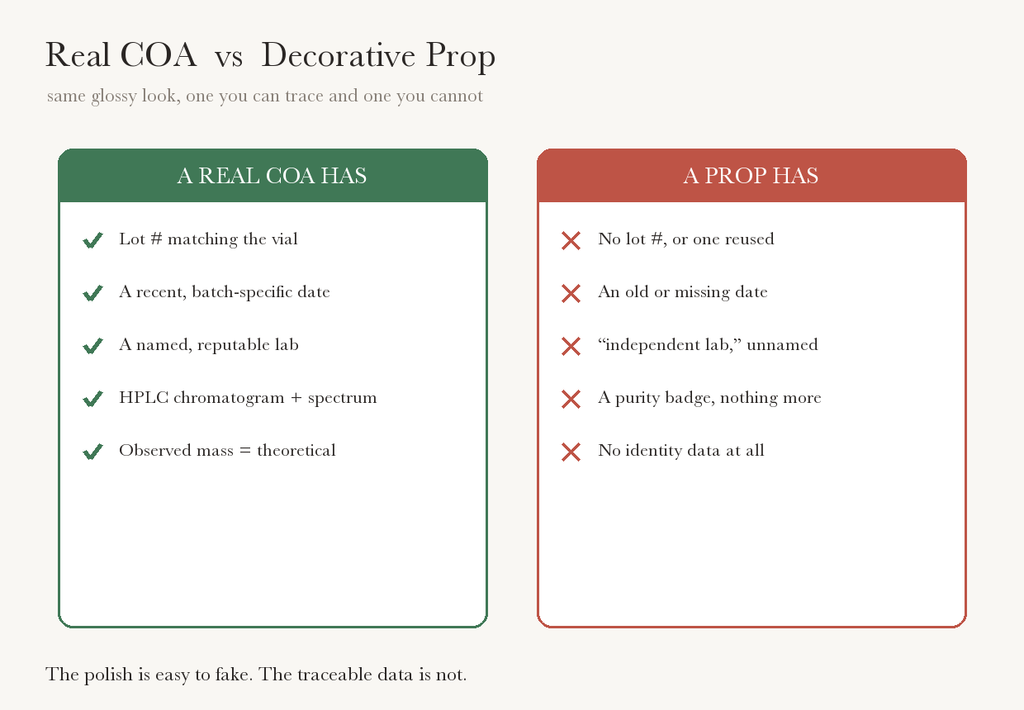
A real COA versus a decorative prop
What to Do If a COA Can’t Be Verified
If a certificate fails a check, the safe move is to pause and ask the vendor for the batch-specific COA that matches your lot, from a named lab. A legitimate seller can produce it quickly, since the document already exists for every batch they stock or ship.
A vendor that stalls, sends the same generic file again, or cannot name its lab has told you what you need to know. There is no research upside to a peptide whose identity and purity you cannot confirm, and plenty of downside if the material is off-spec. When verification fails and the seller cannot fix it, walk away and buy from a source that publishes real, batch-matched COAs.
Frequently Asked Questions
Can peptide COAs be faked?
Yes, a COA is a document, so it can be edited, invented, or reused. Common fakes include an image-editor certificate with a made-up purity number, a real lab’s report reused across every batch, and a genuine COA posted for a product the seller does not actually stock. Verifying it against a batch and a named lab is how you catch these.
How do I know a peptide COA is real?
Do these five checks: the lot number matches your vial, the test date is recent and batch-specific, the lab is named and reputable, HPLC purity and mass-spec identity are both shown with real data, and safety testing appears where relevant. A certificate that clears all five is trustworthy.
What should a real peptide COA include?
A real COA includes a lot or batch number, a test date, the named testing laboratory, an HPLC purity result with a chromatogram, and a mass-spectrometry identity result showing observed mass against theoretical mass. For sensitive research it also includes sterility and endotoxin results. Each item ties the document to a real batch and lab.
Should the lot number on the COA match the vial?
Yes, and this is the single most important check. The lot number on the certificate must match the number on your vial or product, because a COA describes one specific batch. A mismatch, or a missing lot number, means the document does not describe the material you are actually receiving.
The Bottom Line
A peptide COA is only proof when the document is real, and confirming that takes about five minutes. Match the lot number to your vial, check that the test date is recent and batch-specific, confirm the lab is named and reputable, and look for both an HPLC purity result and a mass-spec identity result backed by real data, with sterility and endotoxin where the work calls for it.
A certificate that clears those checks, from a lab whose COAs you can access, is worth trusting. One that cannot is a reason to buy elsewhere.
Disclaimer
This article is for educational and informational purposes only. The peptides referenced are research-use-only, not for human or veterinary consumption, and are not FDA-approved. Nothing here is medical or legal advice. Intended for adults 18 and older.
Peptide Blends vs Single Vials: How to Choose for Research (2026)
For Research Use Only. Not for use in diagnostic or therapeutic procedures. Choosing between peptide blends vs single peptides comes down to…
Read article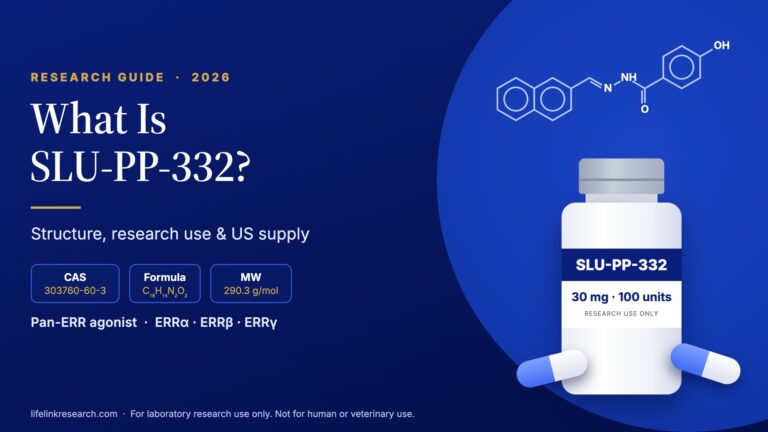
What Is SLU-PP-332? Structure, Research Use & US Supply
Quick Answer SLU-PP-332 is a synthetic small-molecule agonist of the estrogen-related receptors ERRŒ±, ERRŒ≤ and ERRŒ≥ (CAS 303760-60-3, PubChem CID 5338394). It…
Read article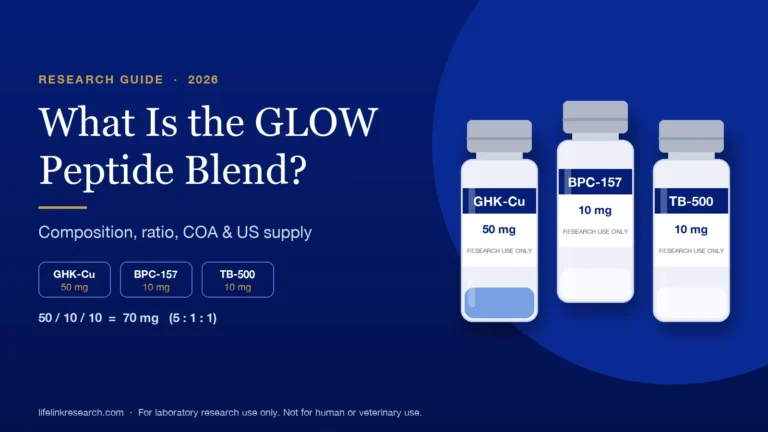
GLOW Peptide Blend: Composition, Ratio & COA (2026)
Quick Answer GLOW is a 70mg research peptide combination of GHK-Cu 50mg, BPC-157 10mg and TB-500 10mg, a 5:1:1 ratio in which…
Read articleResearch-grade peptides
99%+ purity. Verified every batch.
Identity and purity tested on every batch by third-party labs, Janoshik Analytical and US-based laboratories. Shipped same day from California.
Shop all peptides