
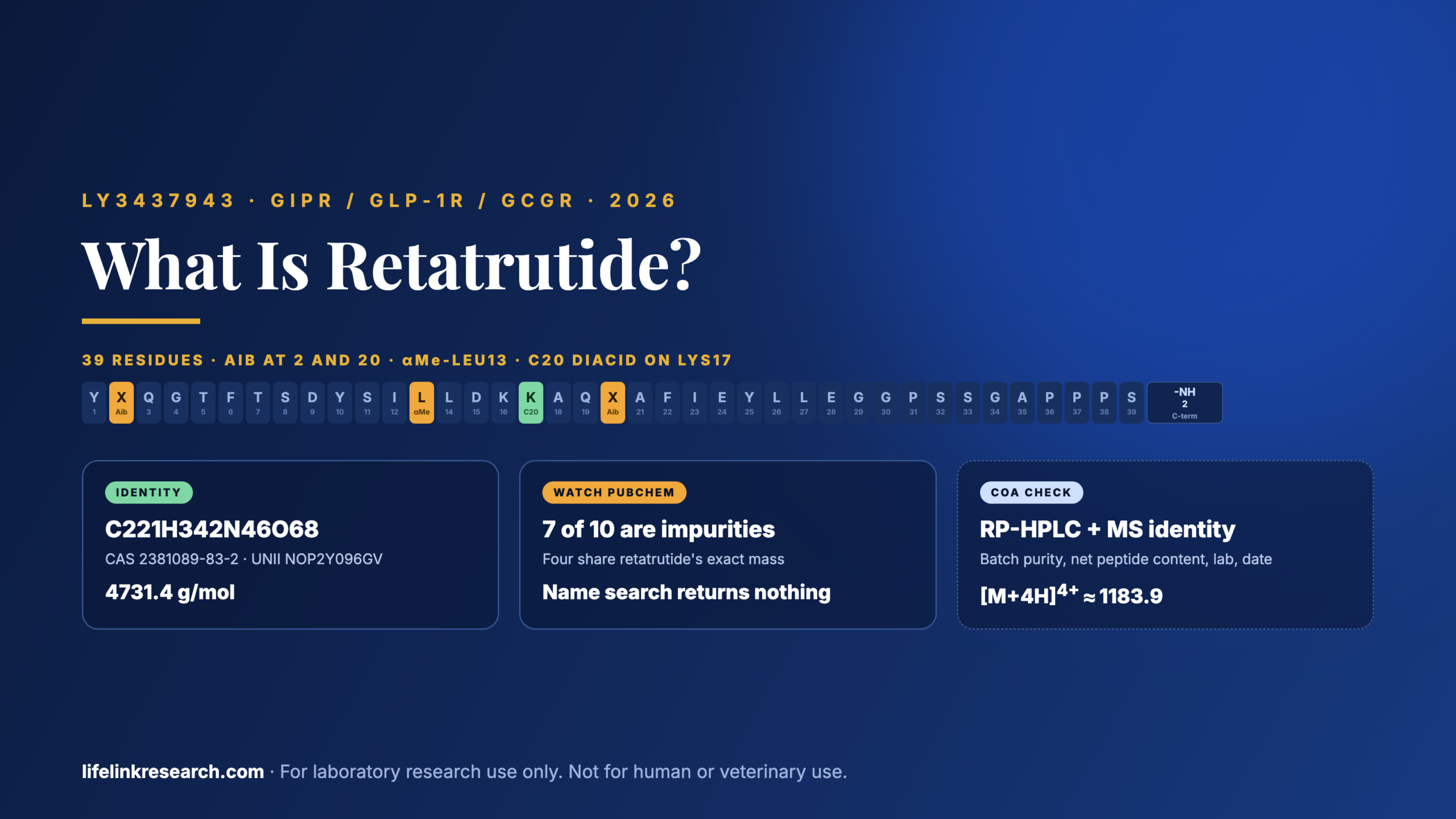
Quick Answer
Retatrutide is a synthetic 39-residue peptide carrying the research code LY3437943, with a 20-carbon fatty diacid chain attached to Lys17. That one sentence is harder to verify than it looks. Search “Retatrutide” in PubChem, and nothing comes back. The record holding its molecular formula is filed under the name “Triple G.” KEGG prints the sequence without marking the methyl group at position 13. Seven of the ten records a PubChem text search does return are impurity standards.
This guide sorts that out. It covers what Retatrutide is made of, the full sequence, the identifiers that actually resolve, the receptor assays behind the triple-agonist label, and what a batch certificate should show.
For Research Use Only. Not for use in diagnostic or therapeutic procedures.
What is Retatrutide?
Quick answer: Retatrutide is a synthetic peptide with the research code LY3437943, developed by Eli Lilly. In cell-based assays, it binds three class B G protein-coupled receptors: the GIP receptor (GIPR), the GLP-1 receptor (GLP-1R), and the glucagon receptor (GCGR). It is an investigational compound.
The “triple agonist” label describes exactly that and nothing more. An agonist is a molecule that binds a receptor and switches it on, and Retatrutide does this at all three targets in transfected cell lines. Older peptides in the same structural family engage one receptor or two. Retatrutide engages three, which is why the shorthand “GLP-3” shows up on supplier listings even though no receptor by that name exists.
LY3437943 is the development code Eli Lilly assigned the molecule, and it remains the most reliable search term across chemical databases. ChEMBL lists it under CHEMBL5095485 with the synonyms LY-3437943 and LY3437943 alongside the INN. The FDA’s own substance registry carries it under the unique ingredient identifier NOP2Y096GV, classified as a protein.
Retatrutide belongs to the lipidated peptide class. The backbone is built by chemical synthesis, then a fatty acid chain is attached at a single position to give the molecule an albumin-binding motif. That design choice drives most of what follows.
What is Retatrutide made of?
Quick answer: Retatrutide is built from a 39-amino-acid backbone with four deliberate modifications: aminoisobutyric acid (Aib) at positions 2 and 20, an alpha-methylated leucine at position 13, a C-terminal amide, and a lipid side chain on Lys17 built from a C20 diacid joined through a gamma-glutamate and an AEEA linker.
Each change does a specific structural job.
| Modification | Position | Structural purpose |
|---|---|---|
| Aminoisobutyric acid (Aib) | 2 | A non-coded residue with two methyl groups on the alpha carbon. It blocks the dipeptidyl peptidase cleavage site that trims this peptide family at the N-terminus. |
| Alpha-methyl-L-leucine | 13 | A second alpha-methylated residue. The extra methyl restricts backbone rotation and shields the position from proteolysis. |
| Aminoisobutyric acid (Aib) | 20 | Stabilises the central helix. Aib strongly favours helical geometry, which is the conformation this peptide family adopts at its receptors. |
| C20 diacid on Lys17, via gamma-Glu and AEEA | 17 | A 20-carbon fatty diacid attached through a gamma-glutamate spacer and an AEEA (8-amino-3,6-dioxaoctanoic acid) linker. The diacid is an albumin-binding motif. |
| C-terminal amide | 39 | The terminal serine is amidated, which caps the C-terminus and removes one negative charge. |
Three of those residues are not among the twenty encoded amino acids, so Retatrutide cannot be made biologically. It is assembled by solid-phase peptide synthesis, with the lipid chain added at the protected Lys17 side chain during the build.
The same C20 diacid and AEEA linker chemistry appears across this peptide class, which is why Retatrutide pairs cleanly with other lipidated peptides in a single vial. The Cagri-Reta blend chemistry runs on the same principle, with cagrilintide carrying its own C20 diacid through a gamma-glutamate.
What is the Retatrutide sequence?
Quick answer: The Retatrutide sequence is YXQGTFTSDYSILLDKKAQXAFIEYLLEGGPSSGAPPPS-NH2, where X marks aminoisobutyric acid at positions 2 and 20. Leu13 is alpha-methylated, Lys17 carries the lipid chain, and the C-terminal serine is amidated. The chain is 39 residues long.
Read in blocks of ten:
| Positions | Residues | Modifications in this block |
|---|---|---|
| 1 to 10 | Tyr Aib Gln Gly Thr Phe Thr Ser Asp Tyr | Aib at 2 |
| 11 to 20 | Ser Ile Leu Leu Asp Lys Lys Ala Gln Aib | alpha-methyl-Leu at 13, lipid chain on Lys17, Aib at 20 |
| 21 to 30 | Ala Phe Ile Glu Tyr Leu Leu Glu Gly Gly | none |
| 31 to 39 | Pro Ser Ser Gly Ala Pro Pro Pro Ser | C-terminal amide on Ser39 |
Note the two adjacent lysines at 16 and 17. Only the second carries the lipid. That pair is the single most common source of confusion when people transcribe the structure, because a drawing that attaches the chain to Lys16 looks almost identical at a glance.
The final nine residues, PSSGAPPPS, form a proline-rich tail. Four of the chain’s prolines sit in that stretch, at positions 31, 36, 37, and 38. Prolines break helical structure, and the tail is flexible enough that it does not resolve in the published cryo-EM maps.
The composition is worth reading closely, because it predicts exactly where this peptide degrades. Serine is the most common residue at five positions, followed by glycine, leucine and proline at four each. Only two aspartates appear, at positions 9 and 15, and only two glutamines, at 3 and 19.
Line those positions up against the impurity standards catalogued in PubChem and every one maps onto a real residue. The beta-Asp9 and beta-Asp15 impurities are backbone rearrangements at the two aspartates. The Glu3 and Glu19 impurities are the two glutamines deamidating. D-Ser32 is one of the five serines epimerising. None of those positions is arbitrary, and knowing which residues are vulnerable tells you what a chromatogram’s shoulder peaks are likely to be.
Common sequence errors
Three errors circulate widely. AI-generated answers have returned a 41-letter string for this peptide, which is two residues too long. KEGG entry D12430 writes position 13 as a plain Leu, with no marking for the alpha-methyl group, and leaves out the C-terminal amide and the Lys17 lipid entirely. Wikipedia’s structural footnote labels are numbered independently of residue position, so reading them as positions puts every modification in the wrong place.
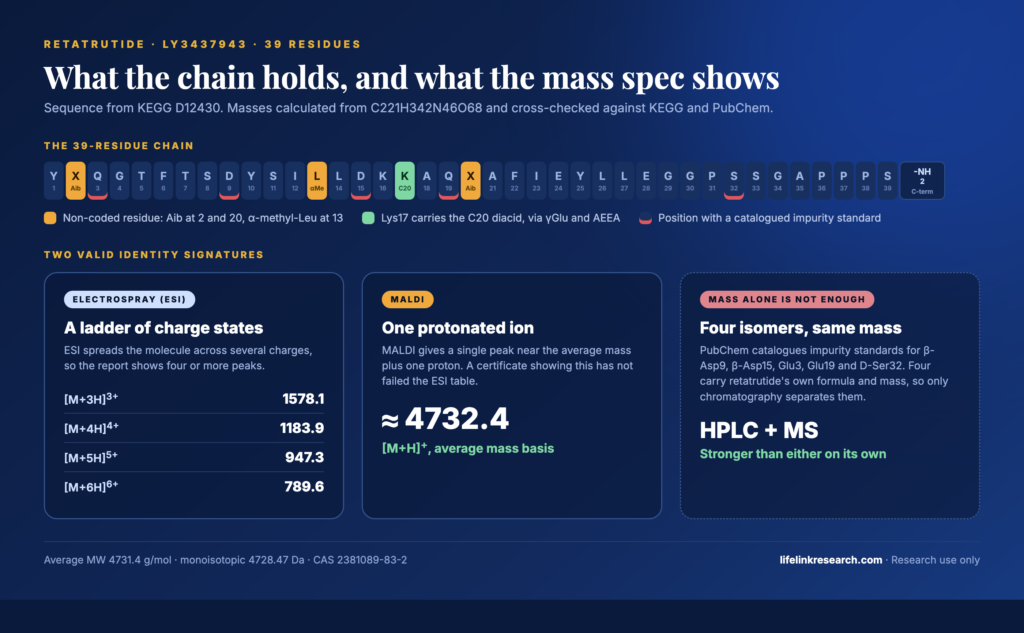
Retatrutide’s 39 residues with Aib at 2 and 20, alpha-methyl-Leu at 13 and the C20 diacid on Lys17, beside the electrospray charge-state ladder and the single MALDI ion.
Retatrutide formula, molecular weight, and identifiers
Retatrutide has the molecular formula C221H342N46O68, an average molecular weight of 4731.4 g/mol, and CAS number 2381089-83-2. The FDA registry identifier is NOP2Y096GV. Its KEGG drug entry is D12430, and its ChEMBL identifier is CHEMBL5095485.
| Identifier | Value |
|---|---|
| Molecular formula | C221H342N46O68 |
| Average molecular weight | 4731.4 g/mol |
| Monoisotopic mass | 4728.47 Da |
| CAS number | 2381089-83-2 |
| UNII | NOP2Y096GV |
| KEGG | D12430 |
| ChEMBL | CHEMBL5095485 |
| Development code | LY3437943 |
| Length | 39 residues |
PubChem is the awkward one. A name search for “Retatrutide” returns no compound at all, and neither does the CAS number. The record that carries the correct formula is CID 171390338, whose only four synonyms are “Triple G,” orb1981169, EX-A7826E, and GTPL13769. The INN is absent from that record, which is precisely why the search fails.
Run a text search instead, and PubChem returns ten records. Seven are named impurity standards: beta-Asp15, Glu3, des+Asp9, D-Ser32, Glu19, and beta-Asp9 variants, plus an unspecified Impurity 2. Four of those seven carry Retatrutide’s own formula and mass. Of the remaining three, one is a genuine sodium salt, one is labelled “Retatrutide (sodium salt)” while carrying the free-acid formula, and one sits under the supplier code WZG0211.
That matters analytically. Four catalogued impurities are isomers of the real thing, identical in mass and distinguishable only by chromatography. A certificate that confirms mass alone has not ruled them out, which is the practical difference between HPLC vs mass spectrometry as identity methods.
Average vs monoisotopic mass
Two mass values appear for Retatrutide, and they measure different things. The average molecular weight, 4731.4 g/mol, uses the natural isotope mix of every element and is the figure to pair with a weighed sample. The monoisotopic mass, 4728.47 Da, uses only the lightest isotope of each element and is the figure a high-resolution mass spectrometer reports.
PubChem shows a third number, an “ExactMass” of 4730.48, which sits 2.007 Da above the true monoisotopic value. PubChem’s separate MonoisotopicMass field agrees with KEGG at 4728.47. An MS report should be read against 4728.47 for high-resolution work, or against 4731.4 for average-mass instruments.
Which receptors does Retatrutide bind?
Quick answer: Retatrutide binds three class B G protein-coupled receptors: GIPR, GLP-1R and GCGR. Activity is measured as cyclic AMP accumulation in cell lines transfected with each receptor, the standard functional readout for this receptor class. Coskun and colleagues reported the original characterisation in Cell Metabolism in 2022.
All three are secretin-family receptors that couple to the stimulatory G protein Gs. Binding the receptor activates adenylate cyclase, raising intracellular cAMP, and the assay reads that rise in a dish. Coskun and colleagues, 2022 ran the cAMP panel across the three receptors and reported the potency profile that established the triple-agonist description.
The assay format explains why the word “agonist” is doing precise work here. Each receptor is expressed in a cell line engineered to carry it, so the signal comes from one receptor at a time. Potency is read off a concentration-response curve and reported as an EC50, the concentration producing half the maximum cAMP response. Running the same peptide across three separately transfected lines is what allows a single molecule to be characterised at three targets.
Structural work followed. Li and colleagues published cryo-EM structures of Retatrutide bound to each receptor in Cell Discovery in 2024. The glucagon receptor complex is deposited as PDB 8YW5 at 2.84 Angstrom resolution, released 7 August 2024. Worth noting for anyone modelling the molecule: RCSB lists the Retatrutide chain in that entry as 30 residues, with modified residues AIB and 2ML present. The proline-rich C-terminal tail is disordered and not modelled.
Retatrutide shares this receptor family with tesamorelin only at the class level. Tesamorelin acts at the GHRH receptor, a different class B target entirely.
Is Retatrutide FDA approved?
Quick answer: No. As of 9 November 2026, Retatrutide is investigational and has not been approved by the FDA. Eli Lilly’s statement of 23 July 2026 describes it as “an investigational, first-in-class GIP, GLP-1, and glucagon triple hormone receptor agonist” and states that “Lilly plans to submit a Biologics License Application (BLA) for Retatrutide to FDA in Q1 2027.”
ChEMBL records the same position independently, listing Retatrutide at max phase 3 with the first-approval field empty. The FDA substance registry holds the molecule under UNII NOP2Y096GV as a registered substance, which records its identity and carries no approval status of its own. Material supplied under this listing is for laboratory research only.
What should a Retatrutide COA show?
Quick answer: A Retatrutide certificate of analysis should show an HPLC chromatogram with the batch purity result, a mass-spectrometry identity confirmation, net peptide content in milligrams, the batch or sample identifier, the testing laboratory, and the date of analysis. Purity by HPLC varies from batch to batch, so the number that counts is the batch result printed on the certificate.
On the mass-spectrometry page, the ion pattern depends on the instrument. Electrospray ionisation spreads the molecule across several charge states, so an ESI report shows a ladder of peaks.
| Ion | Expected m/z |
|---|---|
| [M+3H]3+ | 1578.1 |
| [M+4H]4+ | 1183.9 |
| [M+5H]5+ | 947.3 |
| [M+6H]6+ | 789.6 |
MALDI instruments produce one protonated ion near 4732.4. Both are valid identity confirmations, so a certificate showing a single peak at 4732 has not failed the ESI table above. It was run on a different instrument.
Identity can also be confirmed chromatographically, by matching the sample’s retention time against a reference standard. That method is weaker on its own, because the four isomeric impurities catalogued in PubChem share Retatrutide’s mass, while a retention-time match carries no mass information at all. A certificate that reports both is stronger than one reporting either.
Net peptide content is the figure that separates the weight of a vial from the weight of the peptide inside it. Piatkowski and colleagues tested three products sold as Retatrutide in Australia, each labelled 10 mg, and reported in Drug and Alcohol Review in 2026 that none matched their label: the three vials measured 5.13 mg, 16.5 mg and 19.0 mg of peptide. The authors note that “the quantity present varied substantially from the labelled content,” on a sample of three.
Life Link’s current Retatrutide certificates report content directly. The 15 mg vial was analysed by Bioviridian on 19 June 2026, identity confirmed by MALDI-MS, content 15.96 mg, with a retention time of 11.078 minutes. The 10 mg vial was analysed by Prodigy Labs in San Diego, identity was confirmed by HPLC retention-time match, net peptide content 10.49 mg, alongside a fentanyl screen and five heavy metals by USP <232> and <233>, all not detected.
Open either product page and click View report to read them. Reading a certificate closely is covered in how to verify a peptide COA, and what 98% vs 99% purity means explains why the second decimal place matters less than the method behind it. Our third-party testing runs identity and purity on every batch, with secondary panels on rotation.
How is lyophilized Retatrutide stored?
Quick answer: Lyophilized Retatrutide is stored sealed, dry, and desiccated, protected from light, at -20 degrees C for long-term storage. Let the vial reach room temperature before opening to limit condensation on the powder.
The lipid chain makes Retatrutide more hydrophobic than an unmodified peptide of similar length, and the powder is hygroscopic, so an intact seal matters as much as the temperature. Handling details for powders of this type are in the peptide storage guide, and the stability trade-offs between formats are set out in lyophilized vs pre-mixed peptides.
Solubility: Soluble in water or DMSO for assay preparation.
Retatrutide for research: US supply
Life Link Research supplies Retatrutide as a lyophilized powder in three vial sizes, each shipped with a batch certificate of analysis and dispatched same day from California on orders placed before 2 PM PST.
The Retatrutide 15mg research vial is the standard working size, and its certificate file currently holds ten laboratory documents covering identity, purity, endotoxin, heavy metals, and microbial counts. Every document stays on the product page, so earlier analyses can be read alongside the current one. Smaller and larger programmes are served by the 10mg vial and the 20mg vial, supplied as the same lyophilized powder in different fill weights.
Two formats pair Retatrutide with a second peptide in one order. Cagri-Reta 10/10mg combines it with cagrilintide, and the MAXMORPH kit (Retatrutide + tesamorelin) supplies both peptides as separate vials. The full catalogue of all GLP-family research peptides sits alongside them.
Retatrutide FAQs
Is Retatrutide a peptide?
Yes. Retatrutide is a synthetic peptide of 39 amino acid residues, modified with a C20 fatty diacid side chain on Lys17. Three of its residues are non-coded, so it is assembled by solid-phase peptide synthesis. Its FDA substance registry entry classifies it as a protein.
How many amino acids does Retatrutide have?
Retatrutide has 39 amino acid residues. Two positions, 2 and 20, carry aminoisobutyric acid, a non-coded residue, and position 13 carries alpha-methyl-L-leucine. The C-terminal residue, Ser39, is amidated. Lys17 bears the C20 fatty diacid side chain.
What is LY3437943?
LY3437943 is the development code Eli Lilly assigned to Retatrutide, and it appears as LY-3437943 in some databases. It identifies the same molecule as the INN Retatrutide, with formula C221H342N46O68 and CAS number 2381089-83-2. It remains the most reliable search term across chemical registries.
What is Retatrutide’s CAS number?
Retatrutide’s CAS number is 2381089-83-2. A PubChem search on that number returns no compound record, so the CAS is best cross-checked against KEGG entry D12430 or the FDA unique ingredient identifier NOP2Y096GV, both of which resolve to the same 39-residue structure.
Why does PubChem show several Retatrutide records?
A PubChem text search returns ten records. Seven are named impurity reference standards, including beta-Asp and D-amino-acid isomers, and four of those carry Retatrutide’s own formula. Two more are sodium-salt entries, and one sits under a supplier code. The record holding the correct structure is filed under “Triple G.”
Is Retatrutide a GLP-1 agonist?
In receptor assays, Retatrutide activates the GLP-1 receptor along with the GIP and glucagon receptors, measured as cyclic AMP accumulation in transfected cell lines. Describing it as a GLP-1 agonist alone is incomplete, since all three receptors respond in the same assay panel.
Disclaimer
For Research Use Only. Not for use in diagnostic or therapeutic procedures. Full terms are set out in our research disclaimer.
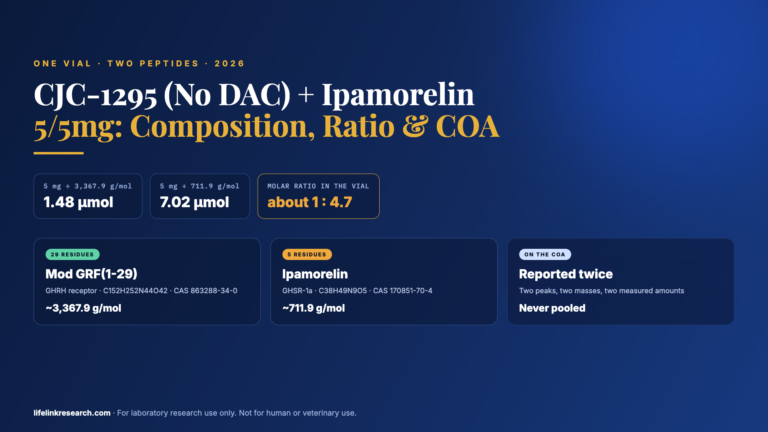
CJC-1295 (No DAC) + Ipamorelin Blend 5/5mg: Composition, Ratio & COA
Quick Answer This article covers what the cjc 1295 ipamorelin blend contains, both sequences and masses, the real molar ratio behind the…
Read article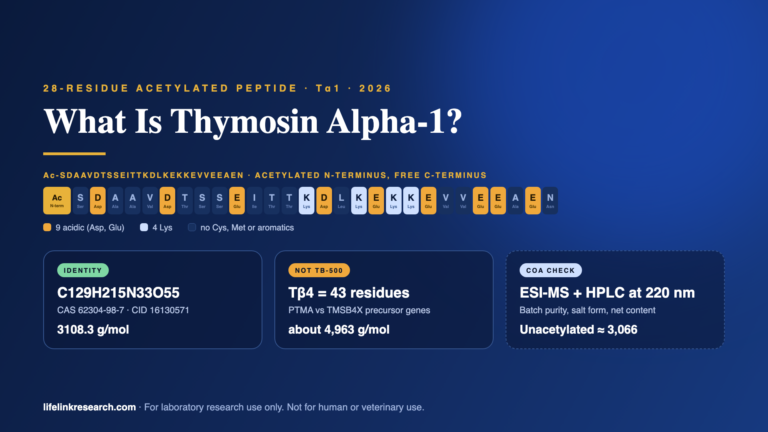
What Is Thymosin Alpha-1? Structure, Research Use & COA
Quick Answer Thymosin Alpha-1 (Tα1) is a 28-amino-acid peptide, acetylated at its N-terminus, with the formula C129H215N33O55. It carries an average molecular…
Read article
What Is Epithalon (Epitalon)? AEDG Structure, Research Use & COA
Quick Answer Epithalon (Epitalon, AEDG) is a synthetic tetrapeptide with the sequence Ala-Glu-Asp-Gly, modeled on the amino-acid composition of the natural extract…
Read articleResearch-grade peptides
99%+ purity. Verified every batch.
Identity and purity tested on every batch by third-party labs, Janoshik Analytical and US-based laboratories. Shipped same day from California.
Shop all peptides