
Quick Answer
Tesamorelin is a synthetic 44-amino-acid analog of human GHRH(1-44), carrying a trans-3-hexenoyl group on the nitrogen end of its first residue. Everything after that cap is the natural hormone sequence, residue for residue. One small acyl group is the entire design change, and it is the reason the molecule behaves the way it does in a protease assay.
This guide covers what a buyer checks before a vial goes into an experiment: the 44-residue backbone and the record it comes from, the acyl cap and the C-terminal amide, the registry identifiers and where they disagree, free base against acetate salt, the GHRH-receptor assays, and what a batch certificate should show.
For Research Use Only. Not for use in diagnostic or therapeutic procedures.
What Is Tesamorelin?
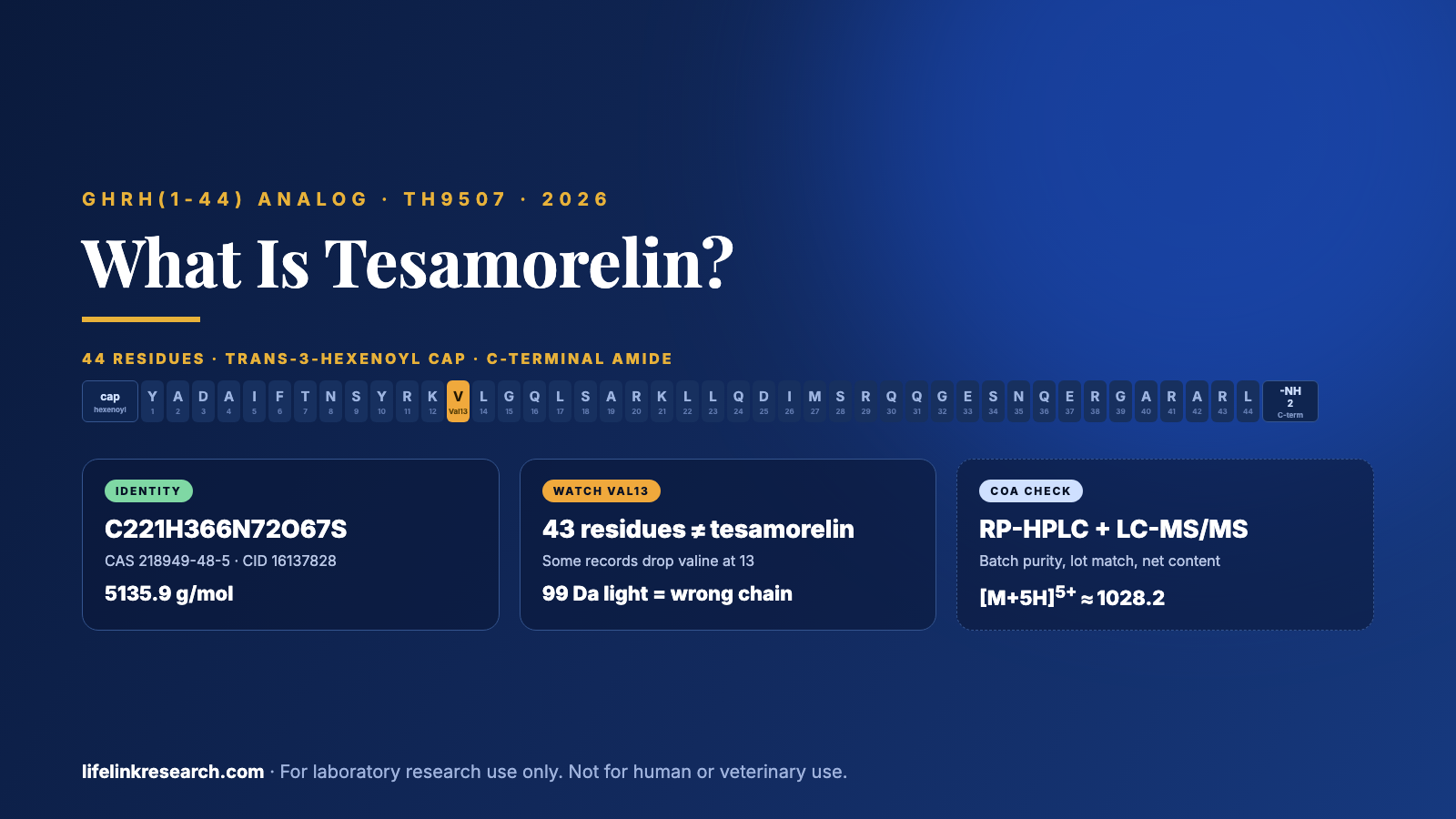
Quick answer: Tesamorelin is a 44-residue analog of GHRH(1-44) developed under the code TH9507, built with an N-terminal trans-3-hexenoyl group and a C-terminal amide. Its molecular formula is C221H366N72O67S and its average molecular weight is 5135.9 Da, under CAS 218949-48-5. Laboratories work with it as a ligand at the GHRH receptor.
Tesamorelin belongs to the growth-hormone-releasing hormone analog class, the family of peptides built on the hypothalamic GHRH sequence. Within that family, it sits at the long end. Sermorelin and modified GRF(1-29) use the first 29 residues; tesamorelin carries all 44.
Tesamorelin still appears under its development code, TH9507, in older literature and on supplier labels. A second registry number, 804475-66-9, resolves to the same PubChem record, CID 16137828, so a certificate quoting it has not quoted the wrong compound.
Tesamorelin and native GHRH(1-44) differ at one position only, and it is not a residue. The 44 amino acids are identical. The change is a six-carbon acyl group bolted to the amino terminus, which leaves the backbone sequence untouched and alters only how the N-terminal end presents itself to enzymes.
Tesamorelin Structure: What Does It Consist Of?
Quick answer: Tesamorelin consists of three structural parts: a 44-residue peptide chain matching human GHRH(1-44), a trans-3-hexenoyl acyl cap on the alpha-amino group of Tyr1, and an amide at the C-terminal leucine. The chain supplies the receptor-binding surface. The cap and the amide sit at the two ends, where they change the molecule’s chemistry.
The 44-Residue GHRH Backbone
Tesamorelin uses the human GHRH(1-44) sequence without substitution. In UniProt, that chain is a defined feature of the somatoliberin precursor: entry P01286 runs 108 amino acids, and residues 32 to 75 are annotated as the mature peptide. Those 44 residues read YADAIFTNSYRKVLGQLSARKLLQDIMSRQQGESNQERGARARL.
Pull the sequence from that chain feature rather than from a free-text field, because free-text copies circulate with an error in them.
The Trans-3-Hexenoyl Cap on Tyr1
Tesamorelin carries an (E)-hex-3-enoyl group, a straight six-carbon acyl chain with a double bond in the trans configuration between carbons 3 and 4, joined through an amide bond to the alpha-amino nitrogen of Tyr1.
Capping that nitrogen has a specific chemical consequence. Dipeptidyl peptidase-IV recognises a free N-terminal amine followed by a small residue at position 2, and native GHRH presents exactly that pattern. Frohman, Downs, Heimer and Felix characterised the reaction in human plasma in vitro and reported in the Journal of Clinical Investigation in 1989 that the enzyme cuts the Ala2-Asp3 bond, carrying off the Tyr1-Ala2 dipeptide and leaving GRH(3-44)-NH2. Diprotin A, a competitive DPP-IV inhibitor, blocked the conversion, and a D-amino acid at position 1 or 2 prevented hydrolysis altogether.
An acyl group on Tyr1 removes the free amine the enzyme needs. In enzymatic stability work in vitro, that is the function the cap performs.
The C-Terminal Amide
Tesamorelin terminates in Leu44-NH2. Amidation replaces the hydroxyl of the terminal carboxylic acid with an amino group, so the peptide ends in a neutral amide instead of a negatively charged carboxylate.
Two things follow. The formula gains an NH and loses an O relative to the free acid, which shifts the mass by roughly one unit. And the C-terminus stops carrying a negative charge at neutral pH, which is worth knowing when interpreting a charge-state envelope on a mass spectrum.
What Is the Tesamorelin Sequence?
Quick answer: The tesamorelin sequence is (E)-hex-3-enoyl-YADAIFTNSYRKVLGQLSARKLLQDIMSRQQGESNQERGARARL-NH2: 44 amino acids in the one-letter code, an acyl cap at the front and an amide at the back. Written out, it runs from Tyr1 through Leu44, with valine at position 13 and a single methionine at position 27.
| Positions | One-letter | Residues |
|---|---|---|
| 1 to 10 | YADAIFTNSY | Tyr-Ala-Asp-Ala-Ile-Phe-Thr-Asn-Ser-Tyr |
| 11 to 20 | RKVLGQLSAR | Arg-Lys-Val-Leu-Gly-Gln-Leu-Ser-Ala-Arg |
| 21 to 30 | KLLQDIMSRQ | Lys-Leu-Leu-Gln-Asp-Ile-Met-Ser-Arg-Gln |
| 31 to 40 | QGESNQERGA | Gln-Gly-Glu-Ser-Asn-Gln-Glu-Arg-Gly-Ala |
| 41 to 44 | RARL | Arg-Ala-Arg-Leu |
Position 1 carries the trans-3-hexenoyl cap. Position 44 carries the amide.
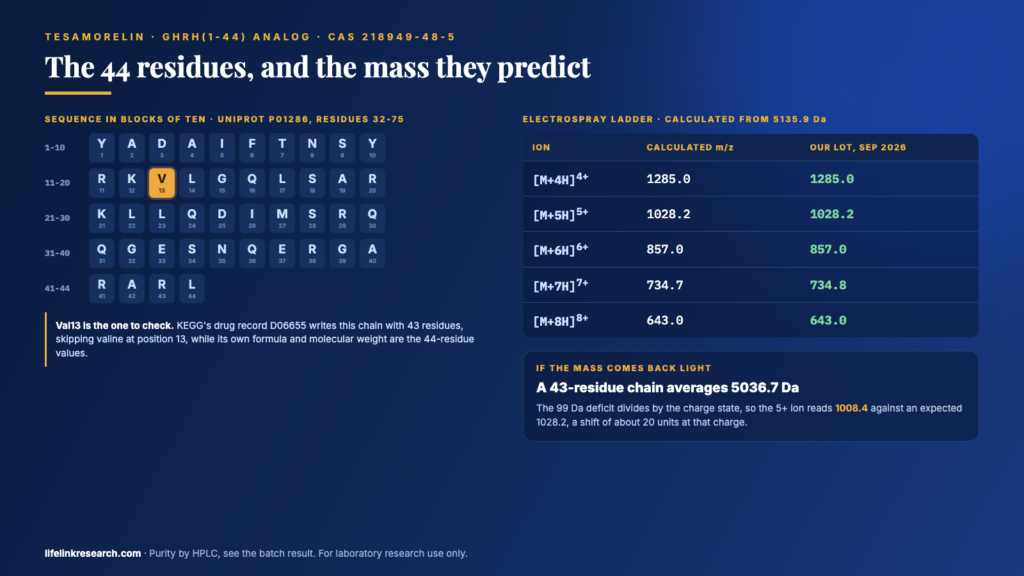
Tesamorelin’s 44 residues in blocks of ten with Val13 highlighted, beside the calculated and observed electrospray charge-state ladder
Composition is as useful a check as the string itself. The chain carries six arginines and two lysines, which makes it strongly basic, and exactly one methionine, at position 27. That single methionine is why the molecular formula ends in a lone sulfur atom, so any sequence offering two methionines is describing something else.
Some databases print this sequence with only 43 residues. The KEGG drug record D06655 is the clearest example: its SEQUENCE field runs Arg-Lys straight into Leu-Gly, skipping Val13 entirely. The same record’s FORMULA field reads C221H366N72O67S and its MOL_WEIGHT reads 5135.78, and both of those are the 44-residue values, so the record disagrees with itself. Two checks catch this in seconds. Count the residues, and confirm that valine sits at position 13 between Lys12 and Leu14. The 44-residue version is the one that produces the published formula and the published mass, and a 43-residue copy will quietly fail both.
Tesamorelin Chemical Data at a Glance
| Field | Value |
|---|---|
| CAS (free base) | 218949-48-5 |
| PubChem CID | 16137828 |
| UNII | MQG94M5EEO |
| Molecular formula | C221H366N72O67S |
| Average molecular weight | 5135.9 Da |
| Monoisotopic mass | 5132.72 Da |
| Length | 44 amino acids |
| Development code | TH9507 |
| Acetate form | C221H366N72O67S·xC2H4O2, x ≈ 7 |
| Acetate CAS | 901758-09-6 |
Small differences between sources are a matter of rounding. Calculated from standard atomic weights, the average mass of C221H366N72O67S is 5135.86. KEGG lists 5135.78, PubChem lists 5136, and the manufacturer’s product description rounds to 5135.9. All four describe the same molecule.
The monoisotopic figure deserves its own note, because a commonly copied value is wrong. Calculated from the formula, the monoisotopic mass is 5132.72 Da, which matches KEGG’s EXACT_MASS field and PubChem’s MonoisotopicMass field. PubChem’s separate ExactMass field on that record reads 5134.72, about 2 Da high, and that is the number that tends to get repeated. Use 5132.72.
The acetate registry number carries a caveat of its own. CAS 901758-09-6 is attached to the USAN name tesamorelin acetate in the KEGG record D09015, alongside the formula C221H366N72O67S·(C2H4O2)x. PubChem returns no compound under that number, so a search there will come back empty even though the number is real.
Tesamorelin Free Base vs Acetate Salt
Tesamorelin is supplied as an acetate salt. The manufacturer’s product description gives the salt formula as C221H366N72O67S·xC2H4O2 with x approximately 7, and the molecular weight 5135.9 Da as free base equivalent. Those seven acetate counter-ions are part of what sits in the vial, and they are not peptide.
Acetate is the standard counter-ion for synthetic peptides because basic side chains need something to pair with after purification. Tesamorelin has eight basic residues: six arginines at positions 11, 20, 29, 38, 41 and 43, plus lysines at 12 and 21. Seven acetates for eight basic sites is the stoichiometry the composition predicts.
The arithmetic matters when reading a certificate. Seven acetates add 420.4 Da to 5135.9, giving a gross salt mass near 5556, so the free base accounts for roughly 92 percent of the salt’s weight. The manufacturer’s own figures say the same thing in a different unit: a presentation stated as 2 mg of tesamorelin is described as approximately 2.2 mg of tesamorelin acetate.
Gross vial weight therefore overstates peptide, and that gap is a live question in analytical chemistry. Nassim Maarouf-Mesli and Charity D. Yongo-Luwawa, in William Lubell’s group at the Université de Montréal, published a 2026 NMR method written up by the American Peptide Society that fixes peptide quantity to a proton signal integration instead of a balance reading. Their method targets trifluoroacetate, and the premise carries across to acetate salts: what you weigh and what you weighed are two different numbers.
How Does Tesamorelin Interact With the GHRH Receptor?
Quick answer: Tesamorelin acts as an agonist at the GHRH receptor, GHRHR, a class B G-protein-coupled receptor that couples to Gs and signals through cyclic AMP. In cell-based work, the readouts are cAMP accumulation in lines expressing recombinant GHRHR, and competition against a labelled ligand in radioligand binding assays.
Tesamorelin studies in this area run in two assay formats. Cyclic AMP accumulation assays measure second-messenger output in transfected cells across a concentration range, and radioligand binding assays measure displacement of a labelled GHRH analog from membrane preparations.
Tesamorelin’s target has been resolved structurally. Zhou and colleagues reported a cryo-EM structure of the human GHRHR in complex with Gs at 2.6 Angstrom resolution in Nature Communications in 2020, deposited as PDB entry 7CZ5 and reconstructed from 307,018 particles. They describe GHRHR as “a prototypical class B GPCR” signalling “through cyclic adenosine monophosphate (cAMP)-dependent pathways”, and report that GHRH “adopts an α-helical configuration when engaged with GHRHR”.
Receptor identity separates GHRH analogs from the other secretagogue family cleanly, because GHRHR and GHSR-1a take different ligands. Ipamorelin acts at GHSR-1a, a receptor tesamorelin has no affinity for.
Tesamorelin vs Sermorelin: Structural Differences
Tesamorelin and sermorelin are both GHRH analogs built on the same natural sequence, and they differ in length and in end-group chemistry. Sermorelin is GHRH(1-29)-NH2, the 29-residue N-terminal fragment with a free amino terminus. Tesamorelin carries the full 44 residues and an acyl cap on Tyr1.
| Feature | Tesamorelin | Sermorelin |
|---|---|---|
| Length | 44 aa | 29 aa |
| N-terminus | trans-3-hexenoyl | Free |
| C-terminus | Amide | Amide |
| Formula | C221H366N72O67S | C149H246N44O42S |
| Average MW | 5135.9 Da | 3357.9 Da |
| Monoisotopic mass | 5132.72 Da | 3355.82 Da |
| CAS | 218949-48-5 | 86168-78-7 |
| PubChem CID | 16137828 | 16132413 |
Sermorelin’s figures come from PubChem CID 16132413. The 1778 Da gap between the two average masses is simply residues 30 to 44 plus the acyl cap, and it is large enough that no mass spectrometer should ever confuse the two.
The structural contrast is sharpest at the N-terminus. Sermorelin’s amino terminus is free, which leaves the DPP-IV pattern intact; tesamorelin’s is acylated. That single difference is why the two behave differently in plasma-stability assays despite sharing their first 29 residues exactly.
A third analog rounds out the family. Modified GRF(1-29) builds on the same 29-residue fragment with four amino acid substitutions, and the question of CJC-1295 with vs without DAC turns on whether a maleimidopropionyl group is attached for albumin conjugation. Comparing the three side by side is the fastest way to see how much of GHRH analog chemistry happens at the two ends of the chain. Sermorelin also anchors a comparison that crosses receptor families, and ipamorelin vs sermorelin sets a GHRH analog against a ghrelin-receptor ligand whose only shared feature is the C-terminal amide.
How to Read a Tesamorelin COA
A tesamorelin certificate of analysis should show four things: an HPLC chromatogram with that batch’s own purity percentage, a mass spectrum confirming identity near 5135.9 Da average, the lot or batch identifier matching the vial, and the name and date of the laboratory that ran the tests. Anything missing from that list is a gap worth asking about.
HPLC Purity
Purity on a tesamorelin COA is a reverse-phase HPLC result for one specific batch, usually read at 214 or 220 nm. Report the batch’s own figure and check the retention time and the chromatogram alongside it, because a single sharp peak tells you more than a number on its own.
We pulled the current certificate for our 10 mg vial before writing this. Bioviridian ran it at 214 nm and reported 99.82 percent overall purity, retention time 10.412 minutes, on a sample received 31 August 2026. That figure belongs to that batch, so read the batch result for the lot you receive. Learning how to verify a peptide COA starts with the number attached to the material in your hand.
Mass-Spec Identity
Identity confirmation on a tesamorelin COA comes from electrospray mass spectrometry, which rarely gives one peak at 5135.9. Large peptides pick up several protons and appear as a ladder of multiply charged ions, each at the molecular mass divided by its charge. Calculated from an average mass of 5135.9 Da, the expected values are:
| Ion | Expected m/z |
|---|---|
| [M+4H]4+ | ≈ 1285.0 |
| [M+5H]5+ | ≈ 1028.2 |
| [M+6H]6+ | ≈ 857.0 |
| [M+7H]7+ | ≈ 734.7 |
| [M+8H]8+ | ≈ 643.0 |
Our current certificate matches that ladder to within 0.1 across the board, with labelled peaks at 734.8, 857.0 and 1028.2 and further peaks at 643.0 and 1285.0.
A mass roughly 99 Da light is the signature to watch for, because it points to a missing valine and ties back to the Val13 problem in the databases. A 43-residue chain averages 5036.7. That deficit divides by the charge state, so the 5+ ion reads 1008.4 against an expected 1028.2, a shift of about 20 units at that charge.
Lot Match and the Testing Lab
Match the lot or batch identifier on the certificate to the one printed on the vial, then check that the laboratory named is an analytical lab. A blank lot field is common and worth querying with the supplier. Our 10 mg certificate carries a web verification code, and our quality testing process runs identity and purity on every batch, with heavy metals, endotoxin, and sterility on a rotating cycle. The case for third-party vs in-house peptide testing rests on exactly this independence.
Net Peptide Content and Acetate
Content and purity answer different questions. Purity is the share of the sample that is tesamorelin; content is how many milligrams of peptide are actually present. Our current certificate reports 10.64 mg by HPLC quantitation for the 10 mg vial. Acetate counter-ions are the reason the two figures rarely line up with the label weight.
Storage of Lyophilized Tesamorelin
Store sealed, lyophilized tesamorelin at −20 °C, protected from light, and keep it dry. The certificate for our 10 mg vial describes the material as a white lyophilized powder, which is the form that tolerates frozen storage best.
Two handling habits help. Let a vial reach room temperature before opening it, so moisture does not condense onto cold powder, and plan how much material each piece of work needs in advance, because repeated freeze-thaw cycling is harder on a 44-residue peptide than on a short one.
For assay preparation, tesamorelin is soluble in water and in DMSO.
Research-Grade Tesamorelin in the US
Life Link Research supplies tesamorelin in two vial sizes for laboratory work, both stocked and shipped from California. The tesamorelin 10mg research peptide is the standard working stock for programmes that run through more material, and the 2mg vial suits smaller-scale assay work.
Every lot ships with a batch-matched certificate of analysis. To read the current one, open the product page and click View report, which opens the certificate library entry for that product with the active document and the earlier ones alongside it.
Tesamorelin sits in the wider catalogue of GHRH and secretagogue research peptides, where the same testing workflow applies across the range. Identity runs by LC-MS and purity by RP-HPLC on every batch, with heavy metals, endotoxin, and sterility tested on a rotating cycle across the catalogue. Material is sold to qualified researchers aged 21 and over, for laboratory use.
Tesamorelin FAQs
How many amino acids are in tesamorelin?
Tesamorelin has 44 amino acids. The chain matches human GHRH(1-44) exactly, running Tyr1 through Leu44, and it is annotated in UniProt entry P01286 as residues 32 to 75 of the somatoliberin precursor. Sequence strings showing 43 residues have usually dropped valine at position 13, which also costs them 99 Da of mass.
What is the molecular weight of tesamorelin?
The average molecular weight of tesamorelin is 5135.9 Da as the free base, from the formula C221H366N72O67S. The monoisotopic mass is 5132.72 Da. Published averages range from 5135.78 to 5136 across databases, and those differences are rounding artifacts.
What is TH9507?
TH9507 is the development code for tesamorelin and refers to the same compound. The code still appears in older literature, on supplier labels, and in database synonym lists. A certificate naming TH9507, or quoting the alternative registry number 804475-66-9, describes the same 44-residue peptide under CAS 218949-48-5.
What is tesamorelin acetate?
Tesamorelin acetate is the salt form the peptide is supplied in, written C221H366N72O67S·xC2H4O2 with x approximately 7. The acetate counter-ions pair with the peptide’s eight basic residues. They add roughly 420 Da to the 5135.9 Da free base, so gross vial weight runs about 8 percent above net peptide weight.
Is tesamorelin the same as sermorelin?
No. Both are GHRH analogs, and they differ in size and end-group chemistry. Sermorelin is the 29-residue fragment GHRH(1-29)-NH2 with a free amino terminus, at 3357.9 Da. Tesamorelin runs the full 44 residues with a trans-3-hexenoyl cap on Tyr1, at 5135.9 Da.
Conclusion
Tesamorelin is a well-characterised molecule with one quirk: the public records describing it do not all agree, and the disagreements are easy to miss. Count the residues, confirm valine at 13, use 5132.72 for the monoisotopic mass, and read the purity figure attached to your own lot.
For Research Use Only. Not for use in diagnostic or therapeutic procedures. Full terms are set out in the research disclaimer.
What Is Retatrutide? Structure, Sequence and Research-Grade COA
Quick Answer Retatrutide is a synthetic 39-residue peptide carrying the research code LY3437943, with a 20-carbon fatty diacid chain attached to Lys17.…
Read article
CJC-1295 (No DAC) + Ipamorelin Blend 5/5mg: Composition, Ratio & COA
Quick Answer This article covers what the cjc 1295 ipamorelin blend contains, both sequences and masses, the real molar ratio behind the…
Read article
What Is Thymosin Alpha-1? Structure, Research Use & COA
Quick Answer Thymosin Alpha-1 (Tα1) is a 28-amino-acid peptide, acetylated at its N-terminus, with the formula C129H215N33O55. It carries an average molecular…
Read articleResearch-grade peptides
99%+ purity. Verified every batch.
Identity and purity tested on every batch by third-party labs, Janoshik Analytical and US-based laboratories. Shipped same day from California.
Shop all peptides