
Quick Answer
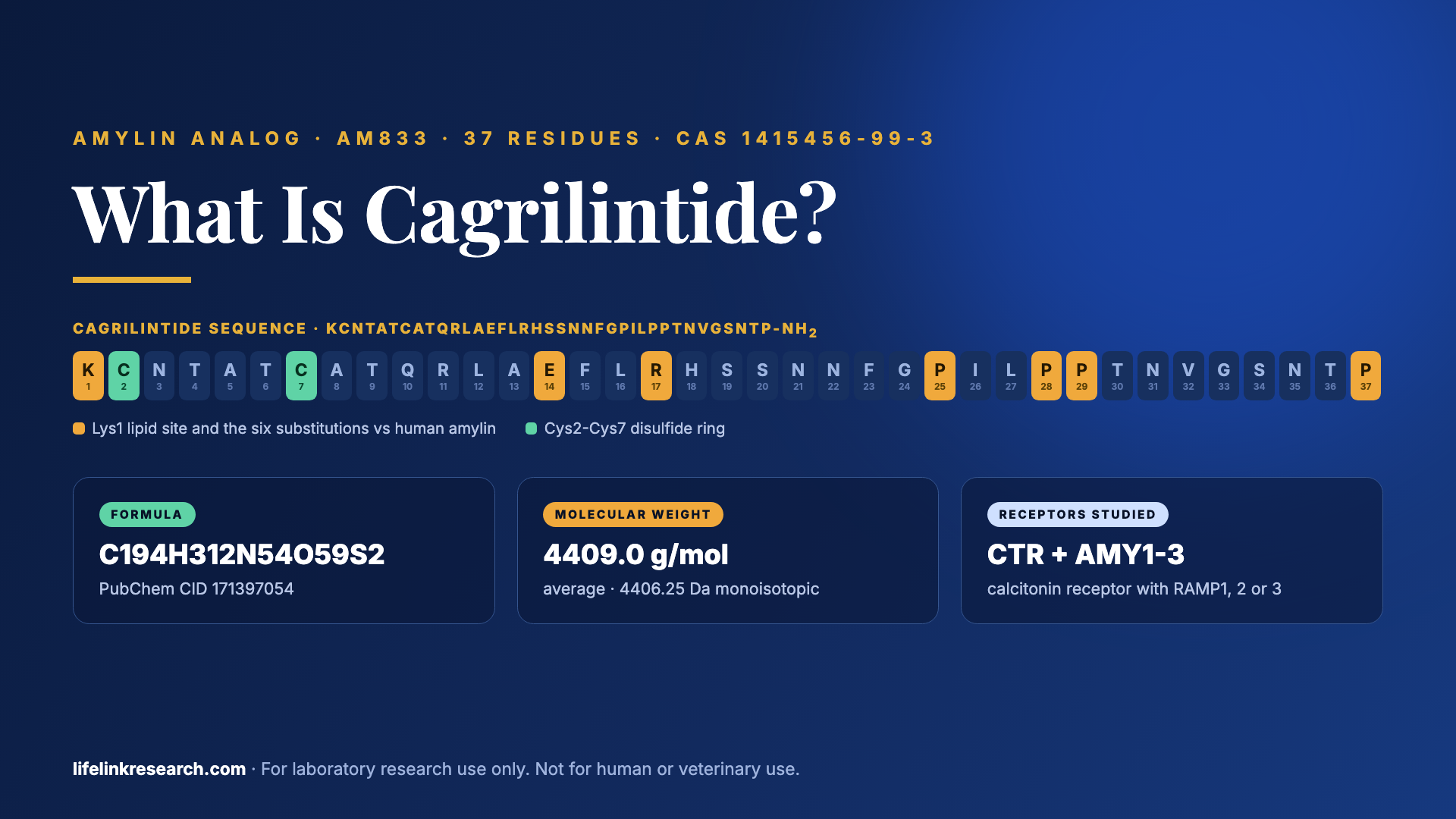
Cagrilintide is a synthetic amylin analog developed by Novo Nordisk under the code AM833. If you have a vial on the bench and a certificate open in another tab, the chemistry is what you need: what the molecule is built from, what the numbers on the label should read, and whether the paperwork matches.
That is what this page covers: the 37-residue sequence in one-letter and three-letter form, the six substitutions that separate cagrilintide from human amylin, the fatty chain on the N-terminus, both molecular weights, the receptors it has been studied at, and a line-by-line way to read a batch COA. Chemistry only.
Everything below describes laboratory material supplied under the research disclaimer that governs every product on this site.
| Field | Value |
|---|---|
| Name and synonyms | Cagrilintide; AM833; NN0174-0833 |
| Class | Lipidated amylin analog |
| Residues | 37 |
| Molecular formula | C194H312N54O59S2 |
| Molecular weight | 4409.0 g/mol average; 4406.25 Da monoisotopic |
| CAS number | 1415456-99-3 |
| UNII | AO43BIF1U8 |
| PubChem CID | 171397054 |
| Modifications | N-terminal C20 diacid on a γ-glutamate linker; Cys2-Cys7 disulfide; C-terminal amide |
| Receptors studied | Calcitonin receptor (CTR); AMY1, AMY2, AMY3 |
Formula, weight, CAS, and CID from PubChem CID 171397054; precisionFDA records UNII AO43BIF1U8 under the name “cagrilintide”.
What Is Cagrilintide?
Quick answer: Cagrilintide is a synthetic peptide analog of human amylin, a 37-residue hormone. It carries a C20 fatty diacid on a γ-glutamate linker at the N-terminus and keeps amylin’s Cys2-Cys7 disulfide ring. Novo Nordisk developed it under the code AM833. In research, it is studied as an agonist at amylin and calcitonin receptors.
Amylin is the parent molecule here, a 37-amino-acid hormone the pancreas releases alongside insulin, which binds a small receptor family built around the calcitonin receptor.
Two words do the heavy lifting. An analog is a peptide rebuilt from a natural sequence with deliberate swaps, keeping the shape that fits the receptor while behaving better as a laboratory compound. Lipidated means a fatty acid chain has been attached, a standard way of making a peptide stick to proteins in blood.
Both choices are documented. The design work was published by Thomas Kruse and colleagues at Novo Nordisk as “Development of Cagrilintide, a Long-Acting Amylin Analogue” in the Journal of Medicinal Chemistry, 2021, volume 64, pages 11183 to 11194. That paper is the primary reference for the next three sections, and the team is blunt about the problem they were solving: human amylin’s habit of clumping into fibrils made it, in their words, “a challenging drug design effort”.
Cagrilintide Structure: The Four Parts of the Molecule
Cagrilintide is a 37-residue peptide chain carrying three modifications: a disulfide ring near the N-terminus, a C20 fatty diacid on a γ-glutamate linker at position 1, and an amide cap at the C-terminus. Take them one at a time, and the molecule is easy to keep in your head.
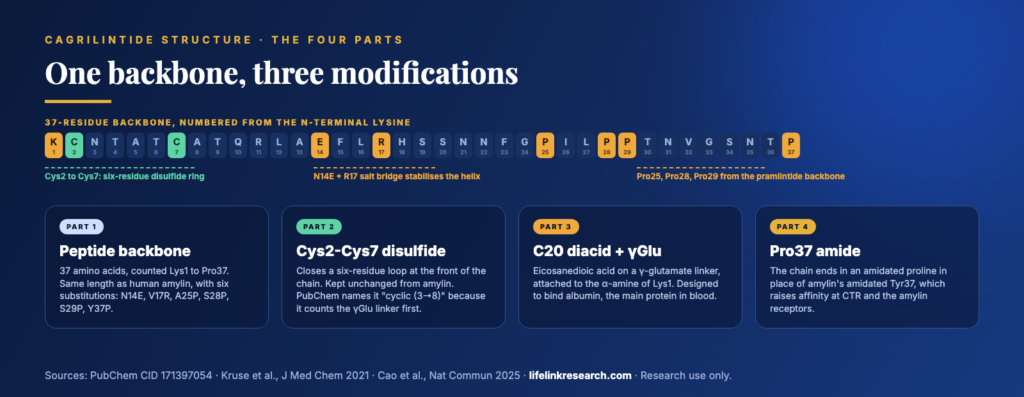
The four structural parts of cagrilintide, with the Cys2-Cys7 ring, the C20 diacid chain and the C-terminal proline amide marked on the 37-residue backbone.
The 37-residue peptide backbone
The backbone runs 37 amino acids, the same length as human amylin, counted from the N-terminal lysine at position 1 to the proline at position 37. Keep that numbering straight, because the chemical naming in some databases counts the γ-glutamate linker as part of the chain and moves every number by two. Stick to peptide numbering and Cys2, Glu14, Arg17, and Pro37 land where the literature puts them.
The Cys2-Cys7 disulfide ring
A disulfide bond joins the cysteines at positions 2 and 7, closing a six-residue loop at the front of the molecule. Human amylin carries the same ring, kept unchanged in cagrilintide. PubChem’s systematic name calls it a “cyclic (3→8)” bridge, which looks wrong until you notice the database counts the γGlu linker as residue 1. Same bond, different starting point.
The N-terminal C20 diacid and γGlu chain
The long chain at the front is eicosanedioic acid, a 20-carbon fatty acid with a carboxyl group at both ends, joined through a γ-glutamate linker to the α-amine of Lys1. Kruse and colleagues chose that chain to make the molecule bind albumin, the most abundant protein in blood. Albumin binding is a chemical design feature of the lipid, and this article makes no claim about what it does in an organism.
Only part of that chain shows up in structural work. In the 2025 cryo-EM maps, the γGlu linker and a short stretch of the diacid could be modelled, and the rest stayed unresolved, which is normal for a flexible lipid tail.
The C-terminal proline amide
The chain ends in a proline amide, written Pro37-NH2, where human amylin ends in an amidated tyrosine. That swap is well tolerated and raises affinity and activity at both the calcitonin receptor and the amylin receptors, as the 2025 structural work describes.
What Is the Cagrilintide Amino Acid Sequence?
Quick answer: Cagrilintide’s sequence is KCNTATCATQRLAEFLRHSSNNFGPILPPTNVGSNTP-NH2, 37 residues. A C20 diacid and γGlu chain are attached at the N-terminal lysine, and a disulfide links Cys2 and Cys7. Compared with human amylin, it carries six substitutions: N14E, V17R, A25P, S28P, S29P, and Y37P.
One-letter:
KCNTATCATQRLAEFLRHSSNNFGPILPPTNVGSNTP-NH2Three-letter:
Lys-Cys-Asn-Thr-Ala-Thr-Cys-Ala-Thr-Gln-Arg-Leu-Ala-Glu-Phe-
Leu-Arg-His-Ser-Ser-Asn-Asn-Phe-Gly-Pro-Ile-Leu-Pro-Pro-Thr-
Asn-Val-Gly-Ser-Asn-Thr-Pro-NH2| Position | Human amylin | Cagrilintide | Why it was changed |
|---|---|---|---|
| 14 | Asn (N) | Glu (E) | Pairs with Arg17 in a salt bridge that stabilises the N-terminal helix and counters fibril formation |
| 17 | Val (V) | Arg (R) | The second half of that salt bridge, same helix-stabilising job |
| 25 | Ala (A) | Pro (P) | Carried over from pramlintide, the backbone peptide cagrilintide was built on |
| 28 | Ser (S) | Pro (P) | Same pramlintide backbone; prolines here break up the stretch that drives aggregation |
| 29 | Ser (S) | Pro (P) | Same pramlintide backbone |
| 37 | Tyr (Y) | Pro (P) | Amidated proline raises affinity and activity at CTR and the amylin receptors |
The N14E and V17R pair is the interesting one. Writing in Nature Communications in April 2025, Jianjun Cao and colleagues at Monash University describe them as a pair of helix-stabilising mutations put in to counteract the amyloid fibril formation that happens with human amylin, forming an internal salt bridge that holds the 5 to 18 helix together.
Two wrong numbers circulate. Some catalogue listings give the length as 39 amino acids, and at least one AI-generated summary inserts an extra proline into the C-terminal run. The chain is 37 residues plus the lipid chain; count the string above to settle it.
What Is Cagrilintide’s Molecular Weight?
Quick answer: Cagrilintide’s average molecular weight is 4409.0 g/mol, from the formula C194H312N54O59S2 on PubChem. Its monoisotopic mass is 4406.25 Da. Lyophilized research material is usually supplied as a salt, such as acetate or TFA, so the mass in the vial includes counter-ions. A COA reports net peptide content separately from HPLC purity.
The two weights answer different questions. Average molecular weight (4409.0) sums the average mass of every element across its natural isotopes, and it is the figure for weighing out material. Monoisotopic mass (4406.25) uses only the lightest isotope of each element, and it is what a mass spectrometer works from.
One trap is in the PubChem record itself. Its “exact mass” field reads 4408.26, about two hydrogens above the monoisotopic value, so a certificate quoting 4406.25 is correct and matches a hand calculation from the formula.
Salt form changes the weight per milligram. A vial labelled 5 mg of a TFA or acetate salt contains less than 5 mg of peptide, because the counter-ions carry part of that mass. Net peptide content is the line that tells you how much.
Vendor pages are not a safe source for any of this. A scan of catalogue listings turns up masses of roughly 3950, 4030, 4052 and 4578 Da for the same compound, none matching the published formula. Take the weight from PubChem or recalculate it from the sequence.
Which Receptors Does Cagrilintide Bind?
Quick answer: Cagrilintide is studied as an agonist at the calcitonin receptor (CTR) and at the three amylin receptors, AMY1, AMY2, and AMY3. Each amylin receptor is a calcitonin receptor paired with RAMP1, 2 or 3. In vitro work measures its activity with cAMP accumulation and radioligand-binding assays, and cryo-EM has resolved its receptor-bound structures.
The RAMP part makes this family unusual. A receptor activity-modifying protein is a small accessory protein that pairs with the calcitonin receptor and changes what it prefers to bind. CTR with RAMP1 gives AMY1; with RAMP2, AMY2; with RAMP3, AMY3. The receptor gene is the same in all three.
Cagrilintide has been resolved at all four. Cao and colleagues determined cryo-EM structures of the peptide bound to Gs-coupled, active AMY1, AMY2, AMY3 and CTR, and reported that it takes up an amylin-like binding mode while inducing “distinct conformational dynamics at calcitonin-family receptors” compared with other peptides. Patrick Sexton, professor of pharmacology at Monash University, is the senior author on that work.
Two assay terms come up constantly. cAMP accumulation measures the second messenger these receptors raise when activated. Radioligand binding measures how tightly a compound binds the receptor by competing against a labelled reference peptide. Both appear in the Kruse paper, alongside structure-activity work at human CTR and AMY3.
Is cagrilintide a GLP-1 receptor agonist?
No. Cagrilintide is an amylin analog, and the receptors it has been characterised at are the calcitonin receptor and the amylin receptors AMY1 to AMY3. The GLP-1 receptor is a separate incretin receptor with its own ligands. The confusion comes from blend products that pair cagrilintide with a GLP-1 compound in one vial.
How to Read a Cagrilintide COA
A cagrilintide COA should show RP-HPLC purity for that batch, ESI-MS identity matching 4409.0 Da, net peptide content, lot number, test date, and the testing lab. Purity is whatever the batch result shows, so read the chromatogram instead of a headline figure. The MS peaks should match cagrilintide’s expected charge states.
| What to check | What it should show |
|---|---|
| HPLC purity | The batch result with its chromatogram attached, and the peak labelled |
| MS identity | Charge states near [M+3H]³⁺ 1470.7, [M+4H]⁴⁺ 1103.3 and [M+5H]⁵⁺ 882.8, calculated from the 4409.0 average; recalculate against the actual report |
| Net peptide content | Stated as its own line, separate from purity |
| Appearance | White lyophilized powder |
| Lot number | Present, and matching the vial label |
| Lab name and date | Both present, and checkable with the lab |
Those charge states are arithmetic. Add three protons to 4409.0, divide by three, and you get 1470.7. A report whose peaks land somewhere else is describing a different molecule. Appearance is the quick sanity check: a white lyophilized powder, and the material itself is soluble in water/DMSO for assay preparation.
Lot number is the field that most often lets a certificate down. The cagrilintide 5mg research vial we sell carries a Prime Analytical report, RP218-17Apr26-1 dated 22 April 2026, giving 100.00% purity at 220 nm and net peptide content of 5.52 mg, with a sample lot field reading “Not Provided”. An earlier Janoshik report, task #68672 from 24 June 2025, gives 99.148% and 5.29 mg. Neither includes a mass-spec run, so identity is not something you can read off them. Third-party testing covers identity and purity on every batch, with heavy metals, endotoxin, and sterility on a rotating cycle.
Finnrick, which publishes buyer-submitted lab results, lists 200 cagrilintide tests between 20 April 2025 and 2 November 2026: 107 passed and 91 failed against a bar of 99.5% purity and dose within 35% of label. Checking the reference number with the lab itself is the first move when you verify a peptide COA.
Cagrilintide in Two-Peptide Research Blends
Cagrilintide is also supplied in two-peptide vials, paired with a second compound in a single lyophilized cake. The certificate then has twice as much work to do.
- Cagri-Reta: 10 mg cagrilintide and 10 mg GLP-3 RT in one vial, sold as the Cagri-Reta 10/10mg vial. GLP-3 RT is a 39-residue peptide carrying its own fatty acid chain at Lys17, so the GLP-3 RT structure and sequence share the lipidation idea with cagrilintide and almost nothing else.
- CagriSema: 5 mg cagrilintide and 5 mg GLP-1 SM, supplied as the cagrilintide + GLP-1 SM 5/5mg vial.
The cagrilintide-GLP-3 RT blend chemistry in the first of those pairs: two molecules roughly 320 Da apart in weight that bind unrelated receptor families.
A two-peptide COA has to resolve both compounds: two separated peaks on the HPLC chromatogram, each labelled and each with its own area, plus two mass identities. An amount per compound should appear too, since the label states a quantity for each. A single purity figure on a two-peptide vial is not a result you can work with, which is the practical argument for weighing blends vs single vials by how much the certificate can prove.
Is Cagrilintide FDA Approved?
Quick answer: As of 14 November 2026, cagrilintide is not approved by the FDA as a standalone drug. It remains an investigational compound, and the agency’s Drugs@FDA database returns no approved product under that name. A combination application naming cagrilintide as one of two active ingredients was submitted by Novo Nordisk in December 2025, and no approval decision has been announced.
Material sold by research suppliers, including everything on this site, is for laboratory research use only and not for human use.
Cagrilintide FAQ
How many amino acids are in cagrilintide?
Cagrilintide has 37 amino acids, the same chain length as human amylin, plus a C20 fatty diacid attached through a γ-glutamate linker at the N-terminal lysine. Catalogue listings that give 39 residues are counting the linker as part of the chain. The peptide sequence itself runs from Lys1 to Pro37.
Who developed cagrilintide?
Novo Nordisk developed cagrilintide, and its chemists published the design work in the Journal of Medicinal Chemistry in 2021. It appears in the literature and in supplier catalogues under two internal codes, AM833 and NN0174-0833. Both names refer to the same molecule, CAS 1415456-99-3.
Is cagrilintide the same as amylin?
No. Cagrilintide is built from the amylin template but differs in three ways: six residue substitutions (N14E, V17R, A25P, S28P, S29P and Y37P), a C20 fatty diacid chain at the N-terminus, and a proline amide at position 37 in place of amylin’s amidated tyrosine. The Cys2-Cys7 disulfide ring is the same in both.
How should lyophilized cagrilintide be stored?
Store the sealed vial of lyophilized powder at -20 °C, kept dry and shielded from light. Leave it sealed until needed, since repeated exposure to room air brings in moisture. These conditions apply to the dry powder as supplied and to nothing else.
What is cagrilintide’s CAS number?
Cagrilintide’s CAS registry number is 1415456-99-3, and its FDA Unique Ingredient Identifier is AO43BIF1U8. The PubChem compound ID is 171397054. Any of the three will pull up the same substance record, a quick way to check a supplier’s paperwork describes the molecule it claims to.
Working with Cagrilintide in the Lab
Four numbers from this page are the ones worth keeping next to the bench: 37 residues, formula C194H312N54O59S2, 4409.0 g/mol average and 4406.25 Da monoisotopic. Check those against any certificate before the vial goes near an assay, and check that the lot on the paper matches the lot on the glass.
For single-compound work, a 5 mg vial with its own batch certificate is the cleaner start: one peptide, one peak, one mass to confirm. The two-peptide blends suit a protocol that calls for both compounds in one preparation, and they ask more of the paperwork.
For Research Use Only. Not for use in diagnostic or therapeutic procedures. These products are laboratory reagents for in-vitro research by qualified professionals aged 21 and over, have not been evaluated or approved by the U.S. Food and Drug Administration, and nothing on this page is medical advice.
What Is Tesamorelin? Structure, Sequence, and COA Guide
Quick Answer Tesamorelin is a synthetic 44-amino-acid analog of human GHRH(1-44), carrying a trans-3-hexenoyl group on the nitrogen end of its first…
Read article
What Is GLP-3 RT? Structure, Sequence and Research-Grade COA
Quick Answer GLP-3 RT is a synthetic 39-residue peptide carrying the research code LY3437943, with a 20-carbon fatty diacid chain attached to…
Read article
CJC-1295 (No DAC) + Ipamorelin Blend 5/5mg: Composition, Ratio & COA
Quick Answer This article covers what the cjc 1295 ipamorelin blend contains, both sequences and masses, the real molar ratio behind the…
Read articleResearch-grade peptides
99%+ purity. Verified every batch.
Identity and purity tested on every batch by third-party labs, Janoshik Analytical and US-based laboratories. Shipped same day from California.
Shop all peptides