

Quick answer: KPV is a tripeptide made of lysine, proline, and valine (Lys-Pro-Val), the last three amino acids at the tail end of alpha-melanocyte-stimulating hormone (alpha-MSH). Preclinical studies focus on its anti-inflammatory signaling in cell and animal models. It carries a research-use-only status, and in July 2026 an FDA advisory committee recommended it for a specific compounding list.
All Eyes on KPV
KPV has become one of the more talked-about small peptides in research circles, and a big FDA meeting in mid-2026 pushed it further into the spotlight. For anyone sourcing it for laboratory work, the useful questions are simple: what is this molecule, how does it behave in published studies, where does it stand with regulators, and how do you know a vial actually contains what the label says. This guide walks through each one.
Research use only. The material below summarizes preclinical (in-vitro and animal-model) findings and regulatory events. It is not medical guidance, and KPV is not approved for human or veterinary use.
| KPV at a glance | |
| Full name | Lysine-Proline-Valine (Lys-Pro-Val) |
| Type | Tripeptide (three amino acids) |
| Parent molecule | Alpha-MSH, residues 11 to 13 (the C-terminus) |
| Research focus | Anti-inflammatory and antimicrobial signaling |
| 2026 status | Research-use-only; under active FDA compounding review |
What Is KPV?
KPV is one of the smallest peptides a lab will handle, just three amino acids linked in a chain. Those three, lysine then proline then valine, sit at the C-terminal end of alpha-MSH, a signaling hormone the body produces naturally. A peptide is simply a short chain of amino acids, so KPV is essentially the tail piece of a larger hormone, snipped down to its shortest active form.
That small size is the whole appeal. Alpha-MSH does several jobs at once, including driving pigment changes in skin. KPV keeps the fragment of the hormone tied to inflammatory signaling while leaving the pigmentation behind, which makes it a cleaner tool for studying one pathway without the rest of the hormone’s activity coming along for the ride.
From Alpha-MSH to KPV: Why the Tripeptide
Researchers didn’t pick three amino acids at random. Alpha-MSH is a 13-residue peptide, and scientists worked backward to find the smallest piece that still calmed inflammation in the lab. That piece turned out to be the C-terminal Lys-Pro-Val sequence.
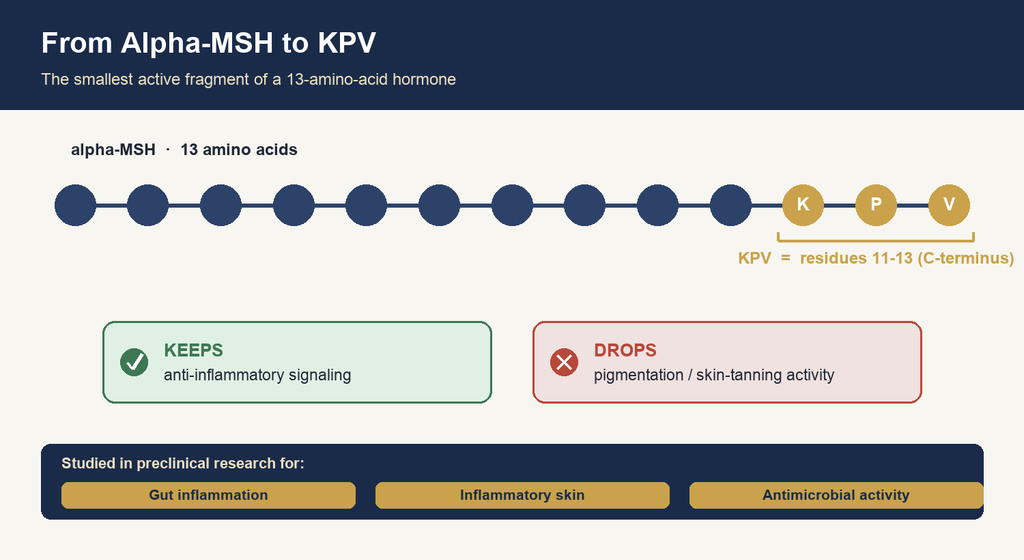
Getting the molecule this small brings practical advantages for research. A shorter peptide is cheaper to synthesize, easier to characterize, and simpler to keep stable. Published work has described KPV-type tripeptides as attractive candidates precisely because of these physicochemical and pharmacokinetic properties. Stripping the hormone down to its active core gives labs a focused probe for inflammatory signaling, which is why the tripeptide draws more study interest than the full-length hormone.
How KPV Signals in Preclinical Research
Here’s where KPV gets interesting, because it appears to break the usual rulebook for how a hormone fragment works. A majority of melanocortin peptides act by docking onto a receptor on the cell surface, but KPV seems to skip that step.
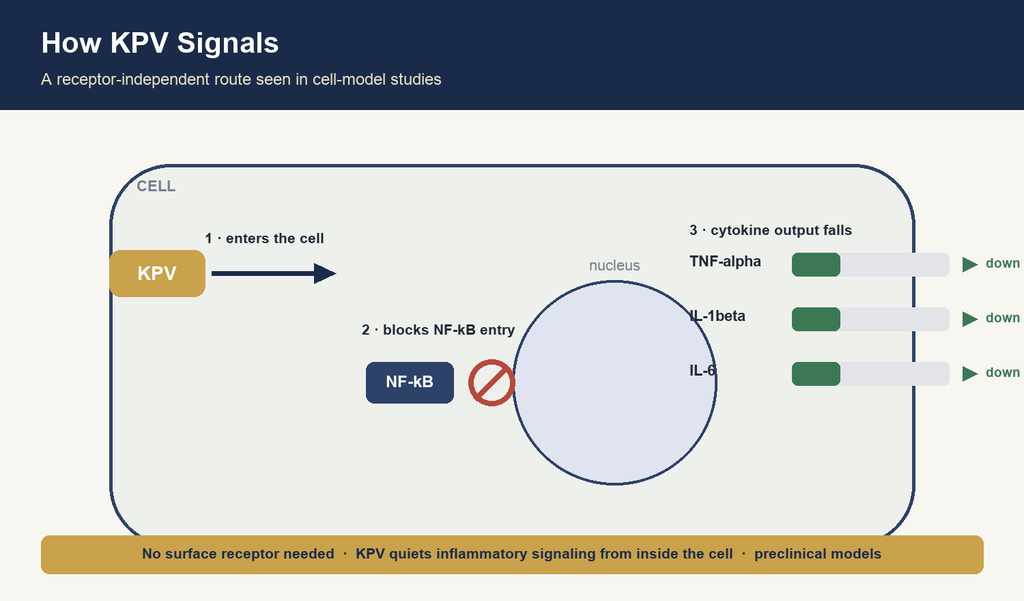
- In a foundational 2003 study, Getting and colleagues found that KPV’s anti-inflammatory effect is clearly different from that of the core alpha-MSH peptides, and that KPV is unlikely to work through melanocortin receptors, acting instead through inhibition of interleukin-1beta (IL-1beta) functions.
- Later work built on this receptor-independent picture. A review of alpha-MSH and its fragments describes how the peptide can enter the cell and directly dampen inflammatory signaling, reducing NF-kappaB and MAP-kinase activity and lowering the output of pro-inflammatory cytokines such as TNF-alpha, IL-1beta, and IL-6.
The takeaway for a researcher is that KPV is studied as an intracellular signaling modulator, one that quiets a cell’s inflammatory response from the inside. That mechanism, drawn from cell and tissue models, is what most current KPV research is built around.
What Researchers Study KPV For
KPV shows up in a few distinct research areas, and all of them trace back to that anti-inflammatory signaling. The evidence base sits at the preclinical stage, which means cell cultures and animal models, with human data still very limited.
- Gut inflammation models- KPV has been tested in murine models of inflammatory bowel disease, including DSS-induced colitis and transfer colitis, as Kannengiesser and colleagues reported in 2008. Intestinal work is one of the most active corners of KPV research.
- Inflammatory pathway studies- Beyond the gut, labs use KPV as a probe for NF-kappaB and cytokine-driven inflammation in cell models generally.
- Skin-inflammation models- The same NF-kB pathway signaling has been studied in skin-cell inflammation models, the area named in the 2026 FDA discussion.
- Antimicrobial activity- The same review that mapped its anti-inflammatory action also noted that alpha-MSH and its C-terminal KPV sequence show activity against microbes including Candida albicans, E. coli, and Staphylococcus aureus, opening a second line of study.
None of this translates to established human uses, and that gap between promising lab signals and proven outcomes is exactly why KPV remains a research compound.
KPV in Research Blends
In practice, labs often encounter KPV inside a combination product. It appears in a BPC-157 and KPV blend, pairing its anti-inflammatory signaling with a peptide studied for tissue-repair pathways, and in the broader KLOW research kit alongside TB-500 and GHK-Cu. These blends are supplied strictly for laboratory research, and each comes with batch-level documentation so the identity and purity of every component can be checked before any work begins.
Why KPV Is in the News: Regulatory Status in 2026
KPV’s profile jumped in 2026 because of a specific regulatory moment. On July 23 and 24, 2026, the FDA’s Pharmacy Compounding Advisory Committee (PCAC) met to evaluate several bulk drug substances, and the panel voted in favor of including KPV on the Section 503A Bulks List for certain uses tied to wound healing and inflammatory conditions.
That vote matters, and it also needs context. A PCAC recommendation is advisory, so it guides the FDA without binding it, and final policy and safety review remain ongoing. KPV is not FDA-approved for any use, and its compounding status has shifted more than once during the year.
This is one of seven peptides that drew regulatory attention in the FDA’s July 2026 review, and the situation is still developing, so the practical stance for a lab is to treat KPV as research-use-only and follow the rulemaking as it unfolds.
How KPV Quality Is Verified
For a tripeptide this small, confirming what’s in the vial is straightforward in principle and essential in practice. Two lab tests carry most of the weight.
- Mass spectrometry checks identity by weighing the molecule and matching it to KPV’s expected mass
- High-performance liquid chromatography measures how pure the sample is.
- Together they answer the two questions that’s most important: is this the right molecule, and how much of the vial is actually it?
The purity figure deserves a close read, since the difference between 98% and 99% reflects how much of the sample is something other than KPV. Both results are present on a Certificate of Analysis, and learning how to read a peptide COA line by line turns a purity claim into something you can actually verify against your batch.
We put a batch-specific COA behind every vial we supply, backed by a full multi-test panel that also covers safety measures a purity number alone won’t show.
What to Look For When Sourcing KPV
When you’re comparing KPV suppliers for research, a short checklist separates the credible from the questionable:
- A batch-specific COA you can match to your vial’s lot number.
- An HPLC purity result with the supporting chromatogram shown.
- A mass-spec identity confirmation matching KPV’s expected mass.
- Independent third-party testing, with the lab named on the report.
- Clear research-use-only labeling and honest regulatory language.
A supplier that hands over all five is one whose numbers you can trust. Anything vaguer deserves scrutiny before it reaches your bench.
Frequently Asked Questions
What is KPV peptide?
KPV is a tripeptide of lysine, proline, and valine, corresponding to the last three amino acids of alpha-MSH. In preclinical research it’s studied for anti-inflammatory signaling. It is a research-use-only compound and is not approved for human or veterinary use.
How does KPV work?
Published cell-model studies suggest KPV works without binding melanocortin receptors. It appears to enter the cell and dampen inflammatory signaling directly, lowering NF-kappaB and MAP-kinase activity and reducing pro-inflammatory cytokine output. This mechanism is drawn from laboratory and animal research.
Is KPV FDA approved?
No, KPV is not approved by the FDA for any use. In July 2026, an FDA advisory committee recommended it for the Section 503A compounding Bulks List for certain uses, but that recommendation is advisory and final policy review is still ongoing.
What is the difference between KPV and alpha-MSH?
Alpha-MSH is a 13-amino-acid hormone with several activities, including pigmentation. KPV is just its C-terminal three residues. That fragment retains the anti-inflammatory signaling studied in the lab while leaving out the pigment-related activity of the full hormone.
How is KPV different from BPC-157?
They’re studied for different pathways. KPV research centers on anti-inflammatory cytokine signaling, while BPC-157 work focuses on tissue-repair pathways. The two are sometimes combined in research blends so labs can study the pathways side by side.
Is there human safety data on KPV?
No. KPV is a research-use-only compound. Published data comes from cell cultures and animal models.
How do I know a KPV sample is genuine?
Check the Certificate of Analysis. A real one shows an HPLC purity figure with its chromatogram, a mass-spec result confirming identity, and third-party testing tied to your batch number. Documentation is what separates a verified sample from a claim.
The Bottom Line
KPV is a small peptide with an outsized research profile: three amino acids borrowed from alpha-MSH that keep the hormone’s anti-inflammatory signaling while dropping its pigmentary side. The lab evidence is genuinely interesting and still preclinical, the 2026 FDA recommendation is meaningful yet non-binding, and the compound stays research-use-only while the rules settle. If you’re sourcing it for that work, let the COA do the talking, since a verified batch is the only kind worth putting to the test.
Research use only. Peptides referenced are for in-vitro laboratory research only, not for human or veterinary use, diagnosis, treatment, or consumption. The claims made on this page have not been assessed by the US Food and Drug Administration.
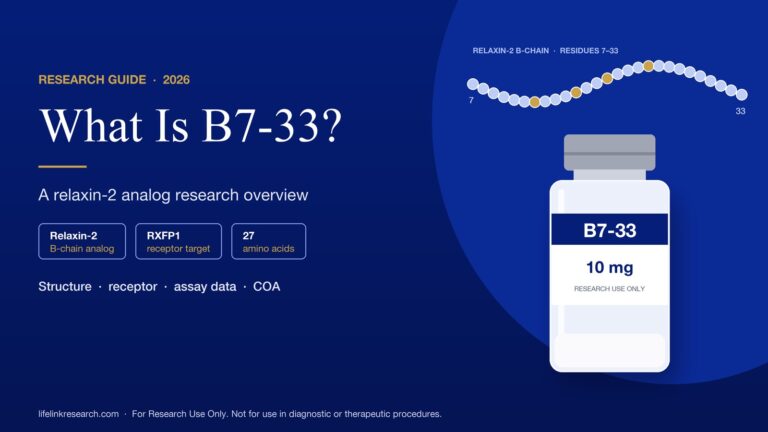
What Is B7-33? Relaxin-2 Analog Research Overview (2026)
Quick Answer B7-33 is a synthetic single-chain peptide built from part of the B chain of human relaxin-2, and it binds the…
Read article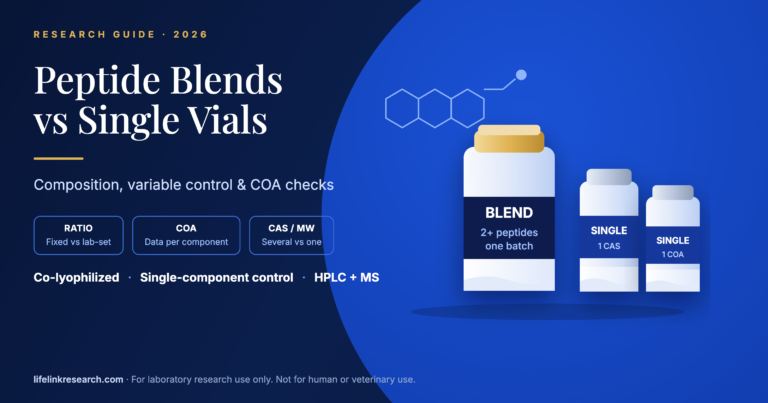
Peptide Blends vs Single Vials: How to Choose for Research (2026)
For Research Use Only. Not for use in diagnostic or therapeutic procedures. Choosing between peptide blends vs single peptides comes down to…
Read article
What Is SLU-PP-332? Structure, Research Use & US Supply
Quick Answer SLU-PP-332 is a synthetic small-molecule agonist of the estrogen-related receptors ERRŒ±, ERRŒ≤ and ERRŒ≥ (CAS 303760-60-3, PubChem CID 5338394). It…
Read articleResearch-grade peptides
99%+ purity. Verified every batch.
Identity and purity tested on every batch by third-party labs, Janoshik Analytical and US-based laboratories. Shipped same day from California.
Shop all peptides