
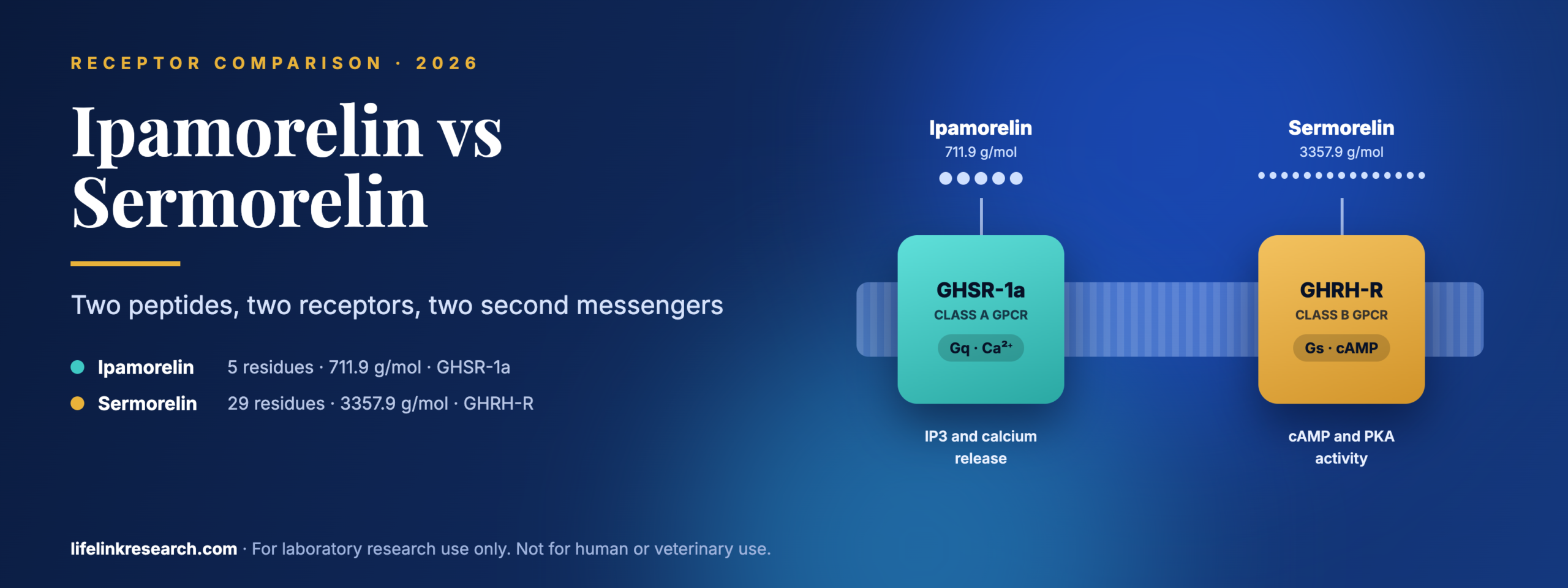
A Novo Nordisk group in 1998 settled which receptor Ipamorelin works through by blocking it. They applied a GHRH antagonist and the compound’s readout held; they applied a GHRP antagonist, and it disappeared. That single experiment placed Ipamorelin on a different receptor from Sermorelin, and it is the distinction most comparisons of Ipamorelin vs Sermorelin assert without ever citing the assay.
The two peptides sit upstream of the same pituitary output, yet they reach it through separate receptors, separate G proteins, and separate second messengers. This page compares identity, molecular targets, and assay design only.
Quick Answer
Sermorelin is GHRH(1-29)-NH2, a 29-amino-acid agonist of the GHRH receptor (class B GPCR, cAMP signaling). Ipamorelin is a synthetic pentapeptide agonist of the ghrelin receptor GHSR-1a (class A GPCR, Gq/calcium signaling). Most of the comparison data come from receptor and pituitary-cell assays.
Ipamorelin vs Sermorelin at a glance
Quick answer: Sermorelin reproduces the first 29 residues of human GHRH and binds the GHRH receptor. Ipamorelin is five residues long, two of them non-natural, and binds GHSR-1a. The size difference is roughly 4.7-fold, and the receptor classes differ, so the two cannot substitute for one another in a binding assay.
Chemical values below were read from PubChem on October 25, 2026. Catalog figures come from Life Link Research on the same date.
| Field | Ipamorelin | Sermorelin |
| Full name | Ipamorelin (NNC 26-0161) | Sermorelin, GHRH(1-29)-NH2 |
| Sequence | Aib-His-D-2-Nal-D-Phe-Lys-NH2 | YADAIFTNSYRKVLGQLSARKLLQDIMSR-NH2 |
| Length | 5 residues (pentapeptide) | 29 residues |
| Molecular formula | C38H49N9O5 | C149H246N44O42S |
| Molecular weight | 711.9 g/mol (PubChem CID 9831659) | 3357.9 g/mol (PubChem CID 16132413) |
| CAS number | 170851-70-4 | 86168-78-7 |
| Origin | Synthetic, from a secretagogue chemistry program | N-terminal 1-29 fragment of human GHRH, amidated |
| Receptor | GHSR-1a (ghrelin receptor) | GHRH receptor |
| Receptor class and signaling | Class A GPCR, Gq, IP3 and calcium | Class B GPCR, Gs, cAMP and PKA |
| Selectivity data | Antagonist profiling in rat pituitary cells and animal models (Raun 1998) | Defined by its parent hormone’s receptor |
| Main assays | Radioligand binding, calcium flux, pituitary-cell readouts | cAMP accumulation, pituitary-cell readouts, DPP-IV stability |
| Study types | In vitro and animal | In vitro and animal |
| FDA status | Not approved; listed in Category 2 of the 503B bulks review | Not approved as marketed today; Geref discontinued |
| Life Link format | Ipamorelin 10mg, lyophilized powder, $67, 44 in stock | Not stocked |
The Sermorelin vs Ipamorelin difference that drives everything downstream shows up in two rows of that table. The receptor-class row decides which second-messenger assay reads out at all, and the length row decides how exposed each chain is to peptidases.
What is Sermorelin?
Quick answer: Sermorelin is the first 29 residues of human growth-hormone-releasing hormone with an amidated C-terminus, written GHRH(1-29)-NH2. PubChem lists C149H246N44O42S at 3357.9 g/mol, CAS 86168-78-7. It acts at the GHRH receptor, a class B GPCR that couples to Gs and raises cAMP.
Sermorelin is the shortened version of a hormone the body already makes, which means its pharmacology was mapped before the fragment itself existed as a research tool.
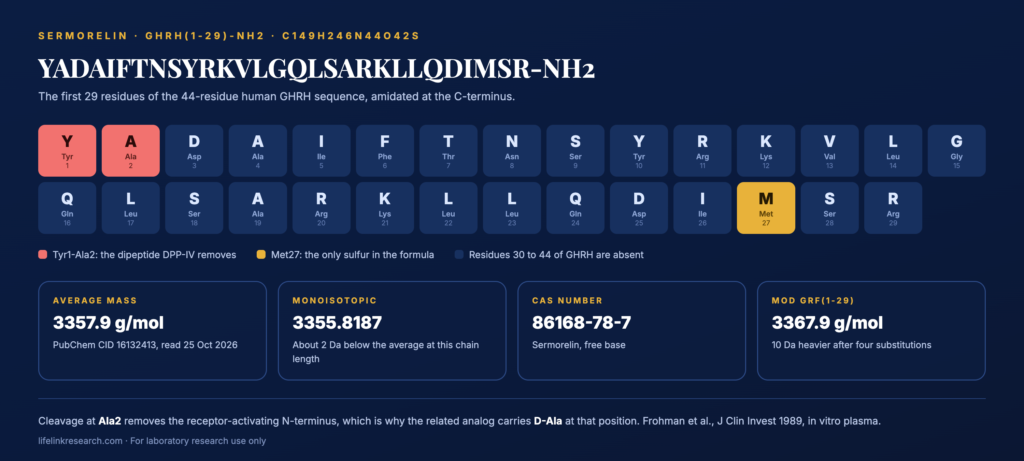
Sermorelin GHRH(1-29) amino acid sequence
Origin
Human GHRH is 44 residues long. Sermorelin reproduces residues 1 to 29 and caps the chain with an amide. The reason that fragment works is positional: the receptor-activating information in GHRH is concentrated in the N-terminal region, so truncating the C-terminal 15 residues removes bulk without removing the part the receptor reads. The amide cap replaces the charged carboxyl that truncation would otherwise leave exposed.
Chemical identity
| Sermorelin identity field | Value |
| Sequence, single-letter | YADAIFTNSYRKVLGQLSARKLLQDIMSR-NH2 |
| Length | 29 residues, amidated C-terminus |
| Average mass | 3357.9 g/mol |
| Monoisotopic mass | 3355.8187 |
| Sulfur-containing residue | Met27, the only S in the formula |
| CAS | 86168-78-7 |
That lone methionine at position 27 is more than a formula detail. It is an oxidation-sensitive residue, and it is also one of the four positions that structurally related analogs change, which the CJC-1295 section below returns to.
What is Ipamorelin?
Quick answer: Five residues, two of them non-natural: Aib-His-D-2-Nal-D-Phe-Lys-NH2 is Ipamorelin, formula C38H49N9O5, 711.9 g/mol, CAS 170851-70-4. Its target is GHSR-1a, the ghrelin receptor, which it reaches with no structural resemblance to ghrelin at all. Our Ipamorelin structure and GHSR guide covers it in full.
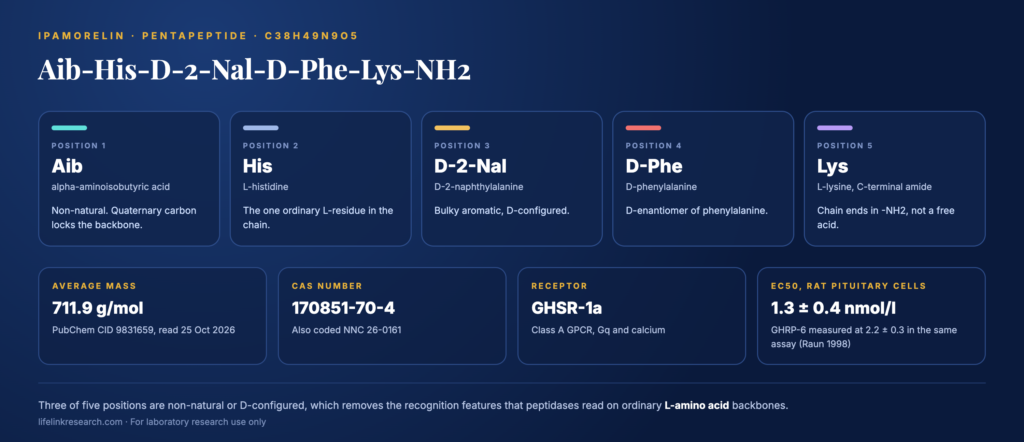
Ipamorelin (Aib-His-D-2-Nal-D-Phe-Lys-NH2) chemical structure
Origin
Raun and colleagues at Novo Nordisk described Ipamorelin in European Journal of Endocrinology in 1998 (PMID 9849822). It emerged from a series of compounds built by removing the central Ala-Trp dipeptide from GHRP-1, which is why it reads as a chemistry-program output and not as a natural fragment.
Chemical identity
Two of its five positions are non-natural, and that is deliberate design, not incidental chemistry.
- Aib (alpha-aminoisobutyric acid), position 1: a doubly methylated alanine. Its quaternary carbon constrains the backbone and removes the usual recognition features at the N-terminus.
- D-2-Nal, position 3: D-configured 2-naphthylalanine, a bulky aromatic residue not found in natural proteins.
- D-Phe, position 4: the D-enantiomer of phenylalanine.
- C-terminal amide: the chain ends in -NH2 instead of a free acid.
GHRH receptor vs ghrelin receptor: how do the targets differ?
Quick answer: The GHRH receptor is a class B GPCR that couples to Gs and raises cAMP through adenylyl cyclase. GHSR-1a is a class A GPCR that couples to Gq, activating phospholipase C to generate IP3 and release intracellular calcium. Different receptor families, different G proteins, different second messengers, and different assay plates.
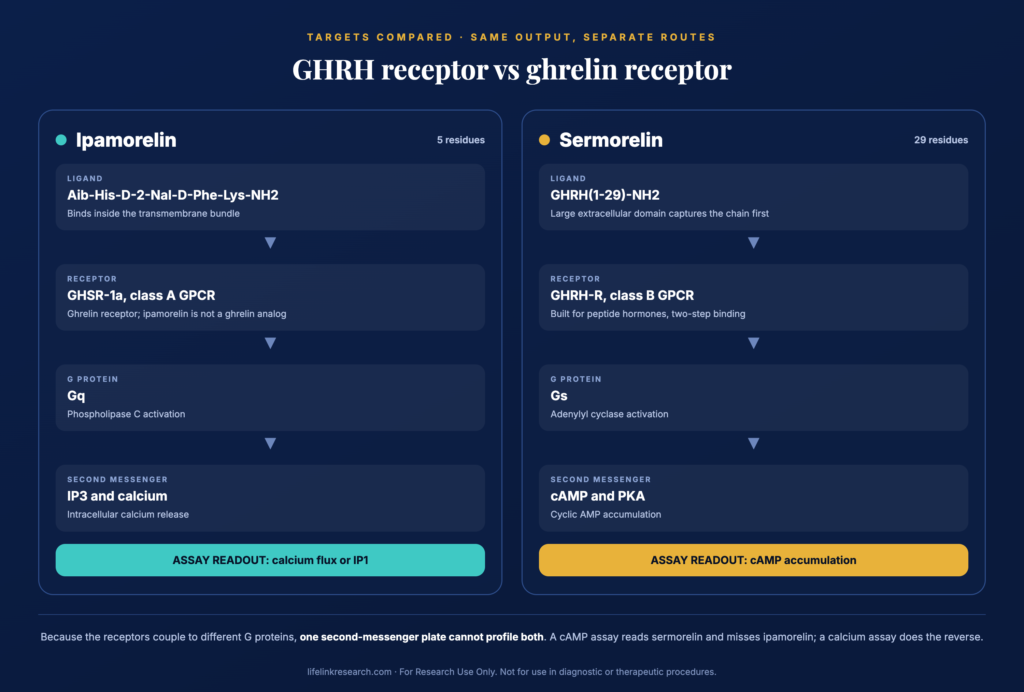
GHRH receptor and GHSR-1a signaling pathway comparison diagram
GHRH-R: class B GPCR, Gs, cAMP and PKA
Class B receptors are built for peptide hormones. They carry a large extracellular domain that captures the peptide’s C-terminal portion first, then lets the N-terminal residues engage the transmembrane core. That two-step geometry explains why a 29-residue fragment still activates the receptor while a five-residue peptide never could: there has to be enough chain to occupy both contact regions.
Downstream, the receptor couples to Gs, adenylyl cyclase produces cAMP and PKA activity follows. In practice that makes cAMP accumulation the standard readout for anything targeting GHRH-R.
GHSR-1a: class A GPCR, Gq, IP3 and calcium
GHSR-1a belongs to the much larger class A family, where the ligand binds within the transmembrane bundle itself, with no separate extracellular domain involved. A compact pocket of that kind can be filled by a well-shaped pentapeptide, which is why Ipamorelin’s size is not an obstacle.
Its canonical coupling is to Gq, running through phospholipase C to IP3 and intracellular calcium release, so calcium flux or IP1 accumulation is the usual readout. Work on agonist-specific coupling at this receptor (Neuroendocrinology, 2004, PMID 14755130) found that different agonists engage its intracellular signaling systems differently, an in vitro finding worth weighing when choosing which readout to measure.
One point deserves emphasis because secondary sources blur it: Ipamorelin is not a ghrelin analog by structure. Ghrelin is a 28-residue acylated peptide. Ipamorelin is five residues with no acyl group and no sequence relationship to it. Shared receptor, unrelated molecules.
Selectivity data
The 1998 paper established Ipamorelin’s receptor assignment through pharmacology rather than inference. In primary rat pituitary cells, Ipamorelin produced its readout with an EC50 of 1.3 ± 0.4 nmol/l, close to GHRP-6 at 2.2 ± 0.3 nmol/l. Antagonist profiling in that same in vitro system then showed the readout was blocked by a GHRP antagonist and not by a GHRH antagonist, which assigns the activity to the GHRP-type receptor now known as GHSR-1a.
Selectivity was examined further in anesthetized rat and conscious swine models, where the paper compared Ipamorelin against other secretagogues across additional pituitary hormone readouts. Those are animal-model findings, reported here as study design only, with no outcomes attached.
How stable are Ipamorelin and Sermorelin in assay conditions?
Quick answer: Sermorelin carries the GHRH N-terminal sequence, which dipeptidyl peptidase IV cleaves after the Ala at position 2. Ipamorelin’s non-natural residues (Aib at position 1, D-amino acids at 3 and 4) remove the recognition features peptidases rely on, so it resists the same enzymatic routes.
Frohman and colleagues (J Clin Invest, 1989, PMID 2565342) identified dipeptidylpeptidase IV and trypsin-like activity as the enzymatic routes that degrade human GHRH in plasma in vitro. The DPP-IV step removes the first two residues, Tyr-Ala, and because the N-terminal region carries the receptor-activating information, the truncated product is no longer the same ligand.
That one cleavage site explains a great deal of the chemistry that followed:
- Sermorelin keeps native Ala at position 2, so it keeps the DPP-IV recognition motif intact.
- Structurally related analogs substitute D-Ala at position 2, which DPP-IV does not accept, which is the single most consequential change in the group.
- Ipamorelin has no DPP-IV site to protect, because Aib at position 1 and D-residues at 3 and 4 are not substrates for the proteases that read natural L-amino acid backbones.
These are in vitro enzymatic observations, not statements about duration in any organism.
Where do CJC-1295 (no DAC) and Mod GRF(1-29) fit?
Quick answer: Mod GRF(1-29), also sold as CJC-1295 no DAC, is GHRH(1-29) carrying four substitutions: D-Ala at position 2, Gln at 8, Ala at 15 and Leu at 27. It is structurally related to Sermorelin, not equivalent to it. The DAC version adds a linker that the no-DAC form does not have.
Reading the registry sequence for CAS 863288-34-0 (PubChem CID 56841945) against native GHRH(1-29) confirms all four positions:
| Position | Sermorelin, GHRH(1-29) | Mod GRF(1-29) | What the change does |
| 2 | Ala | D-Ala | Removes the DPP-IV cleavage motif |
| 8 | Asn | Gln | Replaces a deamidation-prone residue |
| 15 | Gly | Ala | Adds a side chain at a flexible position |
| 27 | Met | Leu | Removes the only oxidation-sensitive sulfur |
Three of those four changes target chemical liabilities rather than receptor contact, which is why the analog is described as structurally related: same receptor family, same 29-residue length, different stability profile. The mass difference follows from the substitutions, 3367.9 g/mol against Sermorelin’s 3357.9.
Life Link stocks CJC-1295 No DAC 5mg at $38, which is the closest available material to Sermorelin for GHRH-receptor work, since Sermorelin itself is not in the catalog. For the pairing comparison, see CJC-1295 vs Ipamorelin.
What assays and models are used to study each?
Quick answer: Radioligand binding plus cAMP accumulation profiles for GHRH-receptor compounds. Radioligand binding plus calcium or IP1 profiles for GHSR-1a compounds. Primary pituitary cells carry both receptors, so hormone release there serves as a shared in vitro readout, and LC-MS identity confirmation precedes all of it.
| Assay | Ipamorelin | Sermorelin | Study type |
| Radioligand binding | GHSR-1a membranes | GHRH-R membranes | In vitro |
| cAMP accumulation | Not the primary readout | Primary readout (Gs-coupled) | In vitro |
| Calcium flux or IP1 | Primary readout (Gq-coupled) | Not the primary readout | In vitro |
| GH release from primary pituitary cells | Reported, EC50 1.3 nmol/l (Raun 1998) | Reported for GHRH-R agonists | In vitro readout |
| DPP-IV stability | No cleavage motif present | Cleaved at Ala2 | In vitro, plasma |
| LC-MS identity | Expected mass near 711.9 | Expected mass near 3357.9 | Analytical |
Tracer choice separates the two workflows as well. A GHSR-1a binding experiment runs against a labeled secretagogue ligand, while a GHRH-receptor experiment runs against a labeled GHRH-type peptide, so the two assays share no reference compound, and their numbers are not comparable across plates. Identity confirmation comes first in both cases, because a binding curve generated from mislabeled material is simply a curve for whatever was actually in the vial.
Two design points follow. Because the receptors couple to different G proteins, a single second-messenger plate cannot profile both compounds: a cAMP assay will read Sermorelin and miss Ipamorelin, and a calcium assay does the reverse. And because primary pituitary cells express both receptors, that system is the one place the two converge, which makes antagonist controls the only way to attribute a readout to one receptor or the other, exactly as the 1998 work did.
Can Ipamorelin and Sermorelin be studied together?
Quick answer: Co-incubation is feasible in primary pituitary cells, which carry both receptors, and the published secretagogue literature has examined GHRH-type and GHRP-type compounds in the same preparation. The design requirement is antagonist controls, since two receptors converge on one measurable output.
Precedent for the design already exists in the founding literature. The 1998 antagonist profiling was itself a co-incubation experiment: Ipamorelin was applied to primary rat pituitary cells alongside a GHRH antagonist in one condition, and a GHRP antagonist in another, and the contrast between those two conditions is what assigned the receptor. Published work pairing a GHRH-type compound with a GHRP-type compound in the same preparation follows the same logic.
Beyond the combination well itself, a dual-receptor design calls for single-compound conditions matched on plate and passage, and a receptor-selective antagonist arm covering each pathway. Skip the antagonist arms and a combined readout can be attributed to neither receptor.
Two further points come from the chemistry above. The compounds differ 4.7-fold in mass, so equal-mass preparation and equal-molar preparation describe different experiments, and the protocol should state which. And since the two readouts run through different second messengers, a combination study usually needs two measurement systems in parallel. Life Link supplies the composition pairing as CJC-1295 + Ipamorelin 5/5mg at $72, which pairs the Ipamorelin pentapeptide with the GHRH-type analog, since Sermorelin itself is not stocked.
What is the FDA status of Ipamorelin and Sermorelin?
Quick answer: Neither compound is an FDA-approved product today. Sermorelin acetate was approved as Geref under NDA 019863 on December 28, 1990, and as Geref Diagnostic under NDA 020443 on September 26, 1997; both are recorded as Discontinued. Ipamorelin acetate appears in Category 2 of the FDA’s 503B bulk substances review.
The Sermorelin approvals and their discontinued marketing status come from the FDA’s own Drugs@FDA records, with EMD Serono as the listed sponsor. That is a record of marketing history only.
For Ipamorelin, the FDA’s page on bulk drug substances that may present significant safety risks lists Ipamorelin acetate in Category 2, added September 29, 2023, under the 503B outsourcing-facility review. FDA stamps that page as current to April 22, 2026.
Three points keep that status accurate:
- Category 2 here concerns compounded preparations made by outsourcing facilities. It is a separate question from the supply of research reagents to laboratories.
- A discontinued approval is not a withdrawal for cause, and this page makes no statement about why marketing ended.
- Neither compound is approved for any use as of October 25, 2026.
Identity and quality checks for research supply
A 4.7-fold mass difference makes these two easy to separate analytically. The documentation still has to be read in a particular order.
- Purity: purity by HPLC, so see the batch result for the figure that applies to the vial you hold, and check the batch number on the report against the label.
- LC-MS identity: expected values are near 711.9 for Ipamorelin and near 3357.9 for Sermorelin. Mod GRF(1-29) lands at 3367.9, only 10 daltons from Sermorelin, which is the one pair on this page where an identity trace has to be read carefully. Walking a certificate line by line is covered in how to read a peptide COA.
- Form and storage: lyophilized powder, listed at -20°C with protection from light.
- Solubility: described as soluble in water or DMSO for assay preparation.
Mass convention needs stating at this size range too. For the 711.9 g/mol pentapeptide, the average and monoisotopic figures sit about 0.5 Da apart, so either one identifies the compound unambiguously. For a 3.3 kDa chain like Sermorelin the separation widens to roughly 2 Da, and the isotope envelope no longer peaks at the monoisotopic mass, so a report quoting one convention against a reference using the other can look like a failure when the material is correct.
For Sermorelin specifically, the Met27 residue makes oxidation a sensible thing to watch on an identity trace, since a +16 increase on a single methionine is the classic signature.
FAQs
What is the difference between Ipamorelin and Sermorelin?
Ipamorelin is a five-residue synthetic peptide that binds GHSR-1a, a class A GPCR signaling through Gq and calcium. Sermorelin, the 29-residue GHRH(1-29)-NH2 fragment, binds a class B GPCR, the GHRH receptor, which signals through Gs and cAMP. Different receptors, different second messengers.
Do Ipamorelin and Sermorelin act on the same receptor?
No. Ipamorelin acts at GHSR-1a, the ghrelin receptor, and Sermorelin at the GHRH receptor. Raun and colleagues established Ipamorelin’s assignment in 1998 using antagonist profiling in rat pituitary cells: a GHRP antagonist blocked the readout, while a GHRH antagonist did not.
Is Sermorelin a GHRH analog?
Yes. Sermorelin is GHRH(1-29)-NH2, meaning it reproduces the first 29 residues of the 44-residue human GHRH sequence with an amidated C-terminus. Those residues carry the receptor-activating region, which is why the shortened chain still binds the GHRH receptor.
What is the difference between GH and GHRH?
They are different molecules at different points of the same axis. Growth hormone is a 191-residue protein. GHRH is a 44-residue peptide that binds its own receptor on pituitary cells. Sermorelin corresponds to GHRH’s first 29 residues, not to growth hormone.
Is CJC-1295 the same as Sermorelin?
No. CJC-1295 no DAC, also called Mod GRF(1-29), is GHRH(1-29) with four substitutions: D-Ala2, Gln8, Ala15 and Leu27, confirmed against PubChem’s registry sequence. The DAC version also carries a linker. Sermorelin has none of these changes.
What receptor does Ipamorelin bind?
Its target is GHSR-1a, known both as the ghrelin receptor and as growth hormone secretagogue receptor type 1a. In primary rat pituitary cells its EC50 was 1.3 ± 0.4 nmol/l, comparable to GHRP-6, with selectivity confirmed by antagonist profiling in that in vitro system and examined further in animal models.
Is Sermorelin FDA approved?
Not as a marketed product today. Sermorelin acetate was approved as Geref (NDA 019863) on December 28, 1990, and as Geref Diagnostic (NDA 020443) on September 26, 1997. Drugs@FDA records both as Discontinued, checked October 25, 2026.
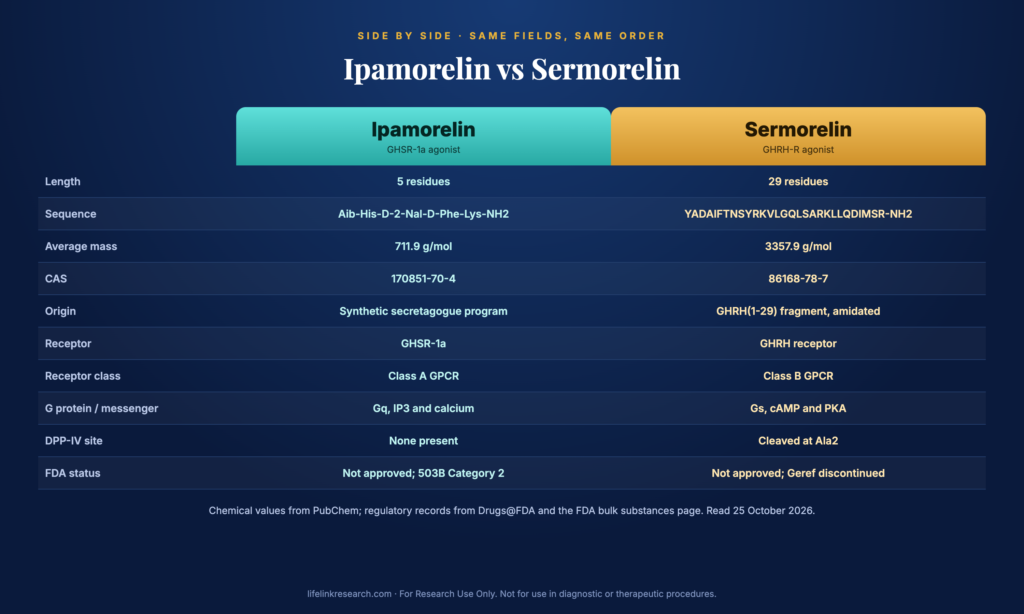
Ipamorelin vs Sermorelin comparison table: receptor, class, signaling, sequence and mass
Closing notes
For Research Use Only. Not for use in diagnostic or therapeutic procedures.
Materials described here are laboratory reagents supplied to qualified researchers. The full research-use policy is set out in the Terms and Conditions.
Author: Trevor Blackwell. Scientific reviewer: Danielle Reyes, PhD (receptor pharmacology). This page was last reviewed on October 25, 2026, the date every chemical value here was read from PubChem and every regulatory record from FDA sources.
References
- PubChem CID 9831659, Ipamorelin: https://pubchem.ncbi.nlm.nih.gov/compound/9831659
- PubChem CID 16132413, Sermorelin: https://pubchem.ncbi.nlm.nih.gov/compound/16132413
- PubChem CID 56841945, CAS 863288-34-0 registry sequence: https://pubchem.ncbi.nlm.nih.gov/compound/56841945
- Raun K et al., Eur J Endocrinol, 1998. PMID 9849822: https://pubmed.ncbi.nlm.nih.gov/9849822/
- Frohman LA et al., J Clin Invest, 1989. PMID 2565342: https://pubmed.ncbi.nlm.nih.gov/2565342/
- Neuroendocrinology, 2004, GHSR-1a agonist-specific coupling. PMID 14755130: https://pubmed.ncbi.nlm.nih.gov/14755130/
- Drugs@FDA, NDA 019863 (Geref): https://www.accessdata.fda.gov/scripts/cder/daf/index.cfm?event=overview.process&ApplNo=019863
- FDA, bulk drug substances that may present significant safety risks: https://www.fda.gov/drugs/human-drug-compounding/certain-bulk-drug-substances-use-compounding-may-present-significant-safety-risks
KPV vs BPC-157: Molecular Identity, Pathways and Research Compared
A PubMed search run in late October returns 230 records for BPC-157 and 47 for KPV. Exactly one record names both, and…
Read article
What Is MOTS-c? Structure, Research Use & US Supply
Quick Answer MOTS-c is a 16-amino-acid peptide coded within a short open reading frame of the mitochondrial 12S rRNA gene (MT-RNR1). It…
Read article
What Is DSIP? Structure, Research Use & US Supply
DSIP is a synthetic nine-residue peptide, WAGGDASGE, listed under the international name Emideltide. On July 24, 2026, it drew the narrowest vote…
Read articleResearch-grade peptides
99%+ purity. Verified every batch.
Identity and purity tested on every batch by third-party labs, Janoshik Analytical and US-based laboratories. Shipped same day from California.
Shop all peptides