Order within --h --m for same day shipping Mon-Fri Free shipping on orders $250+ Free Bacteriostatic Water 30ml with $500+ Purchase Order within --h --m for same day shipping Mon-Fri Free shipping on orders $250+ Free Bacteriostatic Water 30ml with $500+ Purchase Order within --h --m for same day shipping Mon-Fri Free shipping on orders $250+ Free Bacteriostatic Water 30ml with $500+ Purchase Order within --h --m for same day shipping Mon-Fri Free shipping on orders $250+ Free Bacteriostatic Water 30ml with $500+ Purchase
[researchers_badge]

Product Usage

For Research Use Only. Not for Human Consumption. Not for use in diagnostic or therapeutic procedures. This product has not been evaluated by the FDA for safety or efficacy. Sold for laboratory research purposes only.

About

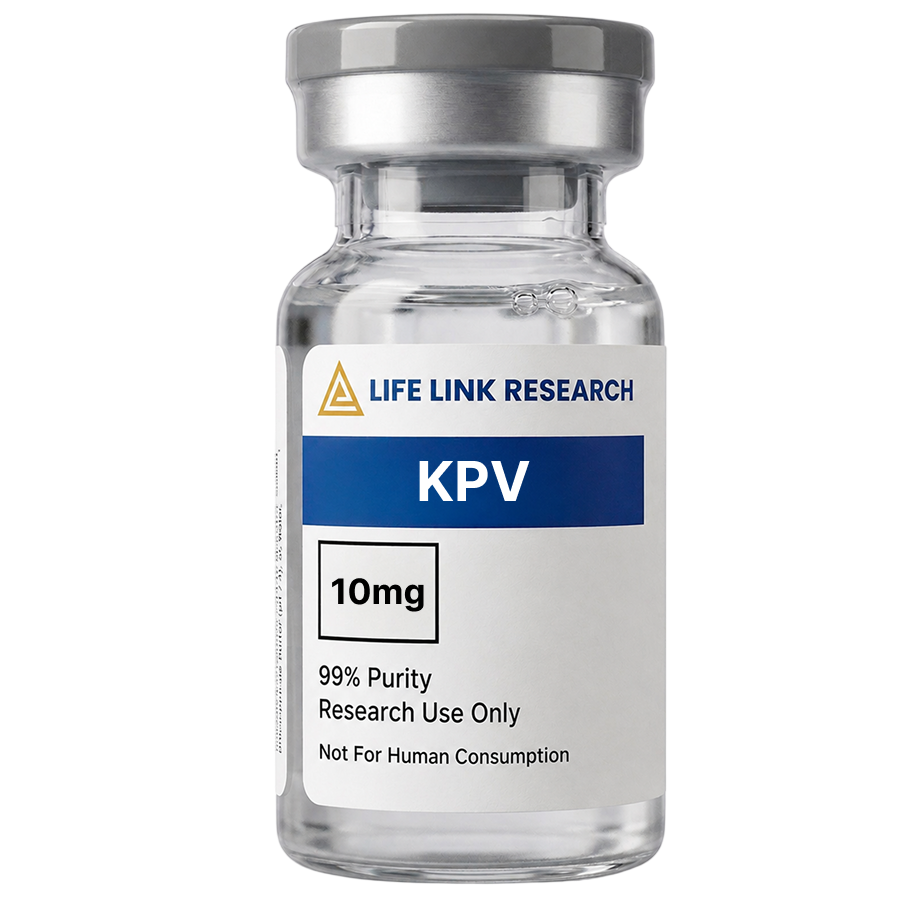
KPV 10mg

CAS: 67727-97-3 · MW: 342.4 Da · Purity: ≥99% by reverse-phase HPLC · Format: 10 mg powder · Identity: ESI-MS confirmed

KPV is one of the smallest signaling peptides in research, just three amino acids. It is the tail end of alpha-melanocyte-stimulating hormone (alpha-MSH), the fragment that carries much of the hormone’s anti-inflammatory signaling while leaving its pigment-related activity behind. Each vial holds 10 mg of freeze-dried powder, supplied for anti-inflammatory and antimicrobial research.

Structure & Identity

KPV is a tripeptide, Lys-Pro-Val, corresponding to residues 11 to 13 at the C-terminal end of alpha-MSH. Despite its small size, it retains a meaningful slice of the parent hormone’s signaling. Because it is only three amino acids, it is simple to synthesize and characterize, which is part of why it is a convenient research probe.

Research Background

KPV research centers on how a very small peptide can quiet inflammatory signaling, plus a separate antimicrobial thread.

  • Alpha-MSH fragment. KPV is the C-terminal tripeptide of alpha-MSH, carrying anti-inflammatory signaling without the pigment activity [PMID: 12750433].
  • Distinct mechanism. Work dissected its anti-inflammatory effect as different from the core alpha-MSH peptides [PMID: 12750433].
  • Intestinal models. It has been studied in murine models of inflammatory bowel disease [PMID: 18092346].
  • Cellular uptake. PepT1-mediated uptake of KPV and its link to intestinal inflammation has been examined [PMID: 18061177].
  • Antimicrobial thread. Alpha-MSH and its C-terminal sequences have shown antimicrobial activity [PMID: 10670585].

These are research contexts, not approved uses. 

Specifications

Attribute Value
Chemical name KPV (Lys-Pro-Val), alpha-MSH(11-13)
Also Known As alpha-MSH(11-13)
Sequence Lys-Pro-Val
CAS number 67727-97-3
Molecular formula C16H30N4O4
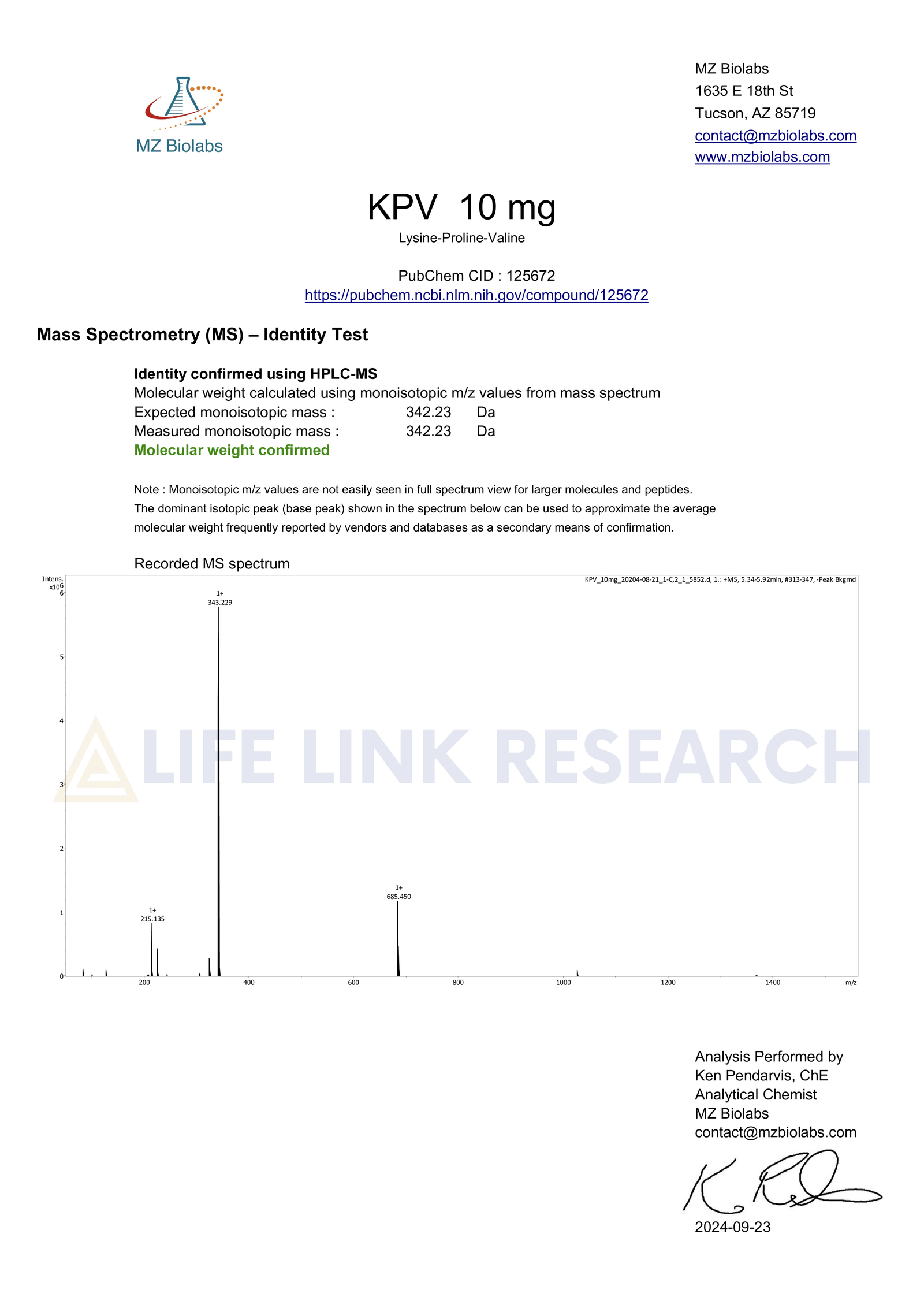
Molecular weight 342.4 g/mol
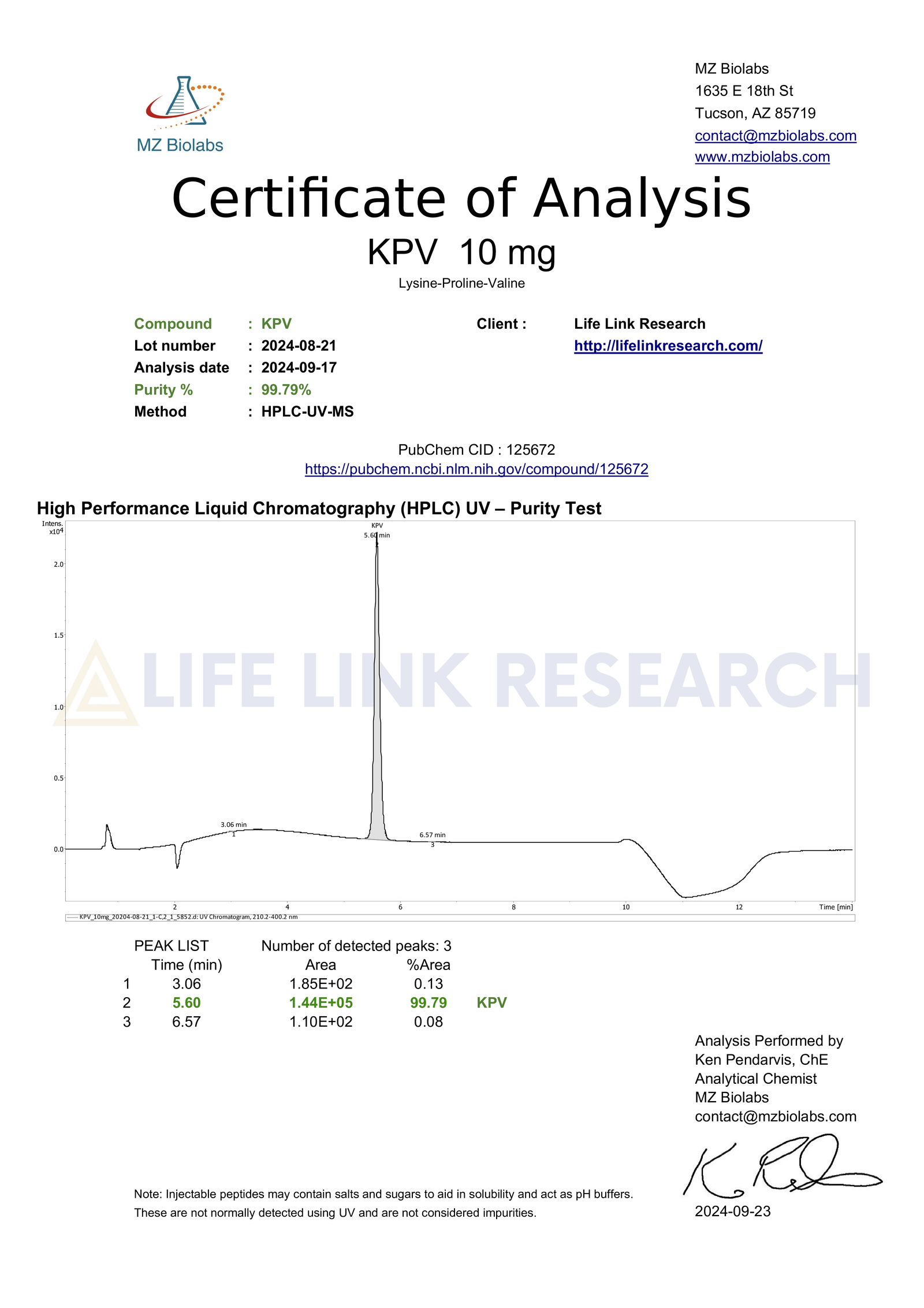
Purity ≥99% by reverse-phase HPLC
Length 3 amino acids (tripeptide)
Identity Confirmed by ESI mass spectrometry
Physical form Lyophilized powder
Appearance White to off-white solid
Quantity 10 mg per vial
Storage -20°C, protected from light
Solubility Soluble in bacteriostatic or sterile water
Classification Research use only


Storage & Handling

Store the sealed vial frozen at -20°C, away from light, until use. Once reconstituted, keep the solution at 2-8°C and use it within about two weeks. KPV is a small, relatively stable peptide, but warming the vial to room temperature before opening and avoiding repeated freeze-thaw cycles are still good practice.

Storage and Handling Guide

Quality Assurance

KPV is produced to research-grade manufacturing standards and verified by an independent lab before release. Purity comes from reverse-phase HPLC and identity from mass spectrometry, carried out by third-party laboratories such as Janoshik Analytical along with domestic US labs. A certificate of analysis is issued for each batch, so its purity and identity data belong to the vial you receive.

Quality & Testing

Frequently Asked Questions

What is KPV?

KPV is a synthetic tripeptide (Lys-Pro-Val) corresponding to the C-terminal end of alpha-MSH. It is studied in anti-inflammatory and antimicrobial research and is supplied for research use only.

Why is KPV interesting despite being so small?

Because a three-amino-acid fragment appears to keep much of alpha-MSH’s anti-inflammatory signaling while dropping the pigmentation activity of the full hormone. That focus is what makes it a useful research probe.

How does KPV relate to alpha-MSH?

KPV is residues 11 to 13 of alpha-MSH, its C-terminal tail. Researchers study it as the minimal fragment that carries the hormone’s anti-inflammatory signal.

What is KPV’s sequence and molecular weight?

Its sequence is Lys-Pro-Val, its formula is C16H30N4O4, and its molecular weight is about 342.4 g/mol, with CAS number 67727-97-3.

Is KPV FDA approved?

No, KPV is not FDA approved as a drug. In 2026 an FDA advisory committee recommended it for a compounding list, but that is not an approval. This material is a research-use-only reference peptide, not for human or veterinary use.

How is KPV different from BPC-157 or GHK-Cu?

They are separate peptides studied for different pathways. KPV research focuses on alpha-MSH-related anti-inflammatory signaling; BPC-157 on gastric-derived repair; GHK-Cu on copper-peptide biology.

How should KPV be stored?

Keep the powder frozen at -20°C and protected from light. Once reconstituted for research, store at 2-8°C and use within about two weeks.

How is this KPV verified?

It is tested to ≥99% purity by reverse-phase HPLC with mass-spec identity confirmation by an independent lab, and each batch has a published certificate of analysis.

References

  1. Dissection of the anti-inflammatory effect of the core and C-terminal (KPV) alpha-MSH peptides. 2003. PMID: 12750433.
  2. Melanocortin-derived tripeptide KPV has anti-inflammatory potential in murine models of inflammatory bowel disease. 2008. PMID: 18092346.
  3. PepT1-mediated tripeptide KPV uptake reduces intestinal inflammation. 2009. PMID: 18061177.

KPV 10mg

$97.00

Choose your quantity Save up to 20%
Quantity
Price / vial
Savings

28 in stock

In Stock
Purchase & earn 97 points.
Purity Guarantee: Every vial is backed by independent third-party domestic lab & Janoshik analytical verification.
Third-Party Tested
Identity + purity, every batch. Secondary testing on rotation.
Janoshik Analytical
3rd party domestic Labs Verified
Same-Day Shipping
Order by 2 PM PST, ships today
Ships from California
2 Day UPS Air
Accepted:
VISA AMERICANEXPRESS ACH
Buy 3 for $ each and save 5%
Buy 5 for $ each and save 10%
Buy 10 for $ each and save 20%
Buy 3 for $ each and save 5 %
Buy 5 for $ each and save 10 %
Buy 10 for $ each and save 20 %

Product Usage

For Research Use Only. Not for Human Consumption. Not for use in diagnostic or therapeutic procedures. This product has not been evaluated by the FDA for safety or efficacy. Sold for laboratory research purposes only.

About

KPV 10mg

CAS: 67727-97-3 · MW: 342.4 Da · Purity: ≥99% by reverse-phase HPLC · Format: 10 mg powder · Identity: ESI-MS confirmed

KPV is one of the smallest signaling peptides in research, just three amino acids. It is the tail end of alpha-melanocyte-stimulating hormone (alpha-MSH), the fragment that carries much of the hormone’s anti-inflammatory signaling while leaving its pigment-related activity behind. Each vial holds 10 mg of freeze-dried powder, supplied for anti-inflammatory and antimicrobial research.

Structure & Identity

KPV is a tripeptide, Lys-Pro-Val, corresponding to residues 11 to 13 at the C-terminal end of alpha-MSH. Despite its small size, it retains a meaningful slice of the parent hormone’s signaling. Because it is only three amino acids, it is simple to synthesize and characterize, which is part of why it is a convenient research probe.

Research Background

KPV research centers on how a very small peptide can quiet inflammatory signaling, plus a separate antimicrobial thread.

  • Alpha-MSH fragment. KPV is the C-terminal tripeptide of alpha-MSH, carrying anti-inflammatory signaling without the pigment activity [PMID: 12750433].
  • Distinct mechanism. Work dissected its anti-inflammatory effect as different from the core alpha-MSH peptides [PMID: 12750433].
  • Intestinal models. It has been studied in murine models of inflammatory bowel disease [PMID: 18092346].
  • Cellular uptake. PepT1-mediated uptake of KPV and its link to intestinal inflammation has been examined [PMID: 18061177].
  • Antimicrobial thread. Alpha-MSH and its C-terminal sequences have shown antimicrobial activity [PMID: 10670585].

These are research contexts, not approved uses. 

Specifications

Attribute Value
Chemical name KPV (Lys-Pro-Val), alpha-MSH(11-13)
Also Known As alpha-MSH(11-13)
Sequence Lys-Pro-Val
CAS number 67727-97-3
Molecular formula C16H30N4O4
Molecular weight 342.4 g/mol
Purity ≥99% by reverse-phase HPLC
Length 3 amino acids (tripeptide)
Identity Confirmed by ESI mass spectrometry
Physical form Lyophilized powder
Appearance White to off-white solid
Quantity 10 mg per vial
Storage -20°C, protected from light
Solubility Soluble in bacteriostatic or sterile water
Classification Research use only


Storage & Handling

Store the sealed vial frozen at -20°C, away from light, until use. Once reconstituted, keep the solution at 2-8°C and use it within about two weeks. KPV is a small, relatively stable peptide, but warming the vial to room temperature before opening and avoiding repeated freeze-thaw cycles are still good practice.

Storage and Handling Guide

Quality Assurance

KPV is produced to research-grade manufacturing standards and verified by an independent lab before release. Purity comes from reverse-phase HPLC and identity from mass spectrometry, carried out by third-party laboratories such as Janoshik Analytical along with domestic US labs. A certificate of analysis is issued for each batch, so its purity and identity data belong to the vial you receive.

Quality & Testing

Frequently Asked Questions

What is KPV?

KPV is a synthetic tripeptide (Lys-Pro-Val) corresponding to the C-terminal end of alpha-MSH. It is studied in anti-inflammatory and antimicrobial research and is supplied for research use only.

Why is KPV interesting despite being so small?

Because a three-amino-acid fragment appears to keep much of alpha-MSH’s anti-inflammatory signaling while dropping the pigmentation activity of the full hormone. That focus is what makes it a useful research probe.

How does KPV relate to alpha-MSH?

KPV is residues 11 to 13 of alpha-MSH, its C-terminal tail. Researchers study it as the minimal fragment that carries the hormone’s anti-inflammatory signal.

What is KPV’s sequence and molecular weight?

Its sequence is Lys-Pro-Val, its formula is C16H30N4O4, and its molecular weight is about 342.4 g/mol, with CAS number 67727-97-3.

Is KPV FDA approved?

No, KPV is not FDA approved as a drug. In 2026 an FDA advisory committee recommended it for a compounding list, but that is not an approval. This material is a research-use-only reference peptide, not for human or veterinary use.

How is KPV different from BPC-157 or GHK-Cu?

They are separate peptides studied for different pathways. KPV research focuses on alpha-MSH-related anti-inflammatory signaling; BPC-157 on gastric-derived repair; GHK-Cu on copper-peptide biology.

How should KPV be stored?

Keep the powder frozen at -20°C and protected from light. Once reconstituted for research, store at 2-8°C and use within about two weeks.

How is this KPV verified?

It is tested to ≥99% purity by reverse-phase HPLC with mass-spec identity confirmation by an independent lab, and each batch has a published certificate of analysis.

References

  1. Dissection of the anti-inflammatory effect of the core and C-terminal (KPV) alpha-MSH peptides. 2003. PMID: 12750433.
  2. Melanocortin-derived tripeptide KPV has anti-inflammatory potential in murine models of inflammatory bowel disease. 2008. PMID: 18092346.
  3. PepT1-mediated tripeptide KPV uptake reduces intestinal inflammation. 2009. PMID: 18061177.
Published Research Applications
PepT1-Mediated Colitis Mechanism (Landmark)
Oral KPV reduces intestinal inflammation via PepT1-mediated uptake (Gastroenterology 2008)
Targeted Oral Delivery / Colitis
Hyaluronic-acid nanoparticle KPV efficiently alleviates ulcerative colitis
Colitis-Associated Cancer
Anti-inflammatory KPV reduces colitis-driven colon-cancer progression in mice
α-MSH C-Terminal Anti-Inflammatory Biology
α-MSH C-terminal tripeptide KPV inhibits inflammatory responses
Dermatologic Inflammation
KPV suppresses contact dermatitis and skin allergic inflammation
NF-κB Suppression Mechanism
KPV inhibits NF-κB activation and downstream cytokine output
Common Questions
How is this product tested?
Every batch is tested for identity (LCMS) and purity (HPLC), with secondary testing — heavy metals (ICP-MS), sterility, and endotoxin — on a rotating batch cycle. Samples are sent to both third-party domestic lab & Janoshik analytical verification. All COA reports are downloadable from this page.
How should I store it?
Store lyophilized peptide at -20°C. Reconstituted: 2-8°C, use within 14 days. Ships ambient, stable for transit.
How fast do you ship?
Orders by 2 PM PT ship same day via USPS Priority from California. 2-3 business days typical. Free shipping $250+.
What payment methods do you accept?
All major credit cards (Visa, Mastercard, American Express), ACH, and cryptocurrency.

Ready to Start Your Research?

99%+ purity. third-party verified. both 3rd party domestic Labs And Janoshik Analytical Verified.

Order

KPV 10mg

Same-Day Shipping Secure Checkout Ships from CA

KPV 10mg

$97.00

 /vial

ADD TO CART

0