
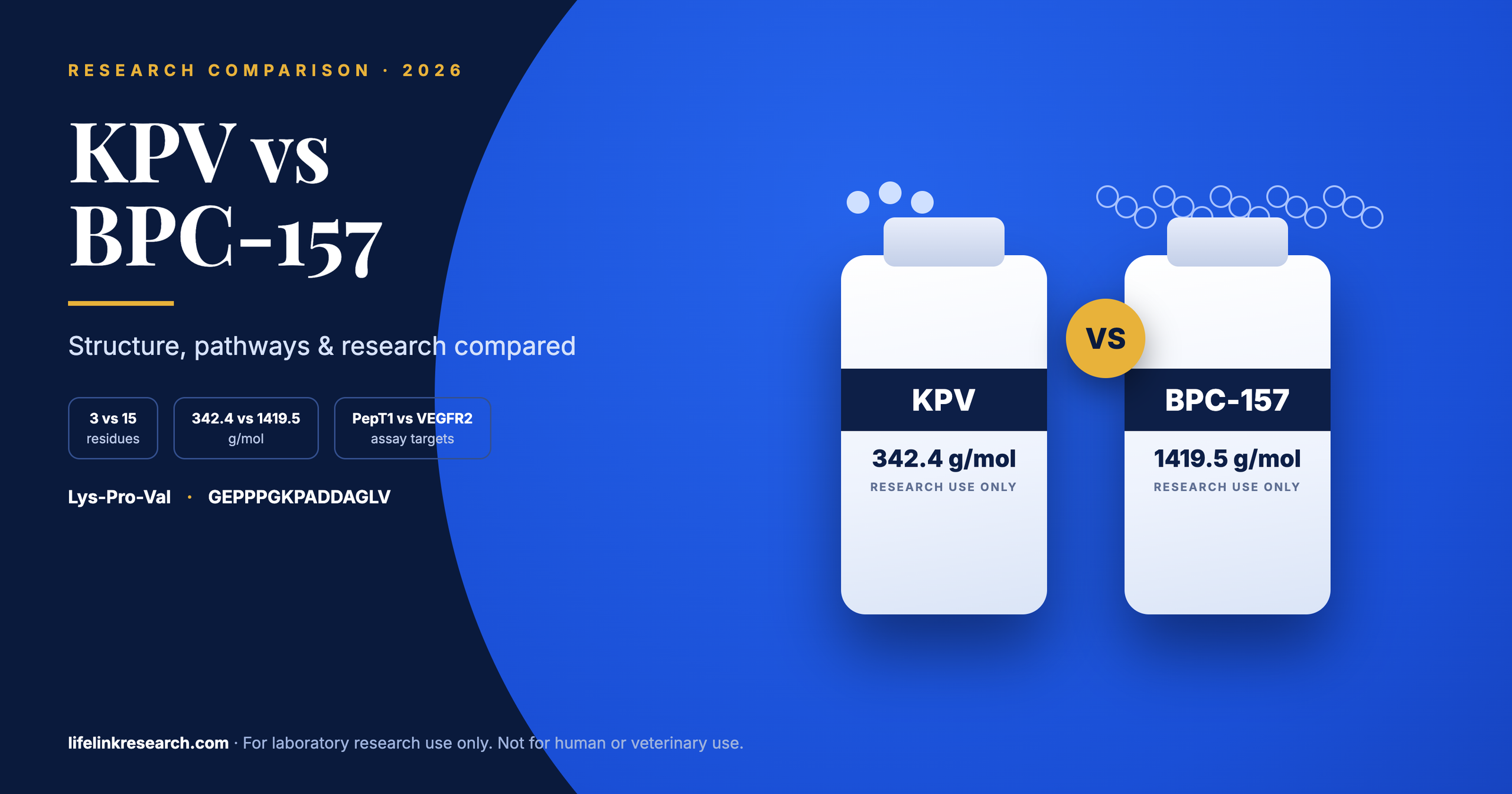
A PubMed search run in late October returns 230 records for BPC-157 and 47 for KPV. Exactly one record names both, and it is a 2026 pharmacy-compounding policy review, not a laboratory study. Two molecules that keep appearing in the same catalogs, the same forum threads, and the same regulatory agendas have almost no shared literature behind them. They also have almost nothing in common chemically: one is three residues long, the other fifteen, and roughly 1,077 daltons separate them. This guide compares KPV vs BPC-157 on identity and research tooling only.
Sequence, formula, mass, CAS number, origin, the receptors and transporters each has been studied against, the assay types that generate the published readouts, and the documentation a receiving lab uses to confirm which vial holds which compound.
Quick Answer
KPV is a 3-amino-acid fragment (Lys-Pro-Val) of alpha-MSH, studied with PepT1 uptake and NF-κB signaling assays. BPC-157 is a synthetic 15-amino-acid peptide studied in VEGFR2, eNOS, and FAK-paxillin pathway assays. Both have mostly in vitro and rodent data, and neither is FDA-approved.
KPV vs BPC-157 at a glance
Quick answer: KPV is a tripeptide of 342.43 g/mol cut from the C-terminus of alpha-MSH. BPC-157 is a synthetic pentadecapeptide of 1419.5 g/mol whose sequence comes from a protein isolated from gastric juice. KPV is studied through a peptide transporter; BPC-157 through receptor-expression and kinase readouts with no single identified receptor.
Every chemical value below was read from PubChem on October 25, 2026. Format and stock figures come from the Life Link Research catalog on the same date.
| Field | KPV | BPC-157 |
| Full name | Lys-Pro-Val, alpha-MSH(11-13) | Body Protection Compound 157 (also coded PL 14736) |
| Sequence | Lys-Pro-Val | Gly-Glu-Pro-Pro-Pro-Gly-Lys-Pro-Ala-Asp-Asp-Ala-Gly-Leu-Val (GEPPPGKPADDAGLV) |
| Length | 3 residues (tripeptide) | 15 residues (pentadecapeptide) |
| Molecular formula | C16H30N4O4 | C62H98N16O22 |
| Molecular weight | 342.43 g/mol average, 342.2267 monoisotopic (PubChem CID 125672) | 1419.5 g/mol average, 1418.7042 monoisotopic (PubChem CID 9941957) |
| CAS number | 67727-97-3 | 137525-51-0 |
| Where it comes from | C-terminal fragment of the hormone alpha-MSH, residues 11 to 13 | Synthetic partial sequence of a protein first isolated from gastric juice |
| Receptors and transporters studied | PepT1 (di/tripeptide transporter), measured in cell lines | No single identified receptor; VEGFR2 and growth-hormone-receptor expression reported as readouts |
| Main assay types | NF-κB reporter, uptake with competitor, cytokine ELISA | Tube formation, migration, Western blot for kinase phosphorylation, qPCR |
| Main study types | In vitro and rodent | In vitro and rodent |
| Human data status | No PubMed records indexed as clinical trials (checked October 25, 2026) | No PubMed records indexed as clinical trials (checked October 25, 2026) |
| Life Link format | KPV 10mg, lyophilized powder, $97, 21 in stock | BPC-157 10mg, lyophilized powder, $89, 12 in stock |
Two numbers in that table carry most of the practical difference. The 4.1-fold mass ratio decides what a mass spectrometer should show, and the 3-versus-15 residue count decides how much chain there is for enzymes to cut.
What is KPV?
Quick answer: KPV is the tripeptide Lys-Pro-Val, occupying the final three positions of alpha-melanocyte-stimulating hormone. PubChem lists it as C16H30N4O4 with an average mass of 342.43 g/mol and CAS 67727-97-3. In published cell work it is taken up through the PepT1 transporter and assayed with NF-κB reporter constructs.
Short peptides give a lab a defined, inexpensive molecule with very few variables. KPV takes that to an extreme: three residues, one basic side chain, one proline and one branched aliphatic residue. There is no secondary structure to speak of and no disulfide chemistry to manage.
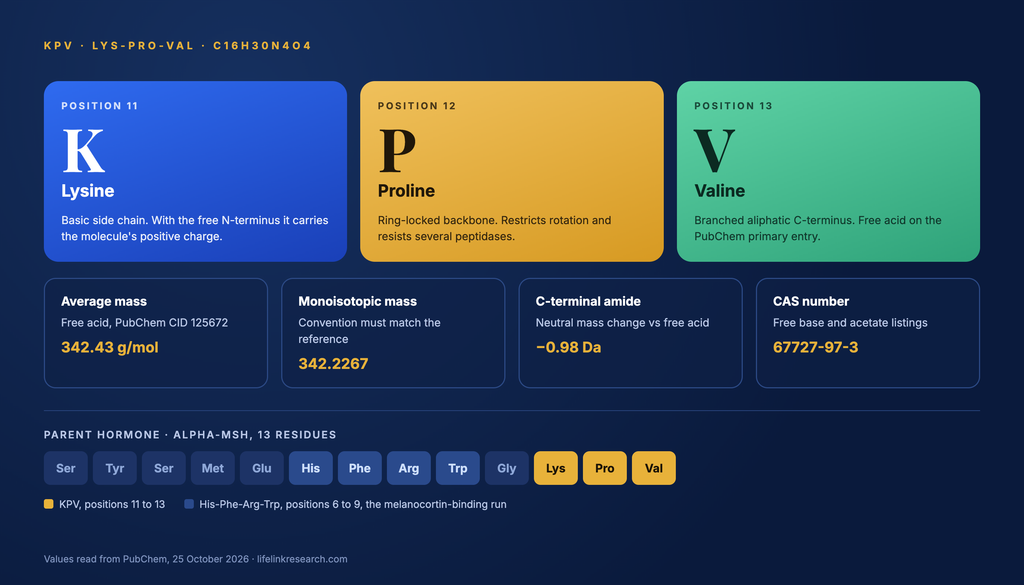
KPV (Lys-Pro-Val) chemical structure
Where it comes from
Alpha-MSH is a 13-residue hormone. KPV is its last three residues, written in the literature as alpha-MSH(11-13). The portion of alpha-MSH that binds melanocortin receptors is the His-Phe-Arg-Trp run at positions 6 to 9, which falls outside the KPV fragment entirely. That single structural point explains why KPV behaves in assays the way a transporter substrate does, and not the way a receptor ligand does, and it is the detail most comparison pages leave out. Our KPV research guide covers the parent hormone in more depth.
Chemical identity
PubChem’s primary KPV entry, CID 125672, describes the free acid, meaning the C-terminal valine ends in a carboxyl group. That distinction is not cosmetic. Swapping the terminal hydroxyl for an amide lowers the neutral mass by about 0.98 Da, so a C-terminally amidated preparation and a free-acid preparation produce different expected ions on the same instrument. Anyone matching an observed mass against a reference value needs to know which form the reference describes, and whether the figure quoted is average or monoisotopic. At this molecular size those two conventions differ by roughly 0.2 Da.
| KPV identity field | Value |
| C-terminus on the PubChem primary entry | Free acid |
| Average mass, free acid | 342.43 g/mol |
| Monoisotopic mass, free acid | 342.2267 |
| Expected [M+H]+ , average | 343.4 |
| Net charge at neutral pH, free acid | Approximately +1 |
What is BPC-157?
Quick answer: BPC-157 is a synthetic 15-residue peptide with the sequence GEPPPGKPADDAGLV. PubChem puts the formula at C62H98N16O22, the average mass at 1419.5 g/mol and the CAS number at 137525-51-0. Published work uses endothelial and fibroblast cell systems with VEGFR2, eNOS and FAK-paxillin readouts, plus rodent models.
Where KPV is a hormone fragment, BPC-157 is a laboratory construct. It is assembled by solid-phase synthesis and has no single natural precursor sold alongside it, which makes the sequence itself the whole of its identity.
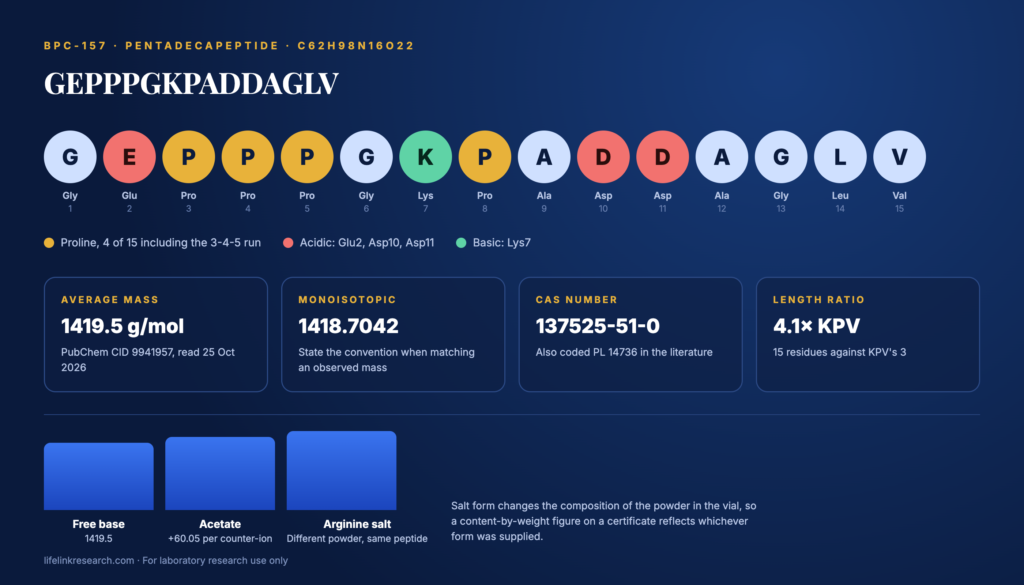
BPC-157 (GEPPPGKPADDAGLV) 15-residue sequence diagram
Where it comes from
The sequence was described as a partial sequence of a protein first isolated from gastric juice. That statement describes the origin of the amino acid order and nothing else: the molecule supplied to labs today is made synthetically, not extracted. Three of its fifteen positions are prolines in a row (positions 3, 4 and 5), with a fourth at position 8, and that proline content is the structural feature most often cited when researchers discuss its behavior in aqueous buffers. The BPC-157 research guide goes through the sequence position by position.
Salt forms
BPC-157 appears in catalogs as a free base, an acetate salt and an arginine salt. These are identity facts, not performance claims, and each changes the weight of the powder in the vial without changing the peptide.
- Free base: the peptide alone, 1419.5 g/mol.
- Acetate: each acetate counter-ion adds about 60.05 g/mol. BPC-157 has basic sites at Lys7 and the N-terminus, so a fully acetated preparation runs roughly 8% heavier than the free base.
- Arginine salt: arginine serves as the counter-ion instead. Catalogs that list an arginine-salt product are describing a different powder composition, not a different peptide.
A certificate reporting peptide content by weight will reflect whichever form is in the vial, which is why the salt form belongs on the label.
How do KPV and BPC-157 differ at the molecular level?
Quick answer: KPV is small enough to be a substrate for a peptide transporter and has a documented route into cells. BPC-157 is four times heavier, has no single identified receptor in the published literature, and is studied through downstream kinase and receptor-expression readouts in place of direct binding.
Receptors and transporters
KPV has the clearer entry route of the two. Working in Caco2-BBE and HT29-Cl.19A cell lines, Dalmasso and colleagues (Gastroenterology, 2008, PMID 18061177) reported that “KPV is transported into cells by PepT1,” the di- and tripeptide transporter, and demonstrated it with uptake experiments using unlabeled KPV as a competitor. That is an in vitro finding in human cell lines.
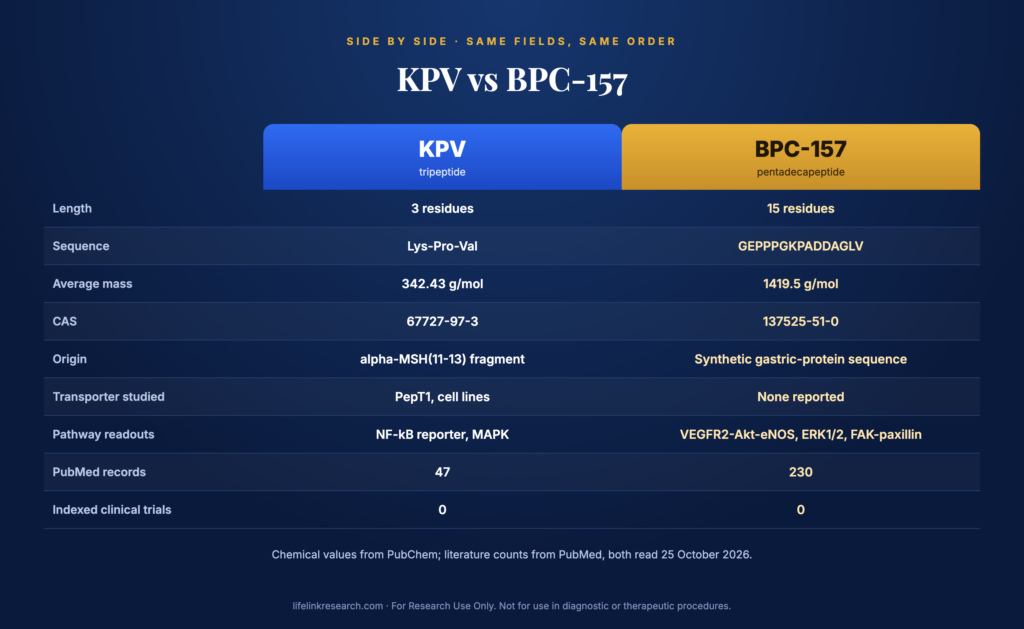
KPV vs BPC-157 comparison table graphic: sequence, mass, origin, pathways and study types
Whether KPV engages melanocortin receptors is a point where secondary sources conflict and the primary literature does not support the stronger claim. No peer-reviewed binding measurement for KPV at MC1R or MC3R appeared in our October 2026 search. Land (Int J Physiol Pathophysiol Pharmacol, 2012, PMID 22837805), frequently cited as evidence for MC3R involvement, attributed the MC3R requirement to gamma-MSH and traced KPV’s measured activity in 16HBE14o- bronchial epithelial cells to its own nuclear import and competition at the importin-alpha binding site on p65RelA. Combined with the absence of the His-Phe-Arg-Trp pharmacophore, the published record points away from receptor binding as KPV’s assay mechanism.
BPC-157 has no equivalent entry point on record. No receptor has been identified as its binding partner in the published literature, so studies report expression and activation of other proteins as readouts. Hsieh and colleagues (J Mol Med, 2017, PMID 27847966) measured VEGFR2 expression and internalization in endothelial cells, with the dynamin inhibitor dynasore used as a block. Separately, Chang and colleagues (Molecules, 2014, PMID 25415472) reported growth-hormone-receptor expression in rat tendon fibroblasts by Western blot and RT-PCR. Both are readouts of what a cell does in the compound’s presence, not demonstrations of a binding site.
Signaling pathways measured
| Pathway or readout | KPV | BPC-157 |
| NF-κB reporter activity | Primary readout, luciferase constructs | Not a standard readout |
| MAPK phosphorylation | Reported alongside NF-κB | Reported as ERK1/2 |
| VEGFR2 to Akt to eNOS | Not studied | Primary readout |
| FAK and paxillin phosphorylation | Not studied | Reported in fibroblast work |
| Transporter-mediated uptake | PepT1, with competitor | Not reported |
The two columns barely overlap, which is the most useful thing a comparison can tell a lab planning controls.
What assays and models are used to study each?
Quick answer: KPV work centers on transporter uptake and transcription-factor reporter assays in epithelial and immune cell lines. BPC-157 work centers on endothelial and fibroblast assays measuring migration, tube formation and kinase phosphorylation. Both literatures are dominated by in vitro experiments and rodent models, with no indexed clinical trials for either.
| Assay | KPV | BPC-157 | Study type |
| PepT1 uptake with competitor | Reported, Caco2-BBE | Not reported | In vitro |
| NF-κB luciferase reporter | Primary readout | Not standard | In vitro |
| Cytokine ELISA readouts | Reported in cell supernatants | Occasionally reported | In vitro |
| Cell migration and scratch assays | Rarely used | Common, fibroblasts and endothelial cells | In vitro |
| Tube formation | Not reported | Common, endothelial cells | In vitro |
| qPCR receptor expression | Rarely used | Common (VEGFR2, GH receptor) | In vitro and rodent tissue |
| Stability in culture media | Short chain, few cleavage sites | Reported as stable in aqueous buffer | In vitro |
Three practical consequences follow from that table. KPV’s assay set depends on a transporter being present and functional, so a cell line’s PepT1 expression is a design variable, so it belongs in the methods section. BPC-157’s assay set is mostly phenotypic, which puts more weight on vehicle controls and on blinding during image analysis. And because neither compound has a reference antagonist in common use, specificity in both cases rests on the control conditions a lab builds, since no pharmacological block is available.
How much published research exists on KPV vs BPC-157?
Quick answer: As of October 25, 2026, PubMed indexes 230 records for BPC-157 and 47 for KPV. Neither compound has a record indexed as a clinical trial. 108 BPC-157 records and 13 KPV records carry the animals indexing tag without the humans tag, and reviews account for 51 and 8 records respectively.
| Measure, PubMed, October 25, 2026 | KPV | BPC-157 |
| Total records, title and abstract | 47 | 230 |
| Indexed as review | 8 | 51 |
| Animal-indexed, not human-indexed | 13 | 108 |
| Indexed as clinical trial or RCT | 0 | 0 |
| Records naming both compounds | 1 (a 2026 policy review) | 1 (the same record) |
Anyone weighing BPC-157 vs KPV for research planning should read those counts carefully, because two features of them shape what the totals actually mean. BPC-157’s total is nearly five times KPV’s, but more than a fifth of it is review articles, so the primary-study difference is narrower than the headline figures suggest.
And the zero in the clinical-trial row is the same zero for both: human data are limited, and nothing in either literature is indexed as a controlled trial. The KPV query also required a peptide or melanocortin term, because the bare initials collide with unrelated abbreviations across the database.
For a comparison built on a similar count-first approach, see BPC-157 vs TB-500.
Can KPV and BPC-157 be studied together?
Quick answer: Combined in vitro work is possible but has essentially no published precedent. One PubMed record names both compounds as of October 25, 2026, and it is a regulatory review with no experiments in it. Any combined design is therefore building its own baseline from scratch.
That single overlapping record (Willis and Vu, Int J Pharm Compd, 2026, PMID 42752426) analyzes compounding-committee recommendations. It reports no assay data for either molecule.
The absence of precedent raises the bar for controls. A combined-exposure plate needs four arms at minimum: vehicle, each compound alone at its own concentration series, and the combination. Without the single-compound arms run on the same plate and the same passage, nothing in the combination well can be assigned to either molecule.
Two further design points follow from the chemistry already described. Because KPV’s uptake depends on PepT1, any combination assay should verify that transporter expression is unchanged across conditions. And since the two compounds differ more than fourfold in mass, an equal-mass exposure delivers roughly four times as many KPV molecules as BPC-157 molecules, so molar matching and mass matching give different experiments. State which one the protocol uses.
What is the FDA status of KPV and BPC-157?
Quick answer: As of October 25, 2026, neither KPV nor BPC-157 is an FDA-approved drug. Neither appears in the FDA’s approved-products database. Both were reviewed by the Pharmacy Compounding Advisory Committee on July 23, 2026, in free base and acetate forms, as candidates for the 503A bulk drug substances list.
The FDA’s advisory committee calendar entry for the July 23 to 24, 2026 meeting lists “BPC-157 (free base)”, “BPC-157 acetate”, “KPV (free base)” and “KPV acetate” among the substances considered on the first day. The page was marked content current as of August 6, 2026.
Three points of context keep that status accurate:
- An advisory committee recommendation is advisory. Placement on the 503A list requires FDA action through notice-and-comment rulemaking, and a committee vote is not an approval.
- The 503A list governs what compounding pharmacies may use. It is a separate question from the sale of research reagents to laboratories.
- Neither compound appears as an approved product in the FDA’s drug approval records, searched on October 25, 2026.
Our BPC-157 regulatory status page tracks the list itself, and the 2026 FDA advisory panel write-up covers the July meeting in detail.
Identity and quality checks for research supply
Because the two molecules differ so widely in mass, the documentation that distinguishes them is straightforward to read once you know which three fields to compare.
- Purity by HPLC: reverse-phase HPLC with UV detection expresses how much of the sample is the named peptide, as an area percentage. See the batch result, which supersedes any catalog figure, and check that the report’s batch number matches the vial.
- Mass by LC-MS: the measured mass needs to line up with the figure predicted for that compound in that form. For KPV, that means a value near 342.4 for the free-acid free base, and for BPC-157 near 1419.5. A salt form changes the powder’s composition, so confirm which the report describes before calling a figure a mismatch. For the certificate layout itself, how to read a peptide COA sets out which box holds which number.
- Form and storage: both compounds are supplied as lyophilized powder and listed for storage at -20°C, protected from light.
- Solubility: both are described as soluble in water or DMSO for assay preparation.
A final identity note specific to this pair. A 342-dalton peak and a 1,419-dalton peak cannot be confused with one another, but a KPV report quoting a monoisotopic value against an average-mass reference can look wrong when it is not. Match convention to convention.
FAQs
What is the difference between KPV and BPC-157?
KPV is three residues long (Lys-Pro-Val) and comes from positions 11 to 13 of alpha-MSH. BPC-157 is fifteen residues (GEPPPGKPADDAGLV) and is a synthetic sequence from a gastric-juice protein. KPV is studied via PepT1 uptake and NF-κB readouts; BPC-157 via VEGFR2, eNOS and FAK-paxillin readouts.
What is KPV’s full name?
KPV stands for its three amino acids: lysine, proline and valine, written Lys-Pro-Val. In the literature it is also written alpha-MSH(11-13), because the three residues correspond to positions 11 to 13 of alpha-melanocyte-stimulating hormone. Its CAS number is 67727-97-3.
What is the molecular weight of KPV?
PubChem lists KPV at an average molecular weight of 342.43 g/mol, with a monoisotopic mass of 342.2267, for the formula C16H30N4O4 (CID 125672, read October 25, 2026). That entry describes the free acid. An amidated C-terminus lowers the neutral mass by roughly 0.98 Da.
What is the BPC-157 peptide sequence?
BPC-157 is Gly-Glu-Pro-Pro-Pro-Gly-Lys-Pro-Ala-Asp-Asp-Ala-Gly-Leu-Val, written in single-letter code as GEPPPGKPADDAGLV. That is fifteen residues, which is why it is described as a pentadecapeptide. PubChem lists the formula as C62H98N16O22 at 1419.5 g/mol average mass.
Is there a lot of research on BPC-157?
PubMed indexed 230 BPC-157 records on October 25, 2026, of which 51 are reviews, and 108 carry the animals tag without a humans tag. No record is indexed as a clinical trial or randomized controlled trial, so the literature is predominantly in vitro and rodent work, and human data are limited.
Can KPV and BPC-157 be studied together?
Only one PubMed record names both, and it is a 2026 compounding-policy review with no assay data. A combined in vitro design therefore needs each compound alone on the same plate as controls, plus a stated choice between molar matching and mass matching, since the two differ fourfold in mass.
Is KPV or BPC-157 FDA approved?
Neither is FDA-approved. As of October 25, 2026, neither appears in the FDA’s approved drug records. Both were reviewed by the Pharmacy Compounding Advisory Committee on July 23, 2026, in free base and acetate forms, as candidates for the 503A bulk substances list. A committee review is not an approval.
Closing notes
For Research Use Only. Not for use in diagnostic or therapeutic procedures.
The products described on this page are laboratory reagents sold to qualified researchers. See the Terms and Conditions for the full policy. Chemical values read from PubChem and literature counts pulled from PubMed on that date.
References
- PubChem CID 125672, KPV: https://pubchem.ncbi.nlm.nih.gov/compound/125672
- PubChem CID 9941957, BPC-157: https://pubchem.ncbi.nlm.nih.gov/compound/9941957
- Dalmasso G et al., Gastroenterology, 2008. PMID 18061177: https://pmc.ncbi.nlm.nih.gov/articles/PMC2431115/
- Land SC, Int J Physiol Pathophysiol Pharmacol, 2012. PMID 22837805: https://pubmed.ncbi.nlm.nih.gov/22837805/
- Hsieh MJ et al., J Mol Med, 2017. PMID 27847966: https://pubmed.ncbi.nlm.nih.gov/27847966/
- Chang CH et al., Molecules, 2014. PMID 25415472: https://pmc.ncbi.nlm.nih.gov/articles/PMC6271067/
- Willis J, Vu N, Int J Pharm Compd, 2026. PMID 42752426: https://pubmed.ncbi.nlm.nih.gov/42752426/
- FDA, Pharmacy Compounding Advisory Committee meeting, July 23 to 24, 2026: https://www.fda.gov/advisory-committees/advisory-committee-calendar/july-23-24-2026-meeting-pharmacy-compounding-advisory-committee-07232026
What Is MOTS-c? Structure, Research Use & US Supply
Quick Answer MOTS-c is a 16-amino-acid peptide coded within a short open reading frame of the mitochondrial 12S rRNA gene (MT-RNR1). It…
Read article
What Is DSIP? Structure, Research Use & US Supply
DSIP is a synthetic nine-residue peptide, WAGGDASGE, listed under the international name Emideltide. On July 24, 2026, it drew the narrowest vote…
Read article
What Is Ipamorelin? Structure, GHSR-1a Receptor and COA Guide
Ipamorelin is a synthetic five-residue peptide that acts as an agonist at the ghrelin receptor, GHSR-1a. It started life as a subtraction.…
Read articleResearch-grade peptides
99%+ purity. Verified every batch.
Identity and purity tested on every batch by third-party labs, Janoshik Analytical and US-based laboratories. Shipped same day from California.
Shop all peptides