
Quick Answer
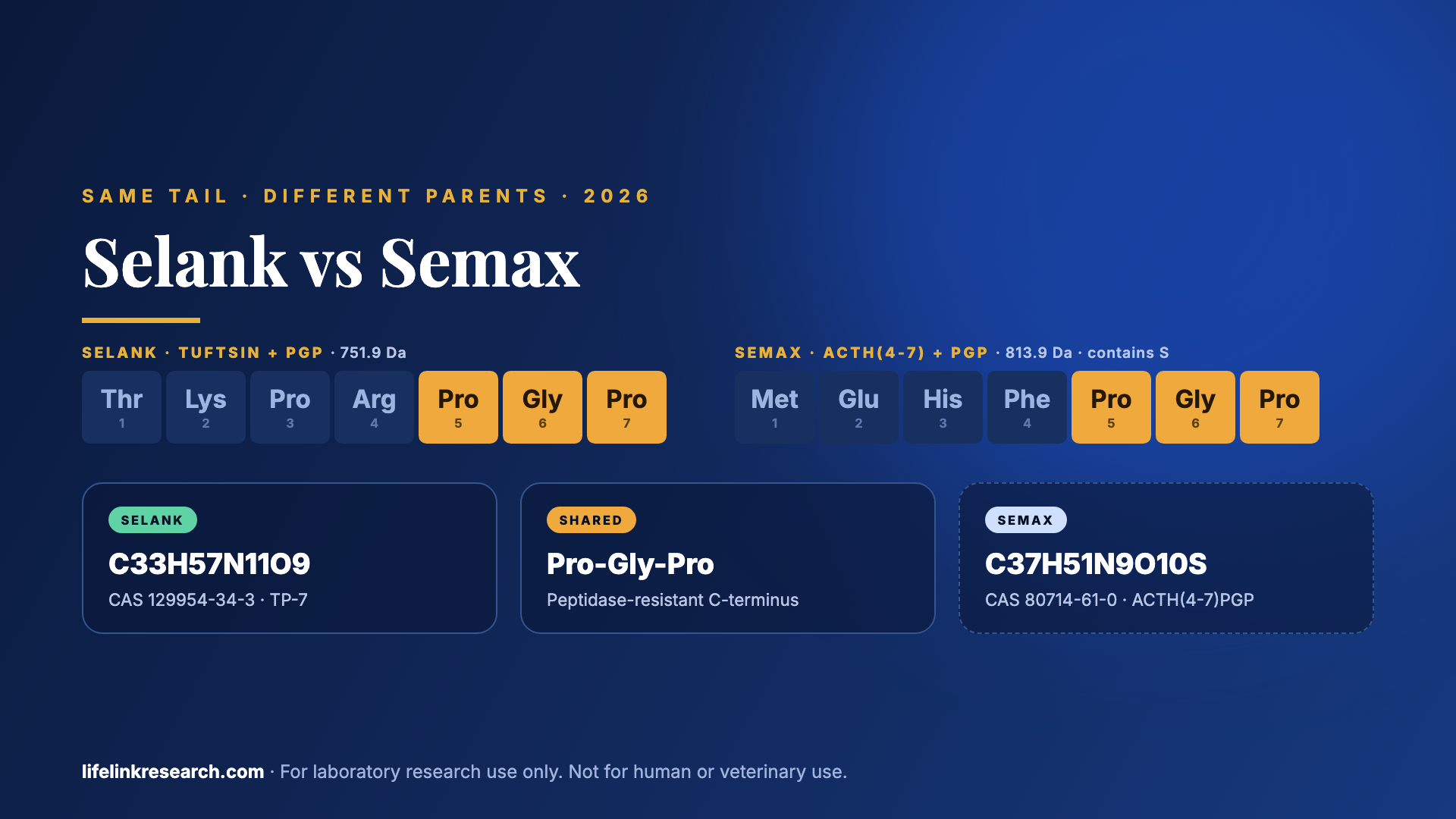
Selank and Semax are both seven-residue synthetic peptides that end in the same Pro-Gly-Pro tail, but their first four residues come from different parent peptides. Selank (Thr-Lys-Pro-Arg-Pro-Gly-Pro) extends tuftsin and weighs 751.9 g/mol; Semax (Met-Glu-His-Phe-Pro-Gly-Pro) extends ACTH(4-7), weighs 813.9 g/mol and contains sulfur.
Key takeaways
- Selank: tuftsin + PGP, C33H57N11O9, 751.9 g/mol, CAS 129954-34-3 (also TP-7)
- Semax: ACTH(4-7) + PGP, C37H51N9O10S, 813.9 g/mol, CAS 80714-61-0
- The shared Pro-Gly-Pro tail slows breakdown by peptidases
- CAS 4037-01-8, often listed beside Semax, belongs to ACTH(4-10)
- By mass spectrometry, the two are 62 Da apart on a COA
Selank is tuftsin with three extra amino acids. Semax is a fragment of ACTH with the same three extras. Both are seven-residue synthetic peptides, and both end in an identical tail: proline, glycine, proline.
That shared ending is why Selank and Semax are such a common pairing, and it hides two quite different molecules. Their front halves come from unrelated parent peptides, their weights differ by 62 Da, and only one of them contains sulfur.
This guide compares Selank vs Semax by structure and identity: sequence, origin, formula, molecular weight, CAS number, the salt and N-acetyl forms that change those numbers, and what each COA should show. Our Semax + Selank research kit supplies both, and it’s the example used throughout.
What’s the Difference Between Selank and Semax?
Quick answer: Selank and Semax are both seven-amino-acid synthetic peptides ending in Pro-Gly-Pro, but they come from different parent sequences. Selank extends tuftsin (Thr-Lys-Pro-Arg), while Semax extends the ACTH(4-7) fragment (Met-Glu-His-Phe). They differ in formula, molecular weight (751.9 vs 813.9 g/mol) and CAS number, and only Semax contains sulfur.
| Property | Selank | Semax |
| Parent peptide | Tuftsin (Thr-Lys-Pro-Arg) | ACTH(4-7) (Met-Glu-His-Phe) |
| Full sequence | Thr-Lys-Pro-Arg-Pro-Gly-Pro | Met-Glu-His-Phe-Pro-Gly-Pro |
| Length | 7 residues | 7 residues |
| Formula | C33H57N11O9 | C37H51N9O10S |
| Molecular weight | 751.9 g/mol | 813.9 g/mol |
| CAS | 129954-34-3 | 80714-61-0 |
| Sulfur | No | Yes, from methionine |
| Other names | TP-7 | ACTH(4-7)PGP |
| Origin | Institute of Molecular Genetics, Russian Academy of Sciences | Institute of Molecular Genetics, Russian Academy of Sciences |
| PubChem CID | 11765600 | 9811102 |
Read the table from the bottom up, and the pattern is clear. Same institute, same tail, same length, different starting material.
What Is Selank?
Quick answer: Selank (also called TP-7) is a synthetic heptapeptide, Thr-Lys-Pro-Arg-Pro-Gly-Pro. It consists of tuftsin, a natural tetrapeptide, with a Pro-Gly-Pro extension added at the C-terminus. It was developed at the Institute of Molecular Genetics of the Russian Academy of Sciences. Its formula is C33H57N11O9 and its CAS number is 129954-34-3.
Sequence and the Tuftsin Core
The Selank peptide is built in two parts. The first four residues are tuftsin, a naturally occurring tetrapeptide: threonine, lysine, proline, arginine. Two of those, lysine and arginine, carry basic side chains, so Selank is strongly positively charged at neutral pH. The added Pro-Gly-Pro makes residues 5 to 7, and the chain ends in a free carboxyl group. With three prolines in seven positions, Selank is a proline-rich, flexible peptide with no fixed secondary structure.
Formula, MW, CAS
PubChem CID 11765600 lists Selank as C33H57N11O9, with a molecular weight of 751.9 g/mol and a monoisotopic mass of 751.43 Da. The record carries CAS 129954-34-3. Tuftsin alone, by comparison, is C21H40N8O6 at 500.6 g/mol (CID 156080).
Assay Targets Reported in the Literature
Published work on Selank centres on GABA receptor systems, measured in two ways:
- Rodent gene-expression study: Volkova et al., 2016 used real-time PCR in rats to measure expression of genes linked to GABA signalling, comparing Selank with GABA itself.
- Rodent receptor-binding study: Vasil’eva et al., 2016 measured radioligand binding at GABA and NMDA receptor sites in two mouse strains.
Both are animal studies, and each result belongs to its own model. Single-compound work uses our Selank 10 mg vial.
What Is Semax?
Quick answer: Semax is a synthetic heptapeptide, Met-Glu-His-Phe-Pro-Gly-Pro. It keeps the ACTH(4-7) fragment and replaces residues 8 to 10 with a Pro-Gly-Pro extension. It comes from the same Institute of Molecular Genetics team in Moscow, and PubChem lists it as C37H51N9O10S under CAS 80714-61-0.
Sequence: Why “ACTH(4-7) + PGP” and Not ACTH(4-10)
The Semax peptide is built the same way, from a different starting point. ACTH, adrenocorticotropic hormone, is a 39-residue peptide. Its fragment 4-10 reads Met-Glu-His-Phe-Arg-Trp-Gly. Semax keeps the first four of those residues and swaps the last three, Arg-Trp-Gly, for Pro-Gly-Pro. So Semax is accurately described as ACTH(4-7)PGP. Calling it “an ACTH(4-10) analog” is common, and it’s where a lot of the identity confusion starts.
Formula, MW, CAS
PubChem CID 9811102 lists Semax as C37H51N9O10S, 813.9 g/mol, with a monoisotopic mass of 813.35 Da and CAS 80714-61-0. A second number, CAS 4037-01-8, often appears beside Semax online. PubChem assigns that CAS to ACTH(4-10) itself, C44H59N13O10S at 962.1 g/mol (CID 123787), so it describes the parent fragment.
Assay Targets Reported in the Literature
Semax studies lean heavily on transcription profiling:
- Rodent gene-expression study: Medvedeva et al., 2014 ran a genome-wide transcriptional analysis in a rat model, mapping which genes changed expression after Semax.
- Rodent receptor-gene study: Liu et al., 2025 examined the μ-opioid receptor gene Oprm1 in mice, including deubiquitination assays.
As with Selank, both are animal studies and describe their own models only. Single-compound work uses our Semax 10 mg vial.
Why Do Selank and Semax Both End in Pro-Gly-Pro?
Quick answer: The Pro-Gly-Pro (PGP) tail was added to both peptides to slow breakdown by peptidases. Short natural fragments like tuftsin and ACTH(4-7) are cleaved quickly in biological matrices, while proline-rich sequences resist many exopeptidases. Stability studies with purified peptidases and rat plasma compared proline-containing peptides and their breakdown products.
Proline is the key. Its side chain loops back onto its own backbone nitrogen, which locks the peptide bond into an awkward shape for many enzymes. Exopeptidases that trim residues one at a time from either end tend to stall when they reach a proline. Placing Pro-Gly-Pro at the C-terminus guards the end that carboxypeptidases attack.
The Institute of Molecular Genetics group behind both peptides has tested this directly. Shevchenko et al., 2019 reviewed in vitro hydrolysis of glyproline peptides by leucine aminopeptidase, dipeptidases, and carboxypeptidases B and Y, and in rat plasma. An earlier 2013 study from the same team tracked the cleavage of simple glyprolines by the same enzymes. Both describe a single design idea applied to two unrelated starting sequences.
Sequence Comparison Table
Lined up by position, the four peptides show where Selank and Semax come from and where they meet:
| Position | Tuftsin | Selank | ACTH(4-10) | Semax |
| 1 | Thr | Thr | Met | Met |
| 2 | Lys | Lys | Glu | Glu |
| 3 | Pro | Pro | His | His |
| 4 | Arg | Arg | Phe | Phe |
| 5 | none | Pro | Arg | Pro |
| 6 | none | Gly | Trp | Gly |
| 7 | none | Pro | Gly | Pro |
| MW (g/mol) | 500.6 | 751.9 | 962.1 | 813.9 |
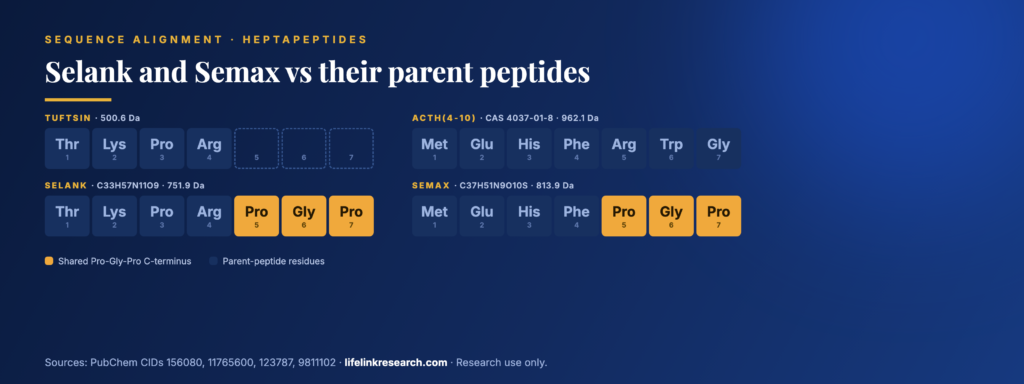
Selank and Semax aligned with their parent peptides, with the shared Pro-Gly-Pro C-terminus highlighted.
Positions 5 to 7 are identical in Selank and Semax. Positions 1 to 4 share nothing, and that’s exactly the part a mass spectrometer reads as a 62 Da difference in weight. Glance down the MW row and the effect of the PGP swap is visible too: Semax is lighter than ACTH(4-10) because Pro-Gly-Pro weighs less than Arg-Trp-Gly.
N-Acetyl and Salt Forms: Different Molecules, Different MW
Quick answer: N-acetyl Semax amidate and N-acetyl Selank are chemically different molecules from standard Semax and Selank. Acetylation and C-terminal amidation change the formula and molecular weight. Salt forms, such as Selank diacetate, also raise the weight on a COA. Always check that the COA’s molecular weight matches the exact form named on the label.
| Form | Change | Formula | MW (g/mol) | PubChem CID |
| Selank | None | C33H57N11O9 | 751.9 | 11765600 |
| Selank acetate | One acetic acid as salt | C35H61N11O11 | 811.9 | 155489759 |
| Selank diacetate | Two acetic acids as salt | C37H65N11O13 | 872.0 | 155804769 |
| N-acetyl Selank | Acetyl group on the N-terminus | C35H59N11O10 | 793.9 | 133082488 |
| Semax | None | C37H51N9O10S | 813.9 | 9811102 |
| N-acetyl Semax amidate | N-terminal acetyl plus C-terminal amide | C39H54N10O10S | 855.0 | 172638603 |
These two kinds of change show up differently on a COA. Salt forms change the weight of the powder, while the mass spectrometer still sees the bare peptide ion. Acetylation and amidation change the peptide itself, so they move the MS result too.
How to Tell Selank and Semax Apart on a COA
Quick answer: Mass spectrometry separates them clearly. Selank should show a mass near 751.9 Da and Semax near 813.9 Da, about 62 Da apart. Only Semax contains sulfur, from its methionine. Each vial in a kit needs its own COA with HPLC purity, an MS identity result matching that peptide, and a lot number matching the vial.
Expected MS Masses ([M+H]⁺ and [M+2H]²⁺)
Small peptides like these usually appear as singly and doubly protonated ions in electrospray MS. Calculated from the monoisotopic masses:
| Ion | Selank (751.43) | Semax (813.35) |
| [M+H]⁺ | m/z ≈ 752.4 | m/z ≈ 814.4 |
| [M+2H]²⁺ | m/z ≈ 376.7 | m/z ≈ 407.7 |
On our current Semax report from Krause Analytical, issued 13 July 2026, the spectrum shows its two main ions at m/z 815.1 and 408.4, with the lab recording a mass spectral match as “ID Confirmed.” Lower-resolution instruments often read the most abundant isotope peak, which reads a little above the monoisotopic value. Our guide to HPLC vs mass spectrometry explains the difference.
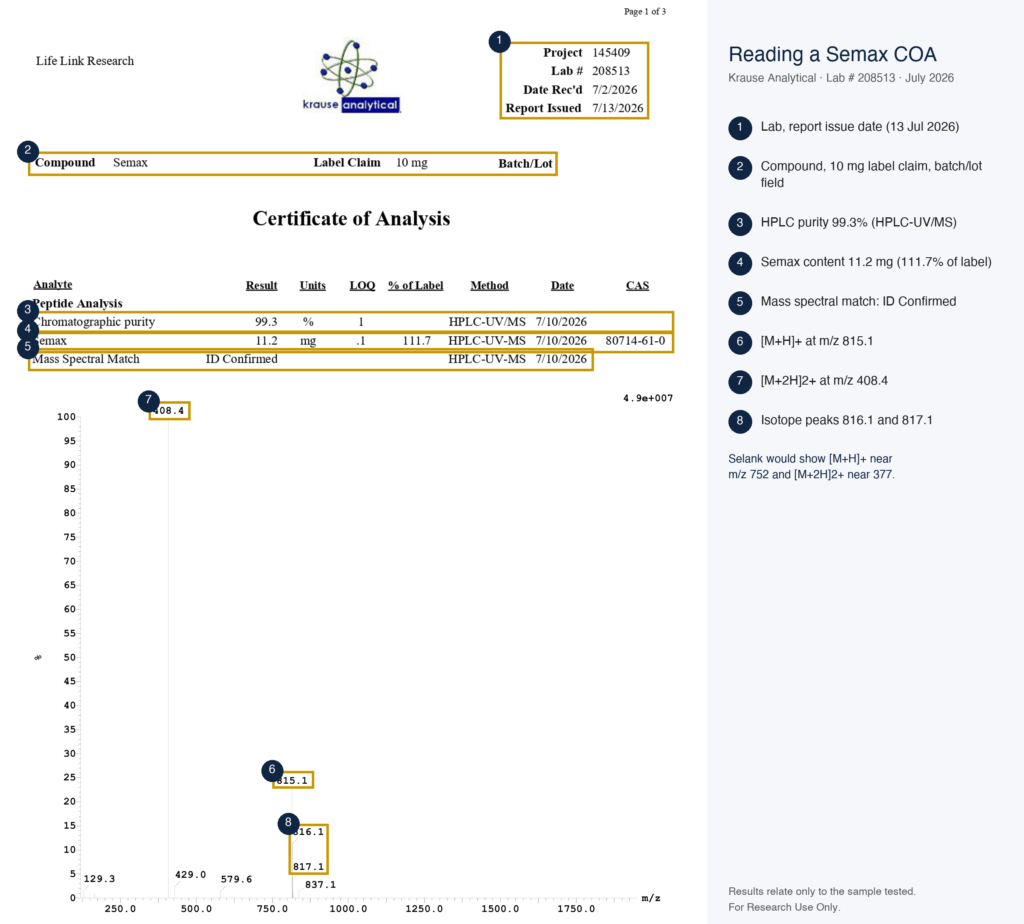
Semax COA from Krause Analytical (2026), with the purity, content, and mass-spec results labelled.
HPLC Purity and the Salt-Form Note
The same Semax report gives chromatographic purity of 99.3% by HPLC-UV/MS, plus a measured content of 11.2 mg against a 10 mg label claim. Our current Selank report, from Prime Analytical Laboratories in March 2026, gives 99.21% HPLC purity. If a label names a salt form, its stated weight includes the counter-ion, so the peptide content per mg runs lower.
Lot, Date and Lab Checks
A Selank COA or Semax COA should carry a lot number that matches its vial, a test date that fits the batch, and a lab you can contact. In a two-vial kit, check each report against its own vial. Our guide on how to verify a peptide COA walks through all six checks.
Why Are Selank and Semax Sold as a Kit?
The kit format is about supply. The Balance kit holds two separate vials, 10 mg of Semax and 10 mg of Selank, and each vial keeps its own batch COA. Nothing is premixed, so each peptide can be weighed, tested, and used in a study on its own terms.
The pairing makes sense for comparison work. Two heptapeptides with the same C-terminal design and different N-terminal sequences make a tidy matched set for studies that look at how the parent sequence shapes a result. For the trade-offs between premixed vials and separate ones, see our guide to peptide blends vs single vials.
Are Selank and Semax FDA Approved?
Quick answer: No. As of 31 October 2026, neither Selank nor Semax is an FDA-approved drug in the US; both are sold for laboratory research use only. Both were developed in Russia, where they hold national registrations as medicines.
- FDA: the FDA’s bulk drug substances page, current as of 22 April 2026, lists “Selank acetate (TP-7)” and “Semax (heptapeptide)” among nominations that were withdrawn.
- Research supply: both peptides are sold in the US as research chemicals for in-vitro laboratory work.
FAQs
Is Selank the same as Semax?
No. Both are seven-residue peptides ending in Pro-Gly-Pro, but their first four residues differ completely. Selank starts with tuftsin (Thr-Lys-Pro-Arg); Semax starts with ACTH(4-7) (Met-Glu-His-Phe). They have different formulas, weights, and CAS numbers, and only Semax contains sulfur.
What is the molecular weight of Selank and Semax?
Selank weighs 751.9 g/mol (C33H57N11O9, CAS 129954-34-3). Semax weighs 813.9 g/mol (C37H51N9O10S, CAS 80714-61-0). The 62 Da difference is easy to see by mass spectrometry. A salt label changes the numbers too: the diacetate form of Selank comes to 872.0 g/mol.
What does Pro-Gly-Pro do in Selank and Semax?
Pro-Gly-Pro is a C-terminal extension that slows breakdown by peptidases. Proline’s ring structure makes the neighbouring peptide bonds hard for many exopeptidases to cut, so the tail shields the peptide’s C-terminal end from trimming enzymes. The design was applied to both parent sequences by the same institute.
Is N-acetyl Semax the same as Semax?
They’re related but distinct. N-acetyl Semax amidate carries an acetyl group on the N-terminus and an amide at the C-terminus. That changes the formula to C39H54N10O10S and the weight to 855.0 g/mol, about 41 Da more than Semax, so it shows a different mass on a COA.
How do I verify a Selank or Semax COA?
Check that the MS result matches the peptide: near 752 for Selank’s [M+H]⁺ and 814 for Semax’s. Then confirm HPLC purity, match the lot number to the vial, and contact the named lab to verify the report. In a kit, check both vials separately.
What is in the Life Link Balance kit?
The kit holds one 10 mg vial of Semax and one 10 mg vial of Selank, packed as two separate vials in one box. Nothing is premixed. Each vial has its own batch COA, and earlier reports for each product stay on its certificate page.
Buy the Semax + Selank Kit With Batch COAs
Our kit pairs one vial of each peptide at 10 mg, each with its own batch report. Identity and purity are tested on every batch through independent labs. To find a batch COA, open the single-peptide product, click View report, and match the batch number to the vial label. Orders placed before 2 PM PST ship the same day from California by UPS 2-Day Air.
For Research Use Only. Not for use in diagnostic or therapeutic procedures.
All products are supplied for in-vitro laboratory research by qualified professionals. Read the full research use disclaimer.
References
- PubChem CID 11765600, Selank: https://pubchem.ncbi.nlm.nih.gov/compound/11765600
- PubChem CID 9811102, Semax: https://pubchem.ncbi.nlm.nih.gov/compound/9811102
- PubChem CID 156080, tuftsin: https://pubchem.ncbi.nlm.nih.gov/compound/156080
- Volkova et al., Front Pharmacol, 2016 (PMID 26924987): https://pubmed.ncbi.nlm.nih.gov/26924987/
- Vasil’eva et al., Eksp Klin Farmakol, 2016 (PMID 29787664): https://pubmed.ncbi.nlm.nih.gov/29787664/
- PubChem CID 123787, ACTH(4-10): https://pubchem.ncbi.nlm.nih.gov/compound/123787
- Medvedeva et al., BMC Genomics, 2014 (PMID 24661604): https://pubmed.ncbi.nlm.nih.gov/24661604/
- Liu et al., Br J Pharmacol, 2025 (PMID 40692165): https://pubmed.ncbi.nlm.nih.gov/40692165/
- Shevchenko et al., Biomed Khim, 2019 (PMID 31258142): https://pubmed.ncbi.nlm.nih.gov/31258142/
- Shevchenko et al., Bioorg Khim, 2013 (PMID 24397030): https://pubmed.ncbi.nlm.nih.gov/24397030/
- FDA, bulk drug substances for compounding (current as of 22 April 2026): https://www.fda.gov/drugs/human-drug-compounding/certain-bulk-drug-substances-use-compounding-may-present-significant-safety-risks
CJC-1295 With DAC vs Without DAC (Mod GRF 1-29): Structure & Identity Compared
Quick Answer CJC-1295 with DAC and CJC-1295 without DAC (Mod GRF 1-29) share the same 29-residue GHRH(1-29) core with four substitutions: D-Ala2,…
Read article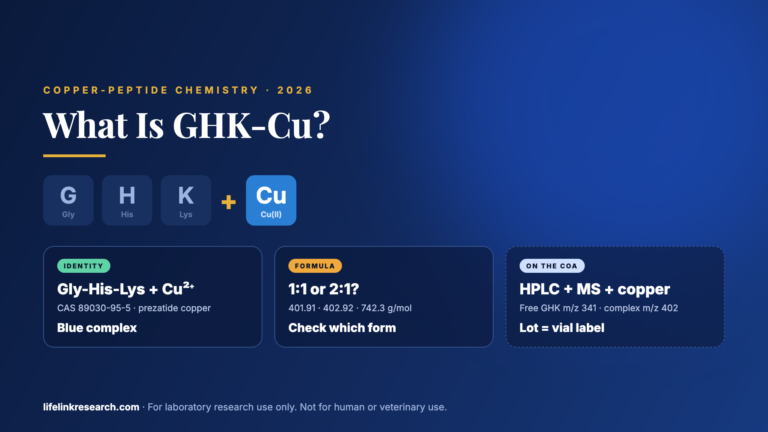
What Is GHK-Cu? Copper-Peptide Chemistry, Structure & COA
Quick Answer GHK-Cu is the copper(II) complex of the tripeptide glycyl-L-histidyl-L-lysine (Gly-His-Lys). The peptide holds one Cu²⁺ ion through three nitrogen atoms,…
Read article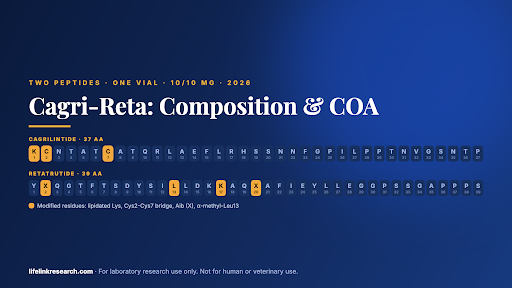
Cagri-Reta (Cagrilintide + Retatrutide): Composition, Structure & COA
Quick Answer Cagri-Reta is a research blend of two synthetic peptides in one vial: cagrilintide, a long-acting amylin analog (4409.0 g/mol), and…
Read articleResearch-grade peptides
99%+ purity. Verified every batch.
Identity and purity tested on every batch by third-party labs, Janoshik Analytical and US-based laboratories. Shipped same day from California.
Shop all peptides