
Quick Answer
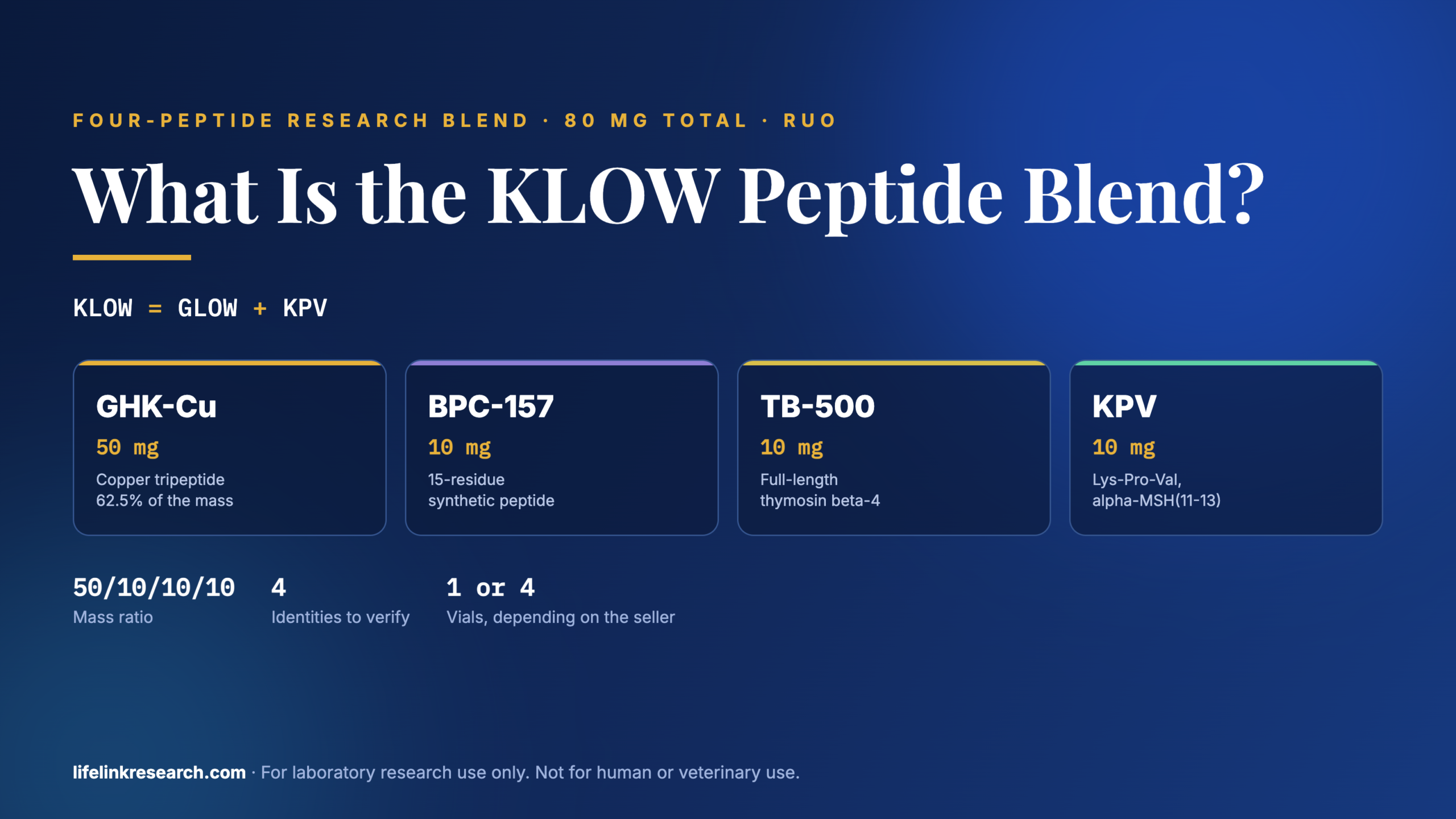
The KLOW peptide blend is an 80mg research combination of GHK-Cu 50mg, BPC-157 10mg, TB-500 10mg and KPV 10mg, a 50/10/10/10 ratio by mass. KLOW = GLOW + KPV. It is supplied for laboratory research only, either as one blended vial or as a kit of four separate vials.
Key takeaways
- KLOW is the three-peptide GLOW composition with 10mg of KPV added.
- The ratio is 50/10/10/10, and GHK-Cu alone is 62.5% of the mass.
- Some vendors sell KLOW as one 80mg vial, others as a four-vial kit. The COA format differs, the ingredients do not.
- A KLOW certificate reports four compounds separately, not one blended percentage.
- Compare price per milligram of verified compound, never price per vial.
One name, four molecules, and only the name is simple. Those four run from three amino acids up to a 43-residue protein fragment. They are made separately, tested separately, and since late 2026 they fall in different places under US compounding policy as well.
Easy to say, awkward to verify. What follows is what is in the vial, why the amounts lean toward one compound, how a four-peptide certificate has to be read, and what it costs.
What Exactly Is KLOW Peptide?
Quick answer: KLOW is a market name for four separately manufactured research peptides: GHK-Cu, BPC-157, TB-500 and KPV. It is literally the GLOW trio plus KPV, sold either as a single blended vial or as a four-vial kit. It is a research reagent, not a brand and not an approved product.
No company owns the word, and no regulator has reviewed anything called KLOW. The name is a mash-up of its parts: GLOW came first, KPV arrived, the G became a K.
Two formats hide behind that word, and everything downstream depends on which you have.
- KLOW blend: All four peptides freeze-dried together in one vial. One container, one certificate.
- KLOW kit: The four peptides as four separate vials, boxed together. Four containers, four certificates. This is what Life Link supplies.
You will also see “KLOW 80” for the blend and “KLOW stack” used loosely for either. Neither label is standardized, so a listing’s contents line tells you more than its product name.
What Is in the KLOW Peptide Blend?
Quick answer: KLOW contains four peptides: GHK-Cu 50mg, BPC-157 10mg, TB-500 10mg and KPV 10mg, 80mg in total, a 5:1:1:1 mass ratio. It is the GLOW composition with KPV added. A KLOW COA should report identity and purity for each of the four separately.
Here is the whole thing in one table, with the registry identifiers you would use to check any supplier’s paperwork.
| Component | Amount | % of mass | Type | Sequence or form | Formula | MW | CAS |
|---|---|---|---|---|---|---|---|
| GHK-Cu | 50 mg | 62.5% | Copper-complexed tripeptide | Gly-His-Lys bound to Cu(II) | C14H22CuN6O4 | 401.9 | 89030-95-5 |
| BPC-157 | 10 mg | 12.5% | Synthetic 15-residue peptide | GEPPPGKPADDAGLV | C62H98N16O22 | 1,419.5 | 137525-51-0 |
| TB-500 | 10 mg | 12.5% | Full-length thymosin beta-4, 43 residues, N-acetylated | Ac-SDKPDMAEIEKFDKSKLKKTETQEKNPLPSKETIEQEKQAGES | C212H350N56O78S | 4,963 | 77591-33-4 |
| KPV | 10 mg | 12.5% | Tripeptide, alpha-MSH(11-13) | Lys-Pro-Val | C16H30N4O4 | 342.43 | 67727-97-3 |
Formulas and masses come from the PubChem records under References. One figure deserves a note: many GHK-Cu labels print 404 as the molecular weight, which is GHK plus a copper atom added up rather than a registry value. The 1:1 complex record is 401.9.
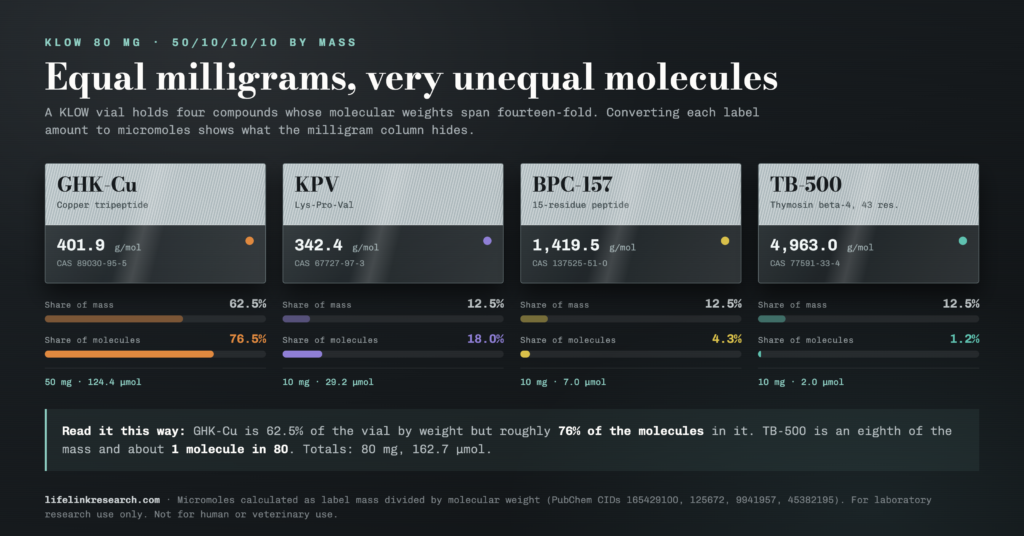
Now read that table right to left. The molecular weights run from 342.43 to 4,963 while the milligram column barely moves. Equal milligrams do not mean equal numbers of molecules, and that single fact drives nearly everything below.
What Is Each Component of KLOW?
Quick answer: GHK-Cu is a copper-binding tripeptide, BPC-157 a 15-amino-acid synthetic peptide, TB-500 here full-length thymosin beta-4, and KPV a three-amino-acid fragment of alpha-MSH. Each has its own literature, almost all in cell and animal models.
GHK-Cu (50mg)
GHK is glycyl-L-histidyl-L-lysine, and in KLOW it carries a bound copper(II) ion, gripped by the histidine in the middle. Remove the copper and you have plain GHK at 340.38; add it back and you have the complex that gives the material its identity and its color. A 2011 structural study in Chemistry: A European Journal described GHK among the naturally occurring high-affinity copper(II) chelators and solved the complex by X-ray and spectroscopy (Hureau et al., 2011). The same paper returns below, because it also measured how readily that copper moves between ligands. Coordination geometry and the GHK-versus-complex distinction run through the GHK-Cu chemistry write-up.
BPC-157 (10mg)
BPC-157 is a synthetic 15-amino-acid sequence, Gly-Glu-Pro-Pro-Pro-Gly-Lys-Pro-Ala-Asp-Asp-Ala-Gly-Leu-Val, derived from a gastric protein. It is the longest of KLOW’s three short peptides, and the only one with three prolines in a row near its start, which produces a distinct retention time on a chromatogram. At 1,419.5 g/mol it is the second-heaviest molecule in the vial, so its 10mg contains comparatively few molecules. The BPC-157 structure breakdown walks that sequence residue by residue.
TB-500 (10mg)
“TB-500” causes more confusion than any other name here. Some sellers use it for a short seven-residue fragment, Ac-LKKTETQ; others for the full 43-amino-acid thymosin beta-4 protein, which is where CAS 77591-33-4 and the 4,963 mass belong.
Life Link’s kit uses full-length thymosin beta-4, and the difference is not cosmetic. The two molecules differ in size by more than five times, so “TB-500 10mg” on two labels can mean two quite different amounts of substance. Which name covers which molecule, and how a COA should distinguish them, is the subject of TB-500 vs thymosin beta-4.
KPV (10mg)
KPV is Lys-Pro-Val, the C-terminal end of alpha-melanocyte-stimulating hormone, at positions 11 to 13. At 342.43 g/mol it is the smallest molecule in KLOW, so its 10mg contains the most molecules of the three minor components.
One wrinkle belongs on any KPV label. The compound exists as a free acid and as a C-terminal amide, differing by roughly one mass unit, and PubChem’s 342.43 record is the free acid. A certificate reporting an observed mass without saying which form it measured leaves that open, and on a tripeptide one Dalton is the whole difference. How KPV engages its receptors is still argued, so the structural facts travel better. A supplier that names the KPV Lys-Pro-Val structure by form has answered the question before you ask it.
What Does KPV Add to KLOW?
Quick answer: KPV is the one compound in KLOW that GLOW lacks: a three-amino-acid fragment of alpha-MSH. Chemically it adds a third peptide class, a tripeptide alongside a copper-complex tripeptide, a pentadecapeptide and a 43-residue protein fragment, which is why a KLOW COA has four lines rather than three.
GLOW already spans a wide range, pairing a tiny copper complex with a mid-length synthetic peptide and a full protein fragment. KPV does not extend that range at the top; it crowds the bottom, putting a second very small molecule next to GHK-Cu, so the two smallest now account for 75% of the vial’s mass.
That has three consequences, none about what the blend does.
Separation gets harder at the front of the run. Small, polar peptides leave a reversed-phase column early and close together, so two tripeptides in one injection means two early peaks a method has to resolve rather than report as one.
The molecule count skews further. KPV’s 10mg contains far more molecules than TB-500’s, because KPV is roughly fourteen times lighter. Four equal-looking minor entries represent very unequal molecular populations.
The certificate grows a line. Three compounds become four: a fourth identity result, a fourth purity figure, and on a kit a fourth batch number.
What KPV does not change is the color, the storage requirement, or the absence of any study of the four together. The two short peptides are compared in KPV vs BPC-157 compared.
Why Is the KLOW Ratio 50/10/10/10?
Quick answer: The ratio weights KLOW heavily toward GHK-Cu, which is handled in larger mass amounts than the other three. It is a supplier convention inherited from GLOW, and no published research tested the four-compound combination and arrived at those numbers.
The pattern traces straight back to GLOW, which already paired 50mg of GHK-Cu with 10mg each of BPC-157 and TB-500. KLOW kept that base and bolted 10mg of KPV onto it. Nothing in the literature worked the proportions out first.
Mass also hides molecule count, in both directions. GHK-Cu is light, so its 50mg contains far more molecules than its 62.5% weight share suggests. TB-500 runs the other way: at nearly 5,000 Da, its 10mg is a small fraction of the vial’s molecules.
The ratio does give you something concrete to check. On a blended certificate, the four results should land near 50, 10, 10 and 10. One reporting GHK-Cu on target and the rest noticeably light points to a filling or synthesis problem the vial alone would never reveal.
Do All KLOW Labels Use the Same Amounts?
No, and one live listing makes the point better than any argument. Midwest Peptide sells a product titled “KLOW 90mg Blend” whose own specifications panel, further down the same page, reads “Unit Size 80mg total blend (1 vial)”. The same vendor separately lists a KLOW 80mg. PeptIQ puts the general case plainly: ratios “vary by seller. Read your own label” (PeptIQ, updated October 12, 2026), documenting an even four-way 40mg label alongside the GHK-heavy 80mg one.
So the name tells you which four ingredients are present, not how much of each. Compare the contents line and the certificate, not the product title.
KLOW vs GLOW vs Wolverine: What’s the Difference?
Quick answer: KLOW is GLOW plus KPV; Wolverine is BPC-157 and TB-500 without the copper peptide. GLOW totals 70mg across three compounds, KLOW 80mg across four, Wolverine 20mg across two. The practical difference is how many identities you have to verify.
| Wolverine | GLOW | KLOW | |
|---|---|---|---|
| Composition | BPC-157, TB-500 | GHK-Cu, BPC-157, TB-500 | GHK-Cu, BPC-157, TB-500, KPV |
| Total mass | 20 mg | 70 mg | 80 mg |
| Ratio | 10/10 | 50/10/10 | 50/10/10/10 |
| Vials in the Life Link kit | Two | Three | Four |
| COA lines required | 2 | 3 | 4 |
The useful way to pick between them is to count what you are willing to verify, because every compound added brings a synthesis, a batch, a purity figure and an identity result with it. KLOW against GHK-Cu alone is the other comparison people run, and that 62.5% share skews it: by mass a KLOW vial resembles a GHK-Cu vial with extras, while by paperwork it is four identities and four purity results instead of one of each.
Drop KPV and you have the GLOW blend composition at 70mg across three vials. Drop the copper peptide too and the Wolverine blend remains, two compounds at 10mg each.
Why Does KLOW Turn Blue?
Quick answer: KLOW turns blue because of the copper in GHK-Cu. Copper(II) complexes look blue in solution, so blue is expected in any material containing GHK-Cu. A KLOW sample with no blue tint may be missing its copper peptide.
Copper(II) ions absorb light at the warm end of the spectrum. As a university chemistry course describes it, the absorption band for dissolved copper(II) “spans the red-orange-yellow portion of the spectrum and green, blue and violet are transmitted” (Western Oregon University). What reaches your eye is what was not absorbed, which is blue.
The dry powder shows it too: GHK-Cu is specified as a blue to blue-violet solid, while BPC-157, TB-500 and KPV are white to off-white. KPV changes none of this, so a KLOW vial and a GLOW vial look much the same.
Treat the tint as a first check and a weak final one. Blue says some copper complex is present, not how much, not whether it is bound to GHK, and not whether the other three peptides are there.
Does Mixing GHK-Cu With Other Peptides in One Vial Cause Problems?
Quick answer: There is little published stability data on GHK-Cu co-lyophilized with BPC-157, TB-500 and KPV, and copper exchanges readily between ligands. Separate vials avoid the question: each compound stays dry on its own and answers to its own certificate.
Worth being precise about what a blend is. Co-lyophilizing four peptides freeze-dries them together from one solution without bonding them, so what you have afterward is four distinct molecules sharing a cake. That is why a certificate can still report them separately.
The open question is what the copper does over time. The 2011 work found that Cu(II)-GHK exchanges its copper quickly and forms mixed complexes with amino acids such as glycine and histidine (Hureau et al., 2011). Nobody has published what happens when that complex shares a vial with three other peptides for months, and BPC-157 and TB-500 both carry residues that coordinate metals.
The practical risk is quiet drift: if one compound degrades faster than the rest, the ratio moves with no visible sign, and a release certificate will never show it.
| Factor | One blended vial | Four separate vials |
|---|---|---|
| Verification | One certificate, four compounds | Four certificates, one per compound |
| Stability unknowns | Copper shares a vial with three peptides | Each compound stays apart |
| Ratio flexibility | Fixed at 50/10/10/10 | Whatever the design needs |
| Storage | One vial to track | Four vials, each labeled |
| Price per mg | Lower | Higher |
How Do You Read a KLOW COA?
Quick answer: A KLOW COA must quantify four compounds separately: identity by mass spectrometry and purity by HPLC for GHK-Cu, BPC-157, TB-500 and KPV, with the lot number on your vials and the issuing lab named. For a four-vial kit that means four COAs; a single-vial blend needs per-component rows on one certificate.
A Certificate of Analysis is a lab’s record for one production batch. HPLC separates the sample so each compound leaves the column as its own peak, and peak areas give purity; mass spectrometry weighs the molecules, and a match against the expected mass confirms identity.
Now the part almost nobody writing about KLOW reaches: how four peptides in one vial get quantified.
Peak area alone will not do it. A detector does not respond equally to equal masses of different molecules, so four peaks of equal area do not mean four equal amounts. Asked how to get concentrations from a chromatogram with no standard, one reply on Chromatography Forum says you cannot, because “the detector response/mass can vary radically between molecules” (Chromatography Forum). The fix is a response factor per compound, which another thread defines as simply “instrument response (usually peak area) divided by analyte concentration” (Chromatography Forum).
In plain terms: quantifying a four-peptide blend properly means four reference standards and four calibrations. A certificate reading “KLOW 80mg: 99%” has done none of that, and cannot say which compound the number belongs to or whether all four are present.
A kit avoids this, because every compound is its own sample. A current Life Link component certificate, field by field:
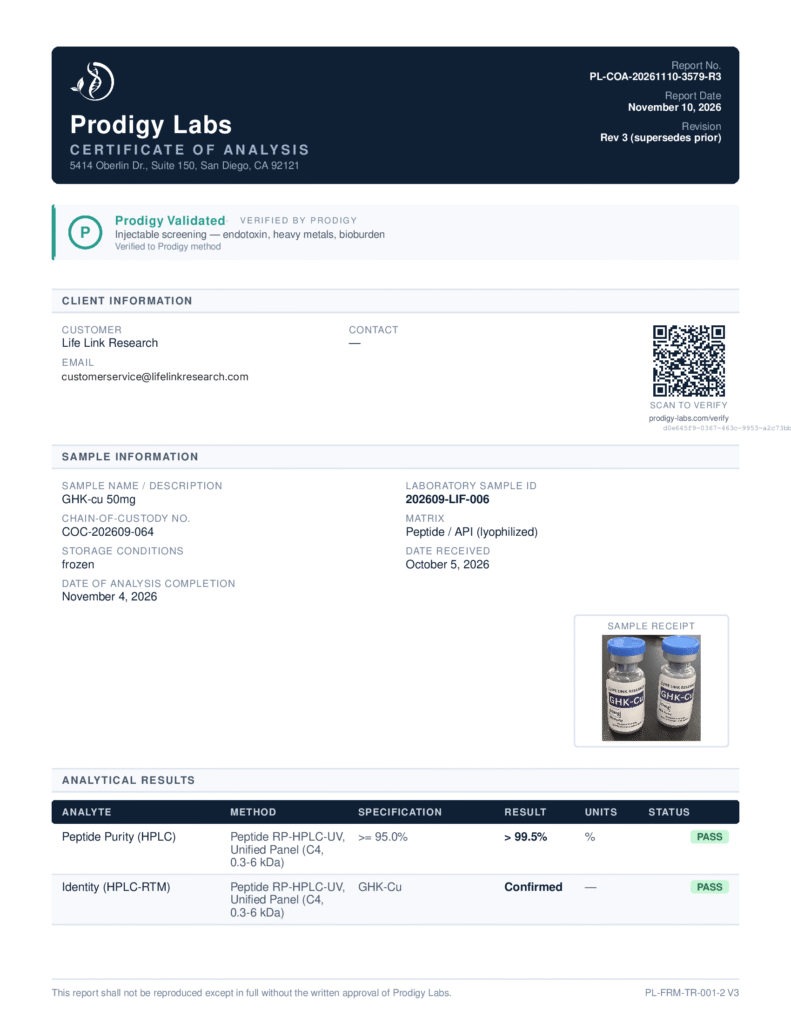
| Field | This report | What you are checking |
|---|---|---|
| Issuing lab | Prodigy Labs, San Diego, CA | A named third-party lab, with an address |
| Report number | PL-COA-20261110-3579-R3 | Traceable, marked Rev 3 as superseding earlier versions |
| Report date | November 10, 2026 | Recent enough to be meaningful |
| Sample | GHK-cu 50mg, peptide/API (lyophilized) | One compound, not “KLOW” |
| Purity, HPLC | Greater than 99.5%, specification 95.0% or higher | The result, and the bar it met |
| Identity | HPLC retention-time matching, confirmed | Which technique established it |
Two details in that last row repay attention. Identity was established by retention-time matching against a reference standard rather than by mass spectrometry, which is the calibration point above in practice. And the lab’s specification is 95% while the result clears 99%, so the figure to quote is the measured one, with the lab and date attached.
Four vials means four of these, often from different runs with different dates. That is normal for a kit; what you check is that none is missing. Before trusting any of it, learn to verify a peptide COA against the issuing lab, and get HPLC purity explained so the percentages mean something.
What Does Published Research Say About KLOW?
Quick answer: No published study has tested the four-compound KLOW combination. Each component has its own literature, almost entirely in cell and animal models. Claims about what KLOW “does” stitch together separate single-compound findings, which is not evidence for the combination.
That absence is the real answer to most KLOW questions, and Google’s own AI Overview says the same: no trials establish the blend as a whole, and what exists is preclinical or isolated-component work.
Searching compound by compound returns four reading lists built over very different timescales. GHK goes back to its isolation from human serum in 1973; the other three are measured in years, and none of those studies ran the rest alongside it. That makes KLOW a choice with open questions attached rather than a validated formulation.
Do You Need a Prescription for KLOW? Is It Legal in the US?
Quick answer: KLOW is not an FDA-approved drug, so there is no prescription version. Its components are sold as research reagents for laboratory use only. A federal policy issued on October 28, 2026 covers three of KLOW’s four components individually and excludes multi-ingredient products, so it does not reach the blend.
This section moved in November 2026, so the detail repays getting right.
HHS published an interim enforcement-discretion policy on October 28, 2026 for six peptide bulk drug substances compounded under section 503A: BPC-157, Epitalon, KPV, MOTS-c, Semax and TB-500. Three of KLOW’s four are named. GHK-Cu, the largest part by weight, is not among the six.
Two things keep this from being an approval. The policy creates no legal status, as Holland & Knight attorneys Sara M. Klock, Michael J. Werner, Sarah Starling Crossan and Andrew I. Namkung write: “The Policy does not add any peptide to the 503A Bulks List, and compounded products made under it remain unapproved drugs” (Holland & Knight, November 4, 2026). Foley & Lardner attorneys William E. Holtz, Nathan A. Beaver and David L. Rosen read it the same way, noting it “does not add these substances to the 503A bulks list or constitute FDA approval of the compounded products” (Foley & Lardner, October 30, 2026).
The conditions also rule out blends by design: discretion applies only where ten are met, among them that the product contain just one active ingredient from the list.
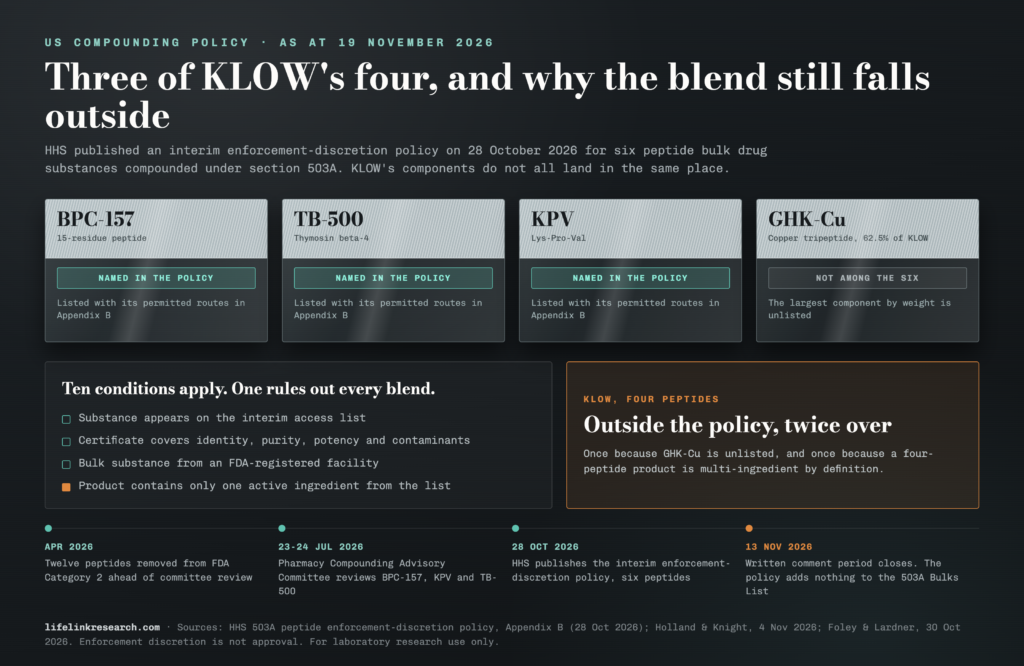
So KLOW falls outside that policy twice: once because GHK-Cu is unlisted, and once because a four-peptide product is multi-ingredient by definition. One component’s path through all of this is traced in BPC-157 legal status. A research-use-only label describes what material is sold for and carries no approval.
How Should KLOW Be Stored?
Quick answer: Store lyophilized KLOW at -20°C, protected from light and moisture. Let vials reach room temperature before opening so condensation does not settle on the powder, and avoid repeated freeze-thaw.
Lyophilized means freeze-dried: water removed under vacuum, leaving a dry cake that keeps far longer than anything in solution. Moisture is the main thing to keep out, and it gets in through a cold vial opened straight from the freezer.
A kit adds a housekeeping job: store all four vials together, label the box with the batch numbers, and keep a copy of each certificate with it. Freezer choice, light exposure and handling get more room in the lyophilized storage guide.
Why Don’t Research Suppliers Publish KLOW Dosing?
Quick answer: KLOW is not approved for human or animal use, so responsible suppliers publish no dosing. Study design belongs in the primary literature and in a laboratory’s own protocols.
The tables floating around online come from clinics and social media, not from suppliers. A supplier publishing one would be presenting its vials for use in people, which is precisely what a research-use-only label says they are not for.
A supplier’s job stops at documenting what is in the vial: identity, purity, content and storage. The four components also differ in mass and stability, so one set of numbers covering all four would be arithmetic dressed up as a protocol.
How Much Does KLOW Cost, and Where Can You Buy It in the US?
Quick answer: US suppliers list single-vial KLOW 80mg blends at roughly $85 to $200 (November 2026). Four-vial kits cost more because every compound is synthesized, tested and certified on its own. Compare price per milligram of verified compound, not price per vial.
Prices checked 19 November 2026. They move, so re-check before buying.
| Format | Price (November 2026) | What you get |
|---|---|---|
| Single blended 80mg vial | $94.99 (Prism Labs) to $200.00 (American Peptides); Averix Labs and Midwest Peptide $119.99 | One vial, often one combined COA line |
| Membership pricing | $84.99 per vial on a $497 membership (Kylo Peptides) | One vial, plus the membership |
| Four-vial kit (Life Link) | $376.20 | Four vials, a certificate for each compound |
| The same four vials bought singly (Life Link) | $396.00 | Four vials, without the kit discount |
The spread between $94.99 and $200 for the same stated composition is the whole argument for reading certificates. A blended vial at the low end can be a sound purchase if its certificate names all four compounds with individual results; a cheap vial carrying one “99%” line leaves you paying for a number attached to nothing. The TB-500 naming issue bites here too, since both molecules can print “TB-500 10mg”.
So divide the price by the milligrams each certificate confirms. Price is only one filter, and choosing a US supplier weighs stock location, lab independence and certificate currency alongside it. The KLOW kit (four vials, four COAs) ships from US stock in California, each component’s certificate linked on its product page.
KLOW Peptide FAQs
What is a KLOW peptide stack?
A KLOW peptide stack is the four KLOW peptides, GHK-Cu, BPC-157, TB-500 and KPV, supplied together, usually at 50mg, 10mg, 10mg and 10mg. Sellers use “stack” for a blended vial and for a boxed set of four, so check the format first.
Is KLOW one vial or four?
Both exist, and the difference is format rather than ingredients. A KLOW blend is all four peptides freeze-dried into one vial with a single certificate. A KLOW kit is four vials, each with its own certificate and batch number, and that is what Life Link supplies. Those trade-offs run through blends vs single vials.
Is there a GHK-Cu and KPV blend?
Not as a standalone two-peptide product. Both come within the KLOW kit alongside BPC-157 and TB-500, each vial carrying its own certificate, which also lets you work with any pair at any ratio.
Which is better, KLOW or GLOW?
Neither, because they answer different questions. GLOW contains GHK-Cu, BPC-157 and TB-500 at 70mg. KLOW adds 10mg of KPV for 80mg: one more compound, one more identity to verify. They share 75% of their composition by mass.
Is KLOW a brand name?
No. KLOW is a market nickname assembled from its ingredients, GLOW plus KPV. Nobody owns it and no regulator has reviewed a product under that name, so the contents line and certificate tell you more than the title.
Is KLOW legal in the US?
KLOW’s components are sold in the US as research reagents for laboratory use only, and none is an FDA-approved drug. The October 2026 HHS policy names three of the four, excludes GHK-Cu, and applies only to single-ingredient compounded products.
Can you buy the KLOW components separately?
Yes. The copper tripeptide ships alone as GHK-Cu, and BPC-157 10mg matches the kit’s label amount. TB-500 10mg is full-length thymosin beta-4, and KPV 10mg completes the four.
What should a KLOW COA show?
Four compounds, each with its own identity and purity result, a batch number matching your vials, and the issuing lab named. One combined percentage cannot show every compound is present, because detector response differs between molecules.
References
- GHK-Cu 1:1 complex: PubChem CID 165429100. Free GHK: CID 73587.
- BPC-157: PubChem CID 9941957.
- Thymosin beta-4: PubChem CID 45382195.
- KPV: PubChem CID 125672.
- Hureau C. et al., copper coordination in GHK. Chemistry: A European Journal, 2011. PMID 21780203.
- HHS, 503A peptide enforcement-discretion policy, Appendix B, October 28, 2026. hhs.gov.
- Mant C.T. and Hodges R.S., HPLC analysis and purification of peptides. PMC7119934.
For Research Use Only. Not for use in diagnostic or therapeutic procedures. KLOW and its four components are laboratory reagents for in-vitro research by qualified professionals, with no FDA approval, and are not for human or veterinary use. Life Link publishes the full terms in its research disclaimer.
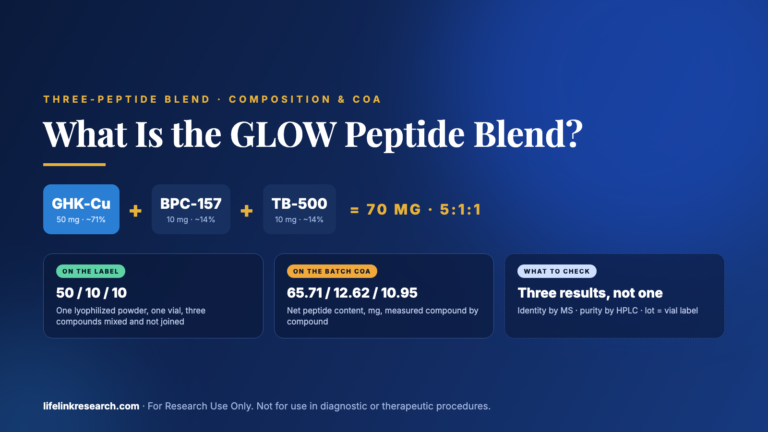
What Is the GLOW Peptide Blend? Composition, Ratio & COA
Quick Answer The GLOW peptide blend is a 70mg research preparation of GHK-Cu 50mg, BPC-157 10 mg, and TB-500 10mg, a 5:1:1…
Read article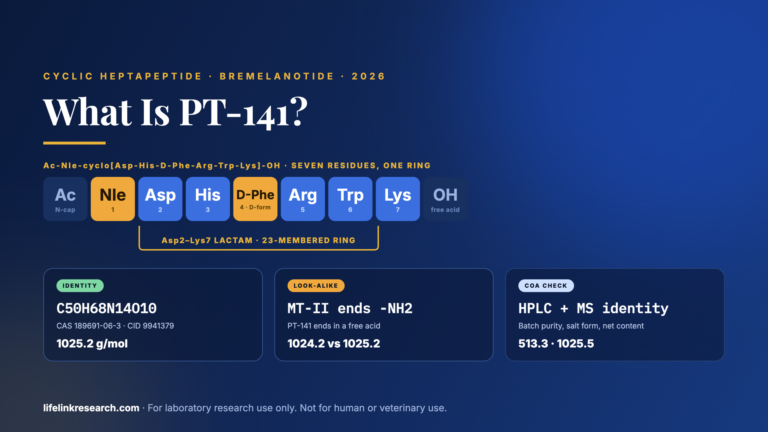
What Is PT-141 (Bremelanotide)? Structure, Receptors & COA
Quick Answer PT-141 is the research code for bremelanotide, a synthetic cyclic peptide studied at melanocortin receptors. Seven amino acids, one ring,…
Read article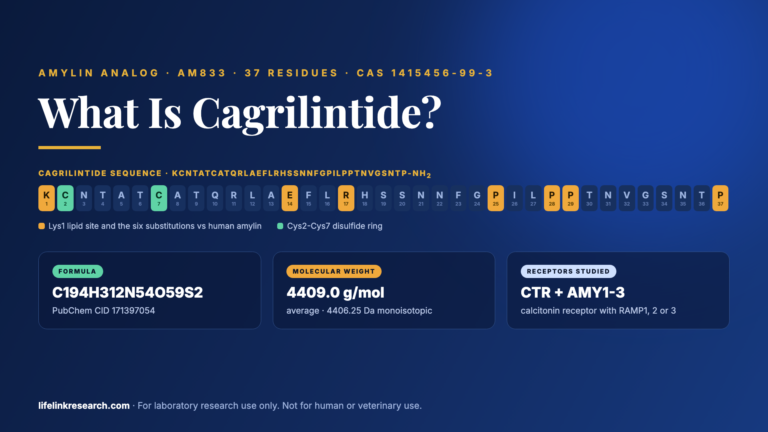
What Is Cagrilintide? Structure, Sequence & COA
Quick Answer Cagrilintide is a synthetic amylin analog developed by Novo Nordisk under the code AM833. If you have a vial on…
Read articleResearch-grade peptides
99%+ purity. Verified every batch.
Identity and purity tested on every batch by third-party labs, Janoshik Analytical and US-based laboratories. Shipped same day from California.
Shop all peptides