
Quick Answer
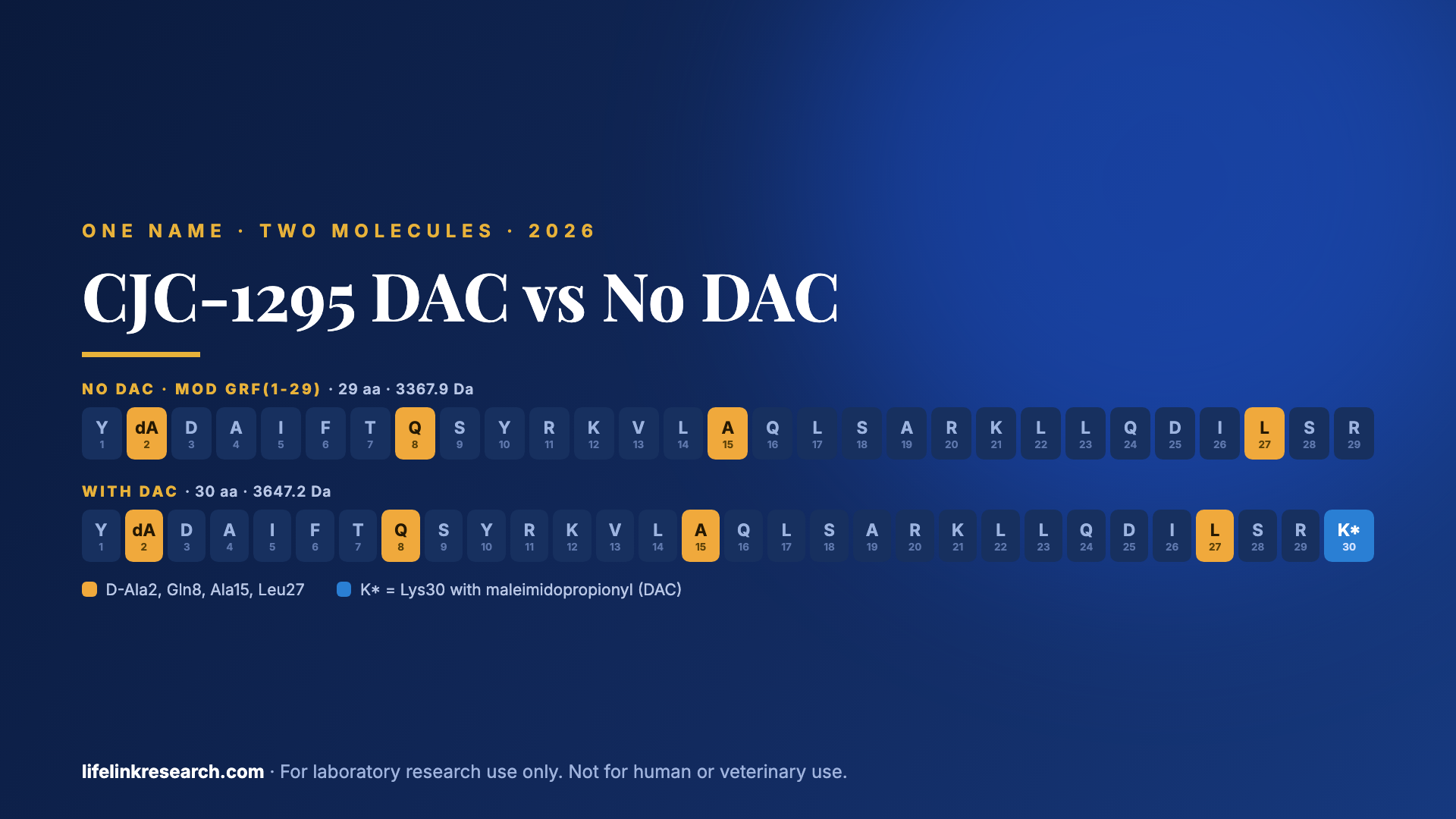
CJC-1295 with DAC and CJC-1295 without DAC (Mod GRF 1-29) share the same 29-residue GHRH(1-29) core with four substitutions: D-Ala2, Gln8, Ala15 and Leu27. The DAC form adds a 30th residue, a lysine carrying a maleimidopropionyl group that bonds to albumin. That raises the weight from 3367.9 to 3647.2 g/mol, a difference mass spectrometry reads clearly.
Key takeaways
- Both forms share the tetrasubstituted GHRH(1-29) sequence: D-Ala2, Gln8, Ala15, Leu27
- With DAC: 30 residues, C165H269N47O46, 3647.2 g/mol, CAS 446262-90-4
- Without DAC (Mod GRF 1-29): 29 residues, C152H252N44O42, 3367.9 g/mol, CAS 863288-34-0
- The DAC linker is a maleimidopropionyl group on Lys30 that reacts with albumin Cys34
- Only a mass-spec result on the COA shows which form a vial holds
CJC-1295 with DAC is a 30-residue GHRH analog carrying an albumin-reactive linker. CJC-1295 without DAC, better known as Mod GRF(1-29), is the same 29-residue core with no linker at all. One name, two molecules, separated by a single lysine and a small chemical hook.
That difference is easy to state and surprisingly easy to lose on a label. In the CJC-1295 DAC vs no DAC comparison, the two forms differ by about 279 Da, carry different CAS numbers, and need different expected masses on a COA.
This guide sets out exactly how they differ in sequence, structure, and identity data, and how to check which one a vial contains, using our CJC-1295 no DAC 5 mg as the worked example.
What’s the Difference Between CJC-1295 With DAC and Without DAC?
Quick answer: Both are synthetic analogs of GHRH(1-29) with the same four amino-acid substitutions. CJC-1295 with DAC adds a 30th residue, a lysine carrying a maleimidopropionyl group, which bonds covalently to albumin. CJC-1295 without DAC, also called Mod GRF(1-29), has no linker. They differ in formula, molecular weight (about 3647 vs 3368 Da), and CAS number.
| Property | With DAC | Without DAC (Mod GRF 1-29) |
| Length | 30 residues | 29 residues |
| C-terminus | Lys30 amide, side chain modified | Arg29 amide |
| Albumin linker | Maleimidopropionyl group on Lys30 | None |
| Formula | C165H269N47O46 | C152H252N44O42 |
| Molecular weight | 3647.2 g/mol | 3367.9 g/mol |
| CAS | 446262-90-4 | 863288-34-0 |
| PubChem CID | 91971820 | 56841945 |
| Name origin | ConjuChem development code | Supplier name for the unlinked core |
| Receptor | GHRH receptor | GHRH receptor |
Everything above the linker row is identical chemistry. Everything below it follows from one extra residue.
What Is CJC-1295 Without DAC (Mod GRF 1-29)?
Quick answer: CJC-1295 without DAC is a 29-amino-acid analog of GHRH(1-29) with four substitutions (D-Ala2, Gln8, Ala15, Leu27) that make it more resistant to enzymatic breakdown in assays than the native sequence. It is also called Mod GRF(1-29) or tetrasubstituted GRF(1-29). It binds the GHRH receptor and carries no albumin-binding linker.
Full Sequence
Tyr-D-Ala-Asp-Ala-Ile-Phe-Thr-Gln-Ser-Tyr-Arg-Lys-Val-Leu-Ala-Gln-Leu-Ser-Ala-Arg-Lys-Leu-Leu-Gln-Asp-Ile-Leu-Ser-Arg-NH2In one-letter code, that’s Y(D-A)DAIFTQSYRKVLAQLSARKLLQDILSR-NH2. The C-terminal amide matches native GHRH(1-29)-NH2, and the D-alanine at position 2 is the only non-standard residue.
Formula, MW, CAS
PubChem CID 56841945 lists the 29-residue structure as C152H252N44O42, with a molecular weight of 3367.9 g/mol and a monoisotopic mass of 3365.89 Da. That record carries CAS 863288-34-0. No sulfur appears in the formula because the one methionine of the native sequence has been replaced.
Why the Four Substitutions Make Chemical Sense
Each change removes a known weak point in the native sequence:
- D-Ala2: the enzyme DPP-IV clips GHRH between positions 2 and 3. A D-amino acid at position 2 resists that cut.
- Gln8: native Asn8 can deamidate, slowly turning into aspartate or iso-aspartate in solution. Glutamine is far less prone to it.
- Ala15: native Gly15 is flexible. Alanine favours the helix this region forms when it binds the receptor.
- Leu27: native Met27 oxidises easily to methionine sulfoxide. Leucine has a similar shape and no sulfur to oxidise.
What Is CJC-1295 With DAC?
Quick answer: CJC-1295 with DAC is the same tetrasubstituted GHRH(1-29) sequence plus a C-terminal lysine whose side chain carries a maleimidopropionyl group, the “drug affinity complex”. In the original ConjuChem design, this maleimide forms a covalent bond with the free cysteine (Cys34) of serum albumin. It has 30 residues and a molecular weight of about 3647 Da.
The DAC Linker: Maleimidopropionyl-Lysine
The linker is small. A lysine is added as residue 30, and its side-chain amine (the ε-nitrogen) is acylated with 3-maleimidopropionic acid. That leaves a maleimide ring, a five-membered ring with a reactive carbon-carbon double bond, pointing away from the peptide. The C-terminus stays amidated.
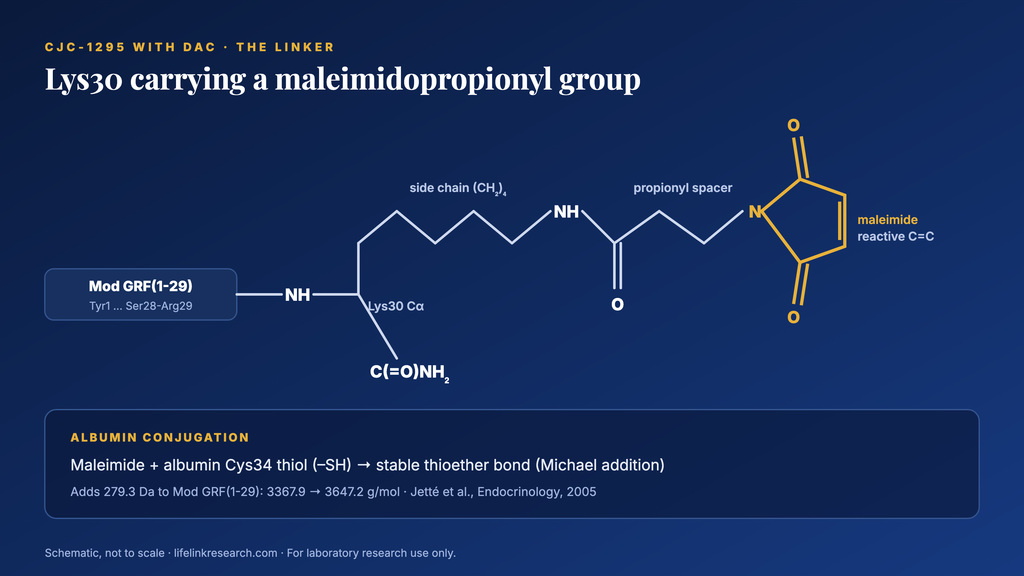
The DAC linker on Lys30: a maleimidopropionyl group attached to the lysine side chain.
The maleimide does all the chemistry. The rest of the molecule is the same Mod GRF(1-29) core described above.
Albumin Cys34 Conjugation
Serum albumin carries one free thiol, on cysteine 34. Maleimides react with thiols in a Michael addition, forming a stable thioether bond. ConjuChem’s team built CJC-1295 around exactly that reaction, placing the maleimide where it could reach Cys34 without blocking the receptor-binding end, as Jetté and colleagues described in 2005. That paper combined ex vivo conjugation to human serum albumin with a rat study, and it is where the CJC-1295 name first appears in the literature.
Formula, MW, CAS
PubChem CID 91971820 lists CJC-1295 with DAC as C165H269N47O46, 3647.2 g/mol, with a monoisotopic mass of 3645.02 Da and CAS 446262-90-4.
Sequence Comparison: Sermorelin vs Mod GRF 1-29 vs CJC-1295 DAC
All three share the same 29-residue backbone. Only five positions change across them:
| Position | Sermorelin, GHRH(1-29) | Mod GRF(1-29), no DAC | CJC-1295 with DAC |
| 1 | Tyr | Tyr | Tyr |
| 2 | Ala | D-Ala | D-Ala |
| 3 to 7 | Asp-Ala-Ile-Phe-Thr | same | same |
| 8 | Asn | Gln | Gln |
| 9 to 14 | Ser-Tyr-Arg-Lys-Val-Leu | same | same |
| 15 | Gly | Ala | Ala |
| 16 to 26 | Gln-Leu-Ser-Ala-Arg-Lys-Leu-Leu-Gln-Asp-Ile | same | same |
| 27 | Met | Leu | Leu |
| 28 to 29 | Ser-Arg | same | same |
| 30 | none | none | Lys(maleimidopropionyl) |
| C-terminus | Amide | Amide | Amide |
| Formula / MW | C149H246N44O42S / 3357.9 | C152H252N44O42 / 3367.9 | C165H269N47O46 / 3647.2 |
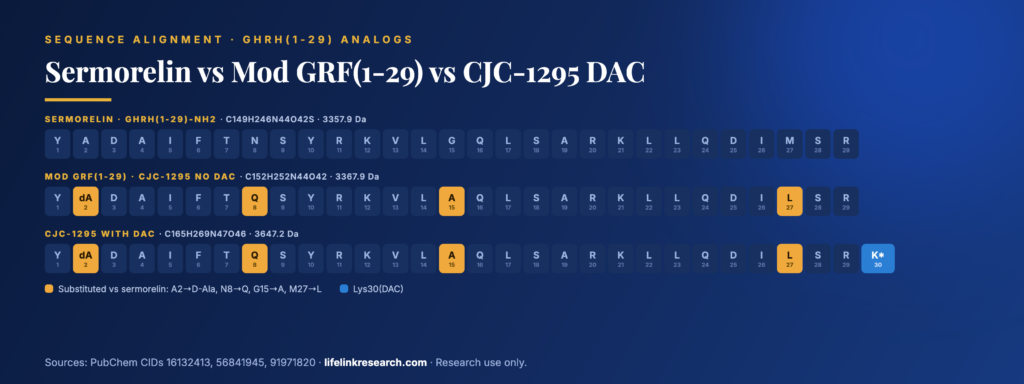
Sermorelin, Mod GRF(1-29) and CJC-1295 with DAC aligned residue by residue, with the changed positions highlighted.
Sermorelin is the unmodified 1-29 sequence, with formula and weight from PubChem CID 16132413. The no-DAC form is therefore a separate molecule, about 10 Da heavier and sulfur-free. For a wider look at sermorelin, see ipamorelin vs sermorelin.
Why Is “CJC-1295” Confusing? Naming Explained
Quick answer: “CJC-1295” was originally the name of the DAC-linked molecule developed by ConjuChem. Suppliers later began selling the unlinked Mod GRF(1-29) as “CJC-1295 no DAC”, so one name now covers two compounds. Always confirm the form by molecular weight on the COA: about 3647 Da with DAC and about 3368 Da without.
| Name on a label | Which molecule | Expected MW |
| CJC-1295 | Usually with DAC, but check | 3647.2 or 3367.9 |
| CJC-1295 DAC | With DAC | 3647.2 |
| CJC-1295 no DAC | Without DAC | 3367.9 |
| Mod GRF(1-29) | Without DAC | 3367.9 |
| Modified GRF 1-29 | Without DAC | 3367.9 |
| Tetrasubstituted GRF(1-29) | Without DAC | 3367.9 |
The confusion began when suppliers kept the familiar CJC-1295 name for the shorter, unlinked peptide. Even public databases trip over this. PubChem holds two records with the 29-residue formula, and both list “with DAC” and “without DAC” among their synonyms. The formula and weight are the reliable part of each record; the synonym lists are supplied by depositors.
How Do Their Half-Lives Compare in Published Studies?
Quick answer: Published figures differ by orders of magnitude. A human pharmacokinetic study of CJC-1295 with DAC (Teichman et al., 2006) reported an estimated half-life of 5.8 to 8.1 days, linked to albumin binding. Mod GRF(1-29) without DAC is usually described as having a half-life of about 30 minutes, a figure often stated without a primary source.
The Teichman figure comes from two randomized, placebo-controlled trials in healthy adults, with the half-life estimated from plasma concentrations of the peptide. We couldn’t trace the 30-minute figure to a pharmacokinetic study of Mod GRF(1-29) itself, so treat it as an approximation. For how these numbers compare with ipamorelin’s, see our CJC-1295 vs ipamorelin half-life comparison.
How to Tell Them Apart on a COA
Quick answer: Mass spectrometry is the clearest check. CJC-1295 without DAC should show a mass near 3368 Da, and CJC-1295 with DAC near 3647 Da, about 279 Da higher because of the extra lysine and maleimidopropionyl group. HPLC purity alone can’t separate the two forms, so a COA must report an MS result that matches the label.
Expected MS Masses and Charge States
Electrospray ionisation adds several protons to a peptide this size, so the spectrum shows a ladder of multiply charged ions, one for each charge state. Dividing (mass + charge × 1.007) by the charge gives the expected positions:
| Ion | Without DAC (3367.9) | With DAC (3647.2) |
| [M+3H]³⁺ | m/z ≈ 1123.6 | m/z ≈ 1216.7 |
| [M+4H]⁴⁺ | m/z ≈ 843.0 | m/z ≈ 912.8 |
| [M+5H]⁵⁺ | m/z ≈ 674.6 | m/z ≈ 730.4 |
Labs then convert the ladder back to one mass. On our earlier MZ Biolabs report pictured below, the no-DAC sample showed ions at m/z 1123.3, 842.7, and 674.4, and a measured monoisotopic mass of 3365.93 Da against 3365.89 expected. Our guide to HPLC vs mass spectrometry explains the method.
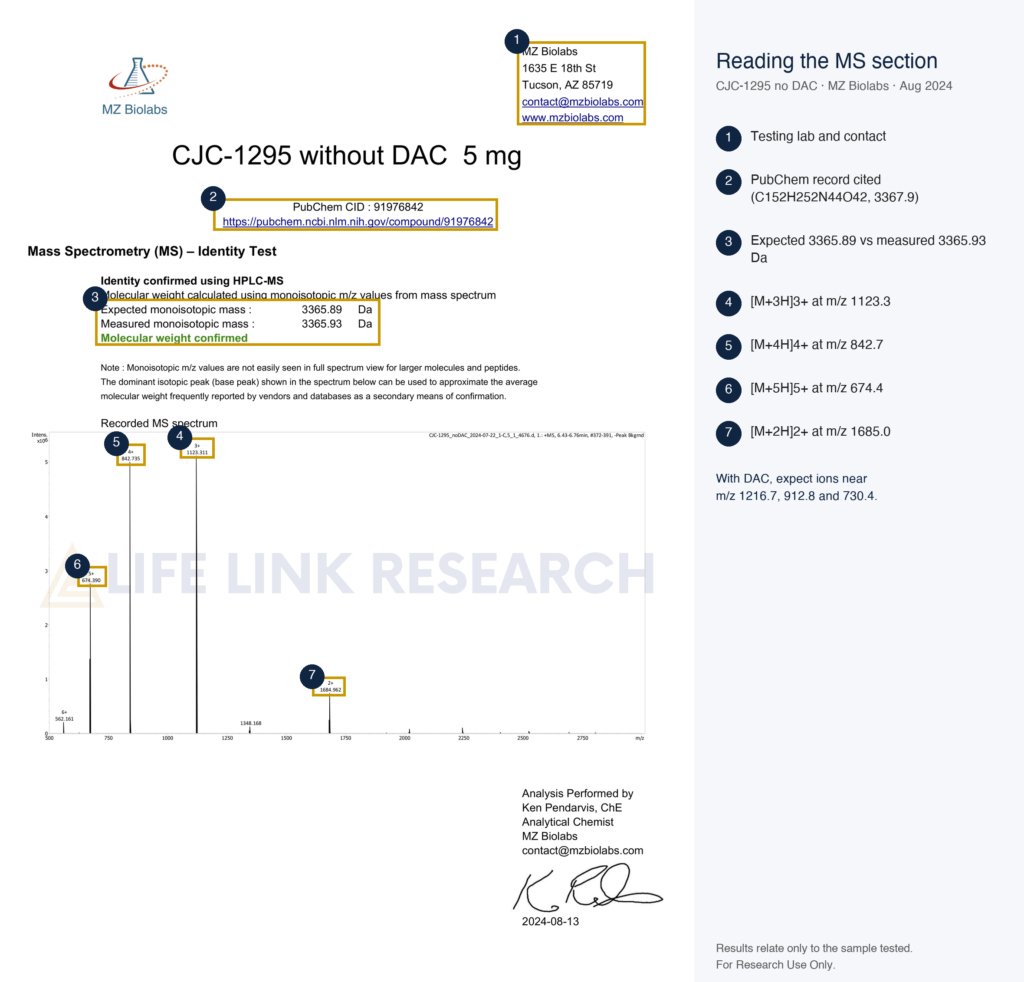
Mass-spec identity section from a Life Link Research CJC-1295 no DAC COA (MZ Biolabs), with each charge state labelled.
HPLC Purity and Retention
HPLC gives purity as the main peak’s share of total area. Our current no-DAC report from Prime Analytical Laboratories, dated 5 May 2026, shows the main peak at 6.317 minutes with 99.30% of the area. The DAC form’s extra hydrophobic linker would shift its retention time, though only a side-by-side run on the same method can show by how much. That’s why purity and identity are separate lines on a good report: one says how clean the sample is, the other says what it is.
Label, Lot and Lab Checks
A CJC-1295 COA should name the form exactly, “no DAC” or “with DAC”, and the vial label should use the same wording. A report that just says “CJC-1295” leaves the main question open, so the MS result has to answer it. Then match the lot number, check the test date, and verify the report with the named lab. Our guide on how to verify a peptide COA covers all six checks.
Receptor Target: GHRH-R
Quick answer: Both forms bind the growth-hormone-releasing hormone receptor (GHRH-R), a class B G-protein-coupled receptor that signals through cAMP. In vitro, both are studied with receptor-binding and cAMP-accumulation assays. The DAC linker doesn’t change the receptor target; it changes how the molecule behaves in albumin-containing systems.
A common set-up compares cells engineered to express human GHRH-R with the parent cell line that lacks it, so any cAMP signal can be tied to the receptor. In practice, assay buffers deserve attention too. A medium containing albumin can capture the DAC form through Cys34, while the no-DAC form stays free, so the two can behave differently in the same cell assay.
CJC-1295 No DAC and Ipamorelin as a Blend
The no-DAC form often appears in a 5/5 mg blend with ipamorelin, and the reason is receptor classes. CJC-1295 no DAC binds GHRH-R, a class B GPCR. Ipamorelin, a pentapeptide (Aib-His-D-2-Nal-D-Phe-Lys-NH2), binds the ghrelin receptor GHSR-1a, a class A GPCR. Two receptor families, one vial. Its COA therefore needs two identity results: the Mod GRF(1-29) mass near 3368 Da and the ipamorelin mass near 711.9 Da (C38H49N9O5, PubChem CID 9831659). Our CJC-1295 / Ipamorelin blend 5/5 mg holds 5 mg of each, and the guide to what is Ipamorelin covers its structure.
Is CJC-1295 FDA Approved?
Quick answer: No. As of 31 October 2026, neither CJC-1295 with DAC nor Mod GRF(1-29) is an FDA-approved drug. Both are sold in the US for laboratory research use only.
- Drug records: the FDA’s openFDA drug database returns no application for either form.
- Compounding: the FDA’s bulk drug substances page, current as of 22 April 2026, lists CJC-1295 among nominations that were withdrawn.
- Sport: the WADA 2026 Prohibited List names GHRH and its analogues, including CJC-1295 and sermorelin, under section S2.2.4.
- Research supply: both forms are sold as research chemicals for in-vitro laboratory work, under research-use terms.
FAQs
Is CJC-1295 no DAC the same as Mod GRF 1-29?
Yes. “CJC-1295 no DAC” and Mod GRF(1-29) describe the same 29-residue peptide: GHRH(1-29) with D-Ala2, Gln8, Ala15 and Leu27, and a C-terminal amide. Its formula is C152H252N44O42, and its molecular weight is 3367.9 g/mol. “Tetrasubstituted GRF(1-29)” is a third name for it.
Is CJC-1295 no DAC the same as sermorelin?
No. Sermorelin is native GHRH(1-29) with no substitutions, formula C149H246N44O42S and weight 3357.9 g/mol. CJC-1295 no DAC changes four positions, removing the methionine at position 27 and its sulfur. A mass spectrometer separates them by about 10 Da.
What does DAC stand for in CJC-1295?
DAC stands for drug affinity complex. In CJC-1295, it’s an extra lysine at position 30, acylated on its side-chain amine with 3-maleimidopropionic acid. The maleimide reacts with the free thiol on cysteine 34 of serum albumin, forming a covalent thioether bond.
What is the molecular weight of CJC-1295 with and without DAC?
CJC-1295 with DAC weighs 3647.2 g/mol (C165H269N47O46, CAS 446262-90-4). CJC-1295 without DAC weighs 3367.9 g/mol (C152H252N44O42, CAS 863288-34-0). The 279 Da difference comes from the added lysine and its maleimidopropionyl group.
How can a COA show which CJC-1295 form is in a vial?
Look for a mass-spec result. The no-DAC form gives a mass near 3368 Da, with ions near m/z 1124, 843, and 675. The DAC form gives about 3647 Da, with ions near m/z 1217, 913, and 730. An HPLC percentage alone can’t tell the forms apart.
Does Life Link sell CJC-1295 with DAC?
Our catalogue carries the no-DAC form only: CJC-1295 no DAC 5 mg on its own and the CJC-1295 / Ipamorelin 5/5 mg blend. Each comes with a third-party batch COA, and earlier reports for the same product stay on its certificate page.
Buy CJC-1295 No DAC With a Batch COA
Our CJC-1295 no DAC comes as 5 mg of Mod GRF(1-29) per vial, with the blend available as a second option. Identity and purity are tested on every batch through independent labs, and current and earlier reports are kept on each product’s certificate page. To find the batch COA, open the product, click View report, and match the batch number to the vial label. Orders placed before 2 PM PST ship the same day from California by UPS 2-Day Air.
For Research Use Only. Not for use in diagnostic or therapeutic procedures.
All products are supplied for in-vitro laboratory research by qualified professionals. Read the full research use disclaimer.
References
- PubChem CID 91971820, CJC-1295 with DAC: https://pubchem.ncbi.nlm.nih.gov/compound/91971820
- PubChem CID 56841945, Mod GRF(1-29): https://pubchem.ncbi.nlm.nih.gov/compound/56841945
- Jetté et al., Endocrinology, 2005 (PMID 15817669): https://pubmed.ncbi.nlm.nih.gov/15817669/
- PubChem CID 16132413, sermorelin: https://pubchem.ncbi.nlm.nih.gov/compound/16132413
- Teichman et al., J Clin Endocrinol Metab, 2006 (PMID 16352683): https://pubmed.ncbi.nlm.nih.gov/16352683/
- PubChem CID 9831659, ipamorelin: https://pubchem.ncbi.nlm.nih.gov/compound/9831659
- FDA, bulk drug substances for compounding (current as of 22 April 2026): https://www.fda.gov/drugs/human-drug-compounding/certain-bulk-drug-substances-use-compounding-may-present-significant-safety-risks
- WADA Prohibited List 2026, section S2.2.4: https://www.wada-ama.org/en/prohibited-list
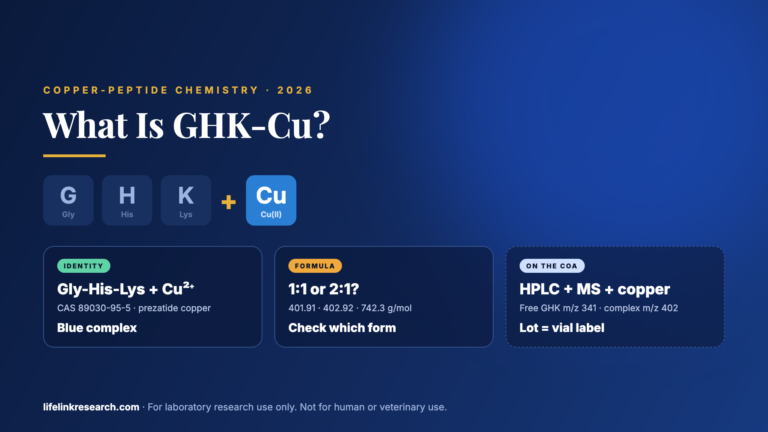
What Is GHK-Cu? Copper-Peptide Chemistry, Structure & COA
Quick Answer GHK-Cu is the copper(II) complex of the tripeptide glycyl-L-histidyl-L-lysine (Gly-His-Lys). The peptide holds one Cu²⁺ ion through three nitrogen atoms,…
Read article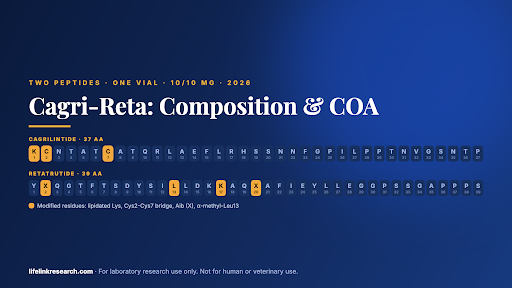
Cagri-Reta (Cagrilintide + Retatrutide): Composition, Structure & COA
Quick Answer Cagri-Reta is a research blend of two synthetic peptides in one vial: cagrilintide, a long-acting amylin analog (4409.0 g/mol), and…
Read article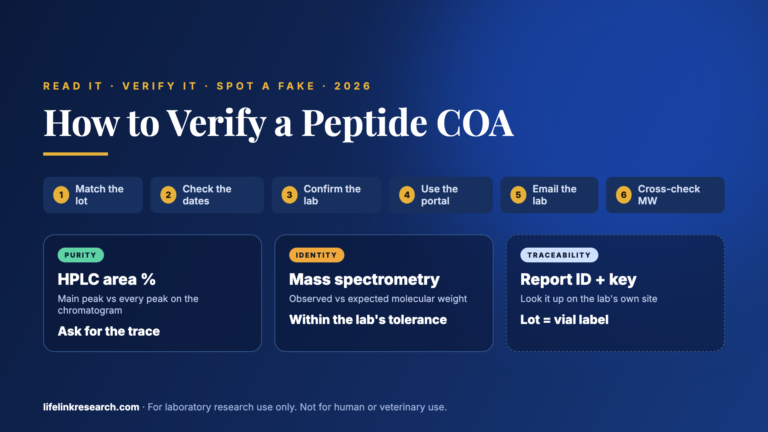
How to Verify a Peptide COA Is Real (and Spot a Faked One)
Quick Answer To verify a peptide COA, check the vial’s lot number against the report, confirm the named lab exists and is…
Read articleResearch-grade peptides
99%+ purity. Verified every batch.
Identity and purity tested on every batch by third-party labs, Janoshik Analytical and US-based laboratories. Shipped same day from California.
Shop all peptides