
📌 Quick Answer
The best US peptide supplier keeps its stock in the US and posts a Certificate of Analysis (COA) from an outside lab for every batch, which you can confirm on that lab’s own site. Those reports confirm 99%+ purity by HPLC and identity by mass spectrometry. Every product is labeled research use only, and the company shows a registered business, written payment and refund policies, and real contact details.
📌 Key Takeaways
• Records you can look up count for more than any marketing line.
• A strong COA names an outside lab, matches the batch on your vial and verifies on the lab’s own site.
• Purity (HPLC) and identity (mass spec) answer two different questions, so you want both.
• Genuine US suppliers publish company details, a US dispatch point and written policies.
• Dosing charts, “protocols” and human-use claims are the clearest red flags.
The supplier list most US labs relied on in 2024 doesn’t exist anymore. Amino Asylum went offline in 2025, Science.bio announced its closure in January 2026, and Peptide Sciences shut its doors on March 6, 2026. Between March and August, the FDA posted warning letters to more than a dozen other sellers. Plenty of researchers switching suppliers are now starting from a blank page.
So where does that leave anyone looking for the best US peptide supplier when half the old names are gone? You check the evidence, and you let the rankings go. Lists of the top research peptide companies in the USA tend to be written by the companies themselves. This guide gives you a 10-point check that takes about ten minutes and leans on public records anyone can open.
It covers sourcing for research-use-only laboratory materials. In the interest of transparency, it’s written by the team at Life Link Research, and the final section runs our own batch through the same test.
In this guide
- What makes a supplier trustworthy
- Types of US peptide suppliers
- The 10-point checklist
- How to tell if a supplier is legit
- Red flags
- What Reddit researchers check
- Suppliers after the 2025-2026 shutdowns
- Legal status in the US
- Where to buy safely
- Popular compounds and their COAs
- Wholesale orders
- How Life Link meets these standards
- FAQs
What Makes a Peptide Supplier Trustworthy?
📌 Quick answer: A peptide supplier earns trust by handing over evidence that outside records confirm. Look for testing by an independent lab, a COA for each batch that the lab itself can confirm, a registered company with written policies, and product pages limited to chemistry, storage and a research-use notice.
Anyone can type “99% pure” on a product page. It costs nothing and proves nothing. A trustworthy supplier hands you something you can test against an outside record, and then it passes that test.
If you’re new to the category, start with what research peptides are. Then judge every supplier on three pillars:
- Testing evidence. Independent lab reports tied to the exact batch you’ll receive.
- Business transparency. A company on file with a state, a street address, written policies and someone who replies to email.
- Compliance. Product pages describe chemistry and storage, and they stop there.
Each of the ten checks below protects one of these pillars. A supplier that’s strong on two and missing the third still isn’t ready for your lab.
The pillars also catch problems at different speeds. Testing evidence shows up in the first COA you open. Business gaps tend to appear the first time a parcel goes missing. Compliance problems often stay hidden until a warning letter lands, and by then your supplier may already be gone.
What Types of US Peptide Suppliers Are There?
📌 Quick answer: US peptide suppliers fall into four types. US manufacturers make peptides in-house. US-stocked resellers import, test and ship from US stock. Drop-shippers send orders straight from overseas. Custom-synthesis labs make peptides to order for institutions. Each type carries different testing habits and delivery times.
Searches for the “top peptide companies in the USA” mix all four types together, which is why so many lists feel like they’re comparing apples with forklifts. A contract manufacturer that sells by the kilogram won’t take a two-vial order. A drop-shipper may list a US phone number while your parcel waits in customs.
| Supplier type | How it works | Typical testing | Delivery speed | Best for |
| US manufacturer | Synthesizes and purifies peptides in its own US facility | In-house QC, sometimes with outside checks | Days to weeks, often made to order | Large or GMP-adjacent projects |
| US-stocked reseller | Sources synthesized material, tests each batch, holds stock in the US | Third-party COA per batch when done well | 1 to 3 days domestic | Most catalog research compounds |
| Drop-shipper | Takes the order online, ships from an overseas warehouse | Often a generic or recycled COA | 1 to 4 weeks plus customs | Rarely the right choice |
| Custom-synthesis lab | Builds a sequence to your spec | Full analytical package per order | 2 to 6 weeks | Novel or modified sequences |
The US-stocked reseller is the model most research buyers end up using. It’s also the type where quality varies the most, which is why the checklist exists.
How Do You Choose a US Peptide Supplier? The 10-Point Checklist
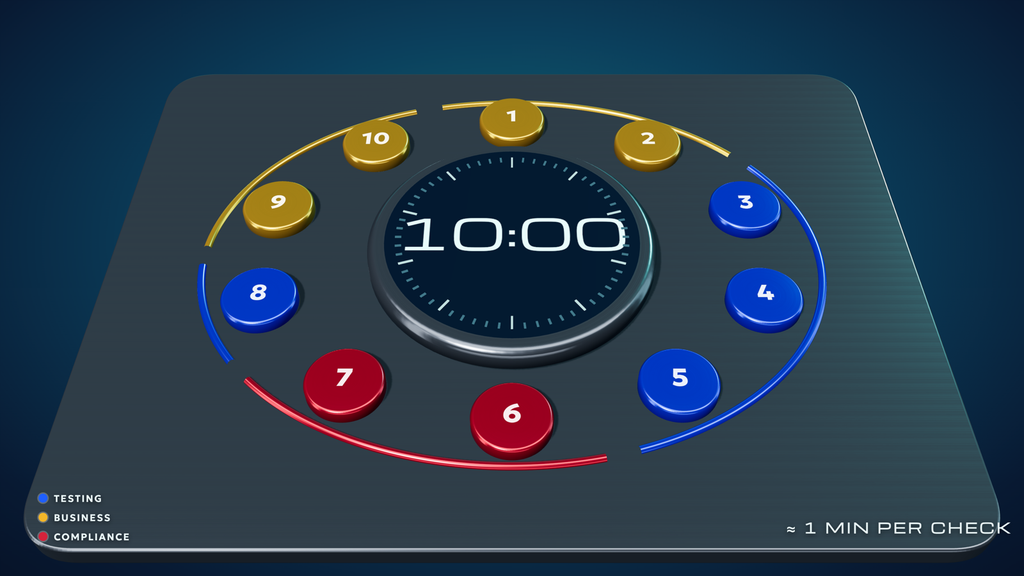
📌 Quick answer: The 10-Minute Supplier Check
1. Registered US business with verifiable details
2. US-held stock and US dispatch
3. Independent, batch-specific COAs
4. COAs that verify at the lab
5. 99%+ purity (HPLC) plus mass-spec identity
6. Research-use-only labeling
7. Complete product documentation
8. Realistic pricing
9. Mainstream payment options and a written refund policy
10. Real reviews and responsive support
Best US peptide supplier checklist 2026
Each check below opens with the short answer, explains what it protects, then gives you a 30-second test you can run right now.
1. Is the Supplier a Registered US Business?
A real supplier is an LLC or corporation with a public filing, a physical address and a business email domain.
Registration gives you a legal entity behind the storefront. When a parcel goes missing or a batch looks wrong, you know who you’re dealing with. A Gmail address and a PO box give you nothing to hold onto. You can see who we are as one example of the details to expect.
⏱ 30-second check: Search the company name on its state’s Secretary of State business search, or on OpenCorporates, which pulls filings from every US state into one search. Match the legal name to the one in the site’s footer.
2. Does It Ship From US-Held Stock?
A US-stocked supplier names its dispatch location, its carrier and a daily cut-off time.
Those three details are hard to fake for long. A drop-shipper can’t promise a 2 PM cut-off when the vial is stored in another country. Stock held in the US also means one customs-free leg, which keeps lyophilized material moving fast.
⏱ 30-second check: Look for a stated US dispatch city and a cut-off time. A good example spells out shipping times and cut-offs in plain numbers.
3. Does Every Batch Have an Independent COA?
A Certificate of Analysis (COA) reports on a single batch, and a solid one names an outside lab, a batch number and a test date.
A single “sample COA” reused across a year of stock tells you about one old vial. A batch-specific report tells you about the vial in your box. The difference between third-party vs in-house testing comes down to who has a reason to report the result straight.
⏱ 30-second check: Open the COA from the product page. Does its batch number match the batch listed on the product, and is the test date within the last year?
4. Can You Verify the COA With the Testing Lab?
A genuine COA carries a code that brings up the identical result in the lab’s database.
Editing a PDF takes about five minutes, so the PDF alone proves little. Janoshik, for instance, stamps every report with a task number plus a unique key, and the original stays on file at the lab. Faked COAs tend to share a few tells: no key, a key that returns a different compound, mismatched fonts, or a date that falls after the batch went on sale. The walkthrough on how to verify a peptide COA is real walks through each one.
⏱ 30-second check: Type the task number and unique key into Janoshik’s verification page. The compound, purity and dates should match the supplier’s copy exactly.
5. Is Purity 99%+ by HPLC, With Identity Confirmed by Mass Spec?
A complete COA answers three questions: is it the right molecule, how clean is it, and how much is in the vial?
United States Pharmacopeia scientists, writing in Pharmaceutical Research, note that peptide quality is “evaluated using a series of analytical tests… to determine identity, purity, and strength” (McCarthy et al., 2023). A research COA follows the same logic on a smaller scale.
| Question | Test | What a good result looks like |
| Purity: how clean is it? | HPLC (high-performance liquid chromatography), which separates a sample into peaks | 99% or higher for the main peak |
| Identity: is it the right molecule? | LC-MS or ESI-MS (mass spectrometry), which weighs the molecule | Measured mass lines up with the theoretical mass |
| Content: how much is there? | Quantified against a reference | At or above the labeled mg per vial |
A sample that reads 99% pure could still be the wrong peptide. That’s the reason the two tests travel together. Our breakdown of HPLC vs mass spectrometry covers the detail, along with a common follow-up: is 99% always better than 98%?
⏱ 30-second check: Find three numbers on the COA: a purity percentage, an observed mass and a measured mg figure. If one is missing, ask the supplier for the report that covers it.
6. Is Everything Labeled Research Use Only?
A compliant supplier describes compounds by chemistry, testing and storage, and publishes no dosing guides or effect claims.
The FDA decides what a product is by how it’s sold. Its 2026 warning letters, dated March 31, June 17 and August 24, cited sellers whose pages carried effect claims and who offered bacteriostatic water as a solvent alongside the vials. A “research use only” label didn’t change the outcome. See where peptides stand with the FDA in 2026 for the full picture.
⏱ 30-second check: Run the site’s search box for “dose”, “protocol” and “results”. Before-and-after photos or bundled injection supplies are an instant fail.
7. Is the Product Documentation Complete?
Every listing should show the sequence, molecular weight, CAS number, physical form, batch number and storage guidance.
Sparse listings often mean the seller barely knows the material. A documented product page such as BPC-157 10mg lists all six, down to the 1419.5 g/mol molecular weight and the CAS number 137525-51-0. You also want plain storage and handling guidance, plus a lyophilized (freeze-dried) form, which holds up far better in transit. Here’s why lyophilized beats pre-mixed.
⏱ 30-second check: Pick one product and tick off the six fields. Missing two or more is a warning sign.
8. Is the Pricing Realistic?
A price well under the US norm usually means a skipped test or a light vial.
Third-party testing, US warehousing and domestic shipping all cost money. A vial priced well under the market floor leaves very little room for any of them. Here’s what US listings looked like when we checked:
| Compound | Range across US listings (checked October 4, 2026) | Life Link price |
| BPC-157 10mg | $44 to $89.99 | $89 |
| GHK-Cu 50mg | $35 to $99.99 | $64 |
A price inside the range proves nothing on its own. A price far below it is a reason to look harder at checks 3 to 5.
⏱ 30-second check: Compare one 10mg vial against three other US listings. Anything priced under half the lowest of them needs a very good COA.
9. Are Payment Options Mainstream, With a Written Refund Policy?
A stable supplier takes cards or ACH, runs a secure checkout and publishes its refund terms.
Card processors and banks review the merchants they work with. Crypto-only or gift-card checkouts often mean a seller couldn’t pass that review. A written refund policy tells you, before you pay, what happens if a parcel arrives damaged. Check the payment options and the refund and returns policy before your first order.
⏱ 30-second check: Go to checkout without paying. Do you see card or ACH, and can you find refund terms in the footer?
10. Are There Real Reviews and Responsive Support?
Good suppliers have independent reviews, answer an email within one business day and give you a real way to reach them.
Reviews on Trustpilot or long-running forum threads carry more weight than five-star quotes on the seller’s own homepage. Support quality shows up the first time something goes wrong. Send a technical question first, such as “which lab tested batch X?”, and see how fast a clear answer arrives. You can contact a real person on our side to try it.
⏱ 30-second check: Email a question about a specific batch. A reply with the lab name and batch number within one business day is a pass.
How Do I Know If a Peptide Supplier Is Legit? (Comparison Table)
📌 Quick answer: You can confirm a peptide supplier is legit in about ten minutes. Its batch COA should match your vial and check out on the lab’s website. The company should appear in a state business registry, publish its policies, take card or ACH, and keep dosing and human-use language off every page.
Use this table side by side with any supplier’s website. Most of these checks take under a minute each.
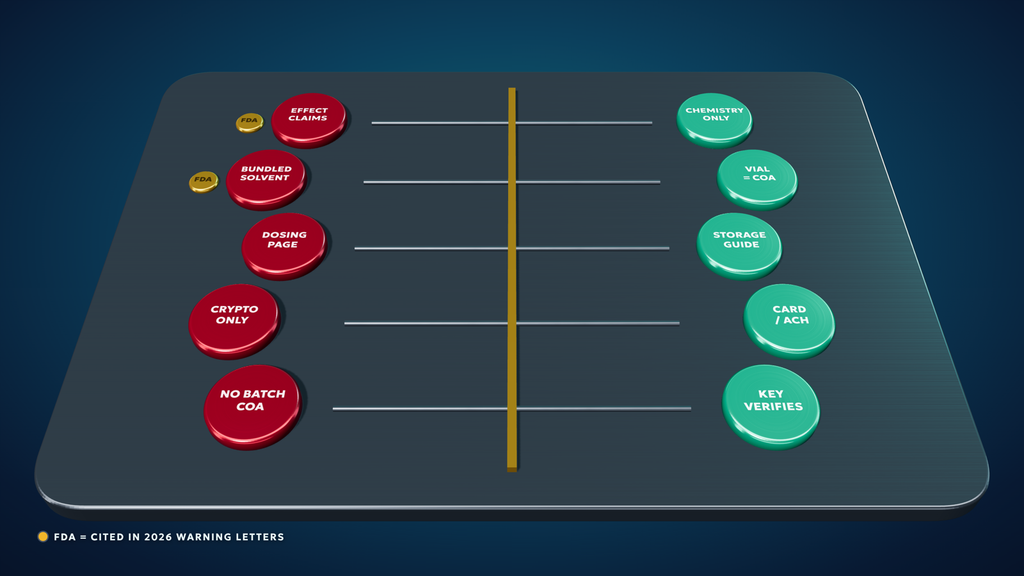
| Check | Where to find it | Green flag | Red flag |
| Business registration | State registry or OpenCorporates | Active LLC or corporation, name matches the site | No filing, or a name that doesn’t match |
| Dispatch location | Shipping policy | US city, carrier and cut-off listed | “Ships worldwide” with no origin |
| Batch COA | Product page or COA library | Batch number and test date shown | One generic COA for every batch |
| Lab verification | The lab’s own site | Task number and key verify | No key, or a key that fails |
| Purity and identity | The COA | HPLC 99%+ and a mass-spec result | Purity only, no identity data |
| Labeling | Product pages | Chemistry, storage and RUO notice | Dosing charts, “protocols”, effect claims |
| Documentation | Product listing | Sequence, MW, CAS, form, batch | Name and price only |
| Pricing | Market comparison | Within the normal US range | Far below every other listing |
| Payment and refunds | Checkout and footer | Card or ACH, written refund terms | Crypto-only, gift cards, no policy |
| Support and reviews | Contact page, third-party sites | Named lab in a one-day reply | Social DMs only, no email |
How to know if a peptide supplier is legit
What Are the Red Flags of an Untrustworthy Peptide Supplier?
📌 Quick answer: Steer clear of any supplier showing these signs: COAs that aren’t tied to a batch, reports the lab has no record of, dosing charts or talk of human use, no company filing, prices well under the US range, crypto-only checkout, sales run through social media alone, or missing refund terms.
One red flag can be an oversight. Two together usually aren’t. Here’s what to watch for, and why each one counts:
- No batch-specific COA. You can’t connect the report to the vial you’re holding.
- A COA that won’t verify. If the lab has no record, treat the PDF as decoration.
- Dosing, “protocols” or effect claims. These are the exact things FDA letters cite, and they put the supplier’s future at risk.
- Reviews that describe effects. A seller that publishes these is marketing to people, whatever the label says.
- No registered business. There’s no legal entity to hold to its refund policy.
- Prices far below the market. Testing and US stock cost money, and something gets cut.
- Crypto-only or gift-card payment. Mainstream payment partners usually declined the merchant first.
- Sales through Instagram, Telegram or DMs only. No storefront means no policies and no paper trail.
- A sudden rebrand to a new domain after an FDA letter. The same operation under a new name still has the same history.
Every one of these shows up on the COA or around it. Learning how to read a peptide COA makes the first two flags easy to spot.
What Do Researchers on Reddit Check Before Buying From a Peptide Supplier?
📌 Quick answer: On Reddit and research forums, the common advice is “order, test, filter.” Buy a small amount, send it for independent testing, and only reorder from suppliers whose results match their COA. Forum users also check vendor history, refund experiences and whether the supplier still operates.
Forum regulars treat a supplier’s COA as a claim to test. Many pool money for group tests, where several members send vials from one batch to a lab and post the results publicly. A batch that tests well gets mentioned again. One that doesn’t gets called out within days.
That testing habit has grown fast. Janoshik’s peptide test volume rose more than 1,200% between 2023 and 2025, according to data the lab shared with Bloomberg Businessweek in June 2026. Much of that growth came from sellers and buying groups sending in samples before they trusted a batch.
They also read a supplier’s history before buying. Long-running threads track who changed domains, who stopped answering emails and who paid refunds without a fight. Since the shutdowns, one more question comes up constantly: is this supplier still shipping this month? Sorting threads by “new” answers that faster than any ranking page.
The habit worth copying is the paper trail. Keep the COA, the batch number and your order date together for every vial. When a forum thread later questions a batch, you’ll know within seconds whether it’s yours.
Are US Peptide Suppliers Legit After the 2025-2026 Shutdowns?
📌 Quick answer: Plenty of US peptide suppliers are real, properly run research-reagent companies. Still, several big vendors closed in 2025-2026, and the FDA sent warning letters to others. The suppliers still worth using publish lab-verifiable results, show their company filing and sell for research use. Anyone missing those is unverified.
The shakeout came in three waves. Amino Asylum went offline in 2025. Science.bio announced its closure on January 27, 2026. Peptide Sciences, long one of the biggest names in the US market, closed on March 6, 2026. The FDA’s warning letters followed on March 31, June 17 and August 24.
Demand kept climbing through all of it. Chainalysis tracked $32 million in crypto payments to peptide sellers in Q1 2026, up 159% on the previous quarter and on pace for more than $100 million a year. Over the same period, average spending on independent testing fell 88%, to about $8 per buyer. More buyers doing less of their own testing puts the weight on suppliers that publish verifiable COAs up front.
Reviews alone couldn’t have predicted any of this. Several of the closed vendors had years of glowing feedback right up to the last day. Reviews describe past orders, while COAs, registry filings and public FDA letters describe the business as it stands today. We track these signals across vendors in our vendor trust index.
Is It Legal to Buy Research Peptides in the US?
📌 Quick answer: In the US, research peptides are sold as lab reagents that carry a research-use-only label. None is an FDA-approved drug, and none is meant for human or veterinary use. Because the FDA looks at how a product is marketed, a seller promoting human use can face enforcement even with the research-use label in place.
The 2026 headlines made this feel murkier than it is. In April, the FDA moved 12 peptides off its “Category 2” list of substances flagged for compounding concerns. In July, its Pharmacy Compounding Advisory Committee voted to recommend six of seven reviewed peptides, including BPC-157, TB-500 and Epitalon, for the 503A compounding list.
Those votes concern compounding pharmacies, and they’re recommendations. As FDA lawyer Joanne S. Hawana of Mintz put it, “Nothing has legally changed yet,” because “an advisory committee vote is not an agency action” (Mintz, July 29, 2026).
For research buyers, the rule hasn’t moved: intended use decides everything. You can search any supplier’s name on the FDA warning letters page. For one compound in detail, see BPC-157’s legal status in 2026.
Where Can You Buy Research Peptides in the USA Safely?
📌 Quick answer:
1. Shortlist registered US suppliers.
2. Confirm their COAs on the testing lab’s site.
3. Check payment and refund policies.
4. Start with a small order and check the vial’s batch against the COA.
The best place to buy peptides online in the USA is any supplier that survives those four steps. In practice, that’s a direct storefront run by a registered company. Marketplaces, social media sellers and resellers who can’t name their lab drop out at step two.
Your first order should be small on purpose, because it’s a test of the supplier as much as the product. Buy one or two vials, match the label’s batch code to the published COA, and store the material as directed. If everything lines up, you’ve found a supplier worth building on. When you’re ready, you can browse US-stocked research peptides with every COA one click away.
Which Research Peptides Are Most Popular, and What Should Their COAs Show?
📌 Quick answer: Researchers most often order BPC-157, TB-500 and GHK-Cu, blends like KLOW, and neuropeptides like Selank. For each one, a full COA shows three things: mass-spec identity, HPLC purity and the measured amount in the vial. Blends need a confirmed result for every component, one by one.
The same three questions apply to every compound, but some products need extra attention. Blends are the big one. A single purity figure for a four-part blend tells you almost nothing about each part.
| Compound | What it is | What the COA must confirm |
| BPC-157 10mg | Synthetic 15-residue peptide | Mass 1419.5 Da, HPLC 99%+, ≥10 mg |
| TB-500 10mg | Synthetic fragment drawn from thymosin beta-4 | Identity by mass spec, HPLC 99%+, ≥10 mg |
| GHK-Cu 50mg | Copper-bound tripeptide (Gly-His-Lys) | Copper complex identity, HPLC 99%+, ≥50 mg |
| KLOW blend | Four-part kit: BPC-157, TB-500, GHK-Cu and KPV | Identity and amount for each of the four |
| Selank 10mg | Synthetic heptapeptide related to tuftsin | Identity by mass spec, HPLC 99%+, ≥10 mg |
| Epithalon 10mg | Synthetic tetrapeptide (Ala-Glu-Asp-Gly) | Identity by mass spec, HPLC 99%+, ≥10 mg |
Short peptides like Epithalon have small, distinctive masses, so mass spec confirms them quickly. Longer sequences and blends take more work, which makes a lab name on the report even more useful.
Where Can I Find Wholesale Research Peptides in the USA?
📌 Quick answer: For bulk research peptides, pick a US supplier that ships the full order from a single batch backed by one COA. Get the volume price in writing, and confirm lead time and storage details before paying.
Bulk orders raise the stakes on every check above. Ten vials from three different batches means three COAs to verify and three chances for variation across your experiments. Ask for a single-batch fill up front.
Life Link offers 20% off orders of 10 or more vials of the same product, and pre-combined research kits come at 5% off. For larger or recurring volumes, send wholesale and partner enquiries through the dedicated page.
How Does Life Link Research Meet These Standards?
📌 Quick answer: Life Link Research ships from US stock in California with same-day dispatch before 2 PM PST. It publishes third-party COAs from Janoshik and US laboratories, labels its full catalog research use only, and accepts card, ACH and Bitcoin under a published refund policy.
Here’s how we score on the same ten checks:
| Criterion | Life Link |
| Registered business | Business address in Sheridan, Wyoming, on every policy page |
| US stock and dispatch | Ships from California; same-day before 2 PM PST, UPS 2-Day Air |
| Independent COAs | Janoshik Analytical and US-based labs |
| Lab verification | Task number and unique key on each Janoshik report |
| Purity and identity | HPLC purity of 99%+ plus mass-spec identity on each batch |
| Wider panel | Heavy metals, endotoxin and sterility on a rotating cycle |
| Research-use labeling | On every product and page |
| Documentation | Sequence, MW, CAS, form and batch on each listing |
| Payment and refunds | Card, ACH and Bitcoin; 30-day returns on sealed items |
| Support | Direct email to customerservice@lifelinkresearch.com |
In 2026 so far, we’ve sent 148 batches for third-party testing. A batch that fails is quarantined, and it never gets relabeled or shipped.
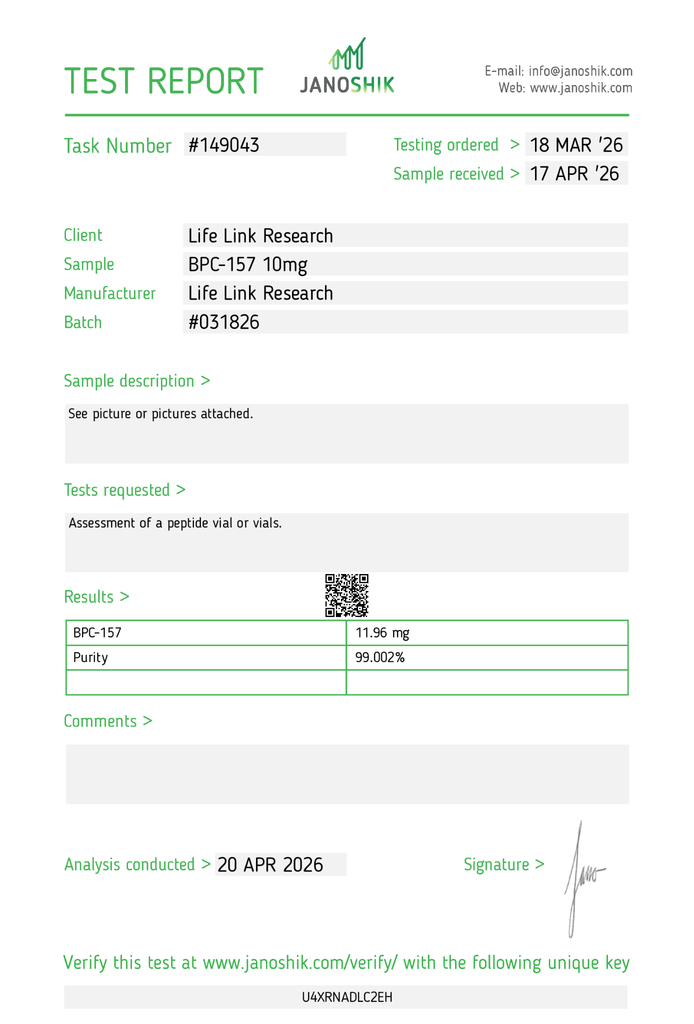
Here’s what one of those reports looks like, field by field.
How to verify a peptide COA batch number and purity
| Field on the report | What it shows | Why you check it |
| Task #149043 | Janoshik’s record number | Needed for verification |
| Batch #031826 | The lot this report covers | Must match the batch on your vial |
| Analysis conducted: April 20, 2026 | Test date | Shows the report is current |
| BPC-157: 11.96 mg | Measured content | Above the 10 mg on the label |
| Purity: 99.002% | HPLC result | Clears the 99% standard |
| Unique key | Lab-side code | Enter it with the task number to confirm |
That report covers purity and content. Identity comes from mass spectrometry, and an earlier BPC-157 report (task #43463) notes “LCMS spectrum attached.” A separate endotoxin report (task #65203) recorded 2.167 EU as part of the rotating panel. All three sit on the product’s certificate page. See our quality and testing process for the full method.
Best US Peptide Supplier: FAQs
What is the most trusted peptide supplier in the USA?
The most trusted US supplier is whichever one’s evidence survives your own checking. That means batch-specific COAs that verify at the lab, a registered company, US dispatch and research-use-only labeling. Trust earned this way survives shutdowns and rebrands, because it rests on records you can open today. A name on someone’s ranking list doesn’t carry the same weight.
How do I know if a peptide supplier is legit?
You know a peptide supplier is legit when its claims match outside records. Verify the COA key on the lab’s site, find the company in a state business registry, and confirm card or ACH checkout and a written refund policy. Then search the FDA warning letter database for the company name. A supplier that passes all four is a strong candidate.
What is the best website to buy research peptides in the USA?
The best website is a supplier’s own storefront that publishes a COA library, a US dispatch point and its legal business details. Product pages should list sequence, molecular weight, CAS number and batch. Checkout should offer card or ACH. Avoid marketplaces and social media sellers, because they rarely link a vial to a verifiable lab report.
Where do peptide sellers get their products?
Most research peptides are synthesized by specialist manufacturers, many of them in China, with a smaller share made in the US. Good resellers then test each incoming batch through an independent lab, store it in the US and package it for dispatch. The testing step is where suppliers differ most, so ask any seller which lab tested your batch.
What happened to Peptide Sciences and other US vendors?
Peptide Sciences closed on March 6, 2026, after Science bio announced its own closure on January 27, 2026. Amino Asylum went offline in 2025. The closures came alongside a run of FDA warning letters, dated March 31, June 17 and August 24, 2026, that targeted sellers marketing research peptides for human use.
What purity should research peptides be?
Research peptides should reach at least 99% purity on HPLC, and a separate mass-spec run should confirm identity. Purity tells you what share of the sample is the target peptide. Identity tells you the molecule is correct. A complete COA also reports the measured amount per vial, so you can confirm the vial holds at least what the label states.
Does a higher price mean better quality?
A higher price doesn’t guarantee quality, but a very low one usually signals missing testing or under-filled vials. Use price as a filter and evidence as the decision. Compare the COA, the lab verification and the documentation first. Between two suppliers that pass every check, choose on price, shipping speed and support.
⏱ The 10-minute supplier check
Registered US business · US stock and a stated cut-off · batch COA from an outside lab · a key that verifies at the lab · 99%+ HPLC purity plus a mass-spec match · research-use-only labeling · full product documentation · market-range pricing · card or ACH with written refunds · a one-day support reply. Ten passes, and you’ve found a supplier worth trusting.
Every product discussed here is a laboratory reagent sold for research use only. None is FDA-approved, and none is intended for human or veterinary use or for diagnostic or therapeutic procedures. Nothing in this guide is medical advice.
Lyophilized vs Pre-Mixed Peptides: What’s the Difference?
Research peptides show up in one of two forms: a dry powder in a sealed vial, or a liquid already dissolved and…
Read article
What Is the KLOW Stack? Composition, Ratio & COA Guide
The KLOW Stack is a four-peptide research kit that supplies GHK-Cu, KPV, BPC-157, and TB-500 as four separate vials, 80mg of peptide…
Read article
How to Verify a Peptide COA Is Real (and Spot a Faked One)
A certificate of analysis is supposed to be your proof that a research peptide is what the label claims. It only works…
Read articleResearch-grade peptides
99%+ purity. Verified every batch.
Identity and purity tested on every batch by third-party labs, Janoshik Analytical and US-based laboratories. Shipped same day from California.
Shop all peptides