
Quick Answer
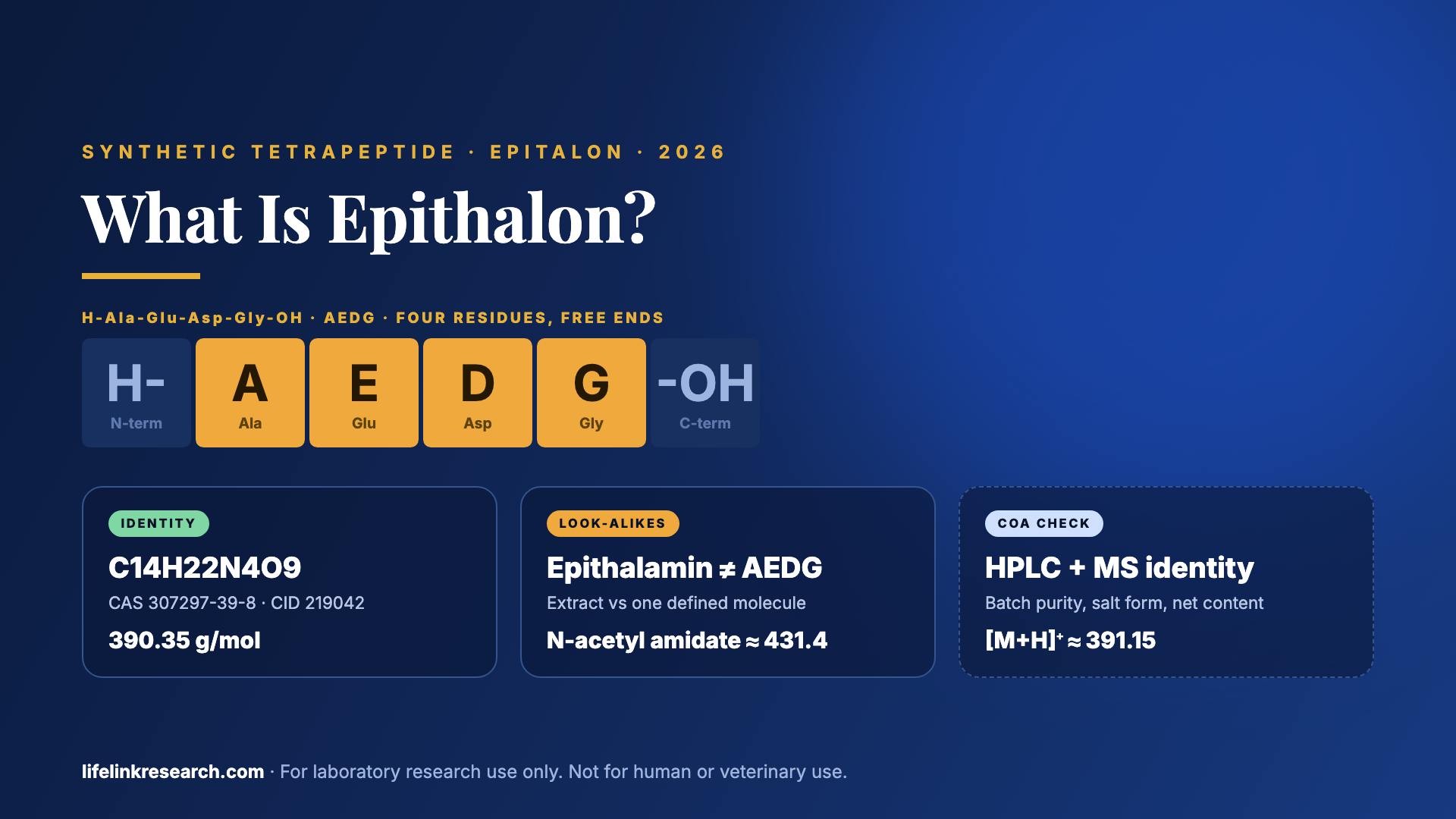
Epithalon (Epitalon, AEDG) is a synthetic tetrapeptide with the sequence Ala-Glu-Asp-Gly, modeled on the amino-acid composition of the natural extract epithalamin. Its formula is C14H22N4O9 and it weighs 390.35 g/mol, registered under CAS 307297-39-8. It is supplied as a lyophilized powder for laboratory research use only.
Key takeaways
- Sequence: H-Ala-Glu-Asp-Gly-OH, four residues, free N-terminus and free C-terminus
- Identity: C14H22N4O9, 390.35 g/mol average (390.1387 Da monoisotopic), CAS 307297-39-8, PubChem CID 219042
- Epithalon, Epitalon and Epithalone are three spellings of one molecule; epithalamin is a different material, a natural extract with no single mass
- COA check: an HPLC chromatogram plus an MS ion near 391.4 ([M+H]+), with the lot number, test date and salt form matching the vial label
- Status: no FDA approval for any use as of November 7, 2026; supplied for laboratory research only
Epithalon (also spelled Epitalon) is a synthetic tetrapeptide with the sequence Ala-Glu-Asp-Gly (AEDG). Its formula is C14H22N4O9, and it carries no ring, no cap and no unusual residue: four standard amino acids in a straight line. So what is Epithalon to a lab that orders it? Mostly a question of paperwork. With a structure this plain, the identity check, the purity trace and the salt form decide whether a vial is what its label says.
The name trips people up too. Epithalon often gets mixed up with epithalamin, the natural extract it was modeled on, and the two are different materials.
This guide covers its origin, chemical structure, the assays used to study it, what a sound Epithalon COA shows, how to store the powder and where it stands with the FDA.
What Is Epithalon?
Quick answer: Epithalon is a synthetic tetrapeptide, Ala-Glu-Asp-Gly, whose design was based on the amino-acid composition of epithalamin, a natural polypeptide extract. Vladimir Khavinson’s group in St. Petersburg, Russia, patented its synthesis in 2000. Today the epithalon peptide is supplied as a lyophilized research material made by chemical synthesis.
The design story starts with an analysis, not a discovery. Khavinson’s team looked at which amino acids dominated epithalamin and built a four-residue peptide from them. A 2025 review in the International Journal of Molecular Sciences marks June 2025 as 25 years since that synthesis was patented.
Epithalon shows what peptides are at a very small scale: amino acids joined by amide (peptide) bonds, here just four residues and three bonds, which is all “tetrapeptide” means.
The line between Epithalon and epithalamin is sharp:
- Epithalamin: A natural polypeptide extract, a mixture of many peptides with no single sequence, formula or mass.
- Epithalon: One defined molecule with one CAS number, one PubChem record and one expected mass.
A team of physicians from Johns Hopkins and Harvard Medical School drew the same line in an October 2026 narrative review (Jain et al., Int J Mol Sci). They describe epitalon as “a synthetic tetrapeptide developed from the amino-acid composition of epithalamin” and assess the epithalamin papers separately.
Epithalon vs Epitalon vs Epithalone: Is It the Same Peptide?
Yes. It’s one molecule with three transliterations of the original Russian name.
- Epitalon: The spelling used in most journal papers and in the FDA’s own listings.
- Epithalon: The spelling common on supplier catalogs, closer to “epithalamin.”
- Epithalone: A rarer variant seen on older pages.
All three point to CAS 307297-39-8 and PubChem CID 219042. In any epitalon vs epithalon comparison, then, only the spelling differs. AEDG, its one-letter code, is the spelling-free way to say the same thing.
What Is Epithalon’s Chemical Structure?
Quick answer: Epithalon is a linear peptide of four residues, alanine, glutamic acid, aspartic acid and glycine, with a free N-terminus and a free C-terminus. Its formula is C14H22N4O9, it weighs 390.35 g/mol, and it’s registered under CAS 307297-39-8.
| Property | Value |
| Sequence | H-Ala-Glu-Asp-Gly-OH |
| One-letter code | AEDG |
| Length | 4 residues |
| Formula | C14H22N4O9 |
| Molecular weight | 390.35 g/mol (average) |
| Monoisotopic mass | 390.1387 Da |
| CAS number | 307297-39-8 |
| PubChem CID | 219042 |
| Net charge at neutral pH | About −2 |
| Solubility | Soluble in water for assay preparation |
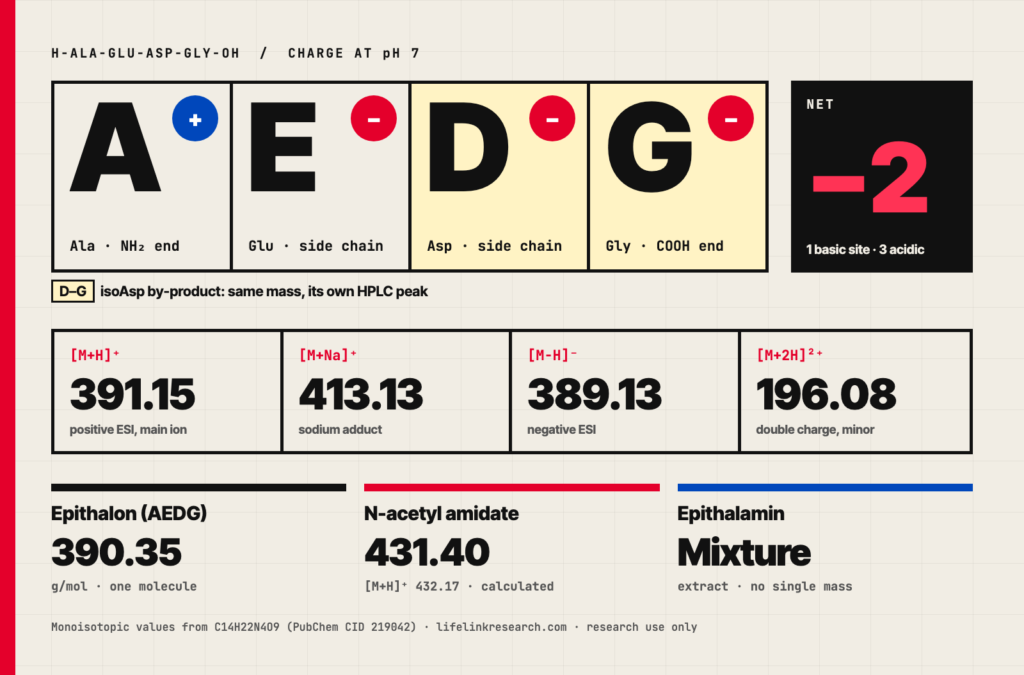
AEDG residue map with charges, expected mass-spec ions and the three look-alike materials
Residue-by-Residue Breakdown
Each residue adds something specific:
- Ala (A): A small methyl side chain. Its free amine at the N-terminus is the molecule’s only basic site, carrying a +1 charge at neutral pH.
- Glu (E): A side chain ending in a carboxylic acid, negatively charged at neutral pH.
- Asp (D): A shorter acidic side chain, also negative. Followed by glycine, it forms an Asp-Gly pair, the sequence most prone to rearranging into isoaspartate during synthesis and storage.
- Gly (G): The only residue without a side chain. Its free C-terminal carboxyl adds the third negative charge.
Three acidic groups against one basic group leave AEDG at roughly −2 overall. That charge, plus a calculated XLogP of −5.5 on PubChem, makes AEDG strongly water-loving and acidic.
Epithalon vs Epithalamin vs N-Acetyl Epitalon Amidate
These are three different materials, so their COAs read differently.
| Material | What it is | Molecular weight |
| Epithalon (AEDG) | Synthetic tetrapeptide, free ends | 390.35 g/mol |
| N-acetyl Epitalon amidate | AEDG with an acetyl cap and C-terminal amide | About 431.4 g/mol (calculated) |
| Epithalamin | Natural polypeptide extract | No single value |
A buyer should check that the COA’s mass matches the material ordered. A report showing about 431 belongs to the capped version, not plain Epithalon.
How Is Epithalon Studied in the Lab?
Quick answer: Published Epithalon research mostly uses cell-line assays and animal models, and human data is limited. Common methods include telomerase activity (TRAP) assays, gene-expression qPCR, immunofluorescence imaging, computer docking against histone proteins and rodent studies.
| Assay type | Model | Study type | Source |
| Telomerase activity (TRAP) assay | Human cell lines and normal fibroblasts | In vitro | Al-dulaimi et al., 2025 |
| C-circle assay and PML-body imaging (ALT markers) | Human cell lines | In vitro | Al-dulaimi et al., 2025 |
| Gene expression (RT-qPCR) | Human gingival mesenchymal stem cells | In vitro | Khavinson et al., 2020 |
| Immunofluorescence with confocal microscopy | Same stem-cell cultures | In vitro | Khavinson et al., 2020 (PubMed 32019204) |
| Peptide–histone docking | Molecular modelling of histones H1, H2b, H3 and H4 | In silico | Khavinson et al., 2020 |
| Rodent studies | Mice and rats | Animal | Araj et al., 2025 (review) |
Two details shape how to read this table. First, most of the record comes from a small number of groups, led for decades by Khavinson’s institute. Second, the 2025 cell study by Al-dulaimi and colleagues used control lines with known telomerase and ALT status, which lets each assay be checked against a reference.
The 2025 review closes on a note many lab teams share: “this additionally justifies the necessity of further studies on this unusual tetrapeptide.”
What Should an Epithalon COA Show?
Quick answer: A valid Epithalon COA shows identity by mass spectrometry (expected [M+H]⁺ about 391.4), purity by HPLC as a batch figure, a lot or sample number and test date, the lab’s name and the salt form. Every one of those details should match the vial label.
| Field on the COA | Expected entry | Red flag |
| Identity | MS mass near 391.15 (monoisotopic [M+H]⁺) or 391.4 (average) | A mass that doesn’t match 390.35 g/mol |
| Purity | HPLC area %, with the chromatogram and detection wavelength | A fixed “99%” with no chromatogram |
| Net peptide content | Measured mg of peptide in the vial | Missing, or far below the label |
| Salt form | Free base, acetate or TFA | Not stated |
| Lab and report | Lab name, address, report number, signatures | No traceable lab |
| Batch link | Lot or sample number, test date, matching label | No way to tie the report to the vial |
Prime Analytical Laboratories, an independent lab in Concord, California, issued Life Link’s current Epithalon batch report in April 2026. It shows 99.27% purity by HPLC and 12.26 mg of net peptide content, so the vial carries slightly more peptide than its 10 mg label.
HPLC and MS check different things here. The Asp-Gly rearrangement noted earlier produces isoaspartate, a by-product with exactly the same mass as AEDG, so a mass reading alone can’t flag it. A clean, single main peak on the HPLC trace is what separates the two. That’s why third-party HPLC and mass-spec testing pairs the two methods instead of relying on one.
Independent testing data show why batch reports deserve a close look. Finnrick, a public peptide-testing platform, lists eight Epithalon tests logged between February and September 2026, and four of the six completed tests didn’t pass its scoring criteria. Those failures are the reason to know how to verify a peptide COA before a vial goes into an experiment: match the mass, the chromatogram and the sample number to the label.
Why the Salt Form (TFA vs Acetate) Changes the Numbers
A lyophilized peptide’s gross weight includes counterions and bound water, not just the peptide. Araj and colleagues note that most commercial Epitalon comes as an acetate or TFA salt. Since AEDG has only one basic site, it binds at most about one counterion per molecule, and a heavier counterion means less peptide per milligram of powder.
That’s why net peptide content and gross weight can differ on the same COA. Weighing adds its own error, too: a 2026 American Peptide Society research summary of work from William Lubell’s lab at the Université de Montréal notes that residual TFA can “make that weighing step a genuine source of error.”
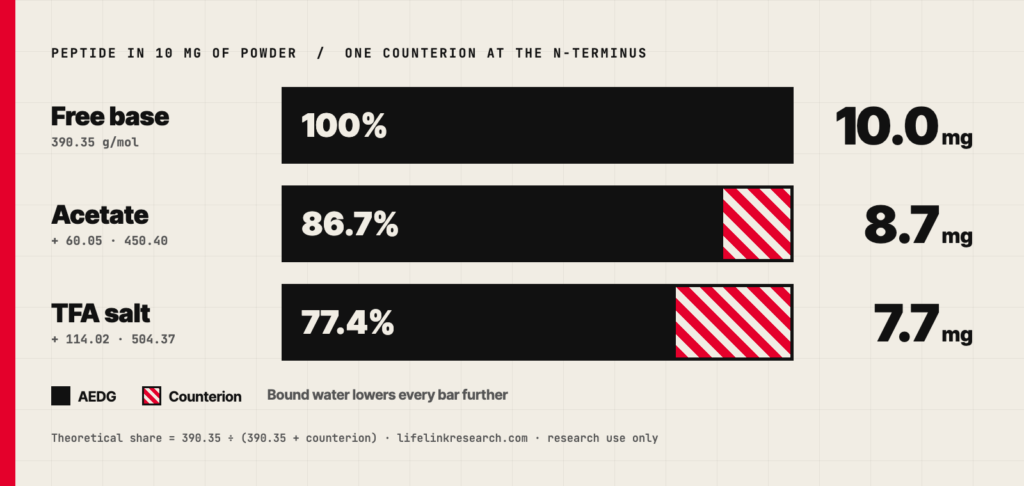
Peptide share per 10 mg of powder for Epithalon free base, acetate and TFA salt forms
How Should Lyophilized Epithalon Be Stored?
Quick answer: Keep sealed vials of Epithalon powder frozen at −20 °C, kept dry and shielded from light. Dry powder is the peptide’s most stable form, and moisture is the main thing to keep out.
A few habits protect the powder:
- Seal: Leave the vial closed until the day it’s needed.
- Temperature: Store at −20 °C for the long term and avoid repeated warm-cold cycles.
- Moisture: Let a frozen vial warm to room temperature before the cap comes off, which stops condensation from wetting the cake.
- Light: Store vials in their box or an opaque container.
Dryness counts double for AEDG. Water drives the Asp-Gly rearrangement, so a dry, cold cake keeps the HPLC profile closest to the one on the COA. Cold, dark and dry are the constants of lyophilized peptide storage for any sequence, and for AEDG, keeping moisture out comes first.
What Is Epithalon’s Regulatory Status in the US?
Quick answer: Epithalon has no FDA approval for any use. US suppliers sell it only as a research chemical for laboratory study.
The FDA’s compounding page on bulk substances, current as of April 22, 2026, lists epitalon under “nominated but withdrawn.” It doesn’t appear among Category 2 substances.
Three months later, on July 24, 2026, the Pharmacy Compounding Advisory Committee reviewed Epitalon (free base) and Epitalon acetate as possible additions to the 503A bulks list. The FDA’s meeting page carries the briefing documents. Then, on October 28, 2026, HHS filed an interim enforcement-discretion policy for 503A compounding, published in the Federal Register on October 30, that names Epitalon acetate among six peptides. It’s a compounding policy while the FDA writes the bulks-list rule, not a drug approval. Epitalon was one of seven compounds in the FDA’s July 2026 peptide review, and the committee’s advice doesn’t change its status as a research chemical.
Epithalon 10mg for Research
Life Link’s Epithalon 10mg research peptide comes as a single vial of lyophilized powder with its batch COA on the product page (open the product and click “View report”). Stock ships from California: anything ordered by 2 PM PST goes out the same day via UPS 2-Day Air, and multi-vial orders get quantity pricing.
At four residues, Epithalon is one of the shortest sequences in the catalog: DSIP runs to nine residues, and MOTS-c, a peptide coded by mitochondrial DNA, to 16. Like Epithalon, both are sold strictly for lab study.
Epithalon FAQs
Is Epithalon the Same as Epitalon?
Yes. Epithalon and Epitalon are two spellings of one molecule, and Epithalone is a third. All three share CAS 307297-39-8, PubChem CID 219042 and the sequence Ala-Glu-Asp-Gly. “Epitalon” is more common in journals, while “Epithalon” turns up more often on supplier catalogs.
What Does AEDG Stand For?
AEDG is the one-letter code for Epithalon’s four amino acids, starting at the N-terminus: A for alanine, E for glutamic acid, D for aspartic acid and G for glycine. The three-letter form is Ala-Glu-Asp-Gly. Researchers often write “AEDG peptide” to avoid the spelling question altogether.
What Is the Molecular Weight of Epithalon?
Epithalon weighs 390.35 g/mol on average, based on its formula, C14H22N4O9. Its monoisotopic mass is 390.1387 Da, the value high-resolution mass spectrometry targets. Salt forms weigh more per molecule, so an acetate or TFA salt has a higher formula weight than the free base.
Is Epithalon FDA Approved?
No. The FDA hasn’t approved Epithalon for any use. An FDA advisory committee discussed it for the compounding list in July 2026, and an October 2026 HHS compounding policy names Epitalon acetate, but neither step is a drug approval. US suppliers offer it as a research chemical only.
How Much Does Epithalon 10mg Cost for Research?
Prices change with stock and order size, so the live product listing shows the current figure. Life Link’s Epithalon 10mg page lists the single-vial price plus lower per-vial pricing on 3, 5 and 10 vials, along with the batch COA for the vial being sold.
Is Epithalon a Peptide or a Supplement?
Epithalon is a synthetic research peptide, not a dietary supplement. It’s made by chemical synthesis, supplied as a lyophilized powder and sold for laboratory research only. It has no approved use, and research suppliers don’t label it for use in people or animals.
For Research Use Only. Not for use in diagnostic or therapeutic procedures.
Life Link Research supplies Epithalon to qualified labs for in vitro study. Full terms are set out in the Life Link research disclaimer.
References
- Araj et al., Int J Mol Sci, 2025, 25 years of AEDG (PMC11943447): https://pmc.ncbi.nlm.nih.gov/articles/PMC11943447/
- Jain et al., Int J Mol Sci, October 2026 narrative review (PMC13664938): https://pmc.ncbi.nlm.nih.gov/articles/PMC13664938/
- Al-dulaimi et al., 2025, telomerase and ALT marker assays (PMC12411320): https://pmc.ncbi.nlm.nih.gov/articles/PMC12411320/
- Khavinson et al., 2020, gene expression in gingival mesenchymal stem cells (PMC7037223): https://pmc.ncbi.nlm.nih.gov/articles/PMC7037223/
- Khavinson et al., 2020 (PubMed 32019204): https://pubmed.ncbi.nlm.nih.gov/32019204/
- PubChem CID 219042, Epitalon: https://pubchem.ncbi.nlm.nih.gov/compound/219042
- Finnrick, Epithalon test listings (February to September 2026): https://www.finnrick.com/products/epithalon
- American Peptide Society, weighing without weighing, 2026: https://americanpeptidesociety.org/research/weighing-without-weighing/
- FDA, bulk drug substances that may present significant safety risks (current as of 22 April 2026): https://www.fda.gov/drugs/human-drug-compounding/certain-bulk-drug-substances-use-compounding-may-present-significant-safety-risks
- FDA, Pharmacy Compounding Advisory Committee meeting, 23 to 24 July 2026: https://www.fda.gov/advisory-committees/advisory-committee-calendar/july-23-24-2026-meeting-pharmacy-compounding-advisory-committee-07232026
- HHS, interim enforcement discretion policy for 503A compounding, Federal Register, 30 October 2026: https://www.federalregister.gov/d/2026-22192
CJC-1295 (No DAC) + Ipamorelin Blend 5/5mg: Composition, Ratio & COA
Quick Answer This article covers what the cjc 1295 ipamorelin blend contains, both sequences and masses, the real molar ratio behind the…
Read article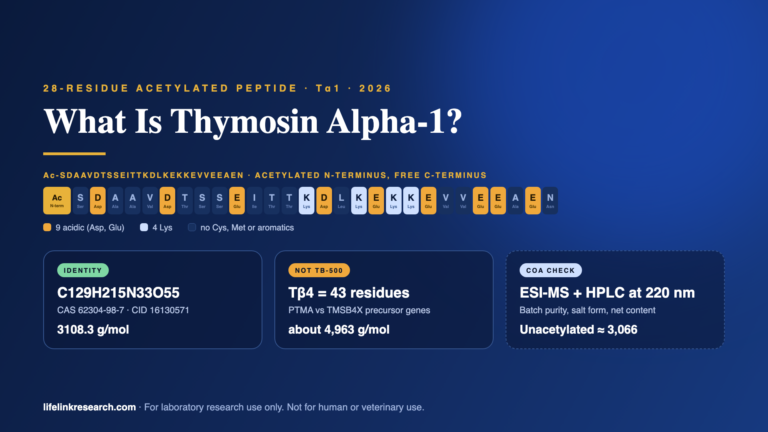
What Is Thymosin Alpha-1? Structure, Research Use & COA
Quick Answer Thymosin Alpha-1 (Tα1) is a 28-amino-acid peptide, acetylated at its N-terminus, with the formula C129H215N33O55. It carries an average molecular…
Read article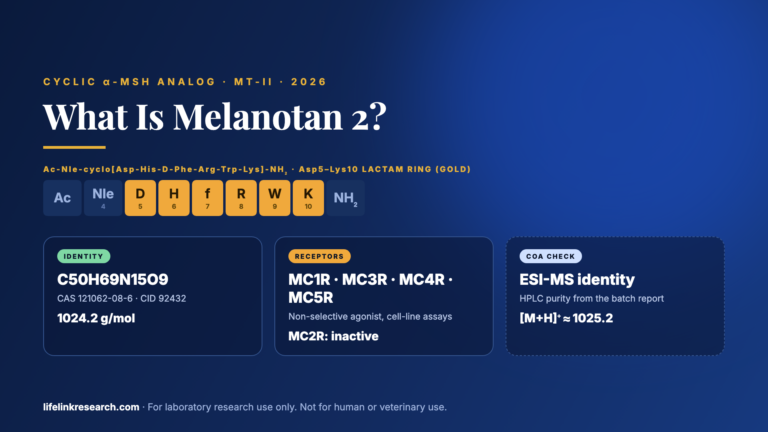
What Is Melanotan 2? MT-II Structure, Receptors & COA
Quick Answer Melanotan 2 (MT-II) is a seven-residue cyclic analog of α-MSH, closed by an Asp-Lys lactam bridge. It is a potent,…
Read articleResearch-grade peptides
99%+ purity. Verified every batch.
Identity and purity tested on every batch by third-party labs, Janoshik Analytical and US-based laboratories. Shipped same day from California.
Shop all peptides