
Quick Answer
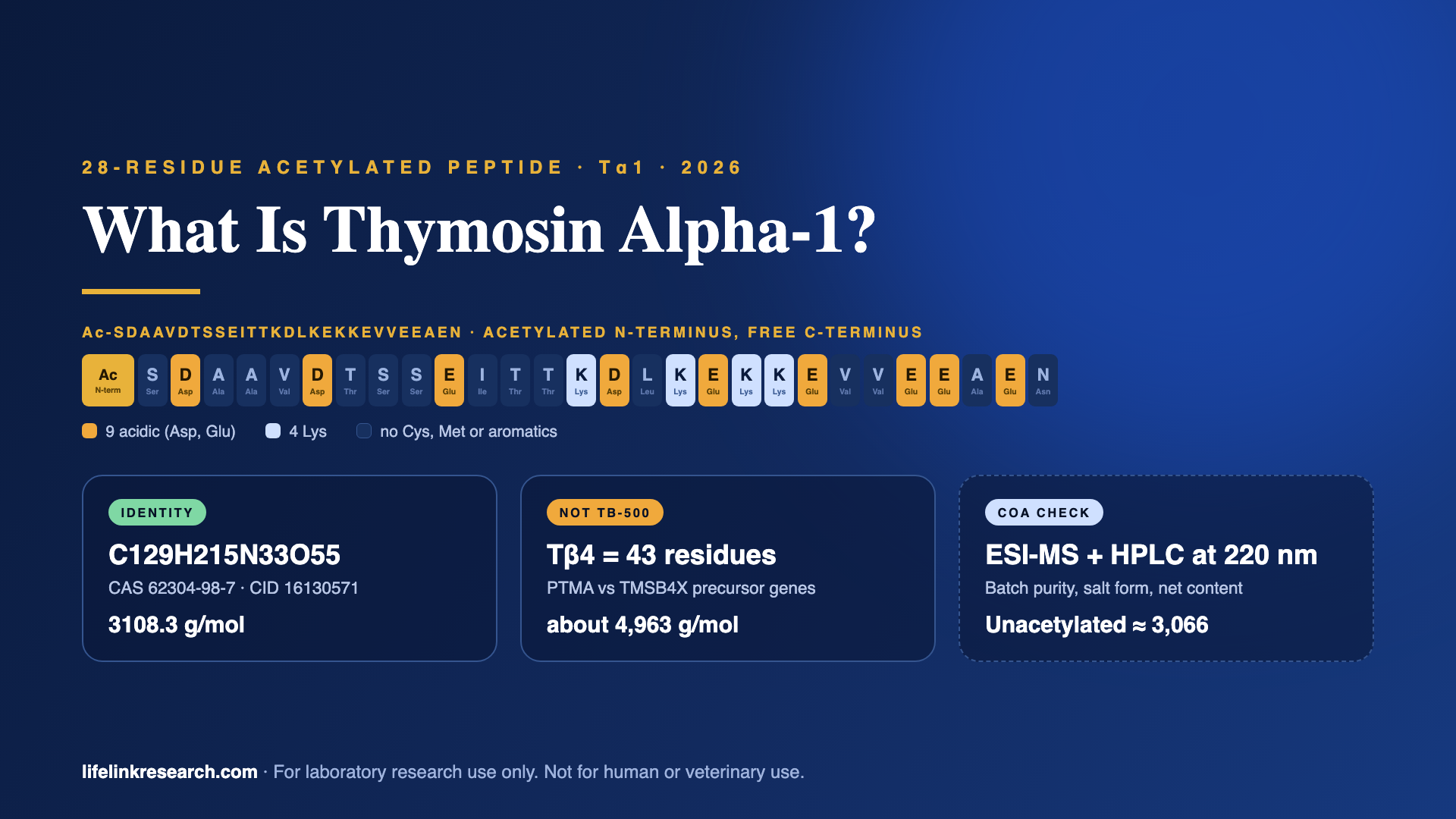
Thymosin Alpha-1 (Tα1) is a 28-amino-acid peptide, acetylated at its N-terminus, with the formula C129H215N33O55. It carries an average molecular weight of 3108.3 g/mol, corresponds to residues 2 to 29 of the precursor protein prothymosin alpha, and is supplied in the United States for laboratory research use only. This page covers its sequence, its measured structure, how it differs from TB-500, and what a valid batch certificate should report.
Key takeaways
- 28 residues, acetylated at the N-terminus,
Ac-SDAAVDTSSEITTKDLKEKKEVVEEAEN - C129H215N33O55, 3108.3 g/mol, CAS 62304-98-7, PubChem CID 16130571
- Cut from prothymosin alpha (gene PTMA), residues 2 to 29
- Nine acidic residues against four lysines, so the chain is strongly acidic
- No cysteine, no methionine and no aromatic residues, which changes how it reads on HPLC and MS
- Thymosin beta-4, the molecule behind the TB-500 name, is a different 43-residue peptide of about 4,963 Da
Two peptides in the same catalogue carry the thymosin name, and roughly 1,855 daltons separate them. That one number settles which is which on a certificate, long before anything else on the page does. Thymosin Alpha-1 is the shorter of the pair: a 28-residue chain with an acetyl cap on one end, nine acidic residues along it, and a molecular weight of 3108.3.
Most of what is published about Tα1 reads as pharmacology. The chemistry underneath it is simpler and far easier to check, and it is the part that decides whether the material in a vial is the right molecule. What follows keeps to that: the sequence, the structure measured by NMR, the arithmetic behind the mass, and the certificate fields that confirm all of it.
What is Thymosin Alpha-1?
Quick answer: Thymosin Alpha-1 is a 28-residue peptide with an acetylated N-terminus. It matches residues 2 to 29 of the precursor protein prothymosin alpha, the product of the PTMA gene. Its sequence was determined in 1977, and research material today is built by solid-phase synthesis. Thymalfasin is its INN name.
The name shortens to Tα1, written Ta1 or alpha-1 thymosin where Greek characters are awkward, and all three refer to one molecule. Thymalfasin is the International Nonproprietary Name assigned to the same 28-residue chain, so a listing using either term describes identical chemistry.
Its sequence was worked out in 1977 and published in the Proceedings of the National Academy of Sciences, volume 74, pages 725 to 729 (PMID 265536), from a purified subfraction of the protein preparation then called thymosin fraction 5. That paper is the origin point for every identity record the peptide carries today.
Research material is no longer purified from tissue. It is assembled by solid-phase peptide synthesis, one residue at a time on a resin, then cleaved, purified by reverse-phase HPLC and freeze-dried. At 28 residues the chain runs long for a synthetic peptide and well short of a protein, which is close to where the line between what peptides are and proteins is usually drawn. Synthesis also explains two things a buyer sees later: the salt form left behind by the purification step, and the net peptide content figure on the certificate.
Where the sequence comes from: prothymosin alpha
Prothymosin alpha is catalogued in UniProt as P06454, where the chain runs to 111 residues. The initiator methionine is removed in the processed form, leaving 110 residues with an acetyl group on the serine that becomes position 2. Tα1 is the stretch from residue 2 to residue 29 of that precursor, which is why the shorter peptide already arrives acetylated: the cap is the precursor’s own.
UniProt annotates the entire 111-residue chain as disordered, with acidic residues concentrated across positions 40 to 84. The 28-residue segment inherits that character, which shapes everything from its behaviour on a column to its shape in water.
What is Thymosin Alpha-1’s structure?
Quick answer: Tα1 is a linear 28-mer, Ac-SDAAVDTSSEITTKDLKEKKEVVEEAEN, with the formula C129H215N33O55 and an average molecular weight of 3108.3 g/mol. Nine of its residues are glutamate or aspartate against four lysines, making the chain strongly acidic, and in plain water it takes no fixed shape.
| Property | Value |
| Sequence | Ac-Ser-Asp-Ala-Ala-Val-Asp-Thr-Ser-Ser-Glu-Ile-Thr-Thr-Lys-Asp-Leu-Lys-Glu-Lys-Lys-Glu-Val-Val-Glu-Glu-Ala-Glu-Asn-OH |
| One-letter code | Ac-SDAAVDTSSEITTKDLKEKKEVVEEAEN |
| Length | 28 residues |
| Modification | N-terminal acetylation |
| Formula | C129H215N33O55 |
| Molecular weight | 3108.3 g/mol (PubChem CID 16130571; Wikipedia gives 3108.315, a rounding difference) |
| Monoisotopic mass | 3106.50 Da |
| CAS | 62304-98-7 |
| UniProt | P06454, residues 2 to 29 |
| PDB | 2L9I |
| Solubility | Soluble in water for assay preparation |
Count the acidic residues and the chain’s character becomes obvious. Six glutamates and three aspartates give nine negative charges, four lysines give four positive ones, and the acetyl cap removes the free amine that would normally add another. Net charge at neutral pH lands near minus six, which is why the peptide is described as highly acidic and why it elutes early on a reverse-phase column.
What the sequence leaves out influences the analytics just as much. There is no cysteine, so no disulfide chemistry to preserve or scramble. There is no methionine, so the plus-16 oxidation peak that complicates many peptide traces cannot appear. And with no tryptophan, tyrosine or phenylalanine anywhere in the chain, Tα1 absorbs almost nothing at 280 nm, so HPLC detection has to run on the peptide bond itself at 214 or 220 nm. A certificate reporting purity at 280 nm for this molecule would be describing the wrong measurement.
One number ties the rest together. A 10 mg quantity of Tα1 is 3.22 micromoles, against 2.01 micromoles for the same gross weight of thymosin beta-4.
Its shape in solution (NMR)
In water alone, Tα1 shows no stable fold. The conformation that has been measured comes from a biophysical study by Elizondo-Riojas and colleagues, published in Biochemical and Biophysical Research Communications in 2011, volume 416, pages 356 to 361 (PMID 22115779) and deposited as PDB entry 2L9I. Working at 800 MHz in 40% trifluoroethanol and 60% water, the authors resolved an alpha-helix spanning residues 14 to 26, plus two double beta-turns within the first twelve residues that together form a distorted helical arrangement.
Trifluoroethanol is a helix-promoting cosolvent, so those features describe what the chain can adopt under those conditions. They record a conformational preference under helix-promoting conditions, and behaviour in an aqueous buffer is a separate measurement.
Thymosin Alpha-1 vs TB-500 (thymosin beta-4): are they the same?
Quick answer: No. They are two different peptides that share the thymosin family name. Tα1 runs 28 residues at about 3,108 Da. Thymosin beta-4 runs 43 residues at about 4,963 Da. They come from different precursor genes, PTMA and TMSB4X, and both start with an acetylated Ser-Asp pair. TB-500 is a vendor name used for Tβ4 or a short fragment of it.
| Thymosin Alpha-1 | Thymosin beta-4 | |
| Residues | 28 | 43 |
| Formula | C129H215N33O55 | C212H350N56O78S |
| Molecular weight | 3108.3 g/mol | about 4,963 g/mol |
| Precursor gene | PTMA (UniProt P06454) | TMSB4X (UniProt P62328) |
| N-terminal start | Ac-SD... | Ac-SD... |
| CAS | 62304-98-7 | 77591-33-4 |
| PubChem CID | 16130571 | 16132341 |
| Sulfur atoms | none | one (Met6) |
| On a COA | MS ions consistent with 3108.3 | MS ions consistent with about 4,963 |
The shared Ac-SD opening is the detail that trips people up, because the first two residues of the two chains are identical and both carry the same acetyl cap. Everything after that diverges, and the formulas make it plain: the single sulfur atom in the beta-4 formula belongs to its methionine at position 6, the residue that can pick up 16 daltons through oxidation. Tα1 contains no sulfur at all, so that peak has no chemical route to appear on its trace.
The label is the other complication. Material sold as thymosin beta-4 (TB-500) is sometimes the full 43-residue peptide and sometimes the seven-residue fragment Ac-LKKTETQ at around 889 Da, and the identity result on the certificate is what separates those two. None of that ambiguity touches Tα1, which maps to one sequence and one registry entry.
How is Thymosin Alpha-1 studied in the lab?
Quick answer: Published Tα1 work runs through three method classes: biophysical structure determination, receptor-binding and expression assays in cultured cell lines, and rodent models. The receptors named in the in vitro work are TLR2 and TLR9.
| Method | Model | Study type |
| NMR conformation analysis | Trifluoroethanol and membrane-mimetic solvents | Biophysical |
| Toll-like receptor binding (TLR2, TLR9) | Cultured cell lines | In vitro |
| Gene and protein expression readouts | Cell cultures | In vitro |
| Rodent studies | Animal models | Animal |
Two review articles indexed in PubMed Central, PMC7747025 and PMC7115394, cover the method record across those categories. Both are secondary literature, so the assay conditions they summarise trace back to the original papers rather than to the reviews themselves.
Two points are useful for anyone reading that literature. Biophysical work on Tα1 is routinely run in cosolvent systems instead of plain buffer, because the peptide adopts no measurable fold without one, so solvent composition belongs in any comparison between structural papers. And the in vitro receptor work is identified by receptor name, TLR2 and TLR9, which makes method-level comparison between papers straightforward even where the systems differ.
Laboratory research of this kind is the only setting the material is supplied for. Nothing in the published record constitutes an approved application.
What should a Thymosin Alpha-1 COA show?
Quick answer: A valid Tα1 certificate reports identity by ESI-MS consistent with 3108.3, HPLC purity as a batch result with its chromatogram, net peptide content, the lot number, the test date, the testing lab, the salt form, and endotoxin where that panel was run. The lot on the certificate has to match the lot printed on the vial label.
| COA field | Value to expect | Red flag |
| Identity (ESI-MS) | A multiply-charged ion series consistent with 3108.3 | A reported neutral mass near 3,066, which is the chain missing its acetyl cap |
| Purity (RP-HPLC) | A batch figure with the chromatogram attached, detection at 214 or 220 nm | A flat “99%” with no trace, or purity read at 280 nm |
| Net peptide content | A stated percentage or milligram figure for the vial | Absent, leaving gross weight as the only number |
| Lot or batch number | A number matching the vial label | Blank, or the lab’s task number reused as the batch |
| Test date | Dated within the batch’s life | Undated, or years older than the vial |
| Testing lab | A named independent laboratory | An unattributed in-house report |
| Salt form | Acetate or trifluoroacetate, stated | Unstated, which leaves net content unexplained |
| Endotoxin | A result in EU/mg where tested | A claim with no report behind it |
The mass arithmetic is the quickest check on the list. An acetyl group adds 42 daltons, so a chain reported near 3,066 is the unacetylated 28-mer rather than Tα1. On an ESI trace the difference appears as roughly 14 m/z units on the triply-charged ion, with Tα1 producing a charge ladder near m/z 1037, 778 and 623 for the 3+, 4+ and 5+ states.
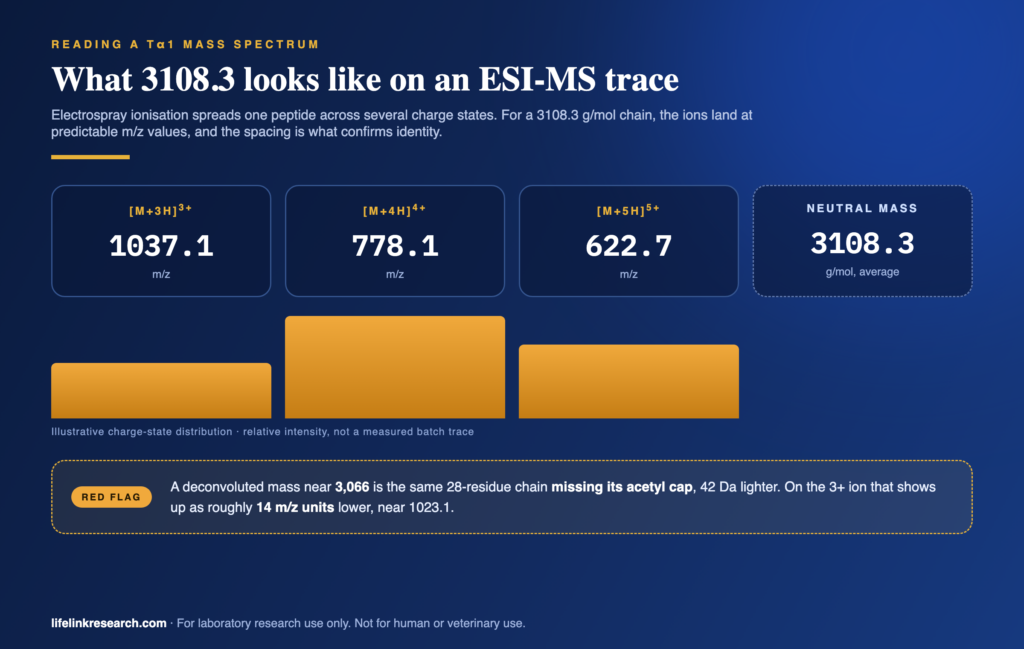
Thymosin Alpha-1 ESI-MS charge ladder: 3+ at m/z 1037.1, 4+ at 778.1, 5+ at 622.7 for a neutral mass of 3108.3, with the unacetylated 3,066 red flag
Purity and identity answer different questions, which is why both belong on the page. HPLC tells you how much of the material is one species; mass spectrometry tells you which species it is. Life Link publishes third-party HPLC and mass-spec testing on every batch, with secondary panels such as heavy metals and endotoxin running on rotation, and the Thymosin Alpha-1 10mg certificate page currently carries four lab documents against that single product. Reading one properly is a short exercise once you know how to verify a peptide COA against the vial in front of you.
Net peptide content, salt form and endotoxin
A 10 mg vial rarely contains 10 mg of peptide. The rest is counterion and residual water, and net peptide content is the figure that quantifies the difference. Bachem, one of the larger peptide manufacturers, defines it in its quality-control guide as “the percentage of peptides relative to non-peptidic material” and makes the distinction from purity explicit: “NPC and purity are not equivalent, because the former includes peptidic contaminants.” Water is measured separately, usually by Karl Fischer titration.
Counterion chemistry follows the sequence. Reverse-phase purification leaves trifluoroacetate behind, and in Tα1 the only residues it can pair with are the four lysines, so an acetate-exchanged batch and a TFA batch will not report the same net content for the same gross weight.
How should lyophilized Thymosin Alpha-1 be stored?
Quick answer: Keep sealed vials of the powder at minus 20 °C, dry and shielded from light, and record the lot number alongside whatever the vial is used for. Lyophilized Tα1 is stable in that state; moisture and repeated warming are the conditions that degrade it.
Two of the usual peptide storage worries do not apply here. With no cysteine there is no disulfide bond to scramble, and with no methionine there is no oxidation-prone side chain to protect from air. The chemistry left to guard against in a chain this acidic is moisture-driven, principally deamidation at its single asparagine and isomerisation at its three aspartates, which is why a dry, sealed, cold vial does most of the work.
The same conditions apply to every freeze-dried research peptide, and the general rules for lyophilized peptide storage apply to Tα1 without modification. Record the lot number when a vial is opened, since the certificate is only traceable through it.
What is Thymosin Alpha-1’s regulatory status in the US?
Quick answer: Thymosin Alpha-1 is not approved by the FDA in the United States, and no approved product record exists for thymalfasin in the FDA’s Drugs@FDA database. It is supplied here as a research chemical, for laboratory use only. This status was checked on November 7, 2026.
The clearest primary record is the Pharmacy Compounding Advisory Committee meeting of December 4, 2024. FDA proposed that thymosin alpha-1 free base and thymosin alpha-1 acetate not be included on the 503A Bulks List, and the committee voted 4 in favour and 17 against placing each form on that list, according to the FDA’s Final Summary Minutes approved on February 21, 2025.
Later federal activity has not changed that. Appendix B of the HHS interim 503A peptide enforcement policy names six substances: BPC-157, epitalon, KPV, MOTS-c, semax and TB-500. Thymosin alpha-1 is not among them. A committee vote and an enforcement policy are procedural steps, and neither is an approval.
Thymosin Alpha-1 10mg for research
Life Link supplies Thymosin Alpha-1 10mg research peptide as a lyophilized powder at $116 a vial, falling to $92.80 a vial on orders of ten or more. Each batch carries its own certificate, and the product’s certificate page currently lists four lab documents, including the current report plus a heavy metals and endotoxin panel.
Orders placed before 2 PM PST ship the same day from California by UPS 2-Day Air, with free shipping over $250. Material is sold to qualified researchers for laboratory use only.
Thymosin Alpha-1 FAQs
Is Thymosin Alpha-1 the same as TB-500?
No. Thymosin Alpha-1 is a 28-residue peptide of about 3,108 Da encoded within the PTMA gene product. TB-500 is a vendor name for thymosin beta-4, a 43-residue peptide of about 4,963 Da from the TMSB4X gene, or for a seven-residue fragment of it. They share a family name and nothing else.
How many amino acids are in Thymosin Alpha-1?
Twenty-eight. The chain reads Ac-SDAAVDTSSEITTKDLKEKKEVVEEAEN and corresponds to residues 2 to 29 of prothymosin alpha, which UniProt records as a 111-residue precursor. Nine of the 28 residues are glutamate or aspartate, and four are lysine.
What is the molecular weight of Thymosin Alpha-1?
The average molecular weight is 3108.3 g/mol for the free peptide, from PubChem CID 16130571, with a monoisotopic mass of 3106.50 Da. A salt form adds the counterion mass on top of that figure, which is one reason a certificate states the salt alongside the weight.
Is Thymosin Alpha-1 the same as thymalfasin?
Yes. Thymalfasin is the International Nonproprietary Name for the same 28-residue acetylated chain, and both names resolve to CAS 62304-98-7 and PubChem CID 16130571. A supplier listing either term is describing one molecule with one set of identity data.
Why is Thymosin Alpha-1 acetylated?
The acetyl group is inherited from its precursor, where the serine at position 2 carries that cap after the initiator methionine is removed. Chemically it blocks the free N-terminal amine and adds 42 daltons, so an unacetylated 28-mer reads near 3,066 on a mass spectrum instead of 3,108.
Is Thymosin Alpha-1 FDA approved?
No. There is no approved product record for thymalfasin in Drugs@FDA. In December 2024 an FDA advisory committee voted 4 to 17 against placing thymosin alpha-1 free base and acetate on the 503A Bulks List, and the 2026 interim 503A peptide enforcement policy does not name the substance.
For Research Use Only. Not for use in diagnostic or therapeutic procedures.
Life Link Research supplies Thymosin Alpha-1 to qualified labs for in vitro study. Full terms are set out in the Life Link research disclaimer.
References
- Goldstein et al., Proc Natl Acad Sci USA, 1977, 74:725-729 (PMID 265536): https://pubmed.ncbi.nlm.nih.gov/265536/
- Elizondo-Riojas et al., Biochem Biophys Res Commun, 2011, 416:356-361 (PMID 22115779): https://pubmed.ncbi.nlm.nih.gov/22115779/
- UniProt P06454, prothymosin alpha (PTMA): https://www.uniprot.org/uniprotkb/P06454/entry
- PubChem CID 16130571, thymalfasin: https://pubchem.ncbi.nlm.nih.gov/compound/16130571
- Bachem, quality control of amino acids and peptides guide: https://www.bachem.com/knowledge-center/quality-control-of-amino-acids-peptides-a-guide/
- FDA, Pharmacy Compounding Advisory Committee final summary minutes, 4 December 2024 meeting: https://www.fda.gov/media/185642/download
- HHS, interim 503A peptide enforcement discretion policy, Appendix B: https://www.hhs.gov/sites/default/files/hhs-503a-peptide-enforcement-discretion-policy-appendix-b.pdf
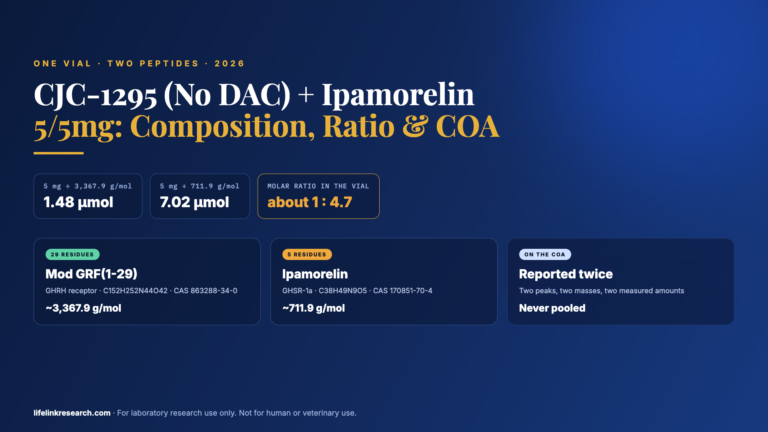
CJC-1295 (No DAC) + Ipamorelin Blend 5/5mg: Composition, Ratio & COA
Quick Answer This article covers what the cjc 1295 ipamorelin blend contains, both sequences and masses, the real molar ratio behind the…
Read article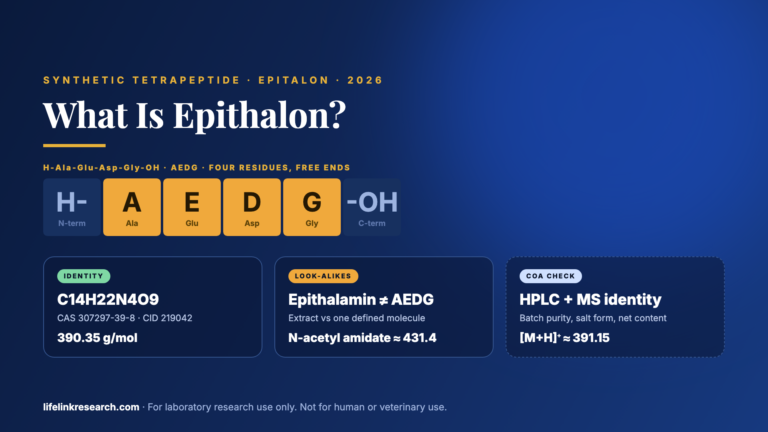
What Is Epithalon (Epitalon)? AEDG Structure, Research Use & COA
Quick Answer Epithalon (Epitalon, AEDG) is a synthetic tetrapeptide with the sequence Ala-Glu-Asp-Gly, modeled on the amino-acid composition of the natural extract…
Read article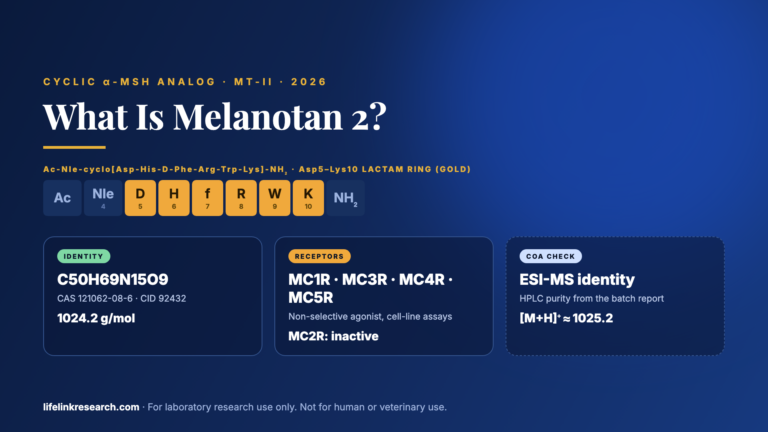
What Is Melanotan 2? MT-II Structure, Receptors & COA
Quick Answer Melanotan 2 (MT-II) is a seven-residue cyclic analog of α-MSH, closed by an Asp-Lys lactam bridge. It is a potent,…
Read articleResearch-grade peptides
99%+ purity. Verified every batch.
Identity and purity tested on every batch by third-party labs, Janoshik Analytical and US-based laboratories. Shipped same day from California.
Shop all peptides