
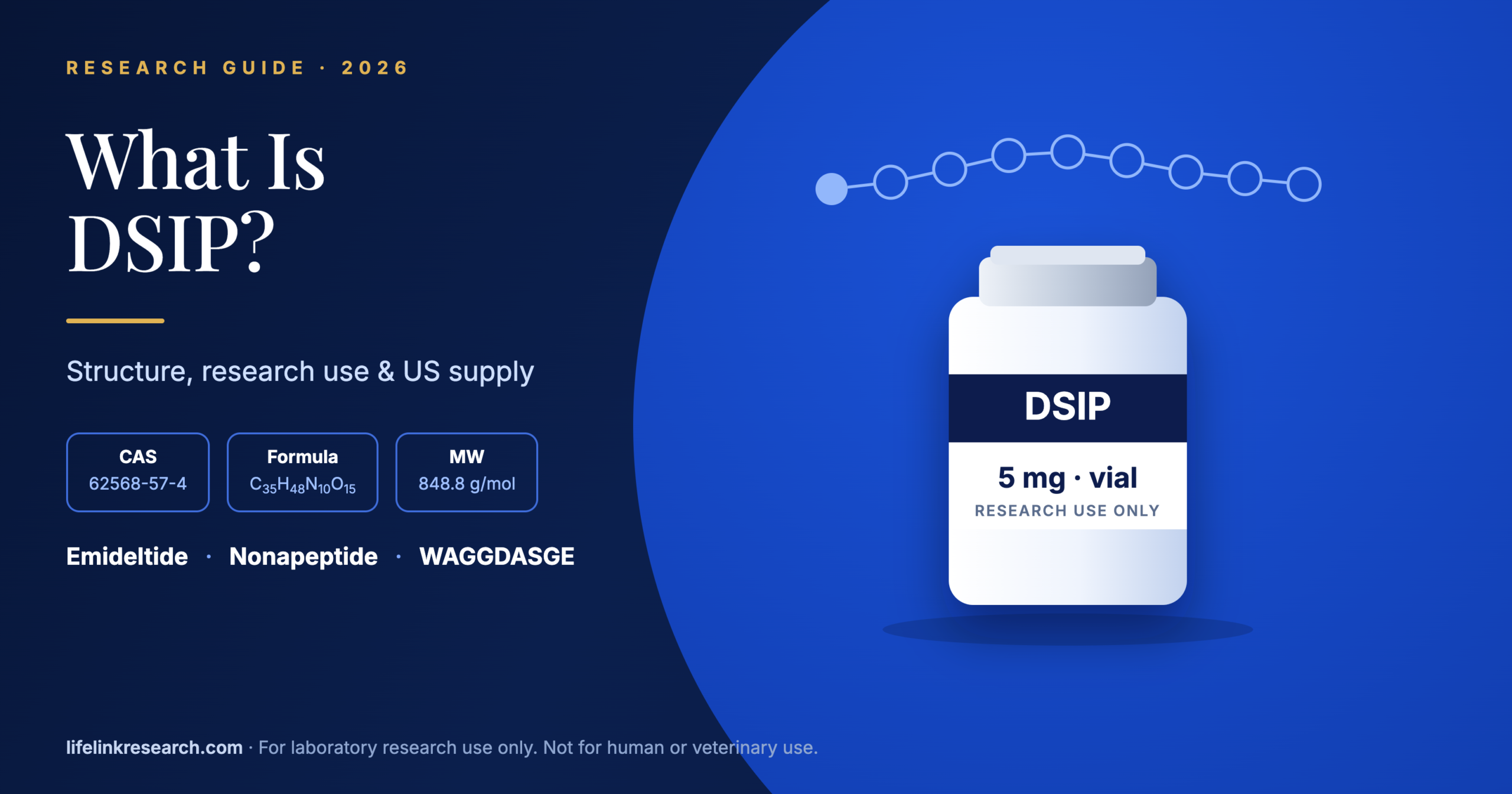
DSIP is a synthetic nine-residue peptide, WAGGDASGE, listed under the international name Emideltide. On July 24, 2026, it drew the narrowest vote of an FDA advisory meeting on compounding peptides, and the agency’s briefing pointed less at biology than at chemistry: how well the molecule is characterized and which impurities might travel with it.
Those are lab questions, and this page answers them in the same spirit. You’ll find the sequence and identifiers, the kinds of assays DSIP turns up in, how to read its certificate of analysis, how sealed vials are stored, its US status and what to ask a supplier. More reference pages are in our research library.
For Research Use Only. Not for use in diagnostic or therapeutic procedures.
What Is DSIP?
Quick answer: DSIP is a linear nonapeptide with the sequence WAGGDASGE, also listed as Emideltide. It was first isolated from rabbit cerebral venous blood in the 1970s by a Basel group. Today it’s made by chemical synthesis and supplied as a lyophilized research peptide for analytical and in vitro work, under research-use-only rules.
The Basel lab of Guido Schoenenberger and Marcel Monnier spent years on the fraction before its sequence appeared. The final isolation and characterization were published in 1977, in Pflügers Archiv (animal tissue source, 1977) and in PNAS (1977). The Pflügers Archiv paper was part X of a series, which explains why some sites quote earlier dates for the “discovery.” The 1977 papers are the ones that put the nine residues on record.
Two things changed after that:
- Synthesis replaced extraction. Once the sequence was known, chemists could build it residue by residue on solid-phase resin. The same group compared native and synthetic material in Experientia that April (1977). Every DSIP peptide vial sold for research today is synthetic.
- The molecule got an INN. “Emideltide” is the international nonproprietary name, and it’s the term FDA uses in its compounding documents. Same peptide, two names, so search both when you check a source.
A 2006 mini-review by Vladimir Kovalzon and Tatyana Strekalova in the Journal of Neurochemistry noted that “DSIP structure is different from any other known representative of the various peptide families” (review, 2006). That uniqueness is part of why analysts treat it as a clean test case: there’s no close natural cousin to confuse it with.
Where the name comes from
DSIP’s name is a historical label. The Basel team named the peptide after the experimental system in which they first tracked the fraction, and the label stuck long before anyone could explain what the molecule does. It’s nomenclature, the way “secretin” or “substance P” reflect the labs that coined them. It isn’t a confirmed description of a property.
That’s also why you’ll see the full phrase, delta sleep inducing peptide, in older indexes and catalogs, while newer regulatory papers default to Emideltide. Kovalzon and Strekalova’s review points out that no gene, precursor protein or receptor for DSIP had been isolated as of 2006, so the name still points back to its origin rather than to a mapped pathway. For anyone searching the literature, use all three terms: DSIP, delta sleep-inducing peptide and Emideltide.
What Is the Structure of DSIP?
Quick answer: DSIP is a 9-amino-acid linear peptide: Trp-Ala-Gly-Gly-Asp-Ala-Ser-Gly-Glu. Its formula is C35H48N10O15, its molecular weight is about 848.8 g/mol, its CAS number is 62568-57-4 and its PubChem CID is 68816. It ends in an unblocked amine at one terminus and an unblocked carboxylic acid at the other, and it’s supplied as a white lyophilized powder.
Amino acid sequence
Three glycines and two alanines give DSIP a small, flexible backbone. Tryptophan at position 1 is the only aromatic residue and the only one with strong absorbance at 280 nm, which turns out to be useful on an HPLC trace.
| Position | Three-letter | One-letter | Side-chain class |
| 1 | Trp | W | Aromatic, hydrophobic |
| 2 | Ala | A | Small, nonpolar |
| 3 | Gly | G | No side chain |
| 4 | Gly | G | No side chain |
| 5 | Asp | D | Acidic |
| 6 | Ala | A | Small, nonpolar |
| 7 | Ser | S | Polar, hydroxyl |
| 8 | Gly | G | No side chain |
| 9 | Glu | E | Acidic |
Count the charges and a pattern appears. Asp5, Glu9 and the C-terminal carboxyl are all acidic, while the N-terminal amine is the only basic group. At neutral pH, DSIP works out to a net charge near −2, which is unusual among research peptides. On a reversed-phase column it elutes early, and in mass spectrometry it ionizes well in negative mode, a detail the COA section returns to.
Physicochemical properties
All values below were checked against PubChem CID 68816 and FDA GSRS on October 18, 2026.
| Property | Value |
| Molecular formula | C35H48N10O15 |
| Average molecular weight | 848.8 g/mol |
| Monoisotopic mass | 848.3301 Da |
| CAS number | 62568-57-4 |
| PubChem CID | 68816 |
| FDA UNII | YN28Z5YZ73 (Emideltide) |
| Computed XLogP | −7.1 (strongly hydrophilic) |
| Appearance | White lyophilized powder |
| Solubility | Soluble in water for assay preparation |
Purity is left out of this table on purpose: it belongs to a batch, and each lot gets its own figure. Our explainer on peptide purity 98% vs 99% shows what that last percentage point represents.
Phosphorylated and analog forms in the literature
DSIP has a phosphorylated relative. Adding a phosphate to Ser7 gives P-DSIP, which raises the average mass by about 80 Da to roughly 928.8 g/mol. It has been prepared synthetically and appears in recent animal research (Life Sciences, 2018).
Researchers have also built structural analogs with substituted residues. The 2006 review notes a naturally occurring decapeptide that matches DSIP at five of nine positions. GSRS separately registers N-acetyl Emideltide (UNII CL985USD2K), a reminder to confirm which form a document describes.
How Is DSIP Used in Research?
Quick answer: In labs, DSIP is used as a reference standard in HPLC and LC-MS method development, in peptide stability and enzymatic degradation assays, and in immunoassays for DSIP-like immunoreactivity in tissue extracts. Researchers should note which findings come from in vitro work, which from animal models, and which from older human literature.
A short, well-defined, acidic peptide with one UV-active residue is handy for analytical chemists. DSIP works as a test analyte when tuning gradients, checking negative-mode mass spectrometry, or comparing column chemistries for polar peptides.
The published literature, meanwhile, falls into three study types. The table lists what kind of work exists in each, not what it found.
| In vitro | Animal | Human |
| Degradation and aggregation studies in plasma and serum (Peptides, 1987) | Original isolation from rabbit tissue (1977) | Small clinical reports from the 1980s, such as a pilot study in European Neurology (1984) |
| Analytical method work: HPLC, LC-MS, peptide mapping | Immunohistochemical mapping of DSIP-like immunoreactivity in tissues | Measurement of DSIP-like immunoreactivity in plasma samples |
| Antibody and immunoassay development | Comparisons of native vs synthetic material (1977) | Few studies, mostly before 2000 |
One caution applies to immunoassays. In 1993, a team characterized a 77-residue protein from porcine brain that an anti-DSIP antiserum also recognized (European Journal of Biochemistry, 1993). “DSIP-like immunoreactivity” therefore doesn’t always mean DSIP itself, and mass spectrometry is the tiebreaker.
What’s still missing is a target. As Kovalzon and Strekalova’s review describes, no specific DSIP receptor has been isolated. Receptor-binding assays, which anchor work on most peptides, have no confirmed partner to run against here. That’s one reason so much DSIP literature is analytical or descriptive: identity, stability, distribution of immunoreactivity. For a lab, it also means every experiment leans hard on knowing exactly what’s in the vial.
How Do You Read a DSIP COA?
Quick answer: A DSIP COA should show the lot number, HPLC purity with a chromatogram, and LC-MS identity matching about 848.8 Da. It should also give appearance, test date and the testing lab. Purity is reported per batch, so check the result for your lot rather than a headline figure. Endotoxin or heavy-metal panels appear only if they were run.
These are the ions to look for, calculated from the monoisotopic mass of 848.3301 Da:
| Ion | Expected m/z | When you’ll see it |
| [M+H]+ | 849.34 | Positive-mode ESI, the usual default |
| [M+2H]2+ | 425.17 | Positive mode, smaller share for an acidic peptide |
| [M−H]− | 847.32 | Negative mode, which suits DSIP’s acidic residues |
| [M+O+H]+ | 865.33 | Trp oxidation product; should be absent or a trace |
For a field-by-field walkthrough of any certificate, see how to read a peptide COA.
HPLC purity vs MS identity
Each test covers a different blind spot. HPLC pulls the sample apart on a column and measures what share of the UV signal lands in the main peak. LC-MS weighs that peak to show it really is DSIP.
DSIP adds a twist. Its tryptophan absorbs at 280 nm, while every peptide bond absorbs at 214 nm. A COA that shows both wavelengths can flag impurities that lack the Trp residue, such as truncated sequences missing position 1. The trade-offs between the two methods are covered in HPLC vs mass spectrometry.
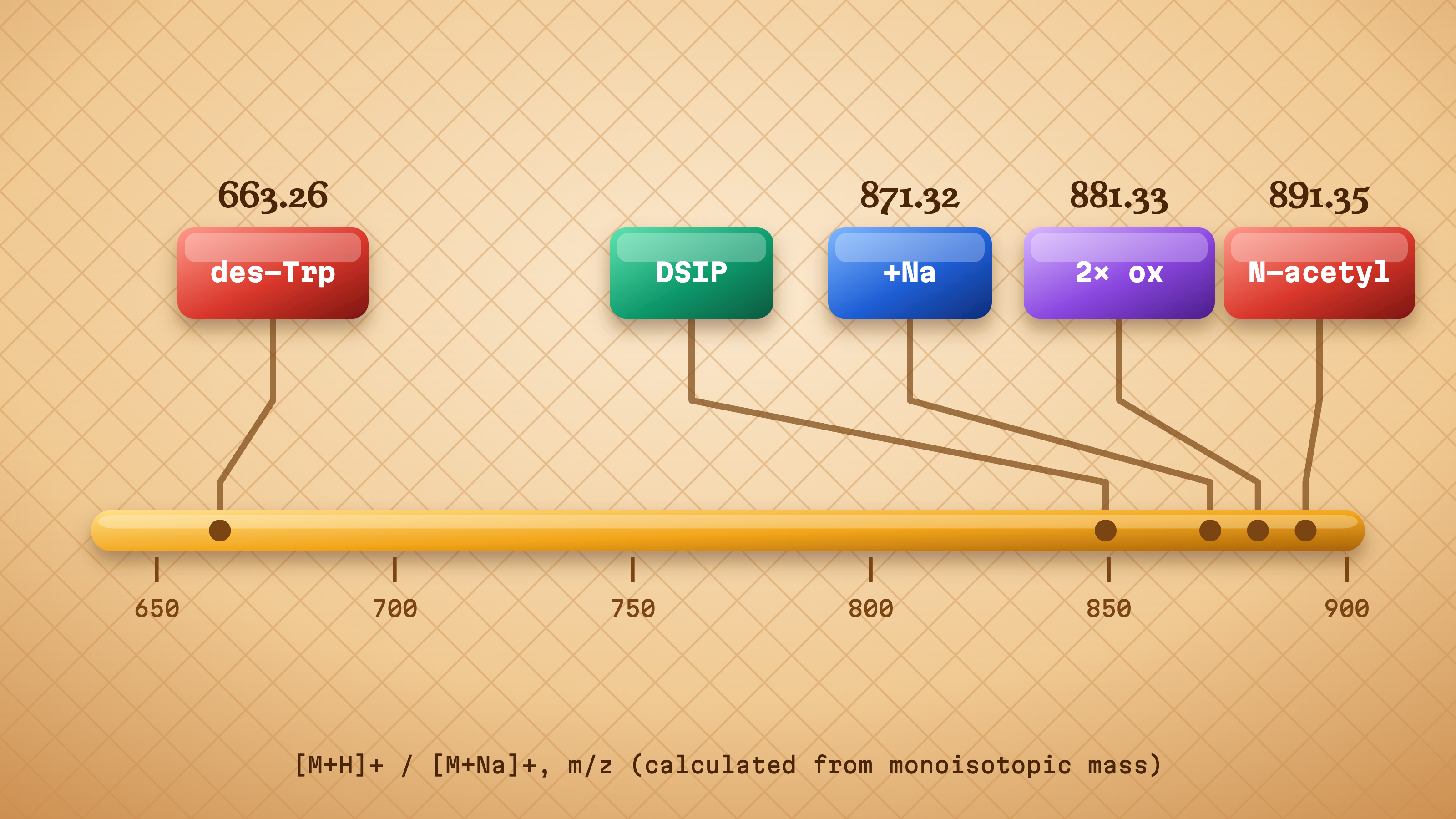
Mass ruler of calculated DSIP-related ions: des-Trp 663.26, sodium adduct 871.32, double oxidation 881.33 and N-acetyl 891.35, beside the protonated DSIP ion
Red flags on a peptide COA
Run down this list before filing any certificate:
- No lot match. The batch number differs from the vial label, or there isn’t one.
- No chromatogram. A bare percentage leaves you nothing to check.
- A recycled date. The same test date appears across lots made months apart.
- No lab name. An anonymous report can’t be traced or confirmed.
- The wrong mass. An ion near 865 or 929 suggests an oxidized or phosphorylated form, not DSIP.
If something looks off, here’s how to spot a fake COA.
How Should DSIP Be Stored?
Quick answer: Store lyophilized DSIP at −20 °C or below, dry, sealed and protected from light. Let the vial reach room temperature before opening to limit moisture uptake. Record the lot number and receipt date. Storage affects how well a sample’s analytical results stay valid over time.
Light protection has a chemical reason here. Tryptophan’s indole ring is the residue most prone to oxidation, and each added oxygen shows up as a +16 Da peak on a later mass spectrum. Keeping the vial dark and dry slows that drift, so a re-test months later still matches the original COA.
Moisture is the other enemy. A lyophilized cake pulls water from humid air, and absorbed water both lowers net peptide content and speeds hydrolysis, which is why a cold vial should warm up before the cap comes off.
A simple log helps: lot number, date received, freezer location and any re-test dates. More detail on sealed-vial handling is in our peptide storage guide.
What Is DSIP’s Regulatory Status in the US?
Quick answer: As of October 2026, DSIP (Emideltide) is not an FDA-approved drug, and FDA says neither the free base nor the acetate is part of any FDA-approved product. In the US it’s sold as a research-use-only chemical for laboratory work, not for human or veterinary use. Check FDA’s current compounding lists before relying on any summary.
Here’s where things stand, each line dated and sourced:
- Approval status. As of October 2026, no Emideltide product appears in FDA’s Drugs@FDA database (source: openFDA, checked October 18, 2026).
- Compounding review. FDA’s briefing for the July 23 and 24, 2026 Pharmacy Compounding Advisory Committee proposed that both the free base and the acetate salt of Emideltide be left off the 503A Bulks List, and noted that neither form has a USP or NF monograph (source: FDA briefing document, July 2026).
- The vote. On July 24, 2026, the committee voted 6 in favor, 7 against, with 1 abstention, on including Emideltide (source: FDA meeting page, July 2026).
- What that vote means. Committee votes are advice to FDA. Any change to the list requires notice-and-comment rulemaking (source: Federal Register notice, April 16, 2026).
What “research use only” means. Under 21 CFR 201.128, a product’s intended use is judged by objective evidence, including labeling, advertising and the circumstances of sale. An RUO label only holds up when everything around the product, including the way it’s described and sold, keeps it in the lab. Treat this as background reading; it isn’t legal advice.
Sources box (all accessed October 18, 2026): FDA PCAC July 23 and 24, 2026 meeting page and briefing document; Federal Register, April 16, 2026; openFDA Drugs@FDA; 21 CFR 201.128 (eCFR).
Sourcing DSIP in the US: What to Check in a Supplier
Every DSIP peptide supplier in the USA says “tested.” The way to tell them apart is to request proof you can confirm on your own. Here’s what to look for, with how Life Link handles each one.
One COA per lot. The certificate should carry the same lot as the vial in your hand, not a sample batch from last year. Life Link publishes a batch-specific report for each product, and identity (LC-MS) and purity (RP-HPLC) are run on every batch. Purity by HPLC, see the batch result.
Who did the testing. An outside lab has no stake in the result. Our reports come from Janoshik Analytical or US-based laboratories, and the reasons are set out in third-party vs in-house testing. Secondary panels (heavy metals, endotoxin and sterility) rotate through the catalog on a schedule, as described in our testing process.
US dispatch and transit. Long, warm journeys are hard on any peptide. Orders placed before 2 PM PST ship the same day by UPS 2-Day Air from California. Details are in our US shipping policy.
Packaging. Lyophilized peptides travel best sealed, dry and out of direct light. Life Link ships in plain, secure outer packaging with nothing on the outside to show the contents. When the parcel arrives, check the seal, match the lot to its COA and move the vial into cold storage the same day.
Clear RUO terms. A serious supplier states research-use-only terms plainly and sells to qualified researchers aged 21 and over.
For a longer checklist, read choosing a US peptide supplier. When you’re ready to order, the DSIP 5 mg research peptide page links its current batch report.
DSIP vs Selank and Semax: Structural Differences
These three short peptides often share a catalog page, but chemically they have little in common. DSIP is a native sequence. Selank and Semax are synthetic designs that each graft the same Pro-Gly-Pro tail onto a short fragment of a larger natural peptide.
| DSIP | Selank | Semax | |
| Residues | 9 | 7 | 7 |
| Sequence | WAGGDASGE | TKPRPGP | MEHFPGP |
| Origin | Native sequence isolated from animal tissue | Synthetic analog: tuftsin (TKPR) + PGP | Synthetic analog: ACTH(4-7) fragment + PGP |
| Average MW | 848.8 g/mol | 751.9 g/mol | 813.9 g/mol |
| Net character | Acidic | Basic (Lys, Arg) | Mixed |
| Supply form | Lyophilized | Lyophilized | Lyophilized |
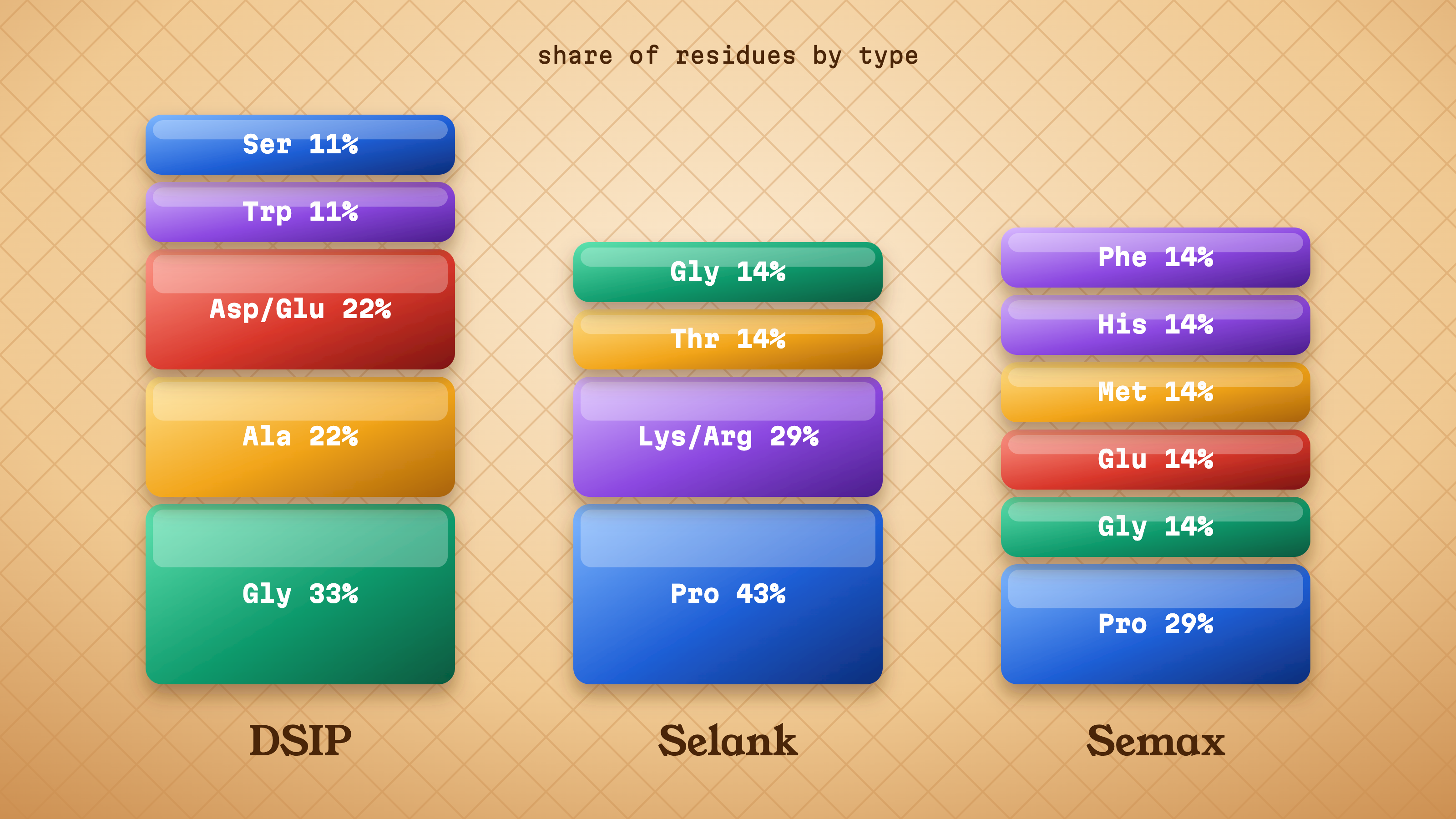
Comparing residue composition: DSIP 33% glycine, Selank 43% proline, Semax 29% proline
The proline-rich tails make Selank and Semax look alike on paper, while DSIP’s glycine-rich, acidic backbone separates it from both on an HPLC column. Product pages: Selank 10 mg and Semax 10 mg.
FAQs
Is DSIP the same as Emideltide?
Yes. Emideltide is the INN (international nonproprietary name) given to DSIP, the nonapeptide WAGGDASGE. Regulators, including FDA in its 2026 compounding documents, use Emideltide, while catalogs and older papers tend to say DSIP. Both names point to CAS 62568-57-4 and PubChem CID 68816, so searching both gives fuller results.
What is the molecular weight of DSIP?
Built from the formula C35H48N10O15, DSIP averages 848.8 g/mol. Its monoisotopic mass is 848.3301 Da, so a mass spectrometer in positive mode should show an [M+H]+ ion near 849.34. A salt form or a phosphorylated variant will read differently, so check which form a COA describes.
What is the CAS number for DSIP?
The CAS Registry Number for DSIP (Emideltide) is 62568-57-4. Useful cross-references are PubChem CID 68816 and FDA UNII YN28Z5YZ73. N-acetyl Emideltide has its own separate UNII, CL985USD2K, so confirm that any identifier on a supplier’s document matches the unmodified peptide you ordered.
Does DSIP come with a batch COA?
It should, and every lot should have its own. At Life Link, each DSIP batch is tested for identity by LC-MS and for purity by RP-HPLC, and the report lists the batch number, test date and testing lab. Check the vial’s lot against the certificate before the sample goes into inventory.
Is DSIP FDA-approved?
No. As of October 2026, Emideltide isn’t an FDA-approved drug, and FDA’s July 2026 briefing says neither the free base nor the acetate form is part of any approved product. An FDA advisory committee voted 6 to 7, with one abstention, against listing it for 503A compounding.
Is DSIP sold for human use?
No. Life Link sells DSIP strictly as a research-use-only chemical for laboratory and in vitro work by qualified researchers aged 21 and over. It isn’t for human or veterinary use, and this page doesn’t describe administration. The product’s label and terms of sale both reflect that limit.
Research use notice. For Research Use Only. Not for use in diagnostic or therapeutic procedures. Life Link Research supplies DSIP as a lab reagent to qualified professionals. It has not been evaluated or approved by FDA, and none of this page is medical advice. Our terms and conditions set out how we supply it. Last updated October 18, 2026.
References
Sources checked on October 18, 2026.
- Schoenenberger GA, Maier PF, Tobler HJ, Monnier M. Pflügers Archiv. 1977;369(2):99-109. Isolation from rabbit tissue (animal). doi:10.1007/BF00591565
- Schoenenberger GA, Monnier M. Proceedings of the National Academy of Sciences. 1977;74(3):1282-1286. Sequence characterization (animal tissue). doi:10.1073/pnas.74.3.1282
- Monnier M, Dudler L, Gächter R, et al. Experientia. 1977. Native vs synthetic peptide comparison. doi:10.1007/BF01922266
- Kovalzon VM, Strekalova TV. Journal of Neurochemistry. 2006;97(2):303-309. Review. doi:10.1111/j.1471-4159.2006.03693.x
- Graf MV, Saegesser B, Schoenenberger GA. Peptides. 1987;8(4):599-603. In vitro (plasma and serum). PubMed 3628078
- Sillard R, Schulz-Knappe P, Vogel P, et al. European Journal of Biochemistry. 1993;216(2):429-436. Protein isolation from porcine brain tissue. doi:10.1111/j.1432-1033.1993.tb18160.x
- Larbig W, Gerber WD, Kluck M, et al. European Neurology. 1984;23(5):372-385. Small human pilot study. doi:10.1159/000115716
- Roy K, Chauhan G, Kumari P, et al. Life Sciences. 2018. Animal study. doi:10.1016/j.lfs.2018.08.026
- PubChem, Emideltide, CID 68816
- FDA Global Substance Registration System, Emideltide, UNII YN28Z5YZ73
- FDA, Pharmacy Compounding Advisory Committee, July 23 and 24, 2026: meeting page
- FDA, PCAC briefing document, July 2026: emideltide briefing
- Federal Register, April 16, 2026, PCAC meeting notice and public docket: 2026-07361
- openFDA, Drugs@FDA database, searched October 18, 2026: open.fda.gov
- Code of Federal Regulations, 21 CFR 201.128
What Is Ipamorelin? Structure, GHSR-1a Receptor and COA Guide
Ipamorelin is a synthetic five-residue peptide that acts as an agonist at the ghrelin receptor, GHSR-1a. It started life as a subtraction.…
Read article
Gonadorelin: GnRH Decapeptide Structure and Receptor Research (2026)
Gonadorelin is the synthetic GnRH decapeptide. Sequence, structure, salt forms, GnRH receptor (GnRHR) signalling, assay readouts and COA checks.
Read article
What Is B7-33? Relaxin-2 Analog Research Overview (2026)
Quick Answer B7-33 is a synthetic single-chain peptide built from part of the B chain of human relaxin-2, and it binds the…
Read articleResearch-grade peptides
99%+ purity. Verified every batch.
Identity and purity tested on every batch by third-party labs, Janoshik Analytical and US-based laboratories. Shipped same day from California.
Shop all peptides