
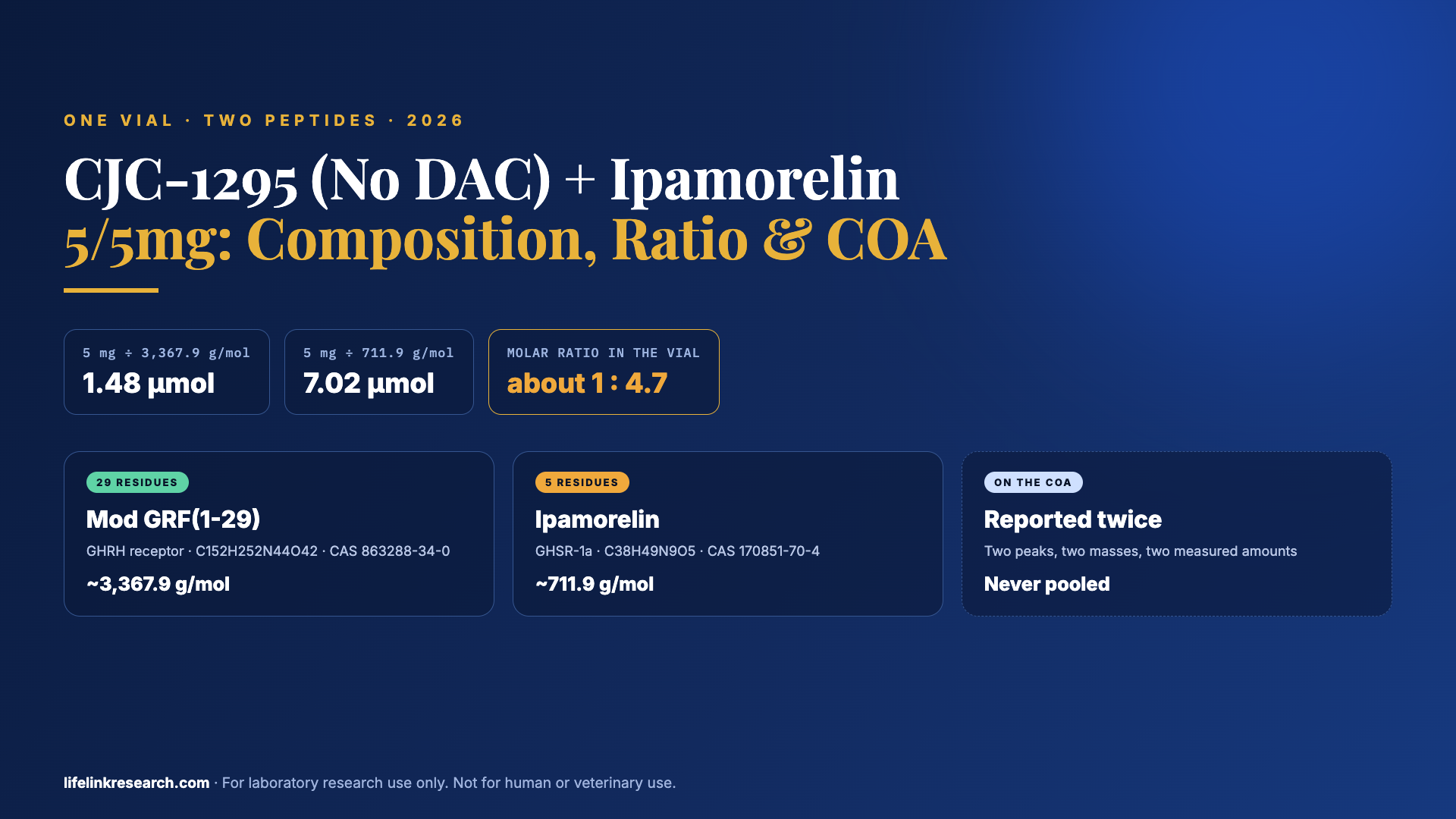
Quick Answer
This article covers what the cjc 1295 ipamorelin blend contains, both sequences and masses, the real molar ratio behind the 5/5 label, how a two-peptide certificate of analysis should be laid out, storage of the sealed vial, and current US regulatory status. Life Link Research supplies this material for laboratory research use only.
Key takeaways
- One vial, two peptides: 5 mg of Mod GRF(1-29), the no-DAC form of CJC-1295, plus 5 mg of ipamorelin
- Identity: Mod GRF(1-29) is C152H252N44O42 at about 3,367.9 g/mol, CAS 863288-34-0; ipamorelin is about 711.9 g/mol
- Equal milligrams are not equal molecules: 1.48 micromol against 7.02 micromol, a molar ratio of roughly 1 to 4.7 in favour of ipamorelin
- No DAC in this vial; the DAC-bearing variant is C165H269N47O46 at about 3,647.2 g/mol, so the two separate by mass alone
- COA check: two resolved HPLC peaks with separate purity figures, two confirmed masses, a measured amount for each peptide, plus lot, test date and named lab
- Status: neither peptide is FDA approved as of November 7, 2026; supplied for laboratory research only
A CJC-1295 (no DAC) + Ipamorelin 5/5mg blend is a single lyophilized vial containing 5 mg of Mod GRF(1-29) and 5 mg of ipamorelin. Equal milligrams, though, is where the symmetry stops. One of these molecules is roughly 4.7 times heavier than the other, so a vial labelled 5/5 contains almost five times as many ipamorelin molecules as Mod GRF molecules. That arithmetic shapes how the material is weighed out, how a certificate should report it, and what a single combined purity figure can and cannot tell you.
Contents
- What is the CJC-1295 + Ipamorelin blend?
- What is in a 5/5mg vial?
- What does “5/5mg” mean, and what is the real ratio?
- Blend vs two separate vials: what changes chemically?
- How are these two peptides studied in the lab?
- What should a two-peptide blend COA show?
- How should a lyophilized blend vial be stored?
- What is the regulatory status of CJC-1295 and ipamorelin in the US?
- CJC-1295 + Ipamorelin 5/5mg for research
- CJC-1295 + Ipamorelin blend FAQs
What is the CJC-1295 + Ipamorelin blend?
It is a premixed lyophilized vial containing two synthetic peptides. Mod GRF(1-29), which suppliers also list as CJC-1295 without DAC, is a 29-residue GHRH-receptor ligand. Ipamorelin is a 5-residue ligand at GHSR-1a. The standard format is 5 mg of each, 10 mg total, equal by weight, and each peptide keeps its own structure in the vial.
Nothing is bonded between them. Both peptides are dissolved, combined and freeze-dried together, which leaves two chemically separate compounds sharing one cake, one lot number and one certificate.
Three label formats turn up across the category:
- 5/5mg: The default, and the format covered here. 10 mg of peptide in total.
- 10/10mg: The same equal weighting at double the fill, 20 mg in total.
- “10mg” with no breakdown stated: Ambiguous. It may mean 5 mg of each or 10 mg of each, and only the certificate settles the question.
That last one is the reason a label alone is a poor specification for a two-peptide vial. Choosing between peptide blends vs single vials turns on whether a fixed ratio or an adjustable one suits the work in hand.
Is Mod GRF(1-29) the same as CJC-1295 no DAC?
Yes. They are two names for one molecule, and the naming history explains the duplication. The compound was first described in the literature as a tetrasubstituted analogue of the first 29 residues of GHRH, shortened in practice to Mod GRF(1-29). The code CJC-1295 was attached to a longer-acting version carrying DAC, a lysine-maleimide group that binds the peptide to albumin after administration. Suppliers then applied the better-known CJC-1295 label to the unmodified 29-residue peptide and distinguished it by adding “no DAC”.
Two names, one structure, and no maleimide group anywhere in this vial. CJC-1295 with DAC vs without DAC sets the two structures side by side, including the 279.3 g/mol the DAC group adds.
What is in a 5/5mg vial?
The vial contains two separate peptides. Mod GRF(1-29) has the formula C152H252N44O42 and an average mass of about 3,367.9 g/mol. Ipamorelin has the formula C38H49N9O5 and an average mass of about 711.9 g/mol. They are mixed before freeze-drying and are not chemically bonded, so each behaves as its own compound in every assay and on every chromatogram.
| Property | Mod GRF(1-29), CJC-1295 no DAC | Ipamorelin |
| Length | 29 residues, C-terminal amide | 5 residues, C-terminal amide |
| Sequence | Tyr-D-Ala-Asp-Ala-Ile-Phe-Thr-Gln-Ser-Tyr-Arg-Lys-Val-Leu-Ala-Gln-Leu-Ser-Ala-Arg-Lys-Leu-Leu-Gln-Asp-Ile-Leu-Ser-Arg-NH2 | Aib-His-D-2-Nal-D-Phe-Lys-NH2 |
| Formula | C152H252N44O42 | C38H49N9O5 |
| Average mass | ~3,367.9 g/mol (monoisotopic 3,366.90) | ~711.9 g/mol (monoisotopic 711.39); vendor sheets often print 711.85 |
| CAS | 863288-34-0 | 170851-70-4 |
| PubChem CID | 56841945 | 9831659 |
| Receptor target | GHRH receptor, a class B GPCR | GHSR-1a, a class A GPCR |
| Solubility | Soluble in water for assay preparation | Soluble in water for assay preparation |
Both CAS numbers were checked against PubChem on 7 November 2026 and resolve to the structures above. One caution applies to the Mod GRF record: PubChem CID 56841945 carries “CJC-1295 with DAC” among its synonyms even though the deposited structure has no DAC group, and a duplicate record, CID 91976842, repeats the same formula. The DAC form is a separate entry, CID 91971820, at C165H269N47O46 and about 3,647.2 g/mol. Anyone pulling identity data by name rather than by structure can land on the wrong one.
Ipamorelin is the smaller and the stranger of the two, with three non-standard residues in five positions. Ipamorelin’s structure walks the Aib, D-2-Nal and D-Phe positions in sequence.
The four substitutions in Mod GRF(1-29)
Four positions carry substitutions against native GHRH(1-29): position 2 becomes D-Ala, position 8 Gln, position 15 Ala and position 27 Leu. Reading PubChem CID 56841945 residue by residue confirms all four, which is worth doing directly, because open-web sources disagree.
Position 27 is the useful one for identity checking. Native GHRH carries Met at 27; Mod GRF carries Leu. A supplier sequence listing Met27 is either quoting the native peptide by mistake or describing something other than Mod GRF, and since Met and Leu differ by about 18 Da across a 3,367.9 g/mol chain, a mass figure alone will not always catch it. The written sequence on the certificate will.
What does “5/5mg” mean, and what is the real ratio?
5/5mg means equal weight, not equal numbers of molecules. Ipamorelin is about 4.7 times lighter than Mod GRF(1-29), so a 5/5mg vial carries roughly 7.0 µmol of ipamorelin against roughly 1.5 µmol of Mod GRF. In molar terms the vial is about 1:4.7, not 1:1.
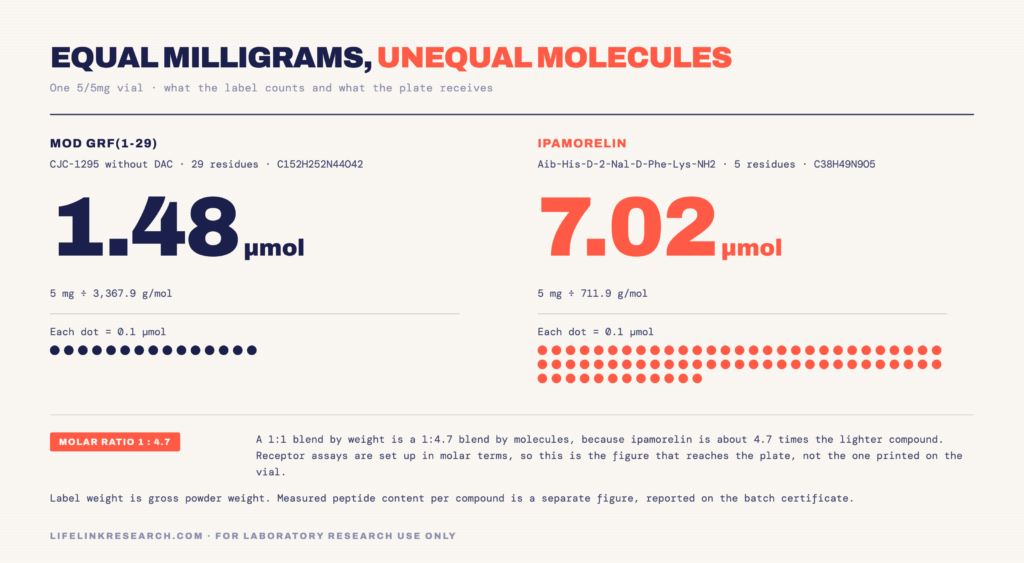
Equal milligrams, unequal molecules: a 5/5mg vial contains about 1.48 micromol of Mod GRF(1-29) against about 7.02 micromol of ipamorelin, a molar ratio of roughly 1 to 4.7
The maths
5 mg ÷ 3,367.9 g/mol = 1.48 µmol of Mod GRF(1-29)
5 mg ÷ 711.9 g/mol = 7.02 µmol of ipamorelin
7.02 ÷ 1.48 = a molar ratio of about 1:4.7
Why this is the number to carry into a protocol rather than the label: receptor assays are set up at molar concentrations, so a working solution made from a 5/5 vial arrives at the plate with nearly five times as much ipamorelin as Mod GRF on a per-molecule basis. A 1:1 weight blend and a 1:1 molar blend are different preparations, and only one of them is in the vial.
One more layer runs under all of this. The 5 mg on the label is gross powder weight, which includes counter-ions and residual water alongside the peptide itself. The measured peptide in each milligram is a separate figure, covered in the certificate section below.
Blend vs two separate vials: what changes chemically?
Nothing changes in either molecule. Both peptides have the same sequence, mass and solubility whether they are freeze-dried together or apart. What a blend fixes is the ratio, set once at manufacture, and what it consolidates is the paperwork: one lot number and one certificate covering both compounds.
The trade-off runs the other way for anyone who needs to vary the proportions. Two separately weighed vials let a laboratory set any molar ratio it chooses, including a true 1:1 by moles, and give each compound its own lot history. A premixed vial forecloses that, which is a reasonable price for the consistency it buys across a long run of plates, and the wrong choice for a concentration-response series on one peptide at a time.
How CJC-1295 and ipamorelin differ comes down to receptor class and chain length, which is why the two are usually run on separate assay panels rather than one.
How are these two peptides studied in the lab?
Both are studied mainly with receptor assays. Mod GRF(1-29) is tested at the GHRH receptor and ipamorelin at GHSR-1a, with the readouts chosen to suit each receptor’s signalling class. The methods below describe what is measured, not what was found.
| Method | Target | Study type |
| Receptor binding, labelled ligand displacement | GHRH receptor / GHSR-1a | In vitro |
| cAMP accumulation | GHRH receptor | In vitro |
| Calcium flux or IP1 accumulation | GHSR-1a | In vitro |
| Receptor-null and knockdown controls | Both | In vitro |
| Rodent models | Both | Animal |
| Circular dichroism, mass spectrometry | Both molecules | Biophysical |
The class difference explains why the readouts diverge. Gs coupling at the class B GHRH receptor makes cAMP accumulation the natural first readout, while Gq/11 coupling at the class A receptor GHSR-1a points to calcium flux or IP1 instead. A single assay panel rarely suits both, which is one practical consequence of a two-peptide vial that the label never mentions.
What should a two-peptide blend COA show?
A valid blend certificate reports each peptide separately. That means two resolved HPLC peaks with their retention times, two mass identities, a measured amount per compound, and a traceable header: which lot, tested when, by whom. One figure covering “the blend” is not a specification for either peptide in it.
The expected mass readings follow from the two molecular weights. Mod GRF(1-29) at about 3,367.9 g/mol usually appears as a multiply charged ion, commonly [M+4H]⁴⁺ near m/z 843.0 or [M+3H]³⁺ near m/z 1,123.6. Ipamorelin at about 711.9 g/mol appears as [M+H]⁺ near m/z 712.9. A spectrum showing only one of these describes only one of the two peptides in the vial.
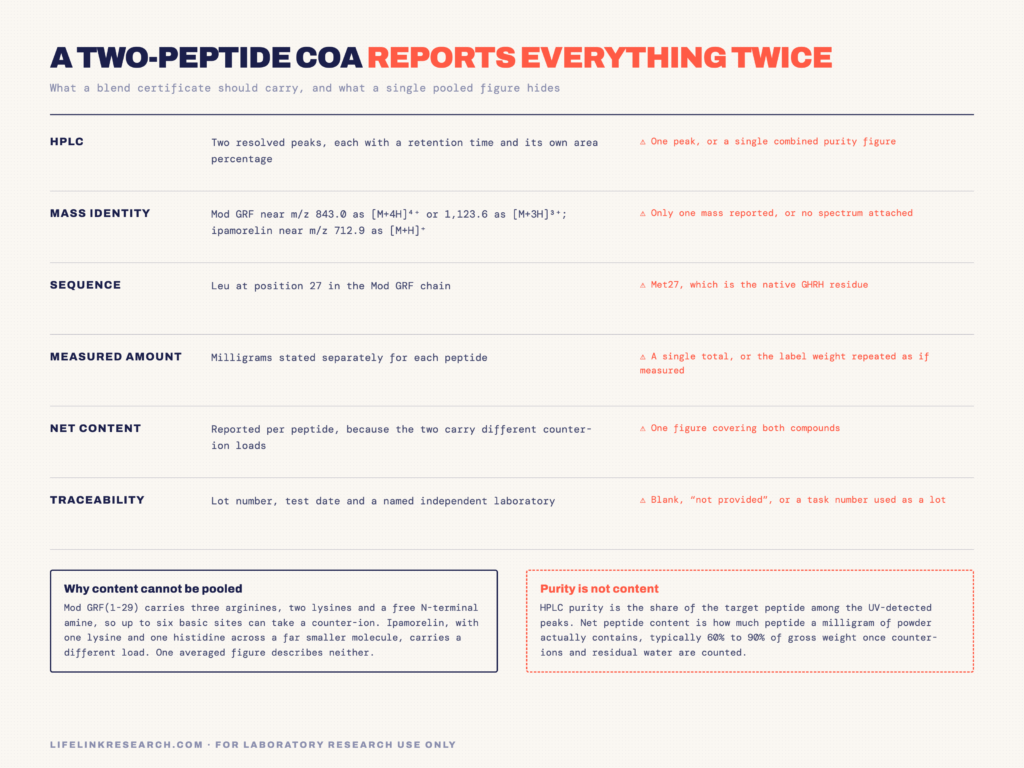
What a two-peptide blend certificate of analysis should report for each compound, and the red flag attached to each field
| COA field | What to expect | Red flag |
| HPLC chromatogram | Two resolved peaks, each with a retention time and its own area percentage | One peak, or a single combined purity figure |
| Mass identity | Both masses confirmed: ~843.0 or ~1,123.6 for Mod GRF, ~712.9 for ipamorelin | Only one mass reported, or no spectrum attached |
| Sequence listing | Leu at position 27 in the Mod GRF chain | Met27, which is the native GHRH residue |
| Measured amount | Milligrams for each peptide, stated separately | A single total, or label weight repeated as if measured |
| Net peptide content | Reported per peptide, not pooled | One figure covering both compounds |
| Lot number and test date | Both present, and matching the vial | Blank, “not provided”, or a task number used as a lot |
| Testing laboratory | Named, and independent of the seller | Unnamed, or described only as “an independent lab” |
Life Link’s own documentation gives a worked example of why label weight and measured content differ. The current certificate for the single CJC-1295 no DAC 5mg vial, issued by Prime Analytical Labs in Concord, California, report RP218-29Apr26-1 dated 5 May 2026, reports 99.30% by HPLC and a net peptide content of 5.57 mg against a 5 mg label. Measured content above label weight is normal, because vials are filled with a margin so the label claim is met after counter-ions and residual moisture are accounted for. The figure a laboratory should record is the measured one.
Third-party HPLC and mass-spec testing runs identity and purity on every batch, with heavy metals, endotoxin and sterility on a rotating cycle across the catalogue. Knowing how to verify a peptide COA means tracing the report back to the laboratory that issued it rather than taking the document at face value. Certificates are reached by opening the product and selecting View report.
Purity is not content
HPLC purity is the share of the target peptide among the UV-detected peaks, which says nothing about how much peptide a milligram of powder contains. Net peptide content is the second figure, typically 60% to 90% of gross weight, with trifluoroacetate or acetate counter-ions and residual water making up the rest.
For a blend, those two figures cannot sensibly be pooled, and the reason is in the sequences. Mod GRF(1-29) carries three arginines, two lysines and a free N-terminal amine, so up to six basic sites can take a counter-ion. Using the standard estimate of about 114 g/mol per trifluoroacetate, a fully loaded chain would run near 83% peptide by weight. Ipamorelin, with one lysine, one histidine and its N-terminal amine across a far smaller molecule, carries a different load entirely. Two compounds with different counter-ion burdens in one vial need two content figures, and a certificate that reports one has averaged away the thing being measured.
How should a lyophilized blend vial be stored?
Keep sealed vials of the powder frozen at −20 °C, dry and away from light, and log the lot number against every experiment that draws on them. Avoid repeated freeze-thaw cycles of the sealed cake, and let a vial reach room temperature before opening so that moisture does not condense onto cold powder.
Two residues set the shelf-life questions for this pair. Mod GRF(1-29) carries asparagine and several glutamines, which are the positions associated with deamidation in aqueous conditions, and ipamorelin’s two aromatic D-residues are the positions to watch for oxidation. Both are reasons the dry, dark, cold condition is the one to keep. Lyophilized peptide storage sets the temperature ranges by compound family, which differ from the sealed-vial condition described here.
What is the regulatory status of CJC-1295 and ipamorelin in the US?
Neither peptide is approved by the FDA, and both are supplied in the US as research chemicals. The FDA’s page on bulk drug substances that may present significant safety risks, current as of 22 April 2026, places them differently from one another, so a single statement covering both would be wrong.
- CJC-1295: Listed under substances nominated for compounding but subsequently withdrawn. The agency states that it “has identified serious adverse events associated with CJC-1295” and notes that the available clinical data are limited.
- Mod GRF(1-29): Absent from the page under that name. The FDA indexes this molecule as CJC-1295, so the entry above is the one that applies.
- Ipamorelin acetate: Category 2 on the interim 503B list, added 29 September 2023, and also present in the withdrawn section. The stated concern relates to administration to people by the intravenous route.
Positions above were read from the FDA’s own page on 7 November 2026. None of this bears on supply as a laboratory reagent, which is what this material is.
CJC-1295 + Ipamorelin 5/5mg for research
One vial, one lot, one batch certificate, shipped from stock in California. The CJC-1295 + Ipamorelin 5/5mg blend carries 5 mg of each peptide with identity by mass spectrometry and purity by reverse-phase HPLC on the batch, and the certificate is reached from the product page.
Laboratories setting their own molar ratio, or running a concentration-response series on one compound at a time, want the two separately. CJC-1295 no DAC 5mg and ipamorelin 10mg are stocked as single vials with their own lot histories and certificates.
CJC-1295 + Ipamorelin blend FAQs
Is Mod GRF 1-29 the same as CJC-1295?
Yes, when CJC-1295 is specified as the no-DAC form. Both names describe one molecule: a modified form of the first 29 residues of GHRH, CAS 863288-34-0, C152H252N44O42, about 3,367.9 g/mol. The DAC version is a different compound with a different formula, mass and CAS number.
What does 5/5mg mean on a blend vial?
It means the vial was filled with 5 mg of each peptide by weight, 10 mg in total, as a single freeze-dried cake. It describes gross powder weight at fill, not the measured peptide content, and not the number of molecules of each compound.
What is the molar ratio in a 5/5mg CJC-1295 + Ipamorelin blend?
About 1:4.7 in favour of ipamorelin. Dividing 5 mg by each molecular weight gives roughly 1.48 µmol of Mod GRF(1-29) and roughly 7.02 µmol of ipamorelin, because ipamorelin is about 4.7 times the lighter molecule. Equal milligrams produce unequal molar amounts.
Does the blend contain DAC?
No. DAC is the lysine-maleimide group carried by the longer-acting CJC-1295 variant, and it is absent here. The no-DAC peptide in this vial has the formula C152H252N44O42; the DAC-bearing compound is C165H269N47O46 at about 3,647.2 g/mol, so the two are separable by mass alone.
How do I check a two-peptide blend COA?
Look for everything twice. Two resolved HPLC peaks with retention times and separate purity figures, two confirmed masses, a measured amount for each peptide, plus a lot number, test date and named laboratory. A single pooled purity or content figure cannot describe either compound.
Is the CJC-1295 / Ipamorelin blend FDA approved?
No. Neither peptide is FDA approved, and the blend is not either. On the FDA’s bulk drug substances page, current as of 22 April 2026, CJC-1295 appears under nominations that were withdrawn, and ipamorelin acetate is Category 2 on the interim 503B list. Both are supplied in the US as research chemicals.
For Research Use Only. Not for use in diagnostic or therapeutic procedures.
Life Link Research supplies the CJC-1295 + Ipamorelin blend to qualified labs for in vitro study. Full terms are set out in the Life Link research disclaimer.
References
- PubChem. Mod GRF(1-29) / CJC-1295 no DAC, CID 56841945; ipamorelin, CID 9831659; CJC-1295 with DAC, CID 91971820. Checked 7 November 2026.
- US Food and Drug Administration. Certain bulk drug substances for use in compounding that may present significant safety risks, current as of 22 April 2026.
- Prime Analytical Labs, Concord CA. Certificate of analysis RP218-29Apr26-1, issued 5 May 2026, CJC-1295 no DAC 5mg.
- AmbioPharm. Technical note on net peptide content and counter-ion load in synthetic peptides.
What Is Thymosin Alpha-1? Structure, Research Use & COA
Quick Answer Thymosin Alpha-1 (Tα1) is a 28-amino-acid peptide, acetylated at its N-terminus, with the formula C129H215N33O55. It carries an average molecular…
Read article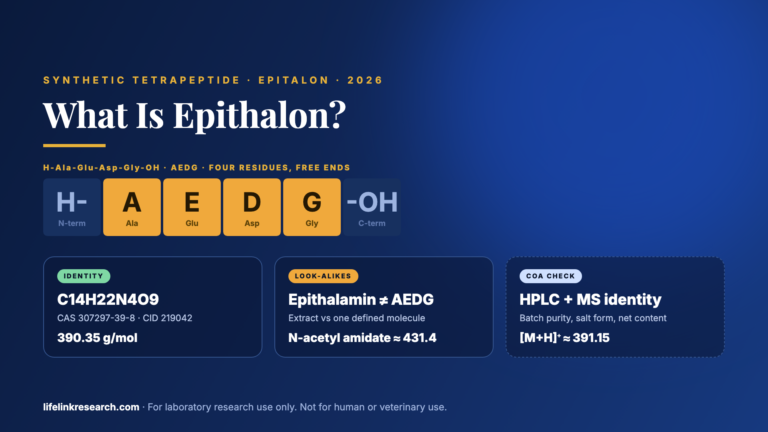
What Is Epithalon (Epitalon)? AEDG Structure, Research Use & COA
Quick Answer Epithalon (Epitalon, AEDG) is a synthetic tetrapeptide with the sequence Ala-Glu-Asp-Gly, modeled on the amino-acid composition of the natural extract…
Read article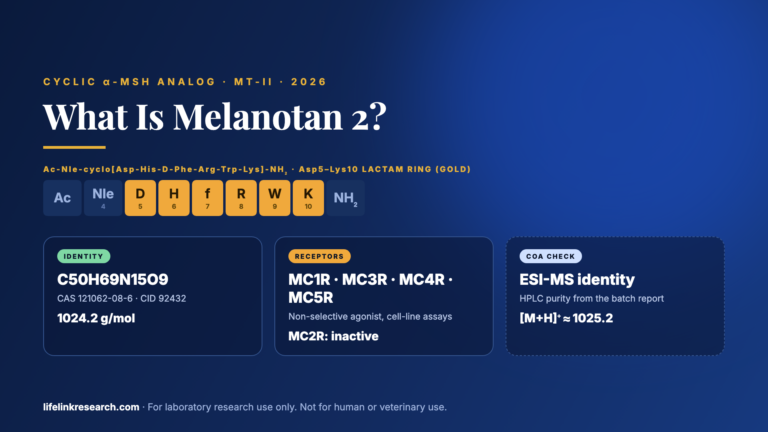
What Is Melanotan 2? MT-II Structure, Receptors & COA
Quick Answer Melanotan 2 (MT-II) is a seven-residue cyclic analog of α-MSH, closed by an Asp-Lys lactam bridge. It is a potent,…
Read articleResearch-grade peptides
99%+ purity. Verified every batch.
Identity and purity tested on every batch by third-party labs, Janoshik Analytical and US-based laboratories. Shipped same day from California.
Shop all peptides