
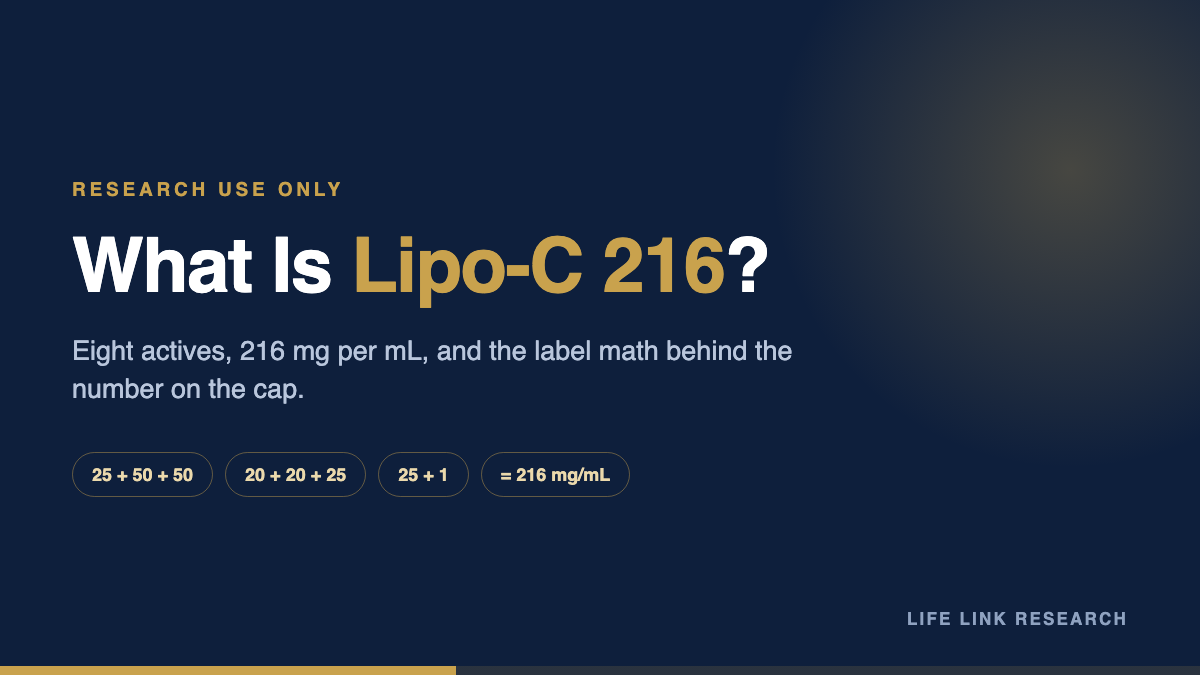
Pick up a vial of Lipo-C 216 and the label gives you a number instead of an answer. The liquid is deep red, the cap says 216mg/ml/10ml, and nothing on it tells you what the 216 is counting.
Quick Answer
Lipo-C 216 is a lipotropic research solution, and it is not a peptide. Each milliliter contains eight actives totaling 216mg: methionine 25mg, inositol 50mg, choline chloride 50mg, L-carnitine 20mg, L-arginine 20mg, dexpanthenol 25mg, vitamin B6 25 mg, and vitamin B12 1mg, preserved with benzyl alcohol. It is supplied as a ready liquid for laboratory research only.
Key takeaways
- 216 is a sum, not a strength: It is the milligrams of actives in every milliliter, added across eight separate compounds.
- A 10mL vial carries 2,160mg of actives: The per-mL figure multiplies straight up.
- Its paperwork reads differently: A formulated blend gets a content check per ingredient, so its certificate looks nothing like a single-peptide COA.
- The name is the least reliable thing about it: “Lipo-C”, “Lipo-B” and “MIC” are used inconsistently across vendors, so read the ingredient list.
What Is Lipo-C 216?
Quick answer: Lipo-C 216 is a premixed laboratory solution built from eight small molecules at a combined concentration of 216 milligrams per milliliter. Break the name into three parts and it makes sense.
“Lipo” is short for lipotropic. In chemistry, a lipotropic compound is one studied for its part in how cells move and process fats, usually through methyl-group chemistry. That describes a pathway, not an outcome.
“C” is commonly read as the carnitine addition to the older three-compound MIC core. Vendors do not agree on this, a recurring headache covered further down.
“216” is arithmetic. Add the eight per-mL amounts, and you land on 216mg. Nothing in the vial is present at 216mg on its own.
The same material is listed under several aliases: LC216, Lipo-C Elite, and Lipo-C/W B12. All point at the same kind of eight-component blend, though the exact ingredient list still varies by supplier.
One more distinction changes what you are buying. Two different markets sell under this name. Compounding pharmacies prepare lipotropic injections to prescription for clinics, a regulated supply chain for identified patients. Research suppliers sell reference solutions for in-vitro laboratory work. This article covers the research reagent.
Most catalogs that stock it are peptide catalogs, so one point bears saying plainly: this is a vitamin and amino acid blend, and there is no peptide in it.
What Is in Lipo-C 216? The 216mg/mL Label Math
Quick answer: Each milliliter of Lipo-C 216 contains eight actives: methionine 25mg, inositol 50mg, choline chloride 50mg, L-carnitine 20mg, L-arginine 20mg, dexpanthenol 25mg, vitamin B6 (pyridoxine HCl) 25mg and vitamin B12 1mg. Those amounts add up to 216mg per mL. Benzyl alcohol is present as a preservative and is counted separately.
Here is the whole label in one place, with the vial column doing the multiplication for you.
| Active | Per mL | Per 10mL vial |
| Methionine | 25mg | 250mg |
| Inositol | 50mg | 500mg |
| Choline chloride | 50mg | 500mg |
| L-carnitine | 20mg | 200mg |
| L-arginine | 20mg | 200mg |
| Dexpanthenol (B5 provitamin) | 25mg | 250mg |
| Vitamin B6 (pyridoxine HCl) | 25mg | 250mg |
| Vitamin B12 | 1mg | 10mg |
| Total actives | 216mg | 2,160mg |
The arithmetic behind the cap, written out once: 25 + 50 + 50 + 20 + 20 + 25 + 25 + 1 = 216.
Each belongs to a different chemical family. The molecular weights below come from the PubChem primary records and match the product specification.
| Active | Chemical class | MW (g/mol) | PubChem record |
| Methionine | Sulfur-containing amino acid | 149.21 | CID 6137 |
| Inositol (myo-inositol) | Cyclitol, a cyclic sugar alcohol | 180.16 | CID 892 |
| Choline chloride | Quaternary ammonium salt | 139.62 | CID 6209 |
| L-carnitine | Quaternary ammonium amino acid derivative | 161.20 | CID 10917 |
| L-arginine | Proteinogenic amino acid | 174.20 | CID 6322 |
| Dexpanthenol | Provitamin alcohol of pantothenic acid | 205.25 | CID 131204 |
| Pyridoxine HCl | Vitamin B6 salt | 205.64 | CID 6019 |
| Methylcobalamin (B12) | Cobalamin, a cobalt-containing corrinoid | 1344.4 | CID 10898559 |
| Benzyl alcohol (preservative) | Aromatic alcohol | 108.14 | CID 244 |
Check the B12 row on any vial you handle, because two different cobalamins appear under the same “Vitamin B12 1mg” label. Methylcobalamin weighs 1344.4 and cyanocobalamin 1355.4, a difference of eleven mass units that a mass spectrum resolves immediately. Suppliers disagree on this: PureRawz lists cyanocobalamin, CAS 68-19-4 in its LC216 blend, while Life Link’s Lipo-C Elite is formulated with methylcobalamin, which is what the batch mass spectrum in its certificate of analysis shows. Two vials, same label line, different molecule.
What Are the Eight Actives?
The eight fall into three groups: a three-compound lipotropic core, two amino acid additions and three vitamin cofactors.
The MIC Core: Methionine, Inositol and Choline
These three are the original lipotropic trio, and the “MIC” in every MIC blend on the market.
Methionine is a sulfur-containing essential amino acid, studied in one-carbon and methyl-donor chemistry. Cells convert it to S-adenosylmethionine, the molecule most methyl-transfer reactions draw on, which is why enzymology work uses it to probe methylation pathways.
Inositol is a cyclitol, a six-carbon ring carrying six hydroxyl groups. Its research role is structural, as the headgroup precursor for phosphatidylinositol and the phosphoinositide signaling lipids built from it. Cell-model studies use inositol depletion and repletion to probe that second-messenger cascade.
Choline chloride is a quaternary ammonium salt, used because it dissolves readily in water. Choline appears in phospholipid-pathway research as a precursor of phosphatidylcholine, and in hepatocyte models examining lipid handling and export.
The Amino Additions: L-Carnitine and L-Arginine
L-carnitine has the most sharply characterized role of the eight. It is the obligate co-substrate of carnitine palmitoyltransferase-1, the enzyme that hands long-chain acyl groups from acyl-CoA onto carnitine so the resulting acylcarnitine can cross the inner mitochondrial membrane for beta-oxidation. In a 2020 review in Molecules, Gnoni and colleagues set out that transport role and note that muscle tissue cannot synthesize carnitine, so it depends on uptake from circulation. The same review is candid that evidence on carnitine supplementation and exercise performance remains unclear, with dose, timing and training status confounding the published results. Longo and colleagues, in Biochimica et Biophysica Acta in 2016, describe the OCTN2 transporter that carries carnitine into cells. Researchers isolating that step often work with a single-compound reference instead of a blend, which is why an L-carnitine 600mg research solution is stocked alongside Lipo-C 216 in the same catalog.
L-arginine is a proteinogenic amino acid, meaning cells build it into proteins. Separately, it is the substrate nitric oxide synthase acts on to produce nitric oxide and L-citrulline, and it enters the urea cycle, which makes it a common reagent in nitrogen-metabolism work.
The Vitamin Cofactors: Dexpanthenol, B6 and B12
Dexpanthenol is the alcohol form of pantothenic acid, vitamin B5. Pantothenate is the backbone of coenzyme A, the carrier acyl groups ride on through central metabolism, so B5 chemistry turns up wherever acyl-transfer is measured.
Vitamin B6, supplied here as pyridoxine hydrochloride, converts in cells to pyridoxal 5′-phosphate. That is the cofactor for transaminases and for the transsulfuration enzymes, which is the point where B6 chemistry meets methionine chemistry.
Vitamin B12 is a cobalamin, built around a cobalt atom inside a corrin ring. Its best-characterized enzymatic job is as the cofactor for methionine synthase. B12 is also the reason the solution is red and the reason it is light-sensitive.
Lipo-C vs MIC vs Lipo-B: What’s the Difference?
Quick answer: MIC is the three-compound core: methionine, inositol and choline. Lipo-C usually means MIC plus L-carnitine. Lipo-B usually means MIC plus vitamin B12. Vendors use the names inconsistently, so one supplier’s Lipo-C is another’s Lipo-B, and the ingredient list and COA, not the name, define what you have.
| Name | Typical core | Typical addition |
| MIC | Methionine, inositol, choline | None |
| Lipo-C | Methionine, inositol, choline | L-carnitine |
| Lipo-B | Methionine, inositol, choline | Vitamin B12 |
That is the convention. What is on sale in the US under the Lipo-C banner looks different:
- Pure Health Peptides sells a 216 blend titled “LC 216 (Lipo-B Formulation)” at $49 for 10mL. Same number, same category, opposite letter.
- PureRawz lists Lipo-C LC216 as an eight-component blend at 216mg/mL with cyanocobalamin as its B12.
- Empower Pharmacy’s compounded Lipo-C Injection contains four actives: methionine, choline chloride, L-carnitine and dexpanthenol. No inositol, no arginine, no B12.
- Olympia Pharmacy’s Lipo-Mino-Mix-C pairs the MIC core and carnitine with vitamins B1, B2 and B6.
- Defy Medical defines its Lipo-C as methionine, inositol and choline, with no carnitine in the definition at all.
Five suppliers, five different ingredient lists, one product name. Researchers in peptide communities have worked this out the hard way and now identify blends by their contents instead. In an LC216 thread on the r/Biohackers forum, the reply that settles the question runs: “With that label and the color plus the ingredients- it’s Lipo-c.” Nobody in that exchange trusts the name on its own.
Life Link’s label settles it by printing all eight actives and their per-mL amounts, so the blend identifies itself.
Is Lipo-C 216 a Peptide?
Quick answer: No. Lipo-C 216 contains no peptide component. Its actives are amino acids, a cyclitol, a choline salt and B vitamins in solution. It appears in research-peptide catalogues because the same labs stock it, but it is chemically a vitamin and amino acid blend, and it is tested as one.
The confusion is understandable, because two of the eight are amino acids and peptides are chains of amino acids. The difference is the bond. A peptide is two or more amino acids joined by peptide bonds into a chain with a defined sequence, while methionine and arginine in this vial are free molecules, joined to nothing.
That changes the paperwork. A peptide gets a sequence confirmation and a chromatographic purity figure, while a blend of eight free small molecules gets a content check, ingredient by ingredient. Calling it a peptide sets the wrong expectation of what its certificate should contain.
Why Is It a Solution Instead of a Lyophilized Powder?
Quick answer: Multi-component blends are supplied as preserved ready solutions because getting eight compounds into a stable, uniform mixture is work best done once, under controlled conditions, by the formulator. Freeze-drying a blend and rehydrating it later invites the components to redissolve at different rates and in different proportions.
Benzyl alcohol, at roughly 0.9 to 1.5 percent, makes a multi-use vial practical. It is a bacteriostatic preservative, so once the seal is pierced the contents stay protected across repeated withdrawals. Without one, an opened vial of aqueous solution has a very short usable life.
This is the opposite format to a single lyophilized peptide, which arrives as a dry cake precisely because it would degrade in water, and which the handling rules for lyophilized peptide storage are written around. Lipo-C 216 skips that step entirely. There is nothing to reconstitute, no diluent to add and no volume calculation to run, because the formulated concentration is fixed at 216mg per mL in the vial you receive.
How Does a Lipo-C 216 COA Read?
Quick answer: A formulated-blend COA reports identity and content for each of the eight actives against the label claim, instead of a single HPLC purity percentage. Expect one row per ingredient with its assayed amount per mL, plus appearance, and a lot number matching your vial. A one-line “purity %” on an eight-ingredient solution is a red flag.
This is where a blend certificate and a peptide certificate part ways:
| Single peptide COA | Formulated blend COA | |
| Identity | Sequence and observed mass vs expected | Each component confirmed by its mass |
| Main number | Purity as a percentage of the sample | Assayed content per component, in mg/mL |
| Method | RP-HPLC with UV, plus MS | HPLC quantitation per analyte, plus MS identity |
| Appearance | Dry cake, color noted | Clear solution, color noted |
| Traceability | Lot number matching the vial | Lot number matching the vial |
The methods differ for a practical reason. Small molecules and vitamins have very different retention behavior and absorbance, so a single chromatographic run tuned for a peptide tells you little about eight unrelated compounds. The B12 component alone carries a molecular weight nearly ten times the others, which is why it appears in its own mass range on the spectrum.
Three checks are worth making before you accept a blend certificate. Confirm the lot number on the document matches the vial, since a certificate from a different lot describes somebody else’s batch. Confirm every label active appears in the identity result, because a missing row means that ingredient was not confirmed. Confirm content is reported per component against the label claim. The same discipline applies whenever you verify a supplier COA, and it is more important here than on a single-compound product, because there are eight claims to check instead of one.
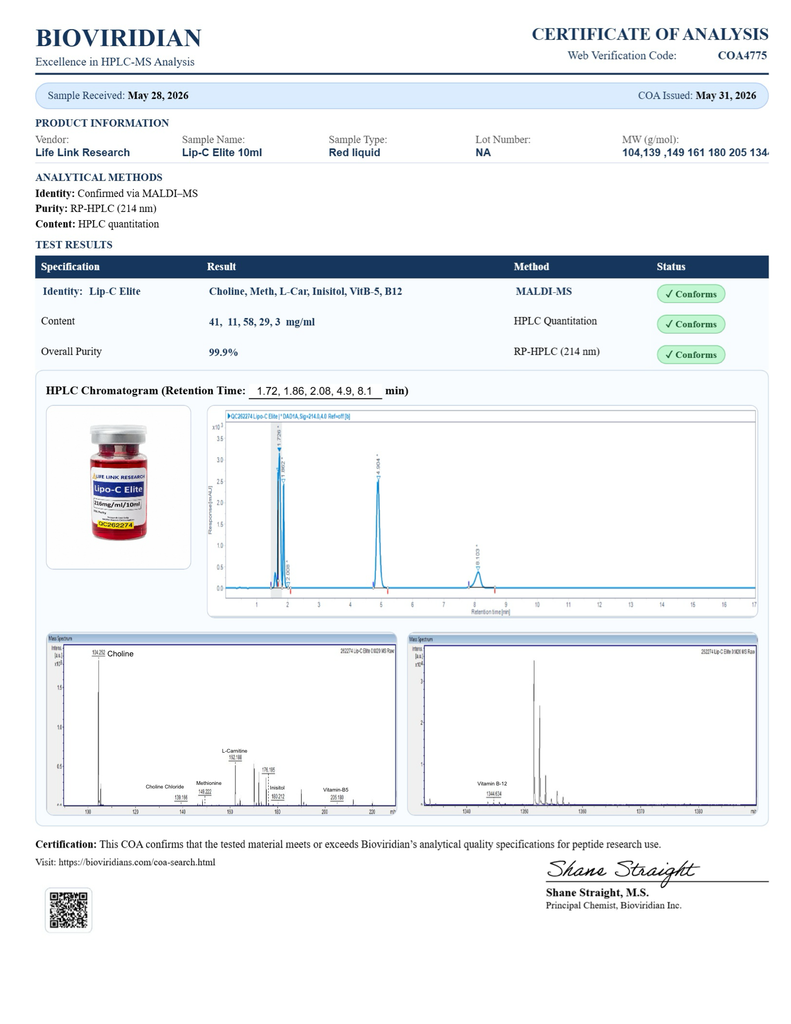
Appearance is what researchers ask about most. A long-running Lipo-C thread on the r/PeptidePathways forum opened with “Has anybody had Lipo c look like this?” and drew 145 replies comparing vial photographs. The answer is that a red tint is expected from the cobalamin, and that the certificate records the appearance of the batch as tested, which gives you something concrete to compare against.
How Should Lipo-C 216 Be Stored?
Quick answer: Refrigerate Lipo-C 216 at 2 to 8°C and protect it from light. Freezing is unnecessary for a preserved aqueous solution and is best avoided. Keep the vial sealed between withdrawals, and inspect the solution for clarity each time you handle it.
Light protection is the instruction people skip. Cobalamins are photosensitive, so a vial left on an open bench under room lighting is losing the component present at the smallest amount, 1mg per mL. An amber vial, the original carton or an opaque wrap all solve it.
Clarity is your visual check. The solution should be clear and evenly colored, with no haze, particles or separation. Anything else means checking the batch against its certificate.
Is Lipo-C FDA Approved? US Regulatory Status (November 2026)
Quick answer: The research solution is not an approved drug. No research-grade Lipo-C 216 has been through FDA review for safety, effectiveness or quality, and it is supplied for laboratory research only, with no human or veterinary use.
Compounded “Lipo-C injections” dispensed by clinics are a different supply chain under different rules. The FDA’s human drug compounding laws page, current as of 17 December 2024, states plainly that “Compounded drugs are not FDA-approved,” and that the agency does not review them for safety, effectiveness or quality before they reach patients.
Two sections of the Federal Food, Drug, and Cosmetic Act govern them. Under section 503A, drugs compounded against valid patient-specific prescriptions are exempt from premarket FDA approval, from current good manufacturing practice requirements, and from labeling with adequate directions for use. Under section 503B, added by the Drug Quality and Security Act enacted on 27 November 2013, a compounder may voluntarily register as an outsourcing facility. Outsourcing facilities are subject to CGMP requirements, are inspected by the FDA on a risk-based schedule, and may supply office stock rather than only patient-specific prescriptions.
Three categories exist: an FDA-approved drug, a compounded preparation that is not FDA-approved, and a research reagent sold for laboratory use. Lipo-C 216 as covered here is the third.
How Much Does Lipo-C 216 Cost in the US?
Quick answer: Research-supplier pricing for a Lipo-C 10 ml vial ranges widely. Checked on 19 November 2026, Peptides Optimized lists Lipo-C from $38.49, Pure Health Peptides lists its LC 216 at $49 for 10mL, and Life Link’s Lipo-C Elite 216mg/mL research solution is $123 for 10mL, with quantity pricing down to $98.40 per vial at ten. Compounded clinic preparations are priced separately and typically higher.
A price spread that wide on an identically labeled product tells you the label is not the whole specification. Compare on assayed content per mL against the certificate, and on what the certificate documents: which analytes were confirmed, whether content is reported per component, and whether the lot is traceable to your vial. The distance between $38 and $123 is largely testing and documentation, the same thing to weigh when choosing a US research supplier for any formulated blend.
One live listing makes the point. A US vendor sells a multi-ingredient “Lipo-C W/B-12” described as a 100mg lipotropic blend with “Purity 99%+” on the listing. A single purity figure cannot describe a solution of five or more different compounds, and that is the specification problem a per-component content table solves.
Lipo-C 216 FAQs
What does 216 mean on a Lipo-C label?
It is the total milligrams of active ingredients in each milliliter, added across all eight compounds in the blend. No single ingredient is present at 216mg. A 10mL vial labeled 216mg/mL therefore contains 2,160mg of actives in total, divided across the eight in fixed proportions.
Is Lipo-C the same as MIC?
No. MIC is the three-compound core of methionine, inositol and choline. Lipo-C conventionally means that core plus L-carnitine, and the 216 blend adds L-arginine, dexpanthenol, vitamin B6 and vitamin B12 on top. Vendors apply these names loosely, so compare ingredient lists instead of names.
Is Lipo-C 216 a peptide?
No. It contains no peptide component. The eight actives are two free amino acids, a cyclitol, a choline salt, an amino acid derivative and three vitamin compounds, none of them joined by peptide bonds. It appears in peptide catalogues because the same suppliers stock it, not because of its chemistry.
Why does it contain benzyl alcohol?
Benzyl alcohol is a bacteriostatic preservative, present at roughly 0.9 to 1.5 percent. It allows a multi-use vial of aqueous solution to stay protected after the seal is first pierced. It is a formulation excipient and is counted separately from the 216mg of actives per mL.
What should a Lipo-C COA show?
Identity confirmation for each labeled active, assayed content per component in mg/mL against the label claim, the appearance of the solution, the analytical methods used, and a lot number that matches the vial you hold. A single overall purity percentage does not describe an eight-component blend.
Is it a powder or a solution?
A solution. It is supplied as a ready preserved liquid at a fixed 216mg/mL, so there is nothing to reconstitute and no diluent to add. Store it refrigerated at 2 to 8°C, protected from light, and check it is clear before each use.
For Research Use Only. Not for use in diagnostic or therapeutic procedures. Full terms are set out in the research disclaimer.
References
- Gnoni A, Longo S, Gnoni GV, Giudetti AM. Carnitine in Human Muscle Bioenergetics: Can Carnitine Supplementation Improve Physical Exercise? Molecules. 2020;25(1):182. PMID 31906370.
- Longo N, Frigeni M, Pasquali M. Carnitine transport and fatty acid oxidation. Biochimica et Biophysica Acta. 2016;1863(10):2422-2435. PMID 26828774.
- US Food and Drug Administration. Human Drug Compounding Laws. Content current as of 17 December 2024.
- PubChem primary records, National Library of Medicine:
- Methionine: CID 6137
- Myo-inositol: CID 892
- Choline chloride: CID 6209
- L-carnitine: CID 10917
- L-arginine: CID 6322
- Dexpanthenol: CID 131204
- Pyridoxine hydrochloride: CID 6019
- Methylcobalamin: CID 10898559
- Benzyl alcohol: CID 244
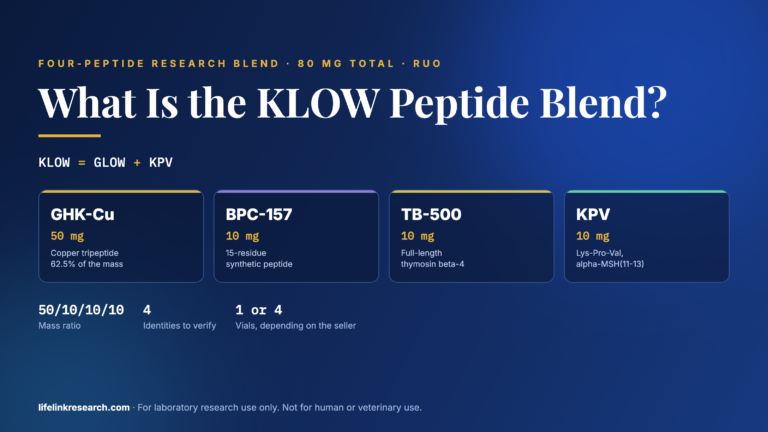
What Is the KLOW Peptide Blend? Composition, Ratio, COA & US Supply
Quick Answer The KLOW peptide blend is an 80mg research combination of GHK-Cu 50mg, BPC-157 10mg, TB-500 10mg and KPV 10mg, a…
Read article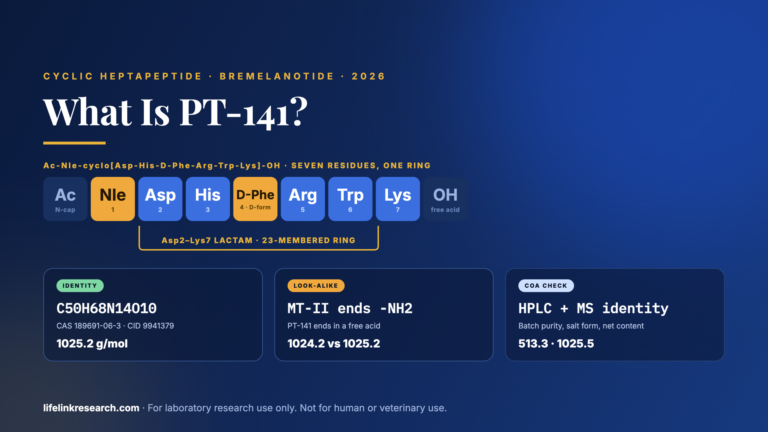
What Is PT-141 (Bremelanotide)? Structure, Receptors & COA
Quick Answer PT-141 is the research code for bremelanotide, a synthetic cyclic peptide studied at melanocortin receptors. Seven amino acids, one ring,…
Read article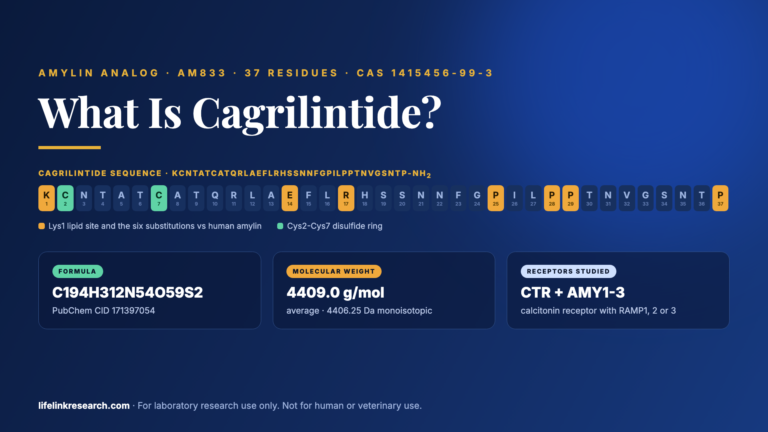
What Is Cagrilintide? Structure, Sequence & COA
Quick Answer Cagrilintide is a synthetic amylin analog developed by Novo Nordisk under the code AM833. If you have a vial on…
Read articleResearch-grade peptides
99%+ purity. Verified every batch.
Identity and purity tested on every batch by third-party labs, Janoshik Analytical and US-based laboratories. Shipped same day from California.
Shop all peptides