
Quick Answer
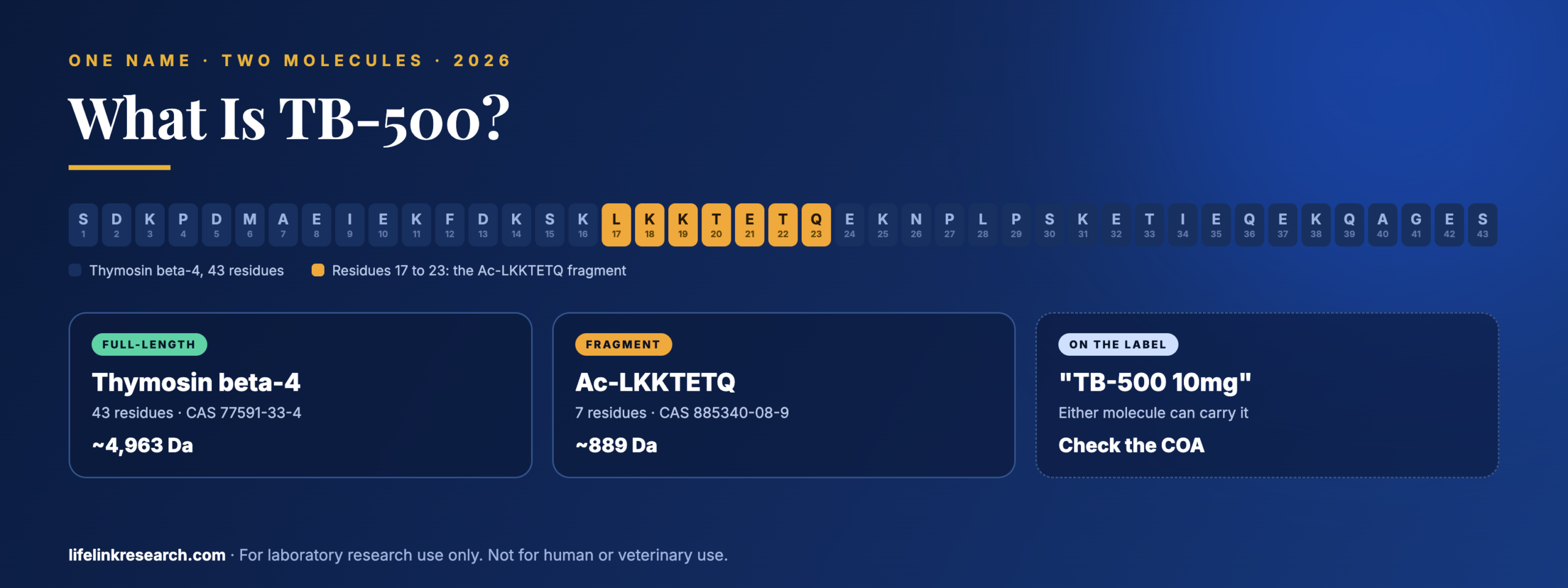
TB-500 is a market name used for two different molecules. Some sellers mean full-length thymosin beta-4 (Tβ4), a 43-residue protein of about 4,963 Da. Others mean Ac-LKKTETQ, a 7-residue fragment of it of about 889 Da. A vial reading TB-500 10mg can hold either, and the identity result on its certificate is what resolves it.
Key takeaways
- TB-500 isn’t one molecule: it’s sold as full-length Tβ4 or a 7-residue fragment
- Full-length Tβ4: 43 residues, about 4,963 Da, CAS 77591-33-4
- The fragment: Ac-LKKTETQ, Tβ4 residues 17 to 23
- The identity result on the COA tells you which one you have
- Compare price per milligram of the same molecule
The name and the vial often disagree. PubChem resolves TB-500 to a seven-residue peptide weighing about 889 daltons, while a great many vials sold under that name hold the whole 43-residue protein at roughly 4,963. Neither source is wrong. The label simply never belonged to one molecule, and that is the first thing to settle when asking what is TB-500.
What follows covers both molecules, how the names came apart, where the published molecular weights disagree, and how a batch certificate resolves which one a given tb-500 peptide vial contains. Life Link’s own TB-500 10mg serves as the worked example.
What Is TB-500?
Quick answer: TB-500 is a vendor name, not a scientific one. It is used for either full-length thymosin beta-4, a naturally occurring 43-residue peptide, or for Ac-LKKTETQ, a synthetic 7-residue segment of it. Nothing has been reviewed by a regulator under that name, and the material is supplied purely for laboratory research.
The designation came out of supplier catalogs, not from any journal or registry. Search the primary literature for thymosin beta-4 and the papers are plentiful; search it for “TB-500” and the term barely appears outside commercial contexts. That origin explains the looseness: a catalog label carries no obligation to specify a molecule, and two sellers can apply it to materials that differ fivefold in size.
Two products ship under it today:
- Full-length thymosin beta-4. The complete 43-residue peptide, acetylated at the N-terminus.
- The Ac-LKKTETQ fragment. Seven residues taken from the middle of that sequence.
Both are legitimate research materials, and they are not interchangeable.
What Is Thymosin Beta-4?
Quick answer: Thymosin beta-4 runs to 43 amino acids, carries an acetyl group on its N-terminus, and was first isolated from thymus tissue. It is one of the most studied members of the beta-thymosin family. In biochemical assays, it binds G-actin, the monomer form of actin, which is the property most research on it starts from.
Structure
The chain is catalogued in UniProt as P62328, where the mature 43-residue peptide runs:
Ac-SDKPDMAEIEKFDKSKLKKTETQEKNPLPSKETIEQEKQAGESThree structural points govern how it behaves in a vial and on an instrument. It carries no cysteines, so there is no disulfide chemistry to preserve. Its single methionine at position 6 is the one residue that can pick up an extra 16 daltons through oxidation. And in solution the peptide is intrinsically disordered, taking on defined structure only when it binds actin, with no fixed fold of its own (Vitamins and Hormones, 2016, PMID 27450730).
What the literature covers
Published work on thymosin beta-4 is overwhelmingly cell-culture and animal-model research, with the G-actin binding interaction serving as the biochemical starting point for most of it. The beta-thymosin family is studied as a group, so papers frequently cover several members at once instead of Tβ4 alone.
TB-500 vs Thymosin Beta-4: What’s the Difference?
Quick answer: Full-length thymosin beta-4 is the whole 43-residue molecule. The “TB-500” fragment is Ac-LKKTETQ, just residues 17 to 23, at about one-fifth of the mass. Sellers use both names loosely, so a vial labelled “TB-500” can contain either. They are different molecules and give different results on a COA.
| Full-length thymosin beta-4 | Ac-LKKTETQ fragment | |
| Residues | 43 | 7 (Tβ4 17 to 23) |
| Molecular weight | about 4,963 Da | about 889 Da |
| Monoisotopic mass | 4,960.49 | 888.49 |
| CAS | 77591-33-4 | 885340-08-9 |
| Formula | C212H350N56O78S | C38H68N10O14 |
| PubChem | CID 45382195 | CID 62707662 |
| Origin | Naturally occurring peptide, made synthetically for research | Synthetic segment |
| Molecules in 10mg | 2.0 µmol | 11.2 µmol, about 5.6× more |
Read the full sequence, and the fragment is easy to locate inside it: positions 17 to 23 spell LKKTETQ, falling just past the midpoint of the chain. That stretch is the part of the molecule most closely associated with actin binding, which is why it was isolated in the first place.
Other fragments circulate too. Ac-SDKP is residues 1 to 4, taken from the opposite end of the same sequence, and it is sold under its own name, not as TB-500.
One framing to retire: asking whether Tβ4 is “better” than TB-500 compares a molecule against a name. The useful question is which molecule a study calls for, and then which one the certificate confirms.
What Is the Molecular Weight of Thymosin Beta-4?
Quick answer: Full-length thymosin beta-4 has an average molecular weight of about 4,963 Da. Some sources list higher figures because they count a salt form or use a different calculation. The fragment Ac-LKKTETQ is about 889 Da. Always compare against the mass stated on the batch COA.
PubChem puts the free-base average at 4,963 and the monoisotopic figure at 4,960.49. Figures above those appear often enough on secondary sites to cause confusion, and there are three ordinary reasons for the spread:
- Average against monoisotopic. At this chain length, the two conventions differ by roughly 2.5 Da. Neither is wrong; they answer different questions, and a report should say which it used.
- Free base against a salt. Research material is frequently supplied as an acetate. Every acetate counter-ion adds about 60 Da to the powder, and with nine lysines in the sequence there are plenty of sites to carry them, so a salt-form figure lands well above the free-base number.
- Transcription errors. A figure copied between vendor pages without a source behind it tends to drift, which is why the arbiter is the batch document rather than a catalog.
The same logic applies to the fragment, where 889 is the free-base average. Which questions each analytical method can answer is set out in HPLC vs mass spectrometry.
How Do You Tell Which “TB-500” Is in Your Vial?
Quick answer: Read the identity line on the COA. A measured mass near 4,963 Da means full-length thymosin beta-4; a mass near 889 Da means the Ac-LKKTETQ fragment. The report should also name the molecule, give its sequence or CAS, show HPLC purity, and carry a batch number matching your vial.
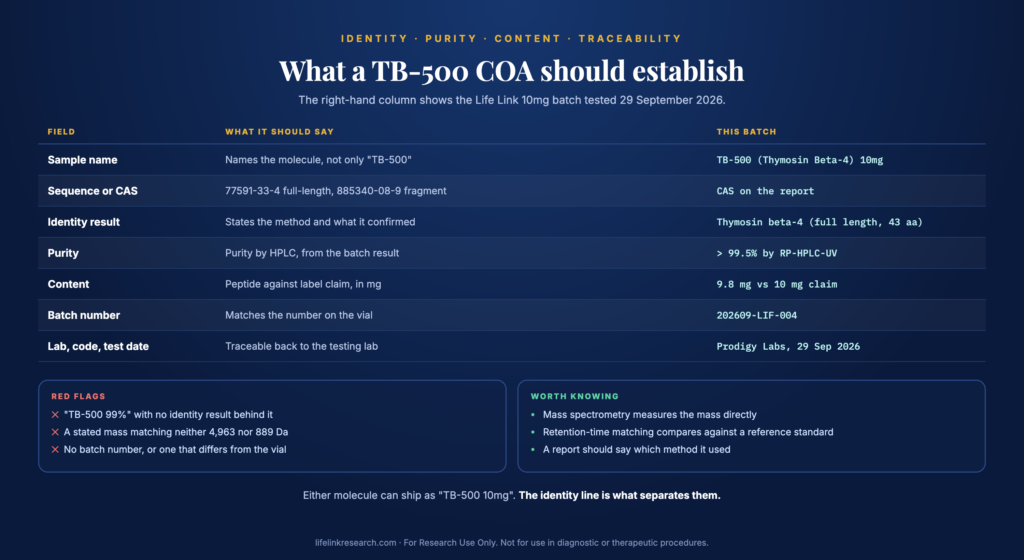
What a TB-500 COA should establish: identity, purity, content and traceability
| Field on the COA | What it should say |
| Sample name | Names the molecule, not only “TB-500” |
| Sequence or CAS | 77591-33-4 for full-length, 885340-08-9 for the fragment |
| Identity result | The method used, and what it confirmed |
| Purity | Purity by HPLC, read from the batch result |
| Content | Peptide against label claim, in mg |
| Batch number | Matches the number printed on the vial |
| Lab, verification code, test date | Makes the report traceable back to the testing lab |
Three red flags cover most problems: a “TB-500 99%” line with no identity result behind it, a stated mass that matches neither molecule, and a missing batch number.
How identity is actually established counts here. Mass spectrometry measures the molecule’s mass directly, which separates 4,963 from 889 beyond argument. Retention-time matching on HPLC is a different test: it compares the sample against a named reference standard and confirms they behave alike on the column. That is meaningful evidence when the reference standard is identified on the report, and it is worth knowing which of the two a certificate relied on.
Life Link’s current 10mg batch, tested by Prodigy Labs on September 29, 2026 (report PL-COA-20260929-BF19-R4), records its identity as “Thymosin beta-4 (full length, 43 aa)”, confirmed by HPLC retention-time matching against a full-length acetate reference standard. Purity is reported above 99.5% by RP-HPLC-UV, and peptide content as 9.8 mg against a 10 mg label claim. So the material is the 43-residue protein. Checking any certificate against the issuing lab is covered in how to verify a COA is real.
Why Does Price per mg Depend on Which Molecule?
Quick answer: Ten milligrams of the fragment and ten milligrams of full-length thymosin beta-4 are very different products. The full-length protein is longer and more costly to make. Compare price per milligram only between listings that contain the same molecule, confirmed on their COAs.
Synthesis cost scales with chain length. Each additional residue is another coupling step, another chance of a deletion sequence, and more purification work to remove what did not couple cleanly. A 43-residue chain is a substantially larger undertaking than a 7-residue one, and the catalog price follows.
The molecule count runs the other way, which is what makes a naive comparison misleading. The same ten milligrams delivers about 2.0 µmol of the full protein or about 11.2 µmol of the fragment. A listing that looks cheap per milligram may simply hold the shorter molecule, so the only sound comparison is between listings whose certificates name the same compound.
TB-500 in Blends and Kits
Quick answer: TB-500 is a component of several multi-peptide products: with BPC-157 (often called “Wolverine”), with BPC-157 and GHK-Cu (GLOW), and with those plus KPV (KLOW). Each blend COA should list TB-500 separately, with its own mass result.
Multi-component products raise the documentation bar rather than lowering it. A certificate covering two or four peptides has to resolve each one, which means a separate identity result per compound and a chromatogram showing a peak for each. A single combined purity figure describes none of them individually.
For TB-500 specifically, the identity question carries straight into the blend: a kit listing “TB-500 10mg” inherits the same ambiguity as a standalone vial, and only the component-level result settles it. The BPC-157 + TB-500 kit keeps each compound in its own vial with its own certificate, which makes that check straightforward. The GHK-Cu, BPC-157 and TB-500 blend guide sets out the three-component composition.
Is TB-500 Legal? FDA and WADA Status
Quick answer: No FDA approval covers thymosin beta-4 or its fragments, and research-grade material goes to laboratories only. An FDA advisory committee took TB-500 up in July 2026 as a 503A compounding candidate, with no binding effect. Thymosin beta-4 also appears on the WADA Prohibited List.
TB-500 appears on the first-day agenda of the July 23 to 24, 2026 advisory committee meeting, listed in free base and acetate forms. FDA stamps that page as current to August 6, 2026. A committee recommendation advises the agency and nothing more: a listing requires notice-and-comment rulemaking, and the 503A list concerns compounding pharmacies rather than reagent supply to laboratories. Dates and next steps are tracked in TB-500 and MOTS-c FDA status.
In sport, the WADA Prohibited List effective January 1, 2026 names the compound under section S2, among growth factors, with the entry reading “Thymosin-ß4 and its derivatives e.g. TB-500”. The wording covers both the full protein and fragments taken from it, and the prohibition applies at all times.
How Should TB-500 Be Stored?
Quick answer: Freeze-dried vials belong at -20°C, sealed, dark, and dry. Warm a vial to ambient temperature first, then open it, which keeps condensation off the powder. Record the batch number against its certificate while the box is still to hand. These are storage conditions for the dry powder only.
One sequence-specific note: with a single methionine at position 6 and no cysteines, oxidation at that one residue is the change most likely to show up on a later identity trace, as an extra 16 daltons. Keeping the vial sealed, cold, and dry is what holds the material close to the state its certificate describes.
TB-500 FAQs
Is TB-500 the same as thymosin beta-4?
Sometimes. Some sellers use TB-500 for the complete 43-residue protein, others for the 7-residue Ac-LKKTETQ fragment taken from it. Because the same label covers both, the molecule named on the batch certificate is what settles it, not the product title.
How many amino acids is TB-500?
Either 43 or 7, depending on the molecule. Full-length thymosin beta-4 runs 43 residues with an acetylated N-terminus. The fragment sold under the same name is 7 residues, Ac-LKKTETQ, corresponding to positions 17 to 23 of the full sequence.
What is Ac-LKKTETQ?
It is a seven-residue peptide matching residues 17 to 23 of thymosin beta-4, acetylated at the N-terminus. PubChem lists it as CID 62707662, CAS 885340-08-9, formula C38H68N10O14, with an average mass near 889 Da. It is the region most associated with actin binding.
What is the difference between TB-500 and BPC-157?
They are unrelated molecules. BPC-157 is a synthetic 15-residue sequence of about 1,419 Da drawn from a gastric protein. TB-500 refers to thymosin beta-4 or its fragment, from an entirely different protein family. Our comparison of BPC-157 vs TB-500 covers both.
Which TB-500 does Life Link sell?
The full-length molecule. The current 10mg batch certificate, issued September 29, 2026, records identity as thymosin beta-4 at full length, 43 amino acids, with purity above 99.5% by HPLC and peptide content of 9.8 mg against the 10 mg label claim.
Why do molecular weights differ between websites?
Three reasons account for most of it: average mass against monoisotopic mass, which differ by roughly 2.5 Da here; free base against an acetate salt, where each counter-ion adds about 60 Da; and figures copied between pages without a primary source. The batch document settles it.
⏱ TB-500 in 30 seconds
TB-500 is a catalog name covering two molecules. One is thymosin beta-4 itself: 43 residues, acetylated, about 4,963 Da, CAS 77591-33-4. The other is Ac-LKKTETQ, seven residues from positions 17 to 23 of that sequence, about 889 Da. Ten milligrams of the fragment contains roughly 5.6 times as many molecules. The identity result on the batch certificate is what tells the two apart.
For Research Use Only. Not for use in diagnostic or therapeutic procedures.
What is described above is a laboratory reagent for qualified researchers aged 21 and over. The Terms and Conditions carry the conditions of sale in full.
References
- PubChem CID 45382195, thymosin beta-4: https://pubchem.ncbi.nlm.nih.gov/compound/45382195
- PubChem CID 62707662, TB-500 (Ac-LKKTETQ): https://pubchem.ncbi.nlm.nih.gov/compound/62707662
- UniProt P62328, thymosin beta-4 (human), 43-residue chain: https://www.uniprot.org/uniprotkb/P62328/entry
- Vitamins and Hormones, 2016, actin-induced structure in the beta-thymosin family. PMID 27450730: https://pubmed.ncbi.nlm.nih.gov/27450730/
- FDA, Pharmacy Compounding Advisory Committee meeting, July 23 to 24, 2026: https://www.fda.gov/advisory-committees/advisory-committee-calendar/july-23-24-2026-meeting-pharmacy-compounding-advisory-committee-07232026
- WADA Prohibited List 2026, effective January 1, 2026: https://www.wada-ama.org/en/prohibited-list
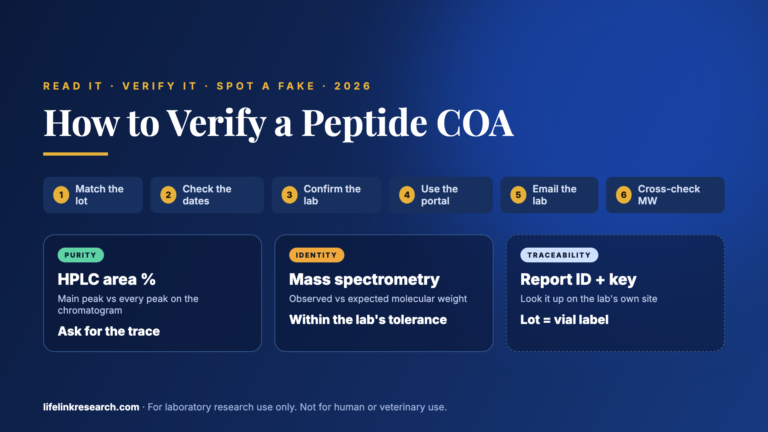
How to Verify a Peptide COA Is Real (and Spot a Faked One)
Quick Answer To verify a peptide COA, check the vial’s lot number against the report, confirm the named lab exists and is…
Read article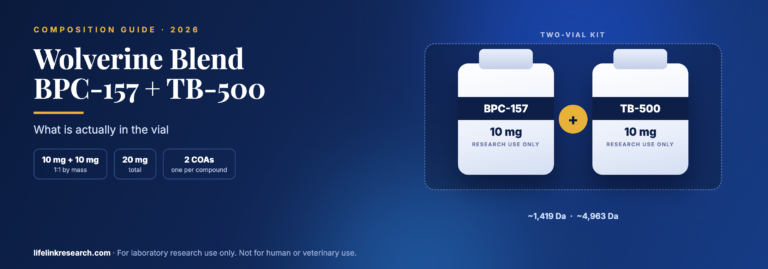
Wolverine Blend (BPC-157 + TB-500): Composition, COA & US Supply (2026)
Quick Answer “Wolverine” is the market nickname attached to a pairing of two research peptides, BPC-157 and TB-500, usually supplied at 10mg…
Read article
Ipamorelin vs Sermorelin: GHSR vs GHRH Receptor Research Compared
A Novo Nordisk group in 1998 settled which receptor Ipamorelin works through by blocking it. They applied a GHRH antagonist and the…
Read articleResearch-grade peptides
99%+ purity. Verified every batch.
Identity and purity tested on every batch by third-party labs, Janoshik Analytical and US-based laboratories. Shipped same day from California.
Shop all peptides