
Quick Answer
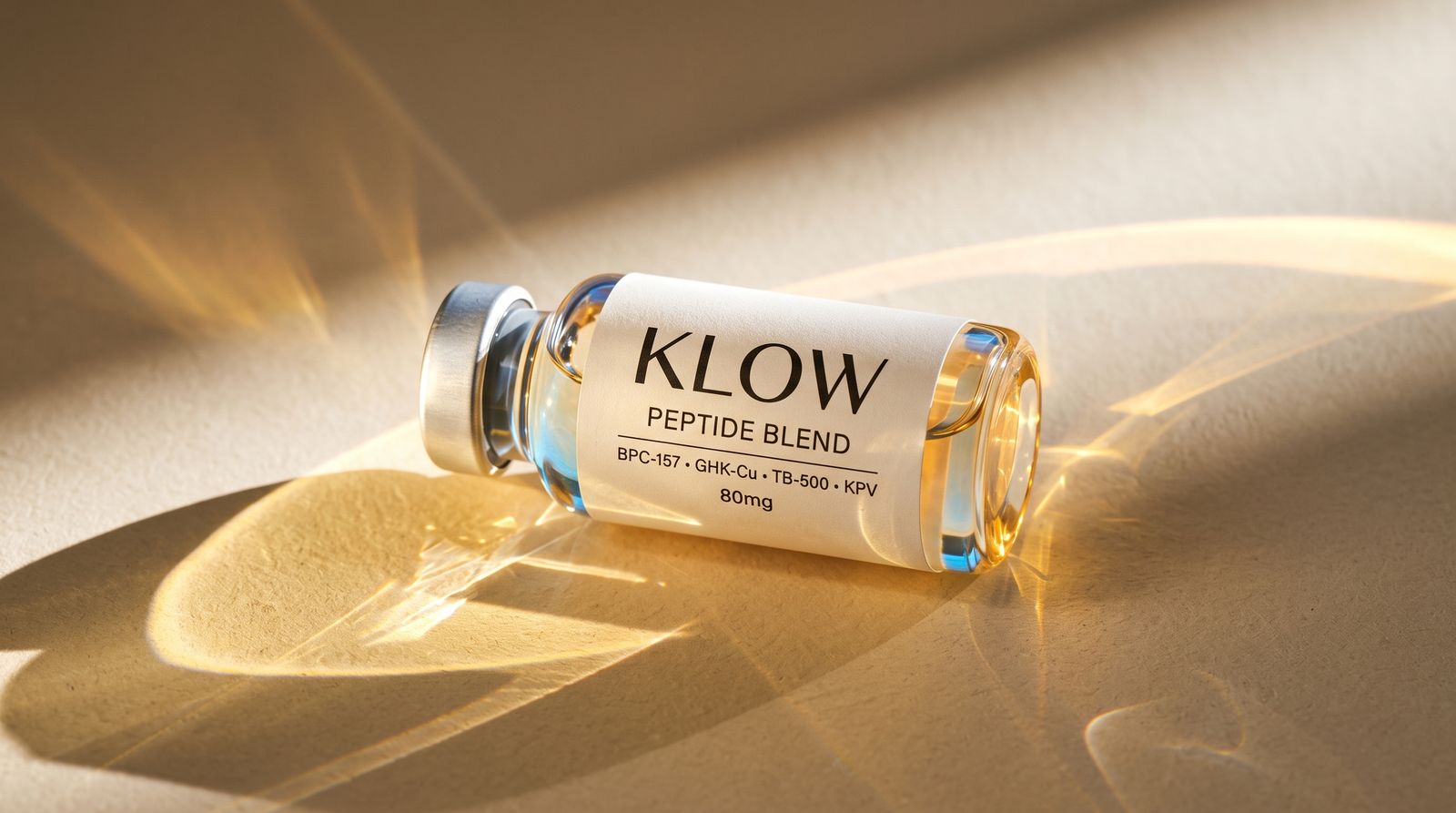
KLOW is an 80mg research peptide combination of GHK-Cu 50mg, BPC-157 10mg, TB-500 10mg and KPV 10mg, a 50/10/10/10 ratio. The name comes from its parts: the three-peptide GLOW blend plus KPV. It is supplied for laboratory research only, either as one blended vial or as four separate vials.
Key Takeaways
- KLOW is GLOW (GHK-Cu, BPC-157, TB-500) with KPV added.
- The ratio is 50/10/10/10, for 80mg in total.
- GHK-Cu makes up 62.5% of the mass.
- A KLOW COA has to confirm all four compounds, one by one.
- Compare price per mg of verified compound, never price per vial.
Search “KLOW peptide” and the first page is mostly clinic pages, med spa blogs, a busy Reddit thread and nine shopping listings. Almost none of them explain what’s in the vial at the molecular level, or how a researcher can check it before lab use.
This guide does that. It covers what the KLOW peptide blend contains, why the ratio leans so hard toward one compound, what a proper certificate looks like, and what the four-part blend costs per milligram in the US. It’s written for researchers sourcing research-use-only laboratory materials. Readers new to the category can begin with what research peptides are.
In this guide
- What KLOW is
- What’s in the blend
- Each component
- Why the ratio is 50/10/10/10
- KLOW vs GLOW
- Why KLOW turns blue
- One vial or four
- Reading a KLOW COA
- Published research
- Legal status in the US
- Storage
- Why no dosing is published
- Cost and US supply
- FAQs
What Exactly Is KLOW Peptide?
Quick answer: KLOW is a market name for a combination of four separately made research peptides: GHK-Cu, BPC-157, TB-500 and KPV. Suppliers sell it as “KLOW blend”, “KLOW 80” or “KLOW stack”, and almost always in the same 50/10/10/10 amounts.
No company owns the name, and no regulator has reviewed a product called KLOW. The word is a mash-up of its ingredients. GLOW came first as a three-peptide combination, and KPV’s arrival turned its first letter into a K.
You’ll see three labels on listings and forums:
- KLOW blend: all four peptides freeze-dried together in one vial.
- KLOW 80: the same blend, named after its 80mg total.
- KLOW stack: usually the four peptides sold as separate vials in one kit.
Those labels aren’t standardized, so read the contents line on any listing. A “stack” from one seller can be a single blended vial from another.
The name stuck because it’s short and easy to search. That convenience has a cost: a buyer typing “KLOW” sees four very different molecules flattened into one word, and has to unpack them again to check what arrived.
What Is in the KLOW Peptide Blend?
Quick answer: KLOW contains GHK-Cu (50mg), BPC-157 (10mg), TB-500 (10mg) and KPV (10mg), for 80mg in total. GHK-Cu makes up 62.5% of the mass. BPC-157, TB-500 and KPV make up 12.5% each.
Every figure below comes from our product specifications, so the table matches what’s on each vial’s documentation.
| Component | Amount | % of mass | Type | Sequence | Molecular weight | CAS |
|---|---|---|---|---|---|---|
| GHK-Cu | 50 mg | 62.5% | Copper-bound tripeptide | Gly-His-Lys : Cu(II) | 404 g/mol (complex) | 89030-95-5 |
| BPC-157 | 10 mg | 12.5% | Synthetic 15-residue peptide | GEPPPGKPADDAGLV | 1,419.5 g/mol | 137525-51-0 |
| TB-500 | 10 mg | 12.5% | Full-length thymosin beta-4 | 43 residues, N-acetylated | 4,963.55 Da | 77591-33-4 |
| KPV | 10 mg | 12.5% | Tripeptide, alpha-MSH(11-13) | Lys-Pro-Val | 342.4 g/mol | 67727-97-3 |
The 80mg total is the sum of four separate weights, and that simple fact drives almost every question further down: how the ratio works, how a certificate should read, and how pricing compares.
Read the table from right to left and the gaps show up fast. The molecular weights run from 342.4 to 4,963.55, a fourteen-fold range, while the milligram column barely moves. Those two columns together decide how much of each molecule a vial really stores.
What Is Each Component of KLOW?
Quick answer: GHK-Cu is a copper-binding tripeptide, BPC-157 is a 15-amino-acid synthetic peptide, TB-500 here is full-length thymosin beta-4, and KPV is a three-amino-acid fragment of alpha-MSH. Each has its own literature, mostly in cell and animal models.
The four molecules differ hugely in size, from three amino acids up to 43. That spread explains why equal milligrams don’t mean equal amounts of each molecule.
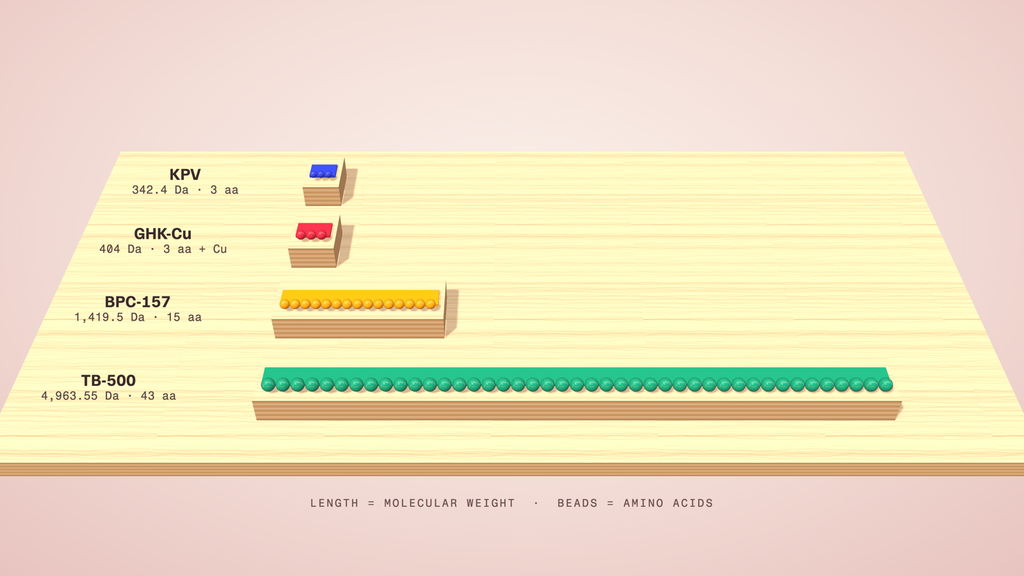
KLOW peptide components molecular size to scale
GHK-Cu (50mg)
GHK is the tripeptide glycyl-L-histidyl-L-lysine, and in KLOW it carries a bound copper(II) ion. That copper is why GHK-Cu takes the largest share by weight: suppliers handle it in larger mass amounts than the other three.
Chemists have mapped its copper binding closely. A 2011 structural study in Chemistry: A European Journal called GHK one of the “naturally occurring high-affinity copper(II) chelators” and solved its copper complex by X-ray and spectroscopy (Hureau et al., 2011). Cultured cell models make up most of the remaining work. See the GHK-Cu 50mg listing for full specifications.
BPC-157 (10mg)
BPC-157 is a synthetic 15-amino-acid sequence, Gly-Glu-Pro-Pro-Pro-Gly-Lys-Pro-Ala-Asp-Asp-Ala-Gly-Leu-Val, derived from a gastric protein. It’s the longest of KLOW’s three short peptides, and the only one with a run of three prolines near its start.
Most published work on it uses rodent models, with a smaller set of cell studies. It’s the second-heaviest molecule in KLOW at 1,419.5 g/mol, so its 10mg share holds relatively few molecules. Specifications are available on the BPC-157 10mg page.
TB-500 (10mg)
“TB-500” causes more confusion than any other name in the blend. Some sellers use it for a short seven-residue fragment, Ac-LKKTETQ. Others use it for the full 43-amino-acid thymosin beta-4 protein, which is where the CAS number 77591-33-4 belongs.
The material in Life Link’s kit is full-length thymosin beta-4 at 4,963.55 Da. Its September 2026 certificate from Prodigy Labs in San Diego names it that way. Thymosin beta-4 is studied mainly in cell culture and animal models for its role in binding actin. Check which version a supplier sells before you compare prices, then see TB-500 10mg for the full specification.
KPV (10mg)
KPV is Lys-Pro-Val, the C-terminal end of alpha-melanocyte-stimulating hormone (alpha-MSH), at positions 11 to 13. At 342.4 g/mol it’s the smallest molecule in KLOW, which means its 10mg holds the most molecules of the three minor parts.
A 2008 study in Gastroenterology examined how intestinal epithelial cell lines take KPV up through PepT1, a transporter for small peptides (Dalmasso et al., 2008). Most KPV work stays in cell and rodent models like these. For a longer walk through that literature, read our KPV research guide.
Why Is the KLOW Ratio 50/10/10/10?
Quick answer: The ratio weights KLOW toward GHK-Cu, one of the smallest molecules after KPV and the one usually handled in larger mass amounts. It is a supplier convention. No published research has validated it as a formula for the four-compound combination.
The 50/10/10/10 pattern traces back to GLOW, which already paired 50mg of GHK-Cu with 10mg each of BPC-157 and TB-500. KLOW kept that base and added 10mg of KPV. Nothing in the literature tested the combination first and arrived at those numbers.
Weight also hides how many molecules you’re working with. GHK-Cu is light, so its 50mg contains far more molecules than its 62.5% weight share suggests. Full-length TB-500 runs the other way: at nearly 5,000 Da, its 10mg holds only a small fraction of the vial’s molecules.
The ratio also gives you something to check. On separate-vial certificates, each compound’s measured milligrams should sit close to its label. On a blended certificate, the four results should land near 50, 10, 10, and 10. A blend reporting 50mg of GHK-Cu and noticeably less of the others points to a filling or synthesis problem that the vial alone would never reveal.
Amounts also vary between suppliers. Some listings use different totals or proportions, so read the label and the certificate before treating any “KLOW” as interchangeable.
KLOW vs GLOW: What’s the Difference, and Which Is Better for Research?
Quick answer: GLOW contains GHK-Cu, BPC-157 and TB-500 (70mg). KLOW adds 10mg of KPV (80mg), so the two share 75% of their composition. Neither is better: KLOW adds one more compound to study and one more identity to verify. Wolverine is BPC-157 plus TB-500 only.
Here’s each option in one line:
- GHK-Cu alone: the copper tripeptide on its own.
- Wolverine: BPC-157 and TB-500, 10mg each.
- GLOW: Wolverine plus 50mg of GHK-Cu.
- KLOW: GLOW plus 10mg of KPV.
| GHK-Cu alone | Wolverine | GLOW | KLOW | |
|---|---|---|---|---|
| Components | GHK-Cu | BPC-157, TB-500 | GHK-Cu, BPC-157, TB-500 | GHK-Cu, BPC-157, TB-500, KPV |
| Total | 50 mg | 20 mg | 70 mg | 80 mg |
| Ratio | n/a | 10/10 | 50/10/10 | 50/10/10/10 |
| Identities to verify | 1 | 2 | 3 | 4 |
| Life Link format | Single vial | Kit, two vials | Kit, three vials | Kit, four vials |
The choice comes down to the question a study is asking. A study focused on copper-peptide chemistry needs GHK-Cu alone. A design looking at how four compounds behave side by side needs KLOW, and it inherits four certificates to check.
KLOW vs GHK-Cu alone is the other comparison people search for. Since GHK-Cu is 62.5% of KLOW by weight, a blend can look like GHK-Cu with extras. In practice, the extras change the paperwork. A single GHK-Cu vial needs one identity and one purity result, while KLOW needs four of each before any experiment starts.
You can compare the three-part version in our guide to the GLOW peptide blend, or the two-part Wolverine kit.
Why Does KLOW Turn Blue?
Quick answer: KLOW turns blue because of the copper in GHK-Cu. Copper(II) complexes give a blue tint when dissolved, so blue is expected in any material containing GHK-Cu. A KLOW sample with no blue tint may be missing its GHK-Cu.
Copper(II) ions absorb light at the warm end of the spectrum. As a university chemistry course puts it, the absorption band for dissolved copper(II) “spans the red-orange-yellow portion of the spectrum and green, blue and violet are transmitted” (Western Oregon University). Your eye sees what’s left over, which is blue.
The tint is a useful first check and a weak final one. Blue shows that some copper complex is present. It can’t tell you how much GHK-Cu is in the vial, whether the copper is bound to GHK, or whether the other three peptides are there at all. Only the certificate answers those.
Even the dry powder shows it. Life Link’s GHK-Cu specification lists the appearance as a “blue to blue-violet solid”, while BPC-157, TB-500 and KPV are all white to off-white. So in a KLOW vial, the color comes from one of its four ingredients, the same one that makes up five-eighths of its weight.
Does Mixing GHK-Cu With Other Peptides in One Vial Cause Problems?
Quick answer: There is little published stability data on GHK-Cu combined with BPC-157, TB-500 and KPV in a single vial, and copper can interact with other peptides. Separate vials avoid the question: each compound is stored dry on its own and checked against its own COA.
The concern on Reddit threads is reasonable, and it’s still an open question. Copper binding to GHK is strong and also mobile. The 2011 structural study found that Cu(II)-GHK exchanges its copper quickly and can form mixed complexes with amino acids such as glycine and histidine (Hureau et al., 2011). Nobody has published what happens when GHK-Cu shares a vial with three other peptides over months of storage.
The practical risk is quiet drift. If one compound in a blend breaks down faster than the rest, the 50/10/10/10 ratio changes without any visible sign, and a certificate issued at release won’t show it. With separate vials, every compound has its own dated report, so a change in one never hides inside the others.
| Factor | One blended vial | Four separate vials |
|---|---|---|
| Verification | One certificate covering four compounds | Four certificates, one per compound |
| Stability unknowns | Copper shares a vial with three other peptides | Each compound stays apart until use |
| Ratio flexibility | Fixed at 50/10/10/10 | Any ratio a study design needs |
| Storage | One vial to track | Four vials, each labeled |
| Price per mg | Lower | Higher |
That table explains why Life Link sells KLOW as a four-vial kit, and why the kit costs more. Keeping each powder dry and apart follows the same logic as why lyophilized beats pre-mixed.
How Do You Read a KLOW COA?
Quick answer: 1. Check that all four compounds are named.
2. Confirm each identity by mass spec.
3. Check purity per compound by HPLC.
4. Match the batch number to your vial.
5. Verify the report with the testing lab.
A Certificate of Analysis (COA) is a testing lab’s record for one production batch. HPLC (high-performance liquid chromatography) pushes the sample through a column, so each compound exits as its own peak, and the peak areas give purity. ESI-MS (electrospray ionization mass spectrometry) measures each molecule’s mass, and a match with the expected mass confirms identity.
A blend makes both jobs harder. Four peptides produce four peaks that can overlap, so a certificate reading “KLOW 80mg: 99%” doesn’t tell you which compound that number belongs to, or whether all four are present. A useful blend COA lists each component by name with its own result.
With separate vials, each compound gets its own report. The current certificates for Life Link’s four KLOW components come from three independent labs: Janoshik Analytical for GHK-Cu and BPC-157, Prodigy Labs in San Diego for TB-500, and Prime Analytical Laboratories in Concord, California for KPV. Each report gives its compound’s purity on a line of its own.
A kit also means four batch numbers. Match each vial to its own report, and keep in mind that the four compounds can come from different production runs with different test dates. That’s normal for a kit. What you’re checking is that every vial has a current report, with no gaps.
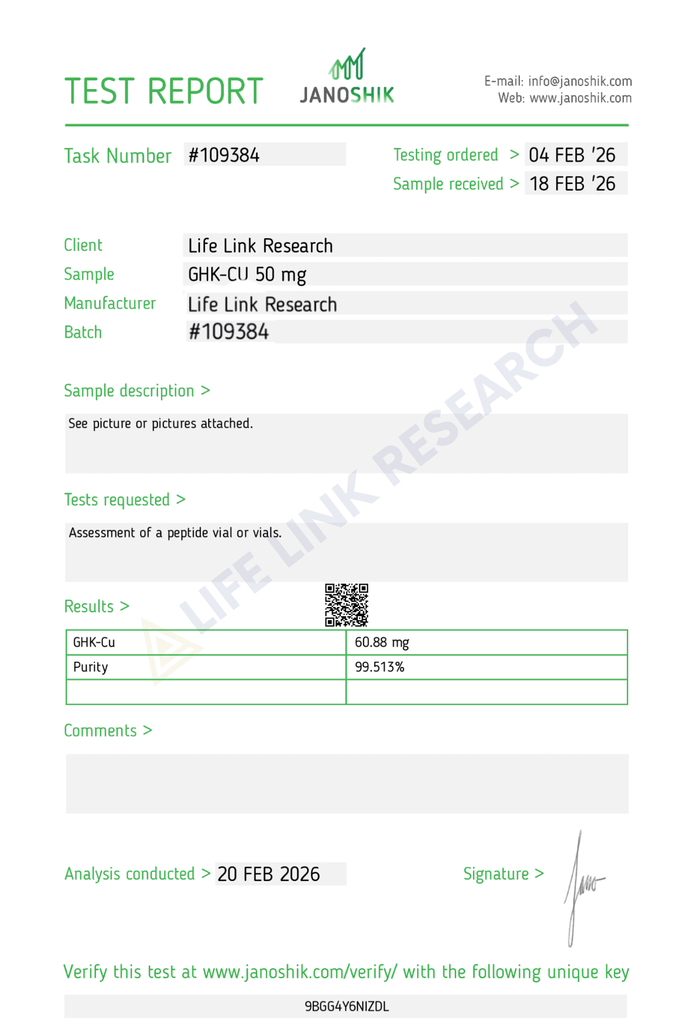
KLOW component peptide COA example
| Field on the GHK-Cu report | What to check |
|---|---|
| Task #109384 | Enter it with the unique key to confirm the report at the lab |
| Sample: GHK-Cu 50 mg | Names GHK-Cu as a single compound |
| Purity: 99.513% | Clears the 99% standard |
| Analysis conducted: Feb 20, 2026 | Shows the report is current |
Learn how to read a peptide COA field by field, and how to verify a COA is real before you trust it.
What Does Published Research Say About KLOW?
Quick answer: No published study has tested the four-compound KLOW combination. Each component has its own literature, mostly in cell and animal models. Claims about what KLOW “does” usually stitch together separate single-compound findings, which isn’t evidence for the combination.
That gap answers the “is KLOW worth it?” question better than any review could. PubMed lists 2026 review articles that discuss several of these peptides side by side, and no experimental study of all four together. A search for each component returns its own literature, built over decades for GHK and over years for the others.
Each study used its own compound, its own model and its own conditions, and none of them tested the others alongside it. The practical route is to read each compound’s primary papers directly, starting with the original structural and cell-model work, and to treat review articles as maps to those papers.
For a researcher, that makes KLOW a design choice with open questions, and each component a separate reading list.
Do You Need a Prescription for KLOW? Is It Legal in the US?
Quick answer: KLOW is not an FDA-approved drug, so there is no prescription version. Its components are sold as research reagents for laboratory use only. In July 2026 an FDA advisory committee recommended BPC-157, KPV and TB-500 for the 503A compounding list, and that vote is non-binding.
Two 2026 events moved the conversation. In April, the FDA took 12 peptides out of Category 2, its list of substances flagged for compounding concerns. All four KLOW components were in that group, though GHK-Cu’s removal covered only one of its forms.
In July, the Pharmacy Compounding Advisory Committee met on July 23 and 24. The FDA describes these committees as a source of “independent expert advice to the FDA on broad scientific topics.” BPC-157, KPV and TB-500 were on the first day’s agenda. GHK-Cu wasn’t on it.
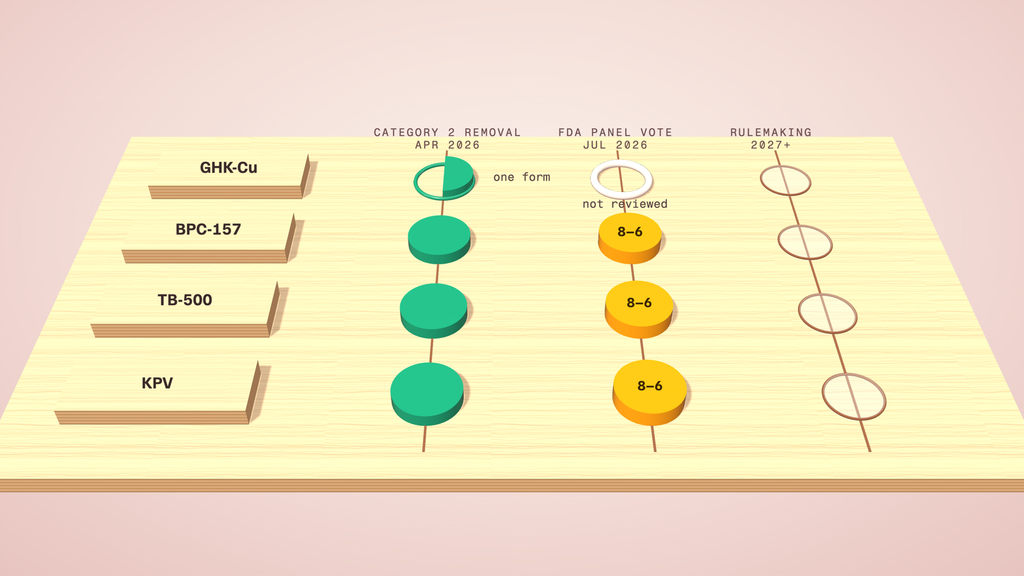
KLOW components FDA status 2026
That leaves the four components in two different places. Three have a committee recommendation behind them and a rulemaking ahead of them. GHK-Cu, the largest part of KLOW by weight, hasn’t had its committee review yet.
The vote starts a process. Lawyers at McDermott Will & Schulte note that formal rulemaking “could occur in 2027 or extend into a multi-year process” (McDermott, July 27, 2026). A “research use only” label describes what the material is sold for, and it carries no approval with it. The details are in our piece on the July 2026 FDA advisory vote.
How Should KLOW Be Stored?
Quick answer: Store lyophilized KLOW at -20°C, protected from light and moisture. Let vials reach room temperature before opening to prevent condensation, and avoid repeated freeze-thaw cycles.
Lyophilized means freeze-dried: the water is removed under vacuum, leaving a dry cake or powder that holds up far longer than any liquid. Moisture is the main thing to keep out. A cold vial opened straight from the freezer pulls condensation onto the powder, so give it time to warm up first.
With a four-vial kit, store all four together and label the box with the batch numbers. Keep a printed or saved copy of each certificate with the box as well, so the batch on each vial can be matched to its report without a search. Our peptide storage guide covers freezer choice, light and handling in more detail.
Why Don’t Research Suppliers Publish KLOW Dosing?
Quick answer: KLOW is not approved for human or animal use, so responsible suppliers publish no dosing. Study designs belong in the primary literature and in a laboratory’s own protocols.
Dosing tables online usually come from clinics or social media. A research supplier that published one would be presenting its vials for use in people. A supplier’s job is to document what’s in the vial: identity, purity, amount and storage. How that material gets used in an experiment is set by the research team and its own review processes.
How Much Does KLOW Cost, and Where Can You Buy It in the US?
Quick answer: US suppliers list KLOW 80mg blends at roughly $70 to $170 per vial (October 2026), about $0.87 to $2.12 per mg. Separate-vial kits cost more. Choose a supplier with US stock and a COA confirming all four compounds, and compare price per mg of verified compound.
| Format | Typical price (October 2026) | Price per mg | What you get |
|---|---|---|---|
| Single blended 80mg vial | $70 to $170 | $0.87 to $2.12 | One vial, often one combined COA line |
| Four-vial kit (Life Link) | $376.20 | About $4.70 | Four vials, a separate COA for each compound |
| Four vials bought one by one (Life Link) | $396.00 | About $4.95 | The same four vials, without the kit discount |
The kit costs more, and here’s what the extra pays for. Four separate syntheses, four separately tested powders, and four reports from independent labs, with no copper sharing a vial with the other three.
A blended vial at the low end of the range can still be a sound purchase if its certificate names all four compounds with individual results. A cheap vial with a single “99%” line leaves you paying for a number you can’t connect to anything.
The TB-500 naming issue affects price too. A blend built on the seven-residue fragment and one built on full-length thymosin beta-4 can both say “TB-500 10mg” on the label. The two molecules differ in size by more than five times, so check which one a listing uses before comparing prices.
To compare suppliers on equal terms, divide the price by the milligrams each certificate confirms. Our guide on how to choose a US peptide supplier covers the checks beyond price. The Life Link KLOW kit ships from US stock, with each component’s certificate on its product page.
KLOW Peptide FAQs
What is a KLOW peptide stack?
A KLOW peptide stack is the four KLOW peptides (GHK-Cu, BPC-157, TB-500 and KPV) sold together, usually as separate vials in one kit. The amounts match the blend: 50mg, 10mg, 10mg and 10mg, for 80mg in total. Some sellers use “stack” for a single blended vial, so check the format before buying.
Which is better, KLOW or GLOW?
Neither is better; they answer different research questions. GLOW holds GHK-Cu, BPC-157 and TB-500 at 70mg. KLOW adds 10mg of KPV for 80mg, which means one more compound to study and one more identity to verify. The two share 75% of their composition by mass.
Is KLOW a brand name?
No, KLOW is a market nickname built from its ingredients, GLOW plus KPV. No company owns it, and no regulator has reviewed a product under that name. Different suppliers use it for slightly different products, so the contents line and the certificate tell you more than the name does.
Is KLOW legal in the US?
KLOW’s components are sold in the US as research reagents for laboratory use only, and none is an FDA-approved drug. The FDA’s July 2026 advisory vote on three of them is a recommendation, and the law stays as it is until rulemaking finishes. Our page on BPC-157’s legal status explains how that plays out for one component.
Can you buy the KLOW components separately?
Yes, each KLOW component is sold as its own vial. That lets you set your own ratio and check each certificate in isolation. GHK-Cu, BPC-157 and TB-500 are linked above, and KPV 10mg completes the set.
What should a KLOW COA show?
A KLOW COA should name all four compounds and give each its own identity and purity result. It should also carry a batch number that matches your vial and a verification code for the issuing lab. A single combined percentage for the whole blend doesn’t show that every compound is there.
⏱ KLOW in 30 seconds
An 80mg combination of GHK-Cu 50mg, BPC-157 10mg, TB-500 10mg and KPV 10mg, in a 50/10/10/10 ratio. GHK-Cu is 62.5% of the mass. It’s GLOW plus KPV, and it’s sold as a blended vial or as four separate vials. Verify all four compounds on the COA, and compare price per verified milligram.
Research use only: KLOW and its four components are laboratory reagents for in-vitro research by qualified professionals. They have no FDA approval and are not for human or veterinary use, or for diagnostic or therapeutic procedures. This guide is not medical advice.
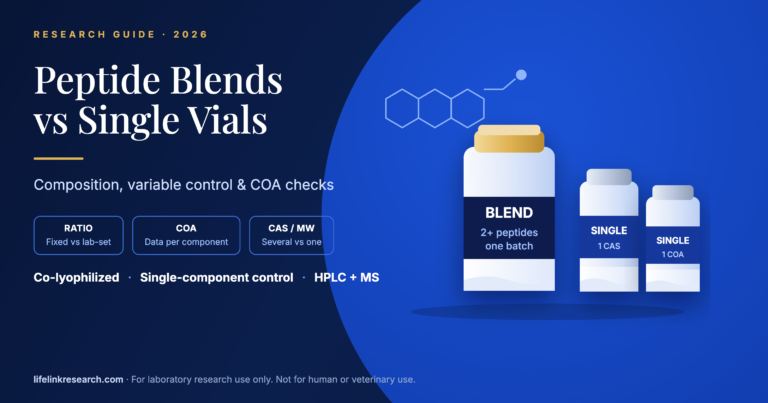
Peptide Blends vs Single Vials: How to Choose for Research (2026)
For Research Use Only. Not for use in diagnostic or therapeutic procedures. Choosing between peptide blends vs single peptides comes down to…
Read article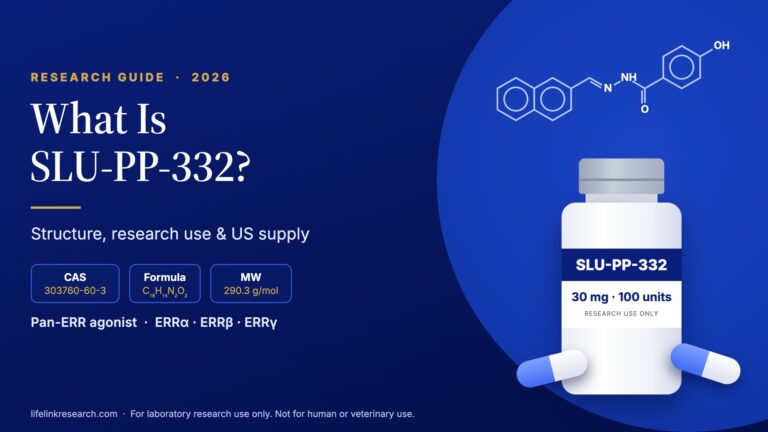
What Is SLU-PP-332? Structure, Research Use & US Supply
Quick Answer SLU-PP-332 is a synthetic small-molecule agonist of the estrogen-related receptors ERRŒ±, ERRŒ≤ and ERRŒ≥ (CAS 303760-60-3, PubChem CID 5338394). It…
Read article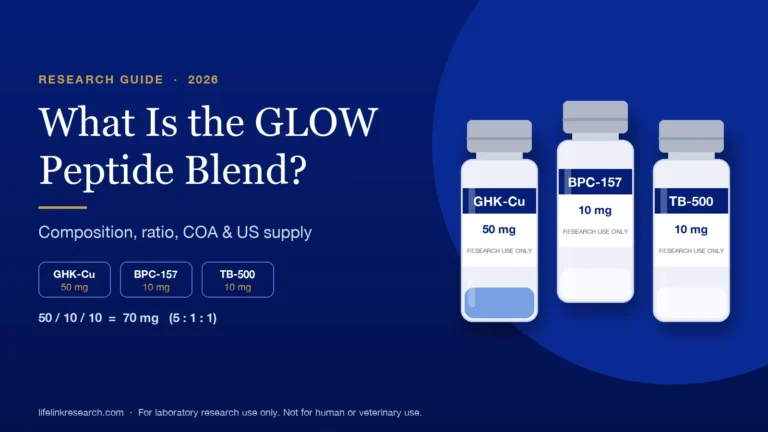
GLOW Peptide Blend: Composition, Ratio & COA (2026)
Quick Answer GLOW is a 70mg research peptide combination of GHK-Cu 50mg, BPC-157 10mg and TB-500 10mg, a 5:1:1 ratio in which…
Read articleResearch-grade peptides
99%+ purity. Verified every batch.
Identity and purity tested on every batch by third-party labs, Janoshik Analytical and US-based laboratories. Shipped same day from California.
Shop all peptides