
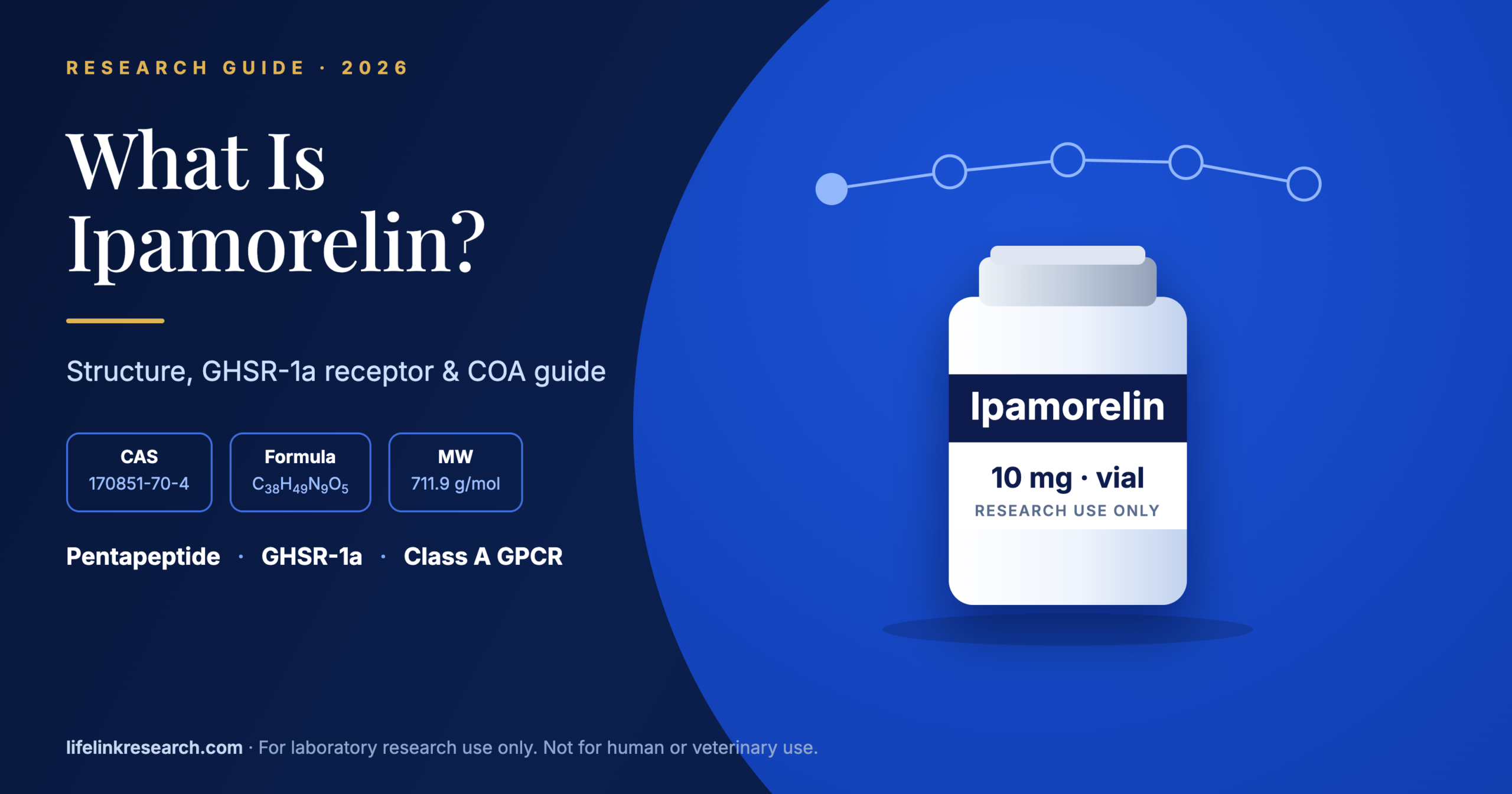
Ipamorelin is a synthetic five-residue peptide that acts as an agonist at the ghrelin receptor, GHSR-1a. It started life as a subtraction. Chemists at Novo Nordisk took an older seven-residue research peptide, cut two amino acids out of its middle, swapped in non-natural building blocks, and the shorter molecule still engaged the receptor.
Before a lab orders an Ipamorelin 10 mg research peptide, it helps to know three things, and the sections below follow that order: the structure and its identifiers, the receptor and the assays built around it, and what a batch’s certificate of analysis (COA) ought to carry.
For Research Use Only. Not for use in diagnostic or therapeutic procedures.
What Is Ipamorelin?
Quick answer: Ipamorelin is a synthetic pentapeptide (Aib-His-D-2Nal-D-Phe-Lys-NH2) first described by Novo Nordisk researchers in 1998 under the code NNC 26-0161. It’s classed as an agonist at the growth hormone secretagogue receptor (GHSR-1a), the receptor bound by the endogenous ligand ghrelin. Research-grade Ipamorelin is a reference material for receptor-binding and signaling assays.
The founding paper is “Ipamorelin, the first selective growth hormone secretagogue” (Raun et al., European Journal of Endocrinology, 1998), an in vitro and animal characterization.
Where the molecule came from. The Novo Nordisk team reported finding Ipamorelin “within a series of compounds lacking the central dipeptide Ala-Trp” of the earlier synthetic peptide GHRP-1. Line the two up and the edit is plain to see:
- GHRP-1: Ala-His-D-2Nal-Ala-Trp-D-Phe-Lys-NH2 (seven residues)
- Ipamorelin: Aib-His-D-2Nal-D-Phe-Lys-NH2 (five residues)
Two residues came out, and the N-terminal alanine became Aib, a small change with big chemical consequences (more on that below).
Why labs reach for it. At five residues and under 712 Da, Ipamorelin handles almost like a small molecule. Its structure is fully defined, it carries no lipid chain or disulfide bond, and mass spec confirms it quickly. That makes it a clean synthetic agonist to run beside ghrelin itself, a 28-residue peptide whose octanoyl ester is harder to make and keep intact.
What Is the Chemical Structure of Ipamorelin?
Quick answer: Ipamorelin has five residues: α-aminoisobutyric acid (Aib), L-histidine, D-2-naphthylalanine, D-phenylalanine and L-lysine, with a C-terminal amide. Its formula is C38H49N9O5 and its average molecular weight is about 711.9 g/mol (CAS 170851-70-4). Two D-amino acids plus the non-natural Aib and 2-Nal residues set it apart from natural peptides.
Every value below was checked against the registry named in the Source column on October 18, 2026.
| Field | Value | Source |
| Name | Ipamorelin (development code NNC 26-0161) | PubChem |
| Sequence (three-letter) | Aib-His-D-2Nal-D-Phe-Lys-NH2 | Raun et al., 1998 |
| Sequence (one-letter style) | Aib-H-(D-2Nal)-(D-F)-K-NH2 (Aib and 2-Nal have no standard one-letter code) | Derived from the above |
| Molecular formula | C38H49N9O5 | PubChem |
| Average molecular weight | 711.9 g/mol (free base) | PubChem |
| Monoisotopic mass | 711.3857 Da | PubChem |
| CAS number | 170851-70-4 | PubChem synonyms |
| PubChem CID | 9831659 | PubChem |
| ChEMBL ID | CHEMBL58547 | ChEMBL |
| FDA UNII | Y9M3S784Z6 | FDA GSRS |
| Common salt form | Acetate | FDA PCAC docket, October 2024 |
One thing to know about the UNII lookup: GSRS also holds a separate record for N-acetyl Ipamorelin (UNII 8NU4QJ4VFG). It’s a different substance, so make sure a search lands on the right one.
How D-amino acids and Aib shape peptide design
Proteases evolved to cut bonds between L-amino acids. Flip a residue to its D-form and its side chain points the wrong way for the enzyme’s binding pocket, so the neighboring bond becomes a poor substrate. That’s why D-residues are a standard design move when a peptide needs to survive serum-stability or tissue-homogenate assays.
Aib does a different job. It carries two methyl groups on its α-carbon, which pins the backbone into a narrow range of angles and favors turn or helix shapes. Placed at the N-terminus, it also blocks aminopeptidases that nibble peptides from that end. The bulky, bicyclic 2-naphthylalanine adds a large aromatic surface for receptor contact.
Free base vs acetate salt: why molecular weights differ
PubChem lists the free base. Most research peptides, though, leave HPLC purification as acetate salts. Ipamorelin has three basic sites (the N-terminal amine, the histidine ring and the lysine side chain), and every acetate it binds puts roughly 60.05 g/mol on the scale. A monoacetate weighs roughly 771.9 g/mol, a diacetate roughly 831.9. It’s the same peptide on a different weighing basis, which is exactly what the COA section below untangles. For a refresher on residues and bonds, see our peptide structure basics.
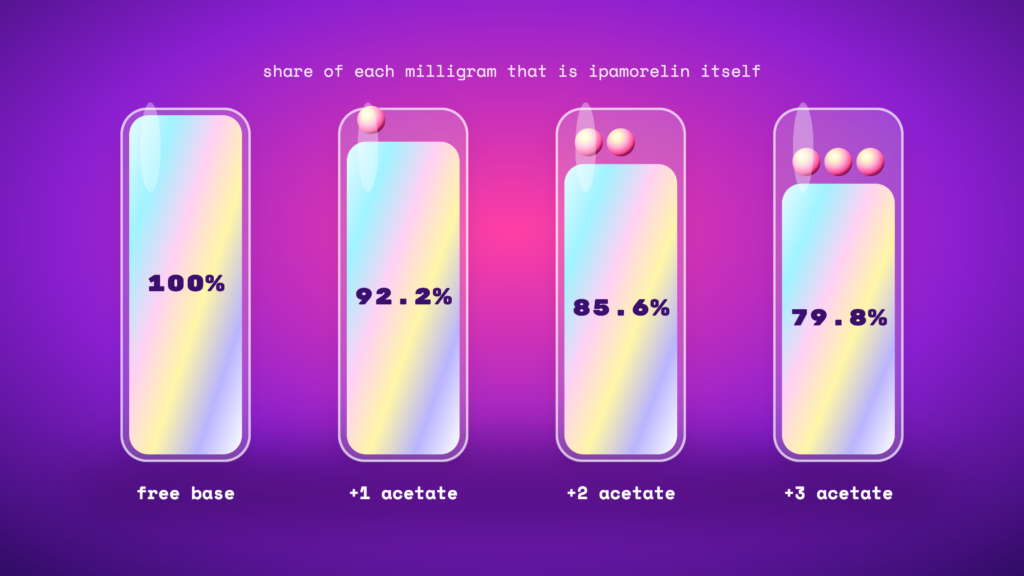
The share of each milligram that is ipamorelin: 100% free base, 92.2% with one acetate, 85.6% with two, 79.8% with three
What Receptor Does Ipamorelin Bind? GHSR-1a Explained
Quick answer: Ipamorelin is an agonist at GHSR-1a, the growth hormone secretagogue receptor type 1a. GHSR-1a is a class A G protein-coupled receptor whose endogenous ligand is acyl-ghrelin. It signals mainly through Gq/11, activating phospholipase C and mobilizing intracellular calcium. That’s why calcium-flux and IP-1 accumulation assays are standard read-outs.
GHSR-1a at a glance
| Property | Detail |
| Gene | GHSR |
| Receptor class | Class A (rhodopsin-like) GPCR, seven transmembrane helices |
| Endogenous ligand | Acyl-ghrelin: 28 residues, with an n-octanoyl group on serine 3 that the discovery paper found essential for activity |
| Main coupling | Gq/11 → phospholipase C → IP3 → calcium release |
| Other pathway | β-arrestin recruitment |
| Basal activity | High constitutive (ligand-independent) signaling |
| Splice variant | GHSR-1b, a truncated form that doesn’t signal |
| Key papers | Receptor cloned by Howard et al., Science, 1996; ghrelin identified by Kojima et al., Nature, 1999 |
That basal activity is unusual. Working in transfected COS-7 and HEK293 cells (in vitro), a University of Copenhagen team led by Birgitte Holst concluded that “the ghrelin receptor is highly constitutively active” (Molecular Endocrinology, 2003). Kojima’s team, for their part, coined “ghrelin” from ghre, the Proto-Indo-European root for “grow.”
What “selective GHSR agonist” means
The 1998 paper called Ipamorelin the first selective growth hormone secretagogue, a label drawn from in vitro cell work and animal pharmacology. In receptor terms, “selective” means activity concentrated at one target at the concentrations tested.
What the label doesn’t give you is a full off-target panel. Labs that need receptor-level selectivity usually run their own counter-screens, testing the compound across a panel of related GPCRs at matched concentrations and comparing the curves. The motilin receptor, GHSR’s closest relative, is a common choice, and Holst’s group used it as the negative control in that 2003 study.
Common GHSR-1a assays that use Ipamorelin
| Assay | Read-out | Notes |
| Radioligand competition binding | Displacement of labelled ghrelin (often ¹²⁵I-ghrelin); gives Ki | Measures affinity only, not activation |
| Calcium mobilization (Fluo-4 or FLIPR) | Fluorescence spike within seconds | Fast, plate-based; suits concentration-response curves |
| IP-1 accumulation (HTRF) | IP-1 builds up when LiCl blocks its breakdown | Stable end-point; also shows the high basal signal |
| β-arrestin recruitment (BRET or enzyme complementation) | Luminescence or energy-transfer signal | Used to compare pathway bias |
Ipamorelin usually runs as a reference agonist beside ghrelin, and plotting both as concentration-response curves gives a direct read on relative potency (EC50) and maximal effect in the same plate. Because the receptor is so active at baseline, many teams add an inverse agonist control. Holst’s group identified [D-Arg1,D-Phe5,D-Trp7,9,Leu11]-substance P as a potent one (EC50 5.2 nM, in vitro). Our GHSR and GHRH-receptor research peptides collect the related reference materials.
What Should an Ipamorelin COA Show?
Quick answer: A batch COA for Ipamorelin should carry the lot number printed on your vial, the HPLC purity with its chromatogram, and a mass-spectrometry identity result close to the expected [M+H]+ of about 712.4. Useful extras are net peptide content, counter-ion (usually acetate), water content, the name of the testing lab and the report date.
Ipamorelin COA field checklist
The masses below come from PubChem’s monoisotopic value (711.3857 Da) plus one or two protons.
| Field | What it confirms | What to look for |
| Lot number | The report belongs to your vial | Exact match to the vial label |
| HPLC purity + chromatogram | Proportion of target peptide in the material | A percentage backed by a visible trace with a dominant main peak |
| MS identity | The molecule is Ipamorelin | [M+H]+ ≈ 712.39; [M+2H]2+ ≈ 356.70 |
| Net peptide content | Peptide mass vs counter-ion and water | A stated percentage, reported separately from HPLC purity |
| Counter-ion | Salt form | Acetate in most cases; trifluoroacetate (TFA) should be named if present |
| Water (Karl Fischer) | Moisture in the solid | A stated percentage |
| Appearance | Physical form | White to off-white solid |
| Lab and date | Who tested it and when | The lab’s name plus a report date close to manufacture |
| Endotoxin (optional) | Bacterial endotoxin level | Stated as a specification, e.g. EU/mg |
Each block is unpacked in our guide on how to read a peptide COA.
HPLC purity vs MS identity
Think of HPLC as a headcount and MS as an ID check. The first says what proportion of the material is one compound; the second says which compound that is. A tall, clean HPLC peak might belong to the wrong peptide, and a correct mass can turn up inside a messy sample. Peptide bonds absorb strongly in the low UV range, so purity runs typically use reversed-phase HPLC read at 210 to 220 nanometers. A trustworthy COA reports both results for the same lot. Our guide to HPLC vs mass spectrometry covers how the two methods work.
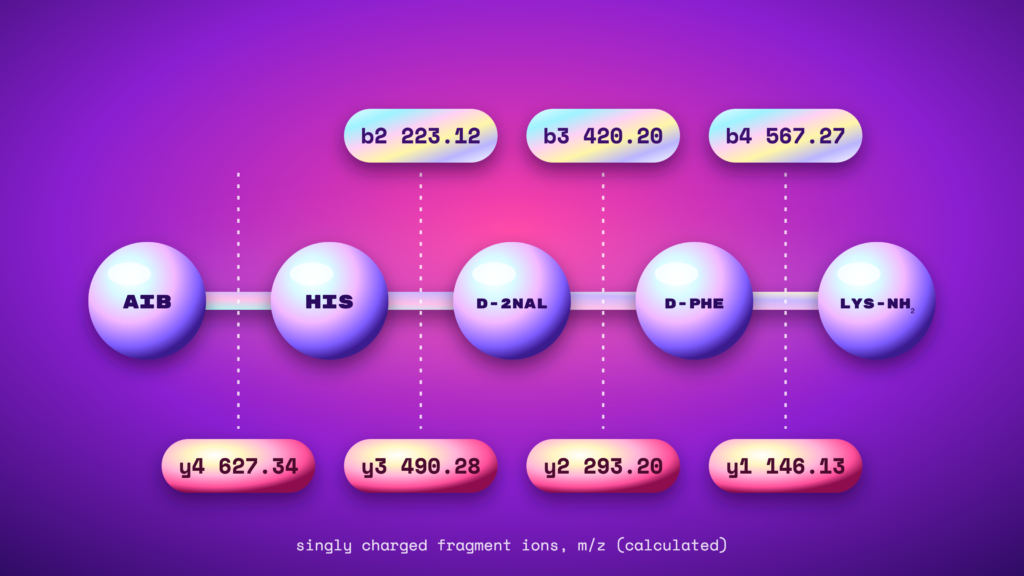
Ipamorelin’s five residues with calculated b-ions (b2 223.12, b3 420.20, b4 567.27) above and y-ions (y4 627.34 to y1 146.13) below
Red flags on an Ipamorelin COA
Most problems show up within a minute of reading, once you know where to look:
- A missing lot number, or one that differs from the vial label
- A purity figure with no chromatogram attached
- A mass that fits neither the free base nor a known salt (an [M+H]+ near 754.4 points to N-acetyl Ipamorelin, a different substance)
- “99%+” printed with no trace behind it
- A report dated years before the batch
- The same COA reused across several lots
To test a document yourself, follow our steps to check whether a COA is genuine. For what a percentage point really represents, see 98% vs 99% purity.
Where to find the Life Link batch result
Purity by HPLC, see the batch result. Every Ipamorelin lot is tested for identity (LC-MS) and purity (RP-HPLC) by Janoshik Analytical or a US-based laboratory, and the report is posted with its batch number and test date. Heavy metals, endotoxin and sterility run on a rotating cycle across the catalog. Find each report in the Life Link batch COA library, and read why we use outside labs in third-party vs in-house testing.
How Is Research-Grade Ipamorelin Supplied and Stored?
Quick answer: Research-grade Ipamorelin is generally supplied as a lyophilized (freeze-dried) white solid, most often the acetate salt, in a sealed vial. Unopened vials are typically kept at −20 °C, in the dark and dry. For laboratory work it’s soluble in water or DMSO for assay preparation. Follow your lab’s SOPs for handling.
A few checks on arrival save trouble later:
- Match the vial’s lot number to the COA before logging it into inventory.
- Confirm the seal and cap are intact.
- Record the receipt date and storage location against the lot number.
Why freeze-dried? Removing water slows the hydrolysis and oxidation reactions that degrade peptides in storage, so a dry solid keeps far longer than anything in liquid form. The acetate salt is preferred over trifluoroacetate (TFA) in many labs because residual TFA can interfere with some cell-based assays.
Our quality testing process explains what happens to each batch before it ships.
Is Ipamorelin FDA-Approved? (Regulatory Status)
Quick answer: No. Checked on October 18, 2026, Ipamorelin is still not an FDA-approved drug in the United States, and the FDA’s drug approvals database returns no Ipamorelin records (source: openFDA Drugs@FDA, checked October 18, 2026). FDA has reviewed it as a bulk drug substance for compounding. Life Link supplies it strictly as a research chemical. For Research Use Only. Not for use in diagnostic or therapeutic procedures.
FDA compounding (503A) status
On October 29, 2024, FDA’s Pharmacy Compounding Advisory Committee (PCAC) considered Ipamorelin acetate and Ipamorelin free base for the 503A Bulks List (source: FDA PCAC meeting page, October 29, 2024). The meeting transcript notes the nominations were withdrawn on September 19, 2024, and FDA presented them anyway (source: FDA PCAC transcript, October 29, 2024). The committee voted against inclusion.
The committee’s July 2026 session dealt with seven other peptides, and Ipamorelin wasn’t on that agenda. Pharmacies operating under Section 503A can compound only with bulk ingredients that clear this review, and the committee’s votes are advice to FDA rather than decisions; any listing still goes through rulemaking. For background on how the list works, see our FDA 503A bulks list explained.
Anti-doping lists
The WADA 2026 Prohibited List, in force from January 1, 2026, names Ipamorelin under S2 among its growth hormone secretagogue examples, alongside anamorelin, ibutamoren and macimorelin (source: WADA Prohibited List, 2026 edition).
How Is Ipamorelin Different From CJC-1295?
Quick answer: Ipamorelin is a GHSR-1a (ghrelin receptor) agonist. CJC-1295 is a GHRH analogue that acts at the GHRH receptor, a class B GPCR coupled to Gs and cAMP. The two target different receptors and are measured with different signaling read-outs. For the full side-by-side comparison, see our CJC-1295 vs Ipamorelin guide.
| Ipamorelin | CJC-1295 | |
| Receptor | GHSR-1a (class A) | GHRH receptor (class B) |
| Main coupling | Gq/11 | Gs |
| Typical read-out | Calcium flux, IP-1 | cAMP accumulation |
On the bench, the difference shows up in the read-out: a Gs-coupled GHRH receptor response shows up in a cAMP assay, while a GHSR-1a response shows up as calcium or IP-1. Some catalogs, ours included, also list a CJC-1295 no DAC / Ipamorelin 5 mg + 5 mg mixture as a single composition.
Ipamorelin FAQs
What is the amino acid sequence of Ipamorelin?
Ipamorelin’s sequence is Aib-His-D-2Nal-D-Phe-Lys-NH2. Reading from the N-terminus, that’s α-aminoisobutyric acid, L-histidine, D-2-naphthylalanine, D-phenylalanine and L-lysine, finished with a C-terminal amide instead of a free acid. Two residues (Aib and 2-Nal) are non-natural, and two (2-Nal and Phe) are in the D-configuration.
What is the molecular weight of Ipamorelin?
Ipamorelin free base weighs 711.9 g/mol on average, with a monoisotopic mass of 711.3857 Da (PubChem CID 9831659). Mass spectrometry usually reports the protonated ion, so expect an [M+H]+ near 712.39 or a doubly charged ion near 356.70. Salt forms weigh more on paper.
What is Ipamorelin’s CAS number?
Ipamorelin’s CAS Registry Number is 170851-70-4, which refers to the free base. Other identifiers that point to the same molecule are PubChem CID 9831659, ChEMBL ID CHEMBL58547 and FDA UNII Y9M3S784Z6. Acetate and other salts can carry their own registry entries, so match the identifier to the form on the label.
Is Ipamorelin a ghrelin mimetic?
In receptor terms, yes. Ipamorelin activates GHSR-1a, the same receptor that acyl-ghrelin binds, so it’s grouped with ghrelin receptor agonists. The two look nothing alike, though. Ghrelin runs to 28 residues and carries an octanoyl group on serine 3, while Ipamorelin is a five-residue synthetic peptide with no lipid chain.
Where does the name “growth hormone secretagogue receptor” come from?
The receptor was named after the compounds used to find it. In 1996, Howard and colleagues at Merck cloned it as the target of synthetic “growth hormone secretagogues,” three years before anyone knew its natural ligand. When Kojima’s team identified ghrelin in 1999, the original name stayed, which is why ghrelin’s receptor still carries a drug-class label.
Why does the molecular weight on a COA differ from PubChem?
PubChem lists the free base at 711.9 g/mol, while research material is usually an acetate salt. With roughly 60 g/mol per acetate, the figure on a COA or label can run higher. Net peptide content then gives the peptide share of the solid, with counter-ion and water making up the rest.
Ipamorelin at a Glance
| Property | Value |
| Sequence | Aib-His-D-2Nal-D-Phe-Lys-NH2 |
| Formula | C38H49N9O5 |
| Molecular weight | 711.9 g/mol (free base) |
| CAS | 170851-70-4 |
| Receptor | GHSR-1a (ghrelin receptor), class A GPCR |
| Assay read-outs | Calcium flux, IP-1, β-arrestin recruitment, radioligand binding |
| COA fields | Lot, HPLC purity + trace, MS identity, net peptide content, counter-ion, water, lab, date |
Research use only. Life Link Research supplies Ipamorelin as a laboratory reagent for in vitro research by qualified professionals aged 21 and over. Human and veterinary use are excluded. For Research Use Only. Not for use in diagnostic or therapeutic procedures. Full supply terms are in our Terms and Conditions.
References
All accessed October 18, 2026.
- Raun K, et al. Ipamorelin, the first selective growth hormone secretagogue. Eur J Endocrinol. 1998;139(5):552-561. In vitro and animal study. doi:10.1530/eje.0.1390552
- Howard AD, et al. Science. 1996;273(5277):974-977. Receptor cloning, in vitro. doi:10.1126/science.273.5277.974
- Kojima M, et al. Nature. 1999;402(6762):656-660. Ligand identification, in vitro and animal. doi:10.1038/45230
- Holst B, et al. High constitutive signaling of the ghrelin receptor. Mol Endocrinol. 2003;17(11):2201-2210. In vitro. doi:10.1210/me.2003-0069
- PubChem CID 9831659, ChEMBL CHEMBL58547, FDA GSRS UNII Y9M3S784Z6
- FDA Pharmacy Compounding Advisory Committee, meeting of October 29, 2024
- WADA Prohibited List, 2026 edition
Gonadorelin: GnRH Decapeptide Structure and Receptor Research (2026)
Gonadorelin is the synthetic GnRH decapeptide. Sequence, structure, salt forms, GnRH receptor (GnRHR) signalling, assay readouts and COA checks.
Read article
What Is B7-33? Relaxin-2 Analog Research Overview (2026)
Quick Answer B7-33 is a synthetic single-chain peptide built from part of the B chain of human relaxin-2, and it binds the…
Read article
Peptide Blends vs Single Vials: How to Choose for Research (2026)
For Research Use Only. Not for use in diagnostic or therapeutic procedures. Choosing between peptide blends vs single peptides comes down to…
Read articleResearch-grade peptides
99%+ purity. Verified every batch.
Identity and purity tested on every batch by third-party labs, Janoshik Analytical and US-based laboratories. Shipped same day from California.
Shop all peptides