
Quick Answer
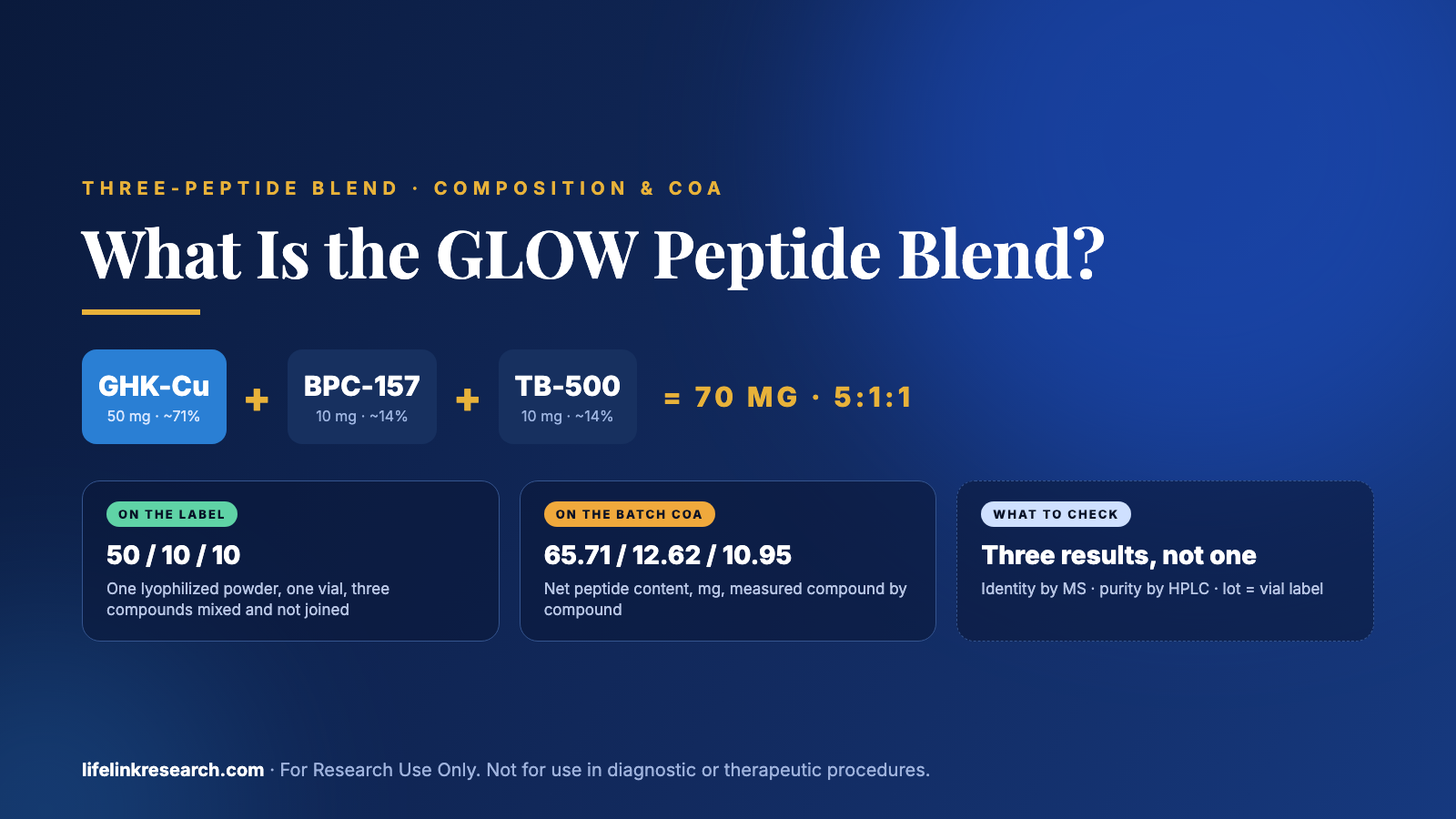
The GLOW peptide blend is a 70mg research preparation of GHK-Cu 50mg, BPC-157 10 mg, and TB-500 10mg, a 5:1:1 ratio in which GHK-Cu carries about 71% of the mass. GLOW is an informal market name, supplied for laboratory research only.
Key takeaways
- GLOW is GHK-Cu 50mg, BPC-157 10 mg, and TB-500 10mg in one preparation.
- It divides 50/10/10, written as 5:1:1, for 70mg in total.
- KLOW is the same three peptides plus KPV, at 80mg.
- A GLOW certificate has to report all three compounds separately, with its own result for each.
- Not every product sold as GLOW contains the same amounts. Read the per-component milligrams, never the name.
Three US suppliers, three prices for what reads like the same 70mg GLOW vial: $69.99, $109.99 and $152.10. Same five letters on every label, same three peptides underneath.
The GLOW peptide blend is GHK-Cu 50mg, BPC-157 10 mg, and TB-500 10mg, pre-combined as one lyophilized powder in a single vial. The name tells you which three compounds went in, and nothing about how much of each one arrived.
That second question is where this guide spends its time, because we opened the batch certificate behind a real GLOW vial. The measured amounts were not the label amounts.
What Is GLOW Peptide?
Quick answer: GLOW peptide is a market name for three research peptides supplied together: GHK-Cu, BPC-157, and TB-500. Vendors list it as “GLOW blend”, “GLOW 70” or a “GLOW kit”. It is unrelated to skincare lines or clinics that use the word Glow in their branding.
Type those four letters into a search bar and three unrelated things come back stacked on each other.
The first is the research preparation this guide covers: three laboratory peptides sold as a reagent. The second is cosmetics, where “glow” has been a product adjective for decades. The third is clinics and med-spas that borrowed the word for an intravenous glutathione drip sharing nothing with the peptides except the letters.
Only the first arrives as a sealed, freeze-dried vial with a batch certificate attached. A research GLOW listing states a total milligram figure, usually 70mg, and breaks it into three named compounds. If a page sells an appointment, a session price, or a tube from a counter, it is one of the other two.
One more distinction before anything else: GLOW is a mixture. The three peptides are stirred together in one powder, nothing is chemically joined, and each keeps the structure and molecular weight it had on its own.
What Is in the GLOW Peptide Blend?
Quick answer: GLOW contains three peptides in one vial: GHK-Cu 50mg, BPC-157 10 mg, and TB-500 10mg, 70mg in total. GHK-Cu is about 71% of the mass, and the other two are about 14% each, which is where the 5:1:1 shorthand comes from. A batch COA should state each compound separately.
By mass:
| Component | Amount | Share of the vial |
| GHK-Cu | 50 mg | ~71% |
| BPC-157 | 10 mg | ~14% |
| TB-500 | 10 mg | ~14% |
| Total | 70 mg | 100% |
Three compounds, three chemical classes, three molecular weights. The identifiers are what a laboratory tests against, and a certificate naming a compound without one is naming a marketing term.
| Component | Type | CAS | Molecular formula | MW (g/mol) |
| GHK-Cu | Copper tripeptide complex | 89030-95-5 (prezatide copper) | C14H23CuN6O4+ | 402.92 |
| GHK (copper removed) | Free tripeptide | 49557-75-7 | C14H24N6O4 | 340.38 |
| BPC-157 | Synthetic 15-residue peptide | 137525-51-0 | C62H98N16O22 | 1,419.5 |
| TB-500 (full-length Tβ4) | Acetylated 43-residue peptide | 77591-33-4 | C212H350N56O78S | 4,963 |
Every row above comes from a PubChem record, checked on 19 November 2026 and listed in full at the end of this guide. Two of them deserve a flag.
GHK-Cu has more than one legitimate form. CAS 89030-95-5 is prezatide copper, a charged 1:1 complex at 402.92 g/mol. The free tripeptide without copper is a different substance at 340.38. Some product pages publish “C14H24CuN6O4, 404” instead, which is GHK plus a copper atom as arithmetic rather than a record you can look up.
TB-500 is two different molecules depending on who is talking. The full-length version is acetylated thymosin beta-4, 43 residues, nearly 5,000 g/mol. The other is the short fragment Ac-LKKTETQ, the actin-binding stretch pulled out of that protein, weighing under 900. They are not interchangeable on a certificate, and it is the most common identity failure in a three-peptide report.
What Is Each Component of GLOW?
GHK-Cu (50mg)
GHK-Cu is a tripeptide carrying a copper ion. The peptide part is glycine, histidine, and lysine in that order, Gly-His-Lys, and the histidine does the structural work: its imidazole ring, with the N-terminal amine and the neighbouring amide nitrogen, forms the pocket that grips copper(II).
That coordination is the whole identity of the molecule. Strip the copper away, and you have plain GHK at 340.38 g/mol. Put it back and you have a charged complex at 402.92 that behaves, elutes and absorbs differently.
Loren Pickart, who first isolated the tripeptide from human serum with Milton Thaler in Nature New Biology on 16 May 1973, still describes it the same way. Writing with Anna Margolina in the International Journal of Molecular Sciences on 7 July 2018, he notes that most authors “attribute effects of GHK to its ability to bind copper(II) ions.” Everything downstream, from the colour of the vial to the 402.92 a mass spectrometer should return, follows from the GHK-Cu copper-peptide chemistry.
BPC-157 (10mg)
BPC-157 is a synthetic chain of 15 amino acids, sequence GEPPPGKPADDAGLV, with a free acid C-terminus. Nothing is glycosylated or cyclised, and there are no cysteines, so no disulfide bridge complicates handling.
At 1,419.5 g/mol it is the smallest of the three peptides and the most forgiving as a reagent. It carries no metal and elutes as a single clean peak under ordinary reversed-phase conditions. On the certificate we read, BPC-157 structure and all, it resolved at 6.224 minutes with no shoulder and no tailing.
The one genuine ambiguity is salt form. Suppliers ship it as a free base or as an acetate or arginine salt, and the counterion changes the mass of the powder while leaving the mass of the peptide alone. A certificate reporting net peptide content has corrected for that; one reporting gross vial weight has not.
TB-500 (10mg)
TB-500 is a research name, and it points at two different things.
Used strictly, it means full-length thymosin beta-4: 43 residues, acetylated at the N-terminus, C212H350N56O78S at 4,963 g/mol, CAS 77591-33-4. Used loosely, which is how the US Food and Drug Administration writes it, TB-500 means “thymosin beta-4, fragment (LKKTETQ)”, the seven-residue actin-binding motif alone, roughly one-fifth of the mass.
Only the certificate settles which one is in your vial, and it settles it by observed mass. A line near 4,963 means full-length. A line near 889 means fragment. A report that simply prints “TB-500” with no observed mass has not answered the question. TB-500 vs thymosin beta-4 is the most consequential identity question in the blend, because at 10mg of label the two forms deliver very different numbers of molecules.
Why Is It Called GLOW?
Quick answer: GLOW is an informal market name coined by suppliers, not a brand, a trademark or an approved product. It describes a combination that vendors assembled and named, and different sellers write it as GLOW blend, GLOW 70, GLOW stack or GLOW kit.
Nobody registered it. No regulator cleared it. The name spread the way nicknames do in this corner of the catalogue, where KLOW and Wolverine follow the same pattern: somebody grouped a few compounds, gave them a short handle, and it stuck because it was easier to type than the ingredient list.
The flattering connotation is doing obvious commercial work, which is exactly why it is a weak unit of information. The identifiers a laboratory can verify are the three compound names and the three milligram figures underneath them.
Vendor naming drifts too. The same three peptides appear as a blend in one vial, as a kit of three vials, and occasionally as “GLOW 70” where the number is the total mass. Two of those are genuinely different products.
Why Is the GLOW Ratio 5:1:1?
Quick answer: The 5:1:1 shorthand describes mass, not molecules. GHK-Cu is supplied at 50mg against 10mg each of BPC-157 and TB-500, so the ratio is five parts to one to one by weight. GHK-Cu dominates the vial because it is by far the smallest molecule of the three.
The ratio reads strangely until you put the molecular weights next to it.
GHK-Cu weighs 402.92 g/mol. BPC-157 weighs 1,419.5, three and a half times more. TB-500, as full-length thymosin beta-4, weighs 4,963. A milligram of GHK-Cu therefore contains roughly twelve times as many molecules as a milligram of TB-500.
So 50/10/10 by mass is nowhere near 5:1:1 by molecule count: GHK-Cu accounts for well over 90% of the molecules in the vial. The mass ratio is a packaging convention, and it misleads if you read it as a molar ratio. Work in moles for anything quantitative.
GHK-Cu is also the cheapest of the three per milligram. The compound carrying 71% of the vial’s weight is the one that costs least to put there.
Do All GLOW Products Use the Same Ratio?
Quick answer: Not reliably. 50/10/10 for 70mg is the common GLOW label across US vendors, but the name is unowned, so nothing stops a seller from using it for different amounts. The name tells you the ingredients. Only the per-component milligrams and the batch certificate tell you the amounts.
Checked across eight US and UK vendor listings on 19 November 2026, every GLOW product advertised the same 70mg at 50/10/10. On the label, the market has converged.
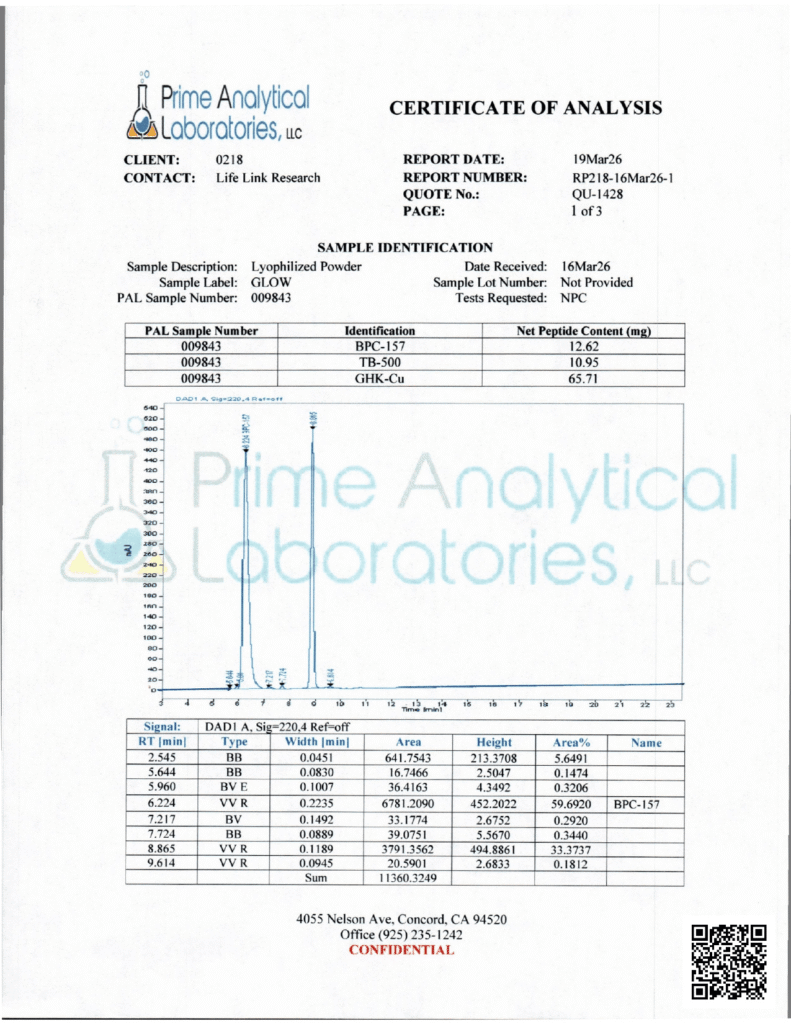
What has not converged is what is in the vial. The batch certificate we read for this article reports GHK-Cu at 65.71mg against a 50mg label, BPC-157 at 12.62mg against 10mg, and TB-500 at 10.95mg against 10mg. Three overages, the largest of them more than 31% above the stated figure.
Overage is not automatically a fault: manufacturers fill above target to cover losses. The narrower point is harder to argue with. The label is a statement of intent, and the certificate is a measurement. Two vials with identical labels can differ by a third.
GLOW vs GHK-Cu Alone: What’s the Difference?
Quick answer: GHK-Cu alone is one compound in one vial with one certificate. GLOW is that compound plus two unrelated peptides in a fixed 5:1:1 ratio under a single certificate that has to report all three. The difference is analytical complexity, not potency.
A single-compound vial is the simpler object in every respect a laboratory cares about.
One identity result. One purity figure. One peak to integrate, one reference standard, one molecular weight to confirm. If a number comes back wrong, you know which compound is wrong.
Add two more peptides and every one of those lines multiplies. The certificate needs three identity results and three content figures, and the chromatography needs conditions that resolve all three. The molecules could hardly be more different: a 403-dalton charged copper complex, a 1,420-dalton neutral peptide, and a 5,000-dalton acetylated protein.
You also give up control of the ratio. The proportions are fixed at the factory, because the three powders are already mixed, so anything calling for a different balance starts from separate vials.
What the blend buys you is a single purchase, a single storage item, and a single document, a real saving in handling for work that uses all three at the supplied proportions.
How Does GLOW Compare With KLOW, Wolverine and NAD+?
Quick answer: KLOW is GLOW plus KPV, at 80mg. Wolverine is BPC-157 and TB-500 without the copper tripeptide, at 20mg. NAD+ is not a peptide at all. Each format changes what the certificate has to prove.
| Preparation | Composition | Total mass | What the COA must show |
| GLOW | GHK-Cu 50mg + BPC-157 10mg + TB-500 10mg | 70 mg | Three identity results, three content figures, copper form stated |
| KLOW | GHK-Cu 50mg + BPC-157 10mg + TB-500 10mg + KPV 10mg | 80 mg | Four of each, with KPV resolved from BPC-157 |
| Wolverine | BPC-157 10mg + TB-500 10mg | 20 mg | Two of each, no metal content to confirm |
| NAD+ | Nicotinamide adenine dinucleotide | 500 mg (typical) | Single small-molecule assay, not a peptide method |
A GLOW vs KLOW comparison turns on exactly one compound: a tripeptide of lysine, proline, and valine at 342.43 g/mol, which is what the KLOW blend (adds KPV) carries on top of GLOW’s three. KPV and GHK-Cu are both small tripeptides and can crowd the same early part of a chromatogram, which makes KLOW the hardest of the four formats to certify.
The BPC-157 + TB-500 blend (Wolverine) is the opposite case. Dropping GHK-Cu removes the copper, the colour, and 50 of the 70 milligrams, leaving two peptides far enough apart in size to separate easily.
NAD+ falls outside the comparison entirely. It is a dinucleotide coenzyme with no amide backbone, quantified by methods sharing nothing with peptide analysis beyond the instrument. A certificate for it looks completely different.
Why Is GLOW Blue?
Quick answer: The colour comes from copper(II) in GHK-Cu. Copper(II) complexes absorb in the orange-red part of the spectrum and transmit blue, so the powder and any solution made from it carry a blue to blue-violet cast. The depth of colour tracks GHK-Cu content.
In GHK-Cu the copper occupies a pocket of nitrogen and oxygen donors from the tripeptide, and that arrangement tunes the complex to absorb red and orange light and transmit blue. Copper sulfate crystals are blue for the same reason.
GHK-Cu is 71% of GLOW’s mass, so the vial reads blue to blue-violet. BPC-157 and TB-500 are colourless and far too faint to change it.
That gives you a two-second plausibility check. A GLOW vial arriving white or off-white is telling you something is wrong with the copper content. Blue proves copper is present and proves nothing about how much, which peptides accompany it, or whether any of it is pure. Colour is a smoke alarm, and the certificate is the inspection.
Single-Vial GLOW Blend or a Three-Vial Kit?
Quick answer: The blend is all three peptides lyophilized together in one vial under one certificate. The kit is three separate vials, each with its own certificate. Kits allow separate handling and per-compound verification; the blend fixes the ratio in one powder. Both list the same 50/10/10 composition.
The two formats answer different questions, and the composition line on the listing is identical for both, which is why they get confused.
A TB-500 + BPC-157 + GHK-Cu blend vial arrives as one powder. The ratio is set, the three compounds share one storage item, and one document covers the lot. Every draw carries all three at 5:1:1, permanently.
A three-vial GLOW kit arrives as three sealed vials, each labelled and certificated on its own: three documents, three storage items, and complete freedom over proportions.
Verification is where they diverge. In a kit, each certificate is an ordinary single-compound report: one peak, one purity figure, one observed mass. In a blend, all three live on one report, and a weak result can hide inside a document that looks complete at a glance.
Choosing between blends vs single vials turns on one question. Does the work ever vary one compound against the others? If yes, separate vials. If no, the blend is fewer moving parts.
What Are the Limitations of GLOW?
Quick answer: No published study has tested the three-compound GLOW preparation itself. The literature exists for each component individually, in separate assays, in separate papers. Combining three compounds in one vial does not combine their evidence.
This is the most important paragraph on the page, and almost nobody selling GLOW will say it.
Search the published literature for GHK-Cu, and you find decades of work. Search BPC-157, or thymosin beta-4, and you find large preclinical bodies. Search for the 50/10/10 combination, tested as a formula against a control in any model, and the result is empty.
Everything claimed for GLOW as a whole is therefore inference: three evidence bases laid side by side, with an assumption of additivity nobody has checked. GLOW is a packaging decision with three independent research literatures behind its components, and none behind itself.
How Do You Check a GLOW COA?
Quick answer: A GLOW COA must report each peptide separately: identity by mass spectrometry and purity by HPLC for GHK-Cu, BPC-157, and TB-500, plus the lot number matching your vial and the issuing lab’s name. One overall “blend purity” number with no per-compound rows is a red flag.
Start with the arithmetic that makes a single blend figure meaningless. If a report says “99.2% pure” for a 70mg GLOW vial, 99.2% of what? Purity is the share of a sample that is the target compound, and a blend has three targets.
The certificate we read makes the reason visible. Prime Analytical Laboratories in Concord, California, issued report RP218-16Mar26-1 for a sample labelled GLOW, received 16 March 2026 and reported on 19 March. Each of its three pages is a separate chromatogram:
| Page | Compound named | Retention time | Net peptide content |
| 1 | BPC-157 | 6.224 min | 12.62 mg |
| 2 | TB-500 | 8.830 min | 10.95 mg |
| 3 | GHK | 3.705 min | 65.71 mg (as GHK-Cu) |
Look closely at pages 1 and 2 and the same two peaks appear on both, with the name moving between them. That is not an error. Each run quantifies one compound against its own reference standard, and the software labels only the peak being measured.
Page 3 is the most instructive. The GHK-Cu run resolves two named peaks: “Copper Ion” at 3.211 minutes carrying 14.48% of the area, and “GHK” at 3.705 minutes carrying 85.28%. The method is pulling the metal apart from the peptide in front of you, the clearest possible demonstration that coordination, rather than a covalent bond, is what joins the two.
Working analysts make the same point from the instrument side. In a thread on separating co-eluting peaks on the Chromatography Forum, a member posting as James_Ball asked whether each compound carries a mass of its own, because if it does, “you don’t have to separate them completely to quantify them accurately.” That is why a blend certificate wants mass spectrometry beside its HPLC. Three well-separated peaks are ideal; three distinct masses are what pin each result to a compound.
What to check, in order:
- A named lab with a reachable address. An unsigned PDF with a logo is not a certificate.
- Three identity results, by observed mass. Near 403 for the copper complex, 1,419.5 for BPC-157, and 4,963 or 889 for TB-500. That last number settles full-length against fragment.
- Three content or purity figures, each labelled. Net peptide content answers “how much peptide is in there”; HPLC purity answers “what fraction is the right compound”.
- A lot number matching your vial. The document we read falls short here: its lot field reads “Not Provided”, making it evidence about somebody’s sample rather than yours.
- Dates in a sensible order. Received 16 March, reported 19 March, approved 23 March.
Net peptide content deserves its own note. A lyophilized vial is never pure peptide: part of the powder is the counterion left from synthesis, usually trifluoroacetate, and part is water the solid pulls from the air. Gross weight and peptide weight can differ by a quarter or more, a problem Vemuri assayed in lyophilized thymalfasin in the Journal of Peptide Research in April 2005 (65:433-9). When you verify a peptide COA, check which weight it quotes.
One last trap. Reading HPLC purity explained as a single ranking misses what the number measures: area percentage at one wavelength, on one method, for one compound. Three compounds means three of those numbers.
Do You Need a Prescription for GLOW? Is It Legal?
Quick answer: As of November 2026, GLOW is not an FDA-approved product in any form, and none of its three components appears on the FDA’s 503A Bulks List. Material sold under this name in the US is supplied as a laboratory reagent for research use only, and is not available by prescription.
The regulatory position is documented, and it is the same for all three.
On the FDA page Certain Bulk Drug Substances for Use in Compounding that May Present Significant Safety Risks, content current as of 22 April 2026, the table “Bulk drug substances nominated but withdrawn” lists all three of GLOW’s components: “GHK-Cu (for injectable routes of administration)”, “BPC-157”, and “Thymosin beta-4, fragment (LKKTETQ), also known as TB-500”. Nominations for each were submitted and then pulled before the agency reached a decision.
That FDA entry is also the clearest official statement anywhere that the TB-500 name refers to the seven-residue fragment.
Separately, the Pharmacy Compounding Advisory Committee met at the FDA’s White Oak campus on 23 July 2026 and discussed BPC-157 (free base and acetate) and TB-500 (free base and acetate) among substances being considered for the 503A Bulks List. A committee discussion is a step in a process. Its recommendations are non-binding, and no inclusion followed.
In practice, nothing here is a prescription product and no pharmacy can dispense it as one. The BPC-157 legal status is the most actively moving of the three, so check the FDA pages directly rather than any summary, this one included.
GLOW is sold in the US to qualified researchers for laboratory use, under a research-use-only designation. Read the full research disclaimer before ordering.
How Should GLOW Be Stored?
Quick answer: Store the sealed lyophilized vial at -20°C, protected from light, and keep it dry. Freeze-dried peptide is stable for long periods under those conditions; the copper in GHK-Cu makes light and moisture exclusion more important here than for a plain peptide.
Three conditions, in order of importance.
Temperature. -20°C for the sealed vial. Freezer storage slows every degradation route, and a lyophilized powder has little free water to drive them anyway.
Light. Amber glass or a closed box. The copper(II) centre in GHK-Cu is photochemically active, so a GLOW vial deserves more care here than a Wolverine vial.
Moisture. Keep it sealed and let it reach room temperature before opening. Lyophilized peptide is hygroscopic: open a cold vial in a warm room and water condenses onto the powder.
A blend concentrates the risk: all three compounds share one container, so whatever happens to the vial happens to 70mg at once. The general rules for lyophilized peptide storage apply with that one extra consideration.
How Much Does GLOW 70mg Cost, and Where Can You Buy It in the US?
Quick answer: US vendors listed 70mg GLOW between roughly $70 and $200 in November 2026. Price per vial is close to meaningless on its own, because the vials differ in what has been verified. Compare price per milligram of compound with a per-component certificate behind it.
Prices from four US vendor pages, 19 November 2026:
| Vendor | 70mg GLOW listing | Price |
| Koi Peptides | GLOW Blend | $69.99 |
| Instant Peptides | GLOW Blend | $84.95 |
| Purely Peptides | GLOW Blend | $109.99 |
| PureLab Peptides | GLOW 70mg | $152.10 |
A spread of more than two to one, for an identical label.
Divide by mass and the cheapest works out around $1.00 per milligram of blend, the dearest around $2.17. Most comparisons stop there, which assumes the 70mg is the same 70mg every time. The certificate from earlier argues otherwise: it measured 89.28mg of peptide against a 70mg label, compound by compound. A vial with no per-component report could contain the stated 70mg, or 50, or quite different amounts.
The question worth asking instead: what does a milligram of verified compound cost here? That makes a $152 listing with three named results and a traceable lot potentially better value than a $70 listing with one unlabelled purity figure. Testing costs money, and a supplier running identity and purity on every batch carries a cost that shows up in the price.
Shipping is the variable people forget. Free shipping over $250 is common, and international orders carry duties the listed price does not show. Choosing a US supplier turns on documentation, lab independence, and shipping terms at least as much as on the headline number.
GLOW Peptide FAQs
What is in the GLOW peptide blend?
GHK-Cu 50mg, BPC-157 10mg and TB-500 10mg, pre-combined in one vial for 70mg in total. The three are mixed rather than chemically joined, so each keeps its own structure and molecular weight.
Is GLOW one peptide or a blend?
A blend. Three compounds share one vial, which is why a GLOW certificate carries three sets of results.
What does the 5:1:1 ratio mean?
Five parts GHK-Cu to one part BPC-157 to one part TB-500, by mass. By molecule count the picture differs completely, because GHK-Cu is roughly twelve times lighter than full-length TB-500.
Do all vendors’ GLOW blends contain the same thing?
On the label, almost always: 70mg at 50/10/10 was universal across the vendors we checked in November 2026. In the vial, no. The batch certificate we read reported GHK-Cu at 65.71mg against a 50mg label, a third away from the stated figure.
How do I know a GLOW COA is legit?
Three named identity results, three labelled content or purity figures, a named laboratory with a real address, and a lot number matching your vial.
What is GLOW used for in research?
It is supplied as a laboratory reagent. The three components are studied in separate contexts: copper coordination chemistry for GHK-Cu, peptide signalling assays for BPC-157, actin-binding work for thymosin beta-4. No published study has tested the combined preparation.
What is the difference between GLOW and KLOW?
One compound. KLOW is the same three peptides plus KPV 10mg, bringing the total to 80mg.
Can I buy the three components separately instead?
Yes, and that is what a kit is. GHK-Cu is the copper tripeptide that carries most of the blend’s mass. BPC-157 10mg matches the amount in a GLOW vial exactly. So does TB-500 (Thymosin Beta-4) 10mg, and each single vial carries its own certificate.
References
- PubChem: CIDs 73587, 71587328, 9941957, 16132341. Accessed 19 November 2026.
- Pickart L, Thaler MM. Nature New Biology, 16 May 1973. PMID 4349963.
- Pickart L, Margolina A. Int J Mol Sci, 7 July 2018; 19(7):1987. PMID 29986520.
- Vemuri S. J Pept Res, April 2005; 65:433-9. PMID 15813890.
- US FDA, Certain Bulk Drug Substances for Use in Compounding that May Present Significant Safety Risks, 22 April 2026.
- US FDA, PCAC meeting, 23-24 July 2026.
- Prime Analytical Laboratories LLC, Concord CA. Certificate RP218-16Mar26-1, sample 009843 labelled GLOW, approved 23 March 2026.
For Research Use Only. Not for use in diagnostic or therapeutic procedures.
Products referenced on this page are laboratory reagents sold to qualified researchers aged 21 and over. They are not FDA-approved, not for human or veterinary use, and nothing above is medical advice.
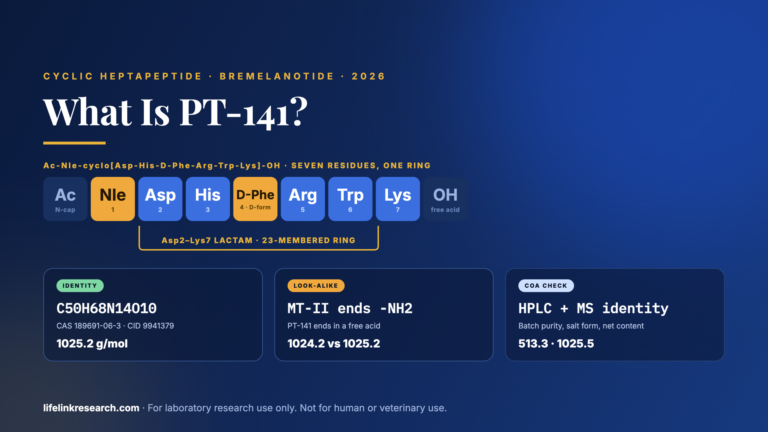
What Is PT-141 (Bremelanotide)? Structure, Receptors & COA
Quick Answer PT-141 is the research code for bremelanotide, a synthetic cyclic peptide studied at melanocortin receptors. Seven amino acids, one ring,…
Read article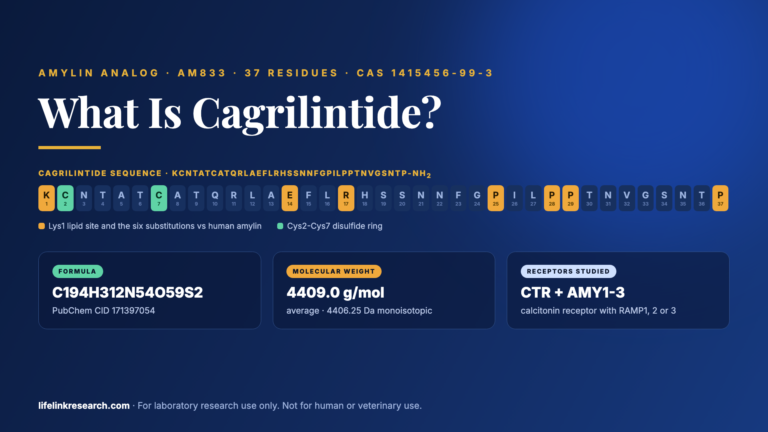
What Is Cagrilintide? Structure, Sequence & COA
Quick Answer Cagrilintide is a synthetic amylin analog developed by Novo Nordisk under the code AM833. If you have a vial on…
Read article
What Is Tesamorelin? Structure, Sequence, and COA Guide
Quick Answer Tesamorelin is a synthetic 44-amino-acid analog of human GHRH(1-44), carrying a trans-3-hexenoyl group on the nitrogen end of its first…
Read articleResearch-grade peptides
99%+ purity. Verified every batch.
Identity and purity tested on every batch by third-party labs, Janoshik Analytical and US-based laboratories. Shipped same day from California.
Shop all peptides