• Order within –h –m
  • Free shipping on orders over $250
  • Free Bacteriostatic Water 30ml with $500+ purchase
  • Every batch tested by an independent lab

Category: Regulatory

  • TB-500 & MOTS-c: FDA Status After the July 2026 Review

    TB-500 & MOTS-c: FDA Status After the July 2026 Review

    Quick answer: In July 2026, an FDA advisory committee voted to recommend both TB-500 and MOTS-c for the Section 503A compounding list, part of a wider vote that backed six of seven peptides reviewed. A recommendation is not approval, though. Both peptides stay research-use-only while the FDA works through final rulemaking, a process expected to run into 2027.

    TB-500 & MOTS-c

    The July 2026 advisory meeting was the biggest regulatory moment the peptide industry has seen in years, and the headlines that followed were easy to misread. TB-500 and MOTS-c both came out of it with a favorable committee vote, yet neither is FDA-approved, and nothing about their legal status changed overnight. This guide lays out exactly what the panel decided, what each peptide is studied for, and what still has to happen before anything shifts.

    Research use only. The material below summarizes a regulatory event and preclinical (laboratory and animal-model) findings. It is not medical guidance, and neither peptide is approved for human or veterinary use.

    Status at a glanceTB-500MOTS-c
    Peptide classThymosin beta-4 fragmentMitochondrial-derived peptide
    Research focusTissue repair, cell migrationMetabolic and mitochondrial signaling
    July 2026 committee voteRecommended for 503A listRecommended for 503A list
    FDA-approved?NoNo
    Current statusResearch-use-only, pending rulemakingResearch-use-only, pending rulemaking

    What Happened at the July 2026 Review

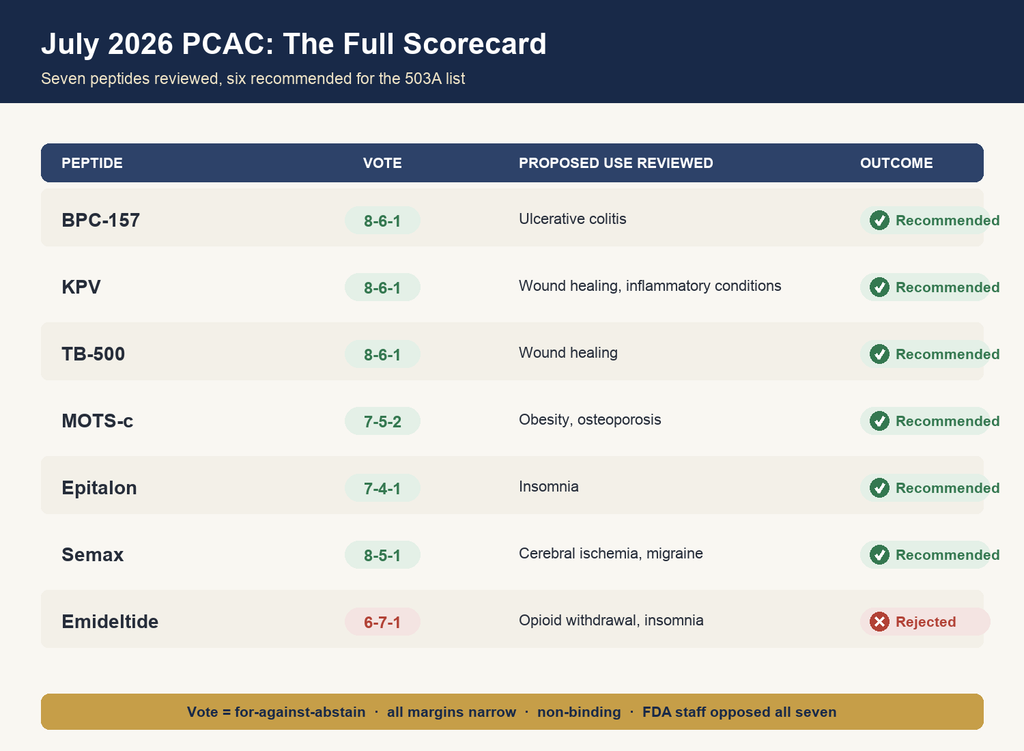
    On July 23 and 24, 2026, the FDA’s Pharmacy Compounding Advisory Committee (PCAC) reviewed seven peptides for possible addition to the Section 503A Bulks List, which sets out the bulk substances that compounding pharmacies are allowed to use. The panel recommended six of the seven: BPC-157, KPV, TB-500, MOTS-c, Epitalon, and Semax. Only Emideltide missed the cut.
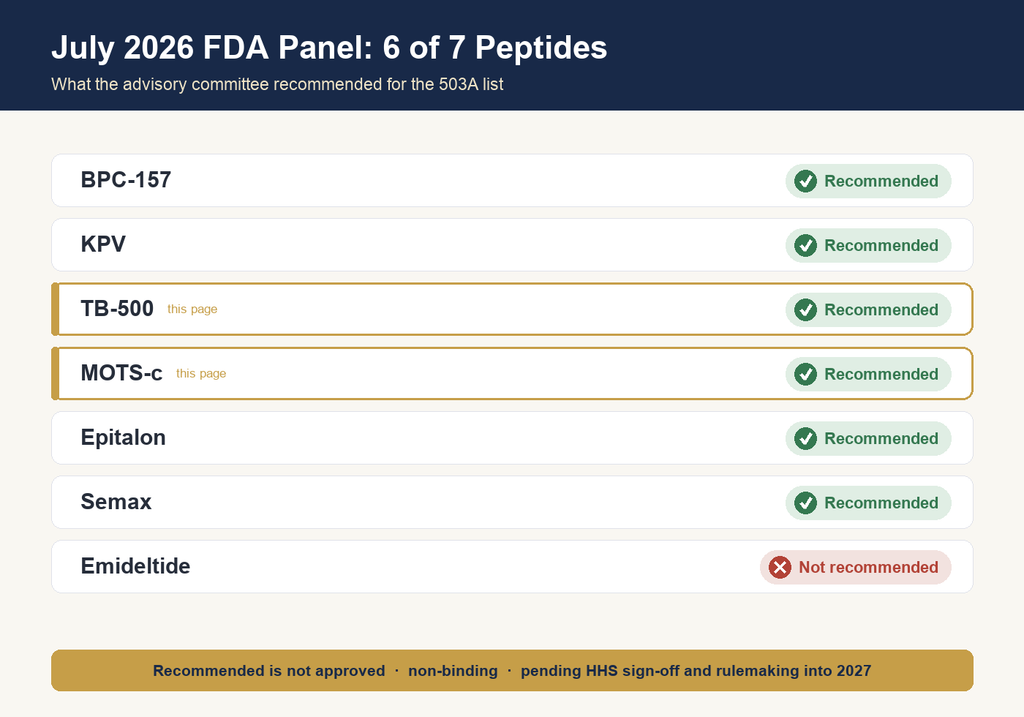
    TB-500 and MOTS-c both landed in the recommended group, with TB-500 backed in its free-base and acetate forms. Here’s the twist that most coverage buried: the FDA’s own career scientists had recommended against all seven peptides, citing short, underpowered studies and gaps in safety and effectiveness data. 

    The advisory panel voted to recommend anyway, over the objection of FDA staff. That split between the reviewers and the panel is a big part of why the outcome sits in a gray zone: it signals a direction while leaving the real question open.

    TB-500: What It Is and What Researchers Study

    TB-500 is a synthetic version of a section of thymosin beta-4, a naturally occurring peptide involved in cell movement and tissue repair. It shows up constantly in recovery research, often studied side by side with BPC-157, and the proposed use the FDA weighed was wound healing.

    Its mechanism is what makes it interesting in the lab. Thymosin beta-4 binds and sequesters G-actin, the building-block form of the protein cells use to build their internal scaffolding. By managing that actin pool, the peptide helps cells migrate toward a site of injury, a process documented in the research on this actin-sequestering protein. 

    Preclinical work has linked that same activity to angiogenesis and tissue remodeling across a range of animal models. As with most peptides in this space, the laboratory evidence is broad while human data stays limited, which is precisely the concern FDA staff raised.

    MOTS-c: What It Is and What Researchers Study

    MOTS-c comes from an unusual place: it’s encoded inside mitochondrial DNA, making it one of a small group of mitochondrial-derived peptides. Metabolic research is its home turf, and the uses the FDA reviewed were obesity and osteoporosis.

    The peptide acts mainly through the AMPK pathway, a central regulator of how cells manage energy. Published work describes MOTS-c influencing energy metabolism, insulin sensitivity, and exercise adaptation through AMPK signaling, and notes that the body’s own MOTS-c levels rise with physical activity. 

    Interest has stayed current, too. A March 2026 study reported that MOTS-c improved muscle mitochondrial performance in a way that depended on the PGC-1alpha and AMPK pathways, adding fresh detail to a mechanism researchers are still mapping.

    TB-500 vs MOTS-c: How They Differ

    For all that they were voted on together, these two peptides have almost nothing in common beyond their July 2026 status. They come from different biology and get studied for different reasons.
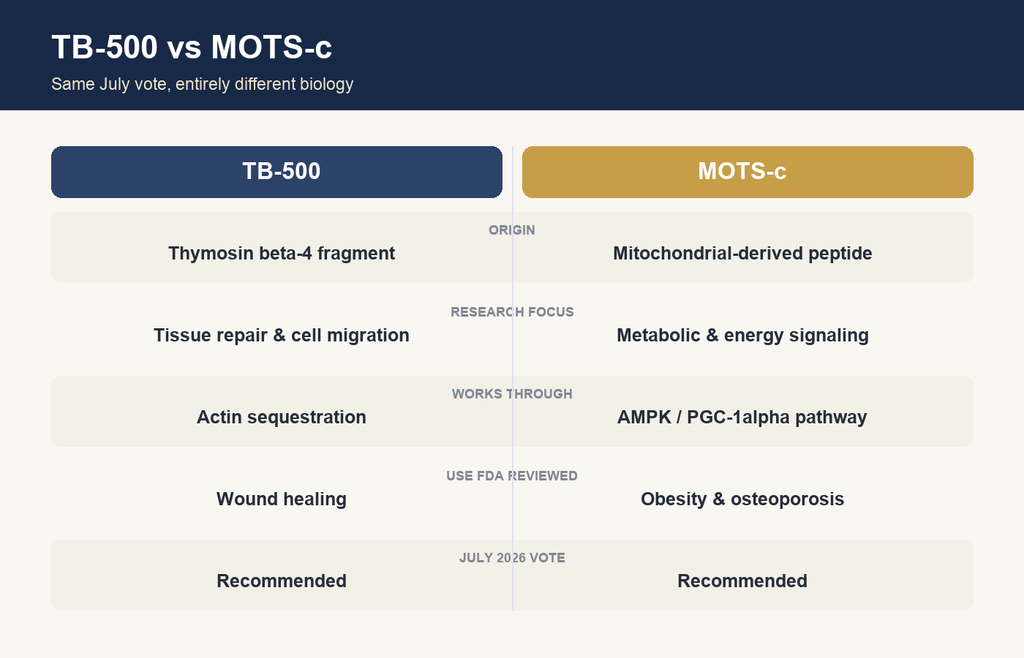
    • TB-500 traces back to thymosin beta-4 and centers on structural repair, working through actin and cell migration. 
    • MOTS-c is a mitochondrial messenger focused on energy and metabolism, working through AMPK. 
    • One is studied as a repair signal, the other as a metabolic one. 
    • The shared thread is simply that both are synthetic research peptides that drew regulatory attention at the same meeting, and both still need verified quality before any lab work is worth trusting.

    What “Recommended” Really Means

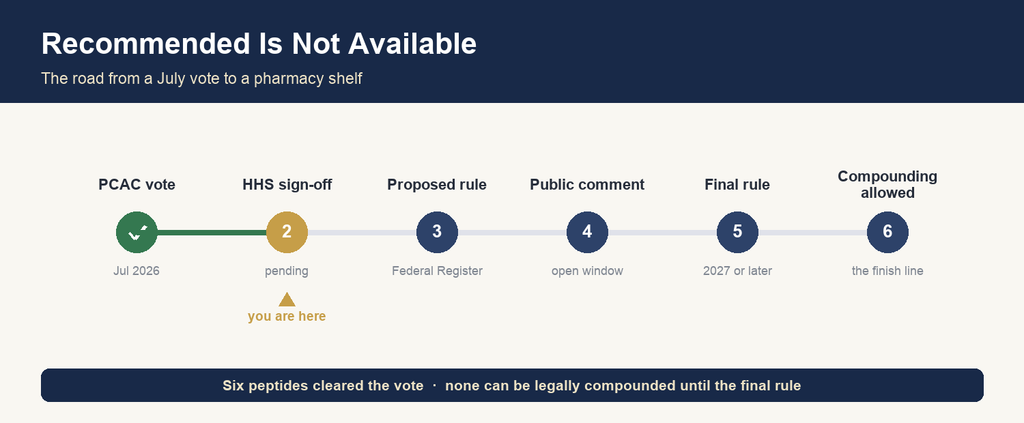
    A committee recommendation is a signal, and it stops well short of a green light. The PCAC advises the FDA, so its votes carry weight without binding the agency to anything. Before TB-500 or MOTS-c could be legally compounded, the Secretary of Health and Human Services has to sign off, and the FDA has to complete formal rulemaking, which means a proposed rule, a public comment period, and a final rule published in the Federal Register.

    That process is slow by design and typically runs a year or more, which is why the timeline points toward 2027. Until it finishes, pharmacies cannot compound these peptides even if pharmaceutical-grade material exists, and the compounds are not legally available through standard regulated channels. This vote is one piece of a broader FDA peptide review that is still unfolding, and the peptides in play could see their status shift again as the rules take shape.

    What It Means for Researchers Right Now

    In practical terms, nothing has changed for lab work. TB-500 and MOTS-c remain research-use-only compounds, supplied strictly for in-vitro study and never for human or veterinary use. The July vote is worth watching because it hints at where policy may head, yet it grants no new permissions today.

    That makes sourcing discipline more important than ever. A favorable regulatory signal tends to bring a wave of new sellers, and the quality bar is what separates a usable research compound from a questionable one. The regulatory story and the quality story run on parallel tracks, and only one of them is settled.

    How TB-500 and MOTS-c Quality Is Verified

    Whatever a label promises, two lab tests decide whether a vial holds what it claims. Mass spectrometry confirms identity by weighing the molecule against its expected mass, while HPLC measures how pure the sample is. Read together, they answer the only two questions that matter at the bench: is this the right peptide, and how much of the vial actually is it.

    The purity reading rewards a careful eye, since the difference between a 98% and a 99% result is a real change in how much of the sample is something else. Both findings belong on a Certificate of Analysis, and being able to read a COA confidently is what lets you check a claim against your specific batch. 

    We publish a COA for every lot we ship and stand it on a multi-test quality panel that reaches past purity into the safety checks a percentage alone can’t capture.

    Research Blends and Related Compounds

    Labs studying tissue-repair pathways often reach for TB-500 as part of a pairing. It anchors a BPC-157 and TB-500 blend built around recovery research, and the same duo forms the core of the Wolverine research kit. TB-500 is also available on its own for single-peptide work. 

    Each is supplied for laboratory research only, and every unit ships with batch documentation so identity and purity can be confirmed before anything begins.

    Frequently Asked Questions

    Is TB-500 FDA approved?

    No, in July 2026 an FDA advisory committee recommended TB-500 for the Section 503A compounding list, but a recommendation is not approval. It stays research-use-only while final FDA rulemaking plays out, a process expected to continue into 2027.

    Is MOTS-c FDA approved?

    No, MOTS-c received the same favorable committee recommendation in July 2026, yet it is not FDA-approved and cannot be legally compounded until rulemaking is complete. For now it remains a research-use-only compound.

    What peptides did the FDA panel recommend in July 2026?

    The committee recommended six of seven peptides for the 503A Bulks List: BPC-157, KPV, TB-500, MOTS-c, Epitalon, and Semax. Emideltide was the one peptide the panel declined to recommend.

    Does the committee vote make TB-500 legal?

    No. The vote is advisory. The Secretary of Health and Human Services still has to approve the addition, and the FDA has to finish formal rulemaking, so these peptides are not legally available through regulated channels yet.

    What is the difference between TB-500 and MOTS-c?

    They come from different biology. TB-500 is a thymosin beta-4 fragment studied for tissue repair through actin and cell migration. MOTS-c is a mitochondrial-derived peptide studied for metabolism through the AMPK pathway.

    Why did FDA staff disagree with the panel?

    FDA reviewers recommended against all seven peptides, pointing to short, underpowered studies and gaps in safety and effectiveness data. The advisory committee weighed the same evidence differently and voted to recommend six of them anyway.

    When could TB-500 or MOTS-c actually become available for compounding?

    There’s no fixed date. The FDA would need to complete formal rulemaking, which includes a public comment period and a final published rule, and that typically takes a year or more. The realistic window points to 2027 at the earliest, and only if the agency follows the panel.

    The Bottom Line

    TB-500 and MOTS-c both cleared the July 2026 advisory vote, and that’s genuinely notable, but a recommendation is the start of a long process, with the finish line still well ahead. The peptides remain research-use-only, the FDA’s own scientists remain unconvinced, and final rules are still a year or so out. 

    For anyone sourcing either compound for laboratory work, the regulatory noise changes little: a verified COA is what tells you a vial is worth your time.

    Research use only. Peptides referenced are for in-vitro laboratory research only, not for human or veterinary use, diagnosis, treatment, or consumption. The claims made on this page have not been assessed by the US Food and Drug Administration.

  • Is BPC-157 Legal in 2026? Regulatory Status Explained

    Is BPC-157 Legal in 2026? Regulatory Status Explained

    Quick answer: As of August 2026, BPC-157 is not an FDA-approved drug, not a legal dietary supplement, and not yet approved for pharmacy compounding. An FDA advisory committee voted 8-6 in July 2026 to recommend it for the 503A compounding list, but that vote is non-binding and formal rules are still months away. For now, it stays research-use-only.

    BPC-157 Legality in 2026

    “Is BPC-157 legal?” sounds like a yes-or-no question, and the truthful answer has a few layers. The molecule belongs in different boxes depending on who’s asking: the FDA, a compounding pharmacy, a supplement retailer, or an anti-doping agency each see it differently. The picture also changed twice in 2026, which is where a lot of the confusion comes from. Here’s where each piece actually stands.

    This page is regulatory information and general commentary, not legal, medical, or purchasing advice. BPC-157 referenced here is for in-vitro laboratory research only, not for human or veterinary use.

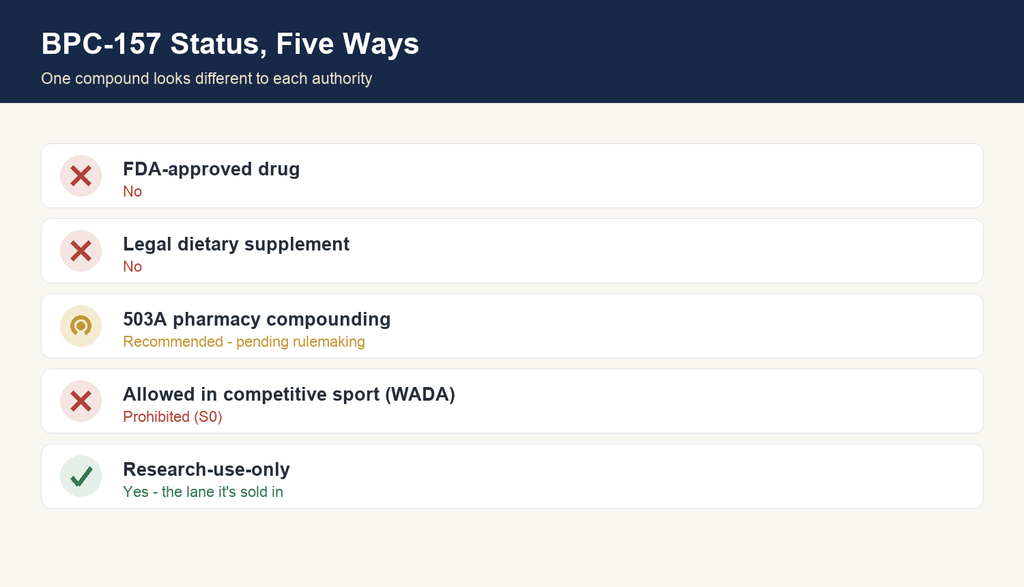
    BPC-157 status, five waysWhere it stands
    FDA-approved drugNo
    Legal dietary supplementNo
    503A pharmacy compoundingRecommended in July 2026, pending rulemaking
    Allowed in competitive sport (WADA)Prohibited (S0)
    Research use onlyYes, this is the lane it’s sold in

    What BPC-157 Is

    BPC-157 is a synthetic peptide, a lab-made chain of amino acids based on a sequence found in a protein in gastric juice. Understanding how peptides are built helps here, because BPC-157 is studied for the same reasons many peptides are: it shows up frequently in preclinical tissue-repair and gut research. The science is interesting and still early, which is the backdrop to every regulatory question that follows.

    A majority of that evidence comes from cell cultures and animal models, with human clinical data still limited. That research stage is worth keeping in mind, because it’s the reason regulators have moved cautiously and the reason the compound continues to sit in a research setting rather than a pharmacy shelf.

    The Two Regulatory Shifts of 2026

    Two separate events changed BPC-157’s status in 2026, and mixing them up is the single most common mistake in coverage of this topic. They’re related, yet they do very different things.

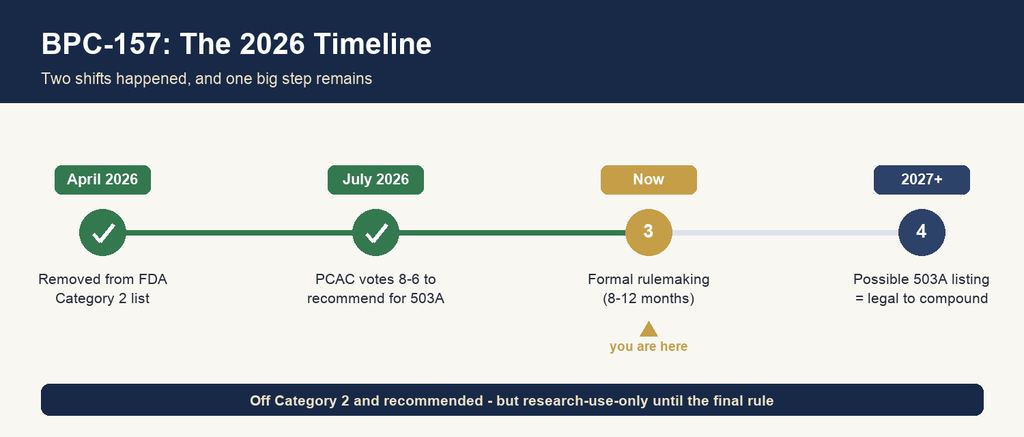
    The first change came in April 2026, when the FDA removed BPC-157 from its Category 2 bulk-substances list. Category 2 flagged substances with significant safety questions, and being on it effectively kept compounding pharmacies away. Coming off that list cleared one obstacle, though it did not, on its own, make BPC-157 legal to compound.

    The second change came at the July 23 and 24 meeting of the FDA’s Pharmacy Compounding Advisory Committee. The panel voted 8-6 to recommend adding BPC-157 to the 503A Bulks List, tied to a proposed ulcerative colitis indication, and it did so over the objection of FDA staff. That recommendation belongs to a wider review of seven peptides the committee took up across those two days.

    So Is BPC-157 Legal in 2026?

    The clean answer is that BPC-157 has no approved legal use for humans right now, and a committee vote hasn’t changed that. It helps to take the question one box at a time.

    • As a drug, it has never been FDA-approved for treating any condition. 
    • As a dietary supplement, it doesn’t qualify either, since regulators treat BPC-157 as an unapproved drug that isn’t a lawful dietary ingredient, which means it can’t be sold over the counter as a supplement. 
    • As a compounding ingredient, it’s recommended but pending, because the July vote guides the FDA without binding it.

    The difference between a recommendation and a rule is where the timeline lives. As regulatory attorney Dustin Robinson of LumaLex Law put it, “the advisory committee’s recommendation still triggers a formal rulemaking cycle that realistically runs eight to twelve months before 503A pharmacies have unambiguous legal authority to compound these substances.” Until that cycle finishes, the honest status is research-use-only.

    BPC-157 and Sport: The WADA Line

    Athletes have their own version of this question, and the answer there is clear-cut. The World Anti-Doping Agency prohibits BPC-157 at all times under category S0, which covers substances that no health authority has approved for human use. Because BPC-157 fits that description, it’s banned in competitive sport regardless of any FDA compounding decision.

    One detail catches people off guard: enforcement can be non-analytical, meaning an athlete can be sanctioned on evidence like admissions or possession, without a positive drug test. The prohibition also reaches U.S. military members under strict-liability rules. WADA’s list moves on its own track, so a future 503A listing wouldn’t lift the sporting ban.

    What “Research Use Only” Means

    Research-use-only is the label that ties all of this together, and it’s a real legal category. It means BPC-157 is supplied for in-vitro laboratory study, and it carries no clearance for human consumption, self-administration, or clinical use. The designation is about what the compound can be sold and used for, and it holds no matter which way the FDA’s compounding decision eventually goes.

    For a lab, that framing is a feature. It sets clear expectations, keeps the work inside the bounds of the law, and puts the focus where it belongs, on the quality and documentation of the material itself.

    What’s Next

    The story isn’t finished. The FDA still has to run its rulemaking, HHS Secretary Robert F. Kennedy Jr. has a role in approving any addition to the bulk list, and more peptides are queued for advisory review before February 2027. BPC-157 traveled a similar road to peptides like the KPV tripeptide, which cleared the same July vote, while others such as TB-500 and MOTS-c sit at their own points in the process. Anyone tracking BPC-157 closely will be watching the Federal Register, where a proposed rule would appear first.

    Why Verified Quality is Still Crucial

    Regulatory status tells you what a compound is allowed to be. The contents of the vial on your bench are a separate question, and that one a lab can actually control. Two tests carry the load here. Mass spectrometry and HPLC together handle confirming a peptide’s identity and purity, answering whether the material is truly BPC-157 and how much of the sample is the peptide versus everything else.

    The purity figure deserves a second look, since what a purity percentage really tells you is how much of the vial isn’t your target compound. Those numbers belong on a Certificate of Analysis, and learning to make sense of a Certificate of Analysis is what lets you hold a supplier to its claims. 

    We attach paperwork to each batch we make and stand it on the full screen we run on every lot, which covers the safety measures a purity reading alone won’t tell you. Whatever the rules become, that verification is the constant.

    Frequently Asked Questions

    Is BPC-157 FDA approved?

    No. BPC-157 has never been approved by the FDA as a drug for treating any condition. In July 2026 an advisory committee recommended it for the 503A compounding list, but a recommendation is not an approval, and it remains an unapproved substance under ongoing federal review.

    Can you legally buy BPC-157 in 2026?

    BPC-157 is sold in the United States as a research-use-only compound for in-vitro laboratory work. It cannot be legally marketed as a dietary supplement or as a drug for human use, and no committee vote has changed that.

    Is BPC-157 a dietary supplement?

    No. Regulators treat BPC-157 as an unapproved drug that doesn’t qualify as a lawful dietary ingredient, so it can’t be sold over the counter as a supplement. That status is separate from the FDA’s compounding review.

    Is BPC-157 banned in sports?

    Yes. WADA prohibits BPC-157 at all times under its S0 category for non-approved substances. Enforcement can be non-analytical, meaning a sanction can rest on evidence like possession, and the prohibition also reaches U.S. military members.

    Are peptides legal in 2026 more broadly?

    It depends entirely on the peptide and the use. A handful earned favorable compounding recommendations in July 2026, some are approved drugs in their own right, and many remain research-use-only. There’s no single rule that covers all peptides at once.

    What’s the latest news on BPC-157?

    The two developments driving 2026 coverage are its April removal from the FDA’s Category 2 list and the July 8-6 advisory vote recommending it for 503A compounding. Both matter, yet neither makes it an approved product, and formal rulemaking is the next milestone to watch.

    Does the July 2026 vote make BPC-157 legal to compound?

    Not yet. The 8-6 vote was a non-binding recommendation. The FDA still has to complete formal rulemaking, a process one regulatory attorney estimated at eight to twelve months, before pharmacies would have clear authority to compound it.

    What does the Category 2 removal mean?

    In April 2026 the FDA took BPC-157 off its Category 2 bulk-substances list, which had flagged safety concerns and blocked compounding. Removal cleared one hurdle, but it’s a separate step from being added to the 503A list that would allow compounding.

    The Bottom Line

    BPC-157 in 2026 is a compound in motion, and its legal picture is easy to overstate in either direction. It came off the Category 2 list, earned a favorable compounding recommendation, and drew real regulatory attention, yet it remains an unapproved drug, an unlawful supplement, a substance banned in sport, and a research-use-only material until formal rules say otherwise. 

    For anyone working with it in that research setting, the quality of what’s in the vial and solid paperwork behind it are most important while the rules catch up.

    Research use only. BPC-157 referenced here is for in-vitro laboratory research only, not for human or veterinary use, diagnosis, treatment, or consumption. This page is general regulatory commentary and not legal advice. The claims made here have not been assessed by the US Food and Drug Administration.

  • What Is KPV? Peptide Research Guide (2026 FDA Update)

    What Is KPV? Peptide Research Guide (2026 FDA Update)

    Quick answer: KPV is a tripeptide made of lysine, proline, and valine (Lys-Pro-Val), the last three amino acids at the tail end of alpha-melanocyte-stimulating hormone (alpha-MSH). Preclinical studies focus on its anti-inflammatory signaling in cell and animal models. It carries a research-use-only status, and in July 2026 an FDA advisory committee recommended it for a specific compounding list.

    All Eyes on KPV

    KPV has become one of the more talked-about small peptides in research circles, and a big FDA meeting in mid-2026 pushed it further into the spotlight. For anyone sourcing it for laboratory work, the useful questions are simple: what is this molecule, how does it behave in published studies, where does it stand with regulators, and how do you know a vial actually contains what the label says. This guide walks through each one.

    Research use only. The material below summarizes preclinical (in-vitro and animal-model) findings and regulatory events. It is not medical guidance, and KPV is not approved for human or veterinary use.

    KPV at a glance
    Full nameLysine-Proline-Valine (Lys-Pro-Val)
    TypeTripeptide (three amino acids)
    Parent moleculeAlpha-MSH, residues 11 to 13 (the C-terminus)
    Research focusAnti-inflammatory and antimicrobial signaling
    2026 statusResearch-use-only; under active FDA compounding review

    What Is KPV?

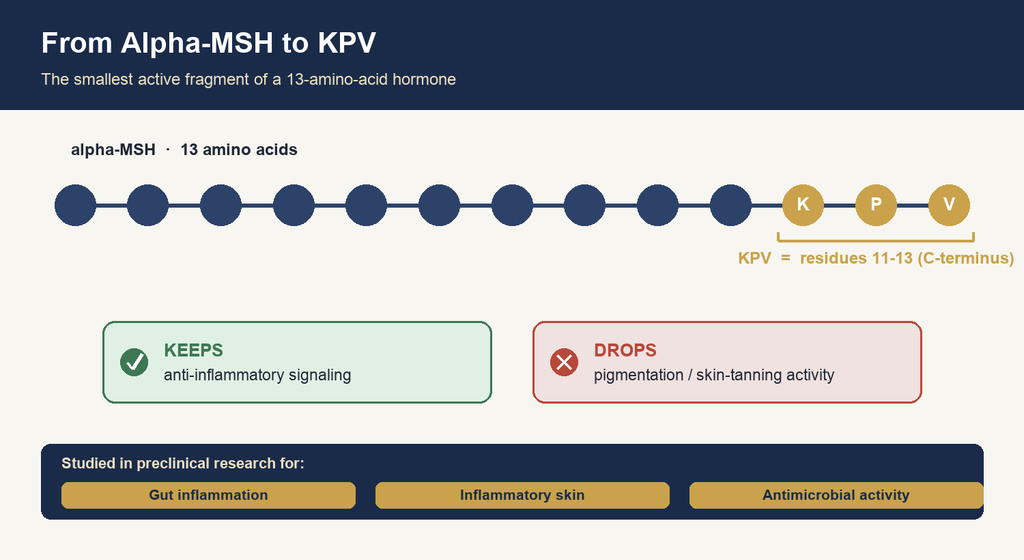
    KPV is one of the smallest peptides a lab will handle, just three amino acids linked in a chain. Those three, lysine then proline then valine, sit at the C-terminal end of alpha-MSH, a signaling hormone the body produces naturally. A peptide is simply a short chain of amino acids, so KPV is essentially the tail piece of a larger hormone, snipped down to its shortest active form.

    That small size is the whole appeal. Alpha-MSH does several jobs at once, including driving pigment changes in skin. KPV keeps the fragment of the hormone tied to inflammatory signaling while leaving the pigmentation behind, which makes it a cleaner tool for studying one pathway without the rest of the hormone’s activity coming along for the ride.

    From Alpha-MSH to KPV: Why the Tripeptide

    Researchers didn’t pick three amino acids at random. Alpha-MSH is a 13-residue peptide, and scientists worked backward to find the smallest piece that still calmed inflammation in the lab. That piece turned out to be the C-terminal Lys-Pro-Val sequence.

    Getting the molecule this small brings practical advantages for research. A shorter peptide is cheaper to synthesize, easier to characterize, and simpler to keep stable. Published work has described KPV-type tripeptides as attractive candidates precisely because of these physicochemical and pharmacokinetic properties. Stripping the hormone down to its active core gives labs a focused probe for inflammatory signaling, which is why the tripeptide draws more study interest than the full-length hormone.

    How KPV Signals in Preclinical Research

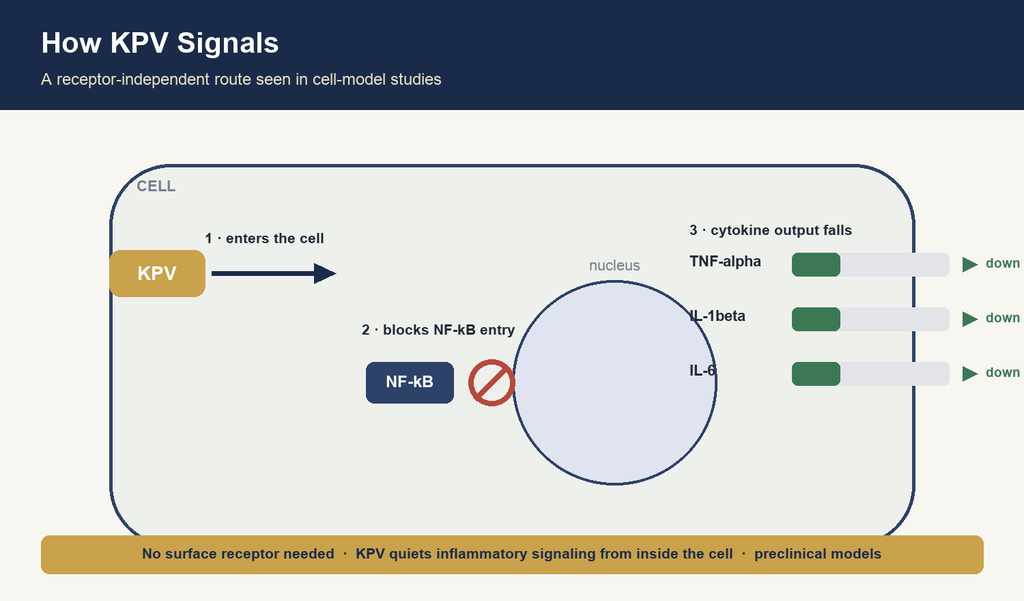
    Here’s where KPV gets interesting, because it appears to break the usual rulebook for how a hormone fragment works. A majority of melanocortin peptides act by docking onto a receptor on the cell surface, but KPV seems to skip that step.

    • In a foundational 2003 study, Getting and colleagues found that KPV’s anti-inflammatory effect is clearly different from that of the core alpha-MSH peptides, and that KPV is unlikely to work through melanocortin receptors, acting instead through inhibition of interleukin-1beta (IL-1beta) functions. 
    • Later work built on this receptor-independent picture. A review of alpha-MSH and its fragments describes how the peptide can enter the cell and directly dampen inflammatory signaling, reducing NF-kappaB and MAP-kinase activity and lowering the output of pro-inflammatory cytokines such as TNF-alpha, IL-1beta, and IL-6.

    The takeaway for a researcher is that KPV is studied as an intracellular signaling modulator, one that quiets a cell’s inflammatory response from the inside. That mechanism, drawn from cell and tissue models, is what most current KPV research is built around.

    What Researchers Study KPV For

    KPV shows up in a few distinct research areas, and all of them trace back to that anti-inflammatory signaling. The evidence base sits at the preclinical stage, which means cell cultures and animal models, with human data still very limited.

    • Gut inflammation models- KPV has been tested in murine models of inflammatory bowel disease, including DSS-induced colitis and transfer colitis, as Kannengiesser and colleagues reported in 2008. Intestinal work is one of the most active corners of KPV research.
    • Inflammatory pathway studies- Beyond the gut, labs use KPV as a probe for NF-kappaB and cytokine-driven inflammation in cell models generally.
    • Skin-inflammation models- The same anti-inflammatory signaling has drawn study interest in skin and wound-related contexts, which is the area the 2026 FDA discussion flagged for possible compounding use.
    • Antimicrobial activity- The same review that mapped its anti-inflammatory action also noted that alpha-MSH and its C-terminal KPV sequence show activity against microbes including Candida albicans, E. coli, and Staphylococcus aureus, opening a second line of study.

    None of this translates to established human uses, and that gap between promising lab signals and proven outcomes is exactly why KPV remains a research compound.

    KPV in Research Blends

    In practice, labs often encounter KPV inside a combination product. It appears in a BPC-157 and KPV blend, pairing its anti-inflammatory signaling with a peptide studied for tissue-repair pathways, and in the broader KLOW research kit alongside TB-500 and GHK-Cu. These blends are supplied strictly for laboratory research, and each comes with batch-level documentation so the identity and purity of every component can be checked before any work begins.

    Why KPV Is in the News: Regulatory Status in 2026

    KPV’s profile jumped in 2026 because of a specific regulatory moment. On July 23 and 24, 2026, the FDA’s Pharmacy Compounding Advisory Committee (PCAC) met to evaluate several bulk drug substances, and the panel voted in favor of including KPV on the Section 503A Bulks List for certain uses tied to wound healing and inflammatory conditions.

    That vote matters, and it also needs context. A PCAC recommendation is advisory, so it guides the FDA without binding it, and final policy and safety review remain ongoing. KPV is not FDA-approved for any use, and its compounding status has shifted more than once during the year. 

    This is one of seven peptides that drew regulatory attention in the FDA’s July 2026 review, and the situation is still developing, so the practical stance for a lab is to treat KPV as research-use-only and follow the rulemaking as it unfolds.

    How KPV Quality Is Verified

    For a tripeptide this small, confirming what’s in the vial is straightforward in principle and essential in practice. Two lab tests carry most of the weight. 

    The purity figure deserves a close read, since the difference between 98% and 99% reflects how much of the sample is something other than KPV. Both results are present on a Certificate of Analysis, and learning how to read a peptide COA line by line turns a purity claim into something you can actually verify against your batch. 

    We put a batch-specific COA behind every vial we supply, backed by a full multi-test panel that also covers safety measures a purity number alone won’t show.

    What to Look For When Sourcing KPV

    When you’re comparing KPV suppliers for research, a short checklist separates the credible from the questionable:

    • A batch-specific COA you can match to your vial’s lot number.
    • An HPLC purity result with the supporting chromatogram shown.
    • A mass-spec identity confirmation matching KPV’s expected mass.
    • Independent third-party testing, with the lab named on the report.
    • Clear research-use-only labeling and honest regulatory language.

    A supplier that hands over all five is one whose numbers you can trust. Anything vaguer deserves scrutiny before it reaches your bench.

    Frequently Asked Questions

    What is KPV peptide?

    KPV is a tripeptide of lysine, proline, and valine, corresponding to the last three amino acids of alpha-MSH. In preclinical research it’s studied for anti-inflammatory signaling. It is a research-use-only compound and is not approved for human or veterinary use.

    How does KPV work?

    Published cell-model studies suggest KPV works without binding melanocortin receptors. It appears to enter the cell and dampen inflammatory signaling directly, lowering NF-kappaB and MAP-kinase activity and reducing pro-inflammatory cytokine output. This mechanism is drawn from laboratory and animal research.

    Is KPV FDA approved?

    No, KPV is not approved by the FDA for any use. In July 2026, an FDA advisory committee recommended it for the Section 503A compounding Bulks List for certain uses, but that recommendation is advisory and final policy review is still ongoing.

    What is the difference between KPV and alpha-MSH?

    Alpha-MSH is a 13-amino-acid hormone with several activities, including pigmentation. KPV is just its C-terminal three residues. That fragment retains the anti-inflammatory signaling studied in the lab while leaving out the pigment-related activity of the full hormone.

    How is KPV different from BPC-157?

    They’re studied for different pathways. KPV research centers on anti-inflammatory cytokine signaling, while BPC-157 work focuses on tissue-repair pathways. The two are sometimes combined in research blends so labs can study the pathways side by side.

    What are the side effects of KPV?

    KPV is a research-use-only compound, so it has no established human safety or side-effect profile, and none should be inferred from preclinical work. Published data comes from cell cultures and animal models, and questions about effects in people fall outside the compound’s current research scope.

    How do I know a KPV sample is genuine?

    Check the Certificate of Analysis. A real one shows an HPLC purity figure with its chromatogram, a mass-spec result confirming identity, and third-party testing tied to your batch number. Documentation is what separates a verified sample from a claim.

    The Bottom Line

    KPV is a small peptide with an outsized research profile: three amino acids borrowed from alpha-MSH that keep the hormone’s anti-inflammatory signaling while dropping its pigmentary side. The lab evidence is genuinely interesting and still preclinical, the 2026 FDA recommendation is meaningful yet non-binding, and the compound stays research-use-only while the rules settle. If you’re sourcing it for that work, let the COA do the talking, since a verified batch is the only kind worth putting to the test.

    Research use only. Peptides referenced are for in-vitro laboratory research only, not for human or veterinary use, diagnosis, treatment, or consumption. The claims made on this page have not been assessed by the US Food and Drug Administration.
  • 7 Peptide Drugs at the FDA in July 2026: Full Review Breakdown

    7 Peptide Drugs at the FDA in July 2026: Full Review Breakdown

    Quick answer: On July 23 and 24, 2026, the FDA’s Pharmacy Compounding Advisory Committee (PCAC) reviewed seven peptides for the Section 503A compounding list and recommended six of them: BPC-157, KPV, TB-500, MOTS-c, Epitalon, and Semax. Only Emideltide was voted down. Every vote was narrow, none is binding, and nothing is approved yet.

    Current Status of Peptides the FDA Reviewed in July

    For a corner of science that usually grows quietly, the July 2026 advisory meeting was a genuinely big deal. Over two days, a federal committee weighed whether seven research peptides should be available through compounding pharmacies, and it backed most of them. The votes were close, though, and the fine print is just as important as the headline. Here’s the full scorecard, what each peptide was reviewed for, and how much really changed.

    Research use only. This page summarizes a regulatory event and preclinical research context. It is not medical guidance, and none of these peptides is approved for human or veterinary use.

    What Happened Over the Two Days

    The PCAC exists to advise the FDA on which bulk substances compounding pharmacies may use under Section 503A. Across July 23 and 24, the committee reviewed seven peptides and recommended six for the 503A Bulks List. The one it declined was Emideltide.

    The votes were tight, and the FDA’s own scientists were against the whole slate. During the meeting, FDA reviewers recommended against inclusion of all seven, citing concerns about safety, efficacy, and how well each molecule is characterized. The advisory panel looked at the same evidence and voted the other way on six of them. That gap between the reviewers and the committee is the tension running underneath this entire story.

    PeptideCommittee voteOutcomeProposed use reviewed
    BPC-1578-6-1RecommendedUlcerative colitis
    KPV8-6-1RecommendedWound healing, inflammatory conditions
    TB-5008-6-1RecommendedWound healing
    MOTS-c7-5-2RecommendedObesity, osteoporosis
    Epitalon7-4-1RecommendedInsomnia
    Semax8-5-1RecommendedCerebral ischemia, migraine, neuralgia
    Emideltide6-7-1Not recommendedOpioid withdrawal, insomnia, narcolepsy

    The Six the Panel Backed

    Each recommended peptide came to the table with a specific proposed use, and the committee’s vote reflected how it weighed the research behind that use.

    • BPC-157 drew a wound-and-gut research profile, and the use reviewed was ulcerative colitis. It passed 8-6 with one abstention.
    • KPV, the small anti-inflammatory fragment of alpha-MSH, was evaluated for wound healing and inflammatory conditions, clearing on the same 8-6 margin.
    • TB-500 and MOTS-c were reviewed for wound healing and for obesity and osteoporosis respectively, and both landed favorable votes. Their regulatory and research picture is worth a closer look on its own.
    • Epitalon, a synthetic tetrapeptide studied in longevity research, was reviewed for insomnia and passed 7-4 with one abstention.
    • Semax cleared 8-5 with one abstention, reviewed for neurologic uses including cerebral ischemia and migraine.

    For anyone new to these compounds, it helps to remember that a peptide is a short chain of amino acids, and each of these six is studied in its own research lane despite sharing a July vote.

    The One That Was Rejected

    Emideltide, a delta sleep-inducing peptide known in the literature as DSIP, was the only compound the committee declined to recommend. Its vote came in at 6 in favor, 7 against, and 1 abstention, the narrowest margin of the meeting. 

    The proposed uses reviewed were opioid withdrawal, insomnia, and narcolepsy. A rejection here doesn’t close the door for good, and compounds that fell short can return with stronger data at a future review.

    Why FDA Staff Pushed Back

    The staff objection is the thread that ties the meeting together, and it’s worth understanding. FDA reviewers looked at the evidence packages for all seven peptides and found them wanting, pointing to short and underpowered studies, thin human safety data, and gaps in how completely each molecule is characterized. 

    Those concerns didn’t sink the votes, since the advisory committee is free to disagree, but they signal how the agency itself is likely thinking as it moves toward a final decision.

    What “Recommended” Actually Means: The Road Ahead

    A favorable committee vote is a milestone, and it sits a long way from the finish line. The recommendation guides the FDA without binding it, so more has to happen before any of these peptides could be legally compounded.

    The Secretary of Health and Human Services has a role here, and reporting suggests the agency could add recommended peptides to a Category 1 list on an interim basis or signal enforcement discretion while the rules are worked out. 

    The durable path, though, runs through formal notice-and-comment rulemaking: the FDA publishes a proposed rule, opens a public comment window, weighs the responses, and issues a final rule in the Federal Register. That process is deliberately slow and may stretch into 2027 or beyond. Until it wraps, pharmacies cannot compound these peptides, even the six with a favorable vote.

    What’s Next Before February 2027

    The July meeting opened a chapter, and the story keeps moving. The FDA has signaled that more peptides are queued for PCAC review before February 2027, so the bulk list is likely to keep shifting over the coming months. 

    Stakeholders watching this space are keeping an eye on the Federal Register, where any proposed rule would surface first. For the seven already reviewed, the next real movement depends on how quickly the agency chooses to act on its committee’s advice.

    What It Means for Researchers Right Now

    For laboratory work, the practical answer is that little has changed. All seven peptides remain research-use-only compounds, supplied strictly for in-vitro study and never for human or veterinary use. The votes hint at where policy could head, yet they grant no new permissions today, and the compounds are not legally available through standard regulated channels.

    If anything, a burst of regulatory attention is a reason for more care, since headlines tend to attract new sellers of uneven quality. The regulatory question and the quality question are separate, and only one of them moves on the FDA’s timeline.

    Why Quality Still Decides Everything

    No committee vote tells you what’s actually in a vial, and that’s where a lab’s diligence earns its keep. Identity and purity are the two things worth confirming before any research begins, and two tests handle them. Mass spectrometry weighs the molecule to verify it matches the intended peptide, while HPLC reports how pure the sample is. The purity number rewards attention, too, since the step from 98% to 99% marks a real change in how much of the sample is anything but the target.

    Both results should appear on a Certificate of Analysis tied to your specific batch, and getting comfortable reading a COA is what turns a supplier’s claim into a fact you can check. 

    We attach a COA to every lot and back it with a broader testing panel that reaches into the safety measures purity alone leaves out. Whatever the FDA decides, that documentation is what makes a research peptide worth choosing.

    Frequently Asked Questions

    Which peptides did the FDA recommend in July 2026?

    The PCAC recommended six of the seven peptides reviewed: BPC-157, KPV, TB-500, MOTS-c, Epitalon, and Semax. Emideltide was the only one the committee voted down, on a narrow 6-7 margin with one abstention.

    Are these peptides FDA approved now?

    No, a committee recommendation is advisory, and it stops short of approval. Before any of these peptides could be legally compounded, the FDA has to complete formal rulemaking, a process expected to run into 2027 or later. All remain research-use-only for now.

    What is the 503A Bulks List?

    It’s the FDA’s affirmative list of bulk drug substances that compounding pharmacies are permitted to use under Section 503A. Adding a peptide to it is what would let pharmacies legally compound with it, and that addition still requires formal rulemaking.

    Why did FDA staff recommend against the peptides?

    FDA reviewers cited short, underpowered studies, limited human safety data, and gaps in how well each molecule is characterized. The advisory committee weighed the same evidence differently and recommended six of the seven anyway.

    Which peptide did the committee reject, and why?

    Emideltide, a delta sleep-inducing peptide (DSIP), was voted down 6-7 with one abstention. It had been reviewed for opioid withdrawal, insomnia, and narcolepsy. Peptides that fall short can return to a later review with stronger data.

    When could these peptides become available for compounding?

    There’s no set date. Formal rulemaking includes a public comment period and a final published rule, which typically takes a year or more, pointing toward 2027 at the earliest and only if the FDA follows its committee.

    What are the risks around these research peptides?

    The FDA’s reviewers flagged limited human safety data and incomplete characterization for all seven, which is part of why they urged caution. For lab use, the practical risk is quality: an unverified peptide can be impure or misidentified, so batch testing and a COA matter regardless of regulatory status.

    The Bottom Line

    The July 2026 review moved the peptide conversation forward without settling it. Six of seven compounds earned a favorable committee vote, the margins were slim, the FDA’s own scientists remain skeptical, and the rulemaking that would make anything official is still ahead. For researchers, the takeaway is steady: the rules are in motion, the status is unchanged, and a verified COA is still what separates a peptide worth studying from one worth skipping. You can browse our research-grade catalog with that standard in mind.

    Research use only. Peptides referenced are for in-vitro laboratory research only, not for human or veterinary use, diagnosis, treatment, or consumption. The claims made on this page have not been assessed by the US Food and Drug Administration.

  • What Is the FDA 503A List? Peptide Compounding Explained

    A lot of the 2026 peptide news comes down to four characters: 503A. If you’ve seen headlines about the FDA “adding peptides to the compounding list,” this is the list they mean. Here is a plain-English explanation and why the July 2026 vote matters. (General information, not legal advice.)

    What is the 503A bulk list?

    Section 503A of the Federal Food, Drug, and Cosmetic Act governs traditional pharmacy compounding — when a licensed pharmacist or physician prepares a medication for an individual patient. To compound with a bulk drug substance, that substance generally must meet one of three conditions: it is a component of an FDA-approved drug, it has a USP or NF monograph, or it appears on the FDA’s 503A bulk substances list. The list is, in effect, a gateway for substances that do not otherwise qualify.

    Why it matters for peptides

    Most research peptides have no USP monograph and are not part of an approved drug — so the 503A list is effectively the only formal compounding pathway open to them. That is why the July 2026 vote to recommend BPC-157 and KPV for the list drew so much attention: it is the first time a US body has moved to formally recognize these compounds for compounding.

    What it does not mean

    Being recommended for — or even added to — the 503A list does not make a peptide an FDA-approved drug, and it does not authorize retail sale or general human use. It concerns compounding pharmacies specifically. Research-use-only materials, like those in our catalog, remain intended for laboratory research only. For peptide-by-peptide status, see the July review roundup.


    Research use only. Peptides referenced are for in-vitro laboratory research only, not for human or veterinary use, diagnosis, treatment, or consumption. This is regulatory and general information, not legal, medical, or purchasing advice.

    Sources: FDA Pharmacy Compounding Advisory Committee meeting, July 23–24, 2026; RAPS and Drug Topics coverage; STAT, NPR, and Time reporting.

  • FDA Advisory Panel Backs BPC-157 & KPV for Compounding (July 2026): What It Actually Means

    On July 23–24, 2026, the FDA’s Pharmacy Compounding Advisory Committee (PCAC) reviewed seven peptides that have spent years in a regulatory gray zone. In the most-watched vote of the meeting, the committee voted 8–6, with one abstention, to recommend that BPC-157 and KPV be added to the 503A bulk drug compounding list — notably, over the objection of the FDA’s own staff reviewers, who had recommended against adding any of the seven.

    The headlines have been fast and loose — plenty of them read “FDA approves peptides.” That is not what happened, and the difference matters. Here is a clear, accurate breakdown of the vote, what it changes, and what it does not.

    What the committee actually voted on

    The PCAC is an advisory committee. It does not approve drugs and it does not write regulations. Its job is to give the FDA a recommendation on whether a bulk substance should be eligible for compounding under Section 503A of the Federal Food, Drug, and Cosmetic Act. Three things follow from that:

    • This was a recommendation, not an approval. The committee’s votes are non-binding. The FDA has said it will not issue a final determination until it reviews the committee’s input — though historically the agency follows PCAC recommendations more often than not.
    • It is about pharmacy compounding, not retail or research sales. The 503A list governs what licensed compounding pharmacies and physicians can prepare for individual patients. It does not turn any peptide into an FDA-approved drug you can buy off a shelf.
    • The FDA staff disagreed with the panel. Agency reviewers argued against all seven substances, citing gaps in characterization, effectiveness, and safety data. The committee’s majority voted the other way on two of them.

    The seven peptides on the table

    The July meeting split the review across two days:

    • July 23 — BPC-157, KPV, TB-500, MOTS-c
    • July 24 — DSIP (emideltide), Epitalon, Semax

    Of those, only BPC-157 (discussed in the context of ulcerative colitis) and KPV (wound and inflammatory conditions) received favorable votes for the compounding list. The remaining five did not clear the committee in July. The FDA has signaled that additional peptides are queued for review before February 2027, so this is the first chapter of a longer process, not the end of it.

    Why this is a big deal anyway

    Even as a non-binding recommendation, this is the furthest a US regulatory body has moved toward formally recognizing peptides like BPC-157. For years these compounds have lived almost entirely in the research and gray markets. A PCAC recommendation — arriving amid a broader push from HHS leadership to expand access — signals real regulatory momentum and near-certain continued scrutiny of the category.

    It also sharpens a distinction the industry has largely blurred: the gap between well-characterized, properly tested material and everything else. The FDA staff’s central objection was not philosophical — it was about data: identity, purity, and consistency. That is precisely the axis on which serious research material is defined.

    What it does not mean

    • It does not make BPC-157, KPV, or any reviewed peptide an FDA-approved drug.
    • It does not authorize these peptides for human use, self-administration, or treatment of any condition.
    • It does not change the status of research-use-only materials, which remain intended for laboratory research only.

    Life Link Research supplies peptides strictly for research use only. Nothing in this vote alters that, and nothing here should be read as a health, treatment, or purchasing recommendation.

    What it means for research buyers

    If the regulatory takeaway from July is that characterization and purity are the whole ballgame, then the practical takeaway for anyone sourcing research peptides is the same. The questions worth asking a supplier are the ones the FDA reviewers asked:

    • Is every batch tested by a third party? Independent HPLC and mass-spec confirmation of identity and purity — not a generic certificate.
    • Can you see the COA for the exact lot you receive? Batch-level documentation, not a marketing PDF.
    • Is purity, sterility, and endotoxin data actually reported?

    Several of the peptides in the FDA’s review are ones researchers already work with. To see how batch-level, third-party-tested material is documented, browse the full research catalog or read background in our research library.

    Frequently asked questions

    Did the FDA approve BPC-157 in 2026?

    No. An FDA advisory committee (PCAC) voted on July 23, 2026 to recommend that BPC-157 be added to the 503A bulk compounding list. That is a non-binding recommendation, not an approval, and the FDA has not issued a final decision. BPC-157 is not an FDA-approved drug.

    Which peptides did the FDA panel recommend?

    Of the seven reviewed on July 23–24, 2026, the committee gave favorable votes to two: BPC-157 and KPV. TB-500, MOTS-c, DSIP (emideltide), Epitalon, and Semax did not receive favorable recommendations in July.

    What is the 503A bulk compounding list?

    It is the list of bulk drug substances that licensed pharmacies and physicians may legally use to compound medications for individual patients when the substance is not otherwise FDA-approved and lacks a USP monograph. Being added to it concerns compounding pharmacies — it does not make a substance a marketed, approved drug.

    Can I buy these peptides for personal use now?

    No. This vote does not authorize retail sale or human use of any reviewed peptide. Research-use-only materials remain intended for laboratory research only.


    Research use only. The peptides referenced here are intended solely for in-vitro laboratory research and are not for human or veterinary use, diagnosis, treatment, or consumption. This article is regulatory news and general information, not medical, legal, or purchasing advice.

    Sources: FDA Pharmacy Compounding Advisory Committee meeting, July 23–24, 2026; RAPS and Drug Topics coverage of the PCAC vote; STAT, NPR, and Time reporting.

    Related reading